Newcomb College Pottery [henceforth, NCP], the coordinate women's institution of Louisiana's Tulane University, opened in 1895, and as Ellsworth Woodward, the head of Newcomb's School of Art and the Pottery's director until 1937, put it, “it was a success from the beginning.”Footnote 1 Alongside art potteries like Ohio's Rookwood and Roseville Potteries, and Massachusetts's Grueby Faience Company and Dedham Pottery, NCP produced high-end ceramic vases, plates, bowls, and tea sets, which in their unique shapes, hand-carved and painted decorations, and experimentation with glazes spoke to what Martin Eidelberg has called “the emphasis on the craftsman and handwork,” “a philosophical theme running through the entire Arts and Crafts movement.”Footnote 2 Indeed, NCP has long been viewed as a quintessential expression of the American Arts and Crafts movement, a movement that dominated and directed the tastes of the nation between 1876—the year of the Centennial Exhibition in Philadelphia—and 1930.Footnote 3 More specifically, art pottery of the kind produced at NCP resonated with the desires of American buyers increasingly literate in modern design and production theory and invested in the revival and cultivation of distinctly American styles.Footnote 4 Until it was dissolved into the arts program in 1940, NCP won numerous national and international awards, greatly diversified its product line, and developed a following in the periodical press and among collectors and connoisseurs. Woodward's retrospective assessment of NCP's success, it would appear, was accurate.
Yet, while the quality of its handicrafts justified its success and reputation, it cannot wholly account for the singular regard in which NCP was and continues to be held.Footnote 5 For that, we must look to one of things that made NCP truly singular: the emergence of this Arts and Crafts enterprise in the climate of the New South. For as much as NCP bears the impress of the Arts and Crafts philosophies that animated the rest of the movement, it has always been distinguished by its regional identity, its fortunes tied to the larger project of “cultural upbuilding” that gripped the South in the last decades of the nineteenth century. A late speech by Woodward tidily summarizes this origin story:
Newcomb began its work 42 years ago. Art became part of our course because art had been laid aside and forgotten under the stress of practical need during the years just gone and now art was deemed necessary to the cultural upbuilding of the South … The city did not offer an open field—here were no jobs for the designer, and thus we felt the need to create them. We entered manufacturing and merchandizing deliberately in the interest of art education. We flew in the face of economics and educational procedure … For 35 years therefore I have been a manufacturing merchant and the school has been an object lesson in practical art.Footnote 6
Woodward's description of the Pottery as “an object lesson” has become something of a byword in Newcomb scholarship, lending itself well to discussions of the college as a working model for the rest of the South in terms of its progressive stance on higher education, on women's work, and on economic and cultural reform.Footnote 7 Yet, as I will argue, this retrospective representation has too often been accepted on its face, resulting in NCP being celebrated as an uncomplicated, harmonious melding of the two major reformist ideologies that helped to usher in what has been described as the “first truly national reform movement in American history.”Footnote 8 While the story I wish to tell denies NCP neither its New South aspirations or its Arts and Crafts bona fides, it does insist that we acknowledge how the often competing agendas of these two reform movements offered a particular challenge to Newcomb's administrators in their efforts to fashion the Pottery's identity and market its wares.Footnote 9 Moreover, by focusing on this tension as it manifests itself at critical junctures in its nearly forty-year history, I seek to complicate a tendency to treat NCP's organizing mission as ideologically static, unchanging from its inception to its dissolution. It is also my intention to promote NCP as importantly distinct from the majority of American Arts and Crafts enterprises, insofar as its geographic location in the cosmopolitan but economically underdeveloped city of New Orleans demanded of it certain ideological negotiations not required of studio workshops in the industrialized North and Midwest, like Stickley's United Crafts, nor of indigenous craft collectives in the rural South, like Berea College's Fireside Industries.Footnote 10
In what follows, I trace the development of NCP's identity over time and across several print and promotional platforms, including local and national newspapers, specialist periodicals, institutional materials such as course catalogues, and recorded speeches. Concerning myself almost exclusively with how NCP was represented and how it represented itself in these venues, I aim to craft an intellectual microhistory, one that reads in Newcomb's efforts to define and market itself to the public the adumbration of the larger maneuvers and struggles of the two reformist movements that gave it birth. In NCP's representational and rhetorical evolution, I argue, we see the pressures both exerted by and acting upon the ideologies of the New South and Arts and Crafts, as each movement swelled in the 1890s, peaked in the early twentieth century, and finally collapsed into general progressivism around the conclusion of WWI. NCP's development as an enterprise follows this bell curve, but what happened to its foundational identity and mission over time is much less easy to chart, owing largely to the fact that the burden of its dual ideological commitments required it at different stages to adopt vastly different rhetorical postures in response to social and economic developments in its region.
I begin with the spectacular event that first situated New Orleans within New South and Arts and Crafts discursive frameworks: the World's Industrial and Cotton Centennial Exposition of 1884–85. Turning then to Pottery's early years, I look at how the program in its inaugural campaign invoked arguments concerning the importance of industry and education to the revival of the South. Next, I look at NCP when it expanded into a veritable handicraft juggernaut, with a separate curriculum, diversified product line, standardized aesthetic, and established business model. It was during this phase of rapid growth that, drawing on certain strains of Arts and Craft rhetoric, NCP began to highlight the dangers of industrialization. The conclusion reads Newcomb's late efforts to reinvent itself post-WWI. With its founders nearing retirement and the program in decline, its focus shifted to the management of its legacy, which entailed the repudiation of the more radical aspirations the Pottery had earlier espoused, the disavowal of NCP's reformist origins (both New Southern and Arts and Crafts), and a reimagination of NCP as a localist enterprise that sought to enshrine the “genius loci,” or spirit, of New Orleans. An examination of how NCP's identity was cultivated and curated at different periods makes it clear that its success had everything to do with its strategic placement at critical ideological junctures, as it evolved from the self-fashioned embodiment of a dream of a brave new world into a carefully constructed exhibit tied to the fantasy of a lost, culturally authentic past one.
MAKING AN EXPOSITION OF ONESELF: THE ORIGINS OF NEWCOMB COLLEGE POTTERY
NCP's foundations were laid at the World's Industrial and Cotton Centennial Exposition, held in New Orleans from December 1884 to June 1885. Covering 249 acres of ground and featuring seven major buildings,Footnote 11 it was the largest of six international exhibitions hosted by Southern cities between 1881 and 1907.Footnote 12 The first major American World's Fair—the 1876 Philadelphia Centennial Exposition—announced its nationalist agenda through its date and location; the Cotton Centennial similarly announced itself, specifically its New South message, with its organizers dating 1784 as the first recorded American export of cotton to England.Footnote 13 Yet, if King Cotton was the symbolic justification for the exposition, it shared the marquee with what New South pundits hoped would become a major Northern export to the Southern states: industry.
At a glance, the Cotton Centennial would seem to resemble the other major fairs of the era and region. Yet, more recent studies have observed that the hegemonic intentions of fair organizers must always be read against other competing interests at play in these spectacular events. Expositions were not just “modern engines of propaganda,”Footnote 14 but “complex and contradictory … arenas of debate about what they contribute to the cultural milieu of societies that hosted them.”Footnote 15 In the case of the Centennial, the debate was over the function of the fair itself.
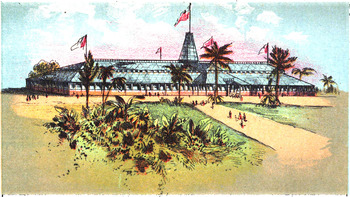
One of the major seven buildings erected on the outskirts of the city of New Orleans for the 1884 World's Industrial and Cotton Centennial Exposition, the U.S. Building featured both national and state exhibits as well as a “Women's Department” and a “Colored People's Department.” Daniel W. Perkins, Practical Common Sense Guide Book through the World's Industrial and Cotton Centennial Exposition at New Orleans. Harrisburg, PA: L. S. Hart, printer, 1885. Courtesy of HathiTrust.

Unlike the Philadelphia Centennial, the Cotton Centennial focused primarily on regional, not national, development. While the Main Building did showcase innovations from around the nation, the major conversation in the U.S. Building revolved around what the commissioner from Iowa described as “the upbuilding of the vast southern section of the United States,” a “neglected and apathetic region.”Footnote 16 Working against such representations, the exposition offered New Orleans the crucial opportunity to capture the national spotlight, to relaunch itself as a vital port, and to advertise Louisiana's natural resources as ripe for industrial harvesting. It also provided the occasion for New South boosters such as the Centennial's director-general to pay obeisance to “our more fortunate neighbors of the North and East” and to profess the South's earnest desire “for improvement” and “for learning.”Footnote 17 Such remarks suggest that while the Centennial was promoted as a vehicle for reconciliation, its real purpose was the “rehabilitation and reform” of what was perceived as a problematic, inferior region.Footnote 18 The fair's literature often perpetuated this representation of the South as at an earlier evolutionary stage, its culture less intellectual but more creative, its people less civilized but more vital; the South was a subaltern at its own world's fair.Footnote 19 Louisiana, in particular, figured as a tropical Other, with the myriad, contradictory connotations one might expect. Where one advertisement promised the Northern visitor freedom and sensual gratification amidst “the tropical luxuriance of the South,”Footnote 20 other fair writers associated the atmosphere with disease, constitutional infirmity and enervation, and cultural “backwardness.” In this framework, even the South's comparatively robust agricultural economy could be disregarded as a less-evolved economic infrastructure and sign of premodern social organization.Footnote 21
Southern participants and visitors could not have failed to notice that this visual spectacle of their nation in miniature reinforced a narrative of national progress from which they were curiously excluded. Thus, as others have averred, it makes sense that Southerners at the fair would have emulated the ideals, programs, and ambitions of Northern participants who seemed to more fully exemplify those of the nation at large. A version of this argument has long been used to explain the genesis of Newcomb College and its Pottery: namely, that NCP was the bloom of a seed planted when the citizens of New Orleans were exposed at the Centennial to model programs in the decorative and industrial arts like those at the Rhode Island School of Design, the Massachusetts Normal School, and the Cincinnati Art Academy. However, by reading Newcomb's origins as the material byproduct of particular events at the 1884 Centennial, rather than as merely the Southern manifestation of a general Arts and Crafts ideology or the inheritor of agendas better suited to Northern communities, it becomes possible to see a more complex and negotiated historical reality for NCP. To put it simply, the Cotton Centennial did bring to New Orleans those Northern Arts and Crafts enterprises that served as prototypes for NCP, but equally important were Southern educators at the fair who opposed their own vision of a New South against Northern models. Their ideological and rhetorical maneuvers as they resisted degrading representations of the region would be equally influential in Newcomb's marketing of its arts program and its pottery in years to come.
One tremendously important Southern educator at the Centennial was directly connected to the founding of Newcomb College a year later: the president of Tulane University, William Preston Johnston. Son of famed Confederate General Albert Sidney Johnston, Johnston himself served as an aide-de-camp of Jefferson Davis until the end of the war. In 1867, Robert E. Lee appointed him “chair of English literature” at Washington College (now Washington & Lee University), a position he later parlayed into the presidency of Louisiana State University in 1880 and Tulane University in 1884.Footnote 22 Laying out his educational philosophy for the South on the opening day of the Programme of the International Congress of Educations at the Centennial, Johnston's speech was held taut between strong Confederate loyalties and the task at hand: stumping on behalf of the New South. Thus, he pushed back against what he saw as the pandering boosterism of Southern fair organizers who presumed to speak on behalf of Louisiana in “humbly confessing our sore need” of intellectual enlightenment from Northern educators.Footnote 23 Johnston rejected this attitude as servile, and went about promoting, consequently, virtues of Southerners other than their ability to recognize the superiority of Northern forms. Though Johnston shared the outlook that Link argues was characteristic of Southern educational reformers—namely, that they were intervening in a regional “crisis of culture”Footnote 24 —he insisted on the South's right to “manage our own affairs in our own way,” which for Johnston, as for many others, was the way of “the white race.”Footnote 25 He also challenged the conceptual binary of “Old South” and “New South,” suggesting that the images that the audience had of both were merely “the fancy of the painter, with all the shades that pessimism and optimism might suggest.”Footnote 26 Granting that “we [Louisiana] can learn more from Massachusetts than she can from us,” he pointed out that “she thinks so too,” a gibe that drew attention to the paternalist agenda of the program in which they were participating.
In what followed, Johnston intervened in this discussion of education as the “great need of the South” by holding up his own university as an example of best practices adapted to prevailing conditions; Tulane, he argued, should be read as a synecdoche for the entirety of “the South”: “We are both building on old lines, instead of casting down the altars and temples of our fathers; but we—the whole South and our young university here—are seeking thoughtfully and earnestly for the best things applicable to our condition, wherever they can be found.”Footnote 27 Critiquing a model of progress for the region that demanded razing old buildings before new construction began, Johnston advocated a blending of “old and new,” such as was found in the architectural design of Tulane's buildings, which melded “the Greek temple to the ‘New Orleans’ style, [combining] the classic and the Creole.”Footnote 28 Yet, he suavely concluded, Tulane's loveliest buildings were still imaginary “castles in Spain,” which could only take “form and substance” if “our wealthy citizens … emulate the generous heart and open hand of the great benefactor of education in Louisiana, Paul Tulane.”Footnote 29
Johnston's wish would soon reach the ear of Josephine Newcomb, a wealthy socialite with ties to New Orleans, who put down the initial funds for a women's college in memory of her deceased daughter. But Johnston was not just soliciting funding at the Centennial; he was also outlining a prospectus for interested investors using the platform of the U.S. Building to articulate a vision of the university that, for the benefit of the local community, inflected a classical liberal arts curriculum with Southern aesthetic, social, political, and moral values and emphasized manual training. Louisiana in the 1880s being especially inhospitable to the development of what educational reformer A. M. Mayo called “the American system” (state-sponsored systems of public education), Johnston promoted the private university as capable of assuming a role usually filled by state and local government, acting as an umbrella institution that contained within itself all the educational facilities and programs that in an industrialized city would be separate organizations. It would see to the “higher education of the young”—limited, in Johnston's scenario, to the white community—but it would also function as “the extension of the area of original research, investigation, and discovery” and would facilitate the “elevation of the public tone and mind.”Footnote 30 At the same time, Johnston's university embraced manual training, offering not simply a “school of manual training” but also “free systematic instruction in drawing to teachers” and “night classes for the benefit of mechanics and others.” Such instructional projects were well underway in the North—in public schools, academic colleges, technical and mechanical institutes, schools of design, and private Arts and Crafts societies. For Johnston, however, Tulane, a private university, would oversee the entire effort, providing such training and “rais[ing] the popular intelligence” by hosting free lectures on topics such as “physiology and hygiene.” In doing so, Johnston believed that he could create the conditions necessary for industry to take root, an important distinction from how manual training was understood in already industrialized societies, where its function was to improve the quality of wares and the lives of the workers.
But for Johnston such training also meant reinforcing distinctions between classes, races, and genders. Hence, in his address at the Colored People's Exhibit, he championed “industrial education” as the ideal form of education for black Americans, which would teach the importance of “doing” instead of “talking” and, it can be inferred, keep the black community entrenched within the laboring class. As for the Women's Department, Johnston entirely avoided the question of women's suffrage and work rights. Unlike other Southern fair organizers, like Colonel Morehead who openly declared himself a “woman's rights man,” Johnston kept women's accomplishments contained in the private sphere of art and literature, praising a handful of “great female writers at whose feet, mentally, he had sat.”Footnote 31 In sum, while Johnston showed himself a convert to one major tenet of the nascent American Arts and Crafts movement—specifically, that training in design and the manual arts was necessary to creating an economically diverse and culturally vibrant economy—his conception of how such training should be implemented worked contrary to progressive projects that advocated a fuller integration of women and persons of color into modern industrial society. Whereas E. H. Fairchild, the president of Berea College, used the Centennial to promote the “co-education of the sexes and the races,” Johnston's university remained stratified along antebellum lines.Footnote 32 This is important in understanding the course of action taken at Tulane and, later, Newcomb, in that it highlights how persons of color were largely left out of the university's program of regional uplift and why women, even in a college that promised industrial training, would be directed into the field of applied rather than manual and industrial arts.
Over the course of the Centennial, Johnston stumped tirelessly for Tulane and for New Orleans, marketing a particular model of higher education that, in form and function, bore a striking resemblance to the exposition itself. The value of an exposition, argued Louisiana's governor at the opening ceremony, was that “this minature [sic] world” allowed for the study of “the underlying motives which have controlled nations in their development.”Footnote 33 At the Centennial and in years to come, Johnston and other administrators at Tulane and Newcomb, particularly the brothers Ellsworth and William Woodward, would use the miniature world of the university as a kind of model classroom in which they could experiment in adapting national reformist ideologies to the dominant culture of New Orleans, trying on different images and agendas to suit changing circumstances. The arts program at Newcomb College provided them with a platform for promoting New Orleans as regionally cosmopolitan, mixing old and new worlds. Aesthetically, this cosmopolitan regionalism would manifest itself in the “Newcomb style” of its pottery, its unique blending of classic art pottery techniques with region-specific ornamentation. Institutionally, the curriculum at Newcomb insulated it from charges of provincial backwardness such as pervaded the Centennial, even as it enabled Newcomb to represent itself as an embodiment of Southern culture. Though Newcomb's approach to this dual mission would alter over its lifetime, what did not change was the main lesson Johnston learned at the exposition, a lesson that determined the university's course as it navigated through the complex network of social forces at work in Progressive Era America: namely, that in efforts to articulate and advocate for one's particular worldview, nothing works better than an eye-catching display.
“A QUAINT LITTLE BUILDING”: NEWCOMB COLLEGE POTTERY, 1895–1909
While Newcomb's meteoric rise to prominence surely results in part from the art pottery renaissance characteristic of fin-de-siècle America, to begin Newcomb's story with the founding of the Pottery in 1894 overlooks how this model industry developed out of an arts curriculum strikingly similar to that promoted by Johnston at the 1884 Centennial. From the opening of its doors in 1887, Newcomb College sought to offer an innovative curriculum that was “specially adapted to prevailing conditions” in the region.Footnote 34 Newcomb's earliest course catalogues make it obvious that the College's arts program sought to replicate on a smaller scale the educational model that Johnston promoted for Tulane at the Centennial. Newcomb College distinguished itself from other women's colleges in offering, in addition to the “solid learning” of a liberal arts education, “opportunities for practical and industrial studies.” Neither a traditional institution of higher learning nor a vocational school nor a teacher's college, Newcomb combined all three. For Newcomb's female students art, broadly defined, was given “special prominence.” The catalogue for the 1888/89 academic year, for example, states that regardless of the educational “track” chosen by a student—Classical, Literary, Scientific, or Industrial—all would study art “in the conviction that the advantages to be derived are of the highest value in the education of the eye and hand, and in the cultivation of correct taste, at the same time that it offers a desirable relaxation from the more exacting work of the classroom.” At Newcomb, art was not an area of study, but the ether in which breathed all of the college's higher aspirations, a way of life and a shared experience that was meant to refine the sensibilities of its students and revitalize a sense of community on campus and in the city. It was from this set of ideas and ideals that the Pottery arose, not simply the exigent tastes of the times or adventitious markets for particular wares.
Situating Newcomb's origins at the Centennial also enables one to see that its art program, like a display at an exhibition, had tremendous tactical value for the college. Vague statements on the “special prominence” given to the study of art were honed into forceful arguments regarding the value of Newcomb's unique arts curriculum, arguments that resonated with the program of the New South but that also invoked elements of Arts and Crafts ideology. This is not to say that the school embodied or exemplified either of these movements; on the contrary, pundits drew variously on both movements for rhetorical effect. In the 1892/93 catalogue, the section devoted to “Special and Normal Art Classes” included a prefatory statement that stressed the progressivism of its system of art education and its applicability as a model for facilitating social change:
The unsatisfactory results of many of the systems for fundamental art training, in this and other countries, is exciting general inquiry for better methods. … Art teachers and critical observers are becoming convinced that much of the failure is due to the separation of the so-called fine and useful arts, and the consequent adopting of different courses of training for the artist, the designer, and the artisan. The effects of this are to narrow the education of each, to occasion misunderstanding, concerning their several functions and to effect their estrangement and antagonism.Footnote 35
On its face, this statement seems consonant with a broader Arts and Crafts critique of the distinction between the “fine” and “useful” arts, traceable back to the writings of one of the movement's progenitors, William Morris.Footnote 36 A closer look, though, reveals that what was being advocated here was not the abolishment of the distinction between the fine and useful arts, which many Art-Crafters believed transformed art forms such as painting and sculpture into elitist, purely academic exercises and devalued handicraft productions such as woodworking and pottery. Rather, Newcomb rejected separate courses of training for the “artist, the designer, and the artisan.” This argument served two functions. First, it made a virtue of necessity; New Orleans lacked the infrastructure necessary to support numerous specialized institutions, such as a design school or a fine arts conservatory, but, seen in this light, that deprivation could be reframed as an institutional commitment to building a vibrant arts community centered in the college. Secondly, the assertion that separate training would effect “estrangement and antagonism” between classes of art workers would have resonated in the “reunion culture” that was still flourishing in the 1880s and 1890s, which sought to sooth sectarian energies by preaching the necessity of overcoming ideological differences and finding a common ground.
In this way, the art department at Newcomb generated enthusiasm for its modish new program by representing its curricular mission as a progressive triumph over an entrenched educational sectarianism. Regardless of their respective talents as art enthusiasts, designers, artists, or artisans, the pupils in Newcomb's art classes would receive an education “both theoretical and practical,” moving through a common “course of training” before being allowed “to elect and pursue a special branch.” Also, in addition to taking common courses, students would attend those art courses in a common space—which in 1893 was “the upper floor of the new college building”—thus reinforcing the connections between different artistic specializations. This community building through art culture, the early catalogues stressed, extended beyond the college grounds; as noted in the 1887/88 catalogue, Newcomb's “instruction in Decorative Art” was part of a larger network of classes and societies in New Orleans that involved the university, largely through the direction of the Woodwards, including the “Free Drawing School” and the “Tulane Decorative Art League for Women,” which shared studio and exhibition space with the short-lived New Orleans Art Pottery Company (1888–ca. 1890).
Newcomb's art program in its first years promoted itself as cosmopolitan in its outlook, inclusive in its curriculum and through its community outreach, and scientific in its approach to instruction. In the climate of the New South, these assertions would have aligned the program with other reformist efforts to modernize and unify the region, by helping to create an environment that anticipated the arrival of industry and that worked to elevate the “popular intelligence” through the training of individuals in “practical and aesthetic matters.”Footnote 37 Its success in promoting itself thus is demonstrated by coverage in the local press and in works like New Orleans and the New South (1888), a piece of New South boosterism, in which Newcomb is singled out for what is rather imprecisely called its “manual training school, in which the principles and practice of the manual arts are demonstrated.”Footnote 38
One limitation, though, to Newcomb's early attempt at self-fashioning was that there was nothing regionally distinctive in how it marketed itself, which, paradoxically enough, limited its sphere of impact to the region. The generally progressive agenda that it professed in its early catalogues and that was reiterated in news coverage was recognizable to Southern audiences as part of the New South project of reform, but national audiences would have been hard-pressed to distinguish between the goals of Newcomb's art program and those of the manual training and industrial design programs in their own communities. To gain national attention, Newcomb needed to define itself in terms of its place, with a novel undertaking that could be represented as tied to the unique conditions of the South and that served to concretely exhibit its progressive ideals. At the same time, it also needed to find a way to figure into larger debates about a newly global and increasingly industrialized American culture. The plan that its administrators hit upon to achieve these ends was hinted at in the redesigned and expanded section devoted to “Special and Normal Art Classes” in the 1893/94 catalogue, which included plans for a new art building “specially devoted to the industrial and fine arts” that in addition to “art galleries, studios for oil and water color classes, life classes, drawing, design, cast drawing, wood carving, clay moulding, [and] casting in plaster” would possess a “kiln for burning pottery and terra-cotta” so that a new course of instruction could begin, devoted to “elements of sculpture, manufacture and ornamentation of pottery.”Footnote 39
As Sally Main has noted, “Ellsworth Woodward introduced the idea of a pottery program … in 1893,” but it was not until the hiring of ceramicist Mary Given Sheerer and professional potter Jules Gabry that Newcomb had the requisite staff to undertake the venture.Footnote 40 Beginning in the 1895–96 academic year with courses in china painting and decoration, NCP spent its exploratory phase experimenting with clays and glazes, ceramic techniques and decorative styles, and methods of instruction. It held its first exhibition and sale in June 1896. “By 1897 much of the early experimentation had ended and a distinctive style was developing”: ceramic ware that “incorporated a predominantly blue and green color scheme and conventionalized plant forms depicted in thick, bold outlines.”Footnote 41 At the century's end, Newcomb would celebrate its first medal (albeit bronze) at a major exposition, the Paris Exposition Universelle de 1900. In a government report following the exposition, an American juror singled out the “virgin efforts” of “Newcomb Pottery Art School” for “especial attention.”Footnote 42 Though glowing, his description of NCP only cursorily treats the actual objects on display, focusing instead on the significance of “this venture in the field of applied art” “in view of the important changes taking place in the industrial conditions of the South.” Whereas his overviews of other major American art potteries at the exposition (Rookwood and Grueby Faience) dwell at length on clays, glazes, shapes, and aesthetic influences, the juror found in Newcomb an “indigenous art which expresses the character of [the South]” and an academic experiment that illustrates “the possibilities of untried resources” in the region. He argues that the “recent movement toward manufacture” in the South has resulted in an influx of “architects and designers bred in the traditions of other surroundings,” who are imperiling the aesthetic “spirit of locality” in the region's architecture and wares. Newcomb, however, modeled for other Southern schools a mode of arts instruction that trained pupils to use “the language of art to interpret the history, social life, and scenery of their native habitat.”Footnote 43
This celebration of Newcomb's “unique” contribution to American art pottery is important because it shows how effective were Newcomb's administrators in developing a national and international reputation through the savvy marketing of its artisanal endeavor. In fact, the juror confesses that he took much of his history of NCP from “the statements that accompanied [its] display.”Footnote 44 By the Paris exposition, Newcomb had not only developed a loosely cohesive aesthetic, it had also created a stable brand, which distinguished it within the national Arts and Crafts movement and won it column space in the numerous “shelter magazines” that were cropping up in mostly Northern and Midwestern cities to promote the fine and the useful arts.Footnote 45 As its administrators had envisioned, the Pottery indeed provided a fitting “object lesson” for the New South, one that national audiences were desirous of supporting as well. That “object lesson” was accompanied by a compelling program history that told the story of the little art school that could, in spite of as well as because of the environs in which it was located.
Newcomb's earliest attempts at branding the pottery program were made through the local press, where it worked to establish its instructors’ credentials, the program's rigor, and the value of this educational experiment in putting college and city on the national radar. An 1895 article in the New Orleans's Daily Picayune exemplified this strategy; profiling Newcomb's first resident potter, the article's author waxed poetic on Gabry's “Parisian” mannerisms as much as his ability “to fashion the beautiful plate, cup, or vase from this seemingly unpromising material.”Footnote 46 Gabry's talents with the deep red, native clay were represented as analogous to the art department's talents with the equally unpromising material of its regional resources: “a French genius will guide the fair fingers in the art of fashioning fancies in clay, and experiments will be made to prove the value of Louisiana soils in useful and decorative art and inspire enterprise.” In playing up Gabry's French heritage, this article heralded one way that Newcomb came to promote its handicrafts’ “indigenous” personality. Echoing Johnston's description of Tulane's architecture as mixing the “classic and the Creole,” the Pottery refined its Southern identity in ways that appealed to Louisiana natives proud of their French and Spanish roots as well as to a national audience that, in the wake of the Cotton Centennial, came to associate New Orleans with Old World romance—European and Southern— still living on in the New.
In the next few years, what was also proved—beyond the suitability of Louisiana soil for pots, and, by metaphorical extension, the ability of an agrarian economy to foster high art—was the value of the Pottery itself. As the ideological linchpin of the aspirational enterprise of the art department, its increasing reputation warranted an expansion of the curriculum—now divided into tracks for art appreciation, art education, fine arts, and pottery specifically—and the updating of facilities, which in turn brought more publicity. By 1898, Newcomb possessed a new art building, which was described in American Art Annual as having “no superior in this or any other country” in its ability to “meet the needs of art classes.”Footnote 47 NCP—and through it, the art department—burst onto the national arts scene in earnest, owing to articles in periodicals such as Keramic Studio, Brush and Pencil, International Studio, The Craftsman, House Beautiful, and Good Housekeeping.
Many of these magazines themselves emerged in the 1890s, out of major urban Arts and Crafts communities, to showcase and debate issues informing the craft revival. In No Place of Grace, Jackson Lears described the Arts and Crafts movement in the United States as “the characteristic antimodern blend of accommodation and protest.”Footnote 48 Though there were hardliners within the American movement who, like Ruskin and Morris before them, desired and predicted a handicraft revolution, others believed in the ameliorative effects of an educational instantiation of a general arts culture or saw in the decorative arts a therapeutic cure for the damaging effects of “overcivilization.”Footnote 49 For others still, their concerns were almost entirely aesthetic, limited to the promotion of the highest standards in creating “beautiful and useful” objects.Footnote 50 To enter onto the national scene was, thus, to be caught up in these ideological crosscurrents; for Newcomb, that required the careful negotiation of its New South and Arts and Crafts identities. It needed a uniquely regional identity that exploited the movement's fascination with pre-industrial culture but it couldn't sacrifice its credentials as a legitimate educational venture.
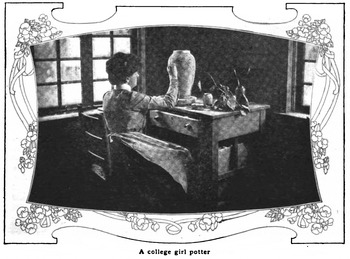
This image of a Newcomb student-potter at work accompanied an article in a special college edition of Good Housekeeping. Celebrating “the pottery work of this Louisiana college” as “an art lesson to American educators,” the article's author notes that “young women of the best families are engaged in the pottery” and when “they make it their vocation they can earn from thirty-five to one hundred dollars a month.” Ednah Lyman Reed, “Arts and Crafts as Shown in College Pottery,” Good Housekeeping, June 1905. Courtesy of Google Books.

Given its early branding of itself as an educational institution that was fulfilling the New South mission of industrial and cultural development, the administrators at Newcomb would have had an incentive to adopt what Lears calls an “accommodationist” stance, seeking a means of balancing its commitment to what Sheerer called “the growth of true art” and its promotion of an art program intended to produce capable art workers in anticipation of manufacturing jobs in the region.Footnote 51 Of course, Newcomb was not the only Arts and Crafts venture to face such conflicts between ideological and practical concerns. The career of Gustav Stickley, for example, was a protracted negotiation between the “Craftsman ideal of authenticity” and the realities of large-scale furniture production, a negotiation that played out in the workshop and in his Craftsman magazine.Footnote 52 Yet, in contrast to entrepreneurs like Stickley, Newcomb was not negotiating between its handicraft philosophy and mechanized production methods; rather, it was using authentic handicraft productions to support an educational program with industrial aspirations. The pottery made at Newcomb—each piece unique and hand-decorated—actually met “Morris's ideal of a craftsman designing and making an object from raw material to finished.”Footnote 53 In its early years, though, Newcomb downplayed NCP's embodiment of Morrisian handicraft ideals precisely because the Pottery was not seen as separate from the art department.
Besides, Morris's utopian vision conflicted with the Newcomb art department's early self-figuration as a heterotopian site, which contained elements of both New South reformist and Arts and Crafts revivalist projects. In 1900, Newcomb was not yet celebrating its Pottery showroom but still “the beautiful Art Building,” a “charming site” exhibiting fine and applied arts in harmony, where “the taper fingers” of “the winsome damsels of the Crescent City, and elsewhere … delv[ed] stoutly into the yielding clay, or dabbl[ed] eagerly in gaily tinted oils.”Footnote 54 If a bit tongue-in-cheek, this yearbook depiction of the art department showcases the representational strategies deployed more earnestly in contemporary characterizations in the shelter magazines listed above. An International Studio article finds Woodward modestly describing the pottery as “at present our most finished output” because “it is easier to secure practical support from this form of art than from any other.” He cautions against the inference that “that ours is essentially a school of design”; rather, pottery making “merely enters into our students’ training as a necessary part of every artist's education.”Footnote 55 In similar articles between 1900 and 1905, Woodward and Sheerer both represent NCP as merely the most visible branch of the art program's parent tree, offering an expeditious means of disseminating its core values and achieving its ends. “[W]here one may be prepared to add to the sum of beauty and achieve personal success through the pictorial arts, a hundred may be trained to useful enterprise in the field of artistic craftsmanship—a limitless field in which the world of industry ministers to the needs of refined civilization,” Woodward propounded in 1901 in the Newcomb Arcade. Footnote 56
In 1902, NCP offered its first classes in artistic needlework, thereby diversifying its line of handicrafts. As with its initial foray into the pottery business, its needlework venture was justified as particularly appropriate to “the great southern section of the country where cities are few and far between” and “especially accessible to women.”Footnote 57 Around this time the older “piecework” method for remunerating student artisans—whereby they purchased their own materials and “were compensated only when the work was sold”—was replaced by a more systematic procedure: the art department purchased outright finished works that met the Newcomb standard and sold them at the Pottery's showroom and through agents in other American cities. These developments helped to transform NCP into a more recognizable industry, as did its implementation of a jury method (likely modeled on that used by Boston's Society of Arts and Crafts) for deciding which student productions were worthy of the Pottery's mark, an “N-within-C cipher.”Footnote 58
Yet, even as NCP began to inhabit the promotional and managerial ethos of the larger Arts and Crafts movement, Woodward still insisted that “in the south the present hope for the artist is set in the future” and that “the nearness or distance of its realization lies partly in the activity and industrial development that shall bring about a need for his services, and partly in the … cultivation of the ruling class, who may learn through such means how large a part the formative arts play in higher life.”Footnote 59 This statement, made in 1902, reveals his entrenched belief that arts education could only function as a “culture study” in the South at that time. Until its economy shifted from agriculture to manufacture, Woodward averred, the region could have no real arts culture, no “public monuments of special merit,” nor “important museums or picture galleries,” nor “artists of national reputation.” Still, he argued, “the rapid development of southern industries” was on the horizon, and arts education would pave the way for the region's industrialization, while avoiding the “losses which have attended the development of manufacture in England, in Germany, and in the great cities of this country.”Footnote 60 In other words, by cultivating within the region an indigenous arts culture before manufacture took root, the South could avoid the phase of soulless, utilitarian mass production that Europe and North America had suffered and had to rectify—through expositions, design schools, and other initiatives—after the fact.
This aspect of Woodward's argument resonates with contemporaneous attempts by Southern reformers to rebrand the region as “belated” rather than “provincial.”Footnote 61 In 1908, in South Atlantic Quarterly, Edwin Mims plots out this position, arguing, “[t]he South is a belated section. Few people ever had a better opportunity than we have now to avail ourselves of the experiences of other sections and other nations. Cosmopolitanism and open-mindedness on the part of our people, will enable us to progress at a rapid rate.”Footnote 62 But those monuments of modern civilization—“libraries, museums, art gallaries [sic], publishing houses, magazines”—required first a regional acceptance of “modern ideas.” The early years in Newcomb's art program exemplified those modern ideas; in its curriculum and early profiles, it promoted the ideals of the New South through the medium of Arts and Crafts. Presenting arts education as a means by which the South could control its own destiny, Newcomb's art department represented itself as a regional model for this new progressive, educated, cosmopolitan, and artistically inclined culture.
Within this model culture, NCP played the role of its model industry, and, in its early years, the art department marketed it largely as an educational experiment in regional handicraft production. As Sheerer wrote in Keramic Studio in 1899, “the whole thing was to be a Southern product, made of Southern clays, by Southern artists, decorated with Southern subjects.”Footnote 63 Yet, as NCP became more well-known within American Arts and Crafts, it started to become conceptually detached from the educational program that housed it. Though a 1904 profile on Newcomb published in Stickley's Craftsman still praised the college's arts education as a form of “sectional patriotism,” which served to “exercise … taste and skill in the producer, develop critical power in the public, and largely increase the prosperity of the locality in which they are located,” the ideological mission of the program was becoming increasingly centered in its handicrafts.Footnote 64 One explanation for this shift is that national periodicals like The Craftsman, Brush and Pencil, and Good Housekeeping were understandably less interested in regional educational reform and less sympathetic to New Southern industrial aspirations than the New Orleans press. Moreover, as Newcomb Pottery became more enmeshed in the American Arts and Crafts network, its administrators and instructors became more invested in the movement's vision of a national domestic culture vivified by a commitment to the useful and the beautiful.Footnote 65 They also had to respond to the fact that the New South ideology was under siege by reactionary forces in the region that were threatening its reformist agenda. New Orleans had been severely checked in this regard by the Robert Charles riots of 1900, which highlighted racial tensions that, in 1884, President Johnston believed could be managed by reforms that would stratify Southern society along racial and gender lines.Footnote 66 For all of these reasons, the next phase of Newcomb's art program expanded in ways that prioritized the Pottery over the department, ushering in new strategies for self-fashioning more in sync with a national reformist agenda but which challenged the New South ideals that brought it into being.
“TYPICALLY ARTS AND CRAFTS”: NEWCOMB COLLEGE POTTERY, 1910–1919
Upon her death in 1901, Josephine Newcomb left the college almost the entirety of her fortune, which, owing to a lengthy lawsuit, it did not receive until 1909. This two-million dollar bequest made Newcomb “the most richly endowed women's college” in the country at that time,” its bounty redounding upon the art department.Footnote 67 The same year that the lawsuit was settled, the college reorganized its departments into separate schools, which resulted in the art department's transformation into an autonomous School of Art [henceforth, SoA]. As reflected in 1910–11 course catalogue, this new title bespoke a new conceptualization of the program's identity and new aspirations. While the curriculum in the freshly minted SoA was still organized into four tracks, these tracks now underscored different types of classes and training. “Collegiate Courses” were intended to aid in “the development of artistic culture and in the formation of taste”; the “Normal Art Course” was “prepared for those who may desire to become teachers”; “Studio Courses” were free-standing fine arts courses “conducted by intensive art school methods”; and then there was the “Newcomb Pottery” track. Once conceived as an experiment, NCP was now deemed a successful industry, discrete from the SoA, and requiring a separate building in “old Spanish style” for an expanded roster of courses in pottery decoration and manufacture and in embroidery, weaving, and dyeing.Footnote 68 A departure from the earlier preferred style, which blended classic and Creole, the Pottery building's exterior instead melded the Mission and the Creole, registering the influence of the Arts and Crafts aesthetic on New Orleans architecture. Inside the building, the changes were even more pronounced; NCP was now spatially cordoned off from the rest of the SoA, creating an ideological division between the fine and useful arts, in contrast to earlier aspirations. Also, whereas the representation of the art program in early catalogues focused on the present and looked toward the future, by 1910, its vantage point was the present, looking comfortably back on its past. This retrospective stance is worth noting because NCP was entering into a phase of expansion unimaginable to its administrators in 1895. Over the next decade, the Pottery would produce ceramics and embroidery, but also metalwork, leatherwork, glasswork, paper goods, and jewelry. On the Exposition circuit, it would enjoy successes that took the luster off its earlier bronze and silver medals: gold medals in 1907 at Jamestown and 1903 in Knoxville and highest honors in San Francisco in 1915. With NCP's awards and brisk sales, Woodward appeared to have made good on what in 1903 he designated his “great ambition”: “to spread the name and fame of Sophie Newcomb's Art Department, with special eye to the extension of the pottery and the embroidery sections.”Footnote 69
Yet, just as the popularity of its wares seemed to have achieved for Newcomb its goal of embodying the spirit of the New South movement, there commenced a noticeable shift in how NCP was marketed. Specifically, it began to be marketed using Arts and Crafts ideology. As previously stated, while the Pottery had always been an artisanal venture, its earlier attempts at self-fashioning largely ignored the Morrisian strains of the American movement, its critique of unchecked industrialization and romanticizing of pre-industrial society. To have done so would have put it at odds with the New South commitment to modernization and upbuilding. With its transformation, though, into the SoA, Newcomb's art program seemed to experience an identity crisis, grounded in the discrepancy between what it increasingly was—a stratified enterprise in arts education and handicraft production—and how it wished to appear—an aspirational incarnation of a unified, regionalist arts culture. This refashioning of NCP as an expression of what Jessie Poesch called “an Arts-Crafts Spirit” thus marked another change in its identityFootnote 70 ; from a speculative model for what the South, socially and economically, could be, it now represented itself as a site for refining, culturally and morally, contemporary Southern culture and for honoring and preserving the best parts of what it once had been.
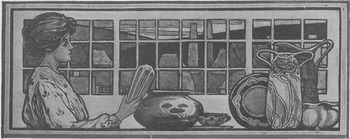
A stylized illustration of a Newcomb's student-potter at work, this one taken from an article in a 1907 edition of Crockery and Glass Journal, celebrating NCP's maintenance of an aesthetic “characteristic of New Orleans and the South.” “Newcomb Art Pottery: A Product Possessing an Individuality All Its Own.” Crockery and Glass Journal 66:25, Dec. 1907: 223. Courtesy of ProQuest.

While Newcomb was described as an “arts and crafts” initiative before 1910, this year witnessed the first sustained effort to explain the art program's mission as exemplary of the broader sociocultural objectives of the Arts and Crafts movement. In the September 1910 edition of Forensic Quarterly, Nathaniel Wright Stephenson argued that the SoA was a “conspicuous illustration” of Arts and Crafts principles applied to general education.Footnote 71 Tracing these principles back to William Morris, Stephenson's article rehearsed the familiar narrative that Arts and Crafts emerged from the conviction that the modern, industrialized world needed to be educated “back to art” by cultivating a widespread appreciation for “the applied arts which come close [to] home [in] every day life.”Footnote 72 By exposure to useful and beautiful household objects, individuals would be able to perform “daily ‘acts of taste,’” thus sharpening their aesthetic faculties. The pottery program at Newcomb, Stephenson asserted, was exceptional in carrying out “the basal Arts and Crafts idea” of producing “a genuinely local product” while teaching its producers to appreciate beauty in its humbler incarnations.
Stephenson's emphasis on Newcomb's regionalist aesthetic and its potential to produce art lovers and art workers seems of a piece with earlier descriptions of NCP. Yet, there is a distinct difference in tone, heard most clearly in his assertion that the Arts and Crafts movement will “educate the world back to art.” Such a statement is based on the idea that the “general art-sense of the world has ebbed,” owing to industrialization and that this quasi-instinctual form of aesthetic appreciation can only be instilled in modern civilization through a revival of interest in handicraft. This belief was closely tied to what Nicola Gordon Bove has described as the Arts and Crafts “search for vernacular expression,” part of a larger quest for “an aesthetically and morally satisfying environment.”Footnote 73
Arts and Crafts spokespersons and communities in America differed in their attitudes toward mechanization and industrial labor; the Chicago Arts and Crafts scene, for example, contained dissenting voices such as Frank Lloyd Wright, Oscar Lovell Triggs, and Thorstein Veblen, all of whom condemned the fetishizing of handwork and the eschewal of the labor-saving mechanical and organizational appurtenances of modern industrial society.Footnote 74 That said, most “craft writers,” Eileen Boris observes, were united in attacking “the general character of a civilization that associated money with happiness, [and] that produced goods for trade and not for ‘the life of the people,’” and the movement's celebration of vernacular expression was fundamental to its ideological opposition to consumer capitalism.Footnote 75 By reawakening in the public an appreciation for this authentic form of cultural production, the Arts and Crafts movement thus aimed to educate the people “back to art,” art broadly defined as a “skill,” “its display, application, or expression” [OED], a way of living in the world that many feared was being blunted by the conditions of modernity.
Though Newcomb's two main spokespersons had each taken every opportunity in earlier phases of the Pottery's existence to underscore its regional identity, it is not until Stephenson's article that we see Woodward and Sheerer really embrace the idea of its handicrafts as vernacular expressions of the culture of the Deep South. Compare, for example, Woodward's description of the program's raison d'etre in 1903 with a description from 1910. In 1903, Woodward is quoted in Sunset Magazine, exhorting his students “to be the voice of your environment,” for this “is to strike the great, high note in your own, or any art.”Footnote 76 Yet, 1910 finds Woodward declaring that “the South has no voice in art, principally because the few artists she has given birth to have expatriated themselves … The beauty and romance of the South are waiting the generation of training and power which will speak of all those things which most of us feel dumbly but have no power to communicate.”Footnote 77 In the space of seven years, Woodward goes from optimistically challenging his students to be the voice of the environment to soberly announcing that the South has, as yet, no voice, because her native artists have decamped for more cultured climes. While he still acknowledges “the social and economic value of art teaching” to be the “prefacing idea to [the] work” of the SoA, his comment implies that this objective is now less important than capturing the “romance and beauty of the South” through art objects.
This newly sounded, sentimental, nativist strain to Woodward's rhetoric in 1910 is echoed by Sheerer in the same article, when she asserts that Newcomb's distinctive aesthetic developed “following the lines of least resistance”: “characteristic motifs offered by abundant surrounding material.”Footnote 78 Earlier, Newcomb's designs were explained in terms of design theory, as the conventionalization of natural forms found in the college's immediate surroundings, each the result of self-expression tempered by a comprehensive arts education. Now, the creative process is represented as akin to automatic writing, the harnessing of an instinctual native aesthetic dormant in the region's collective consciousness. As for the designs themselves, they are “forms familiar and endeared by association to our Southern students, who, in childhood, have gathered the fallen petals of the white magnolia blossom to make their fairy boats, or have marked the coming of spring by the first appearance of the climbing jasmine and the Cherokee rose.”Footnote 79 This romanticized invocation of childhood, the students’ but also the region's, signals a departure from the program's earlier insistence on its modern, “scientific” design training. Sheerer trades instead on a depiction of the Old South as a pastoral wonderland of yesteryear, where nature played a fundamental role in the individual's relationship to her environment.
How do we account for Newcomb's retrenchment from its New Southern faith in industry and progress and its embrace of a sentimental vision of itself as an amanuensis for Southern culture? One explanation can be found in the Pottery's narrowing of its earlier aesthetic experimentalism as a response to market preferences. The public's taste in art pottery had changed since the late nineteenth century, particularly in the wake of Rookwood Pottery's development of a translucent matte glaze called a “vellum glaze,” which was “devoid of lustre and exhibited a slight haze.” This glaze produced “a light fogginess to the composition,” particularly conducive to the rendering of “tonalist landscapes” on pottery.Footnote 80 Newcomb's decorators began experimenting with these moody, atmospheric landscapes soon thereafter, and when its resident chemist Paul Cox created a similar glaze in 1911, it ushered in, in earnest, NCP's “middle or matt period,” which was dominated by a particular “oak, moss, and moon motif” so popular that the Pottery was discouraged by its sellers from sending anything else.Footnote 81 As this motif—of misty moonlight shining through Spanish-moss-draped Louisiana live oaks—began to represent Newcomb to the American public, it is reasonable to assume that its administrators adapted their marketing of NCP to capitalize on the nostalgia these tonalist compositions evoked.
Another possible contributing factor was NCP's difficulty in attaining the economic goals that were central to its founding. When still an experiment, Newcomb could be celebrated simply for instantiating an educational model that augured “the upbringing of an industry which means so much to Southern working women.”Footnote 82 By 1911, though, that promise rung a bit hollow; Newcomb's artists, noted an article in Art and Progress, “at present … are poorly paid in comparison with other artists of equal ability,” owing to the fact that the college deemed it “expedient to market the product more at the price of a commodity than at that of a work of art.”Footnote 83 That Newcomb, which by then was a full-fledged handicrafts enterprise, still found it “expedient” to price its wares below comparable art potteries highlights a tension between theory and practice that the program could not fully resolve. On the one hand, Woodward continued to introduce new handicrafts, stating that it was always his “policy to fit the application of art to some local need and requirement”;Footnote 84 on the other, those later experiments in book binding and jewelry making remained largely speculative endeavors, training students in handicrafts that offered few opportunities to earn a living wage.
To have been truly profitable, the Pottery would have had to renounce the production standards that made it an Arts and Crafts “object lesson” and adopt methods employed by art potteries like Rookwood to stay financially solvent.Footnote 85 Even had it wanted to, though, NCP did not have the capital, resources, or support for such an undertaking, and doing so would have cut the last ties to its original identity as an educational program. Rather than dealing with these contradictions and inconsistencies directly, those in charge, particularly Woodward, instead embarked on a new promotional campaign that underscored the value of NCP's handicrafts as cultural artifacts, charmingly pre-industrial, the romantic and untutored expression of a region still light-years behind the national standard.Footnote 86 In its early years, the arts program had stressed its cosmopolitanism and represented itself as a beacon to attract exogenous capital to the South, thus fostering regional industry. By the second decade of the twentieth century, this perspective had changed. Gone was the expansionism characteristic of the New South creed, its investment in economic and cultural progress; in its place was a protectionist, preservationist attitude. Now, the environs of the South were not simply to be represented but exalted as a romantic ideal through Newcomb's wares. A 1914 article in Vocational Education captures this new aesthetic imperative: “Newcomb girls are told that they must see as much beauty in the old back yards of New Orleans as in the canals of Venice … It is then their privilege to express that beauty thru [sic] their work, and so release its power to influence life.”Footnote 87 Once modern art workers, the student artists at Newcomb were reimagined as artistic mediums for their environment, privileged to express its beauty, not their own self-expression.
Woodward also invoked this argument in a contemporaneous speech that celebrated “art as a means of expression.” Herein, he voiced priorities for his program markedly different from his earlier insistence on a comprehensive arts education blending the study of art history and theory with studio work in the fine and practical arts. Now, he judged as paramount the artist appreciating her immediate surroundings:
It is a very great thing to impart a real love and appreciation of a carbon print of the Parthenon, a Madonna by Botticelli, a landscape by Corot, but I conceive it to be a greater and more vital thing that our pupils should be intelligently critical of the architecture of the local courthouse, should appreciate the Madonna that sits by every hearthstone and feel with enthusiasm the claims upon our love and admiration that exists in the landscape of the corn and cotton fields of our intimate acquaintance.Footnote 88
Of course, Newcomb's art program had always emphasized drawing inspiration from the college's location, and the romanticizing of the South was a part of the New South program from its beginning. Yet, roughly thirty years after his arrival to New Orleans, Woodward's speech is troubling in its insistent aestheticizing of history, its elision of how the city had changed for better and for worse during that time, with, on the one hand, a modernized sewerage and water system and, on the other, the institutionalized segregation of public spaces.Footnote 89 Woodward's picturesque analogy also glosses over the ugly historical realities attached to the specific locations he suggests his students commemorate in their productions. The three symbols of the Old South that he promotes over works of European art are weighted by associations with the oppression and exploitation of slavery. Whether consciously or not, Woodward sets the Parthenon, a tribute to Athena, goddess of wisdom and justice, against the Presbytere, the New Orleans courthouse which until 1910 enacted “justice” according to an inherently unjust legal system. And in the place of Botticelli's Virgin Mary, we have the infamous feminine archetype of the Southern mammy, the enslaved surrogate mother of the plantation household. And finally, against Corot's pastoral images of peasants disporting themselves in nature, we have the bleak landscapes of slaves laboring in cotton and corn fields. While Woodward's valorization here of domestic and pre-industrial culture can read in terms of the Arts and Crafts pursuit of the vernacular, it nevertheless highlights the movement's nativist and primitivist undertones, which often lurked beneath superficially sentimental invocations of the past.
Curiously, though, the nostalgic turn that Woodward takes at this time was not reflected in NCP's curriculum. Though no longer a separate course of study as of the 1914–15 catalogue, even in its new placement in the studio art section NCP continued to modernize its courses.Footnote 90 By the 1915–16 academic year, the “pottery making course” had been divided into three years of study, which educated its students in all aspects of pottery production.Footnote 91 While Newcomb still employed a professional potter and a ceramics chemist, the pupils were no longer restricted to the decoration of pottery, testifying to Sheerer's will to overcome the gendered division of labor common in Arts and Crafts enterprises. Ideologically, though, NCP increasingly became Woodward's vehicle to promote his “sense of responsibility [regarding] the unexpressed need that locality has for the interpreter of its innate beauty and home sentiment.”Footnote 92 In his last years as SoA's Director, Woodward became more conservative in his articulations of Newcomb's mission, focusing particularly on the preservation of Southern traditions. Whereas in 1904, he denigrated the provincialism of America's expositions by comparing them to country fairs, his “art as a means of expression” speech celebrates “the art department of the country fair as possessing vast significance, for there [one] seem[s] to find the art impulse at its primitive source.” If this “unconcious [sic] instinct” could be harnessed, he argues, “a community consciousness might be developed that would go far.”Footnote 93 Woodward's abandonment of the exposition model of cultural representation for that of the country fair is indicative of changing priorities. Lacking the cosmopolitan, aspirational energies of the exposition, the country fair instead displays the character and values of a rural community through amateur exhibitions of local talent.
Woodward's newfound appreciation of the country fair heralded a paradigm shift that impacted his representation of SoA and NCP from this point forward. Newcomb's art program had been a model for Southern culture; now, NCP was an expression of Southern culture. A May 1916 article finds Woodward stating that “the work which simply depicts an object, without giving it such an atmosphere that it is distinctive and will be recognized at once as representing a section, a people or a community, and the article made, which is not practically applicable to the needs of everyday life, is not true art.”Footnote 94 This convoluted and unwieldy definition of “true art” manifests the strain of Woodward's later efforts to tie the Morrisian dictum that art should be both useful and beautiful to what Richard Megraw has called his “aesthetic localism,” a belief that art should always be an expression of one's native environment.Footnote 95 Woodward's professed faith in the power of the “genius loci”—the indigenous “spirit” of a particular place—was a relatively late phenomenon, which allowed him to retrofit its mission to reflect his own growing nostalgia for a uniquely Southern aesthetic damaged by modernization.Footnote 96 That Woodward became a passionate advocate for the historic preservation of New Orleans's French Quarter is another manifestation of this desire to preserve the symbolic markers of regional cultural authenticity, including “the climatic and geographical specificities” that generate “love and loyalty to locality—the genius loci which is the essence of art as well as of patriotism.”Footnote 97
Much in the same way that NCP had crafted in its early years a distinctive New South identity in an Arts and Crafts discursive context, in the years following the creation of the SoA, it developed a distinctive Arts and Crafts identity in progressive education journals, such as Art and Progress, Vocational Education, and School Arts Magazine. In these venues, Woodward promoted NCP, but more and more often, in the service of his interests in “native artistry” and local culture.Footnote 98 Around 1910, Woodward became involved with founding of New Orleans's first public art museum, the Isaac Delgado Museum of Art. Now truly the lion of New Orleans's art scene, Woodward's association with the museum helps explain the role he assumed in his last years at Newcomb and of his life.Footnote 99 In numerous speeches and articles between 1915 and his death in 1939, the SoA's current and former director functioned as its first historian, crafting a retrospective narrative for the art program of which he was the principle architect. In doing so, Woodward contributed directly to the “museumification” of Newcomb, even while NCP was still in operation. Now, when telling its story, Woodward situated Newcomb in the past, explaining the decision of the art department to venture into handicraft production in ways that argued for the valuation of Newcomb's wares as historical artifacts, worthy of preservation as testaments to the South's struggle to find its own artistic voice in and through artisanry. Woodward's late Newcomb narratives touched upon many influences and events mentioned in this article—the Cotton Centennial, the art program's early days, its initial foray into handicraft and development into a recognized art pottery—but with a hand that deliberately smoothed over the inconsistencies, tensions, and ideological alterations that marked the Pottery's evolution from educational experiment to handicraft enterprise. Little is said of the program's aspirations in the years before the founding of NCP or of its shifting allegiances to and negotiations of the overlapping ideological frameworks of the New South and Arts and Crafts. Yet, this revisionist history is somehow fitting, in that it stands as one final effort at self-fashioning on the part of Newcomb's chief visionary. In his final years, Woodward remodels himself into a cultural sage (à la Ruskin and Morris) and remodels Newcomb using the template not of the exposition or the county fair but rather the museum.Footnote 100 He writes, in essence, the curatorial catalogue essay for a future special exhibit, ensuring Newcomb's legacy as an arts program that emerged out of the exposition grounds of the New South and that adapted as aspirations were replaced by realities and as “progress” came to be defined not just in terms of what could be gained for the future but also by what from the region's past had been—for better or worse—irretrievably lost.