While recent elections for the US Congress and the Japanese Diet have broken records for female representation, women remain under-represented in both countries, especially in comparative perspective. In September 2010, the US ranked 73rd and Japan ranked 94th for female representation in the lower house of the national legislative body. Both countries fall below the average of 19.3% for lower house female representation, with women representing 16.8% of the seats in the US House of Representatives in September 2010 and women constituting 11.3% of the seats in the Japanese Lower House after the 2009 election. A similar picture emerges when comparing the US Senate and the Japanese Upper House. Women comprise 15.3% of the seats in the Senate after the 2008 elections, while women occupy 18.2% of the seats in the Upper House following the 2010 election in Japan (Inter-Parliamentary Union, 2010). This article compares the obstacles that women politicians face in both countries as well as the resources available to women to challenge these obstacles. In particular, it develops a comparison of EMILY's List and WIN WIN, women's organizations established to support female candidates for office in the United States and Japan respectively.
While EMILY's List and WIN WIN have many similarities, related to the fact that WIN WIN in many ways modeled itself on EMILY's List, WIN WIN has not performed as well in Japan as its counterpart has in the United States. Specifically, after initially receiving a large amount of national media coverage and recruiting nearly 1,000 dues paying members, the organization, while still in existence, has suspended its fundraising and monetary donations to candidates. Why did WIN WIN have limited success in its efforts to bring the EMILY's List model to Japan? This article argues that differing institutional environments and cultures have less explanatory power than decisions made at the organization level. In particular, while differences in the political funding regimes and so-called ‘cultures of giving’ exist, they do not necessarily preclude the success of an EMILY's List-type organization in Japan. Instead, WIN WIN made significant strategic organizational decisions that have impeded its ability to have a significant impact on female candidacy at the national level.
In essence, this article explores the complexities of institutional transfer.Footnote 1 Specifically, it asks why WIN WIN has struggled to successfully implement the EMILY's List model. The first section justifies this article's case selection at both the country and organization levels. The next section then addresses the extent to which the institutional environment and/or gender influence one's ability to acquire money, publicity, and/or votes in the United States and Japan. This discussion illustrates the remarkably similar obstacles women candidates face in both countries and argues that these similarities suggest that the fundamental constraints in both countries are resource based. The third section develops a stylized case study of two similar organizations in both countries designed to address these resource-driven constraints. EMILY's List and WIN WIN, in the US and Japan respectively, both seek to increase the number of women in office by providing funds early in the candidate's campaign. WIN WIN's lack of accountability to its members combined with its broader commitment to gender consciousness have limited its success in the Japanese context. In the end, WIN WIN tried to copy EMILY's list but failed due to organization-level decisions. The conclusion considers how the EMILY List's model of national fundraising might be adapted at the organizational level to achieve higher levels of performance and institutionalization, and thereby secure greater legitimacy in the national political arena.Footnote 2
Case selection
This study adopts a most different systems research design to explore the role of women's organizations in supporting the election of women candidates for office. Indeed, comparing women's organizations in the US and Japan provides significant analytical leverage given the different institutional and cultural environments these organizations function in. The United States is a federal system. The single-member district electoral system for all major legislative bodies at the national and state levels supports a two-party system. The US regulates both political funding and campaign activities; however, these regulations still promote individual and corporate fundraising most commonly through the creation of Political Action Committees (PACs). Money politics scandals do emerge but with much less frequency than in Japan. Culturally, an emphasis on equality has fueled a vibrant women's movement.
In contrast, Japan is a centralized system with top–down decision making. Since 1994, the Lower House of the Japanese parliament has adopted a combined single-member district/proportional representation (SMD/PR) electoral system which supports both large and small parties. Political funding and campaigning is highly regulated with a ban on corporate contributions to individual politicians, strict limits on individual contributions, and high incentives for political corruption. Culturally, women have considered politics less relevant to their lives, and the women's movement has remained marginal.
These differences have added significance in the investigation of WIN WIN's attempt to transfer the EMILY's List model to Japan. While the institutional environment and/or culture are usually seen as preventing successful institutional transfer, this article argues that WIN WIN's lack of accountability to its members and vague policy stance have limited its success. As currently configured, WIN WIN has been unable to gather the level of support needed to make a significant impact on national elections.
EMILY's List and WIN WIN were selected as cases of women's organizations that support female candidates for office in the US and Japan respectively for several reasons. First, these organizations have similar goals. Both organizations support female candidates for office at the national level by providing endorsements and financial support early in the election cycle. Second, these organizations are the most important organizations of this type in the two countries. In the US, EMILY's List is the premiere donor network for women. WIN WIN is the only organization of this type in Japan; most women's organizations in Japan focus on preparing candidates to run at the local level through education. Finally, the fact that WIN WIN explicitly modeled itself on EMILY's List allows the case study to speak to the literature on institutional transfer (Jacoby, Reference Jacoby2000). In short, the case will illustrate the difficulties of institutional transfer.
Electoral obstacles in Japan and the United States
A comparison of the literature on the electoral obstacles faced by women in the US and Japan reveals several similarities, despite the varying institutional environments. In the US, obstacles for female candidates include the electoral structure, particularly the advantage it gives to incumbents (Carroll, Reference Carroll1994; Darcy et al., Reference Darcy, Welch and Clark1994; Jacobson, Reference Jacobson1992); experience in fields that feed politics often referred to as the social eligibility pool (Carroll, Reference Carroll1994; Darcy et al., Reference Darcy, Welch and Clark1994); socialization, which deters female candidate self selection (Fox and Lawless, Reference Fox and Lawless2005), media bias (Kahn, Reference Kahn1996); and party recruitment and nomination (Sanbonmatsu, Reference Sanbonmatsu2006). Fundraising can present an obstacle, but research indicates that when women run, especially after receiving the party's nomination in the primary, they raise funds on par with their male counterparts, in some cases raising more funds than their opponents (Burrell, Reference Burrell1994).
An exploration of electoral obstacles in Japan presents a similar picture. In Japan, all candidates – both male and female – face three major obstacles when running for national office: jiban (building a constituency), kanban (publicity/endorsements), and kaban (money). In addition to the traditional electoral constraints, women also face constraints embedded in cultural and social norms. Women in Japan tend to think of politics as distant from their lives (Iwao, Reference Iwao1993; LeBlanc, Reference LeBlanc1999). Even if women become more interested in politics through their involvement in local activism, certain gender expectations remain. Specifically, while the social roles available to women are broadening, these roles remain constrained such that women have a difficult time balancing work and family.
The obstacles in the US and Japan are comparable, but the way they manifest themselves as well as the relative weight of their influence varies. In the US, incumbency is a significant obstacle that emerges in response to the incentives and constraints of the single-member district electoral system. Women have the greatest chance of building a constituency of support for open seats.
Historically, organizational support has been quite important in the context of Japan's strict campaign regulations and electoral system rules. The importance of organizations (such as personal support groups, labor unions, or religious groups) disadvantages women by favoring incumbents and insiders (Christensen, Reference Christensen, Lee and Clark2000). In Japan, the traditional resource for building a constituency is a kōenkai, a personal support organization. Kōenkai are individual political machines that allow candidates to compete based on the personal vote. These organizations court individual, business, and agricultural support to raise funds and votes. Liberal Democratic Party (LDP) candidates in particular develop kōenkai to provide patronage and pork to constituents in return for votes (Curtis, Reference Curtis1971). In general, women lack the personal connections necessary to build such organizations. Women are less likely to come to politics through the most common career paths of bureaucrat, political secretary, or local politics. Moreover, they often live in areas based on their husbands’ careers (Bochel et al., Reference Bochel, Bochel, Kasuga and Takeyasu2003: 27). These factors limit their ability to build kōenkai, especially absent party support.
The obstacle of media coverage and party endorsements in the US is comparable to the Japanese obstacle of kanban (publicity and endorsements). In the US, women often face more negative media treatment as well as less coverage in general (Kahn, Reference Kahn1996). At the very least, gender socialization and stereotyping make publicity more complicated for women in a variety of ways (Williams, Reference Williams, Thomas and Wilcox1998). Japan has extensive restrictions on media advertising during the official campaign period. Still in Japan, the media, and sometimes even the candidates themselves, tend to emphasize women more in their traditional role. For example, Doi Takako, a female politician who reached the level of speaker of the Upper House, used the cultural image of women as ‘clean’ quite effectively when the Japan Socialist Party (JSP) successfully saw ten of its female candidates elected in 1989 (Ogai, Reference Ogai2001: 209).
Party support, while important, does not have the same level of significance in the US when comparing it to Japan. Instead, the weak party system in the US results in the added importance of self selection. Parties do not discriminate against women per se: at least discrimination has diminished greatly (Thomas, Reference Thomas, Thomas and Wilcox1998). It is not clear, however, how actively parties recruit and nominate women candidates (Sanbonmatsu, Reference Sanbonmatsu2006). Parties do support women on par with men once the female candidate has won the primary (Burrell, Reference Burrell, Carroll and Fox2006: 165–6). Barriers that prevent women from being competitive in primaries such as self selection, incumbency, and money remain relevant factors. Significantly, US political parties do not have gender quotas.
Party support seems to be of more importance in the Japanese case due in part to the differences in the US and Japanese electoral systems. The Lower House of the Japanese Diet employs a combined SMD/PR electoral system. To be nominated in single-member districts, a candidate needs party endorsement. A primary system to receive party endorsement does not exist. Candidates in Japan also are reliant on parties for positions on PR lists. None of the Japanese political parties has a gender quota in place.
Money (kaban) is a much sought after resource in both countries. The challenges posed by fundraising have varied over time in the US and Japan. As we shall see, organizations such as EMILY's List have done much to reduce money as an obstacle for women. Moreover, once women have become a party's nominee for office, they are able to raise funds comparable to men (Burrell, Reference Burrell1994); however, it does appear that the way they go about raising funds is different. For example, women tend to receive individual contributions for smaller amounts when compared to men (Fox, Reference Fox1997). Women's Political Action Committees also bundle individual contributions to raise funds (Burrell, Reference Burrell, Carroll and Fox2006).
In Japan, the old electoral system for the Lower House, a multiple member district system with a single non-transferable vote, amplified the importance of money in elections. This electoral system forced members of the same party to compete against one another. Factions emerged in response to this competition and played a key role in funding candidate campaigns. In particular, factions in the dominant LDP supported candidates financially in return for candidate support of the faction leader in the party presidential election. This election determined the prime minister during the period of LDP dominance from 1955 to 1993 (Curtis, Reference Curtis1988). With the changes to the political funding regulations that accompanied the switch to a combined SMD/PR electoral system, party subsidies are available to support electoral activities. The role of factions has been diminished due to these and other revisions to the electoral system and funding laws in 1994 (Krauss and Pekkanen, Reference Krauss and Pekkanen2004). Women must be tapped as party candidates, however, to receive the benefits of party subsidies. In the end, candidates in both countries, especially new candidates, are always seeking outside funds.
Resources for challenging electoral obstacles: the role of women's organizations
A vibrant women's movement provides women additional resources to overcome electoral obstacles. Women's organizations afford women the chance to gain administrative and political experience as well as the opportunity to build a support base. An association with a reputable organization can provide legitimacy to a woman's candidacy, and even help an aspiring candidate gain party affiliation. The organizations in turn can provide resources such as a volunteer base or financial backing that can aid a woman candidate's campaign (Matland, Reference Matland, Ballington and Karam2005: 95).
In this section, I compare and contrast two women's organizations that support female candidates running for office in the US and Japan. In the US, the dominant means of supporting women candidates for office comes through early fundraising. Women's Political Action Committees have gone far to reduce the constraints posed by raising funds for viable female candidates for Congress, especially in the critical early stages of campaigning. EMILY's List was a pioneer in raising early money for candidates at the national level, and will be the focus of the case study below. In Japan, most women's organizations focus on training and education, especially for candidates running for local office. WIN WIN is an exception. It explicitly modeled itself on EMILY's List and raises funds for first-time candidates who are committed to promoting gender consciousness. As we shall see, however, significant organizational differences exist between EMILY's List and WIN WIN, and these differences explain why WIN WIN's attempt to copy EMILY's List has floundered.
EMILY's List
EMILY's List was founded in 1985 as a political network with the explicit goal of financially supporting pro-choice female Democratic candidates. The acronym EMILY stands for ‘Early Money Is Like Yeast’ because it makes dough rise and reflects the organization's goal of providing early seed money to viable female candidates for office at the national level. In addition to funding, EMILY's List provides political networks and institutional support for campaigns, training for potential candidates, programs for female involvement in the political process at the local and state levels, and voter education and mobilization efforts targeted at women. These activities address the constraints posed by self selection, the social eligibility pool, and building a constituency. In essence, as Jamie Pamelia Pimlott argues, over time EMILY's List has shifted from a donor network with its main focus on funding to a ‘multi-pronged influence organization that functions as a PAC, an interest group, a party adjunct, and a campaign organization’ (2010: 3).
Arguably, the most significant resource EMILY's List provides female candidates is financial support. Fundraising was the organization's initial focus. The key innovation of EMILY's List was nationalizing local elections through the unifying goal of electing pro-choice Democratic candidates to Congress (Sarah Brewer, personal interview, 19 June 2006). Members are asked to make an initial contribution to EMILY's List followed by two $100 contributions to candidates endorsed by EMILY's List in the following election cycle. The PAC established by EMILY's List is restricted in the amount it can give each candidate. The $100 contributions to individual candidates, however, are submitted to EMILY's List or to the candidate directly, and thus are classified as individual contributions. The ‘bundling’ of individual contributions allows EMILY's List to raise additional funds since these checks are written to the candidate from an individual. These bundled contributions must be reported to the Federal Election Commission (FEC), but this strategy allows EMILY's List to go beyond the normal restriction on PACs (Nelson, Reference Nelson, Cook, Thomas and Wilcox1994).
Early money is important for a variety of reasons. First, it provides credibility to the campaign. As Candice Nelson explains, ‘Early PAC money gives a sense of legitimacy to a campaign, and it shows that organizations apart from the candidate's immediate supporters are paying attention’ (Reference Nelson, Cook, Thomas and Wilcox1994: 184). Money also provides access to important campaigning resources such as pollsters, fundraising experts, and other campaign support staff that allow candidates to prepare for early challenges (Day and Hadley, Reference Day and Hadley2005: 20; Nelson, Reference Nelson, Cook, Thomas and Wilcox1994: 183).
An endorsement by EMILY's List is a resource for confronting the obstacle of name recognition. EMILY's List has earned a reputation as a strong organization committed to supporting viable pro-choice Democratic candidates. This reputation prompts many voters to give candidates endorsed by EMILY's List a second look (Anne Capara, research tracker, EMILY's List, personal interview, 21 June 2006).
Since 1994, EMILY's List also has provided education and training services to confront the related obstacles of experience and self selection. Citing a National Women's Political Caucus study in 1994, Duerst-Lahti points out that women see training and institutional support as critical resources in their decision to run (Reference Duerst-Lahti, Thomas and Wilcox1998: 23).Footnote 3 A similar study by Jennifer Lawless and Richard Fox uncovered that self selection is the key obstacle to candidacy. This study finds that women with comparable qualifications are less likely to run for office than their male counterparts. Women tend to think of themselves as less qualified to run for office. Women also put added weight on how running for office might affect their families (Lawless and Fox, Reference Lawless and Fox2004: 8). In a personal interview, the chief of staff of EMILY's List noted that training at EMILY's List was developed in response to these findings (Britt Cocanour, personal interview, 20 July 2007). Training includes the mental and emotional preparation needed to run for office as well as the practical skills needed to run a successful campaign. Training is tailored to each state but covers such topics as how to organize one's life as a candidate, how to ask for money, and how to deal with the press and the media (Britt Cocanour, personal interview, 20 July 2007).
Until 2001, EMILY's List's main focus was on the national level. In the last several years, though, EMILY's List has begun to institutionalize support for candidates at the state and local levels through its Political Opportunity Program (POP) program. This program tackles the social eligibility pool constraint and seeks to place more women in the pipeline for national office. Unlike with endorsements where the selection criteria are stringent, this program encourages participation by women who are simply thinking about running. It also provides concrete training for those who will run at some point. In this way the program targets women with two different goals, initial education and training for an actual run (Britt Cocanour, personal interview, 20 July 2007). The POP program has influenced the national-level recruitment process. EMILY's List now has a deeper reach into the state and a better sense of women leaders in each state (Britt Cocanour, personal interview, 20 July 2007). Overall, the money, training, support staff, networking, and exposure provided by EMILY's List have helped elect 80 Congress women and 15 female senators in the last two and a half decades (EMILY's List, 2010a).
Female candidates supported by EMILY's List point to several aspects of the organization that were critical in their successful bids for office. Early money is helpful in bringing credibility to the campaign. For example, in EMILY's List's ‘We are Emily’ campaign, Senator Barbara Mikulski, the first woman elected to the US Senate in her own right in 1986, explains how a poll sponsored by EMILY's List increased her legitimacy as a candidate:
EMILY's List gave the money for the very first poll that showed the depth of my support. That first poll that EMILY paid for surprised the whole Democratic establishment in Maryland. They said, ‘we can't believe it’ because it went against conventional wisdom. We know that conventional wisdom is just a nice, pleasant word for negative stereotypes. (EMILY's List, 2010b)
In this instance, early funding aided Senator Mikulski in overcoming the obstacles of money and publicity/endorsements. Senator Debbie Stabenow nicely summarized EMILY's List's role in her campaign stating, ‘It [EMILY's List] is very much about being there for women and really giving them the resources we need’ (EMILY's List, 2010b).
Indeed, EMILY's List's support extends beyond funding. Senator Kirsten Gillibrand, a first-time candidate for the New York Senate seat in 2006 found the grassroots endorsement of thousands of women critical in giving her the confidence to battle her opponent. Senator Gillibrand characterized the support of EMILY's List in the following way:
EMILY's List made an enormous difference in my campaign. First of all, it gave my campaign unbelievable credibility. My opponent's strategy to beat me was to take my legs out early . . . His attacks were very gender based and he said I was just another pretty face. I was really glad I had EMILY's List's support because I knew I had thousands of women all across the country who were standing right there with me who were going to fight for this seat. (EMILY's List, 2010b)
In this case, EMILY's List enabled Gillibrand to overcome gender bias and stereotypes by providing her a sense of solidarity and belonging. Overall, the success of EMILY's List stems from its ability to tap into a support base and bundle individual contributions by supporting viable pro-choice Democratic women for office.
WIN WIN
Women in the New World, International Network (WIN WIN) is a nonpartisan organization focused on raising funds to support women candidates running for office, mainly at the national level in Japan. It was established in 1999 by six prominent women, including Akamatsu Ryoko, a former Education Minister and ambassador; Shinomura Mitsuko, a journalist; Kawashima Ruri, the director of the Japan Society; Ogawara Akiko, a business executive; Hayashi Yoko, a lawyer; and Meguro Yoriko, a professor of sociology and gender studies at Sophia University. Many of these women served as advisors to the Japanese Government at the UN Conference on Women in Beijing in 1995. All of them were members of Leadership 111, an organization of successful women formed in 1994 to promote the involvement of women in the policy-making process (Eto, Reference Eto2008: 130).
WIN WIN models itself on EMILY's List. In fact, the founders of WIN WIN learned of EMILY's List on an educational tour of the United States with Leadership 111 (Eto, Reference Eto2008: 130). The founding women hoped that the EMILY's List model would transfer to Japan and remedy some of the negative aspects of political fundraising. When Shinomura Mistsuko was vice president of WIN WIN she stated, ‘Elections cost a lot of money, but the method of collecting money humbly from all over the country has the possibility to change conditional giving and pork-barrel politics’ (Asahi Shinbun, 29 March 2003). The founders felt the EMILY's List model could break some of the barriers of the old boys’ network through grassroots support.
When WIN WIN was initially established, it had a two-tiered organization. The founders created a leadership circle just under 100 members. These members, like the founders, were prominent figures. This group was in charge of endorsements and networking. The general membership then sat underneath the leadership circle and consisted of small-scale donors (Eto, Reference Eto2008: 130). Near its height in 2003, WIN WIN had 761 members (Mitsui, Reference Mitsui2003).
Like EMILY's List, WIN WIN tackles the obstacle of political funding (kaban) by providing its endorsed candidates donations from its members. Women candidates apply for support from WIN WIN. Applicants must exhibit a strong commitment to gender issues. A 13 member steering committee reviews written applications and conducts interviews with perspective candidates. WIN WIN endorses candidates based on unanimous support of its committee members (Eto, Reference Eto2005). Members of WIN WIN then donate 10,000 yen (approximately $100) or more to at least one endorsed candidate of their choosing (Mitsui, Reference Mitsui2003; Takao, Reference Takao2006). The organization collected seven million yen from around the country in the 2000 Lower House election and five million yen in the 2001 Upper House election (Asahi Shinbun, 29 March 2003). WIN WIN only provides financial support to first-time candidates; however, it endorses women running for re-election. WIN WIN brings attention to its endorsed candidates through campaign speeches by influential WIN WIN members, press conferences, articles on its website, and canvassing (Eto, Reference Eto2005; Mitsui, Reference Mitsui2003). Between 2000 and 2010, WIN WIN has seen 24 of its endorsed candidates elected to the Lower House and 23 of its endorsed candidates elected to the Upper House (WIN WIN, 2010).Footnote 4
Despite the fact WIN WIN modeled itself on EMILY's List, several key differences exist. First, WIN WIN has chosen a much broader policy stance. Specifically, it defines itself as an organization committed to supporting women who promote gender consciousness (Eto, Reference Eto2005). Choosing a broader policy stance allows for the endorsement of a greater number of women across parties.
Moreover, unlike EMILY's List, which concerns itself with supporting candidates running as Democrats, WIN WIN is nonpartisan. EMILY's List saw bipartisanship as a weakness of past women's organizations, and felt that it could garner more support from women by becoming partisan. Over time, the organization gained legitimacy, and now in many ways the Democratic party looks to EMILY's List when determining endorsements (Pimlott, Reference Pimlott2010: 32). Other women's organizations in the US with political action committees have remained nonpartisan, such as the Women's Campaign Fund and the Women Under Forty PAC, but these PACs have not had the same level of success as EMILY's List. It appears that partisanship can offer leverage in fundraising.
Somewhat surprisingly, female Diet members supported by WIN WIN give the organization mixed reviews. Komiyama Yoko, a Democratic Party of Japan (DPJ) politician known best for her work on the domestic violence legislation, explained that she welcomed an organization to help out with fundraising since it is difficult for women to raise funds. She noted, however, that ‘the organization's rules are too complicated. WIN WIN only financially supports the first election. Then it only recommends female candidates.’ It was not clear to Komiyama how to build up the organization, especially given its reliance on individual contributions (personal interview, 28 March 2006). The first-time candidate rule affected Madoka Yoriko, a DPJ politician who heads her own organization to educate women on politics and potentially running for political office. Madoka was not eligible for financial support because she was not a first-term candidate. Instead, she got more personal support from WIN WIN's director, Akamatsu Ryoko (personal interview, 27 March 2006).
WIN WIN has been struggling in recent years. It experienced initial success with its membership nearing 1000 in the early 2000s. By 2005, however, its fundraising efforts stalled considerably. It only collected donations from 10% of its supporters in 2005 (Asahi Shinbun, 19 September 2009: 37). As a result, the organization currently has suspended its fundraising efforts; instead, it is focusing exclusively on female networking (Asahi Shinbun, 19 September 2009: 37; Eto, Reference Eto2010). It also continues to officially endorse candidates.
Institutional transfer: its problems and potential
So why has WIN WIN struggled to implement the EMILY's List model? Many scholars would not find this outcome surprising; they would expect institutional transfer to fail. Those who argue against the efficacy of institutional transfer point to institutions or culture as the decisive variables preventing success. Those who see structure as preventing institutional imitation argue that the larger political and social context impede the transfer of rules and practices from one country to another. Institutions from one country simply do not ‘fit’ in another country.Footnote 5 Advocates of the cultural approach also emphasize difference, arguing that the divergent values and beliefs in different countries preclude successful institutional transfer (Pye, Reference Pye1985). Wade Jacoby (Reference Jacoby2000), however, rejects both of these explanations in his study of institutional transfer from West to East Germany after both World War II and reunification. Instead, he argues that institutional transfer can be successful due to the role of political actors, something that both the institutional and cultural approaches ignore. His concern is the imitation of institutions by the national government, not the imitation of civil society institutions such as EMILY's List, but his findings speak to the case of EMILY's List and WIN WIN. He argues that for ‘effective institutional change to persist and perform, it must be “pulled in” by social actors rather than decreed by policymakers alone’, claiming that flexibility and buy in by domestic actors are key parts of the process of imitation (Jacoby, Reference Jacoby2000: 15). Indeed, an exploration of potential variables influencing the performance and persistence of WIN WIN suggest that institutions and culture are not decisive. Instead, decisions made by actors at the organizational level have impeded the organization's overall success in recent years.
The role of institutions, culture, and organizational decisions
Institutions: the political funding regime
One plausible explanation for WIN WIN's limited success with institutional transfer would be the fact that WIN WIN operates under a different political funding regime than EMILY's List. This explanation fits with the structuralist approach and its emphasis on ‘fit’. Indeed, the funding strategy of EMILY's List was an explicit attempt to maximize its impact given the various funding regulations it faced. One could hypothesize an organizational strategy of bundling individual contributions simply does not work in the Japanese context. As the comparison below will illustrate, however, this variable is not decisive. If anything, the Japanese funding environment is just as conducive to this type of fundraising strategy.
The campaign finance regulations in both countries have a reputation of being both extensive and restrictive. As we shall see, restrictions are placed on donations from individuals and political groups in both countries with fewer restrictions placed on contributions to party committees (US)/party branches (Japan) than on direct contributions to candidates. Historically, both political funding regimes have sought to lessen the influence of large corporations and unions in comparison to individual contributions.Footnote 6 A comparison of the restrictions placed on individuals, parties, and political groups in both countries reveals a comparable environment for individual and political group donations.
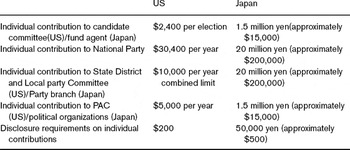
EMILY's List was founded in 1985 and its political action committee was subject to the Federal Election Campaign Act (FECA) regulations passed in the 1970s. These regulations continued the ban on direct contributions from corporations and unions and created stricter contribution and disclosure limits for individuals, parties, and political action committees. Political action committees are political groups created to raise and give funds connected to federal elections. Many PACs are directly connected to corporations and unions. EMILY's List, however, is an ideological PAC that raises funds to support candidates with similar policy positions. The restrictions on all PACs are the same – PACs can contribute $5,000 to an individual candidate per election (primary, general, or special election), $15,000 to political parties per year, and $5,000 to other PACs. Limits on individual donations were raised by the Biparisan Campaign Reform Act (BCRA) in 2002. Currently individuals can donate up to $2,400 to candidate committees per election, $30,400 per year to national political parties, $10,000 per year combined limit to state, district, or local party committees, and $5,000 to PACs. Candidates must disclose the name and address for all individual contributions over $200 (FEC, 2010). As discussed above, EMILY's list began ‘bundling’ individual contributions from its members in order to increase its impact beyond the $5,000 per candidate limit.
Restrictions on contributions from individuals, parties, and political groups, while similar, are actually less severe in monetary terms in Japan. WIN WIN was established in 1999 and has been subject to the campaign finance regulations passed as part of the 1994 political reform package. These regulations (like both the FECA and the BCRA) increased the restrictions on donations as well as the disclosure requirements. WIN WIN is a nonprofit organization with special tax exempt status. WIN WIN has never sought to impact elections through direct contributions from its organization to candidates. Instead, like EMILY's List, it has attempted to encourage individual contributions to its endorsed candidates from its members. Given this, as with EMILY's List, the restrictions on individual contributions are most relevant.
In Japan, politicians receive money from three sources – a fund agent, the party branch, and political organizations such as kōenkai. Under the 1994 political funding regime, politicians can establish one fund agent. It receives direct contributions from individuals, the party branch, and other political organizations. Corporations and unions are banned from contributing to the fund agent in Japan. Significantly, however, corporations and unions can contribute to the party branch (which can then contribute to the fund agent). Individuals can contribute 1.5 million yen (approximately $15,000) per year to the fund agent, 20 million yen (approximately $200,000) to the national party, 20 million yen (approximately $200,000) to the party branch and 1.5 million yen (approximately $15,000) to political organizations. All contributions over 50,000 yen (approximately $500) must be reported. Transfers among fund agent, party branch, and political organizations are not restricted. Since there are more limited restrictions on contributions to the party branch from corporations, the party branch can serve as an indirect path to financing individual politicians with corporate contributions from corporations and unions (Carlson, Reference Carlson2007).
This comparison reveals that the constraints posed by the political funding regime in Japan are no more severe than those found in the United States. While the particular sources of funding vary, the types of restrictions placed on these sources are quite similar. As Table 1 illustrates, in every case the upper limit placed on individual contributions to various sources is actually higher in the Japanese case. That is, there are fewer restrictions on individual contributions. The disclosure limit is also higher in Japan, suggesting that the barriers to bundling ‘small’ contributions from individuals in Japan should be less, at least from the standpoint of incentives posed by the legal structure.
Political funding regulations in the US and Japan

Source: FEC (2010), Carlson (Reference Carlson2007).
A weak culture of giving
One of the most common explanations given by those familiar with WIN WIN and its fundraising difficulties suggests that WIN WIN has been unable to thrive in Japan due to a weak culture of giving. In fact, when reflecting on the organization's shift from fundraising to networking, the current president of WIN WIN, Ryoko Akamatsu, has asserted, ‘I really feel that Japan does not have a culture where individuals donate money to candidates’ (Asahi Shinbun, 19 September 2009: 37). Indeed, a cursory look at the statistics on total donations to nonprofit organizations in both countries seems to support this explanation. Individual giving in the United States stood at $227.41 billion in 2009 (The Center on Philanthropy, 2010). No perfectly comparable data exists in Japan. National Tax Agency figures for fiscal year 2001 indicated that individuals deducted 25.2 billion yen ($272 million) in fiscal year 2001. At this point in time, individual giving in the US stood at $212 billion (Matsubara and Todoroki, Reference Matsubara and Todoroki2003: 4). Many Japanese do not report charitable contributions on their tax returns due to the added paperwork involved. Moreover, only a limited number of nonprofit organizations have tax deductible status and contributions to these organizations must exceed 10,000 yen to qualify (Matsubara and Todoroki, Reference Matsubara and Todoroki2003: 4–5, 9). Indeed, other studies have put charitable giving as high as 131.5 billion yen (in 2006) (Tsukada, Reference Tsukada2008: 1).
Interestingly enough, studies have indicated that the rate of giving by individuals in the United States and Japan is comparable – the key difference is the amount that individuals give. For example, approximately 89% of households in the US make charitable contributions compared to 77% in Japan (Japan Center for International Exchange (JCIE), 2004). The difference rests in the amount of the contribution. The average contribution for US households in 2001 was $1,620 (175,000 yen) compared to 3,199 yen ($29.67) for Japanese households in 2000 (Matsubara and Todoroki, Reference Matsubara and Todoroki2003: 5; JCIE, 2004). The average contribution per household in Japan has fallen in recent years (due perhaps to the absence of natural disasters in Japan/Asia as well as the poor economic climate). In fiscal year 2006, the average contribution per household was 2,654 yen (Tsukada, Reference Tsukada2008: 1).
According to a study by the Central Community Chest (CCC) in Japan, Japanese tend to give out of a desire to ‘help one another’ or ‘repay what one has received from society’. In contrast, the main motivation for giving in the US is ‘connection to the cause’ (Matsubara and Todoroki, Reference Matsubara and Todoroki2003: 25). Indeed, the types of organizations that performed the best in Japan fit better with the desires expressed in the CCC survey. In this sense, the culture of giving might not fit the EMILY's List model. However, when those surveyed by the CCC were asked specifically why they donated to their organization the top response was ‘I agreed with the objective of the fundraising’ (Matsubara and Todoroki, Reference Matsubara and Todoroki2003: 26). This organization-specific response is not out of line with the US notion of connection to cause. The motivations for giving in both the US and Japan suggest that the ‘cause’ and ‘objective’ must be clear. As we shall see, the objective of WIN WIN has been less clear, making fundraising more difficult.
Overall, the fact that individuals in Japan do give, even if in considerably smaller amounts than their US counterparts, belies the notion that a culture of giving is absent in Japan. Instead, these figures suggest great untapped potential for giving. The key seems to be organizational approach. Several nonprofits have done quite well (even without attaining the tax deductible status). The organization often cited as achieving particular success is the orphan organization, ASHINAGA. In general, organizations that support medical services and relief, local activities, social welfare, temples and shrines, and the environment have been the most successful in Japan (Matsubara and Todoroki, Reference Matsubara and Todoroki2003: 26). The most successful organizations have fundraising strategies that work and mission statements that resonate in the Japanese context.
The organizational weakness of WIN WIN
Those who reject the weak culture of giving argue that the main fundraising barriers rest at the organizational level. Advocates of this argument suggest that organizations need to do more to appeal to Japanese individuals in a way that taps into their desire to give. There is also a need for organizations to be more accountable (Matsubara and Todoroki, Reference Matsubara and Todoroki2003). The struggles of WIN WIN lend support to this critique.
WIN WIN is somewhat exceptional as a Japanese nonprofit organization (NPO) in that (at least until recently) it has actively sought funds from supporters. Most NPOs have not relied on individual contributions and thus have not developed fundraising strategies. Instead, these organizations have sought membership dues, government subsidies, and the like. WIN WIN's fundraising strategy was to develop a strong, respectable core membership that would attract media attention and motivate others to give. WIN WIN's core group was composed of successful journalists, academics, and business people. This core group of about 90 did manage to recruit a membership nearing 1,000 at the organization's height (Eto, Reference Eto2008: 130). As mentioned earlier, membership and contributions have declined considerably in recent years. I argue that this decline is related to a lack of accountability, a weak fundraising strategy, and ill-conceived divergences from the EMILY's list model. Specifically, the group's commitment to the somewhat vague notion of gender consciousness has weakened its ability to attract committed supporters.
WIN WIN like many other NPOs in Japan has not made accountability to its members a priority, something that has harmed the organization's overall success. When discussing accountability, Matsubara and Todoroki conclude: ‘there appears to be a tendency among donors to have an increased sense of satisfaction when they are able to see and sympathize with the beneficiaries of their giving, as well as to share in the joys and sorrows of their difficulties, struggles and aspirations’ (Reference Matsubara and Todoroki2003: 31). WIN WIN does highlight its endorsed candidates on its website. For example, each candidate who has received WIN WIN support and won office writes a message to WIN WIN supporters that is posted on its website.
The accountability problem, however, seems to rest at the selection stage. Many candidates who have received funding did not appear to need extra monetary support. The lack of transparency in the selection process has disillusioned initial contributors and made them less willing to give repeated contributions (Ogai Tokuko, independent scholar, personal interview, 24 March 2006). Diet member Komiyama Yoko received funds from WIN WIN in her first bid for office in a by-election. When discussing WIN WIN in a personal interview, however, Komiyama explained that ‘it is not always clear why WIN WIN is recommending a candidate. It does not have strict rules [for selection]; therefore, [its decisions can seem] unfair’ (personal interview, 28 March 2006). Moreover, the organization allows very little feedback from members. Instead, the founders of WIN WIN adopted a top–down leadership style. Members contributed money but had little say in the selection of candidates. The limited amount of input also appears to have turned off supporters (Ogai interview, 24 March 2006).
Interesting enough, EMILY's List is also a top–down organization. It made this choice feeling that the democratic nature of prior women's organizations had contributed to their inability to become effective political agents (Pimlott, Reference Pimlott2010: 27). In contrast to WIN WIN, though, EMILY's List does a much better job of communicating with its supporters. In any given election cycle, it sends out several direct mail appeals highlighting its candidates and asking for donations. These mailings are followed up by emails and web newsletters. As Jamie Pamelia Pimlott explains:
Regardless of the format, these mailings play a critical role in the organization's strategy. They keep donors connected to the organization, inform them of the organization's connection to and perspective on current events, and most importantly, serve to reinforce and mobilize EMILY's List members. (2010: 63)
Overall, this strategy has enhanced the accountability of EMILY's List with its members.
In contrast, WIN WIN had a weak fundraising strategy. The most common method of fundraising in Japan is proposal writing, usually in an attempt to garner government subsidies or grants (Onishi, Reference Onishi2007: 213). This type of fundraising was not the focus of WIN WIN. Instead, WIN WIN conformed to another fundraising ‘norm’ in Japanese culture – it relied on word of mouth (Onishi, Reference Onishi2007: 210). Here, establishing a core of well-known notables was essential in guaranteeing the viability of the organization. These distinguished members were then charged with recruiting new members. Certainly initially, WIN WIN attracted a significant amount of positive media attention, due to the prestige of its founders as well as its ‘first comer’ status. It did not develop an effective fundraising cycle though, something not uncommon for Japanese NPOs (Onishi, Reference Onishi2007: 210). As a result, it was unable to grow its membership and contributions.
In addition to accountability and fundraising difficulties, as mentioned earlier WIN WIN chose to diverge from EMILY's List in some significant ways, which seem to have impacted its overall success. As noted above, unlike EMILY's List, WIN WIN failed to connect itself with either a political party or a decisive policy goal. Decisions to amend aspects of an organization do not invalidate the institutional transfer. In fact, flexibility can be key in enhancing the borrowed organizations ‘performance’ and facilitating its ‘persistence’ (Jacoby, Reference Jacoby2000: 11). In the case of WIN WIN, the founders’ decision for the organization to remain nonpartisan did in fact enable the organization to respond better to the political opportunity structure. Party identification is much stronger in the US than in Japan. When looking at registered and likely voters, approximately 32.7% of Americans identify themselves as Democrats and a comparable 26.2% identify as Republicans, with 34.3% as independents.Footnote 7 In Japan, party identification is even weaker. The number of independent voters exceeds 50%. No political party even approaches this amount of support (Horiuchi et al., Reference Horiuchi, Imai and Taniguchi2007: 671). In a weaker partisan environment, the decision to remain nonpartisan makes more sense. Mikiko Eto, a Japanese scholar and expert on women's organizations in Japan, explains, ‘such a non-profit organization with the privilege of tax exemption as WIN WIN avoids declaring their partisan color in order to collect more support from the public’. She also explains that the organization's overall goal was to increase the total number of women in the Diet, regardless of party (personal communication, 23 June 2010). As the single-member district portion of the Lower House electoral system pushes Japan more toward a two-party system, however, women's organizations in Japan might find declaring a partisan affiliation more advantageous.
In contrast, the absence of a clear policy focus has hampered the ability of the organization to recruit members. WIN WIN need not have adopted pro-choice as its core policy. In fact, here variation seemed to be called for as this issue is not as galvanizing in Japan. Its shift from the particular to the broad, however has not resulted in broad support. Instead, its focus on the broad concept of gender consciousness has contributed to its struggles with accountability. A commitment to a particular policy would make the executive committee's decisions on endorsements clearer to the membership, something the membership seems to desire. Moreover, it is also possible that WIN WIN's commitment to gender consciousness is out of line with the concerns of many women voters (Eto, personal communication, 23 June 2010). It is not clear that the Japanese female voter values symbolic representation or believes that symbolic representation results in substantive representation. WIN WIN did not find a common language to mobilize grassroots support for female candidates at the national level. Something more specific than a commitment to gender consciousness might be needed to convince voters to provide monetary support to candidates outside their district.
Conclusion
In the end, an organization such as WIN WIN needs legitimacy with supporters, endorsed candidates, political parties, and the general public for institutional transfer to be successful. Legitimacy emerges because an organization has been effective in achieving its goal, it is considered to be grounded in a ‘just’ ideology that is consistent with society's values and beliefs, or its practices have been accepted through experience (Jacoby, Reference Jacoby2000: 19). WIN WIN has struggled on all three dimensions. While it has seen many of its endorsed candidates elected to national office, it has not been able to sustain repeated contributions from its membership. As a result, it has suspended its financial support of candidates. Moreover, it is not clear that WIN WIN's emphasis on gender consciousness is consistent with the values of a large portion of women voters in Japan. It could be that the fundraising strategy did not effectively tap into this value, but it also appears that the broad claim does not resonate among women in Japan. In fact, even the organization's endorsed candidates show some confusion over the organization's goals and some doubts concerning its strategies. Finally, the practice of asking for individual contributions and reporting on what those contributions have done has not been implemented effectively. As a result, membership has declined. Moreover, many of the original founders are no longer associated with the organization.
Despite WIN WIN's difficulties, its decision to imitate EMILY's List was not preordained to fail. Several factors suggest that the EMILY's List model could succeed in Japan. Japan's political funding regime restricts contributions from individuals in similar ways. In this sense, bundling individual contributions could provide an alternative to pork barrel politics which has prevailed until recent years. Japan's culture of giving is different from the US's but not in ways that are completely incompatible with the EMILY's List model. Individuals prefer small contributions that help others or repay society. Small contributions are the basis of EMILY's List's bundling strategy. Donors are less interested in supporting a ‘cause’ in Japan, but innovative organizational leadership could potentially overcome this constraint, especially given that surveys indicate that people do support organizations because they believe in their goals. This fact suggests that WIN WIN's failure could rest with inadequate communication of mission. Significantly, some nonprofits have flourished in Japan. The key for WIN WIN or other women's organizations that might seek to imitate the EMILY's List model is to learn from the experiences of these NPOs.
In the end, WIN WIN has fallen short in imagining the ways around the culture of giving constraint. Here, individual agency is key. One of the lesson's of EMILY's List's success is the significant role its founder, Ellen Malcolm, played in addressing the fact that women donate far less to political campaigns than men. Instead of being deterred by this constraint, Malcolm's innovative leadership provided a vision for overcoming it. As Pimlott explains, ‘Malcolm used a certain type of identity politics to connect the organization to the women's movement’ (Reference Pimlott2010: 149). This innovation – its support of viable, pro-choice Democrats – lay the foundation for EMILY's List and its success.
Finally, while some of its divergences from the EMILY's List model, such as its decision to be nonpartisan, are sound given the political context, its decision to focus on a broad policy of gender consciousness has confused supporters and endorsed candidates alike. The lesson of WIN WIN's experiment with the EMILY's List model should not be that a US institution cannot ‘fit’ in the Japanese context. Instead, its experience should be taken to illuminate new ways for women's organization to better appeal to potential constituents in the face of existing constraints.
About the author
Alisa Gaunder is an associate professor of political science at Southwestern University in Georgetown, Texas. Gaunder received her Ph.D. from the University of California, Berkeley in 2001. Her research interests include comparative political leadership, campaign finance reform in Japan and the United States, and women and politics. She is the author of Political Reform in Japan: Leadership Looming Large (Routledge, 2007) and the editor of The Routledge Handbook of Japanese Politics (forthcoming, 2011).
Acknowledgement
The author would like to thank Sarah Wiliarty, Sara Watson, Jenny Suchland, Mari Miura, Mikiko Eto and the participants at the 2010 Japanese-American Women's Symposium for comments on earlier drafts of this article and Shunsuke Fujita and Hikari Nishimoto for research assistance. This research could not have been completed without generous grants from the Associated Colleges of the South/Mellon Foundation, the Sam Taylor Foundation and Southwestern University.