Introduction
Research shows that when bilinguals produce words in just one language, both languages are simultaneously activated (Costa & Caramazza, Reference Costa and Caramazza1999; Costa, Miozzo & Caramazza, Reference Costa, Miozzo and Caramazza1999; De Bot, Reference De Bot1992; Hermans, Reference Hermans2000; Marian & Spivey, Reference Marian and Spivey2003; Sadat, Martin, Magnuson, Alario & Costa, Reference Sadat, Martin, Magnuson, Alario and Costa2016). Research also shows that simultaneous activation sometimes facilitates, but sometimes delays, retrieval of the intended words (Costa, Caramazza & Sebastian-Galles, Reference Costa, Caramazza and Sebastian-Galles2000; Costa, Colomé, Gómez & Sebastian-Gallés, Reference Costa, Colomé, Gómez and Sebastian-Gallés2003; Hermans, Bongaerts, De Bot & Schreuder, Reference Hermans, Bongaerts, De Bot and Schreuder1998; Poulisse & Bongaerts, Reference Poulisse and Bongaerts1994). The facilitation findings suggest that the mental operations underlying dual language activation are well controlled by mechanisms that allow selection of the word in the intended language, whereas the interference findings suggest that dual activation is not always easily resolved, even in the presence of a language cue or a speaker's intention to use one language or the other.
Gollan and Kroll (Reference Gollan, Kroll. and Rapp2001) introduced the distinction between activation of L1 and L2 and selection of L1 or L2 to conceptualize the retrieval processes. In these terms, facilitation was interpreted as dual activation with successful selection (Costa et al., Reference Costa, Miozzo and Caramazza1999; Kroll, Bobb & Wodniecka, Reference Kroll, Bobb and Wodniecka2006; Kroll, Dijkstra, Janssen & Schriefers, Reference Kroll, Dijkstra, Janssen and Schriefers2000), whereas interference was interpreted as dual activation with impeded selection, due to (temporarily) unresolved competition between L1 and L2 representations (Costa et al., Reference Costa, Miozzo and Caramazza1999; Green, Reference Green1998; Hermans, Reference Hermans2004; Kroll & Stewart, Reference Kroll and Stewart1994). It was also proposed that responses in one language are open to influence from a second language at one or more of the linguistic levels involved in retrieval – conceptual, lexical, sublexical, and even articulatory (Jacobs, Fricke & Kroll, Reference Jacobs, Fricke and Kroll2015; Kroll et al., Reference Kroll, Bobb and Wodniecka2006). Further, the level at which competition between L1 and L2 is resolved varies considerably with the type of word (e.g., cognates, homophones, homographs), type of response required (e.g., lexical decision, naming task), degree of activation of the nontarget word, bilingual competence, etc. (Dijkstra, Miwa, Brummelhuis & Baayen, Reference Dijkstra, Miwa, Brummelhuis and Baayen2010; Kroll et al., Reference Kroll, Bobb and Wodniecka2006).
Across this wide variety of task conditions, Kroll et al. (Reference Kroll, Bobb and Wodniecka2006) sketched several possible models of bilingual processing that would derive from the nature of activation and language-selection at various levels of linguistic representation, and accommodate a wide variety of results and theoretical claims regarding the locus of selection. For example, situations in which the speaker's intention is sufficient to easily overcome any problems associated with parallel activation (La Heij, Reference La Heij, Kroll and De Groot2005) can be accommodated by a model that would postulate language-selectivity from the conceptual to all subsequent levels of retrieval and production. In such cases, selection of the target word takes place right at the conceptual level and any further parallel activation, although possible, is insufficient to produce continued competition for selection (Costa et al., Reference Costa, Miozzo and Caramazza1999). Alternatively, competition through lower levels of representation would be accommodated by models that take into account a (temporary) state of language-nonselectivity subsequently followed by a language-selection process, whose locus can be variable: at the lexical level (e.g., Hermans et al., Reference Hermans, Bongaerts, De Bot and Schreuder1998), phonological level (e.g., Costa & Caramazza, Reference Costa and Caramazza1999, Costa et al., Reference Costa, Caramazza and Sebastian-Galles2000, Macizo, Reference Macizo2016), or beyond the phonological level, namely, at the articulatory level (e.g., Jacobs, Gerfen & Kroll, Reference Jacobs, Gerfen and Kroll2005, but see also Flege & Hojen, Reference Flege and Hojen2004 and Sadat, Martin, Alario & Costa, Reference Sadat, Martin, Alario and Costa2012 for a discussion of how smooth unfolding at articulatory levels can be precluded by still ongoing higher order planning of utterances).
Although variable locus of language-selection is acknowledged, one issue that was not formulated explicitly is whether one language-selection process at one locus of selection is sufficient for ensuring a state of language-selectivity that ‘protects’ the target from further competition at subsequent levels of production. Indeed, in studies of monolingual production, evidence of sublexical interference after selection at the lexical level (selection of the whole-word representation) suggests that the selection process is not a one-time event with irreversible outcome, but instead, multiple selection processes at multiple loci of selection (likely at each level of production) are necessary for complete retrieval and production of the target word. For example, delays and inaccuracies during phonological or orthographic execution after the onset of a response, documented in several monolingual studies (Baese-Berk & Goldrick, Reference Baese-Berk and Goldrick2009; Bonin, Peereman & Fayol, Reference Bonin, Peereman and Fayol2001; Goldrick & Blumstein, Reference Goldrick and Blumstein2006; Kello, Plaut & MacWhinney, Reference Kello, Plaut and MacWhinney2000) strongly suggest competition (i.e., impeded selection) at the sublexical level, even though selection at the lexical level had been accomplished.
Detected with tasks that tap various retrieval modalities, and generically called sublexical competition, this phenomenon arises from a variety of sources, for example, simultaneous activation of target and nontarget phonological units (Baese-Berk & Goldrick, Reference Baese-Berk and Goldrick2009; Goldrick & Blumstein, Reference Goldrick and Blumstein2006; Yaniv, Meyer, Gordon, Huff & Sevald, Reference Yaniv, Meyer, Gordon, Huff and Sevald1990), inconsistent phono-orthographic mapping in writing of irregular words (Bonin et al., Reference Bonin, Peereman and Fayol2001), or partial activation of target phonological representations due to overlap between planning and articulation of a verbal response (Kello et al., Reference Kello, Plaut and MacWhinney2000). Consistent with this evidence, Buz and Jaeger (Reference Buz and Jaeger2015) showed that higher density of phonological neighbors (PND) facilitated lexical retrieval (shorter word naming latencies), but impeded execution (longer articulatory durations), suggesting that factors at ‘lower’ linguistic levels (e.g., PND) can first assist and then impede the word production process (see also Heller & Goldrick, Reference Heller and Goldrick2014). Also, evidence for sublexical difficulty comes from Tip of the Tongue (TOT) studies, where difficulties in retrieving a word are not due to failure to access the whole-word lexical representation, but, instead, failure arises at a later locus of retrieval, at the level of phonology (Burke, MacKay, Worthley & Wade, Reference Burke, MacKay, Worthley and Wade1991). That is, in TOT experiences, lexical access (feeling of knowing the word) is achieved even though not all phonological elements of the word are sufficiently activated to enable production of the word.
In the present study, we propose that in bilinguals too, successful language-selection and facilitated retrieval at the lexical level may not necessarily promote unimpeded execution of the target word in the target language. Instead, language-selection at one level does not guarantee language-selectivity at subsequent levels. That is, during word realization, the language-selection process may operate efficiently at one level, and inefficiently at a subsequent level. For example, as we argue below, in the context of an orthographic production task, even if facilitation in lexical retrieval manifests at the onset of production (dual activation with successful selection of the whole-word representation), it may be followed by interference manifested during execution of the word, as orthographic elements of the word are being unfolded. In other words, even if language-selection appears to have succeeded at the lexical level, competition may emerge at a sublexical level and further affect latency or accuracy of production. By suggesting that accurate and complete production of a word in the target language requires multiple language-selection processes at multiple loci, we may integrate various views regarding the locus of language-selection, and bring additional insight to this unresolved issue.
To test this hypothesis, we employ a translation typing task with stimuli (i.e., cognates) that can promote both facilitation and competition. We measure the onset and offset of the response and track errors during production. Based on whether dual activation results in facilitation or in interference at various levels, we will infer whether language-selection succeeded or was (temporarily) impeded at those levels. Additionally, if facilitation at one level is followed by interference at a subsequent level, we will infer that the selection mechanism operates differentially across levels of representation.
Unlike word naming, orthographic production is an overtly serial activity that allows us to track word processing through letter-by-letter production, and to take several latency and accuracy measures. We will measure the time to initiate a typed response and determine whether the first letter is correct, which will indicate how long it took to select at the lexical level, and whether selection succeeded at this level. We will also measure the time to complete the response and track errors during execution, which will indicate how quickly and accurately participants select sublexical segments at the orthographic level.
In the task, we employ cognates and noncognates in Romanian (L1) and English (L2). Cognates (e.g., folclor in Romanian and folklore in English) are particularly interesting cases with respect to examining the operation of language-selection, because there is considerable overlap at all levels of representation in L1 and L2 (semantic, lexical, and sublexical) that might produce cross-language effects. Manifestations of facilitation or interference in cognates relative to noncognates or in cognates with different degrees of sublexical (orthographic and phonological) overlap have been documented in experimental paradigms including word reading (Schwartz, Kroll & Diaz, Reference Schwartz, Kroll and Diaz2007), lexical- or language-decision (Dijkstra et al., Reference Dijkstra, Miwa, Brummelhuis and Baayen2010), picture naming (Costa & Caramazza, Reference Costa and Caramazza1999; Gollan & Acenas, Reference Gollan and Acenas2004; Jacobs et al., Reference Jacobs, Fricke and Kroll2015), and word translation (Kroll & Stewart, Reference Kroll and Stewart1994) tasks. In the present study, we utilize these stimuli in an orthographic production task to elicit both facilitation and interference, with the goal of examining the course of these effects across multiple levels of representation.
To develop our hypotheses, we first describe how bilinguals overcome simultaneous cross-language activation, and explore evidence for facilitation and interference at various levels of retrieval and production. Then, we review existing accounts for the locus of language-selection (see Kroll et al., Reference Kroll, Bobb and Wodniecka2006 for full review), and suggest that a bilingual model that allows for multiple language-selection processes at multiple loci of selection would account for existing data (i.e., facilitation followed by interference during retrieval and production of cognates).
Activation during bilingual retrieval and production
Activation models were first developed to account for monolingual language processing, but the complexity of language-selection in bilinguals prompted their extension to bilingual processing. It is typically assumed that in monolingual word production, semantic activation is followed by activation of multiple related lexical nodes, with activation proceeding to the phonological level (for speaking) or the orthographic level (for writing) (Gollan & Acenas, Reference Gollan and Acenas2004). For example, when a speaker intends to name a picture of a table, the semantic system activates not only the lexical item table, but also lexical items related to it (e.g., stool, chair). However, existing monolingual models differ in their descriptions of the time course of activation across these levels. In a discrete processing model (Levelt, Roelofs & Meyer, Reference Levelt, Roelofs and Meyer1999), activation occurs in a top-down direction with lower levels activated only after activation of the preceding level is finished, whereas, in a cascaded activation model, all activated lexical nodes stimulate their corresponding phonologies with the possibility of simultaneous activation at each level (Dell, Reference Dell1986). Further, a complementary interactive model (MacKay, Reference MacKay1987) assumes that activation occurs in both top-down and bottom-up directions, with selection of a lexical item influenced by activation from the semantic as well as the phonological system. Yet a fourth model (Van Orden & Goldinger, Reference Van Orden and Goldinger1994) proposes that all four subsystems (semantic, lexical, phonological, and orthographic) are interconnected regardless of the type of expression intended (i.e., speech vs. written production).
In bilingual processing, these patterns of activation are also acknowledged. In addition, there is emerging agreement that a common semantic store activates lexical items in both L1 and L2. Thus, bilingual models must stipulate how bilinguals overcome cross-language activation and resolve competition in order to overtly produce a response in just one language (De Bot, Reference De Bot1992; Gollan & Kroll, Reference Gollan, Kroll. and Rapp2001; Green, Reference Green1998). Several theories/models that incorporate a language-selection mechanism emerged from the results of recent experimental studies (see full review in Kroll et al., Reference Kroll, Bobb and Wodniecka2006).
Selection during bilingual retrieval and production
Results from a variety of studies suggest that language-selection can occur at variable linguistic levels: 1) the conceptual level or immediately following the conceptual level, ensuring proper retrieval and production of the target lexical item and its sublexical segments; 2) the lexical level or immediately following the lexical level, ensuring retrieval of the target sublexical segments; 3) the sublexical level or immediately following the sublexical level, ensuring proper execution of phonological or orthographic segments of the response; or 4) during the execution of the spoken or written response. Empirical evidence for each account is presented next.
1) Locus of selection at the conceptual level (or immediately following the conceptual level)
In this account, the intention to speak in one language is presumed to be sufficient for immediate selection of the target language. Competition between languages is assumed to be resolved easily because a) the target receives an optimal level of activation from the semantic system, whereas the nontarget equivalent is not (or is just minimally) activated, and therefore unable to compete further with the target (La Heij, Reference La Heij, Kroll and De Groot2005); b) the nontarget equivalent is not even considered for selection because the language cue is sufficient to prevent competition between the two languages (Costa & Caramazza, Reference Costa and Caramazza1999, see also Finkbeiner, Gollan & Caramazza, Reference Finkbeiner, Gollan and Caramazza2006; Kroll et al., Reference Kroll, Bobb and Wodniecka2006); or c) the activation of the lexical nodes in the nontarget language is suppressed, making selection of the target easily accomplished (Green, Reference Green1998; see more information in Finkbeiner et al., Reference Finkbeiner, Gollan and Caramazza2006). For example, in Costa et al.’s (Reference Costa, Miozzo and Caramazza1999) study, Catalan–Spanish bilinguals saw pictures (e.g., a table) with printed words in Catalan (e.g., taula) or Spanish (e.g., mesa) and named the picture in Catalan. Compared to a control condition (pictures with unrelated words), faster naming responses were observed in both same-language and cross-language conditions. Even though the facilitative effect was larger in the same-language condition, they argued that a longer latency in the cross-language condition does not reflect language non-selectivity, but, rather, that printed words activated both the lexical and phonological levels in the same-language condition and only the lexical level in the cross-language condition (see also Hermans, Reference Hermans2004).
Facilitation at the lexical level may also be promoted through bottom-up activation from overlap between sublexical features of words in L1 and L2. For example, Kroll et al. (Reference Kroll, Dijkstra, Janssen and Schriefers2000) and Costa et al. (Reference Costa, Caramazza and Sebastian-Galles2000) found facilitation and lack of interference at the lexical level for cognates when compared to noncognates, and argued that this was due to efficient selection of the target's lexical representation (Costa et al., Reference Costa, Colomé, Gómez and Sebastian-Gallés2003). Similarly, Gollan and Acenas (Reference Gollan and Acenas2004) found that Spanish–English bilinguals had faster reaction times and fewer ‘Don't Know’ responses (i.e., lower TOT rates) for English cognates relative to noncognates, and suggested that overlapping phonological nodes in L1 and L2 cumulated their activation and simultaneously fed back to the lexical representations of cognates, speeding selection at the lexical level. In addition, in two different tasks (word naming, lexical decision), Dijkstra et al. (Reference Dijkstra, Miwa, Brummelhuis and Baayen2010) found facilitation at the lexical level for orthographically similar Dutch–English cognates compared to noncognates, with a smaller facilitation effect when there was less orthographic similarity. They also concluded that some degree of orthographic overlap was sufficient to promote dual activation and faster selection at the lexical level.
Despite this evidence, there are numerous bilingual studies suggesting that selection of the target lexical item is not always easily accomplished (Costa & Caramazza, Reference Costa and Caramazza1999; Green, Reference Green1998; Schwartz et al., Reference Schwartz, Kroll and Diaz2007). Conceptual activation followed by competition at one or more of the subsequent levels (lexical, phonological/orthographic, and/or articulatory) is proposed to account for observed delays or inaccuracies in word production in bilinguals (De Bot & Schreuder, Reference De Bot, Schreuder, Schreuder and Weltens1993).
2) Locus of selection at lexical level (or immediately following the lexical level)
According to this view, an activated conceptual node stimulates lexical nodes in both languages, which compete for selection and temporarily delay retrieval of a target word (Costa & Caramazza, Reference Costa and Caramazza1999). When competition is resolved and selection finally occurs, language selectivity is proposed to propagate top-down to the subsequent phonological or orthographic levels.
In support of this view, Hermans et al. (Reference Hermans, Bongaerts, De Bot and Schreuder1998) found that Dutch–English bilinguals’ reaction times to name a picture in English (e.g., a mountain) were longer when English distractor words (e.g., berm) were phonologically related to the target's Dutch translation (e.g., berg). Further, retrieval of English target words was delayed at stimulus onset asymmetries (SOA) of 300ms and 150ms before the picture, but not at SOA of 150ms after the picture. Hermans et al. (Reference Hermans, Bongaerts, De Bot and Schreuder1998) concluded that when translation equivalents were activated simultaneously, they competed for lexical selection; however, interference disappeared at positive SOAs because once activation reached the lexical level, phonological representations of translation equivalents were no longer activated and able to interfere with retrieval of the target.
Non-selectivity prior to the lexical level was also investigated using stimuli that have common orthographic representations but dissonant L1 and L2 phonological representations or vice versa. Several researchers (e.g., Brysbaert, Van Dyck & Van de Poel, Reference Brysbaert, Van Dyck and Van de Poel1999; Dijkstra, Grainger & Van Heuven, Reference Dijkstra, Grainger and Van Heuven1999; Jared & Kroll, Reference Jared and Kroll2001; Nas, Reference Nas1983) argued that if a bilingual's two languages share the same alphabet but have different pronunciations for letters, phonological conflict will be generated for a given letter string. For example, in Jared and Kroll's (Reference Jared and Kroll2001) study, stimuli shared orthography but had divergent phonologies, either within English (English enemies: e.g., pint versus mint; see also Stone, Vanhoy & Van Orden, Reference Stone, Vanhoy and Van Orden1997), or between English and French (French enemies: e.g., the body _ait in the English word bait, similar to the French word lait, generates alternative pronunciations in English (i.e., /ˈbāt/) and in French (i.e., /lɛ/).”). Competing phonologies for English enemy words delayed word naming compared to words with no enemies, and for bilinguals nondominant in English, alternative French phonology slowed naming of words with enemies compared to words with no enemies. Similarly, in studies in which Spanish–English (e.g., Schwartz et al., Reference Schwartz, Kroll and Diaz2007) and Dutch–English (e.g., Kroll & Stewart, Reference Kroll and Stewart1994) bilinguals were asked to read cognate words that varied in the degree of orthographic and phonologic overlap, reading phonologically dissimilar cognates was delayed. Such studies suggest that feed-forward activation from common orthography to inconsistent phonologies of L1 and L2 (or within a language), followed by feed-back activation from those phonologies to orthographic nodes, slowed the retrieval process; in other words, similar orthography alone is not sufficient to boost cognate lexical retrieval.
3) Locus of selection at the sublexical level (or immediately following the sublexical level)
According to this account, activated lexical nodes in each language stimulate their respective phonologies, which compete for selection and delay retrieval (Finkbeiner et al., Reference Finkbeiner, Gollan and Caramazza2006; Levelt et al., Reference Levelt, Roelofs and Meyer1999). When competition is resolved and selection occurs, selectivity propagates to the subsequent level, namely, response execution. A study by Colomé (Reference Colomé2001) demonstrates delayed response due to temporarily unresolved competition at the sublexical level. Catalan–Spanish bilinguals viewed pictures (e.g., a table) and heard initial phonemes either from the Catalan name (/t/ from taula), the Spanish name (/m/ from mesa), or a control phoneme. They were asked to decide whether a target phoneme was part of the picture name in Catalan. Compared to phonemes from the target language, decision latencies for phonemes from the nontarget language were longer, and decision latencies to nontarget language phonemes were longer than to control phonemes, suggesting that both translations were activated to the level of phonology, where competition temporarily delayed language selection and response. Further, Gollan and Goldrick (Reference Gollan and Goldrick2012) found that balanced Spanish– and Mandarin–English bilinguals who were asked to repeat English tongue twisters with word and non-word targets produced significantly more errors than English monolinguals. Although Mandarin–English speakers were equally disadvantaged by word and non-word targets, Spanish–English bilinguals produced more errors especially for non-word targets, suggesting that sounds that are similar in English and Spanish but have language specific acoustic/articulatory properties (e.g., the Spanish /d/ is a prevoiced stop, whereas in English it is an unaspirated short-lag stop; Pierrehumbert, Beckman & Ladd, Reference Pierrehumbert, Beckman, Ladd, Burton-Roberts, Carr and Docherty2000; cf. Gollan & Goldrick, Reference Gollan and Goldrick2012) competed at the phonological level and temporarily delayed production of the targets. Cross-language competition was not considered the only mechanism underlying this effect, but results suggest that sublexical processing is affected when similar orthography renders different pronunciation variants in L1 and L2.
4) Locus of selection at the execution level
According to this view, cross-language competition or language non-selectivity can extend to the execution level, even after the response is initiated. Studies showed that within a language, delays and errors are observed when alternate pronunciations interfere during response execution. For example, in a study by Kawamoto, Kello, Jones, and Bame (Reference Kawamoto, Kello, Jones and Bame1998), when spelling-to-sound correspondence for vowels was inconsistent (e.g., pint vs. pine or hind vs. hide), articulation was initiated, but then delayed because conflict at the subsequent vowel (i.e., i) was not fully resolved. Thus, dual activation can cascade and continue to influence the execution of speech, even after passing the point of abstract specification of phonology and the onset of articulation (Kello et al., Reference Kello, Plaut and MacWhinney2000; Kroll et al., Reference Kroll, Bobb and Wodniecka2006).
Similarly, Bonin et al.’s (Reference Bonin, Peereman and Fayol2001) monolingual study in French showed that inconsistencies between phonological representations and alternative orthographic representations delayed realization of targets. When asked to write names of pictures whose phonemes varied in phono-orthographic consistency (e.g., /k/ in French has several orthographic alternatives – qu, c, k, ch – but only one when it is followed by /r/ in a word like crime), errors were more frequent for inconsistent than for consistent words. Moreover, when the serial position of the inconsistent units was manipulated in a follow-up experiment (i.e., words were inconsistent in their initial, middle, or final parts), initial inconsistency but not middle or final inconsistency had a detrimental effect on onset latencies. This result suggests that in a written picture naming task, “phonology-orthography sublexical conversion works serially from left to right or that writing starts as soon as the first letter becomes available [that is, before full orthographic encoding of the target], allowing for final inconsistency to be resolved during actual writing” (Bonin et al., Reference Bonin, Peereman and Fayol2001, p. 702). Thus, when phonological representations have multiple orthographic specifications or vice versa, selection of the appropriate segments is complicated. Bonin et al.’s (Reference Bonin, Peereman and Fayol2001) findings support our choice of a written translation task as a way to examine possible interference effects during orthographic execution of the response, after successful lexical selection. These results will help us to determine whether a single language-selection process, at one level of production, induces a permanent state of selectivity (that excludes the need of other selection processes at subsequent levels) or, instead, language-selectivity is a state that can be reversed if conditions for cross- language interference continue to arise.
The present study
Whether facilitation at one level of bilingual language processing precludes interference at a subsequent level or, instead, these processes can occur sequentially (facilitation first, then interference) is a question that has not received much investigation. To date, facilitation and interference effects have been examined and explained in separate paradigms. Thus, although Dijkstra et al. (Reference Dijkstra, Miwa, Brummelhuis and Baayen2010) found cognate facilitation in a lexical decision task and cognate interference in a language decision task, and noted that this apparent contradiction can be explained by different processes required by the two tasks (lexical selection vs. language selection, respectively), as yet no experiment has attempted to capture both facilitation and interference serially, over the course of retrieval and production in the same task, as we propose to do here. That is, in contrast to Dijkstra et al. (Reference Dijkstra, Miwa, Brummelhuis and Baayen2010), we will examine language selection at the lexical level as well as at the orthographic level, in the same English to Romanian translation typing task.
To examine these effects, we track the time course of processing by dividing response time into two segments. We refer to response-onset time, the time from the onset of an English stimulus word to the first key press (i.e., the first letter of a Romanian word) as lexical latency because it indicates that the participant accessed the whole-word lexical representation of the target in order to begin typing it. We refer to response-completion time, the time from the onset of the response to the completion of the response (i.e., full orthographic realization of the Romanian translation) as orthographic latency because it indicates that all of the orthographic segments of the word in the target language were retrieved and produced. A written production task is ideal for this segmental analysis because words are produced sequentially, letter-by-letter; latencies for response-onset and for completion of the entire word are easily measured, and errors are easily tracked.
We present randomized lists of English cognates and noncognates under three experimental conditions. In the first condition (visual modality/first letter response), stimulus words are presented visually, and participants are instructed to type just the first letter of the Romanian translation, in order to measure lexical latency. In the second condition (visual modality/full word response), stimulus words are presented visually, and participants are asked to type the entire Romanian translation, in order to measure lexical latency, orthographic latency, and errors. In the third condition (visual and auditory modalities/full word response), stimulus words are presented both visually and acoustically, and participants are asked to type the entire Romanian translation, in order to measure lexical latency, orthographic latency, and errors when phonological representations of the stimulus are overtly stimulated (as opposed to Condition 2, in which it is assumed that phonological representations of the stimulus are activated by visual orthographic input).
We test Romanian–English bilinguals for several reasons. First, Romanian is a Romance language and there are many cognate words in English and Romanian. Second, most cognates in English and Romanian are marked by orthographic similarity rather than true phonological similarity. According to the International Phonetic Alphabet (IPA) only a small subset of consonants are pronounced similarly in English and Romanian (i.e., b, d, f, m, n, s, v, and x). All other letters have language-specific pronunciations, increasing the probability of dual mapping between common orthography and different phonologies in English and Romanian (see Macizo & Bajo, Reference Macizo and Bajo2006; Schwartz et al., Reference Schwartz, Kroll and Diaz2007; Schepens, Dijkstra, Grootjen & Van Heuven, Reference Schepens, Dijkstra, Grootjen and Van Heuven2013). Third, unlike English where equivocal phonological-orthographic or orthographic-phonological conversions can occur (pint vs. mint, or bead vs. deed), in Romanian spelling-sound correspondences are regular: there are no multiple spellings for the same sound or multiple pronunciations for the same grapheme or combination of graphemes. Therefore, after the whole-word lexical representation of a target item has been selected, there are no within-language confusions. Lastly, the translation direction, from nondominant English to dominant Romanian, was chosen to test whether orthographic performance in L1 – well-established in native speakers – can be impeded by the influence of a weaker L2 when there are sources of interference. Evidence for longer articulatory durations for cognates, especially for low frequency cognates, compared to noncognates in a word naming task in L1 (Sadat et al., Reference Sadat, Martin, Alario and Costa2012) suggests that cognates in L1 are not always easily retrieved.
In this study, we also include a control group of monolingual Romanian speakers to ensure that differences in reaction time and accuracy between cognates and noncognates are due to participants’ bilingual status and not to physical aspects of typing such as manual coordination, letter frequency, or language characteristics of the specific set of words. Earlier research on typing suggests that lexical and sublexical properties such as letter frequency word frequency, or sound-spelling consistency can influence execution latency or accuracy (Behmer & Crump, Reference Behmer, Crump and Jones2015, in Pinet, Ziegler & Alario, Reference Pinet, Ziegler and Alario2016; Logan & Crump, Reference Logan and Crump2009; also see Pinet, Dubarry & Alario, Reference Pinet, Dubarry and Alario2016). Therefore, comparing the orthographic execution time for cognates and noncognates typed by bilinguals and monolinguals would reveal any language nonequivalence that might not have been controlled by matching of word characteristics.
Hypotheses
We propose three hypotheses: first, we hypothesize that a facilitation effect will be evident in response-onset times (lexical latency) in all three experimental conditions such that lexical latency will be faster for cognates than for noncognates, as found in previous word naming, lexical decision, and TOT studies (Dijkstra et al., Reference Dijkstra, Miwa, Brummelhuis and Baayen2010; Gollan & Acenas, Reference Gollan and Acenas2004; Grainger & Jacob, Reference Grainger and Jacob1996). Second, we propose that production of all required orthographic segments for cognate words (orthographic latency) will be slower and more susceptible to spelling errors compared to noncognates. That is, orthographic similarity coupled with phonological dissimilarity is expected to produce cross-language competition, challenging the selection mechanism for the correct orthographic sequence (Kroll & Stewart, Reference Kroll and Stewart1994; Jared & Kroll, Reference Jared and Kroll2001; Schwartz et al., Reference Schwartz, Kroll and Diaz2007). Our third hypothesis is that facilitation at the lexical level and interference at the sublexical level will be absent among monolingual Romanian speakers.
Method
Participants
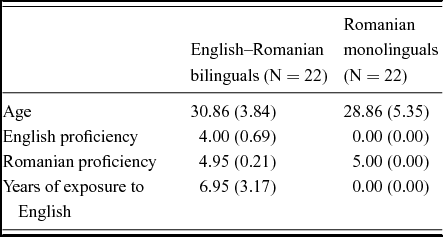
Twenty four Romanian–English bilingual undergraduate, graduate, and post-doctoral students were recruited by advertising at International Student Centers at several universities in the Los Angeles area. Bilingual participants completed a language history questionnaire in which they estimated their daily usage of Romanian and English, reported the number of years of exposure to English as a second language, and rated their language proficiency in Romanian and English on a scale from 1 to 5, with 1 being ‘little knowledge’ and 5 being ‘like a native speaker’. Only participants with medium to high (3 to 5) levels of proficiency in English and Romanian were selected for this study. Table 1 summarizes participants’ language proficiency characteristics. Twenty-two Romanian monolingual undergraduate, graduate, and post-doctoral students were recruited from University of Bucharest (Romania) as a control group for testing the physical aspects of typingFootnote 1. We reasoned that, if there is no cross-language influence, the stage or sequence of stages that follow after initiation of typing would be similar regardless of whether the word was just translated (as in bilinguals) or just read (as in monolinguals). Therefore, comparing the orthographic execution time for cognates and noncognates within monolinguals and within bilinguals will reveal effects attributable to bilingualism and cross-language influences.
Means (Standard Deviations) of Self-Reported Age, LI and L2 Proficiency Levels, Years of Continuous Exposure to L2 in the US.

Note: Proficiency ratings are on 0 – 5 scale, where 0 indicates “no proficiency” and 5 indicates “native proficiency”. Proficiency values represent the average of the participants’ responses.
Materials
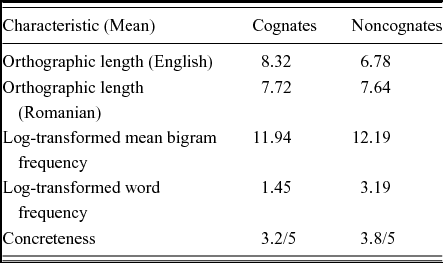
A Windows XP Intel Pentium laptop computer was used for the experiment. One hundred and twenty English words were used as stimuli, including 60 Romanian–English cognates with similar meaning and form and 60 noncognates with similar meanings but different forms in the two languages. An additional set of 15 words of each type served as practice items. Item characteristics that are known to be prognostic of lexical or orthographic latency (word frequency, concreteness, orthographic length, letter bigram frequency) were fitted in the linear regression model as covariate predictors. Word frequencies were obtained from SUBTL Word Frequency (Brysbaert & New, Reference Brysbaert and New2009). Concreteness was obtained from a list based on ratings of 40,000 words (Brysbaert, Warriner & Kuperman, Reference Brysbaert, Warriner and Kuperman2014). Log-transformed letter bigram frequency counts based on a corpus of 183 million words were obtained from Jones and Mewhort (Reference Jones and Mewhort2004). Item characteristics are provided in Table 2, and the complete set of experimental words is provided in Appendix A.
Characteristics of the Materials Used.

To reduce any other potential nonequivalence between the two sets of words, we created three randomized lists, each composed of 20 cognates and 20 noncognates. For bilinguals, the assignment of lists to experimental conditions was counterbalanced across participants, with the order of conditions the same for all participants (i.e., Condition 1 was presented first, followed by Conditions 2 and 3). We controlled for repetition effects by counterbalancing the lists across conditions; that is, participants who received a certain list in Condition 1 did not receive the same list in Condition 2 or 3. We also reasoned that counterbalancing reduced possible effects of fatigue towards the end of the experiment, which could affect latencies. For monolinguals, three random subgroups of participants were created. Because stimuli from each of the three lists were presented just visually, only list order was counterbalanced across subgroups of participants.
Procedure
Participants were tested individually in a quiet room. They were seated in front of a computer monitor and received verbal instructions at the beginning of each condition. Bilinguals were informed that their task was to type the first letter of the Romanian translation for condition 1, and to type the entire Romanian translation for conditions 2 and 3. Monolinguals were informed that their task was to type the Romanian word that had just been presented on the screen. The other instructions for monolinguals were identical to those given to bilinguals. Before the onset of each stimulus, the word “READY” appeared in the center of the computer monitor, and words were presented one at a time. Participants responded using the keyboard, and letters appeared on the computer screen as they were typed. The English stimulus word disappeared as soon as the participants began typing the Romanian response. Participants were instructed to correct any spelling errors (using the backspace key). They were instructed to perform as quickly and accurately as possible, and to press Enter at the completion of each response word. To proceed to the next stimulus, they were instructed to press Enter a second time. If the participants did not know the response, they were instructed to press Enter and go to the next stimulus. Each condition began with 10 practice trials, followed by the block of 40 experimental words. There were no pauses between conditions, and the entire experiment lasted approximately 15 minutes. For both groups of participants, Presentation software was used for stimulus delivery and timing. Two latencies were recorded in milliseconds: 1) from onset of the stimulus to the first key press (lexical latency) and 2) from first key press to press of the Enter key, signaling completion of the response (orthographic latency). Errors and self-corrections were also recorded; latencies on trials that contained errors were not used in analyses.
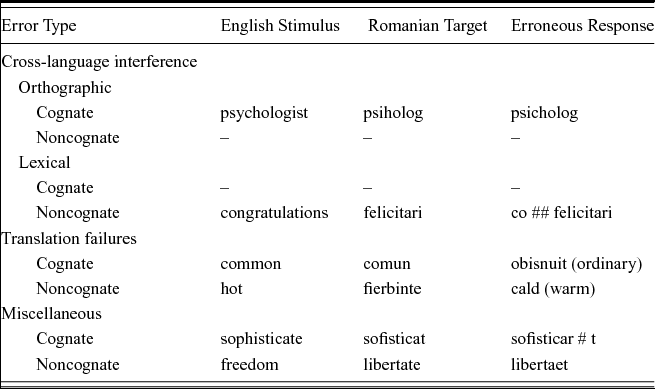
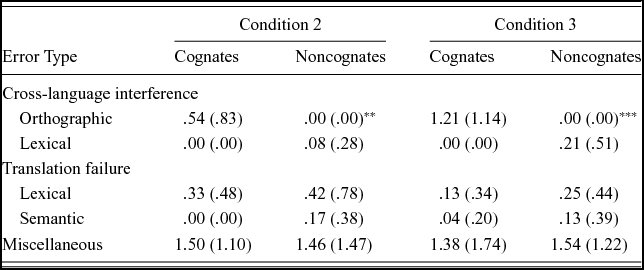
As shown in Table 3, bilinguals made four types of errors: 1. Cross-language orthographic interference errors were intrusions from the nonresponse language (e.g., for the English stimulus word psychologist, the response psicholog – instead of the correct Romanian translation psiholog – contained a c intrusion from English). 2. Cross-language lexical interference errors were translation failures (e.g., the English stimulus chair – scaun in Romanian – was began in English and self-corrected, as cha ### scaun). 3. Translation failure errors were inaccurate translations or translations of words closely related to the stimulus word (e.g., the English stimulus hot elicited a translation for warm – cald in Romanian – instead of the more accurate fierbinte). These errors suggest that the entire lexical representation was momentarily affected by the stimulus word. 4. Miscellaneous errors were errors that were, apparently, due to typing mistakes. Frequencies of each error type were tallied. Error types 1 and 2 reflect failures of language-selection. Error type 3 reflects lexical or semantic confusion within L2.
Examples of Errors by Error Type and Cognate Status.

Note: # indicates corrections using the backspace key.
Results
Data trimming
Only latencies for correct responses were included in analyses. In addition, response latencies three standard deviations above a participant's mean on any word were considered outliers and eliminated from the analysis.
Latency analyses
The effects of cognate status (cognateness) and experimental condition on lexical and orthographic latency were examined with linear mixed-effects regression models with participant and item as random factors. Several item characteristics that were not matched at selection but are known to be prognostic of lexical latency or orthographic latency were added to the model as covariates: word frequency, semantic concreteness, orthographic length, and letter bigram frequency. Word and letter-bigram frequencies were log-transformed to reduce skewness of their distributions. Preliminary correlation analyses were performed to determine potential collinearity of covariates. All correlations were nonsignificant; therefore, no further residualizing was necessary for dealing with collinearity.
Lexical latency, bilinguals
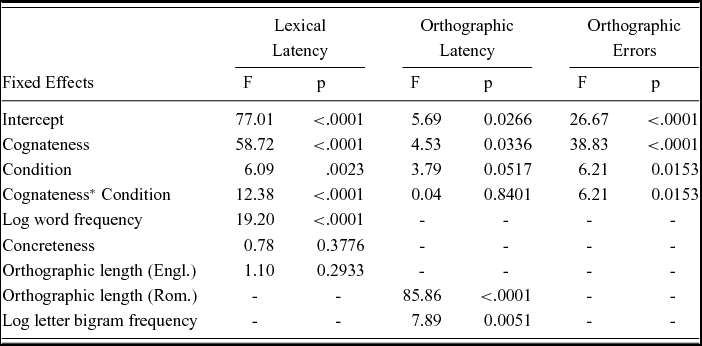
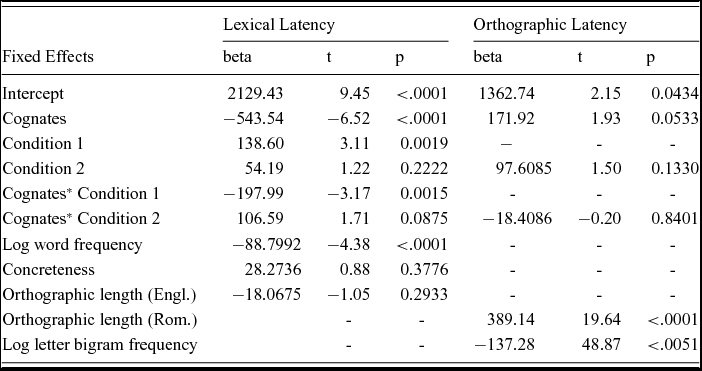
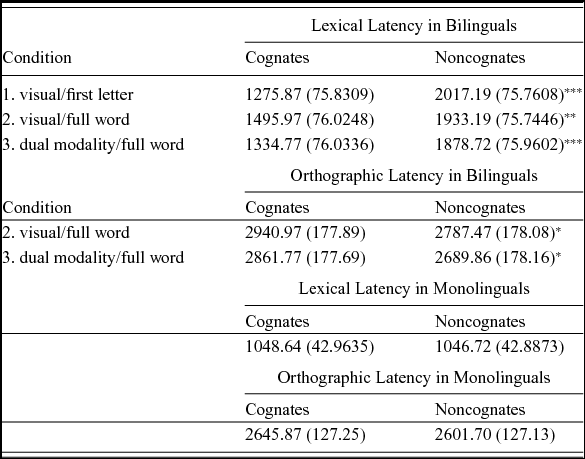
The fixed effects and the results of the main model are summarized in Tables 4a and 4b, and the outcomes of subsequently performed analyses are reported below. Estimated mean latencies for correct responses to cognates and noncognates by condition are based on the main model and are shown in Table 5.
Fixed Effects of Significant Predictors in the Linear Mixed-Effects Regression Model for Lexical Latency, Orthographic Latency, and Orthographic Errors in Bilinguals.

Beta Coefficients, t-values, and p-values for Fixed Effects of Significant Predictors in the Linear Mixed-Effects Regression Model for Lexical Latency and Orthographic Latency in Bilinguals.

Note: Condition 3 is the reference level.
Mean Estimated Latencies (msec) and Standard Errors by Condition and Word Type in Bilinguals, and by Word Type in Monolinguals.

*p < .05. **p < .01. ***p < .001.
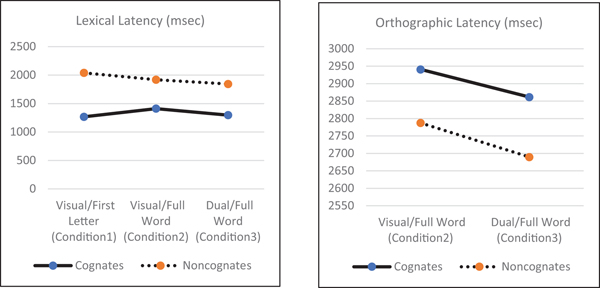
The regression analysis revealed that the estimated mean lexical latency for cognates was shorter than for noncognates for all three conditions, F(1, 2161) = 58.72, p < 0.0001 (see Figure 1). However, the interaction between condition and cognateness was also significant, F(2, 2161) = 12.38, p < 0.0001. Post hoc tests showed that, for cognates, estimated mean lexical latency for Condition 1 was shorter than lexical latency for both Condition 2, F(1, 701) = 47.23, p < 0.0001 and Condition 3, F(1, 701) = 5.24, p = 0.02. No significant difference between conditions 2 and 3 was found. For noncognates, no differences between conditions 1, 2, and 3 were found. After removing stimuli that started with the same phoneme but not with the same letter in L1 and L2 (e.g., farmacie vs. pharmacy), the overall estimated difference between cognates and noncognates increased by 29.15 msec, with other simple, main, and interaction effects remaining unaffected.
Mean Estimated Latencies by Word Type and Condition in Bilinguals.

Lexical latency, monolinguals
Estimated mean latencies for monolinguals by word type are shown in Table 5. The model included fixed effects for cognateness, list, the interaction between cognateness and list, and orthographic length. The analysis revealed that across the three lists, the estimated mean lexical latency for cognates was not different from noncognates, F(1, 2265) = 0.13, p = 0.99, and the interaction between list and cognateness was not significant, F(2, 2265) = 0.8, p = 0.46.
Orthographic latency, bilinguals
Orthographic latencies were recorded only for Conditions 2 and 3 because the participants were not asked to type the entire word in Condition 1. The fixed effects and the results of the main model are summarized in Tables 4a and 4b, and the outcomes of subsequently performed analyses are reported below. Estimated mean latencies by word type and condition are shown in Table 5. The analysis revealed that the mean orthographic latency for cognates was longer than for noncognates for both conditions, F(1, 1198) = 4.53, p = 0.03 (see Figure 1). There was no main effect of experimental condition, F(1,1198) = 3.79, p = 0.052, and no interaction between cognateness and experimental condition F(1, 1198) = 0.04, p = 0.84. After removing the non-significant effects (i.e., experimental condition and the interaction between experimental condition and cognateness), the main effect of cognateness remained significant, F(1, 1201) = 4.44, p = 0.03.
Orthographic latency, monolinguals
Estimated mean latencies by word type are shown in Table 5. The model included fixed effects for cognateness, list, and orthographic length. The regression analysis revealed that the estimated mean lexical latency for cognates was not different from noncognates, F(1, 2112) = 0.90, p = 0.34, and the interaction between list and cognateness was not significant F(2, 212) = 1.77, p = 0.17.
Error frequency analysis
Orthographic errors were recorded only for Conditions 2 and 3. Mean frequencies of all error types were calculated as percentages of 60 cognate and 60 noncognate words (see Table 6).
Mean (SD) Percentages of Error Types by Condition and Word Type in Bilinguals.

**p < 0.01. ***p < 0.001.
The effects of cognateness and experimental condition on orthographic errors were examined with generalized linear mixed-effects regression models with logistic link function. The model included fixed effects for cognateness, experimental condition, and the interaction between cognateness and experimental condition. The analysis revealed more orthographic errors for cognates than for noncognates in Condition 2, F(1, 21) = 26.38, p < 0.001, and in Condition 3, F(1, 21) = 8.89, p = 0.007. No significant differences between cognates and noncognates were found for lexical interference errors, translation failure errors, or miscellaneous errors. In monolinguals, the analysis revealed no difference between the mean number of errors for cognates and noncognates.
Discussion
We examined the mechanism of language-selection in bilinguals by investigating lexical and sublexical processing in an L2-to-L1 translation typewriting task. Our goal was to create conditions that would lead to cognate facilitation and cognate interference, to identify points in the production process at which the two phenomena manifest, and to draw inferences about the mechanisms that allow them to occur. We found that facilitation and interference operated serially, in this order, during retrieval and production. That is, the two phenomena occurred at distinct stages (i.e., lexical vs. orthographic), and different factors determined whether the language-selection mechanism succeeded or failed at a particular stage. Based on the observed order of events (facilitation first, then interference), we infer that the process of language-selection is not a one-time event, and selection at one stage does not imply selectivity at subsequent stages. A bilingual production model that allows multiple selection processes at multiple loci of selection, during the same retrieval attempt, can accommodate this phenomenon.
Facilitation in the production of orthographic translations
Our results show that lexical latencies for cognates were shorter than for noncognates, which is consistent with earlier findings for picture naming, lexical decision, and translation tasks (Costa et al., Reference Costa, Caramazza and Sebastian-Galles2000; De Groot, Reference De Groot, Schreuder and Weltens1993; Dijkstra et al., Reference Dijkstra, Miwa, Brummelhuis and Baayen2010; Gollan & Acenas, Reference Gollan and Acenas2004; Kroll & De Groot, Reference Kroll, De Groot, De Groot and Kroll1997; Kroll & Stewart, Reference Kroll and Stewart1994; Macizo & Bajo, Reference Macizo and Bajo2006; Schwartz et al., Reference Schwartz, Kroll and Diaz2007). As these researchers explain, facilitated selection of cognates is due to cumulated feedback activation from overlapping sublexical (orthographic and phonological) nodes in L1 and L2.
Further, we compared lexical retrieval times for Condition 1 (first letter) and Conditions 2 and 3 (full word). For cognates, we found significant differences in lexical latencies between Condition 1 and Conditions 2 and 3, suggesting that when the task requires production of the full word, the response is delayed. Such differences were not found for noncognates. Also, after removing stimuli that started with the same phoneme but not with the same letter in L1 and L2 (e.g., farmacie vs. pharmacy), overall lexical latency for cognates relative to noncognates decreased even more, suggesting that dual orthography/ similar phonology correspondence (e.g., f vs. ph) right at the beginning of the word required resolution time before participants initiated the response. These results are consistent with Bonin et al.’s (Reference Bonin, Peereman and Fayol2001) proposal for monolinguals that participants initiate writing as soon as the first letter of the lexical item becomes available for output (see also Sadat, Martin, Costa & Alario, Reference Sadat, Martin, Costa and Alario2014), but onset of writing is delayed when phonological-orthographic inconsistencies occur at the beginning (although not when inconsistencies occur in the middle or final parts) of the word. This may be true especially for cognates because, by their nature, they are susceptible to rushed onset, sometimes before ensuring that all sublexical items of the target are available and orderly prepared in an orthographic loop. In sum, our results suggest facilitative effect of cognates on lexical retrieval but also possible effect of phoneme competition during response preparation
Alternatively, a factor that has an impact on lexical latency is the number of translation equivalents. Research shows that words with more than one translation are translated more slowly than words with only one translation (Schaeffer, Dragsted, Hvelplund, Balling & Carl, Reference Schaeffer, Dragsted, Hvelplund, Balling, Carl, Carl, Bangalore and Schaeffer2016; Tokowicz & Kroll, Reference Tokowicz and Kroll2007), and noncognate words are translated more slowly than cognate words (Macizo & Bajo, Reference Macizo and Bajo2006). Although responses that did not match our intended target were eliminated from the analysis, we do not exclude the possibility that the number of translation alternatives may have increased lexical latency for noncognates in our task, and also account for the difference in lexical latencies. Indeed, for cognates, there is total semantic overlap (De Groot & Nas, Reference De Groot and Nas1991) with, usually, one-on-one correspondence between lexical equivalents in the two languages. Also, cognate status is a valid cue that usually alerts participants to the expected response word – thus, alternatives are less likely searched for cognates; but see Balling (Reference Balling2013) for situations in which cognates can elicit non-cognate translationsFootnote 2. Therefore, the cognate advantage in lexical latency could be taken as a noncognate delay rather than as cognate facilitation. In support of this interpretation, in a picture naming task, Sadat et al. (Reference Sadat, Martin, Magnuson, Alario and Costa2016) found bilingual inhibition for noncognates rather than facilitation for cognates. As the authors explained, cognates resemble one another in the two languages, and a strong cue to the intended target is naturally provided for cognates, making their translation less susceptible to alternatives and more easily accomplished.
Nevertheless, we note that faster response time for cognates at response-onset (i.e., faster lexical latency) has been demonstrated in numerous experiments and it was not the primary focus of this study. We measured lexical latency to contrast it with orthographic latency in order to demonstrate that a cognate advantage at the lexical level is not necessarily preserved when the orthographic level is traversed.
Interference in the production of written translations
As hypothesized, latencies for full orthographic production were significantly longer for cognates, and error analysis revealed significantly more orthographic interference errors for cognates than for noncognates. In our experiment, cognates were affected by cross-language intrusions rather than by motoric miscoordination of the target letters, suggesting that the problem might have arisen at the orthographic selection of the target letters, not at the level of motor-planning. As others have argued, dual mapping between orthographic nodes common in L1/L2 with phonological nodes dissonant L1/L2 creates confusion, slowing realization of letters as typing of a word progresses (Dijkstra et al., Reference Dijkstra, Grainger and Van Heuven1999; Dijkstra & Van Heuven, Reference Dijkstra and Van Heuven2002; Doctor & Klein, Reference Doctor, Klein and Harris1992; Schwartz et al., Reference Schwartz, Kroll and Diaz2007). Further, the absence of a cognate effect among Romanian monolinguals suggests that the effect observed in bilinguals is attributable to the bilingual task's complex processing demands and not simply to differential effects of typing cognates versus noncognates.
To illustrate the possible mechanism of non-target intrusions due to orthographic-phonological conflict and language-selection impediment at the sublexical level, we provide an example of a participant's error. One participant typed the English sequence cellu instead of the target Romanian sequence celu. (The orthographic error was immediately followed by self-correction, and continuation of typing the remaining graphemes.) For the pair of words (cellular /ˈsel-iə-lə:/ vs. celular /  -lu-lɑr/), the orthographic sequence of the first three letters is identical in the two languages; however, pronunciation of cel is different in English and Romanian. (Cel in Romanian is pronounced like cel in the English word cello.) Within the present framework, the shared orthographic fragment in L1 and L2 (i.e., cel) may have initiated feed-forward activation to the language-specific phonologies of English and Romanian, followed by feed-back activation from the two phonologies to the remaining orthographic sequences (i.e., _ular in Romanian and _lular in English). A brief slip of the language-selection mechanism may have allowed insertion of a second l, part of the unintended sequence _lular, which is correct in English but incorrect in Romanian.
The study design allowed us to also assess whether the phonological nodes of the nontarget word were activated automatically when words were just visually presented. Comparing orthographic latencies in Condition 2 (visual modality/full word) and Condition 3 (visual and auditory modalities/full word), results showed that the orthographic interference effect (e.g., errors or delays in typing) was similar even in the soundless task, suggesting that phonology of the nontarget word was automatically activated by mere visual perception of orthographic segments, without overt phonological stimulation.
Implications for models of bilingual language processing
Our results support a model of cognate processing that incorporates cumulative activation with interactive feedback between lexical and sublexical representations as well as among sublexical representations of L1 and L2. During orthographic production, the sequence is realized letter-by-letter through sound-letter mapping. According to interactive models (MacKay, Reference MacKay1987; Van Orden & Goldinger, Reference Van Orden and Goldinger1994), a sufficient number of overlapping sublexical (orthographic and/or phonological) units from both languages cumulate their activation and boost lexical retrieval of cognates through bottom up connections. However, if orthographic units shared by L1 and L2 receive input from dissonant L1-L2 phonologies, conflict generated by dual phonology-orthography routes may disturb production.
An alternative, but not mutually exclusive, explanation for opposite results at the lexical vs. sublexical level could be that overlapping sublexical nodes received augmented cross-language activation, whereas nonoverlapping nodes received too little activation to enable accurate and complete unfolding of the word. To illustrate this mechanism, we provide another example of a participant's error. In response to the English stimulus frequent (= frecvent in Romanian), one participant typed the sequence frecu instead of the target sequence frecv. (The orthographic error was immediately followed by self-correction.) For this pair of words, the orthographic sequences of the first three (i.e., fre) and the last three letters (i.e., ent) are identical in English and Romanian, but the sequences of the middle two letters are different (qu in English vs. cv in Romanian). According to this framework, the shared letters were immediately produced due to cumulative activation and easy access, whereas the language specific letters were prone to weaker activation. Consequently, the participant typed the letter u, which is correct in English but incorrect in the target Romanian. The explanation that overlapping nodes receive sufficient activation to provide a strong basis for lexical retrieval (feeling of knowing the word), whereas nonoverlapping nodes are less activated and perhaps more vulnerable to cross-linguistic interference is in line with the transmission deficit hypothesis formulated for monolinguals (Burke et al., Reference Burke, MacKay, Worthley and Wade1991) and the frequency-lag /weaker links hypothesis formulated for bilinguals (Gollan & Acenas, Reference Gollan and Acenas2004; Gollan, Montoya, Cera & Sandoval, Reference Gollan, Montoya, Cera and Sandoval2008; Gollan, Slattery, Goldenberg, Van Assche, Duyck & Rayner, Reference Gollan, Slattery, Goldenberg, Van Assche, Duyck and Rayner2011; Li, Goldrick & Gollan, Reference Li, Goldrick and Gollan2017).
Conclusion
The pattern of findings raises a larger question: namely, why might language-selection succeed at the lexical level and then become vulnerable at the sublexical level? A task like the one used here that requires translation to L1 is set up for language selectivity at the lexical level because the word to be translated is presented, and participants are cued to respond, in the dominant languageFootnote 3. As Jared and Kroll (Reference Jared and Kroll2001) explained, when bilinguals respond exclusively in their dominant language, they might be able to quickly inhibit any competing information from the nontarget language and still benefit from dual activation of overlapping elements, showing facilitation at the lexical level. Nevertheless, sublexical (e.g., orthographic) retrieval and production is a more highly specified process, whose completion requires realization of every segment of the word, allowing more time for competing information at the sublexical level to intrude and perturb the selection process. Errors like psicholog reflect competition between the subtly different psychologist in English and psiholog in Romanian, and reveal the difficulty of selecting between two active representations. In our task, nontarget phonology of cognates may have been maintained at a high level of activation (or constantly reactivated) by overlapping L1 and L2 orthographic segments that were accessed sequentially, sending obstructive feedback as participants attempted to type the target word. In other words, in online execution of each orthographic segment, conflict might not be easily resolved if the selection mechanism does not constantly monitor activated orthographic segments that are intruding from the nontarget language throughout the process. If, at any point, the selection mechanism ‘relaxes’, manifestations of cross-language interference are observed.
It could also be argued that, in the present study, cross-language activation of orthographic nodes was a direct consequence of the task rather than automatic non-selectivity at the sublexical level. This is not to say that dual activation followed by language non-selectivity may not be characteristic of other types of tasks as well. If our results are replicated, for example, in total absence of orthographic cueing (e.g., if pictures rather than words were presented), then we could conclude that cross-language orthographic activation is automatic, and that the phenomenon of orthographic interference has nothing to do with overt exposure to alternative orthography. Such experimental variants will help us draw more accurate conclusions about the processes involved in writing translated words.
In summary, our experiment demonstrated both facilitation and interference in retrieval and production of cognates and suggests that the language-selection mechanism operated successfully at the lexical level but was later challenged at the sublexical level. Activation of overlapping sublexical nodes of cognates assisted as well impeded their production, and these different processes, reflected in lexical facilitation vs. orthographic interference, occurred at different levels of the linguistic architecture. Moreover, we found evidence that orthographic interference can occur after facilitation and selection at the lexical level, suggesting that an initial selection mechanism does not have an irreversible effect (Muscalu, Reference Muscalu2007). That is, our results suggest that language-selection is not a unique, permanent event that, once initiated at a certain level, propagates language-selectivity to subsequent linguistic levels. Competition at the sublexical level observed in this experiment shows that even when language-selection succeeds at initial lexical retrieval, it can subsequently slip when full orthographic realization of a lexical item is required by the taskFootnote 4. Thus, our results suggest a bilingual system characterized by language nonselectivity (even when responding in L1), with a selection mechanism that succeeds or slips, depending on factors that accompany transitioning through a particular level of the linguistic architecture. This phenomenon can be accommodated by a model of language production that allows for multiple selection processes and multiple loci of selection, perhaps one at each level of processing. Our results also suggest that fine-grained linear and temporal tracking of each grapheme should be considered in the methodology of future studies.
Appendix
Experimental Words.