Introduction
Venous thromboembolism (VTE) is a common disorder affecting nearly one in 1,000 adults annually and accounting for substantial mortality (Oger, Reference Oger2000). It is also one of the main causes of morbidity and mortality in hospitalized patients (Oger, Reference Oger2000; Agnelli, Reference Agnelli2004). Surgical, and particularly orthopedic, patients are at high risk of VTE, and VTE prophylaxis is routinely used in this group (Agnelli, Reference Agnelli2004). For hospitalized medical patients, guidelines produced by The Australia and New Zealand Working Party on Management and Prevention of VTE (2005) recommend prophylaxis for those in high-risk category based on the following risk factors – age greater than 60 years, acute ischemic stroke, history of VTE, active cancer, decompensated heart failure, acute on chronic lung disease, and acute on chronic inflammatory disease. Other risk factors relevant to older patients include prolonged immobilization, trauma, obesity, and varicose veins. Combinations of these risk factors often exist in hospitalized patients, further increasing VTE risk (Rosendaal, Reference Rosendaal1999; Alhenc-Gelas et al., Reference Alhenc-Gelas, Aiach and de Moerloose2001).
Although many of the listed acute medical VTE risk factors are absent in psychogeriatric in-patients, many of the chronic factors are present, and previous studies have shown VTE risk is moderately increased in psychiatric patients compared to the general population (Vandenbroucke et al., Reference Vandenbroucke1998; Thomassen et al., Reference Thomassen, Vandenbroucke and Rosendaal2001). A Danish register study of 25,834 patients and 117,815 controls found significantly increased occurrence of PE in patients with bipolar disorder (incidence rate ratio (IRR) = 1.61; 95% CI (1.38, 1.88)). An association was also found in schizophrenic (IRR = 1.78; 95% CI (1.27, 2.51)) and anxiety patients (IRR = 1.49; 95% CI (1.10, 2.02)) (Strudsholm et al., Reference Strudsholm, Johannessen, Foldager and Munk-Jorgensen2005).
Several studies also indicate that medications used in treatment of psychiatric disorders may cause, or at least contribute, to this increased VTE risk, although the results are conflicting (Hägg et al., Reference Hägg, Spigset and Soderstrom2000; Zornberg and Jick, Reference Zornberg and Jick2000; Parkin et al., Reference Parkin, Skegg, Herbison and Paul2003; Waage and Gedde-Dahl, Reference Waage and Gedde-Dahl2003; Liperoti et al., Reference Liperoti, Pedone, Lapane, Mor, Bernabei and Gambassi2005; Ray et al., Reference Ray, Mamdani and Yeo2002; Parker et al., Reference Parker, Coupland and Hippisley-Cox2010). A nested case-control study (Zornberg and Jick, Reference Zornberg and Jick2000), from a database of 29,952 recipients of antipsychotic drugs, found that current exposure to conventional antipsychotic agents was associated with increased risk of idiopathic VTE compared with non-use in patients less than 60 years of age (adjusted OR = 7.1; 95% CI = 2.3–21.97). The use of low potency antipsychotic drugs, such as chlorpromazine and thioridazine, was more strongly associated with VTE (OR = 24.1; CI = 3.3–172.7) than high-potency drugs such as haloperidol (OR = 3.3; CI = 0.8–13.2) when compared to non-users. Risk was highest during first few months of conventional antipsychotic drug use.
The use of modern, atypical antipsychotic agents, such as clozapine and olanzapine, has also been associated with increased VTE risk in case and registry studies, often in patients without a preceding history or conventional risk factors for VTE (Hägg et al., Reference Hägg, Spigset and Soderstrom2000; Waage and Gedde-Dahl, Reference Waage and Gedde-Dahl2003). A retrospective cohort study of nursing home residents, 19,940 new users of antipsychotic agents and 112,078 non-users, found rate of hospitalization for VTE was significantly increased for users of atypical antipsychotic agents (clozapine, risperidone, olanzapine) when compared with non-users. However, it found no increased hospitalization for VTE with phenothiazines and other conventional agents (Liperoti et al., Reference Liperoti, Pedone, Lapane, Mor, Bernabei and Gambassi2005).
A nested case-control study, based on primary care clinical records of 115,000 people in United Kingdom, found an association between antipsychotic drug use and VTE risk (Parker et al., Reference Parker, Coupland and Hippisley-Cox2010). The increased risk was more marked among new users and those prescribed atypical antipsychotic drugs. The absolute risks, however, were low, with an excess of four cases of VTE per 10,000 patients (of all age groups) treated over one year, but rising to ten cases per 10,000 for patients aged 65 years and over.
However, another large population-based cohort study (Ray et al., Reference Ray, Mamdani and Yeo2002), established no association between the use of antipsychotic agents and VTE in patients aged 65 years or older, except for a slightly increased risk among users of butyrophenones.
While the majority of studies have looked at community-dwelling populations (Hägg et al., Reference Hägg, Spigset and Soderstrom2000; Parkin et al., Reference Parkin, Skegg, Herbison and Paul2003; Waage and Gedde-Dahl, Reference Waage and Gedde-Dahl2003; Liperoti et al., Reference Liperoti, Pedone, Lapane, Mor, Bernabei and Gambassi2005; Ray et al., Reference Ray, Mamdani and Yeo2002; Hägg et al., Reference Hägg, Jönsson and Spigset2009; Parker et al., Reference Parker, Coupland and Hippisley-Cox2010), there is a paucity of similar VTE data on in-patient psychiatric populations. Given that many of these patients have antipsychotic medications commenced or increased in hospital, and the potential for reduced physical activity and mobility levels in restricted in-patient settings (Radcliffe and Smith, Reference Radcliffe and Smith2007), this group might be expected to have a greater VTE risk.
While the evidence and guidelines for VTE risk assessment and prophylaxis in medical and surgical inpatients are well established both locally and internationally, currently there are no such guidelines for psychogeriatric in-patients. The only attempt to establish a formal VTE risk assessment for these patients in the literature was made by Malý et al. (Reference Malý, Masopust and Hosak2008). Although not prospectively validated, the authors proposed a scoring system for VTE risk in hospitalized psychiatric patients with reduced mobility, using evidence-based risk factors.
Therefore, in this retrospective audit, we have adapted the VTE risk scale derived by Malý et al. to document the incidence of, and risks for, VTE, and the use of VTE prophylaxis, in psychogeriatric in-patients at Bankstown Hospital, New South Wales, Australia.
Methods
We retrospectively reviewed medical notes and discharge summaries of consecutively admitted psychogeriatric inpatients aged 65 years or more, admitted to Bankstown Hospital from 01 January 2007 to 31 December 2009. Patients taking anticoagulation therapy prior to admission were excluded from this study. Data collected included patient's age, length of hospital stay, gender, psychiatric diagnosis, antipsychotic medications, VTE prophylaxis used (i.e. nothing, TEDS stockings alone, unfractionated heparin (UFH)/low molecular-weight heparin (LMWH), or TEDS stockings combined with UFH/LMWH), new documented diagnosis of VTE (deep vein thrombosis (DVT) or pulmonary embolism (PE)), and VTE risk score. The psychiatric conditions were subclassified as depression, behavioral disorders not otherwise specified, schizophrenia, dementia, and other psychiatric illnesses.
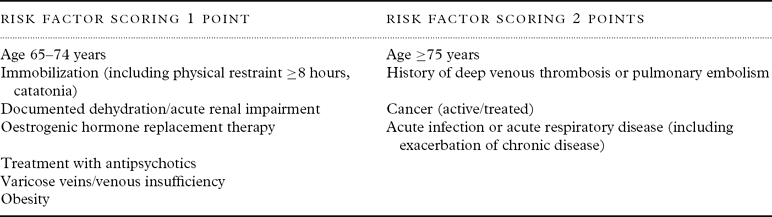
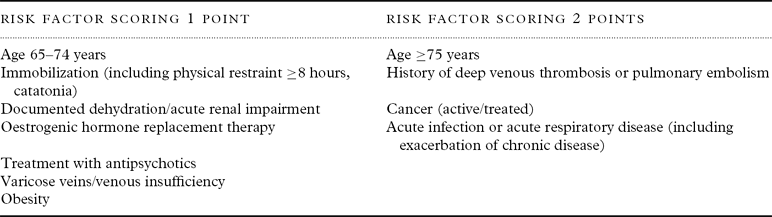
We adapted the scoring system of Malý et al. for VTE risk in hospitalized psychiatric patients (Table 1) to better represent a psychogeriatric population (Table 1) – oral contraceptive use was removed, as was thrombophilia (laboratory), which would rarely be checked in an elderly patient. The presence of acute renal failure was also added as a proxy for dehydration. Patients were assigned as low (score 0–3), medium (4–7), and high (≥8) risk for VTE as in the original scoring system.
VTE risk factor scoring for psychogeriatric in-patients
Data were analyzed using SPSS Statistics version 15.0.1 (SPSS Inc., Chicago, IL, USA). χ2 test was used to compare the differences between VTE occurrence in different categories of VTE risk and selected psychiatric diagnoses and use of antipsychotics. Unpaired independent sample t-tests were used to compare VTE risk scores between the group of patients with VTE and those who did not. Binary regression analyses were performed for the predictive risk of VTE. The factors selected were those that showed statistically significant differences between the VTE and non-VTE groups in the initial analyses (e.g. p < 0.1). Results were expressed as mean ± SD, percentage, and 95% CI. A difference was considered significant when p value was < 0.05.
Results
Two hundred and fifteen sets of notes of psychogeriatric patients admitted during the study period were examined. We excluded 18 patients due to use of anticoagulants preceding admission, and 5 who were under age 65 years, leaving 192 patients as part of the study. Mean age was 79.1 ± 7.0 years, and length of hospital stay was 24.8 ± 21.3 days (range 1–168). Among the patients, 59.9% were female and 40.1% male. The majority of patients had a psychiatric diagnosis of dementia (106/192, 55.2%) on presentation; followed by behavioral disorders not otherwise specified (78/192, 40.6%); depression (64, 33.3%); and schizophrenia (19, 9.9%). Most patients were admitted from home (46.9%), followed by nursing home (42.2%), and hostel (9.4%).
Based on the VTE risk scoring system outlined previously, 81.8% (157/192) were assessed as low risk, 18.2% (35/192) medium risk, and 0% high risk. Overall, 16.7% (32/192) received VTE prophylaxis in the form of LMWH or UFH alone, or with the addition of TED stockings. Of these, a significantly higher proportion of the recipients was in medium risk as opposed to low-risk category (28.6% vs. 14%, respectively, p = 0.037).
Overall, five patients (2.6%) had a VTE during admission (all DVT, no PE events). This equated to a VTE incidence of 10.5 per 10,000 patient-days (five new cases in 4,756 patient-days). Four events occurred in the medium-risk group (4/35; 11.4%), equating to a VTE incidence of 44.2 per 10,000 patient-days, and significantly higher than one event in the low-risk group (1/157; 0.6%, p = 0.004 for intergroup comparisons). Those who had a VTE event had a significantly higher risk score than those who did not (4.2 ± 1.3 vs. 2.89 ± 0.95, p = 0.03). With regards to the occurrence of VTE based on VTE prophylaxis status, three events occurred in the group that received no prophylaxis giving an incidence of 7.5 per 10,000 patient-days (three new cases in 4,001 patient-days). In the group that received VTE prophylaxis, the incidence was paradoxically higher at 26.5 per 10,000 patient-days (two new cases in 755 days).
Four of the five VTE positive patients had a diagnosis of depression and the other, schizophrenia. Depression was associated with significantly higher VTE occurrence (6.3% in those with the diagnosis vs. 0.8% in those without, p = 0.043), and dementia with a lower VTE occurrence (0% in those with the diagnosis vs. 5.8% in those without; p = 0.017). Overall, 79.7% (153/192) of patients were on antipsychotic medications (existing or newly prescribed treatments) during their stay, but there was no statistically significant difference between those who received antipsychotic medication compared to those who did not (2.6% vs. 2.6%, p = 1.00). Also, 83.0% (123/157) of patients receiving antipsychotic treatments were assessed as low risk for a VTE event.
Binary regression analyses were performed for the predictive risk of VTE. The factors selected were age, gender, length of hospital stay, psychiatric diagnoses, antipsychotic treatment, VTE prophylaxis, and VTE risk. Of these, only VTE risk was predictive of subsequent VTE event, with an RR of 6.02 (95% CI = 1.76–20.7, p = 0.004) for the occurrence of VTE with every one-point increment in the risk score.
Discussion
Most of our psychogeriatric in-patients (81.8%) were assessed to be at low risk of VTE with a small percentage at medium risk (18.2%) and none at high risk. They had a 2.6% risk of VTE events overall, with an event rate of 10.5 per 10,000 patient-days, similar to that documented in older patients with psychiatric illness in a primary care setting (Parker et al., Reference Parker, Coupland and Hippisley-Cox2010). However, four of the five VTE events occurred in those identified as medium risk (4/35, 11.4%) resulting in a higher event rate of 44.2 per 10,000 patient-days for this subgroup. This compares to an overall figure of 7.4 per 10,000 patient-days from Australian Hospital discharge data in 2008 (Access Economics, 2008).
In our study, the low rate of VTE prophylaxis use in the low-risk group therefore seems appropriate given the low rate of VTE. Although prophylaxis use was higher in the medium-risk group, nearly two out of three patients were left untreated. Although the group that received VTE prophylaxis had a higher VTE incidence of 26.5 per 10,000 patient-days compared to those who did not (7.5 per 10,000 patient-days), the numbers in the study are small, with only five VTEs occurring. Also, the study did not aim to analyze a treatment effect of VTE prophylaxis, but to examine VTE risk, risk assessment, and prophylaxis use.
As the VTE risk score was overwhelmingly predictive of VTE incidence, far outweighing other factors such as age, LOS, psychiatric diagnoses, and so forth, using the scoring system appears useful in identification of psychogeriatric in-patients at higher risk of VTE, and assisting in VTE prophylaxis decision making. Although none of our patients were assigned as high risk based on the scoring system, it seems logical that this could be extrapolated to such patients. Alternatively, it may be more appropriate, as in the Australia and New Zealand Working Party VTE risk assessment flowchart for hospitalized medical patients, to assign psychogeriatric in-patients as either low (score 0–3) or high risk (>3) only.
In our study, antipsychotic agents did not appear to affect the VTE event rate. VTE incidence was identical in those who received antipsychotic treatments and those who did not. This finding is in keeping with existing literature where the evidence is mixed (Vandenbroucke et al., Reference Vandenbroucke1998; Hägg et al., Reference Hägg, Spigset and Soderstrom2000; Zornberg and Jick, Reference Zornberg and Jick2000; Waage and Gedde-Dahl, Reference Waage and Gedde-Dahl2003; Strudsholm et al., Reference Strudsholm, Johannessen, Foldager and Munk-Jorgensen2005). The biological mechanisms involved in the pathogenesis of potential antipsychotic drug associated VTE risk are largely unknown, but several hypotheses have been suggested in the published studies (Hägg et al., Reference Hägg, Spigset and Soderstrom2000; Waage and Gedde-Dahl, Reference Waage and Gedde-Dahl2003; Liperoti et al., Reference Liperoti, Pedone, Lapane, Mor, Bernabei and Gambassi2005; Ray et al., Reference Ray, Mamdani and Yeo2002; Hägg et al., Reference Hägg, Jönsson and Spigset2009; Parker et al., Reference Parker, Coupland and Hippisley-Cox2010) such as drug-induced sedation, obesity, increased levels of antiphospholipid antibodies, enhanced platelet aggregation, hyperhomocysteinemia, and hyperprolactinemia. It has also been postulated that duration of antipsychotic use may affect VTE occurrence, but we were unable to further categorize our patients into antipsychotic naïve or experienced groups.
Patients with a diagnosis of dementia in our study did not have any VTE events, but those diagnosed with depression had a higher rate of VTE. Whether the latter relates to the use of antidepressant medications is unclear. A case-control study of fatal PE found an increased risk for current users of antidepressants when compared with non-users (OR = 4.9, 95% CI = 1.1–22.5) (Parkin et al., Reference Parkin, Skegg, Herbison and Paul2003), while no association was found between antidepressant drugs and VTE in adults aged 65 years and older (Ray et al., Reference Ray, Mamdani and Yeo2002). We postulate that differing levels of mobility and activity in patients with dementia and depression may contribute to their differing risks of VTE, with depressed patients less likely to ambulate compared to wandering or behaviorally disturbed patients with dementia.
The limitations of our study include its retrospective nature and that patient and event numbers were small. However, we were able to detect an at-risk group, so a prospective cohort study using this risk scoring system and with a larger sample size would be able to overcome these limitations. Consideration could also be given to the inclusion of the diagnosis of depression in the scoring system, given the association of an increased VTE risk with depression in our study.
Conclusion
Our study demonstrated evidence of increased VTE occurrence in psychogeriatric in-patients with medium VTE risk scores. We believe that this finding, in accordance with other related studies, suggests that VTE risk assessment and appropriate VTE prophylaxis should be considered for psychogeriatric in-patients with medium and high risk scores during their hospital admission.
Conflict of interest
None.
Description of authors’ roles
Dr Liu and Dr O'Rourke formulated the study idea and objectives. Dr Liu collected the data. Dr Liu and Dr Van Nguyen entered and analyzed the data. All authors were involved in writing and revising the paper.