Many governments have experienced that major institutional reforms are difficult to carry through. Reforms affect the distribution of political and economic benefits to the advantage of some and disadvantage of others (cf. Knight Reference Knight1992). Large scale reform programs therefore mobilize organized political groups, and especially those who stand to suffer concentrated losses have incentives to create political resistance against the reform government (cf. Wilson Reference Wilson and Wilson1980; Pierson Reference Pierson1994, Reference Pierson1996). This mobilization is often highlighted as a main reason why reform programs are either modified during the process or simply removed from the agenda (Immergut Reference Immergut, Steinmo, Thelen and Longstreth1992; Pierson Reference Pierson2000; Klitgaard Reference Klitgaard2008).
The story about institutional reforms that stall because of resistance from designated losers is, however, only partial. Significant and controversial institutional reforms are accomplished in as different contexts as authoritarian regimes in Latin America (Schmitter Reference Schmitter, Diamond and Plattner1996; O'Donnell Reference O'Donnell, Diamond and Plattner1996), former communist countries in Eastern Europe (Offe Reference Offe and Goodin1996), and advanced capitalist OECD economies (Scharpf and Schmidt Reference Scharpf and Schmidt2000). We claim that various reforms get accomplished because political changes ultimately are shaped and decided in processes of interaction between strategic actors, and because reform governments can adopt strategies to reduce resistance from oppositional groups. Thus, we suggest theoretically that deliberate and strategic organization of the decision making processes in which reforms are decided, may contribute to the success and failure of institutional reforms. We develop this argument with inspiration from Gibson and Goodin's (Reference Gibson, Goodin, Egeberg and Lægreid1999) idea about veils of vagueness in political decision making. Gibson and Goodin state that controversial reforms more often succeed if the cost-benefit profile of a reform proposal is masked by a veil of vague information to involved actors. If these actors receive only vague information about distributional consequences of the reform, potential losers only have weak incentives to develop oppositional strategies – in some cases they may in fact help create the necessary reform dynamic (Gibson and Goodin Reference Gibson, Goodin, Egeberg and Lægreid1999).
The argument is elaborated in the next section and subsequently applied in a paired and structured comparison of institutional reforms of local government structures and the labor market administration in Denmark. This particular case selection allows us to compare a set of positive cases (reform success) with a matched set of negative cases (reform failure). We hypothesize, and ultimately conclude, that reform success and failure correlate systematically with the degree to which the reform government deploys a veil of vagueness strategy. This conclusion finally raises a democratic discussion. We demonstrate how governments may increase their decision making capacity by deliberate organization of reform processes, but implicitly we also demonstrate that this is at the expense of civil society participation in such processes. This may ultimately cause a decline of trust in government since citizens not only react to the outcome of political decisions, but also to the way they are produced (cf. Levi and Stoker Reference Levi and Stoker2000).
The Controversial Politics of Institutional Reforms
According to Weaver and Rockman (Reference Weaver, Rockman, Weaver and Rockman1993: 6) governmental effectiveness can be assessed by measuring a set of governmental capabilities. One is the ability to impose losses on well-organized, powerful groups. This is a relevant measure, since governments often need to overcome opposition from organized groups to realize political programs. This is also why governments often experience reform programs caught in deadlocks. Institutional change is a difficult political branch because the incentive structures of actors affected by redistributive reforms often are asymmetric. Compared to groups who expect to benefit from reform, actors who expect to suffer losses can better overcome collective action problems and co-ordinate political activities to avoid losses being imposed on them (Olson Reference Olson1965; Wilson Reference Wilson1973; Kahneman and Tversky Reference Kahneman and Tversky1979). Institutional reforms become controversial in the first place because they typically involve a redistribution of costs and benefits. Besides mitigating collective action problems, institutions are weapons of coercion and structural means by which political winners pursue their own interests (Knight Reference Knight1992; Moe Reference Moe1990: 213). Institutions provide some but not other actors with institutionalized benefits, i.e. positions in the decision making process from where these actors can influence policy choices (Christiansen et al. Reference Christiansen, Nørgaard and Sidenius2004: 27), and reforms often affect the distribution of such positions.
The scholarly literature widely recognizes the difficulties of institutional reform, and a dominant explanation for reform failure is that reform proposals often need to pass multiple veto points in the decision making chain. This explanation is especially emphasized as a reason why reform proposals often stall in the American system of divided government (Weaver and Rockman Reference Weaver, Rockman, Weaver and Rockman1993; Steinmo and Watts Reference Steinmo and Watts1995; Klitgaard Reference Klitgaard2008). But parliamentarian regimes in Western Europe also experience divided government. Especially where proportional voting produces minority governments in which the executive is controlled by parties that controls less than a legislative majority (Laver and Shepsle Reference Laver and Shepsle1991: 250). In these systems the reform capacity of the executive is reduced due to veto players within the cabinet and/or in parliament (Immergut Reference Immergut, Steinmo, Thelen and Longstreth1992; Tsebelis Reference Tsebelis1995; Bonoli Reference Bonoli and Pierson2001; Strøm et al. Reference Strøm, Müller, Bergman, Strøm, Müller and Bergman2006: 716).
This explanation, however, cannot account for the variation in reform success and failure that can be observed between countries with an equal number of veto opportunities, or between policy areas in individual countries (cf. Klitgaard Reference Klitgaard2007). Such patterns may be produced by other variables often highlighted in the reform literature, such as the economic conditions under which reforms are pursued (cf. Scharpf and Schmidt Reference Scharpf and Schmidt2000; Keeler Reference Keeler1993; Vis and Kersbergen Reference Vis and van Kersbergen2007), by differing strengths of government (cf. Tsebelis Reference Tsebelis1995), differing government partisanships (Green-Pedersen Reference Green-Pedersen2001), or policy learning (cf. Jones et al. Reference Jones, Guthrie, Steane, Jones, Guthrie and Steane2001). In the same way as decision makers learn about the content of public sector reform in order to find out what works (cf. Jones et al. Reference Jones, Guthrie, Steane, Jones, Guthrie and Steane2001) decision makers may also learn about the reform processes in order to accomplish reforms. It is not the aim of this article to test the strengths and weaknesses of these traditional theories, which have all contributed explanatory power to the reform literature. We intend to test another explanation and therefore design the empirical study in such a way that the discussed alternative explanations can be treated as constants.
Decision Making Behind a Veil of Vagueness
It hardly comes as a surprise to reformers that controversial reform proposals are met by fierce resistance from members of parliament, lobbyists, NGOs, media campaigns, threats of legal sanctions etc. etc. When reform governments are confronted with such challenges they can increase the likelihood of reform success by deliberately organizing the process to control, for instance, the flow of information and who is in and who is out at what time in the process. According to a few examples from the literature it seems a promising theoretical path to follow. If, for example, conservative minority governments intend to reform labor market policy, their chance of social democratic support in parliament increases if they invite labor unions to negotiate on the proposal before it is presented to parliament (Christiansen and Nørgaard Reference Christiansen, Nørgaard, Christiansen and Togeby2003: Ch. 8). Another example is that bilateral negotiations between superpowers are more likely to lead to agreements if key negotiations occur at times when the parties are in the ‘mood’ for making agreements (Goodin Reference Goodin1988).
We develop and empirically investigate another argument postulating a causal relationship between the strategic control of information in reform processes and the final outcome. Since designated winners and losers have asymmetric incentives to engage in the process, reform governments most often meet more heavily organized resistance than support. We hypothesize that governments can increase the likelihood of reform success if they manage to organize the decision making process to take place behind a veil of vague information about the cost-benefit profile of the reform proposal. This argument to some extent resembles Weaver's (Reference Weaver1986) and Pierson's (Reference Pierson1994) ideas about blame avoidance strategies to succeed in welfare state retrenchment. The blame avoidance argument is, however, first and foremost about hiding controversial policy outcomes from the public, while the veil of vagueness argument is about facilitating outcomes from controversial processes.
The theoretical idea about the veil of vagueness was originally launched by Gibson and Goodin (Reference Gibson, Goodin, Egeberg and Lægreid1999: 358) and developed to account for processes of purposeful and deliberate intervention aimed either at establishing new institutional structures or at rearranging old ones. Gibson's and Goodin's model covers actors from rational choice institutionalism, i.e. calculating and self-interested actors, as well as actors from sociological institutionalism, i.e. rule and norm following actors. They argue, though, that a veil of vagueness perhaps most commonly is deployed in decision making situations for strategic and manipulative reasons (1999: 372), which is why we assume actors to be strategic and intentional, and to strive to maximize political and institutional benefits when they engage in processes of institutional change (cf. Moe Reference Moe1990; Knight Reference Knight1992).
Information is a critical resource in political decision making, which can be either shared or withheld for strategic purposes. Reform governments may reduce reform opposition through control of information (Gibson and Goodin Reference Gibson, Goodin, Egeberg and Lægreid1999). The strategy is to mask the overall cost-benefit profile of a proposal behind a veil of vague information until as late as possible in the decision making process. Actors who stand to suffer losses have incentives to organize resistance against the proposed reform, but only from the moment where such losses are identifiable. If this is difficult due to planned ambiguity and scarcity of information, the reform government can stimulate a process where reform is discussed at a rather general level. This requires the government to keep its own preferences and the details – of which some is probably not yet known – of the reform behind a veil of vague information as long as possible and, hence, to mask the consequential distribution of costs and benefits following from its implementation. In other words, a veil of vagueness prevents actors from knowing ahead of time what the outcome will be, who will be advantaged or disadvantaged by a reform, and stimulate consequently a reform discussion held in generalities and highlighting possible future benefits (Gibson and Goodin Reference Gibson, Goodin, Egeberg and Lægreid1999: 372).
The veil of vagueness idea is, altogether, constituted on a rather simple line of theoretical reasoning; information is a critical resource for political players and can for strategic reasons be allocated with different degrees of specification. To our knowledge the theory has not been further developed since it was launched some years ago, nor has it been the subject of systematic empirical investigation even if Gibson and Goodin provide some examples of its possible relevance. With this article we intend to make it the subject of a more systematic empirical analysis.
Methodology
We apply the theory of a supposed effect of using a veil of vagueness in decision making in matched comparisons of institutional reform processes in the local government structures and the labor market administration in Denmark. This allows us to maximize variation on the dependent variable since we can compare positive and negative cases. Positive and negative cases are distinguished by their score of the phenomenon of scholarly interest on the dependent variable. Positive cases are defined as successful institutional reforms imposing a loss of institutional benefits on organized groups. These are compared to negative cases, selected in accordance with the possibility principle holding that only cases in which the phenomenon of interest is a real possibility should be included as relevant control cases (Mahoney and Goertz Reference Mahoney and Goertz2004). We meet this principle by including negative cases where the government invested political resources in the reform project and demonstrated clear preferences for enacting a significant reform, but eventually failed.
Concerning institutional reforms in local government structures, we selected as the positive case the dismantlement of 14 independent counties with the right to levy taxes and a broad portfolio (Ministry of Interior and Health 2006: Ch. 3). In 2004 it was decided to replace the counties with five regions whose responsibility would be limited almost exclusively to operating the public health care system and would not have the right to collect taxes from their citizens. The dismantled counties were organized in the traditionally influential Association of County Councils (ACC) whose members lost a significant part of their administrative tasks, their economic independence and suffered a devastating loss of institutional benefits with this reform (Christiansen and Klitgaard Reference Christiansen and Klitgaard2008). Our corresponding negative case is the failed attempt to complete an almost similar, but less extensive, reform in the capital region of Copenhagen in 1996 (Recommendation 1307, 1995). After intense political negotiations, this reform proposal stalled, and local government structures in the capital area remained unchanged for 10 more years.
The unification of the Danish labor market administration constitutes the positive case in the area of labor market policy. In 2009 the government amalgamated the dual labor market administration into a coherent and unified system under municipal purview. This change imposed a significant loss of institutional benefits on The Confederation of Danish Employers (DA) and The Danish Confederation of Trade Unions (LO). Through a range of corporatist bodies DA and LO traditionally enjoyed strong influence on Danish labor market policy. These benefits were significantly reduced when the National Employment Service was dismantled and its policy tasks delegated to 98 city councils without traditions for corporatist decision making. The negative case is here constituted by an identical attempt to unify the dual labor market administration in 2004 (Ministry of Interior and Health 2004: 43ff.), but on this occasion the government had to give up its reform plan (Christiansen and Klitgaard Reference Christiansen and Klitgaard2008: Ch. 7).
The research design allows us, as mentioned, to assess the strength of the suggested hypothesis by comparing positive cases with closely matched negative ones (cf. Pierson and Skocpol Reference Pierson, Skocpol, Katznelson and Milner2002), as well as to treat the alternative variables discussed above as constants. First, the veto point argument is irrelevant since we compare reforms in one country within a time frame where the number of veto points is unchanged (cf. Immergut Reference Immergut, Steinmo, Thelen and Longstreth1992). Second, the periods covered by the cases (1994–1996 and 2004–2008) are characterized by largely similar economic conditions with a booming economy, balance of payment surplus, and public sector surplus, so differences in economic conditions can hardly explain differences in outcomes. Third, in all four cases the government is a minority coalition government depending on the support of at least one party outside the government and vulnerable to organized resistance since possible allies may serve as entries for oppositional groups. Even if the Liberal-Conservative minority government with its permanent support party, the Danish Peoples Party, in the latter period is stronger than the Social Democratic-led government of 1994–1996, government strength is an unlikely explanation, since the stronger government produced success and failure. This implies moreover a lack of correlation between the color of the government and the empirical pattern we set out to explain. The only explanation that so far cannot be ruled out is that of learning. In both areas the first reform attempt was a failure; the second a success. While it could hardly be otherwise, we will discuss the possible role of learning in the concluding section of the article.
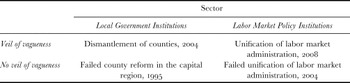
So far we explore the hypothesis that the government realized its reform proposals only when a veil of vagueness was deployed to overcome resistance from well-organized special interests, while it failed when such a veil was absent and governmental preferences early known by the special interests. In the empirical analysis we expect altogether to observe a pattern as the one shown in Table 1.
Success and failure in reforming local government and labor market policy institutions in Denmark

The key concepts in this article are vagueness and strategic allocation of information during decision making processes on institutional reforms. Regarding information, decision making processes consist of a supply side (the reform government) and a demand side (special interest groups) of equal importance to the analysis. The central questions related to the supply side are: When in the process does the government explicitly unveil the reform preferences? To what extent is the control of information used strategically to increase the chance of reform success? In relation to the demand side the central research questions are: When do organized interest groups know that they stand to suffer institutional losses? Do they have sufficient time to mobilize against the reform, or is the veil of vagueness replaced by clarity so late that it becomes impossible to mobilize sufficient opposition?
Our data material consists of public documents, non-public archives, and interviews with key politicians, public officials and interest group representatives.
Success and Failure in Reforming Local Government Institutions
How to Dismantle a Layer of Government
In August 2002 the Danish prime minister formed the Commission on Administrative Structure – consisting of four government officials, four municipal/county officials and four experts – to analyze the possibilities of a local government reform in Denmark (Christiansen and Klitgaard Reference Christiansen and Klitgaard2008: Ch. 3). Although a dismantlement of the counties was an element in the early reform debate, it was not a big concern to the Association of County Councils, ACC, which had heard the threat many times before. Two of the three parties behind the government – the Conservatives and the Danish People's Party – were hostile towards the counties, but the biggest government party, the Liberals, had a strong support base in municipalities and counties and was traditionally a defender of local autonomy.
The ACC representatives contributed positively to the commission's work, because it was seen as an opportunity to document that the counties addressed their tasks well. Leading ACC officials also recognized some arguments for shifting some administrative responsibilities to the municipalities as well as for amalgamation of counties to perform better in health care.
The ACC ended up quite satisfied with the commission's work upon its release in January 2004, because the report only discussed various models without making priorities among them. One model, the so called ‘county model’, implied a mere reduction in the number of counties without depriving them of tasks. When the Social Democrats, by all observers perceived as a veto player in the process, in January 2004 declared its preference for the ‘county model’, the counties looked into what they saw as a bright future.
The government's internal work on a reform proposal was initiated prior to the submission of the report. The proposal was prepared in a narrow group of top ministers, top civil servants, a top representative from the minority government's base of parliamentary support, the Danish People's Party, and the CEO of the powerful organization of Danish municipalities, Local Government Denmark (LGD) (Christiansen and Klitgaard Reference Christiansen and Klitgaard2008: 116). The opposition and representatives from other interest groups, including the ACC, were kept in ignorance and had no information about the government's intentions. The Minister of the Interior and Health met with the opposition parties several times, but he did not inform them about the government's plans. The ACC experienced an ‘iron curtain’ in its relations with the government, and it was impossible for the ACC to affect anything and anyone at all during the process.
It came as a bombshell to the opposition in parliament and to the ACC when the government on April 27, 2004 released a proposal to replace 14 counties with five health care regions without the right to levy taxes (cf. Box 1). The government proposal could hardly be more hostile to the opposition and the counties.

The center-left opposition and the ACC were outraged that the regional level of government was to be deprived of all functions but health care and the right to levy taxes, and that the administrative responsibility in the fields of social policy, planning and environmental policy would be shifted to the municipalities. The minister entered the expectedly difficult negotiations with the Social Democrats with confidence because right before the negotiations started, the Danish People's Party's top representative announced that he would show up only to find out where to put his signature on the government proposal (Christiansen and Klitgaard Reference Christiansen and Klitgaard2008: 121). The government had a secured majority before negotiations had even started.
Negotiations ran from early May to mid-June 2004, but a compromise with the Social Democrats was never reached. Consequently the local government reform finally rested upon a minimal winning coalition consisting of the government parties and the Danish People's Party. During the negotiations the ACC was completely cut off from any contact with the government – in contrast to its municipal counterpart, the LGD. Even if the government gave a few concessions, to be kept in the final agreement, there were only insignificant differences between the government's initial proposal and the final outcome. Consistent with the theoretical argument, the ACC did not have many chances to mobilize resistance. The government kept its detailed plans behind a veil of extremely vague information until the final stage of the process – a stage where the ACC could be treated as an irrelevant player.
Reform Failure in the Capital Region, 1995
Danish local government was reformed in the 1970s. About 1200 municipalities and 28 counties were amalgamated into 275 municipalities and 14 counties (Pallesen Reference Pallesen2004; Mouritzen Reference Mouritzen, Albæk, Eliason, Nørgaard and Schwartz2008). The main principle for the amalgamation reform was one city, one municipality, implemented throughout Denmark – except in the capital, Copenhagen. The governance structure in the capital area remained quite complicated: Two city municipalities, Copenhagen and Frederiksberg, were not part of a county but, contrary to all other Danish municipalities, counties and municipalities at the same time. The greater Copenhagen area was therefore split into 33 units: Two municipalities with special status, 28 ordinary municipalities and three counties. Thus, a number of transboundary problems, transportation, environmental planning, inter-hospital coordination etc., witnessed profound coordination problems. In 1974 the Greater Copenhagen Council was established to reduce these problems, but sufficient degrees of decision making power were not delegated to the Council. Consequently it had severe problems performing its coordinating role and it was ultimately abolished in 1989 (Bruun Reference Bruun and Sharpe1995; OECD 2009).
In 1994 the Social Democratic government found the time ripe for a thorough reform of the governance structure in the greater Copenhagen area. The government formed a commission consisting of top civil servants from five ministries to analyze ‘different potential models for a reform of the county structure and the provision of county services and facilities in the Copenhagen Metropolitan Area’ (Recommendation 1307/1995). The commission's report from January 1996 suggested two solutions. The first implied a merger of the three independent counties with the county responsibilities of the two inner-city municipalities as well as a transfer of some county responsibilities to the municipalities. The second was a limited version of the first with fewer responsibilities transferred from counties to municipalities and with two of the counties left out of the proposed new entity. Both proposals were rather simple, based on well known administrative structures, and easy to grasp for the public.
Neither proposal survived the decision making process (see Bruun Reference Bruun, Blom-Hansen, Bruun and Pallesen2002). Despite broad support for reform, it was not possible to create a majority for any proposal. The first model was countered by the ACC, who feared that the counties' administrative portfolio would be diminished. The second model was opposed by the county mayors from outside Copenhagen, because they feared that a strong metropolitan county would be too powerful, and the county mayor of Copenhagen County fought the abolition of the Copenhagen County. The Liberal Party – traditionally a strong player in municipal and county matters – was strongly against a large regional unit, and it was eventually blocked by a strong alliance of the ACC, the Liberal Party and some strong mayors.
The more limited reform model had better chances, but was also given up because of strong opposition from the mayors of Copenhagen and Frederiksberg municipalities, and a reluctant commitment from the two parties with the strongest stands in local and regional government, the Social Democrats and the Liberals. A disappointed minister of the interior concluded in March 1996 that the reform process had stopped because of resistance from ‘special interests’ (Politiken, March 15, 1996). Open and full deliberation did not benefit the reform entrepreneur in the county reform. All actors had plenty of information and time to calculate the consequences of the different reform proposals and to create sufficient coalitions to stop the government from realizing its plans.
Failure and Success in Reforming Labor Market Policy Institutions
Reform Failure in the Labor Market Administration, 2004
The Liberal-Conservative government that came to power in 2001 immediately signaled that the labor market administration was up for change. Danish labor market administration had been split in two for generations. The National Employment Service was a corporatist regulated state agency dominated by the Confederation of Danish Employers (DA) and the Danish Confederation of Trade Unions (LO). It provided employment service to unemployed persons covered by an unemployment insurance scheme. Employment service for uninsured, i.e. recipients of social payments was provided and administered by the municipalities. The organization of the labor market administration is a controversial political issue because unemployment funds are controlled by the unions and are instrumental to the high level of unionization (cf. Rothstein Reference Rothstein1992; Scruggs Reference Scruggs2002), and because the state part of the system leaves the DA and LO in extremely powerful positions.
DA and LO were well aware that discussions about the dual labor market administration could be part of the local government reform agenda formed in 2002. The government had a strong preference for a unified employment service run by local governments, while DA and LO on their side had an even stronger preference for a state-driven and corporatist regulated system because of the institutional benefits associated with this alternative. It is, ceteris paribus, easier to influence one ministry and one minister than 100 local governments and mayors.
The Commission on Administrative Structure – analyzing needs for a general local government reform – began its work by asking all ministries to analyze existing administrative structures and eventually formulate a few reform suggestions (Christiansen and Klitgaard Reference Christiansen and Klitgaard2008: Ch. 4). The Ministry of Employment's report was prepared in the National Labor Market Agency (AMS). The ministry asked the AMS to conclude that a unified and decentralized employment service would yield greater efficiency than a unified and centralized system.
DA and LO were not involved in the preparation of the report, but were informed about the conclusions before it was delivered to the commission. At the time, spring 2003, DA and LO decided to coordinate their strategy to prevent the government from realizing the labor market part of the reform. Both organizations invested considerable resources in the strategy, and they established contacts with civil servants and with all relevant political parties. Eventually they came up with their own proposal: a unified employment service with regional and local offices but – of course – controlled by a corporatist regulated state agency (DA et al. 2003: 3–4; Christiansen and Klitgaard Reference Christiansen and Klitgaard2008: 170).
Nevertheless, the commission recommended a unified employment service to be a municipal matter (Recommendation 1434, 2004, summary: 39). DA and the LO had forged a coalition with the Social Democrats against the government, which on its side was allied with the Danish People's Party and LGD (Christiansen and Klitgaard Reference Christiansen and Klitgaard2008: Ch. 7). When the government published its proposal for the local government reform in late April 2004, it implied a new unified employment service under municipal control, cf. Box 2.
The government's proposal for reform of the labor market administration

Source: Government (2004)
This was unacceptable to the DA, the LO, and the Social Democrats, but they were not surprised. Prior to the public presentation the minister of employment arranged two meetings with the Social Democratic labor market spokesman and presented the proposal to him. Since the labor market organizations were already alert it took little time until the DA and LO had mobilized to fight the government (the Social Democrats 2004; archival material). Negotiations with the opposition parties began a few hours after the announcement of the proposal. The DA and LO were closely involved as they coordinated closely with the Social Democratic negotiator and provided him assistance and support. The Social Democratic negotiator gave back detailed information to be used by the employer organization DA when it lobbied against the normally allied liberal and conservative government parties.
Strong, well organized, and co-ordinated pressure from the labor market organizations and the Social Democrats prompted the government to offer significant concessions. Although negotiations collapsed in mid-June, concessions were kept in the final agreement. Instead of a unified and decentralized employment service, the government established a system where state agencies were to cooperate with the municipalities on employment policy. The National Employment Service was kept under control of the central authorities and the corporatist structures were left intact (Christiansen and Klitgaard Reference Christiansen and Klitgaard2008: 182–3). In other words, the designated losers in the government's initial proposal managed to mobilize and thwart the government plans for a unified employment service. Early on, the organizations had detailed information on the government's preferences. A coordinated strategy against the government was developed and the interest groups found an important ally in the Social Democrats.
How to Dismantle a Labor Market Agency
Even if the government failed in creating a unified labor market administration, the reform implied major changes in the labor market administration. The state part and municipal part of the system were forced to work closer together and would physically be located together. The new labour market administration was implemented on January 1, 2007 together with the other parts of the local government reform. Contrary to what the government maintained (Government and Danish People's Party 2004) it was not simpler than the previous system and probably not more efficient. In combination with a strong desire to reduce the power of the DA and LO on labor market issues, this is probably why the government never gave up on the original preference for a unified municipal labor market administration.
During the 1990s it became quite common to enact large and controversial reforms in combination with the annual national budget negotiations (Loftager Reference Loftager2004). Budget negotiations are windows of opportunity which opens every year and a convenient arena for logrolling, because it is an arena controlled by the political elite. Interest groups and the media never get access to budget negotiations (Blom-Hansen and Laursen Reference Blom-Hansen, Laursen, Blom-Hansen and Daugbjerg1999). The outcomes of budget negotiations are normally presented as a fait accomplí to the public (Larsen and Andersen Reference Larsen and Goul Andersen2004).
In November 2008 the issue of unifying the dual labour market administration became part of the budget agreement between the government and the Danish People's Party (plus the new, small party Liberal Alliance), i.e. the same coalition that failed to realize an identical reform in 2004. Prior to the agreement and during negotiations the government did not even hint that this issue was up for discussion. The public as well as the opposition and the relevant and strongly affected interest groups were informed through a press release on November 10, 2008, which simply stated that from August 2009 the labour market administration would be a unified part of the municipal administration (Ministry of Finance 2008). The LO and DA protested together with other labour market organizations, accusing the government of breaking existing agreements. Even though the government was met by co-ordinated opposition (LO et al. 2009), the battle was lost for the DA and LO.
In 2008, four years after the failure in 2004, the government succeeded in unifying the dual labour market administration, and thus in imposing a concentrated loss of institutional benefits on the labour market organizations. Unlike the 2004 failure, the government used a strategy of strong information control. The veil of vagueness strategy on this occasion almost became a veil of silence. The decision came like a thief in the night and left two traditionally powerful interest groups without any real possibilities of mobilizing sufficient opposition against the government.
Institutional Reform and the Veil of Vagueness
On the basis of two paired comparisons, we conclude that the theoretical proposition advanced in the paper is supported empirically.
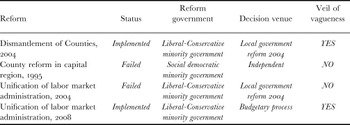
Table 2 demonstrates a matching pattern between the application of a veil of vagueness strategy and successful implementation of institutional reforms with consequences for the distribution of political and economic benefits. Our empirical analysis demonstrates that the capacity for governments to pursue controversial reforms varies when constitutional, political and economic constraints are largely similar. Our basic argument is that governments, even when they do not control a majority in parliament, have the capacity to enact reforms insofar as they manage to design the reform process for that exact purpose; to control and manipulate the flow of information during the process (Gibson and Goodin Reference Gibson, Goodin, Egeberg and Lægreid1999). If governments manage to control the distribution of information and mask their exact preferences, the predictable opposition from well-organized interest groups can be either reduced or, as illustrated by the 2008 labor market case, completely eliminated.
Summary of Empirical Analysis

While it is difficult to imagine that the sequence could be reversed, it is worth considering whether learning could be an alternative to the veil of vagueness theory, implying that minority governments without a permanent majority over time learns how to enact controversial reforms in insecure political waters. However, we prefer to see the learning argument as complementing the veil of vagueness theory rather than being a true alternative. Calculating the outcomes of behavior, pursuing optimal outcomes from decision making processes, and reforming public sector institutions against the will of organized special interests, can be seen as a complicated puzzlement on behalf of society that governments over time come to master – for instance by deploying a veil of vagueness during the process.
Besides concluding that the veil of vagueness theory is supported by empirical findings, we also emphasize that the theory should be elaborated into a more rigorous and formalized model, which can be tested against a larger data set (cf. Bendor, Moe and Shotts Reference Bendor, Moe and Shotts2001). Formalization should carefully consider whether any sufficient or necessary conditions are required for the veil of vagueness strategy to succeed. In a process of theoretical refinement it may be valuable to consider exactly the role and importance of learning, and whether the choice of decision making venue, as suggested with Table 2, conditions the success and failure of a veil of vagueness strategy.
It has not been our purpose to discuss any normative, democratic aspects of institutional reform procedures, and on the face of it, all four processes complied with the formal rules. The counties were dismantled and the labor market administration unified after public hearings, parliamentary readings, and scrutiny by parliamentary committees. Yet decisions were taken without public involvement, and without participation by civil society at large. By excluding the public in general and the most strongly affected groups in particular, the reform processes also evaded a range of qualified inputs and incurred a deficit of democratic deliberation (Cohen Reference Cohen, Bohmann and Rehg1997: 412f.). All real world political decisions cannot be produced on the basis of broad deliberations (Warren Reference Warren1996). Nonetheless, political legitimacy, trust and trustworthiness in democratically elected governments are to a certain extent produced by deliberation and broadly based on participation by civil society, and these are democratic deeds as valuable as decision making effectiveness.