The role of economists in organizing the domestic U.S. economy for the rigors of World War II has been fairly well documented.Footnote 1 Before and during the war they had set up the U.S. national income accounts, which helped to identify ways in which resources could be used more productively.Footnote 2 Economists in the Office of Price Administration managed to allocate resources to the civilian economy in such a way as to keep inflation under control and minimize opportunistic behavior while ensuring that the supply of resources to military forces in Europe and Asia was more than adequate.Footnote 3 Economists in the War Production Board helped to oversee conversion of industry from civilian to military production and helped to coordinate procurement among the military branches in such a way as to ensure that those resources most needed by the armed forces received priority and to prevent wasted resources by avoiding the emergence of bottlenecks in key raw materials such as aluminum.Footnote 4 In so doing, civilian economists often prevailed over senior military officials in having their recommendations adopted by the Roosevelt administration. In so doing, they actually helped to increase the output of completed military goods by reducing the quantity of partially completed but unusable capital equipment, factories, and military goods that could not be finished due to the presence of bottlenecks.Footnote 5 In addition to their work in these temporary agencies, economists also played a major role in formulating policy at the Federal Reserve Board and the United States Treasury.Footnote 6 Indeed, management of the civilian economy was so successful that the United States was the only major belligerent in the war to see civilian consumption actually increase during the war.Footnote 7 In a 1944 article in The New Republic, Paul Samuelson would write that the “economist, whether recruited from the permanent civil service or from academic life, has done an excellent job, either in comparison with reasonable expectations or in comparison with business executives who have been called to the government service,” even going so far as to call World War II an “economists' war.”Footnote 8
Economists also played a crucial role in collecting military intelligence during World War II that aided in the defeat of the Axis powers. They did this through their work in three federal agencies; the Research and Analysis Branch of the Office of the Coordinator of Information (known after January 1943 as the Office of Strategic Services, the forerunner of the Central Intelligence Agency), the Enemy Objectives Unit in London, and the Statistical Research Group at Columbia University, a unit of the Office of Scientific Research and Development. These three groups featured a number of young economists who would make major contributions to economics in the postwar era including Milton Friedman, George Stigler, Allan Wallis, Charles Kindleberger, Moses Abramovitz, Kermit Gordon, Edward Mason, Sidney Alexander, Richard Ruggles, Walt Rostow, William Parker, Wassily Leontief, Abram Bergson, and Carl Kaysen.
THE COORDINATOR OF INFORMATION
The Office of the Coordinator of Information (COI) was created by executive order on 11 July 1941. It was led by William J. Donovan, a New York lawyer who was awarded the Congressional Medal of Honor for his service in World War I. A close friend of Franklin Roosevelt, he was sent to England by the President in 1940 to assess that country's chances of surviving the Nazi onslaught. Almost alone among the President's advisors, he correctly predicted that England would win the war in the air. His trip also convinced Donovan of the need for a centralized government agency to gather foreign intelligence. Upon his return, he wrote a “Memorandum of Establishment of Service of Strategic Information” for the President, which argued that “information already existed in the United States which, if gathered together and studied in detail by carefully trained minds, with a knowledge both of the related languages and techniques, would yield valuable and often decisive results.”Footnote 9 The memo resulted in the creation of the COI less than a month later.
Responsible directly to the President and the Joint Chiefs of Staff, the COI combined functions that in Great Britain had been carried out by at least four intelligence services. As such, it “came far closer to combining all of the purposes of intelligence than any democratic agency had previously allowed itself in peacetime.”Footnote 10 With the FBI statutorily restricted to domestic operations, international intelligence had previously been handled by the Army and Navy, each of which had independent military intelligence units staffed by officers frequently lacking in specialized training and expertise. Other agencies involved in international intelligence included the Coordinator of Inter-American Affairs, who collected intelligence data for Latin America; and at least nine other government agencies, including the U.S. Treasury and the State Department, that conducted foreign intelligence operations with varying degrees of professionalism. The best work on the collection of economic information had been done by the Bureau of Foreign and Domestic Commerce in the U.S. Department of Commerce, where professional economists led by Simon Kuznets and Robert Nathan had developed the U.S. national income accounts.Footnote 11
One of the COI's responsibilities was “to collect and analyze all information and data which may bear upon the national security.”Footnote 12 To accomplish this, Donovan turned to Archibald MacLeish, the Librarian of Congress, for help. On 28 July 1941 a meeting was arranged between members of the Library of Congress, the National Archives, the American Council of Learned Societies, the Social Science Research Council, and leading social scientists from several universities. As a result of the recommendations originating from these meetings, the Research and Analysis Branch was established as a division of the COI. James P. Baxter III, the president of Williams College, was named as the first chief of the branch, and William L. Langer, a diplomatic historian from Harvard who would later succeed Baxter as chief, was named as the first director of research. The branch was initially organized into three functional sections—the Economic, Geographic, and Psychological Divisions—as well as eight regional sections. Research was supervised by a Board of Analysts, which included representatives of various government agencies as well as academics.
The Research and Analysis Branch was charged with applying the techniques of academic research to problems brought to it by a variety of government agencies including the U.S. Army and Navy, the State Department, the Office of Export Controls (later the Board of Economic Warfare, subsequently renamed the Foreign Economic Administration), the Office of Facts and Figures (later the Office of War Information), as well as other branches of the COI, particularly the Foreign Information Service. To do this work, the Research and Analysis Branch utilized between 80 and 100 large collections of source materials that had not been previously used by government agencies. These included the libraries of embassies and consulates of friendly countries, confiscated German and Italian reference materials, university libraries, and the files and accumulated data of other government agencies. The files of private American businesses, such as shipping and insurance, as well as missionary organizations also proved to be important sources of information. For example, the sale by a U.S. manufacturer of locomotives and rolling stock to a German railway required complete information on the railway's tracks, water quality and availability, fueling arrangements, clearances, switch points, tunnels, and bridges. Delivery of oil products required information on storage, pipelines, and other delivery mechanisms. Insurance firms reinsuring foreign structures had information on construction details, surroundings, and vulnerability.Footnote 13
Over the course of the war, the Research and Analysis Branch would collect more than 100,000 documents and amass perhaps the finest map collection in the world, which it would use to produce over 3,000 reports, many dealing with economic issues.Footnote 14 In order to maintain objectivity, the scholar analysts were removed from the onset from any policy-making role. As such, “they had no incentive to adjust their findings to meet the approval of prospective ‘clients’ or otherwise compromise the intellectual integrity of their work.”Footnote 15 This objective ideal was strictly enforced by a Projects Committee, created in July 1942 as the executive arm of the Board of Analysts, and given the authority to determine research priorities, monitor research procedures, and approve for distribution finished reports once they were cleared of bias.
THE REORGANIZATION OF THE COORDINATOR OF INFORMATION AS THE OFFICE OF STRATEGIC SERVICES
The Economics Division of the COI was established in October 1941, at the same time that the other two functional divisions (Geographic and Psychological) were set up. The Economics Division was headed by Edward Mason of Harvard, who had “initiated the modern field of industrial organization” by creating “the dominant paradigm of the industry study, exploring the relationship between industry structure, the conduct of firms in the industry, and the economic performance that resulted.”Footnote 16 Mason brought in Emile Despres, previously economics advisor to Federal Reserve Board Chairman Marriner Eccles, to serve as chief of the Economics Division, and Chandler Morse, also of the Federal Reserve Board, as assistant chief. The Economics Division was ultimately staffed with five future presidents of the American Economics Association (Calvin Hoover, Charles Kindleberger, Edward Mason, Wassily Leontief and Moses Abramovitz), one of whom also became a Nobel Laureate (Leontief).
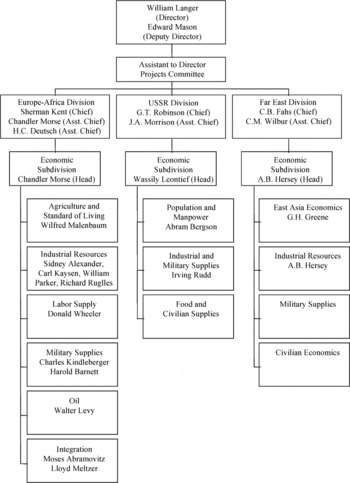
Initially the functional divisions within the Research and Analysis Branch were independent of the regional divisions. It was found that this development led to two problems. First, there were often jurisdictional conflicts, such as whether a study of the Soviet wheat crop, for example, was in the jurisdiction of the appropriate regional section or of the Economics Division. More important, analysts in one specialty often worked independently without the benefit of interaction with specialists in other fields. These deficiencies were corrected in January 1943 shortly after the COI was streamlined and reorganized as the Office of Strategic Services (OSS). The various regional and functional divisions within the Research and Analysis Branch were reassigned to four broad areas corresponding with major theatres of operation: the Europe-Africa Division, which focused on German capabilities and intentions along with the needs of the U.S.'s western allies; the Far East Division, which concentrated on Japan; and smaller divisions responsible for the Soviet Union and Latin America. An incomplete organization chart for the Research and Analysis Branch after the reorganization of the COI into the OSS, as it relates to the economists, is shown in Figure 1.
The Europe-Africa, Far East, and USSR divisions each had an economics subdivision, and these all had several sections. For example, the economics subdivision of the Europe and Africa Division, under the overall control of Chandler Morse, had six sections. The agriculture and standard of living section, headed by Wilfred Malenbaum, produced estimates of production and consumption which concluded that, unlike during World War I, the British blockade of Germany would not be effective in making food a factor in the outcome of the current war. The industrial resources section, headed by Sidney Alexander, studied production, inventories, and military and civilian requirements of basic raw materials such as minerals and oil. The labor supply section, headed by Donald Wheeler, correctly predicted the importance of the labor shortage to both the Wehrmacht and the German economy, possibly presaging the German use of slave labor. The military supplies section, headed first by Harold Barnett and later by Charles Kindleberger, made estimates of German armaments production. The oil section, founded later and headed by Walter Levy, pointed out the critical importance of oil to the German war effort, and thus the importance of North Africa, Romania, and the Caucasus to Germany. Finally, the economic integration section, led by Moses Abramovitz, produced aggregate national income data for Germany from data produced by other sections and other sources.Footnote 17 Initially the economists' work was concentrated on the European theatre, but later economics subdivisions for the USSR, led by Wassily Leontief, and for the Far East, led by A. B. Hersey, would also be established and make major contributions to the U.S. war effort.
ECONOMISTS IN THE RESEARCH AND ANALYSIS BRANCH

Economists in the Research and Analysis Branch showed their usefulness early, in “The German Military and Economic Position,” a report dated 12 December 1941.Footnote 18 The official War Report of the OSS notes that “the conclusions reached were interesting, not only because they appear in retrospect to have been quite accurate, but because in several instances they were in direct conflict with the prevailing opinion in high intelligence quarters.”Footnote 19 For example, the prevailing opinion of military intelligence at the time was that Germany was in danger of an acute food shortage. The economists found that, on the contrary, military rations for front-line soldiers for each of three important food groups—flour, meats, and fats and oils—had actually increased since 1936/37. Further, although civilian consumption of these three food groups had declined, these losses were at least partially compensated for by a 50 percent increase in potato consumption since 1939. The OSS economists concluded that “in terms of caloric, or energy, intake, present German diets appear sufficient or nearly so” and that present German food supplies allowed for a level of German consumption substantially above that which prevailed in World War I.Footnote 20 A later study, “The Nutritional Situation in Axis Western Europe,” found that although German caloric intake had declined by 15 percent during the war, the average German still consumed 2,784 calories per day.Footnote 21
After the war, the general conclusions of this report were found to be correct. The average daily consumption of the German urban population had fallen from 3,370 calories per head in 1940 to 2,555 calories in 1942, but rose to 2,751 calories in 1943 and 2,810 calories in 1944.Footnote 22 But although the caloric value of the German diet may have been sufficient, it was relatively monotonous, based mainly on grains. The standard ration for meat and fats was about the same in Germany that it was in Britain, but food rationing was introduced much earlier in the war in Germany and covered a wider range of products.Footnote 23 In spite of the caloric value of the diet, nutrient intake was not sufficient to prevent workers engaged in heavy manual labor from losing weight.Footnote 24 Also, as Adam Tooze points out, the German diet was kept relatively stable only by severely depriving subject populations.Footnote 25
Similarly, OSS economists concluded that, contrary to the assessment of military intelligence, lack of armaments and strategic raw materials would not be a serious impediment to the German war effort in the foreseeable future.Footnote 26 The economists correctly argued that the critical shortage would be an absence of men of military age due to the Russian campaign and especially the low number of births during World War I. In 1941, Germany had 2.24 million men between the ages 23 and 28, 40 percent fewer than if the prewar birth rate had prevailed from 1914 to 1918. This forecast was also proved to be correct by later scholarship. Richard Overy finds that a quarter of the German army was over 34 by 1944.Footnote 27 As a consequence of its low initial numbers and losses from earlier in the war, some of the units manning the French coastal defenses prior to D-Day were comprised of wounded men brought in from the eastern front and other men of poor physical condition. One division of the Normandy sector was made up of men with stomach ailments; other units were made up of men with lung or ear problems.Footnote 28 By the time of the invasion, one-sixth of the recruits of the German seventh army was composed of volunteer battalions from the occupied Soviet Union.Footnote 29
One possible weakness of the report is that it understandably (but incorrectly) assumed that the German economy was fully mobilized for war by 1941 and was operating at full capacity. There is much debate on the extent to which the German economy mobilized, particularly in the early years of the war. The conventional view was set forth by the U.S. Strategic Bombing Survey in the immediate aftermath of the war. John Kenneth Galbraith pointed out that German mobilization throughout the war was poor relative to that of the Allies.Footnote 30 Germany partially demobilized after the fall of France and after the initial success in the Russian campaign; it did not fully remobilize until late 1944. Moreover, throughout most of the war its key factories only ran one shift, and the number of domestic servants was nearly the same at the end of the war as it had been at the beginning. Further, unlike the United States, Germany hardly used native female laborers at all in war production, preferring much less motivated prisoners of war and slave laborers from countries that it had conquered. The view of the Strategic Bombing Survey, which holds that the German economy did not fully mobilize until Albert Speer was named Armaments Minister, has been accepted by a number of economists.Footnote 31 Barry Katz accepts this conventional view, arguing that had the economists been in closer contact with the political scientists in the Research and Analysis Branch (as they would be after the 1943 reorganization), they might have known that the Nazi regime was so confident in a quick victory that they left significant reserves of capital stock in the civilian economy.Footnote 32
However, more recent scholarship has challenged the view that the German economy was undermobilized in the early years of the war. Overy argues that that there was no demobilization after the invasion of the Soviet Union, only a planned reduction in munitions production, after adequate stocks had been built up, so that resources could be used for other urgent war production.Footnote 33 Moreover, real per capita consumption declined 32 percent in Germany between 1938 and 1942, compared to a decline of only 13.4 percent in Britain, which had a higher initial level of consumption than did Germany.Footnote 34 Overy also argues that, in spite of Nazi propaganda, female employment was actually higher in Germany during the war than in Britain or the United States, and that many German women who had been classified as domestic servants were actually agricultural workers. Overy finds that the problem was not that German resources were underutilized, but that they were inefficiently used due to lack of standardization in weapons that made mass production techniques difficult to apply, unrestricted competition between the various services (Germany had no equivalent to the U.S. War Production Board), a poor incentive structure for German labor and firms, and especially, declining labor quality as Germany became increasing reliant on unskilled German workers and unfree foreign workers. Both Overy and Tooze find that forced labor was much less efficient than German labor, partly due to malnutrition.Footnote 35 In spite of this, the German economy became increasingly reliant on forced labor. According to Hans Mommsen, ultimately 26 percent of the German labor force was comprised of either civilian workers from Western Europe or forced labor from the east.Footnote 36 The labor problem became so severe that one of the objectives for the disastrous German offensive at Kursk in July 1943 was the capture of Russian civilians to be used as forced labor in the Reich.Footnote 37
THE GERMAN SUPPLY PROBLEM ON THE EASTERN FRONT
After Germany invaded the Soviet Union in 1941, the Economics Group was called upon to estimate the resources that Germany would need to defeat the USSR, as well as the USSR's capacity to defend itself. At the beginning of the war, the German Wehrmacht had captured ten major Soviet railway lines on which to transport 200 divisions and their supplies into the interior of Russia. Based on the fragmentary data available, the OSS economists were called upon to derive the capacities of the captured Russian rail lines to deliver the supply requirements of the invading German armies in order to calculate the earliest date at which the German offensive could resume in 1942, following the successful Russian defense of Moscow. To accomplish this task, Chandler Morse had his economists perform tasks such as visit local Washington railways to ascertain such issues as the performance of locomotives in subzero temperatures and the maximum number of trains that could be run over a single or a double track per day under varying circumstances, research the daily forage requirements of the types of horses used by the German infantry, calculate the volume and weight of dehydrated rations and clothing allowances shipped to the German troops, compute the daily tonnage of ammunition required for each of the German services under six different assumptions about the level of combat intensity (determined on the basis of studies conducted by the U.S. army and of the actual British experience in the Libyan campaign), and compile a database of meteorological information over a period of years.Footnote 38 In a classified report titled, “The German Supply Problem on the Eastern Front,” the economists concluded that the Germans had been adequately supplied in the first six months of the campaign against Russia only because of the massive amounts of supplies that had been accumulated before the attack, that these reserves had been seriously depleted over the course of the campaign, and that every advance of an additional 200 kilometers into Russia would require 35,000 additional freight cars or else a reduction of 10,000 tons in daily deliveries to the front line. As a result the Germans would be in a much weaker position at the start of the 1942 campaign.
Postwar research has generally upheld the economists' conclusion. The German strategy had been based on a quick victory in which the Red Army would be destroyed before the Soviets could mobilize their immense population and natural resources.Footnote 39 Failing this, “strategic economic considerations would take priority.”Footnote 40 As a consequence, in the autumn of 1942 German forces were diverted from the attack on Moscow, the target that would have made the most military sense, in favor of an attack on the Ukraine in order to control that region's grain and raw materials.Footnote 41 By the time the Moscow offensive was resumed, the Russians had strengthened their defenses and winter had set in. Moreover, the Wehrmacht had reached the limit of its transport capacity. All available rail transport was needed to send fuel and ammunition to the front, depriving the German troops of spare parts and the limited cold weather stores that had been stocked for the invasion.Footnote 42
Further, by the beginning of 1942, the fuel situation had become critical, forcing the Nazis to curtail naval operations in order to maintain the Wehrmacht's mobility on the Eastern front.Footnote 43 The Germans attempted to compensate for this problem with an attack on the oil fields of the Caucasus in the summer of 1942, which ended with the disaster at Stalingrad. German stocks of coal, steel, and ammunition were also in short supply.
The first analysis by the Economics Group for U.S. military action was in connection with the 1942 North Africa invasion. In preparation for that campaign, OSS economists examined the files of the U.S. insurance companies that were actively involved in the re-insurance of North African properties. These companies often had detailed street-by-street maps with plans for every building on a particular block. Such data were used to prepare detailed landing intelligence for the North Africa invasion.Footnote 44 They also prepared “The Economic Resources of Morocco,” the first of many studies that they would conduct of the economic strengths and weaknesses of areas targeted for Allied invasion. The report concluded that over the past year, the Moroccan standard of living had been declining as France sought to maximize food exports to the Axis powers and that due to the effectiveness of the Allied blockade on North Africa the Germans had made a great effort to expand machine shop capacity for the repair of airplanes and the manufacture of spare parts.Footnote 45
THE ESTIMATION OF GERMAN BATTLE CASUALTIES
The economists of the OSS also used ingenious methods to estimate enemy casualties. They took advantage of the deep-seated German custom that local newspapers published officers' obituaries, including rank, unit, and location of death. The analysts used a sample of German newspapers collected in Switzerland (representing about 25 percent of total German newspaper circulation) to compute the average number of obituaries printed by each paper per issue per month. From this, they computed a preliminary estimate of the total number of German casualties occurring between 22 June 1941 and 31 October 1942, which they circulated in Research and Analysis Report no. 413, “Estimate of German Army Casualties Derived from Published Obituaries of Officers.” German military organization tables were used to establish the ratio of officers to enlisted men. Finally, to obtain all German battle deaths, the OSS economists used data from World War I to compute the battle death ratio of officers to other soldiers. This figure—21.2 enlisted men killed per officer killed—compared favorably to the ratio found later for the African campaign.Footnote 46 This ratio was then multiplied by the number of officers killed per month in World War II to obtain the total number of German soldiers killed per month. To these were added estimates of wounded and missing based on World War I data, and actual data on Germans taken as prisoners of war to obtain total German monthly battle casualties. The technique proved to be so successful that the OSS estimates came to be accepted by both U.S. Army and Navy intelligence.Footnote 47
The economists' estimates proved to be relatively accurate for the western front. For example, they estimated that 114,000 Germans soldiers had died before the invasion of Russia. The most recent estimate puts this figure at 134,000.Footnote 48 Unfortunately, the economists' estimates proved to be much less accurate for the Eastern front. For the period from the beginning of the invasion of Russia in June 1941 until October 1942, the economists estimated that 1,813,000 German soldiers had been killed. The actual number was much lower, at 774,000.Footnote 49 The economists' forecast for casualties from the Stalingrad campaign were better; an estimate of 407,000 deaths verses the actual total of 307,000.
OSS economists in the oil section also used some of the same German newspapers (as those used to estimate German battle casualties) to analyze German railroad rates. Walter Levy, head of the Oil Section of the Europe and Africa Division, discovered that petroleum received preferential rates and that rate tables were not proportionately altered after the war began, so that even if the actual flow of commodities was kept secret, it was possible to tell from rate schedules which lines carried oil. They also used German freight schedules to discover the location of two previously unknown refineries whose presence was confirmed by aerial photo reconnaissance. The economists also correctly surmised that a decline in the shipping rate on coal to a destination that was suspected of having a synthetic oil plant implied that the plant was starting up, because the large amount of coal shipments required for operation would normally lead to a reduction in shipping rates due to economies of scale.Footnote 50 OSS economists also made highly accurate estimates of both Allied and enemy oil consumption. They estimated oil requirements of enemy military units through an analysis of daily communiqués, order of battle data, and comparable U.S. data, making allowances for wastage and loss in battle. They estimated civilian consumption, country by country, by sifting through some five to ten thousand fragments of information including newspaper clippings, basic reference books, radio broadcasts, and trade journals to make estimates of the quantity of oil used in automobiles, railways, shipping, dwellings, in agriculture, and in manufacturing plants. Some 500 separate estimates were made by country, by use, and by type of petroleum. This mass of military and civilian data was then summed to arrive at a total estimate of oil consumption for each country. These estimates proved to be remarkably accurate. When French and Rumanian official statistics became available in late 1944, the OSS estimates were found to be off from actual figures by only about 3 or 4 percent.Footnote 51 Indeed, Moses Abramovitz concludes that one of the great things to happen to intelligence work during the war was the shift from reliance on anecdotal evidence from travelers returning from behind enemy lines or from prisoner of war interrogations to systematic quantitative analysis of census and other published materials.Footnote 52
THE EVALUATION OF GERMAN ARMAMENTS PRODUCTION
But the economists' skills at estimation techniques were best displayed in their calculations of German armaments production. In 1943 Richard Ruggles, Sidney Alexander, and William Parker, while working with Economic Warfare Division of the American Embassy in London, began analyzing serial numbers and other markings obtained from captured German equipment and documents to obtain estimates of German war production. Such markings typically included the name and location of the manufacturer, the date of manufacture, some type of serial number, and miscellaneous other markings such as trade marks, mold numbers and casting numbers that, when properly analyzed, provided Allied intelligence officers with a wealth of useful information about German industry.
Serial number analysis was first performed on German tires. Using tires taken from captured or destroyed equipment representing a 0.3 percent sample of German tire production, OSS economists were able to determine that five German manufacturers produced over 70 percent of all tire output, as well as to estimate monthly capacity and production, and calculate enemy consumption of natural and synthetic rubber. This information could be put to valuable strategic use, as a check on separate estimates of German aircraft production, as an indicator of the importance and location of each producer along with the length of time between the manufacture of a tire and its use by the army, and as a measure of the effectiveness of Allied bombing campaigns by allowing analysts to compare production figures for a particular plant both before and after a raid.Footnote 53 Markings indicating synthetic content proved very useful in determining the Germans' ability to substitute synthetic for natural rubber. To further study the problem, the Research and Analysis Branch arranged for the shipment of 13 captured German tires to the United States, where various parts were analyzed for synthetic content to determine the relative scarcity of rubber in the German economy.Footnote 54 Analysis of tire markings also proved valuable in forecasting future German armaments production. Estimates of tank tread production, for example, could yield valuable estimates of planned German production by type of tank.
Encouraged by the promising results obtained from analyzing tire markings, OSS economists next turned to more advanced German military equipment. Using captured or destroyed vehicles and logbooks, they obtained the serial numbers for 1,200 tanks, along with more detailed markings for a smaller number. From this information, the economists were able to determine that two manufacturers were responsible for Germany's entire tank engine production, that gearboxes were made in only two plants, and that the number of final tank assemblers was smaller than had been previously believed. They could also make yearly and later, monthly, estimates of German tank production by make and model. Toward the end of the war, analysts could make accurate predictions of German tank production as recently as within the previous two months. This information was very useful in Allied selection of German bombing targets. For example, OSS economists could estimate the time elapsing between the manufacture of various tank components and the assembly of the tank, and finally its appearance in battle. As we shall see, this information was critical in assessing the vulnerability of the German war effort to attacks on particular plants.
Buoyed by their successes in examining tank markings, the OSS economists extended their analyses to German fighter planes, motor vehicles, guns, ammunition, V-1 flying bombs, and V-2 rockets. Such analysis was crucial in Allied selection of bombing targets. For example, analysis of V-1 flying bomb markings revealed that production was widely dispersed among 50 component manufacturers, making the industry a poor choice for targeting. Likewise, calculations of the time elapsing between the manufacture of ammunition and its use on the front revealed that, for most types, stockpiles of ammunition were adequate to prevent any shortage that might result if any particular munitions plants were bombed. Thus the ammunition industry was rejected as a potential target.
Prior to serial number analysis, Allied intelligence agencies had used other methods to estimate production such as prisoner of war interrogations or estimates based on prewar German production. These methods tended to greatly overestimate German war production. For example, American air intelligence overestimated German air strength in 1940 by a factor of ten.Footnote 55 Allied intelligence agencies also attempted to estimate the production of advanced weapons such as tanks based on the area occupied by factories. But this also led to overestimates, as it was common practice in Germany to build tanks in establishments also engaged in the construction of other heavy engineering items such as locomotives.Footnote 56
Estimates that OSS economists produced through serial number analysis proved to be much more accurate than these other methods. For example, Allied intelligence agencies estimated average monthly German tire production in 1943 at about one million units. OSS economists using serial number analysis put this figure at 186,100, which was much closer to the actual monthly average of 175,500. There were similar discrepancies for more advanced German military equipment. Allied intelligence agencies estimated German tank production at 1,550 units for the month of August 1942. Using serial number analysis, OSS economists put this figure at 327 units. The actual number, discovered after the war, was 342 units.Footnote 57 Richard Ruggles argues that this systematic overestimation of German war production had unfortunate consequences. It resulted a needless delay in the invasion of Europe. Instead, the British and Americans fought side battles in North Africa, Sicily, and Italy that needlessly prolonged the war, resulting in western Allied battle casualties and civilian deaths that were higher than necessary and greatly complicating the postwar settlement by increasing the territory held by the USSR at the time of the German surrender.Footnote 58
THE USSR DIVISION
Although most of the attention was rightly focused on Germany and her allies, OSS economists in the USSR and Far East Divisions also made significant contributions to the war effort. Russia was a concern not only because it was the most important battlefield during World War II, but also because the capabilities and intentions of that nation were perhaps the greatest imponderables of World War II. Unfortunately, the USSR Division's conclusions were usually so far from conventional wisdom that they were often ignored. For example, many experts feared that the vast territories of the USSR that the Germans had already conquered would provide them with almost unlimited natural resources. However, Research and Analysis Report No. 605, “Gains of Germany (and Her Allies) Through the Occupation of Soviet Territory,” dated 14 March 1942, challenged this assessment. This report noted that the German invasion had imposed heavy economic losses on Russia, but argued that the gains to Germany from her conquests of Soviet territory would be limited. For one thing, the industrial goods that were most likely to be captured by the Germans were “precisely those raw and semi-finished materials that required much further handling by the half-destroyed railroads and industrial plants of the war zone, or the factories of the Axis countries,” rather than finished goods that the Russians would have removed or destroyed to prevent from falling into enemy hands.Footnote 59 Appropriation of Soviet goods would also be hampered by the underdeveloped Soviet railroad system, which had been heavily damaged in the fighting. The report asserted that “the acuteness of the transport crisis is suggested by the fact that at least for a time the Germans moved considerable quantities of men and material to the front by air.”Footnote 60
The report further found that the human resources in enemy territory of which the Germans could take advantage were also severely limited. The Soviets had been relatively successful in instilling a revolutionary spirit in the industrial work force that made it unwilling to collaborate with the Germans. Although the agricultural peasantry had been less successfully indoctrinated, it turned against the Germans because of their harsh policies in retaliation for partisan attacks. The report also noted that the Germans had done nothing to appeal to the nationalist sympathies of non-Russians who might have been willing to cooperate with the Germans in exchange for independence from the Soviets. Finally, the Germans were severely hampered by the Soviets' wholesale evacuation (or execution) of the leadership of the conquered Soviet territories, which had a particularly acute effect because the Soviet economy was so centralized. The report concluded that “the problem of replacing this lost skill, leadership, and force, is by all odds the most difficult that the Germans have faced in any of the countries that they have thus far over-run.”Footnote 61
German difficulties in converting Soviet agricultural production to their own use were even more daunting. The report found that due to shortages of horses and fuel, crop yields in captured Soviet territories would be, at most, two-thirds of prewar levels. Moreover, the Soviet agricultural system was geared towards large-scale, collectivized production, whereas “the Nazis had long preached the virtues of individual peasant property and small-scale cultivation.”Footnote 62 Yet the Germans must have known that any attempt to break up the agricultural collectives into small plots would have resulted in vast confusion and a large decline in output in the short run. This placed Germany in the “peculiar position of trying to maintain and operate a collective system of agriculture which they have condemned with the help of certain anti-collectivist peasants whose desires they have been afraid fully to satisfy.”Footnote 63 Unable to either operate the collectives at full strength or to abolish them outright, the report concluded that “the Nazi agricultural system in Russia has been hanging in the air.”Footnote 64
Studies conducted after the war largely confirmed the report's conclusions. One of the main objectives of the invasion had been to gain control of the highly fertile lands of the Ukraine. The Germans were remarkably successful in capturing Soviet farmland; at the maximum extent of German occupation land responsible for two-thirds of prewar Soviet food production came under German control.Footnote 65 In spite of this, the annual supply of Russian grain appropriated (including that taken for consumption by German occupation forces) amounted to only 14 percent of Germany's own crop in the two harvest years of organized occupation.Footnote 66 Indeed, the real value of food expropriated from Russia into Germany in 1942 (the yearly maximum under German occupation) was actually about 10 percent less than the real value of net exports of food from Russia to Germany in 1940.Footnote 67 One of the main reasons for this was that the Germans, due to the racism of Nazi ideology, went out of their way to alienate subject non-Russian populations in the Baltic states, the Ukraine and Belarussia that might have been willing to work with them. They did this through their policies of suppression of nationalist aspirations, forced labor, seizure of property, and the systematic use of terror. As a result, the level of collaboration among these populations, although often significant, was much less than it might have been.Footnote 68
As Katz points out, it is ironic that as Hitler's own intelligence staff was warning him in the summer of 1942 that Soviet forces were massing at Stalingrad, the OSS economists were coming to a similar conclusion, and getting a similarly hostile reception from their superiors.Footnote 69 One report predicted that in terms of manpower, basic industries, military supplies, food, transport and morale, “Russian strength is likely to remain high,” and that Soviet resistance was increasing. If anything, OSS projections tended to underestimate the Russian powers of recuperation, but they came closer to the truth than the conventional wisdom that dominated official thinking in Washington.
Late in the war, the USSR Division was commissioned by Assistant Secretary of State Dean Acheson and Donald Nelson, head of the War Production Board, to chart the probable course of the USSR's recovery. This work was led by two economists who would play prominent roles in national income accounting in the postwar period, Wassily Leontief, who would win the Nobel Prize in Economics in 1973 for his work in input-output analysis, and Abram Bergson, who would become one of the leading experts on the Soviet economy. Using the Cobb-Douglas production function, the Kuznets index of industrial production, and the existing forecasting of the time, they made detailed estimates of Soviet national income in the years immediately following the war.Footnote 70 In Research and Analysis Report No. 2060, “Russian Reconstruction and Postwar Foreign Trade Developments,” dated 9 September 1944, the economists concluded that the USSR had lost about 25 percent of her capital stock as a result of the war.Footnote 71 They concluded that with levels of foreign assistance or German reparations totaling $1.5 billion per year, the USSR would be able to reach the level of national income prevailing in 1940 within four years of the conclusion of the war, and that living standards could reach their prewar level in the first year of reconstruction. What was even more surprising was that the OSS economists concluded that the absence of any foreign aid or reparations would only delay full recovery from the war by a few months, and that the Russians had sufficient foreign exchange balances to purchase any urgently needed imports.Footnote 72 The prevailing opinion in Washington at the time was that the Soviet economy had been so damaged by the war that it would take a generation for them to recover.Footnote 73 The OSS economists' calculations indicated that American aid would have little impact on Soviet policy, either as a carrot or as a stick.
Once again, the report's conclusions proved to be substantially accurate. Both Angus Maddison and R. H. Moorsteen and R. P. Powell find that the USSR had reached its 1940 level of real GDP by 1948.Footnote 74 However, other scholars find that, in many ways it took the USSR much longer to recover from World War II. Agricultural output had still not reached its 1940 level by 1950: grain per capita was still about 7 percent below its 1940 level in 1950, and total grain output and the number of cows had still not reached their prewar levels in 1952.Footnote 75 More importantly, Mark Harrison argues that although prewar levels of GDP, the capital stock, and other economic variables were surpassed within a relatively short time after the war, the Soviet Union never returned to its prewar economic trajectory.Footnote 76 For most other combatants, growth rates after the war accelerated, allowing their economies to eventually return to or surpass their prewar trajectories.Footnote 77 However, the Soviet Union's growth rate before and after the war was approximately the same, implying that its “war losses were never made good, or made good only very slowly.”Footnote 78 Moorsteen and Powell find that although the net stock of fixed capital returned to its prewar level by 1950, the capital stock in this year was only about half as high as it would have been had the prewar growth rate prevailed throughout the 1940s.Footnote 79
But the effectiveness of OSS economists on issues relating to the Soviet Union may have been limited by the dominance within its ranks of New Deal liberals who tended to favor a more lenient approach to that country, particularly in the postwar settlement. In the extreme, this political bias could result in policy recommendations that no U.S. government could adopt. In a letter to Ed Mason dated 24 April 1944, OSS economist (and Marxist) Paul Sweezy argued that the best way for Europe and the United States to avoid conflict with the Soviets was to pursue policies that would ensure full employment, thereby assuaging Russian fears of “American reaction and imperialism.” Many considered such a policy to be socialist. For example, when President Truman proposed that the government should act to maintain full employment in legislation that would become the Employment Act of 1946, U.S. Senator Robert A. Taft argued that it was impossible to maintain full employment under a capitalist system.Footnote 80 Partly as a result of such opposition, the legislation was greatly watered down.Footnote 81
Another document, “Three Power Co-Operation and the Occupation of Germany,” probably written in late 1944, argued that the USSR had no intention of occupying territory beyond her 1940 borders. It concluded that “there is no reason to suppose that Russia has any intention or desire to occupy such territory some time in the future, or to acquire control of the resources located therein” (p. 3) and that “official Russian pronouncements and acts have shown a meticulous regard for the independence of neighboring states” (p. 4). Time would quickly refute this conclusion. The report concluded that the United States should politically support the USSR against the United Kingdom, and aid in the creation of a federation of European socialist states.
THE FAR EAST DIVISION
OSS economists also made significant contributions to the war against Japan. In a letter dated 24 November 1941 sent to William Donovan, Emile Despres concluded that “the pressure of economic blockade puts Japan in an unendurable position from which she must seek to free herself either by diplomatic negotiation or force.” In a report dated 6 December 1941, “Evidence of Economic Pressure in Japan,” economists in the Far East Division stated that, due mostly to American sanctions, Japan had lost almost 60 percent of her traditional sources of imports and that export industries were only operating at 30 percent of capacity. It was also reported that Japanese debt had increased fivefold since 1936, that the rate of increase in the money supply had risen 300 percent since 1937, and that extensive rationing of electricity, labor, food, and commodities as well as export controls had already been put in place.
The Far East Division would write many other reports dealing with Japan's economic position and capabilities over the course of the war. For example, an April 1945 report, “The Food Position of Japan,” summarized the effect of the war on the Japanese diet. It found that even before the war, the average level of consumption in Japan was lower in comparison with western countries, both in quantity and quality. As a result of trade disruptions attributable to the war, the total food supply had fallen by at least 10 percent, but this was partially offset by restrictions of sake manufacture. Nevertheless, during the war, average caloric intake had been reduced by about 10 percent, from 2,270 calories per day in the late 1930s to 2,050 calories in 1944, and the quality of the diet had deteriorated even further, particularly in fats and starches. Nevertheless, it was estimated that due to storage and rice rationing, which had been implemented in 1942, Japan could withstand an effective blockade for almost two years with only a slight decline in consumption below the 1942 level.
Once again, postwar studies largely confirmed these conclusions. B. F. Johnston et al. estimate that consumption fell by about 15 percent in 1944 and 1945, largely due to the destruction of 88 percent of Japan's total merchant shipping capacity, which resulted in a 90 percent decline in Japanese rice imports, which had made up almost a quarter of total rice Japanese consumption before the war.Footnote 82 They also find that the quality of the diet had deteriorated, with sharp reductions in the supplies of fish, vegetables, fats, and oils. One consequence of this was chronic malnourishment, particularly in urban children. Between 1941 and 1945 children from urban areas were found to be shorter and lighter than children of the same age from rural areas, and this difference increased over the course of the war.Footnote 83 Nevertheless, Japan managed to avoid starvation through the compulsory collection of food directly from farmers and strict rationing.
Another study, “The Labor Supply in Japan,” estimated the effects of the war on the Japanese labor market. It concluded that as a result of the war and due to drastic restrictions on the rights of workers to select their occupation and place of employment, the percentage of the labor force working in heavy industry and living in urban areas increased drastically. The labor force participation rate of women, children, and the elderly, which had always been high, also increased, particularly in agriculture, to free males for manufacturing and the military. Further, in spite of government efforts to decentralize, the concentration of industry in the great urban centers increased, making them a target for heavy bombing. This bombing would reverse the trends toward urbanization and industrialization brought on by the war. Following the war, OSS economists produced the report “National Income of Japan,” the first national income estimates made for Japan since 1930.
Economists serving with the Far East Division made another contribution to the war effort early in 1942, when the military requested assistance on target selection for General Doolittle's raid of 18 April 1942 on the Japanese home islands.Footnote 84 This was the beginning of the OSS economists' target selection work, which was to become one of their major services to the military.
THE ENEMY OBJECTIVES UNIT
Perhaps the most important contribution of OSS economists to the Allied war effort was their work as members of the Enemy Objectives Unit (EOU) on the selection of enemy targets. The EOU was founded in 1942 as the brainchild of Colonel Richard D'Oyly Hughes, an American who had served with the British Army in World War I. During World War II he served as the senior target planning officer for the U.S. Air Forces in Europe. Finding himself dependent upon British intelligence sources for target selection, he asked the American ambassador to request that qualified staff be sent to London to work on the problem.Footnote 85 The EOU was a part of the Economic Intelligence section of the Economic Warfare Division, attached to the U.S. Embassy in London and headed by Winfield W. Riefler, an economics professor at Princeton, a director of the National Bureau of Economic Research, and the former president of the American Statistical Association. However 13 of the 15 professionals who served with the EOU over its 32 months in operation came from the OSS.Footnote 86 The staff included Chandler Morse, who served as the unit's first chief, Charles Kindleberger, who succeeded him, Walt Rostow, Harold Barnett, Carl Kaysen, William Salant, and others.
The first phase of the EOU's operations was to gather information concerning aiming points, the most vital and vulnerable points in an industrial target. To identify such points, EOU economists visited leading British industrial plants to obtain information that could be used on their German counterparts for which aerial photographs and other information concerning plant layout were available. The EOU was required to determine the appropriate aiming points for each enemy plant, locate them on a photograph, and submit these recommendations, together with the supporting evidence, to the U.S. Eighth Air Force.Footnote 87
The second phase was to establish priorities in targeting. The EOU's strategy in target selection was set forth in a 17 December 1942 memorandum written by William Salant, a Harvard graduate who was one of a number of economists to come to the OSS after having worked for the Federal Reserve. In it he argued that enemy target selection should be based on the ability of Allied forces to reach the target and drop bombs on it, the ability to damage the target when hit, and the ability to directly or indirectly impair the enemy war effort given that the target was damaged, and that all three criteria had to be met. To quantify the problem in order to rank potential enemy targets, he argued that the EOU should ask three questions:
How great is the impairment to the enemy's war efforts per unit of destruction?
How many units of physical destruction will be achieved per ton of bombs dropped on the target?
How many tons of bombs can be dropped on the target per unit of cost, including losses inflicted to planes and crew, expenditure of bombs and gasoline, etc.
The three questions could be combined into a single equation for cost-benefit analysis:

The resulting answer was harm to the enemy resulting from a proposed bombing raid as a percentage of the cost of the raid to the allies. This methodology allowed the EOU to objectively rank proposed enemy targets. Impairment to the enemy could be measured in a variety of ways, including the value of plant and equipment, final output, or enemy man-hours lost in a raid.Footnote 88
Of these three questions, the second was an engineering problem—a function of the physical vulnerability of the target hit—and the third was an operational question depending on the size of the target, location, and the strength of enemy defenses that could best be answered by military personnel. The economists on the other hand had a comparative advantage in answering the first question, which required familiarity with the enemy's industrial sector and the inputs required for different types of output. This question could be quite complicated as a result of the interconnectedness of the component sectors of an industrial economy. Many goods serve as both inputs and outputs for each other; steel, for example is needed to produce coal but coal is also needed to produce steel. This insight, which became known as input-output analysis, would result in a Nobel Prize in economics for Wassily Leontief, an OSS economist with the USSR Division who did much to popularize the concept.
The EOU economists also realized that to have an impact on the enemy war effort, a bombing raid had to take into account both the depth and the cushion of the enemy industry. The depth was a measure of how long it took for damage from a particular bombing raid to have an impact on enemy capacity on the battlefield. Final products such as tanks or fighter planes have less depth than intermediate products such as ball bearings and are therefore, ceteris paribus, better targets. The cushion was a measure of the capacity of the enemy military to absorb losses to a particular industry through drawing down inventories, diverting stocks from civilian to military use, or finding substitutes. Goods such as guns, whose purpose is purely military, would have less of a cushion than goods that have both civilian and military uses, such as textile factories. EOU economists also invoked capital theory to measure the extent to which manpower drafted from the civilian sector, prisoner of war camps, or occupied territories could be used as substitutes for other inputs destroyed in Allied bombing raids. Practically, these criteria meant that the most effective enemy targets would be those industries producing some component vital to armaments production that were geographically concentrated, used specialized equipment, held small inventories, and were working at capacity.Footnote 89
After the war, the U.S. Strategic Bombing Survey (USSBS) was asked to gauge the effectiveness of allied bombing raids on German industry. They concluded that the bombing had only a limited effect on armaments production. Indeed, the number of German planes produced actually rose during the most intensive phase of the Allied bombing campaign. Apparently the Allies were able to damage buildings but had a harder time destroying the equipment upon which aircraft production depended. Allied area bombing of cities, advocated by the British, also proved counterproductive as it missed the armaments factories, which tended to be located in the suburbs, while the destruction of urban restaurants, banks, and other civilian businesses actually helped the German mobilization by freeing up a sizeable labor force that was absorbed by the defense industry.Footnote 90 Contrary to British claims, area bombing did not have a detrimental affect on civilian morale. However, the USSBS did find that Allied attacks severely reduced the output of oil refineries. As a result, many Panzer units were idled when they ran out of gasoline. The raids also severely disrupted the transportation system. In fact, the damage to oil refineries and railroads had more of an impact on industrial production than the direct bombing of factories. The raids were also effective in depleting the German supply of skilled pilots who were lost as Germans attempted to defend their aircraft factories from Allied air attacks. It was this depletion of human capital, along with scarcity of oil, that greatly diminished the effectiveness of the Luftwaffe in the last year of the campaign. However, the USSBS concluded that the Allied armed services had greatly overestimated the effects of their bombing campaign on the German economy.Footnote 91
Recent scholarship has challenged some of the conclusions of the U.S. Strategic Bombing Survey. Tooze finds that from May 1943 to February 1944, when Allied forces were bombing the German industrial heartland in the Ruhr, the average monthly growth rate in armaments production fell to zero, compared with an average monthly growth rate of 5.5 percent in the period from February 1942 to May 1943.Footnote 92 Growth in German war production only resumed after the Allies diverted their attacks to the administrative center of Berlin and to France in preparation for the Normandy invasion. The USSBS also omits many severe indirect effects of the Allied bombing on the German war effort. Overy argues that the bombing campaign decimated the German air force.Footnote 93 From late 1943 until the spring of 1944 half of all German fighters and a quarter of its pilots were being lost each month. By September 1944, about 80 percent of the German fighter force was based in Germany to defend against the bombing raids.Footnote 94 As a result, the Luftwaffe was seriously outnumbered on both the eastern and western fronts. By D-Day, the Luftwaffe could muster only 300 aircraft against 12,000 Allied planes, while on the eastern front in April 1944, the Germans had only 500 fighters to face over 13,000 Soviet aircraft.Footnote 95 The Allied bombing campaign also forced the Germans to shift from the production of offensive bombers to defensive fighters. In 1942, over half of all German aircraft produced were bombers; by 1944 this proportion had fallen to only 18 percent.Footnote 96 The Allied bombing campaign also forced the Germans to shift vast resources away from the fighting fronts in order to combat the bombing threat. By 1944 the anti-aircraft effort absorbed one-third of artillery production, 20 percent of ammunition production, one-third of the output of the optical industry, and over half of the radar equipment.Footnote 97 Finally, the bombing campaign worsened the German labor shortage; by 1944 about two million people were engaged in anti-aircraft defense, repairing damaged factories, and cleaning up after the raids.Footnote 98
Based on their analysis, the EOU initially recommended that Allied forces target factories producing airframes and ball bearings.Footnote 99 The result was an attack by the U.S. Eighth Air Force on the ball bearing plant at Schweinfurt in central Germany on 17 August 1943. The raid was a disaster. Flying in daylight without fighter escort, 36 of the 229 B-17 Flying Fortress bombers that set out on the mission were shot down, an attrition rate of 16 percent, or more than three times the rate that had been established as “acceptable” for a single mission.Footnote 100 As a consequence, the Eighth Air Force suspended operations into Germany for five weeks, and did not fully resume them until long-range fighters had been produced that could escort the bombers for their entire missions.Footnote 101
There is some debate as to whether ball bearings were in fact the best economic target. In his memoirs, Albert Speer, the Nazi armaments minister, states that as a result of the Schweinfurt raid, the production of ball bearings dropped by 38 percent, forcing the Germans to use up stocks held by the armed forces as repair parts. He argues that if the Allies had followed up these attacks, German armaments production would have been crucially weakened after two months and brought to a complete standstill after four months.Footnote 102 However, John Keegan argues that Germany had an alternative source of ball bearing supply from Sweden, which was dependent on German coal exports.Footnote 103 In his autobiography, Charles Kindleberger concludes that ball bearings turned out to be a poor target choice because they had too much depth and cushion.Footnote 104 The Germans managed to increase the depth of ball bearings by redesigning some equipment to eliminate their need for ball bearings. It was found that the quantity of ball bearings used in tanks, for example, could be reduced, and although this would reduce the life of the tank, it did not matter because most tanks were destroyed in battle well before the engines had a chance to wear out.Footnote 105 The Germans also responded to the bombing campaign against ball bearings by increasing the cushion. That is, they reduced required inventories on assembly lines by having salesmen hand-carry ball bearings from the manufacturers to the assembly lines and install them into the equipment at the last moment that it was technically feasible to do so rather than at the most efficient time.Footnote 106 Of course, since ball bearings also had multiple uses, the Germans could also respond to shortages by diverting ball bearings from civilian use to military use.
PREPARATION FOR THE NORMANDY INVASION
As preparation for the Allied invasion of France intensified in early 1944, U.S. economists from the EOU and British military intelligence personnel were asked to recommend a bombing campaign to lessen German resistance to the Allied landings. The two groups had a fundamental difference of opinion on bombing strategy.Footnote 107 Following heavy casualties from daylight bombing raids on specific targets that failed to accomplish the objective, the British preferred area bombing (also known as carpet or saturation bombing) of cities and other large targets by night.Footnote 108 They cited the negative effect of area bombing on civilian morale (which as noted earlier was refuted by the USSBS after the war), arguing that such a collapse in morale was responsible for the German surrender in 1918.Footnote 109 As such, they recommended that the Allies attempt to prevent German forces from reaching the invasion beachheads by attacking railroad marshalling yards, where trains were concentrated, maintained, and organized. They came up with a plan calling for an attack on 76 marshalling yards in France, Belgium, and Western Germany. In addition to preventing the movement of military personnel and materiel, advocates of this strategy held that it would seriously harm the German economy by reducing the flow of trade within the Reich.Footnote 110
In contrast, American economists with the EOU preferred daylight precision bombing of smaller targets that could directly impair the enemy war effort. This was made possible by improving technologies such as the Nordon bomb sight and the Flying Fortress and longer range bombers that provided more protection for bombing crews. As such, they recommended that the Allied bombing campaign be concentrated against bridges and the oil industry. They advocated an attack on 54 oil targets with follow up attacks to prevent repairs, holding that this would deny Germany over half of her petroleum reserves within six months, thereby grounding German tanks, vehicles, and aircraft and crippling the civilian economy.Footnote 111 The EOU argued that marshalling yards had too much cushion, as resources could be diverted from civilian to military use, and that although bombing damage could be extensive, critical functions could be quickly resumed after a raid. Contrary to popular wisdom, they also argued that the German surrender in 1918 was due to its defeat on the battlefield rather than the collapse in civilian morale.Footnote 112 On the other hand, the British argued that German resistance would be too heavy and Allied bombing was too inaccurate to attack specific targets such as bridges and that any damage inflicted on such targets would come at too high a cost in terms of bombs and crews. The dispute between economists and high military officials bore some similarities to that which had taken place in the United States earlier over the feasibility of the U.S. military's rearmament program in preparation for U.S. entry into the war. Participants in the debate over pre-invasion bombing strategy continued to argue the relative merits of both plans for many years after the war.Footnote 113
The issue came to a head at a meeting on 25 March 1944, in which General Eisenhower accepted the British plan because it would have a more immediate effect on Germany's response to the invasion. However, a series of incidents convinced the general to reconsider his decision. In a series of experimental raids in late April and early May 1944, U.S. Army Air Force crews managed to destroy critical bridges over the Seine River, with a precision that Walt Rostow claims was not equaled until the bombing of Iraq during the first Gulf War in 1991.Footnote 114 Moreover, the cost in bombs per bridge destroyed turned out to be about one-fifth of the British estimate. The campaign was intensified, and by the time of the invasion all river crossings below Paris had been blocked. As a result, German men and equipment had to be ferried across the Seine, making them vulnerable to being bombed piecemeal by Allied planes. Meanwhile, the attacks on German marshalling yards proved disappointing. Although more than 45,000 tons of bombs were dropped on these targets, the Germans managed to make the necessary repairs quickly and also redistributed train traffic in such a way as to avoid the most damaged points.Footnote 115
At the same time, an attack on German oil targets in mid-May proved to be surprisingly effective. Allied intelligence picked up German alarm over these attacks, resulting in the diversion of German fighters from the protection of critical aircraft factories to guard oil refineries that had yet to be hit. At the same time, marshalling yards were left undefended. The EOU economists had in fact underestimated the impact of the bombing of oil targets on German operations. They had correctly estimated that the Germans had a three-month supply of oil stocks, but failed to anticipate that the Germans would respond to an attack on oil by immediately taking actions to conserve. Thus, within two weeks of the first major assaults on German oil targets, the Germans began to cut back on the supply of oil to training divisions and the navy. Armed with this new evidence, the campaign against the German oil industry intensified. As a result, German aircraft fuel production declined dramatically, from a peak of 180,000 tons in March 1944 to 54,000 tons in June and only 10,000 tons in September.Footnote 116
The EOU economists were also remarkably successful in getting their points across to both the American and British high commands. One way they did this was by transferring key personnel to both armies. For example, Walt Rostow transferred to the British Air Ministry, Carl Kaysen was attached to the U.S. Ninth Air Force, Harold Barnett went to Army Intelligence (G2) of Supreme Headquarters, Allied Expeditionary Force (SHAEF), and Charles Kindleberger was assigned to the British Tactical Air Command. This tactic, which the EOU members dubbed “Operation Octopus” among themselves, allowed the economists to widely disseminate their strategy. Thus the EOU, which at its height had a professional staff of only about a dozen, managed to obtain influence far in excess of its numbers.
GERMAN WAR REPARATIONS
The last service that OSS economists performed in the war was in preparation for the United States' negotiation with the other victorious powers over the governance of postwar Germany and war reparations. The Research and Analysis Branch took a relatively moderate position, arguing that the military government should demilitarize Germany and root out active Nazis from business and government, but leave the shaping of postwar institutions to Germans while ending the postwar occupation as soon as possible.Footnote 117 For example, Emile Despres argued in a paper, “Treatment of Germany,” that “measures imposed on Germany for an exclusively punitive purpose should be restricted in their effects to the generations of Germans now living,” concluding that “drastic territorial adjustments and deindustrialization measures should be made only after it has become evident that such measures are in fact necessary for security reasons.” Another report, “Problems of German Reparations,” was also sensitive to the need to allow the country enough resources so that a democratic government could succeed.Footnote 118 In another report, Kermit Gordon argued that deindustrialization would destroy Germany's ability to export and pay for its minimum imports, resulting in unemployment and shortages of basic necessities. It would also hamper recovery in Western Europe by depriving it of imports of the German industrial goods on which it had always heavily relied.Footnote 119
This plan was strongly opposed by U.S. Secretary of the Treasury Henry Morgenthau, who advocated the complete deindustrialization of Germany, that the Ruhr Basin be internationalized, and that what was left of Germany be divided into two agricultural states. Ultimately the Pentagon, seeing the difficulties of administrating a largely unemployed population with a low standard of living, adopted a policy closer to that of the OSS than Morgenthau. It was the OSS line that found its way into the SHAEF Handbook for Military Government, which would become the official position on German occupation for the Western allies.Footnote 120
THE STATISTICAL RESEARCH GROUP AT COLUMBIA
In addition to their work with the OSS, economists were also involved in the analysis of military problems through their work with the Statistical Research Group at Columbia University, which was founded in 1942 as a division of the Applied Mathematics Group, a part of the federal Office of Scientific Research and Development. Although it was concerned with the practical application of statistics to military problems, among its 18 principals were a number of young scholars who would become prominent in economics, including future Nobel Laureates Milton Friedman and George Stigler, as well as W. Allen Wallis and Abraham Wald. In the three years that it existed, the Statistical Research Group produced 561 substantive reports, memoranda, and letters for the U.S. armed forces.Footnote 121 As a direct by-product of its work, four books were published within three years of the war, one of which, Wald's Sequential Analysis, would prove to be a seminal work in statistical theory.Footnote 122 After the war, many alumni of the Statistical Research Group would play a major role in the “Chicago School” of economics.Footnote 123
There were three major types of problems analyzed by the Statistical Research Group. The first was in the area of operations research. An example of this would be the study of aircraft vulnerability. Milton Friedman looked at the problem of the optimal number and size of pellets in an anti-aircraft shell and found that a relatively large number of small pellets would be most effective.Footnote 124 Other members of the group also examined records of Allied airplanes that returned damaged from bombing missions in order to identify the most vulnerable parts of an aircraft. If no plane ever came back with damage to a particular spot, it could be inferred that the airplane was particularly vulnerable in that spot. It was found, for example, that few planes ever came back with the oil filter hit.Footnote 125
Another area of operations research concerned the proximity fuse, a tiny radar device built into the nose of a shell that caused it to explode when it came within a specified distance of an airplane. In designing the optimal distance from an airplane for the shell to explode, there was a tradeoff between the probability that the shell would get close enough to the plane to be triggered and the probability that the fragments produced would destroy the plane. If the fuse was timed to go off when the plane got very close, it was more likely that the shell would miss the plane completely and not go off, while if the shell exploded when it was too far away from the aircraft, it was more likely that by the time the fragments reached the aircraft they would be going too slowly to do any harm.Footnote 126 As a result of its analysis, the Statistical Research Group was able to double or triple the effectiveness of the shells. Other operational questions that the group studied included optimal methods of searching for enemy submarines and the optimal number and caliber of machine guns to place on fighter aircraft.
The second broad area of the Statistical Research Group's work concerned sampling inspection. In response to the military's request for information about the proper procedures to employ when inspecting batches submitted by suppliers for approval, the Statistical Research Group prepared and conducted a course for the military on proper testing procedures and prepared a manual that was published after the war. The group also handled a rather unusual request from an undisclosed source regarding a testing procedure to ensure the reliability of an inexpensive but crucial component. They replied that while there was no test to ensure complete reliability, assuming that the failure of one component did not have an effect on the likelihood that another component would fail (i.e., that the two devices were independent), the risk of failure could be greatly reduced if two or more of the same component were installed. The advice was apparently accepted, as the Manhattan Project that dropped two atomic bombs over Japan decided to install several detonators for each bomb to ensure that one would function properly.Footnote 127
By far the most important contribution of the Statistical Research Group to postwar statistics was its creation of sequential analysis. It arose when the Navy came to the Statistical Research Group with a testing problem involving two alternative designs for a projectile. It wanted to know which was superior. Ordinarily the Navy would conduct several hundred or thousand tests comparing the two designs side by side and then analyze the results. But it was argued that this might be wasteful, as a seasoned ordnance officer might be able to see that one design was obviously superior well before the test was scheduled to be completed. The Navy thus sought a new testing method that provided a rule for when the testing could be terminated. In response, Abraham Wald developed the technique that came to be known as sequential analysis. In his autobiography, George Stigler argues that sequential analysis saved the government more per month in the purchase of rocket propellant than the entire wartime cost of the Statistical Research Group.Footnote 128
Unfortunately not all of the techniques used proved to be as successful. For example, one of Milton Friedman's assignments was to serve as a statistical consultant to a number of projects seeking to develop an improved alloy that could withstand high temperatures so that the alloy could be used as blades of turbo superchargers and gas turbines and as lining for jet engines. The testing procedure was to hang a specified weight on a standard turbine blade made from the alloy, put it in a furnace at a given temperature, and measure the time it took for the blade to break. At one point, Friedman thought it would be possible to calculate a single multiple regression equation that would express the time to fracture as a function of stress, temperature, and the components of the alloy, from which it would be possible to predict the strengths of alloys yet untested. The resulting equation fit the data very well. Based on this equation, Friedman had two alloys created that should have worked very well but these actually ruptured under heat within one to four hours—results that were much poorer than for many prior alloys.Footnote 129
CONCLUSIONS
By any objective measure, economists proved remarkably adroit at analysis for military purposes. Economists were at least as successful at this type of work as academics from any other discipline or other professionals such as lawyers and businessmen. The participants have varied opinions as to why this was the case. Milton Friedman argues that economists were extremely useful during the war, but not always for their knowledge of economics.Footnote 130 Rather, social scientists in general and economists in particular knew statistical techniques and were better at using estimation techniques to work with poor data than physical scientists who were accustomed to being able to take exact measures in controlled experiments.Footnote 131 Under wartime conditions, data are rarely precise, complete, or in the form that the researcher would prefer.
Another explanation offered for the success of economists in solving military problems, particularly in regards to target selection, was their familiarity with such simple economic concepts as substitutes. Carl Kaysen, for example, points out that some noneconomists wanted to target apparently crucial targets such as grinding wheels for which ready substitutes were available. For example, they argued that grinding wheels were a good target because they were required by all machine tool manufacturers. But the economists correctly pointed out that grinding wheel factories would not be an effective target because of the presence of numerous substitutes. Indeed, grinding wheels could be made anywhere. A target such as gasoline, however, would be effective as there are no substitutes readily available for it.Footnote 132
Economists also tended to be better at optimization problems. A classic example is the problem of the optimal-sized convoy in the North Atlantic. In that case, noneconomists had decided that the correct objective function was the ratio of German U-boats sunk to domestic Allied merchant ships lost. Based on this, it was recommended that the average convoy size be increased. This case was even cited as a textbook example of operations research.Footnote 133 However as Charles Hitch, a member of the OSS and EOU pointed out in a 1953 article, the objective function chosen was erroneous. The ratio of enemy to Allied losses ignored the problem of reduced operating efficiency of ships in large convoys. Large convoys tended to swamp port facilities, resulting in longer turnaround times. Also, since the speed of a convoy was determined by that of the slowest ship, there tended to be an inverse relationship between convoy size and speed. As Hitch pointed out, it may well have been worth a few additional merchant ship sinkings to ensure the timely delivery of forces and equipment for such operations as the Normandy invasion.Footnote 134
One result of the successful use of economists (and social scientists in general) as consultants on military questions during World War II is that they would play a prominent role in the new research organizations that emerged in the postwar period. Even after the OSS was disbanded in September 1945, the work of the Research and Analysis Branch of the OSS continued as the branch was transferred to the State Department. In addition, many of the alumni of the Research and Analysis Branch were subsequently employed by the Office of National Estimates, a division of the newly formed Central Intelligence Agency that was responsible for all analysis of foreign countries' capabilities and intentions. The success in using experts from a variety of fields to study problems of a geographical area or country was replicated after the war in a variety of area studies programs initiated at several leading universities. The first programs were devoted to the study of the USSR, but eventually other programs were devoted to analysis of the Middle East, Africa, Latin America, China, Japan, and Asia in general. The research begun at the Office of Scientific Research and Development was continued at the RAND Corporation, which was created with the support of the U.S. Air Force.Footnote 135 It was founded in 1945 as a subsidiary of Douglas Aircraft and became independent in 1948.
Finally, the work of economists with the Statistical Research Group and particularly the Office of Strategic Services had a significant impact on the later careers of the economists involved. As Katz points out, the economists with the OSS had initially resisted the attempt to revoke their separate status as an independent division within the OSS in order to integrate them into the rest of the Research and Analysis branch by reassigning them into one of the four geographic divisions. They tended to look down on the other disciplines within the branch because they did not apply the same rigorous mathematical and statistical techniques as did economics. However, as they worked with historians, geographers, and political scientists, they came to realize that these other fields had something to offer to the study of economics. Many of them subsequently achieved distinction in their academic careers in areas of applied economics that tend to be interdisciplinary, including international trade (Alexander, Salant), economic growth and development (Mason, Despres, Rostow, Ruggles, Malenbaum, Abramovitz), economic history (Parker, Kindleberger), and the economics of defense (Hitch), education (Kaysen), and natural resources (Morse).