INTRODUCTION
The analysis of benthic community structure is a useful tool for describing changes in the state of marine systems (Heip et al., Reference Heip, Huys and Alkemade1992). Most studies on marine nematodes and meiofauna communities are either focused on the intertidal, sublittoral or in deep-sea sites. A considerable number of studies show the importance of environmental effects on meiofauna communities, nematodes in particular (Heip et al., Reference Heip, Vincx and Vranken1985; Giere, Reference Giere1993, for reviews). Besides structural aspects of standing stock and community composition (family, genus and species), functional approaches, based on feeding type, may give alternative insights on the impact of the environmental parameters (Vanhove et al., 2004).
Meiofauna has been extensively studied in the Bohai Sea (Zhang et al., Reference Zhang, Li, Tu and Yu1989, Reference Zhang, Gu and Yu1990, Reference Zhang, Zhou, Yu and Han2001a; Mu et al., Reference Mu, Zhang and Guo2001; Guo et al., Reference Guo, Zhang and Mu2002; Zhou et al., Reference Zhou, Zhang, Liu, Tu and Yu2007) and the Huanghai Sea (Zhang et al., Reference Zhang, Zhou, Guo and Mu2001b; Liu et al., Reference Liu, Zhang and Huang2005a; Huang et al., Reference Huang, Zhang, Liu and Zhang2006; Liu et al., Reference Liu, Zhang and Huang2007) in China. In the East China Sea, several studies on meiofauna and free-living nematodes in some Changjiang (Yangtze River) Estuary areas (Zhang et al., Reference Zhang, Lin, Zhou, Han, Wang and Tian2004; Lin et al., Reference Lin, Zhang and Wang2004; Hua et al., Reference Hua, Zhang and Zhang2006) have been carried out. However, there are few studies on the meiofauna community structure and the controlling factors in the Changjiang Estuary and its adjacent waters. In recent years considerable attention has been directed towards the physical, chemical and biological dynamics of this area.
The Changjiang Estuary and its adjacent area is a complex area since it is influenced by fresh water invasion, a high sedimentation rate, the Taiwan warm currents and coastal water from the north. Sand, nutrients and pollutants brought by Changjiang runoff, coastal upwelling and human activities settle quickly and stimulate phytoplankton blooms (Zhou et al., Reference Zhou, Yuan, Hou and Yin2004). The resulting higher primary production can act as a bottom-up stimulus to production at successively higher trophic levels and can thereby increase total system production in estuarine and marine systems (Elmgren, Reference Elmgren1989). In turn, those factors are determined by the hydrodynamic features of the estuary. All the complex and related environmental variables influence the meiobenthos in this area. Salinity is one of the most important environmental variables affecting the distribution and abundance of benthic animals in estuaries (Warwick et al., Reference Warwick, Goss-Custard, Kirby, George, Pope and Rowden1991). Several other sediment variables such as grain size, organic content, Chl-a and Phaeo-a concentrations are also important factors (Levin et al., Reference Levin, Huggett and Wishner1991). The purpose of the present study was to determine the nematode community structure and function at sublittoral muddy sites in Changjiang Estuary and its adjacent waters, and to measure the natural variability of the community in relation to environmental characteristics.
MATERIALS AND METHODS
Study area and sampling method
Sediment samples were collected from Changjiang (Yangtze River) Estuary and its adjacent waters in the East China Sea during a cruise on the RV ‘No.2 Dongfanghong’ in June 2003. A grid of 18 stations was located at 28°22′~31°45′N and 121°54′~123°00′E (Figure 1).
Sampling stations of the Changjiang Estuary waters and isolines of water depths (m) (omit the ‘03’ before the station number).

Three replicate samples were collected with a modified 0.1 m2 Gray–O'Hara box corer. From each box, two sub-samples, one for meiofauna and one for chlorophyll-a (Chl-a) and phaeophytin-a (Phaeo-a) analysis, were collected with a sawn-off syringe with a 2.9 cm inner diameter and immediately sectioned vertically in fractions of 0–2, 2–5 and 5–8 cm. To avoid the core-compression, the hypodermic syringe was first pushed slowly into the sediment to a certain depth. The syringe with its plunger was then withdrawn carefully from the sediment. Many previous subtidal studies have indicated that most meiofauna individuals (nematodes in particular) are distributed in the top 0–5 cm layer which accounts for over 80–90% of the total meiofauna. In addition, one further sub-sample was taken from one replicate sample to a depth of 5 cm for analysis of grain size and organic matter. All meiofauna samples were fixed on board with 5% formalin solution buffered in seawater. Samples for grain size, organic matter, Chl-a and Phaeo-a were deep-frozen at −20°C for future laboratory analysis. Conductivity/temperature/depth (CTD) profiles were made for water depth, water column salinity and temperature.
Determination of environmental variables
MEASUREMENTS OF ABIOTIC CHARACTERISTICS
Samples for grain size analysis were collected from surface sediments. Sieving and sedimentation were jointly used for grain size analysis. The sieving method was used to analyse particles over 63 µm and the sedimentation method was used to analyse particles smaller than 63 µm.
MEASUREMENT OF BIOTIC CHARACTERISTICS
The organic matter content of the sediment was measured by the chromic acid method (Higgins & Thiel, Reference Higgins and Thiel1988).
In the present study, Chl-a and Phaeo-a contents were determined by the fluorometric method of Lorenzen & Jeffrey (Reference Lorenzen and Jeffrey1980) and modified by Liu et al. (Reference Liu, Wu, Gao and Zhang1998) for wet sediment.
Meiofauna sample processing in laboratory
Meiofauna is defined here as metazoans that pass through a 0.5-mm mesh sieve, but are retained on a 0.031-mm mesh sieve. The samples were stained with Rose Bengal for more than 24 hours and then washed through 0.5 and 0.031 mm sieves. The meiofauna was extracted using the Ludox centrifugation technique (Heip et al., 1985; Zhang et al., Reference Zhang, Li, Tu and Yu1989). All meiofauna individuals were sorted into major groups and counted under a stereoscopic microscope.
Nematodes were placed in anhydrous glycerol, mounted on permanent slides (Zhang & Platt, Reference Zhang and Platt1983), and identified to genus (or to species wherever possible) using a compound microscope (Olympus BH2-NIC) with differential interference contrast.
Nematode feeding type was measured as a nematode functional aspect. Free-living marine nematodes display high diversity in the structure of their buccal cavity. Wieser (Reference Wieser1953) devised a classification of feeding types consisting of four types. Although various authors have later revised and modified this classification (Jensen, Reference Jensen1987; Moens & Vincx, Reference Moens and Vincx1997), nevertheless nematode genera in this study were assigned according to Wieser's classification as this is the only scheme available that considers free-living marine nematodes from a variety of habitats (Schratzberger et al., Reference Schratzberger, Warr and Rogers2007).
Data analyses
In order to assess interrelationships among the meiofauna abundance, expressed as individuals per 10 cm2 sediment, and sediment characteristics, Pearson correlation analysis was performed. One-way analysis of variance (ANOVA) was performed to test differences of meiofauna abundance and nematode community diversity among different stations. Levene's test was used to test for homogeneity of variance before differences in univariate indices were explored using ANOVA. Where Levene's test indicated non-homogeneity of variances, data were log-transformed and Levene's test was repeated to confirm that variance was homogeneous following transformation. Following the detection of significant differences (P ≤ 0.05) among stations, the Tukey HSD multiple comparisons test was used. The above analyses were carried out using SPSS 11.0.
The univariate measures were computed in the PRIMER 5.0 (Plymouth Routines in Multivariate Ecological Research) software package: nematode community biodiversity (Shannon–Wiener diversity index H′), evenness (as Pielou's J′), species richness (d), and Simpson dominance index (λ) (Zhang et al., Reference Zhang, Zhou, Guo, Mu, Yu, Han and Zhou2000, Reference Zhang, Zhou and Mu2001c).
Principal components analysis (PCA), BIOENV, non-metric multi-dimensional scaling (MDS) analyses were performed using the PRIMER 5.0 software package.
RESULTS
Environmental variables
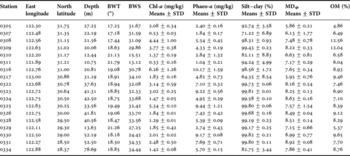
Various measurements of environmental factors were made, including sediment grain size, salinity, temperature, sediment organic matter content, Chl-a and Phaeo-a. CTD profiles indicated that at the studied sites, temperature decreased from about 22°C at the surface to ~18°C on the bottom. Vertical profiles of salinity indicated a superficial thin layer of low salinity water (23.8‰, affected by Changjiang runoffs), followed by a relatively high salinity (31.7) layer. Most of the sediment studied consisted of poorly sorted silty-clay (TY) and clayey-silt (YT) with a generally high silt–clay fraction (higher than 90%; Table 1).
Environmental variables of the studied stations.

BWT, bottom-water temperature; BWS, bottom-water salinity; OM, organic matter content.
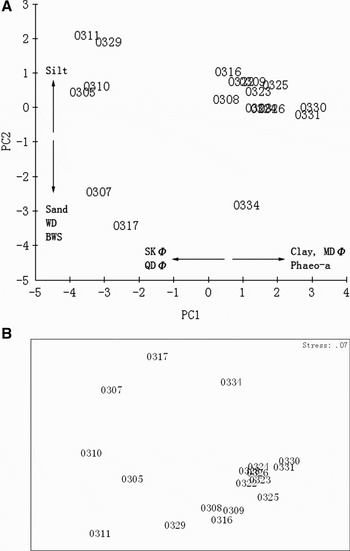
MDS and PCA ordination of environmental variables showed a clear separation of the studied stations (Figure 2). The first two components shown in Figure 2 accounted for 66.9% of the total variance of the data, being responsible for the differences among the studied stations. Concerning the first component, the coastal stations (Station 0305-0311 and Station 0329) were clearly separated from the other stations. Higher negative values along the first component were related to sediment SKΦ and QDΦ, whilst higher positive scores were due to MDΦ, clay content and Phaeo-a concentration (Figure 2). The separation of stations along the second principal component was less pronounced. High positive value along PC2 was related to silt content, while high negative values were related to sand content, water depth (WD) and bottom-water salinity (BWS). The results of PCA ordination suggested that environmental variables of the Changjiang Estuary and its adjacent waters were heterogeneous, mainly because of sediment granulometric variation. A relatively close relationship among sediment granularity and biotic characteristics was apparent (Pearson's P < 0.05). This result confirmed that sediment granularity was the major influencing factor of benthic environment in the studied area.
PCA (A) and MDS (B) ordination on the environmental variables of the different stations.

Meiofauna major distribution patterns
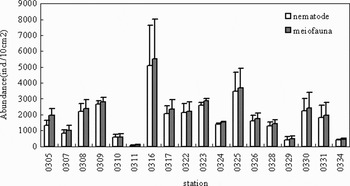
A total of 21 meiofauna groups were identified in this study. Meiofauna abundance ranged from 76±44 ind10 cm−2 at Station 0311 to 5510±2497 ind10 cm−2 at Station 0316. Nematodes dominated the samples at all stations, ranging from 61.3% (Station 11) to 96.8% (Station 16) of total meiofauna (Figure 3).
Meiofauna and nematode abundance at sampling stations (the error bars refer to standard deviations).

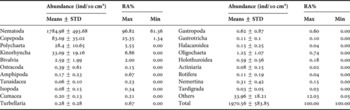
Results from the one-way ANOVA revealed significant differences between sampling stations in terms of meiofauna abundance (log, F = 30.117, P < 0.001), nematode abundance (log, F = 28.041, P < 0.001) and dominance (Kruskal–Wallis ANOVA, P = 0.008). Harpacticoid copepods were the next numerically important group at the studied stations, accounting for 4.2% of total meiofauna on average (Table 2). Results from ANOSIM confirmed that meiofauna assemblages at all stations from the studied area were significantly different from each other (Global R = 0.635, P < 0.01). From applying a multidimensional scaling ordination (MDS) plot of square-root transformed meiofauna abundance, differences between stations can be detected (Figure 4A). Apparently, the meiofauna assemblages of Stations 0310, 0311 and 0329 differed from those of the other stations.
Mean abundance and relative abundance (%) of meiofauna groups.

Max, maximum; Min, minimum.
Nematodes community structure
NEMATODES SPECIES COMPOSITION AND BIODIVERSITY
A total of 263 nematode species or morpho-species belonging to 119 genera and 29 families was recorded at the studied stations. Xyalidae (34.8%), Comesomatidae (16.9%), Linhomoeidae (14.8%), Axonolaimidae (6.7%) and Chromadoridae (4.6%) were the most abundant nematode families at all stations, accounting for 77.8% of the total nematode fauna. The most abundant genera were Daptonema, Cobbia, Sabatieria, Dorylaimopsis and Terschellingia, accounting for 50.0%. The ten most abundant species were Cobbia sp. 1, Dorylaimopsis rabalaisi, Daptonema sp. 3, Filitonchus sp. 2, Parodontophora marina, Microlaimus sp. 2, Daptonema sp. 5, Cobbia sp. 3, Axonolaimus sp. 1 and Spilophorella sp. 2, accounting for 52.8%.
MDS of square-root transformed nematodes abundance data showed a similar pattern to that of meiofauna abundance (Figure 4B). The differences between stations can be seen in the MDS plot: most of them showed aggregation except for Stations 0334, 0330 and 0329. In addition, results from the MDS revealed that the nematodes species assemblages of Stations 0310 and 0311 differed significantly from those of the other stations.
MDS ordination on square-root transformed absolute abundance data of meiofauna taxa (A) and nematodes (B).

Biodiversity indices Shannon H′, species richness d, and evenness index J′ were low at stations near the Changjiang Estuary (such as Stations 0310 and 0311) and Simpson dominance index λ was high at these stations. At other stations the indices differed little and showed a similar biodiversity level (Figure 5).
K-dominance curves of nematode species at the different stations of this study.

FUNCTIONAL ASPECTS OF THE NEMATODE COMMUNITY
The analysis of the trophic structure of the nematode community from the studied area showed a dominance of epigrowth feeder types (2A) constituting 45.3±10.4% of nematode abundance. In particular, 2A dominance was prominent at Station 0311 (73.3% of nematode abundance), and lowest at Station 0310 (27.1% of nematode abundance). Selective feeder types (1A) and non-selective feeder types (1B), taken together, made up 52.5±22.8% of nematode abundance. However, 1B showed complete dominance, comprising 65.9% of nematode abundance at Station 0310. At Station 0334, 1B comprised only 10% of nematode abundance while 1A predominated, comprising 45.0% of nematode abundance. Predators were 2.2±1.3%. The ratio 1B to 2A was different among stations ranging from 0.24 (Station 0334) to 2.43 (Station 0310). There was a weak gradient from stations near the Changjiang Estuary to the more distant stations. Only in the furthest away Stations 0330 and 0334, the ratio was less than 0.5 and much lower than that of other stations. In other stations, the ratio was high and the highest ratio was observed in the coastal Stations 0310, 0317 and 0329 (1B/2A larger than 1). This indicated that organic detritus was abundant in most coastal stations.
Correlation analysis with environmental variables
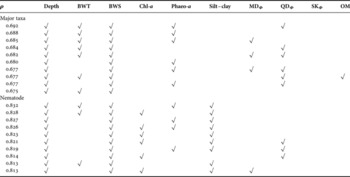
Correlation analysis of the meiofauna numbers and environmental variables indicated that total meiofauna abundance and nematode abundance had highly significant correlations with bottom-water temperature (Pearson's r = −0.602 and −0.571, P < 0.01), bottom-water salinity (Pearson's r = 0.688 and 0.691, P < 0.01), Chl-a (Pearson's r = 0.824 and 0.839, P < 0.01), Phaeo-a (Pearson's r = 0.777 and 0.806, P < 0.01), and organic matter content (Pearson's r = 0.471 and 0.499, P < 0.05). MDS plots based on meiofauna and nematodes assemblages generally agreed with those of environmental variables. BIOENV was used to determine the subsets of environmental variables, which provide the closest matches with the meiofauna community structure. The results showed that no single variable was highly correlated with the variation in meiofauna or nematode community structure (Table 3).
Summary of BIOENV results. Environmental variables (√) contributing to subsets providing the ten ‘best’ matches (ρ = Spearman's rank correlation) with nematode and meiofauna abundances across sites.

BWT, bottom-water temperature; BWS, bottom-water salinity; OM, organic matter content.
Variation in the meiofauna community structure across stations was most highly correlated with five variables (Spearman's ρ = 0.692), namely water depth, BWT, BWS, Phaeo-a and QDΦ. Among these, water depth and BWS were included in all the ten best combinations of environmental variables. Sediment variables and Phaeo-a were included in most combinations.
The data treatment indicates that nematode community structure variation (Spearman's ρ = 0.832) is influenced by five variables: water depth, BWT, BWS, Phaeo-a and silt–clay content. Among these, water depth, BWS and silt–clay content were included in all the ten best combinations. Nematode trophic structure was influenced by water depth, bottom-water salinity, Chl-a and Phaeo-a (Spearman's ρ = 0.72). The correlation analysis of nematode trophic structure with environmental variables showed that all the nematode feeder types abundances were positively correlated with BWS, Chl-a, and Phaeo-a (all P < 0.01). In addition, types 1A and 2A were negatively correlated with BWT (Pearson's r = −0.677 and −0.547, P < 0.05). Types 2A and 2B were correlated positively with organic matter content (Pearson's r = 0.47 and 0.537, P < 0.01) and negatively with QDΦ (Pearson's r = −0.588 and 0.48, P < 0.01).
DISCUSSION
Benthic environment
The studied area is located in the inshore area of the continental shelf. The dominant sediment types of the sampling stations are silty-clay (TY) and clayey-silt (YT) and the attenuated currents allow fine sand and mud to be deposited (Giere, Reference Giere1993). In addition, the studied area receives deposits from Changjiang runoffs. This area received run-offs from the Changjiang River, which transports mud and sand from the land. The gradual sedimentation of the discharges may result in the actual sediment composition in the studied area. Due to anthropogenic activities (estuarine training engineering, aquaculture, sewage discharge and pollution, etc.), sediment chloroplastic pigments and organic matter accumulated in the benthic environment. Sediment chloroplastic pigments and organic matter content were higher than those of the Bohai Sea (Guo et al., Reference Guo, Zhang and Mu2002) and the southern Yellow Sea (Liu et al., Reference Liu, Zhang and Huang2007). In the studied area, the proportion of carbon originating from the terrestrial environment was high (Liu et al., Reference Liu, Zhai and Niu2005b). This is the main reason why the studied area had higher organic matter content than other adjacent seas of China. A relatively close relationship among sediment granularity and sediment biotic factors confirmed that the environmental variables of the studied area were heterogeneous, mainly because of sediment grain size variation.
Relationship between nematode assemblages and their habitat
The densities of total meiofauna and the important meiofauna groups reported here are broadly in line with those reported in marine sediments from a variety of studied locations (Zhang et al., Reference Zhang, Li, Tu and Yu1989, Reference Zhang, Lin, Zhou, Han, Wang and Tian2004; Mu et al., Reference Mu, Zhang and Guo2001; Liu et al., Reference Liu, Zhang and Huang2005a). The predominant nematode genera Daptonema, Cobbia, Sabatieria, Dorylaimopsis and Terschellingia are also dominant in the sublittoral of other areas, albeit in different proportions (Somerfield et al., Reference Somerfield, Fonsêca-Genevois, Rodrigues, Castro and Santos2003; Huang et al., Reference Huang, Zhang, Liu and Zhang2006). In addition, the genera found in the Changjiang Estuary and its adjacent waters are also found in other sediments world-wide (Lambshead et al., Reference Lambshead, Brown, Ferrero, Hawkins, Smith and Mitchell2003; Schratzberger et al., Reference Schratzberger, Whomersley, Kilbride and Rees2004). In the light of these facts there is no evidence that the nematode communities in the Changjiang adjacent waters are very different to those already studied in the other sublittoral areas of the world, and therefore they should be expected to respond to changes in environmental conditions in similar ways.
In general, the studied nematode communities exhibited high nematode abundance and high species diversity. According to the location and habitat heterogeneity, nematode assemblages showed differences reflecting a weak influence of the Changjiang runoff, which was considered to have a potential impact on benthos. Apart from differences that might have resulted from stochastic causes, environmental variation may explain, to a certain extent, the observed similarities or differences in composition among the studied sites. Different combinations of environmental variables can be considered as responsible for the meiofauna and nematode communities' structures (Coull, Reference Coull1999). In the present study, the main factors governing the meiofauna (with emphasis on nematodes) community assemblage, diversity and functional aspect were: water depth, salinity, Chl-a, Phaeo-a, and silt–clay content, as reported in other studies (Vincx et al., Reference Vincx, Meire and Heip1990; Danovaro & Gambi, Reference Danovaro and Gambi2002). The present study also showed that water depth, salinity, Chl-a and Phaeo-a were mostly responsible for nematode assemblages' discriminations in the studied area, as they control or affect nematode communities to different extents.
The presence of Chl-a and Phaeo-a is essential for nematode density and distribution. Sand, nutrients and pollutants brought by Changjiang runoff settled in the studied area. The silty-clay sediment texture indicates a low energy and reduced sedimentation rate with large amounts of fine particles where land-source organic matter and detritus settle. The ratio of non-selective deposit feeders and epigrowth feeders (1B/2A) was used to indicate the alteration of nematode trophic characteristics and the amount of organic detritus in the substrate (Lambshead, Reference Lambshead1986). In the present study, the 1B/2A ratio value of nematodes decreased from the stations near the coast to more distant stations. The low value along the gradient indicates that organic detritus is abundant in most coastal stations. In addition, the significant coastal upwelling increased the density, production and biodiversity of phytoplankton resulting in the phytodetritus sinking to the bottom (González et al., Reference González, Menschel, Aparicio and Barría2007; Montero et al., Reference Montero, Daneri, Cuevas, González, Jacob, Lizárraga and Menschel2007). These rich food sources, represented by high values of Chl-a and Phaeo-a, may support an abundant meiofauna community as has been reported by Levin et al. (Reference Levin, Huggett and Wishner1991), Zhang et al. (Reference Zhang, Lin, Zhou, Han, Wang and Tian2004) and Liu et al. (Reference Liu, Zhang and Huang2005a). The highest meiofauna standing stocks have generally been observed in areas with high phytodetritus deposition, such as upwelling regions (West Africa) and frontal areas (Pfannkuche, Reference Pfannkuche1985). Deposit feeders become abundant with the increase of available food resources in the sediment. At most stations, considerable quantities of microplankton settle, benefiting from coastal upwelling and fresh water intrusion. Epigrowth feeders also increase with the presence of benthic or recently settled diatoms, as is the case in the studied area which is dominated by epigrowth feeders, indicative of increased food supply.
The salinity effect becomes noticeable at Stations 0310 and 0311 where nematode assemblages are very different from each other as well as different from the other stations. Metalinhomoeus sp. 1 was dominatant at Station 0311 and Daptonema sp. 1 at Station 0310. These two nematode assemblages exhibit low abundance, few species and low biodiversity. These two stations are the sites closest to the Changjiang Estuary where the low salinity (13.1–15.5‰) becomes one of the distinguishing features differentiating nematode assemblages from others (P < 0.01). Warwick et al. (Reference Warwick, Goss-Custard, Kirby, George, Pope and Rowden1991) stated that the most important environmental variables controlling or affecting the distribution and abundance of benthic animals in estuaries are salinity and several interrelated sediment variables (grain size and organic content), which in turn are determined by the hydrodynamic features of the estuary. The present results are very much in line with the findings of this study and of Yu et al. (Reference Yu, Tian and Yan2004), in which he shows that tides, currents, runoff and fresh water invasion are the main hydrodynamic features in the studied area. Suspended sand is brought by the Changjiang runoff and resuspended sediment from the low transparency turbid zone just beyond the estuary is carried in by tidal action. The turbid water impedes the assimilation and absorption of surplus nutrient brought by the Changjiang runoff, and is responsible for the markedly lower abundance of organisms in the estuary in comparison with other water bodies (Zhang et al., Reference Zhang, Li, Tu and Yu1989; Wang et al., Reference Wang, Huang, Liu and Zhang2004). The high turbidity and low salinity not only decrease meiofauna biodiversity (positive correlation with BWS, P < 0.01), but also affect the trophic structure of nematode communities. Deposit feeders (1A,B) are more abundant than epigrowth feeders (2A) that feed on benthic or recently settled diatoms. Epigrowth feeders seemed more sensitive to low BWS (Pearson's r = 0.661, P < 0.01). However, 2A dominance was prominent at the lowest salinity Station 0311. This however may be a sporadic occurrence, since the nematode abundance is very low.
Water depth was potentially important in influencing benthic assemblage structure, most likely because it determines other factors such as the amount and quality of phytoplankton-derived carbon reaching the sea-floor (Schratzberger et al., Reference Schratzberger, Whomersley, Kilbride and Rees2004). With the increase in water depth, nematode abundance and biodiversity at Stations 0330, 0331 and 0334 decrease. As stated by Coull (Reference Coull1999), Soltwedel (Reference Soltwedel2000) and many others, meiofauna abundance and density decrease with increasing water depth. Although the water depth variations within the studied stations are not significant, nevertheless meiofauna abundance decreased with increasing water depth while differences in meiofauna community structure related to water depth were also evident.
In the present study, the assemblages of both major taxa and nematodes species provide evidence that water depth, salinity, Chl-a, Phaeo-a, and silt–clay content are important determinants of community structure. However, Changjiang runoff, tides, currents, Zhejiang coastal upwelling etc are essential abiotic environments for the area studied. Together they interacted, to determine the conditions which shaped the meiofauna community structure in the Changjiang Estuary and its adjacent waters.
ACKNOWLEDGEMENTS
We acknowledge the help of Mr Yu Zishan, Ms Du Yongfen, Mr Pu Xiangwei in collecting the samples, and other participants in RV ‘No.2 Dongfanghong’ in June 2003, and acknowledge the assistance of Mr Liu Xiaoshou and Dr Huang Yong for data analysis and species identification. This study was supported by the National Key Basic Research Program from the Ministry of Science and Technology, People's Republic of China (No. 2002CB412400) and the National Natural Science Foundation of China (No. 40576061.40730847). We thank two anonymous referees for critically reading and commenting on the earlier version of this manuscript and Professor Anastasios Eleftheriou of the Hellenic Centre for Marine Research for improving the English.