Implications
In this study, resistant starch (RS) seemed to prolong satiety, to increase 24 h short-chain fatty acid and triglyceride concentrations, to reduce postprandial glucose, insulin and serotonin, but not to affect some putative hormonal regulators of satiety, such as glucagon-like peptide-1 and peptide tyrosine tyrosine. Increased knowledge about the underlying mechanisms by which RS induces satiety could facilitate a deliberate and effective application of RS in animal and human diets. RS may potentially be used for improving welfare in restrictedly fed sows that may experience hunger. Moreover, RS may be used for reducing energy intake and BW gain in humans.
Introduction
RS escapes enzymatic digestion in the small intestine and is largely fermented in the caecum and colon into short-chain fatty acids (SCFA) (De Leeuw et al., Reference De Leeuw, Jongbloed, Spoolder and Verstegen2005; Darzi et al., Reference Darzi, Frost and Robertson2011). Behavioural studies on pigs suggest that RS prolongs the duration of satiety (Bolhuis et al., Reference Bolhuis, van den Brand, Bartels, Oostindjer, van den Borne, Kemp and Gerrits2010; Souza da Silva et al., Reference Souza da Silva, Van den Borne, Gerrits, Kemp and Bolhuis2012 and Reference Souza da Silva, Bolhuis, Gerrits, Kemp and Van den Borne2013). For adult pigs, RS appeared to be more satiating than other types of fermentable fibre, likely because of its slow rate of fermentation, which may affect feelings of satiety (Souza da Silva et al., Reference Souza da Silva, Bolhuis, Gerrits, Kemp and Van den Borne2013).
In humans, however, studies on the satiating properties of RS have yielded inconsistent results (Higgins, Reference Higgins2004; Wanders et al., Reference Wanders, van den Borne, de Graaf, Hulshof, Jonathan, Kristensen, Mars, Schols and Feskens2011), which could be related to the difficulty to standardize external factors affecting satiety regulation (age, BW, gender, food intake) and the time required for microbial adaptation to fermentable fibre (Souza da Silva et al., Reference Souza da Silva, Van den Borne, Gerrits, Kemp and Bolhuis2012). Therefore, pigs that are also omnivorous colonic fermenters (Topping and Clifton, Reference Topping and Clifton2001) are increasingly used as models for human digestive function.
Putative mechanisms for the satiating effects of RS are related to the increased microbial production of SCFA. First, increased absorption of SCFA may prolong postprandial energy supply to the body (De Leeuw et al., Reference De Leeuw, Jongbloed, Spoolder and Verstegen2005; Darzi et al., Reference Darzi, Frost and Robertson2011), which may cover energy requirements particularly after intestinal absorption of glucose is completed, and thereby prolong satiety (De Leeuw et al., Reference De Leeuw, Jongbloed, Spoolder and Verstegen2005). It has been shown that exchange of enzymatically digestible starch by RS in the diet, indeed, resulted in stabilized postprandial levels of glucose and insulin, which prolongs satiety likely by preventing drops in glucose levels below basal levels (De Leeuw et al., Reference De Leeuw, Jongbloed, Spoolder and Verstegen2005; Serena et al., Reference Serena, Jorgensen and Bach Knudsen2009). Second, SCFA may stimulate the release of the satiety-related hormones peptide tyrosine tyrosine (PYY) and glucagon-like peptide-1 (GLP-1) from entero-endocrine cells (Keenan et al., Reference Keenan, Martin, Raggio, McCutcheon, Brown, Birkett, Newman, Skaf, Hegsted, Tulley, Blair and Zhou2012). Both hormones affect satiety via an effect in the brain (either through the circulation or through vagal afferent signals, or both) and via the ‘ileal brake’ (Sleeth et al., Reference Sleeth, Thompson, Ford, Zac-Varghese and Frost2010). Finally, SCFA may stimulate the release of serotonin (5-hydroxytryptamine (5-HT)) in the colon through activation of free fatty acid 2 receptors expressed in 5-HT-containing cells, which affect colonic motility and overall transit time of digesta, thus contributing to satiety regulation, independently of PYY and GLP-1 (Sleeth et al., Reference Sleeth, Thompson, Ford, Zac-Varghese and Frost2010).
Postprandial changes in metabolic and hormonal profiles and physical activity induced by RS are not well characterized over time, and are important to study the mechanisms by which RS promotes long-term satiety. Therefore, the present study aimed to assess the time-course of RS-induced changes in general physical activity and behaviour (as an indicator of hunger/satiety), satiety-related hormones and metabolites in growing pigs, and relate those to feeding behaviour and meal size during an ad libitum meal.
Material and methods
Animals and housing
Ten Landrace barrows (initial BW: 58±1.6 kg; age: 4 months) from eight litters (one to two pigs per litter) were assigned to two dietary treatments in a 2×2 cross-over design with two identical 14-day experimental periods. Pigs were individually housed in metabolism pens (2×1 m) within a temperature controlled room (20±2°C). Lights were on from 0500 h until 1900 h and dimmed during the night. Pens were equipped with a feeder and cleaned daily. A metal tray and funnel system beneath a rubberized metal-grid floor (0.5 cm oval holes) allowed urine collection with minimal faecal contamination. The Animal Care and Use Committee of Wageningen University and Research Centre (Lelystad, The Netherlands) approved the experiment.
Diets, feeding and surgery
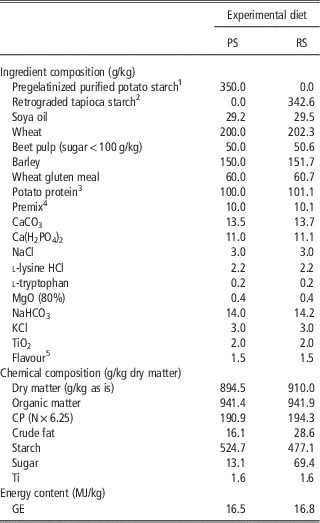
Treatments differed in the type of starch in the diet: pregelatinized potato starch (PS) or retrograded tapioca starch (RS). The two experimental diets contained either 35% PS (PaselliTM WA4, Avebe Food, Veendam, The Netherlands) or 34% RS (C*Actistar 11700, Cargill, Amsterdam, The Netherlands), and were designed to meet nutrient requirements according to the Dutch feed evaluation system for pigs (Centraal Veevoeder, 2007). Diets were formulated to provide equal amounts of gross energy (GE) (~17 MJ GE/kg diet). Table 1 shows the ingredient and analysed chemical composition of the diets. Diets were produced as a single batch of a basal diet to which starch sources were added. Diets were flavoured to mask differences in palatability as much as possible, and TiO2 was added as an indigestible marker. Diets were fed as mash and mixed with water (water : feed=2.5 : 1) in the feeders just before feeding. Pigs were fed at 0700h and 1600 h at 2.8× the energy requirements for maintenance (MEm=450 kJ/kg0.75per day). The amount of feed was adjusted daily according to the metabolic BW (kg0.75) of the pigs and an anticipated daily gain of about 500 g. Water was continuously available.
Ingredient and analysed chemical composition of experimental diets

PS=pregelatinized potato starch diet; RS=retrograded tapioca starch diet; GE=gross energy.
1 PaselliTM WA4, Avebe Food, Veendam, The Netherlands.
2 C*Actistar 11700, Cargill, Amsterdam, The Netherlands.
3 Protastar, Avebe Food, Veendam, The Netherlands.
4 Provided the following per kg of feed: vitamin A: 7500 IU; vitamin D3: 1500 IU; vitamin E: 60 mg; vitamin K3: 1.0 mg; vitamin B1: 1.0 mg; vitamin B2: 4.0 mg; vitamin B6: 1.0 mg; vitamin B12: 20 μg; niacin: 20 mg; calcium-d pantothenate: 10.5 mg; choline chloride: 100 mg; folic acid: 0.4 mg; Fe: 120 mg (FeSO4.H2O); Cu: 15 mg (CuSO4·5H2O); Mn: 60 mg (MnO); Zn: 75 mg (ZnSO4·H2O); I: 4.0 mg (KI); Se: 0.30 mg (Na2SeO3); anti-oxidant: 75 mg.
5 Luctarom Advance Cherry Honey, Lucta S.A., Barcelona, Spain.
During 1-week habituation, pigs were fed a 50 : 50 mix of the PS and RS diets, and adapted to individual housing and feeding regime. After the habituation period, pigs were provided with two permanent blood vessel catheters in the carotid artery for blood sampling and in the jugular vein for back-up in case of a malfunctioning arterial catheter (see Koopmans et al., Reference Koopmans, Van Der Meulen, Dekker, Corbijn and Mroz2006 for details). In the week after surgery, pigs were habituated to blood sampling. After 4 to 6 days of postsurgical recovery, pigs were gradually switched to the experimental diets. In each experimental period (days 1 to 14), pigs were daily fed a restricted meal of either the PS or RS diet, with the exception of the morning meal on day 10, when an ad libitum meal of either the PS or RS diet was provided during 1 h.
Measurements and sample collection
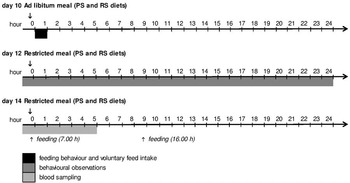
BW was measured weekly. Faeces (for GE and Ti analyses) and urine (for GE analysis) were collected quantitatively per pig from days 13 to 14 and from days 12 to 14, respectively, of each experimental period. Faecal samples were collected directly from the pen floor twice daily and urine samples were collected daily from the total urine output of each pig, and stored at −20°C until analysis. In each period, satiating effects of the diets, that is, the time-course of changes in general physical activity and behaviour (as an indicator of hunger/satiety), and in satiety-related hormones and metabolites, were assessed when pigs were fed a restricted morning meal (days 12 and 14, respectively) of either the PS or RS diet. In addition, an ad libitum meal of either the PS or RS diet was provided in the morning of day 10 for 1 h, during which feeding behaviour (for details see Behavioural observations) and voluntary feed intake were measured (see Figure 1).
Schedule of measurements of (feeding) behaviour and blood sampling applied to growing pigs fed an ad libitum morning meal (day 10) and a restricted morning meal (days 12 and 14) of a diet containing either pregelatinized potato starch (PS) or retrograded tapioca starch (RS).

Blood samples (6 ml) were collected in EDTA tubes with protease and dipeptidyl peptidase-IV inhibitors before (at −30 and 0 min) and after (at 20, 40, 60, 90, 120, 180, 240 and 300 min) the restricted meal of the PS and RS diets on day 14, placed in ice water and centrifuged at 1300×g for 10 min at 4°C within 20 min after collection. Plasma was stored at −80°C until analysis. Extra blood samples (9 ml) were collected in EDTA tubes before (at −30 min) and after (at 20 and 300 min) the restricted meal on day 14. For measuring 5-HT levels, tubes with blood were placed in ice water and centrifuged at 160×g for 10 min at room temperature to obtain platelet-rich plasma (PRP). The extracted PRP (1 ml) was centrifuged at 16 100×g for 15 min at room temperature to obtain platelet pellets. The washed (with 1 ml of 0.9% NaCl solution, followed by centrifugation at 16100×g for 5 min) pellets were stored at −80°C until analysis. For measuring monoamine oxidase (MAO) activity, blood samples (1.2 ml) were stored at −80°C until analysis.
Chemical analyses and calculations
Diets were analysed for dry matter, ash, starch, sugar, CP, crude fat, GE and Ti, as previously described (Bosch et al., Reference Bosch, Verbrugghe, Hesta, Holst, van der Poel, Janssens and Hendriks2009), see Supplementary Material S1 for details. Blood plasma was analysed for glucose, insulin, triglycerides, non-esterified fatty acids (NEFA), active GLP-1, active PYY, tryptophan (Trp), large neutral amino acids (LNAA) and SCFA. Blood platelet pellets were analysed for 5-HT, and whole blood was analysed for MAO activity (see Supplementary Material S1 for details). Apparent faecal energy digestibility coefficient was calculated as previously described (Bosch et al., Reference Bosch, Verbrugghe, Hesta, Holst, van der Poel, Janssens and Hendriks2009) and the digestible energy (DE) content of the diet as its GE content multiplied by this coefficient. The metabolizable energy (ME) content was calculated as GE intake minus energy lost in faeces and urine.
Behavioural observations
On day 12 of each experimental period, the pigs’ postures and behaviours were scored from video recordings using 10 min instantaneous scan sampling for 24 h and expressed as percentages of observation time. Postures were standing and walking, kneeling and sitting, lateral lying and ventral lying (Souza da Silva et al., Reference Souza da Silva, Bolhuis, Gerrits, Kemp and Van den Borne2013). Behavioural oral activities were explorative behaviour (rooting or nosing floor or pen fixtures), chewing (repetitively chewing of pen fixtures or sham chewing) (Bolhuis et al., Reference Bolhuis, van den Brand, Bartels, Oostindjer, van den Borne, Kemp and Gerrits2010), feeder-directed behaviour (eating, and sniffing, licking or touching the feeder with the snout), drinking and other (all other behavioural activities).
Furthermore, pigs were observed continuously for 1 h during the ad libitum meal of either the PS or RS diet (day 10). Behaviours and postures scored were the same as described above, except that eating was scored separately, and used to determine the duration of the first bout of eating. The Observer software package (Noldus Information Technology B.V., Wageningen, The Netherlands) was used for all behavioural recordings.
Statistical analyses
Data were analysed using a mixed model in SAS (version 9.1; SAS Institute) with values in time and treatment of individual pigs taken as repeated measurements. For feed intake and BW data, the model included period and diet as fixed effects and pig as random effect. For the behaviours (days 10 and 12), plasma hormones and metabolites (day 14) the model included period, diet, time (of sampling or observation), and interaction of diet and time as fixed effects, and pig and pig (diet) as random effects. Sequence of treatments effect was removed from the final model if not significant (P>0.10). Data are presented as least-square means±s.e.m.
Results
Catheters functioned well during the experiment and were accurately placed as confirmed after section. None of the diets offered was refused during the experiment. All pigs remained healthy and had a normal growth throughout the experiment. Pigs’ BW at the start (57.9±1.6 kg) and at the end (79.7±2.0 kg) of the experiment did not differ between diets.
Diets and feed intake
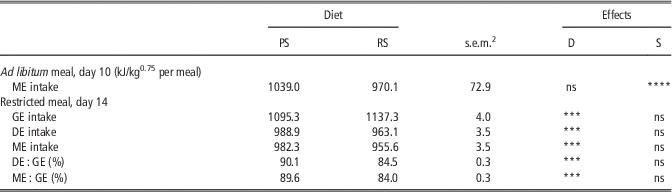
Energy digestibility (DE : GE) and metabolizability (ME : GE) were ~6% lower (P<0.001, Table 2), and ME intake was ~27 kJ/kg0.75 per day (~3%) lower in the RS compared with the PS diet (P<0.001, Table 2). When the PS and RS diets were fed ad libitum in the morning of day 10, feed intake was about twice the normal meal size: 70.3 and 68.8 g/kg0.75 (s.e.m.=5.0) in PS-fed and RS-fed pigs, respectively, with no difference between diets (P=0.83). There was an effect of the sequence of treatments on the size of the ad libitum meal consumed on day 10 (Table 2). Pigs receiving the PS–RS sequence tended to eat 15 g/kg0.75 less compared with pigs receiving the RS–PS sequence (P=0.07). This corresponded to a difference in ME intake of 214 kJ/kg0.75 (P=0.08).
Digestible and metabolizable energy intake (in kJ/kg0.75 per day, unless indicated otherwise) in growing pigs fed an ad libitum morning meal (day 10) and a restricted morning meal (day 14) of a diet containing either pregelatinized potato starch (PS) or retrograded tapioca starch (RS)Footnote 1

DE=digestible energy; GE=gross energy; ME=metabolizable energy.
Statistical significance of effects of diet (D) and sequence of treatments (S) is indicated: ***P<0.001, ****P<0.10, ns=non-significant. Period (P) did not influence energy intake.
1 Throughout the experiment, pigs were fed daily a restricted meal of the PS and RS diets, with the exception of the morning meal on day 10. On this day, an ad libitum meal of the PS and RS diets was provided for 1 h, during which feeding behaviour and voluntary feed intake were measured.
2 Pooled standard error of the least-square means.
Physical activity (24 h)
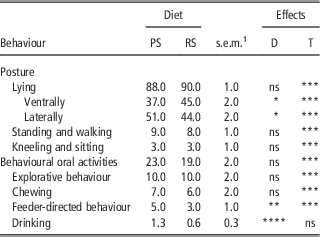
Behaviours on day 12 were affected by time of the day (all P<0.001, Table 3), except for drinking behaviour. Generally, pigs showed a daily activity pattern characterized by peaks of activity around feeding in the morning (between 0700h and 0900 h) and in the afternoon (between 1600h and 1800 h), interspersed by resting periods. Lying did not differ between diets (P=0.30). RS-fed pigs spent more time lying ventrally (45% v. 37%) and less time lying laterally (44% v. 51%, s.e.m.=2) than PS-fed pigs (both P<0.05, Table 3). PS-fed pigs performed more feeder-directed behaviours (5% v. 3%, s.e.m.=1, P=0.001), and tended to spend more time drinking (1.3% v. 0.6%, s.e.m.=0.3, P=0.10) than RS-fed pigs (Table 3).
Daily physical activity (in % of observation time) of growing pigs fed a restricted morning meal (day 12) of a diet containing either pregelatinized potato starch (PS) or retrograded tapioca starch (RS), based on video observations using 10 min instantaneous scan sampling for 24 h

Statistical significance of effects of diet (D) and observation time (T) is indicated: *P<0.05, **P<0.01, ***P<0.001, ****P<0.10, ns=non-significant. Interaction between diet and time (D×T), and period (P) did not influence daily physical activity.
1 Pooled standard error of the least-square means.
Behaviour during ad libitum meal
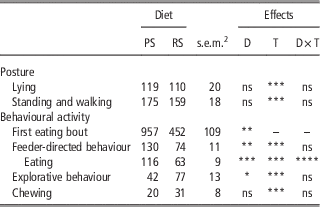
During the ad libitum meal of either the PS or RS diet (day 10), all behaviours were affected by time (all P<0.001, Table 4). Generally, activity of the pigs decreased after the first 15 min of the meal. The duration of the first bout of eating was shorter (P<0.01) in RS-fed (452 s) than in PS-fed pigs (957 s, s.e.m.=109). RS-fed pigs spent more time on non-feeder-directed explorative behaviour (77s v. 42 s, s.e.m.=13, P<0.05), and less time on feeder-directed behaviour, including eating, than PS-fed pigs (74s v. 130 s, s.e.m.=11, P<0.01). RS-fed pigs (63 s) spent less time eating than PS-fed pigs (116 s, s.e.m.=9, P<0.001), and this effect tended to be most pronounced during the first 30 min of the meal (diet×time interaction, P=0.06).
Mean duration (s) of behaviours performed by growing pigs during an ad libitum morning meal (day 10)Footnote 1 of a diet containing either pregelatinized potato starch (PS) or retrograded tapioca starch (RS), based on video observations using continuous sampling

Significance of effects of diet (D), observation time (T), and their interaction (D×T) is indicated: *P<0.05, **P<0.01, ***P<0.001, ****P<0.10, ns=non-significant. Period (P) did not influence behaviour.
1 Throughout the experiment, pigs were fed daily a restricted meal of the PS and RS diets, with the exception of the morning meal on day 10. On this day, an ad libitum meal of the PS and RS diets was provided for 1 h, during which feeding behaviour and voluntary feed intake were measured.
2 Pooled standard error of the least-square means.
Blood parameters
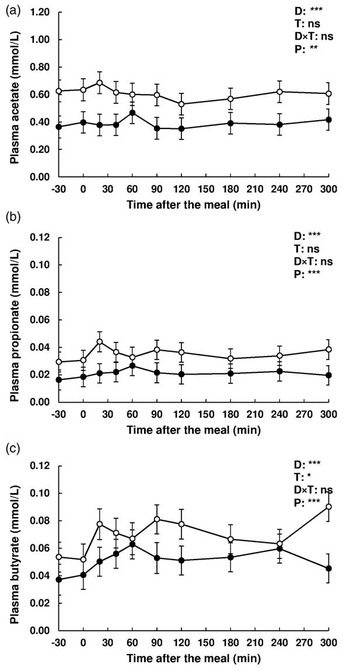
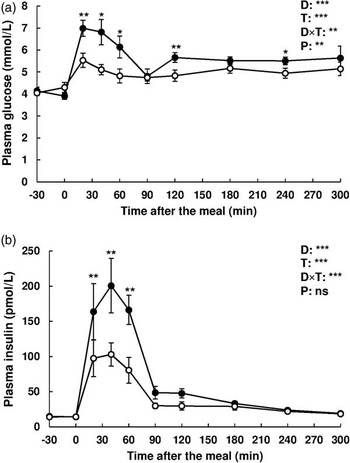
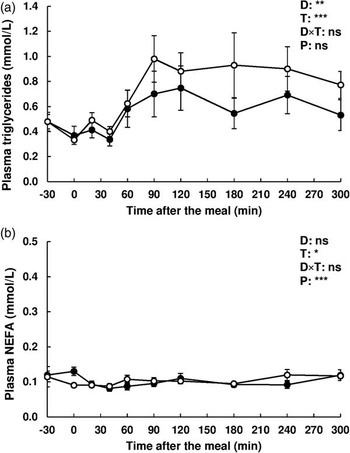
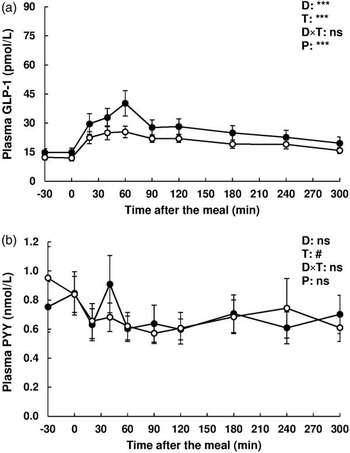
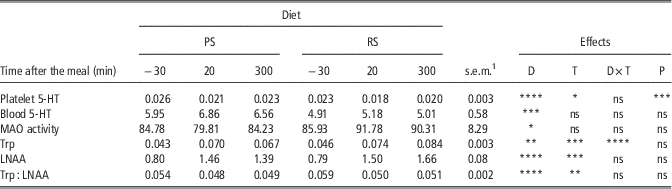
The plasma levels of SCFA, glucose, insulin, triglycerides, NEFA, GLP-1 and PYY around ingestion of the restricted PS and RS meals on day 14 are presented in Figures 2 to 5. 5-HT, MAO, Trp, LNAA and Trp : LNAA ratio are given in Table 5. Plasma SCFA levels were higher in RS-fed than in PS-fed pigs (all P<0.001). Basal glucose and insulin levels did not differ between diets. Plasma glucose levels were affected by diet (P<0.001), sampling time (P<0.001) and their interaction (P<0.01), with lower levels in RS-fed than in PS-fed pigs, particularly at 20, 40, 60, 120 and 240 min postprandial. The peak in glucose levels at ~20 min postprandial was lower in RS-fed than in PS-fed pigs (P<0.01). Plasma insulin levels were affected by diet (P<0.001), sampling time (P<0.001) and their interaction (P<0.001), with lower levels in RS-fed than in PS-fed pigs, particularly at 20, 40 and 60 min postprandial. The peak in insulin at ~40 min postprandial was lower in RS-fed than in PS-fed pigs (P<0.01). Plasma triglyceride levels were higher in RS-fed pigs than in PS-fed pigs (P<0.01). Triglyceride levels differed between sampling times (P<0.001), with higher levels at 90 min postprandial than at 0 min. Plasma NEFA levels were unaffected by diet (P=0.90), but were affected by sampling time (P<0.05), with higher levels at 90, 120, 180 and 240 min than at 40 min postprandial. Plasma GLP-1 levels were lower in RS-fed than in PS-fed pigs (P<0.001). GLP-1 levels differed between sampling times (P<0.001), with higher levels at 60 min than at 90, 120 and 180 min postprandial. Plasma PYY levels were unaffected by diet (P=0.90), but tended to be affected by sampling time (P=0.06), with higher levels at −30 min than at 120 min postprandial.
Plasma concentrations of short-chain fatty acids: acetate (a), propionate (b) and butyrate (c), in peripheral blood collected before (−30 min), during (0 min) and after (20 to 300 min) feeding growing pigs a restricted meal of the pregelatinized potato starch (PS) diet (●) and retrograded tapioca starch (RS) diet (○) in the morning of day 14. Statistical significance of effects of diet (D), sampling time (T), their interaction (D×T) and period (P) is indicated: *P<0.05, **P<0.01, ***P<0.001, ns=non-significant.

Plasma concentrations of glucose (a) and insulin (b) in peripheral blood collected before (−30 min), during (0 min) and after (20 to 300 min) feeding growing pigs a restricted meal of the pregelatinized potato starch (PS) diet (●) and retrograded tapioca starch (RS) diet (○) in the morning of day 14. Statistical significance of effects of diet (D), sampling time (T), their interaction (D×T) and period (P) is indicated: *P<0.05, **P<0.01, ***P<0.001, ns=non-significant.

Plasma concentrations of triglycerides (a) and non-esterified fatty acids (NEFA, b) in peripheral blood collected before (−30 min), during (0 min) and after (20 to 300 min) feeding growing pigs a restricted meal of the pregelatinized potato starch (PS) diet (●) and retrograded tapioca starch (RS) diet (○) in the morning of day 14. Statistical significance of effects of diet (D), sampling time (T), their interaction (D×T) and period (P) is indicated: *P<0.05, **P<0.01, ***P<0.001, ns=non-significant.

Plasma concentrations of glucagon-like peptide-1 (GLP-1, a) and peptide tyrosine (PYY, b) in peripheral blood collected before (−30 min), during (0 min) and after (20 to 300 min) feeding growing pigs a restricted meal of the pregelatinized potato starch (PS) diet (●) and retrograded tapioca starch (RS) diet (○) in the morning of day 14. Statistical significance of effects of diet (D), sampling time (T), their interaction (D×T) and period (P) is indicated: #P<0.10, *P<0.05, **P<0.01, ***P<0.001, ns=non-significant.

Platelet serotonin (platelet 5-hydroxytryptamine (5-HT), in μmol/109 platelets), whole blood serotonin (blood 5-HT, in μmol/l), monoamine oxidase activity (MAO, in μmol/l/h), tryptophan (Trp, in mmol/l), large neutral amino acids (LNAA, in mmol/l) and Trp : LNAA ratio in peripheral blood of growing pigs fed a restricted meal of a diet containing either pregelatinized potato starch (PS) or retrograded tapioca starch (RS)

Significance of effects of diet (D), sampling time (T), their interaction (D×T), and period (P) is indicated: *P<0.05, **P<0.01, ***P<0.001, ****P<0.10, ns=non-significant.
1 Pooled standard error of the least-square means.
Platelet 5-HT was affected by sampling time (P<0.05) with higher levels at −30 min than at 20 min postprandial, and tended to be lower in RS-fed pigs (P=0.08). Blood 5-HT levels were lower (P<0.001) and MAO activity was higher in RS-fed than in PS-fed pigs (P<0.05). Plasma Trp levels were affected by diet (P<0.01), sampling time (P<0.001) and there was a trend for the effect of their interaction (P=0.07). Trp levels were higher in RS-fed than in PS-fed pigs, particularly at 300 min postprandial. Plasma LNAA levels and Trp : LNAA ratio tended to be higher in RS-fed than in PS-fed pigs (P=0.08 and 0.07, respectively). LNAA levels were affected by sampling time (P<0.001), with higher levels at 300 min postprandial than at −30 min. The Trp : LNAA ratio was affected by sampling time (P=0.001), with higher levels at −30 min than at 20 and 300 min postprandial.
Discussion
To assess satiating effects of RS, we studied general physical activity during 24 h, and feeding behaviour and meal size during an ad libitum meal in growing pigs. RS-fed pigs showed less feeder-directed and drinking behaviours than PS-fed pigs over 24 h, indicating a long-term satiating effect of RS, which corresponds with studies reporting reduced signs of hunger, such as decreased feeding motivation (Souza da Silva et al., Reference Souza da Silva, Van den Borne, Gerrits, Kemp and Bolhuis2012 and Reference Souza da Silva, Bolhuis, Gerrits, Kemp and Van den Borne2013), reduced physical activity and preprandial restlessness, and prolonged satiety with dietary RS in restrictedly fed pigs (Bolhuis et al., Reference Bolhuis, van den Brand, Bartels, Oostindjer, van den Borne, Kemp and Gerrits2010).
When the PS and RS diets were fed ad libitum, RS-fed pigs decreased duration of the first bout of eating and reduced feeder-directed behaviour (including eating), suggesting that RS may have led to earlier satiation or meal termination in pigs, likely reflecting a satiating effect of the previous RS meal (Souza da Silva et al., Reference Souza da Silva, Bolhuis, Gerrits, Kemp and Van den Borne2013). These effects of RS were found with RS-fed pigs having a 3% lower ME intake than PS-fed pigs. During an ad libitum meal, however, feed intake was similar for RS-fed and PS-fed pigs. Thus, satiating effects of RS diets successfully compensated for a reduced ME content of the diet, but were apparently not able to further reduce voluntary feed intake during an ad libitum meal. Possibly, the drive for lean growth in the growing pigs used in the present study partly overruled the satiety-enhancing effect of RS previously observed in adult pigs (Souza da Silva et al., Reference Souza da Silva, Bolhuis, Gerrits, Kemp and Van den Borne2013). Alternatively, the ad libitum meal test may be less sensitive after a prolonged period of restricted feeding (~9 h inter-meal interval), resulting in temporary over-feeding and large variation in voluntary feed intake. Remarkably, feed intake during the ad libitum meals on day 10 tended to be lower for pigs receiving PS in period 1 followed by RS in period 2, than for pigs receiving RS–PS (sequence effect), which could be because of a decrease in the time needed for adaptation to the RS after feeding PS. Adaptation of the intestinal microbiota composition may occur more rapidly when pigs are changed from a low to a high fibre diet, which is accompanied with increased fermentation activity (Sappok, Reference Sappok2012). This increased fermentation likely contributed to the decreased voluntary feed intake in pigs receiving RS as last treatment.
Mechanisms for satiating effects of RS
To explore mechanisms by which RS may promote long-term satiety, we evaluated the effect of dietary RS on postprandial satiety-related hormones and metabolites. Mechanisms for the satiating effects of RS may be related to increased production of SCFA (De Leeuw et al., Reference De Leeuw, Jongbloed, Spoolder and Verstegen2005; Darzi et al., Reference Darzi, Frost and Robertson2011), which can prolong energy supply to the body (De Leeuw et al., Reference De Leeuw, Jongbloed, Spoolder and Verstegen2005). In the present study, peripheral SCFA levels were elevated throughout the day (both preprandial and postprandial) in RS-fed pigs compared with PS-fed pigs, in accordance with previous studies (Topping and Clifton, Reference Topping and Clifton2001; Regmi et al., Reference Regmi, van Kempen, Matte and Zijlstra2011). Moreover, postprandial glucose and insulin responses were lower in RS-fed pigs than in PS-fed pigs, reflecting a decreased influx of glucose by enzymatic digestion of RS as compared with PS, in line with other studies (Regmi et al., Reference Regmi, van Kempen, Matte and Zijlstra2011; Giuberti et al., Reference Giuberti, Gallo and Masoero2012). It should be noted that differences in dietary sugar levels were larger (13.1 and 69.4 g/kg DM for PS and RS diets, respectively) compared with a previous study on adult pigs fed similar diets (Souza da Silva et al., Reference Souza da Silva, Bolhuis, Gerrits, Kemp and Van den Borne2013). This could be owing to a difference between production batches of RS, and it might have reduced the contrast in glucose responses between diets.
In rats, SCFA from RS stimulate the release of satiety-related hormones, such as GLP-1 and PYY from entero-endocrine cells (Keenan et al., Reference Keenan, Martin, Raggio, McCutcheon, Brown, Birkett, Newman, Skaf, Hegsted, Tulley, Blair and Zhou2012), which could be a biological mechanism by which RS promotes satiety. In the present pig study, however, postprandial GLP-1 levels were lower for RS-fed than for PS-fed pigs, and PYY levels were similar for both diets throughout the day. The effect found on GLP-1 could be attributed to the lower amount of glucose released from the RS diet as compared with the PS diet, as it has been shown in pigs that GLP-1 secretion is maintained by glucose until 4 h postprandial, and thereafter by SCFA until up to 10 h postprandial (Regmi et al., Reference Regmi, van Kempen, Matte and Zijlstra2011). In our pigs, it was only possible to relate GLP-1 secretion to the differences in glucose response, and not to the differences in SCFA levels. SCFA and glucose can stimulate PYY secretion in rat intestine, but both to a lesser extent as fatty acids, which are considered the most potent stimulators of PYY secretion (Onaga et al., Reference Onaga, Zabielski and Kato2002). In the present study, the intake of long-chain fatty acids was identical between diets; thus, the similar postprandial PYY levels likely resulted from reduced glucose and increased SCFA concentrations in RS-fed pigs. It is unknown whether the PYY-stimulating potential of SCFA equals that of glucose in pigs; however, studies on rats suggest that the PYY response may be less strong with normal luminal physiological concentrations of SCFA than with supra-physiological intestinal infusions (Onaga et al., Reference Onaga, Zabielski and Kato2002). The absence of a preprandial treatment difference in plasma PYY implies that the influence of SCFA on plasma PYY is limited, as preprandial SCFA uptake likely exceeds that of glucose in RS-fed pigs (Gerrits et al., Reference Gerrits, Bosch and van den Borne2012). Alternatively, a negative feedback of GLP-1 on PYY secretion may exist, as also demonstrated in humans (Näslund et al., Reference Näslund, Bogefors, Skogar, Grybäck, Jacobsson, Holst and Hellström1999), and may have contributed to the PYY responses observed in our study.
Over the three sampling times, blood 5-HT levels were lower, whereas MAO activity and Trp levels were higher in RS-fed than in PS-fed pigs, indicating dietary effects on 5-HT metabolism. In the present study, 5-HT was quantified in blood platelets, which possess a high-affinity uptake system and accumulate high concentrations of excess 5-HT produced by the intestine (Keszthelyi et al., Reference Keszthelyi, Troost and Masclee2009). Dietary manipulation can influence intestinal 5-HT release (e.g. Bertrand et al., Reference Bertrand, Senadheera, Markus, Liu, Howitt, Chen, Murphy, Sandow and Bertrand2011), which in turn changes intestinal motility and transit (Kemperman et al., Reference Kemperman, Bruins, Te Lintelo, Van der Dijs, Erwich, Landman, Muskiet, Kema and Muskiet2007), and thereby potentially affects satiety (Sleeth et al., Reference Sleeth, Thompson, Ford, Zac-Varghese and Frost2010). Intestinal motility could be reduced in RS-fed pigs, possibly leading to a reduced passage rate of digesta in the colon, in line with a previous study demonstrating increased full weights of the caecum and colon in pigs fed native potato starch (Bolhuis et al., Reference Bolhuis, van den Brand, Staals and Gerrits2007). It should be noted though that the relationship between intestinal 5-HT release and motility is not always in the same direction (see Bertrand et al., Reference Bertrand, Senadheera, Markus, Liu, Howitt, Chen, Murphy, Sandow and Bertrand2011). The role of locally produced 5-HT on colonic motility, transit time and satiety in relation to dietary RS remains to be elucidated.
The increased plasma Trp levels (5-HT precursor) and Trp : LNAA ratios in RS-fed pigs, combined with the reduced blood 5-HT levels found in RS-fed pigs may reflect a decreased uptake of Trp into the peripheral tissues. Plasma Trp : LNAA ratio has been shown to be a major determinant of brain 5-HT concentration (Fernstrom and Wurtman, Reference Fernstrom and Wurtman1972), which has been reported to be involved in the regulation of feeding behaviour (Magalhaes et al., Reference Magalhaes, de Freitas, Nogueira, Campina, Takase, de Souza and de Castro2010). For instance, it has been demonstrated that food-seeking and food-taking behaviours are usually reduced in non-human primates with increased brain 5-HT turnover (Foltin, Reference Foltin2001). Although it is unknown whether the higher Trp levels and Trp : LNAA ratios in the RS-fed pigs resulted in higher brain 5-HT levels, this would be consistent with the lower level of feeder-directed behaviours in these pigs.
NEFA levels measured in blood reflect mobilized fatty acids from adipose tissues, and were expected to increase just before the morning meal, particularly in PS-fed pigs, likely coinciding with a drop in respiration quotient (Bolhuis et al., Reference Bolhuis, van den Brand, Staals, Zandstra, Alferink, Heetkamp and Gerrits2008) owing to increased fatty acid oxidation. There were no differences, though, in NEFA levels between treatments, likely because in growing animals the majority of nutrients is used for muscle and adipose tissue growth, with minimal rates of lipolysis. Particularly in pigs, most body lipids originate from de novo fatty acid synthesis, and mainly glucose is used as a substrate by adipose tissue (major site of fatty acid synthesis) for de novo lipogenesis (O’Hea and Leveille, Reference O’Hea and Leveille1969).
Plasma triglyceride levels were increased after feeding RS-diets, particularly between 90 and 300 min postprandial, corresponding with our previous observations in pigs fed similar diets (Haenen et al., Reference Haenen, Zhang, Souza da Silva, Bosch, van der Meer, van Arkel, van den Borne, Pérez Gutiérrez, Smidt, Kemp, Müller and Hooiveld2013). An explanation is that RS may have increased plasma levels of angiopoietin-related protein 4 (Angptl4), which is related to an upregulated expression of Angptl4 in the distal small intestine of RS-fed pigs (Haenen et al., Reference Haenen, Zhang, Souza da Silva, Bosch, van der Meer, van Arkel, van den Borne, Pérez Gutiérrez, Smidt, Kemp, Müller and Hooiveld2013). Angptl4 inhibits lipoprotein lipase, which is responsible for the hydrolysis of triglycerides, thereby increasing plasma triglyceride levels (Delzenne et al., Reference Delzenne, Neyrinck, Backhed and Cani2011). The large difference in postprandial glucose and insulin responses between treatments occurred predominantly before 90 min postprandial. It is generally assumed that insulin stimulates triglyceride uptake in the peripheral tissues and inhibits triglyceride production by the liver (Morand et al., Reference Morand, Rémésy, Levrat and Demigné1992). Consequently this would have led to reduced plasma triglyceride responses in PS fed pigs, particularly in the first 90 min postprandial. Such a response was not observed. Moreover, no inverse relationship between the area under the curve (AUC) was observed between plasma triglycerides and insulin until 300 min postprandial (r=0.04, P=0.88). In contrast, AUC for triglycerides and SCFA (particularly acetate) were highly correlated (r=0.62, P<0.01), which suggests that increased plasma triglyceride levels are mainly driven by increased SCFA levels. The expression of two genes responsible for fatty acid transport (fatty acid-binding protein 1) and fatty acid synthesis (Acetyl-CoA carboxylase α) were indeed found to be upregulated in the liver of RS-fed pigs (both P<0.05, 2.58 and 1.33 fold increase, respectively) (Haenen, Souza da Silva et al., unpublished results). Inhibition of hepatic fatty acid oxidation seems to increase food intake in rats, mice and humans, although a suppressive effect of an enhanced hepatic fatty acid oxidation on feeding has not been demonstrated (Leonhardt and Langhans, Reference Leonhardt and Langhans2004). Further studies are required to investigate whether triglyceride levels signal satiety.
In conclusion, although RS-fed pigs showed behavioural signs of increased satiety and reduced postprandial glucose and insulin responses compared with PS-fed pigs, we did not find an increase in GLP-1 and PYY plasma levels. Dietary RS did, however, affect SCFA and triglyceride plasma levels throughout the day, and 5-HT metabolism. The involvement of these in the satiating effects of RS merits further research.
Acknowledgements
The authors thank Lucta S.A. for kindly providing the flavour used in the diets, Fleur Bartels and Monique Ooms for their assistance with behavioural observations, and Rudie Koopmanschap, Merel Verhoeven, Iris van der Heden, Saskia van Laar, Tamme Zandstra, Erika Beukers, Jacques Vervoort and Lisette Ruuls van Stalle for assistance with laboratory analyses. They are grateful to Jan van der Meulen, Dirk Anjema, John Jansen, Gerrit Jan Deetman, Gerald Lok, Ruud Dekker, Katja Lange and personnel of experimental facilities at the Animal Science Group in Lelystad for their assistance during data collection.