Introduction
Panic disorder with agoraphobia can be effectively treated with cognitive behavioral therapy (CBT), an empirically based treatment with central elements of in vivo exposure and specific cognition challenging (Clark, Reference Clark1986; Barlow & Craske, Reference Barlow and Craske1994; Clark et al. Reference Clark, Salkovskis, Hackmann, Middleton, Anastasiades and Gelder1994, Reference Clark, Salkovskis, Ost, Breitholtz, Koehler, Westling, Jeavons and Gelder1997). In clinical settings, alternative forms of psychotherapy are also frequently used in the treatment of panic disorder. There is, however, surprisingly little systematic research on the effectiveness of these therapies, as most treatment studies for panic disorder have focused primarily on CBT (Goisman et al. Reference Goisman, Rogers, Steketee, Warshaw, Cuneo and Keller1993).
There are indications that primary panic attacks arise during times of increased interpersonal life stress (Faravelli & Pallanti, Reference Faravelli and Pallanti1989; Pollard et al. Reference Pollard, Pollard and Corn1989). Consequently, therapeutic approaches targeting the interpersonal context of the patient have the potential to be effective treatments for panic disorder. Initial studies in this area have yielded mixed results. Shear et al. (Reference Shear, Pilkonis, Cloitre and Leon1994) found a non-prescriptive treatment focusing on interpersonal life stressors was as effective as CBT for the treatment of panic disorder. However, the subsequently developed emotion focused therapy (EFT; Shear & Weiner, Reference Shear and Weiner1997), which emphasizes interpersonal conflicts as triggers for panic attacks, was demonstrated to be inferior to CBT (Craske et al. Reference Craske, Maidenberg and Bystritsky1995; Shear et al. Reference Shear, Houck, Greeno and Masters2001).
Another approach focusing on the interpersonal context of the patient is interpersonal psychotherapy (IPT; Klerman et al. Reference Klerman, Weissman, Rounsaville and Chevron1984). In relation to the above-mentioned interpersonal approaches, IPT focuses on the external interpersonal world instead of intrapersonal emotions and conflicts. IPT was originally developed and subsequently proven to be successful as a treatment for major depression (Klerman et al. Reference Klerman, Weissman, Rounsaville and Chevron1984; Elkin et al. Reference Elkin, Shea, Watkins, Imber, Sotsky, Collins, Glass, Pilkonis, Leber, Docherty, Fiester and Parloff1989; Weismann et al. Reference Weissman, Markowitz and Klerman2000; Luty et al. Reference Luty, Carter, McKenzie, Rae, Frampton, Mulder and Joyce2007). The effectiveness of this approach has also been demonstrated in bulimia nervosa (Fairburn et al. Reference Fairburn, Jones, Peveler, Carr, Solomon, O'Connor, Burton and Hope1991; Wilfley et al. Reference Wilfley, Welsch, Stein, Spurrell, Cohen, Saelens, Dounchis, Frank, Wiseman and Matt2002).
An open pilot study by Lipsitz et al. (Reference Lipsitz, Gur, Miller, Forand, Vermes and Fyer2006) yielded promising results for IPT as a treatment for panic disorder but more systematic research is required. The present study is the first to compare the effectiveness of CBT and IPT as treatments for panic disorder with agoraphobia in a randomized clinical trial. We studied CBT and IPT without adjacent pharmacological treatment to have a clear indication of their relative effectiveness.
Method
Participants
Participants were recruited, assessed and treated at the Academic Community Mental Health Center in Maastricht between 1996 and 2005. Diagnostic status was determined with the Structured Clinical Interview for DSM-III-R and DSM-IV Axis I disorders (SCID-I; First et al. Reference First, Spitzer, Gibbon and Williams1990, Reference First, Spitzer, Gibbon and Williams1996). Inclusion criteria consisted of a primary diagnosis of panic disorder with moderate to severe agoraphobia and age 18–60 years. Exclusion criteria included: co-morbid psychosis or bipolar disorder, alcohol or drug dependence, use of psycho-active drugs, an intelligence quotient (IQ) <80, insufficient understanding of the Dutch language, formal CBT or IPT treatment for the same complaint in the previous year, cardiovascular or respiratory disease, or epilepsy. Patients who were able to stop the use of psycho-active medication were included after 2 weeks of non-usage. The study was approved by the institute's ethics board, and all participants provided written informed consent. Of the 268 patients with a primary diagnosis of panic disorder with agoraphobia screened for participation, 91 (34.0%) were initially included in the study (see online Supplementary Fig. S1 for the subject flow chart and Table 1 for subject characteristics at baseline).
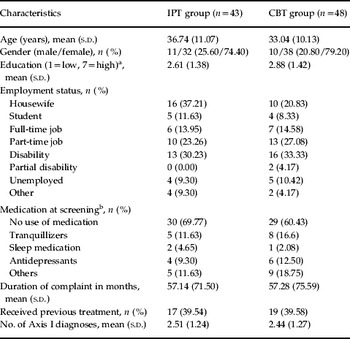
Baseline characteristics of study participants

IPT, Interpersonal psychotherapy; CBT, cognitive behavioral therapy; s.d., standard deviation.
a None of the participants completed a university education.
b Medication was tapered 2 weeks before baseline assessment.
Interventions
IPT treatment was based on standard IPT for depression. Twelve 1-h individual weekly sessions were subdivided into three main phases: first, providing information, placing panic disorder into the medical model, determining treatment focus (role conflict, transition, grief or skills deficit); second, exploring the interpersonal problem area and considering options for improvement; and third, preparing for treatment termination (a more detailed description of IPT treatment is available online in Supplementary Table S1).
CBT treatment was based on the models of Beck et al. (Reference Beck, Emery and Greenberg1985), Clark (Reference Clark1986) and Barlow (Reference Barlow1988) and combined cognitive therapy with in vivo and interoceptive exposure to reduce chronic (situational) avoidance. Treatment also consisted of 12 1-h individual weekly sessions that were highly structured compared to IPT. Panic attacks were proposed to be the result of misinterpreted bodily sensations. These misinterpretations were subsequently challenged with a range of cognitive and behavioral techniques. Agoraphobic avoidance was addressed with hierarchical assignments of exposure in vivo.
Design and procedures
Patients were randomly assigned to CBT (n = 48) or IPT (n = 43). Randomization occurred at the therapists' meetings after inclusion and baseline assessment. A non-treating therapist assigned the two conditions to heads or tails and a second non-treating therapist tossed the coin visible to all therapists present. Assessments took place at baseline (0 months), immediately after treatment (3 months) and at 4 months. Panic diaries were collected weekly during therapy and the 1-month follow-up period.
Treatment integrity
Protocol adherence was assessed with an adapted version of the Collaborative Study Psychotherapy Rating Scale – Form 6 (CSPRS-6; Hollon et al. Reference Hollon, Evans, Auerbach, DeRubeis, Elkin, Lowery, Kriss, Grove, Thason and Piasecki1988, Reference Hollon, Waskow, Evans and Lowery1994). The CSPRS-6 was originally used as an adherence check for treatment protocols (IPT, CBT and clinical management) in the Treatment of Depression Collaborative Research Program (Elkin et al. Reference Elkin, Parloff, Hadley and Autry1985). To use the CSPRS-6 in the present study, adjustments were made to the original 96 items: non-relevant items were deleted (i.e. items related to clinical management) and some items related to CBT were adjusted because CBT treatment for panic differs from CBT treatment for depression (Beck et al. Reference Beck, Rush, Shaw and Emery1979). The items related to IPT and the non-modality specific scales (i.e. facilitative conditions and explicit directiveness) were changed slightly because the applied IPT remained predominantly similar to IPT for depression (Klerman et al. Reference Klerman, Weissman, Rounsaville and Chevron1984).
Two randomly selected audiotaped sessions of a therapist–subject pair were scored by two independent raters who were blind to condition. Raters received 40 h of training prior to scoring.
Treatment credibility
At the end of the first therapy session, patients completed three treatment credibility self-report items on nine-point Likert scales, assessing the credibility of the treatment rationale and the patients' expectations regarding treatment (Borkovec & Nau, Reference Borkovec and Nau1972; Devilly & Borkovec, Reference Devilly and Borkovec2000). Scores were concealed from the therapists.
Therapists
Over 9 years, a total of 17 therapists participated in the present study. The initial therapist group attended a 2-day workshop of IPT given by J. C. Markowitz and CBT given by P. Salkovskis. New therapists entering the protocol were trained and assessed by these initial therapists. To control for individual therapist characteristics, therapists provided care in both treatment modalities. Therapists were masters-prepared or higher-level clinicians with a range of experience in delivering CBT and IPT (1–10 years) prior to this study.
Sample size
Based on previous studies we estimated that CBT treatment would have an effect size of 1 (Clark et al. Reference Clark, Salkovskis, Hackmann, Middleton, Anastasiades and Gelder1994). If IPT had only non-specific (placebo) effects, we expected its effect size to be approximately 0.33. To detect the difference in effect size of 0.67 at a two-sided significance level of 5% and a power of 80%, a sample size of 36 patients per group (in total 72 patients) was needed. To account for attrition, we increased the sample size to 91 patients.
Primary outcomes
Panic attack frequency
Panic diaries were completed on a daily basis, reporting each panic attack and associated experienced symptoms. Only attacks meeting DSM-IV criteria were taken into account.
Behavioral test
Three behaviors of increasing level of difficulty relevant to the patient but usually avoided were specified in cooperation with the therapist before randomization. Together, the therapist and patient explored situations that the patient usually avoided, and ranked them. From the top quartile, three situations were selected to represent severe avoidance. Safety behaviors were explored and prohibited in the instructions given to the patient. The therapist subsequently discussed the assigned task with peers and the investigator, and adapted the instructions as needed to increase feasibility. Examples of behavioral situations are: (1) taking the bus alone for 30 min at a busy time of the day, (2) taking a walk alone through the city center for 20 min without bringing along a bottle of water, and (3) taking the stairs to the fifth floor of a building and walking at a normal pace (so that the patient's heart would pound faster). Assessment by a research assistant took place at 0 and 4 months. Situations had to be executed to a normally tolerable degree without force, and it was stated specifically that execution or completion was not obligatory. Degree of performance (0% = no performance to 100% = complete performance) and experienced fear (0 = totally at ease to 8 = totally in panic) were rated by the patient and research assistant.
Secondary outcomes
Panic and agoraphobia severity
The Body Sensation Questionnaire (BSQ; Chambless et al. Reference Chambless, Caputo, Bright and Gallagher1984; Bouman, Reference Bouman1998) assesses fear of bodily sensations on three subscales: disposition, frequency and state. The Fear of Fear (FOF) questionnaire (Van den Hout et al. Reference Van den Hout, van der Molen, Griez and Lousberg1987) measures fear of bodily sensations experienced during a panic attack. The Fear Questionnaire (FQ; Marks & Mathews, Reference Marks and Mathews1979) assesses the amount of fear and avoidance in agoraphobic situations, and has idiosyncratic ratings.
Panic-related cognitions
These were assessed with the Agoraphobic Cognition Questionnaire (ACQ; Chambless et al. Reference Chambless, Caputo, Bright and Gallagher1984) and the Anxiety Sensitivity Index (ASI; Reiss et al. Reference Reiss, Peterson, Gursky and McNaly1986). The ACQ is a checklist of 14 thoughts possibly experienced during a state of anxiety, and the ASI evaluates the tendency to respond fearfully to anxiety-related symptoms.
General psychopathology
The 90-item Symptom Checklist (SCL-90; Derogatis et al. Reference Derogatis, Lipman and Covi1973; Arrindell & Ettema, Reference Arrindell and Ettema1981) assesses recently experienced psychological and physical complaints on eight subscales: fear, agoraphobia, depression, somatic complaints, mistrust and interpersonal sensitivity, inadequacy of thought and action, sleeping problems and anger/hostility. The items are rated on a five-point Likert scale (total score of the Dutch version ranges from 90 to 450). State and trait types of anxiety were assessed with the State–Trait Anxiety Inventory (STAI; Spielberger et al. Reference Spielberger, Gorsuch, Lushene, Vagg and Jacobs1983). Both instruments have good reliability and validity (Metzger, Reference Metzger1976; Evers et al. Reference Evers, Vliet-Mulder and Van Groot2000).
IPT and CBT specific measures
Cognitive beliefs
The 14-item Body Sensation Interpretation Questionnaire (BSIQ-14; Clark et al. Reference Clark, Salkovskis, Ost, Breitholtz, Koehler, Westling, Jeavons and Gelder1997) assesses interpretations of ambiguous events, including a range of bodily sensations. Additionally, the patient and therapist formulated 1–3 idiosyncratic catastrophic interpretations (Arntz, Reference Arntz2002) of feared bodily sensations before randomization. Their credibility at the moment of assessment and during a panic attack (retrospectively) was rated at each assessment using a 0–100-mm visual analogue scale (VAS).
Interpersonal functioning
The Inventory of Interpersonal Problems (IIP; Horowitz et al. Reference Horowitz, Rosenberg, Bear, Ureno and Villaseñor1988), a 127-item self-report scale, assesses interpersonal functioning. Higher scores indicate poorer functioning.
Data reduction and analysis
Statistical analyses were performed using SPSS version 15.0 for Windows (SPSS Inc., USA) and the statistical package R (R Development Core Team, 2009). Because of missing data, sample size varies to some extent among outcome measures. Intermittent missing data were imputed by the mean value of the previous and subsequent time point. Other missing data were not imputed. Intention-to-treat (ITT) analyses were conducted based on the last observation carried forward (LOCF, n = 91) method. Additional per-protocol analyses were carried out for the primary outcome measures with therapy completers (patients who received the full 12-session treatment and completed the study measurements, n = 67) and study completers (therapy completers n = 67, plus patients who completed the study measurements but dropped out, at any given point, during treatment n = 3; total study completers n = 70).
Primary measures
Panic attack frequency
Blocks were created from the panic diary data by averaging the number of panic attacks during baseline and each subsequent 3 weeks of therapy until the end of the study at 4 months. Log transformations were executed to reduce the extreme skewness of the data; however, the data still violated the assumptions for parametric testing and were consequently analyzed with robust statistical methods (Wilcox, Reference Wilcox2005). Within-condition effects were investigated with a percentile bootstrap method for estimating significance for one-sample data on the linear trend from 0 to 4 months. We tested therapy effects with the Wilcox ANCOVA on 20% trimmed means with a percentile bootstrap method, with the linear trend from 0 to 4 months as the dependent variable and baseline as the covariate. Because of their avoidant behavior, many patients with panic disorder with agoraphobia experience no panic attacks at the time they come into therapy (no experienced panic attack during the baseline period of 3 weeks: CBT: 20.9%; IPT: 26.8%). Consequently, a floor effect is inherent to the panic attack frequency measure.
Behavioral test
A principal component analysis (PCA; eigenvalues and explained variance at 0 months 3.72 and 93% respectively, and at 4 months 3.66 and 92% respectively) indicated that the behavioral test scores loaded on a single factor, so a composite measure was created by averaging patients' and research assistants' performance and fear ratings (transformed fear 0 = maximum to 100 = minimum). The reliability of the composite measure was sufficient (α = 0.75). The data violated the assumptions for parametric testing and were consequently analyzed with robust statistical methods (Wilcox, Reference Wilcox2005). To investigate within-condition effects, a percentile bootstrap method for estimating significance for one-sample data was used on difference scores. The therapy effect was tested with the Wilcox ANCOVA on 20% trimmed means with a percentile bootstrap method, with the linear trend from 0 to 4 months as the dependent variable and the baseline rank scores as covariate.
Secondary measures
For the secondary measures, only ITT analyses were executed. Based on a PCA, three composite measures (agoraphobia, general psychopathology and anxiety-related feelings and cognitions) were created from the remaining set of secondary outcomes to reduce experiment-wise error and increase power (Hollon et al. Reference Hollon, DeRubeis, Evans, Wiemer, Garvey, Grove and Tuason1992; Clark et al. Reference Clark, Salkovskis, Hackmann, Middleton, Anastasiades and Gelder1994; an outline of the subscales and composite measures is available online in Supplementary Table S2). Scores on the main 23 secondary (sub)scales were transformed for each participant into z scores (mean and standard deviation were computed for each measure across all measurement times). Composite measures were created by averaging z scores of the relevant (sub)scales per measurement time.
Data for the agoraphobia composite measure were transformed by a square root transformation. The general psychopathology and anxiety-related feelings and cognitions composite measures remained non-normally distributed after transformation. Within-condition effects were investigated with a one-sample t test or a percentile bootstrap method for estimating the significance for one-sample data on difference scores. Between-condition analyses were conducted on the linear trend from 0 to 4 months by ANCOVA or Wilcox ANCOVA on 20% trimmed means with a percentile bootstrap method, using therapy modality as the between-subjects factor and baseline measurement (0 months) as the covariate.
IPT and CBT specific measures
IPT and CBT specific measures were not intended as clinical outcome measures; therefore, only therapy completers' analyses were conducted. For the BSIQ-14, only items relating to bodily sensations and the belief scores of their negative interpretations were taken into account, as previous findings indicate that the changes in belief scores are more sensitive for treatment compared to ranking scores (Clark et al. Reference Clark, Salkovskis, Ost, Breitholtz, Koehler, Westling, Jeavons and Gelder1997). A PCA including pre–post-measure difference scores of the BSIQ-14 belief scores and the idiosyncratic misinterpretations showed that these measures loaded on a single factor (eigenvalue and explained variance: 1.736, 58%). Subsequently these scores were transformed for each participant into z scores (mean and standard deviation were computed for each measure across all measurement times) and a composite measure of beliefs was created by averaging the z scores for each measurement time.
The data of the IIP and the Beliefs composite measure violated the assumptions for parametric testing, apart from the ANCOVA on the IIP, and were consequently analyzed with robust statistical methods (Wilcox, Reference Wilcox2005). To investigate within-condition effects, a percentile bootstrap method for estimating significance for one-sample data was used for difference scores. The therapy effect was tested on the linear trend from 0 to 4 months by ANCOVA or by Wilcox ANCOVA on 20% trimmed means with a percentile bootstrap method and the baseline measurement (0 months) as covariate.
Effect sizes and reliable change
Improvement effect sizes were determined for all outcome measures and all time points according to Cohen's d statistic (Cohen, Reference Cohen1988) calculated from the one-sample t statistic (if necessary, estimated from the p value) of the difference scores. The between-condition effect sizes were also determined according to Cohen's d and calculated from the ANCOVA t statistic (if necessary, estimated from the p value). The percentage of reliably changed patients was determined for the primary outcome measures according to the method of Jacobson & Truax (Reference Jacobson and Truax1991): reliable change index (RC) = (x 2 – x 1)/S diff, where S diff = √[2(S E)2] and S E=s 1√(1 – r xx). An RC value >1.96 indicates an actual change at a significance level of p < 0.05.
Results
Pretest differences
Differences on pretreatment variables including age, sex, educational level, duration of complaints, medication use, pretest panic frequency, pretest behavioral composite score and pretest (composite) questionnaire scores were non-significant and clinically non-relevant between the two groups (Table 1).
Dropouts
Nine patients (21%) dropped out of IPT before the 12th session and 15 (31%) dropped out of CBT [χ2 (1; n = 91) = 1.24, p = 0.27]. The reasons for therapy termination for IPT were: the patient refused continuation because they felt that another problem was more urgent or prominent to treat, which led to another treatment indication (n = 2), no show and not traceable (n = 4), complaint improvement (n = 1), medication use (n = 1) and referred because of infatuation with the therapist (n = 1). CBT termination reasons included: pregnancy (n = 1), lack of time (n = 2), complaint improvement (n = 1), no show and not traceable (n = 3), crisis (n = 4), the patient refused continuation because they felt that another problem was more urgent or prominent to treat, which led to another treatment indication (n = 2) and medication use (n = 2) (subject flow chart available online).
Treatment integrity
Inter-rater reliability and internal consistency of the treatment integrity ratings were good to very good: CBT scale (0.91, 0.84), IPT scale (0.90, 0.91), facilitative conditions (FC) scale (0.75, 0.81), and explicit directiveness (ED) scale (0.58, 0.48). Predictive validity of the adapted CSPRS-6 was excellent; 76 out of 77 CBT tapes were classified correctly as CBT sessions and 58 out of 60 IPT sessions were classified correctly as IPT sessions by a discriminant analysis with the CSPRS-6 CBT and IPT subscales as independent variables. (means, s.d. and independent-samples t tests of the subscales are available online in Supplementary Table S3).
Treatment credibility
The internal consistency of the scale was sufficient (α = 0.83). Mann–Whitney tests revealed no significant difference in sum scores between the two conditions (U = 599.5, p = 0.955), indicating equal credibility of CBT (mean = 1389) and IPT (mean = 1095) treatment rationales.
Primary outcome measures
Panic attack frequency (n = 87)
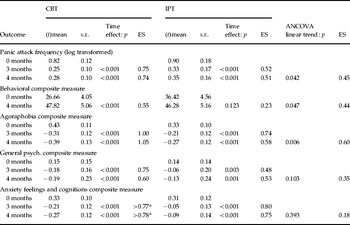
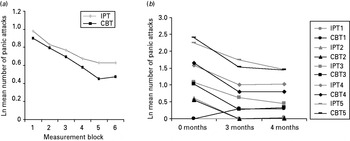
The linear trend of panic attack frequency deviated significantly from zero in both treatment modalities. Descriptive data, p values and effect sizes of all outcome measures are presented in Table 2. The decrease was significantly larger for CBT than for IPT (see Fig. 1 for the linear trend of panic attack frequency).
LOCF mean scores (s.e.) for primary and secondary outcome measures (20% trimmed means)

LOCF, Last observation carried forward; CBT, cognitive behavioral therapy; IPT, interpersonal psychotherapy; s.e., standard error; ES, effect size (Cohen's d).
a The ES is an estimate of the minimum size of the effect. The ES was calculated with the p value and, in these cases, the p value was 0 and contained, at the maximum number of bootstraps, no value other than 0 beyond the decimal point (e.g. 0.00000). Consequently the p value was set at <1/no. of bootstraps (e.g. < 1/700.000 or <0.0000014) so as to be able to calculate a minimal ES.
Behavioral composite measure (n = 85)
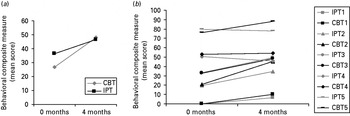
Achievements improved significantly for CBT but not for IPT. There was significantly more improvement in recipients of CBT compared to IPT (see Fig. 2 for the linear trend of the behavioral composite measure).
(a) Trimmed means of panic attack frequency [log transformed, last observation carried forward (LOCF)]. (b) Panic attack frequency (log transformed) trimmed means (LOCF) per quintile (divided into fifths), determined by the Wilcox ANCOVA design points.

Secondary outcome measures
Scores on the agoraphobic, general psychopathology and anxiety cognitions and feelings composite measures decreased significantly in both treatment modalities (n = 91). Decrease of scores on the agoraphobic composite measure was significantly larger for CBT than IPT. For the other two composite measures there were no significant differences in the linear trend between the two conditions.
IPT and CBT specific measures
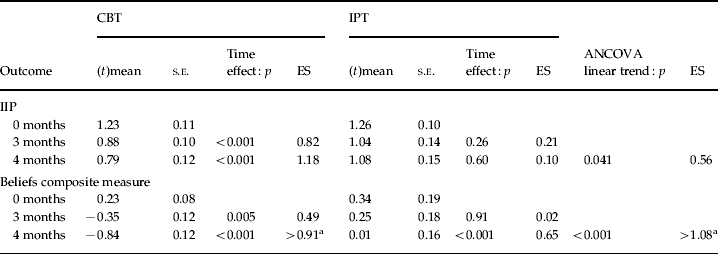
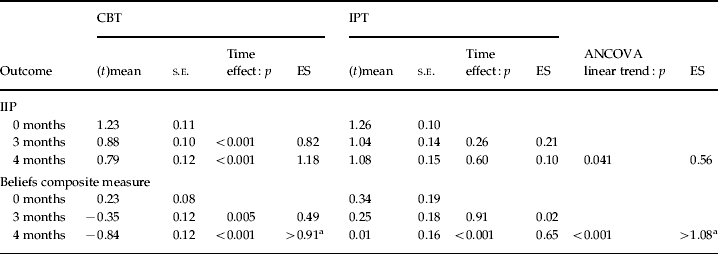
IIP (n = 57)
Scores decreased significantly for CBT from 0 to 3 and 4 months but no significant decrease occurred for IPT. There was a greater significant linear trend decrease in CBT (Table 3).
(a) Trimmed means of behavioral composite measure [last observation carried forward (LOCF)]. (b) Behavioral composite measure trimmed means (LOCF) per quintile (divided into fifths), determined by the Wilcox ANCOVA design points.

Completers' mean scores (s.e.) for condition-specific measures (20% trimmed means)
CBT, Cognitive behavioral therapy; IPT, interpersonal psychotherapy; IIP, Inventory of Interpersonal Problems; s.e., standard error; ES, effect size.
a The ES is an estimate of the minimum size of the effect. The ES was calculated with the p value and, in these cases, the p value was 0 and contained, at the maximum number of bootstraps, no value other than 0 beyond the decimal point (e.g. 0.00000). Consequently the p value was set at <1/no. of bootstraps (e.g. <1/700.000 or <0.0000014) so as to be able to calculate a minimal ES.
Belief composite measure (n = 60)
Scores decreased significantly for CBT from 0 to 3 and 4 months and from 0 to 4 months for IPT. The decrease was significantly larger for CBT than for IPT (Table 3).
Reliable and clinically significant change
Panic attack frequency
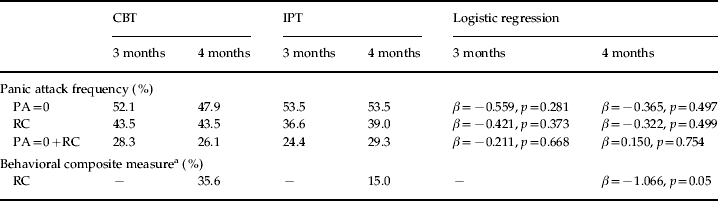
Percentages of panic-free patients, reliable change and their combination at 3 and 4 months are presented in Table 4. Logistic regression analyses with panic attack absence (yes/no) at 3 or 4 months as the dependent variable, baseline panic attack frequency as covariate and condition as independent variable showed no significant condition effects.
Primary outcome measures: absence of panic attack (PA) and reliable change (RC) at 3 and 4 months (LOCF)
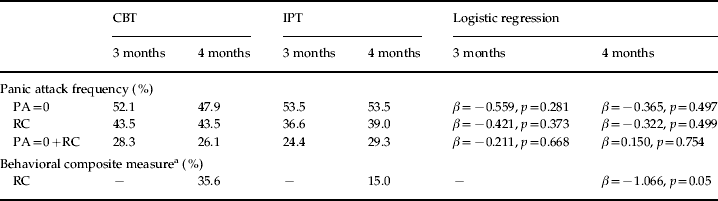
LOCF, Last observation carried forward; CBT, cognitive behavioral therapy; IPT, interpersonal psychotherapy.
a For the behavioral composite measure no clinically significant change was calculated because no norm data are available for this measure and we regard the absence of behavioral fear and avoidance or a change of at least 2 s.d. from the pretreatment mean too strict a criterion.
Behavioral composite measure
Reliable change percentages are displayed in Table 4. Logistic regression with reliable change (yes/no) at 4 months as the dependent variable, baseline measurement as the covariate and condition as the independent variable showed a significant condition effect in the direction of CBT.
Per-protocol analyses
The results of the per-protocol analyses for the number of panic attacks differed from the ITT analyses as the within-condition effect sizes (ES) in the CBT condition became larger for both the study and therapy completers (n = 70, 67) (>0.98, >1.03). The between-condition difference increased for both the study and therapy completers (p < 0.001, ES = 0.63; p < 0.001, ES = 0.68).
For the idiosyncratic behavioral test, the effect sizes within the CBT condition became larger for both the study and therapy completers (n = 59, 57) (4 months: 0.85, 0.86). The condition effect also became larger for both study and therapy completers (p = 0.005, ES = 0.77; p = 0.002, ES = 0.88).
Adverse events
No adverse events were noted for either CBT or IPT treatment conditions.
Discussion
Main findings
This randomized trial compared CBT and IPT as treatments for panic disorder with agoraphobia. Only medication-free patients were included to obtain a clear comparison of the two psychological treatments. Independent raters gave high treatment adherence scores to both treatments (Hill & O'Grady, Reference Hill and O'Grady1992), indicating that the treatments were given as intended. On the two primary outcome measures, the results indicate the superiority of CBT over IPT. Agoraphobic avoidance and fear assessed with an idiosyncratic behavior test, in addition to panic attacks, improved more after 12 sessions of CBT than after 12 sessions of IPT treatment. These results held for all tests (ITT analyses, study completers and therapy completers). There was no difference between CBT and IPT in percentages of dropouts. Regarding the secondary outcome measures, the results from the self-reported agoraphobic symptoms are in line with the findings on the behavioral test. The decrease of self-reported agoraphobic problems was stronger in CBT than in IPT at 3 and 4 months. Although not reflected in the behavioral test, subjects within the IPT condition reported a significant decrease in agoraphobic behavior at all assessment times. However, the decrease was more prominent for CBT than IPT. General psychopathology was reduced in line with previous research (Fairburn et al. Reference Fairburn, Jones, Peveler, Carr, Solomon, O'Connor, Burton and Hope1991; Wilfley et al. Reference Wilfley, Welsch, Stein, Spurrell, Cohen, Saelens, Dounchis, Frank, Wiseman and Matt2002) and was similar for both treatment conditions. CBT was superior in reducing the beliefs composite measure, and interpersonal problems only reduced significantly in CBT.
Interpretations and methodological considerations
The effect sizes in the present study were medium to large, suggesting clinically meaningful differences in addition to statistically significant differences (Norman et al. Reference Norman, Sloan and Wyrwick2003). We conducted the present trial in routine clinical practice, at an academic mental health center. One obvious reason for the loss of patients before randomization was the requirement that medication should be tapered: 32 patients refused or felt unable to fulfill this requirement. We applied no strict criteria in the sampling procedure concerning the presence or absence of panic attacks, and consequently a large number of the participating patients were mainly agoraphobic and did not experience (many) panic attacks. This obviously limits the attainable effect size of therapy on panic attack frequency, which is indeed reflected in the effect sizes obtained in our study.
The trial was conducted over a period of 9 years with the participation of 17 therapists. These therapists had various levels of experience and many were novice therapists. Most participating therapists were CBT orientated and therefore might have had difficulty applying IPT for panic disorder with agoraphobia. However, the treatment adherence ratings were good and the therapists generally experienced no difficulty in finding an IPT focus with their patients.
A possible criticism of this study is that the applied IPT protocol is not substantially different from the IPT protocol for depression. The only adaptation we made was to focus more on future events instead of past events, which made IPT highly acceptable for the patients and helped to find a treatment focus. Contrary to CBT, IPT is a treatment not directly focused on the complaint but more on the circumstances surrounding the complaint. Therefore, the IPT protocol has a theoretically broader application than merely for the treatment of depression, and consequently does not require further adaptation for use in panic disorder interventions.
The absence of change in interpersonal functioning in the IPT condition, as measured with the IIP, and the relatively small effect sizes in the IPT condition suggest that the significant improvement of panic symptoms in IPT are not caused by the treatments' theoretically assumed mechanism of change. This suggests that common therapeutic factors or even a placebo attention effect could be responsible for the observed improvement. However, because CBT led to a reduction of interpersonal problems (although CBT does not address interpersonal problems), this suggests that it is possible that, when overcoming a panic disorder and associated agoraphobic avoidance, interpersonal problems reduce accordingly. However, based on the present results we cannot draw distinct conclusions regarding the possible mediating effects of changes in cognitive beliefs and interpersonal functioning between CBT and IPT on changes in panic disorder symptoms. These relationships should be investigated in further detail to elaborate on the condition-specific mechanisms of change.
Another issue of relevance in the context of the larger ongoing debate on the effective elements in psychological treatment is the structure of the treatments. CBT is a highly structured and directive treatment whereas IPT is less structured and less directive (e.g. no homework assignments). To what extent this difference in structure contributes to the difference in effectiveness, apart from the specific content of the treatments (e.g. changing cognitions versus improving interpersonal functioning), is also a question that remains unanswered.
Finally, it would be interesting to conduct longer follow-up assessments to investigate the long-term effects of IPT and CBT. Ethical restrictions prevented us from studying clear long-term effects of IPT and CBT, as the center was obliged to offer further treatment after the 4-month assessment.
Conclusions
We are the first to study IPT as a treatment for panic disorder with agoraphobia and compare this treatment with CBT in a randomized trial. The results suggest that CBT is superior as a treatment for panic disorder with agoraphobia. Future studies should indicate to what degree exposure in vivo is the essential treatment ingredient if there is an agoraphobia complicating the panic disorder. For panic disorder with agoraphobia, CBT seems the psychological treatment of choice (see also Craske et al. Reference Craske, Maidenberg and Bystritsky1995; Shear et al. Reference Shear, Houck, Greeno and Masters2001). The results of the present study are convincingly in favor of CBT.
Supplementary material
For supplementary material accompanying this paper, visit http://dx.doi.org/10.1017/S0033291712000876.
Acknowledgments
We thank the therapists and research assistants at the Academic Community Mental Health Center (Riagg) Maastricht for their contributions to the trial. This trial was financed by the Institute of Experimental Psychopathology (EPP).
Declaration of interest
None.