Introduction
The introduction of non-native species often has negative impacts on native biota, in some cases fundamentally altering ecosystem structure and function (Mack et al. Reference Mack, Simberloff, Lonsdale, Evans, Clout and Bazzaz2000). Biological invasions are rightly recognized as one of the major contemporary threats to biodiversity (McKinney & Lockwood Reference McKinney and Lockwood1999). Antarctic terrestrial ecosystems have distinctive structural and functional features, primarily supporting low functional and taxonomic diversity and comparatively simple community structure (Convey Reference Convey2007), and have been recognized as being vulnerable to the introduction of non-native species (Frenot et al. Reference Frenot, Chown, Whinam, Selkirk, Convey, Skotnicki and Bergstrom2005).
Until very recently in its history, the Antarctic continent has been effectively isolated and protected from the impacts of direct human contact seen elsewhere on the planet (Tin et al. Reference Tin, Fleming, Hughes, Ainley, Convey, Moreno, Pfeiffer, Scott and Snape2009). Even today, around 95% of documented non-native species establishment events in Antarctica are limited largely to the climatically less severe sub-Antarctic islands (Frenot et al. Reference Frenot, Chown, Whinam, Selkirk, Convey, Skotnicki and Bergstrom2005, Convey Reference Convey2006). In the sub-Antarctic c. 200 non-native species, both intentionally and unintentionally imported, are known to be established and persist, in some cases becoming invasive and even out-competing native biota (Gremmen et al. Reference Gremmen, Chown and Marshall1998, Frenot et al. Reference Frenot, Chown, Whinam, Selkirk, Convey, Skotnicki and Bergstrom2005). A smaller, but increasing, number of instances are reported from the Antarctic Peninsula and maritime Antarctic islands, where the climate is warmer and wetter relative to the majority of the continent and ease of access for logistic and tourist operations attracts a great number of visitors (Frenot et al. Reference Frenot, Chown, Whinam, Selkirk, Convey, Skotnicki and Bergstrom2005, Lynch et al. Reference Lynch, Crosbie, Fagan and Naveen2010, Smith & Richardson Reference Smith and Richardson2011, Olech & Chwedorzewska Reference Olech and Chwedorzewska2011). The introduction of a non-native species has also been observed on the Antarctic continent itself. An individual specimen of a grass was found growing near the Japanese Syowa Station (Dronning Maud Land, East Antarctica; 39°35′E, 69°00′S) in 1995 (Kanda et al. Reference Kanda, Ohtani and Imura2002), where no higher plants had previously been reported (Smith Reference Smith1984). This plant produced flowers for at least 13 years before its removal in 2007, although it did not successfully set seeds.
The accidental introduction and subsequent establishment of non-native species facilitated through human activities within the Antarctic Treaty area are now recognized as one of the most serious threats to biodiversity in this region, given that the recent climate changes seen in parts of Antarctica may affect the establishment success of imported biota (Chown et al. Reference Chown, Gremmen and Gaston1998, Walther et al. Reference Walther, Post, Convey, Menel, Parmesan, Beebee, Fromentin, Hoegh-Guldberg and Bairlein2002, Convey Reference Convey2006). Thus, the importance of this risk, and of developing measures to assess and prevent occurrence, or mitigate consequences, has been recognized by its inclusion as a standing agenda item of the Committee for Environmental Protection of the Antarctic Treaty.
A considerable risk of accidental introduction of non-native species into Antarctica through the transportation of expeditioners, cargo, fresh foods, and vessels associated with the various national scientific operations has been documented (Whinam et al. Reference Whinam, Chilcott and Bergstrom2005, Lee & Chown Reference Lee and Chown2009a, Reference Lee and Chown2009b, Hughes et al. Reference Hughes, Lee, Tsujimoto, Imura, Bergstrom, Ware, Lebouvier, Huiskes, Gremmen, Frenot, Bridge and Chown2011). Propagule pressure is a key element in the establishment success of introduced populations (Lockwood et al. Reference Lockwood, Cassey and Blackburn2005). Precise knowledge of it is also an essential component of the accurate risk assessment of different transport/dispersal pathways, and in determining the efficacy of various management strategies (Hulme Reference Hulme2009). Consequently, understanding of the magnitude of and influences on the initial dispersal stage is the first and the most important step in developing an effective approach towards the prevention and management of biological invasions (Puth & Post Reference Puth and Post2005).
The Japanese Antarctic Research Expedition (JARE) is operated by the National Institute of Polar Research (NIPR) in Tokyo. Under the JARE operation, around 60 personnel and 1100 tonnes of cargo are sent annually to Antarctica, primarily using the icebreaker Shirase along with the occasional transportation of personnel by air using the Dronning Maud Land Air Network (DROMLAN). Roughly 90% of cargo items, including building materials, machinery, vehicles, fuel, food and scientific and field equipment are transported to Syowa Station from Japan largely for the maintenance and support of the station itself and the various scientific activities carried out in and from there. In 2009 the NIPR relocated its cargo handling facilities along with its office to a new location, at the same time as a new icebreaker, 2nd Shirase, was being commissioned. The adoption and operation of new facilities, both in terms of onshore cargo handling and operations in Japan and the change of transport vessel, meant that the cargo transportation system of the JARE operation underwent substantial changes commencing from the JARE 51st expedition (JARE 51) in 2009.
The main objective of the current study was to identify and quantify the potential risk of non-native species introduction into Antarctica associated with the JARE cargo transportation operation. In order to identify any specific risks associated with the current and newly adopted system relative to its predecessor, the study was conducted on transportation operations to Antarctica under both the old (JARE 49, southbound to Antarctica in the 2007–08 summer) and the new systems (JARE 51, 2009–10) (the JARE 50 operation was supported by the icebreaker Aurora Australis and the Australian Antarctic Division, with a very limited amount of cargo transported). The study focused on quantifying propagule attachment and carriage on the outer surfaces of various types of cargo item. The data obtained were combined with a compositional survey of cargo according to packing types and storage locations (in Japan, pre-consignment), in order to identify those elements posing the most significant risk of non-native species transport and introduction, and thereby contribute to developing the most effective and efficient mitigation measures to minimize risk.
Materials and methods
NIPR study locations and icebreakers
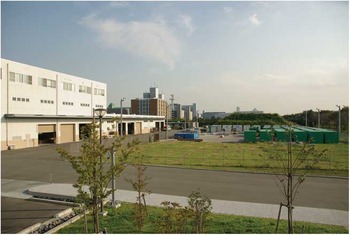
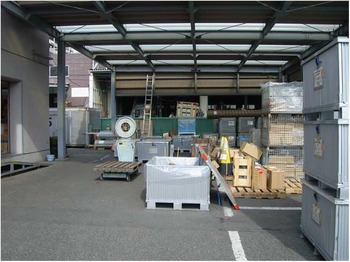
NIPR operates JARE logistics and large amounts of cargo are prepared and stored at NIPR facilities prior to dispatch to the Antarctic. NIPR moved its cargo handling facility along with its office to Tachikawa-shi in May 2009 after 40 years of operation at the previous location in Itabashi-ku. The facility in Itabashi-ku was located in a relatively urban environment, which is within Tokyo's 23 wards. This location is 23.8 km north-west of Tokyo port, where all JARE cargo is loaded and shipped south between October and November each year. The new NIPR office and cargo facility were constructed in Tachikawa-shi, a comparatively new town inland from central Tokyo, 45.8 km west-north-west of Tokyo port. A National Government Park of about 180 ha is located within 1 km of this facility. At the new facility, NIPR operates a detached warehouse for indoor cargo storage whose area (1809 m2) is about ten times greater than that of the facility in Itabashi-ku, where a part of the research building was used for indoor cargo storage. Additionally, a large field (c. 4400 m2) adjacent to the warehouse at Tachikawa-shi is used exclusively for container storage, itself being next to a lawned training field of about half the area (Fig. 1). At the location in Itabashi-ku, very limited numbers of cargo items were stored outside in a small cargo handling area (136 m2) that was roofed and located adjacent to the building (Fig. 2).
The location of the warehouse, the cargo handling area and the container yard of the National Institute of Polar Research (NIPR) in Tachikawa-shi.

The outdoor cargo handling area of the National Institute of Polar Research (NIPR) in Itabashi-ku.

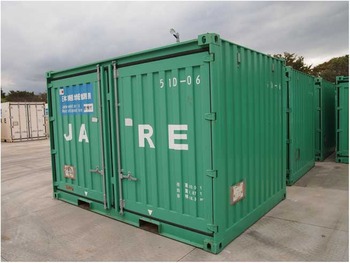
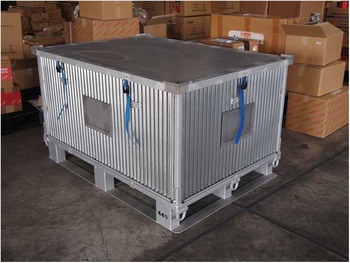
The icebreaker 1st Shirase was launched in December 1981 and served as an icebreaker and logistic support vessel for 25 years (JARE 25–JARE 49) between 1983 and 2008. Around the same time as NIPR started operations from the new cargo location, the newly completed icebreaker 2nd Shirase was launched in April 2009 and started her service in Antarctica from the JARE 51 operation in 2009. The 2nd Shirase has different cargo handling capacity to its predecessor, in particular being equipped to carry a maximum of 56 12 ft steel containers. This has allowed the introduction of these containers into the JARE operation, seldom used previously, as a major cargo transportation medium. JARE now possess JARE steel containers (JARE SCs) in two sizes, 12 ft (Fig. 3) and 4.9 ft (Fig. 4), while only the smaller JARE 3.9 ft SCs were used until JARE 49. For the JARE 51 operation, new 4.9 ft JARE SCs were obtained, which were required to fit in the new helicopters (CH-101) operated on 2nd Shirase.
The outer surface structure of 12 ft Japanese Antarctic Research Expedition (JARE) steel containers (SCs).

The outer surface structure of 4.9 ft Japanese Antarctic Research Expedition (JARE) steel containers (SCs).

JARE cargo transportation
There is one voyage of Shirase from Japan to Syowa Station in Antarctica in support of the JARE operation each year. Some cargo items are stored at the NIPR facility, either within or outside the building before being loaded onto the icebreaker. Other cargo, including fresh and frozen foods, extra-large or otherwise exceptional equipment and machinery, flammable fuels and gases, and some cargo required for JARE routine observations that are carried out by other national institutions, are stored by their source suppliers or institutions and transferred directly to the wharf. After loading cargo between mid-October and early November, Shirase departs from Harumi wharf in Tokyo port in mid-November, making a port call in Fremantle, Western Australia, about two weeks later. Some additional fresh food and fuel are loaded at Fremantle, but no cargo originating from Japan is unloaded until arrival at Syowa Station typically in mid- to late December.
Assessment of propagule load of cargo items
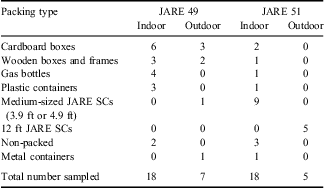
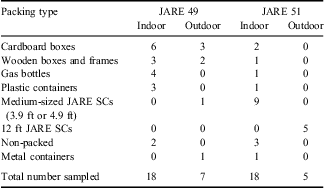
A range of JARE cargo packing types were inspected for the presence of biological propagules before being loaded on Shirase. For the purpose of this study, biological material of a minimum size visible under a dissection microscope, such as seeds, plant fragments and invertebrates, were treated as potential propagules. In total 25 cargo items for JARE 49 and 23 for JARE 51, representing seven or eight packing types respectively, were randomly selected for inspection (a standard medium-sized commercial steel container was classified separately from the medium-sized JARE-owned SCs) (Table I). JARE 49 cargo items stored either within or outside the NIPR building were sampled at the Itabashi-ku facility in October 2007. JARE 51 cargo items stored either in the warehouse or in the external container yard were sampled at the new facility at Tachikawa-shi in October 2009. All external material on the surface of each cargo item was collected into plastic bags using a brush and a pan, and then stored at -20°C. On subsequent examination with the aid of a dissection microscope, the collected materials were sorted and potential propagules were recorded. The Wilcoxon signed-rank test was conducted (using R, version 2.14.0) to determine significance of differences in the number of propagules collected per square metre of surface area sampled for JARE 49 and JARE 51. The test was carried out separately on cargo samples stored indoors or outdoors for three types of propagules encountered, seeds, mites, and moss fragments. Seeds were separated and identified to the lowest taxonomic level possible based upon their morphological characteristics (size, shape, colour, and texture) using a Japanese seed guide (Nakayama et al. Reference Nakayama, Inokuchi and Minamitani2000), guides to grasses in Japan (Osada Reference Osada1989, Koba et al. Reference Koba, Ibaragi and Katsuyama2011), and photographic guides to invasive plant species in Japan (Shimizu et al. Reference Shimizu, Morita and Hirota2001, Uemura et al. Reference Uemura, Katsuyama, Shimizu, Mizuta, Morita, Hirota and Ikehara2010). For those seeds identified to species, their historical status in the Japanese flora, as well any previous record of occurrence in sub-Antarctic and Arctic localities, were collated (Kitamura et al. Reference Kitamura, Murata and Hori1957, Polunin Reference Polunin1959, Kitamura & Murata Reference Kitamura and Murata1961, Kitamura et al. Reference Kitamura, Murata and Koyama1964, Tyge et al. Reference Tyge, Kjeld and Knud1968, Osada Reference Osada1976, Shimizu et al. Reference Shimizu, Morita and Hirota2001, Frenot et al. Reference Frenot, Chown, Whinam, Selkirk, Convey, Skotnicki and Bergstrom2005), and species listed on the Global Invasive Species Database (GISD) were indicated (http://www.issg.org/database/welcome/, accessed 16 August 2011.). Mites were classified to distinct morphotypes based upon their morphology and identified to suborder where possible using a Japanese mite guide (Ehara Reference Ehara1980). Moss fragments were identified to families and genera based upon their morphology using a Japanese moss guide (Iwatsuki & Mizutani Reference Iwatsuki and Mizutani1978).
Number of cargo sampled in each packing type at each location for JARE 49 and JARE 51. JARE SCs = Japanese Antarctic Research Expedition steel containers.
Overall cargo compositions for JARE 49 and JARE 51
The relocation of NIPR's cargo handling facility and the introduction of 2nd Shirase into service have been accompanied by major changes in the proportion of cargo stored at NIPR in addition to the types and packaging of cargo sent to the Antarctic from Japan. In order to identify whether these changes are linked in any way with the risk of associated carriage of propagules, information about all cargo items transported from Japan to Syowa Station in the JARE 49 and 51 operations was collated. Information about total cargo in terms of numbers of items, weight, volume and surface area, along with the proportion utilizing NIPR storage, was collated to assess the overall change in the system. The numbers of different cargo/packing types and their surface areas were then calculated to identify any change in the risk of propagule carriage associated with changes in the packing type composition between the two expeditions. The total surface areas of cargo stored at NIPR in different cargo/packing types were required in particular for the determination of effective mitigation measures to be implemented under NIPR management. Marine fuel (c. 420 m3) and aviation fuel (c. 150 m3) were directly transferred to Shirase from refuelling vessels and thus were excluded from the analysis. Packing types recognized in this analysis included large or otherwise exceptional items with no external packaging (e.g. machinery, vehicles, building materials, field equipment), cardboard boxes, wooden boxes and frames, medium-sized steel containers, 12 ft steel containers, plastic containers, gas bottles, metal barrels, cans, cloth and rolls. Remaining items not assignable to these categories were described as ‘other’. Thirty empty and collapsed 4.9 ft JARE SCs transported during the JARE 51 operation were classified as ‘non-packed’ rather than ‘medium-sized JARE SCs’. After compiling this information, cargo items from the four most frequently used packing materials in terms of total surface area for both JARE 49 and JARE 51 were then separated out for analysis of changes in the packing type composition between JARE 49 and JARE 51. Five ‘most common’ packing types were represented in the two expeditions, and numbers and surface areas of items of each packing type were calculated. For those cargo items which were individually packed but then stored inside the 12 ft JARE SCs for transport to Syowa Station, numbers and surface areas (757 items with a total surface area of 1628 m2) were not included in this analysis since most of them were stored inside the 12 ft JARE SCs immediately after they had been packaged.
Results
Cargo inspection for attachment of propagules
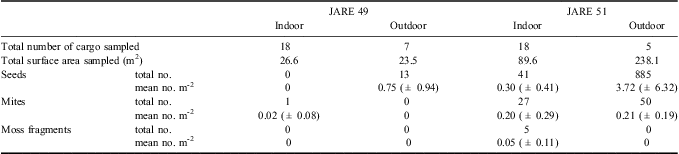
A total of 1022 propagules were found attached to cargo items stored at both NIPR cargo handling facilities (Table II). Three types of propagules, seeds, mites, and moss fragments, were encountered in this study. Of these, the most frequently observed propagules were seeds. Thirteen seeds (0 from indoor and 13 from outdoor storage locations) and 926 seeds (41 indoor, 885 outdoor) were collected from the JARE 49 and JARE 51 cargo items examined, respectively. In addition to seeds, mites were frequently encountered on JARE 51 cargo from both indoor and outdoor storage locations, whereas they were rarely obtained from the JARE 49 cargo (Table II). Five moss fragments were found on cargo of JARE 51 stored indoors.
Summary of results for propagule attachment on cargo at each location for JARE 49 and JARE 51. Numbers in parentheses represent the standard deviation of the mean.
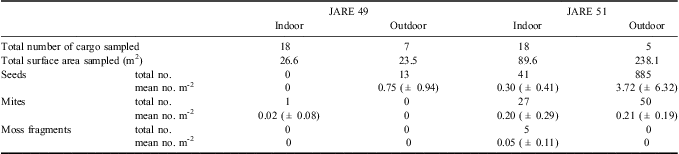
The mean numbers of propagules collected per unit surface area for each JARE 51 cargo type were greater than those for JARE 49 (Table II). Numbers of seeds collected per unit surface area for indoor-stored cargo were significantly higher in JARE 51 compared with JARE 49 (P < 0.001) while those for outdoor-stored cargo did not significantly differ (P = 0.186). Numbers of mites collected per unit surface area were significantly higher in JARE 51 for both locations (indoor P < 0.01, outdoor P < 0.01). Numbers of moss fragments collected from indoor-stored cargo were also relatively higher in JARE 51 (P = 0.080).
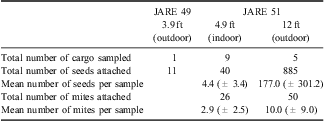
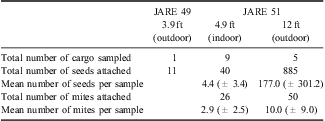
Of the eight cargo packing types sampled, propagules were particularly associated with the various sizes of JARE SCs (3.9 ft, 4.9 ft, 12 ft) (Table III). Seeds were found on every JARE SC that was examined. A mite was found on a wooden box stored indoors. The moss fragments found on JARE 51 cargo were collected from two 4.9 ft JARE SCs. A seed and a mite were found attached to a JARE 51 cloth bag stowing a tent for field camping which was classified as non-packed.
Results of major propagule attachment on three sizes of JARE SCs from the JARE 49 and JARE51 cargo samplings. Numbers in parentheses represent the standard deviation of the mean.
Propagule identity
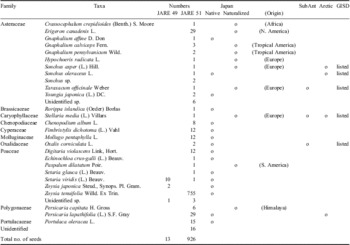
Only representatives of Poacea (two species of two genera identified) were found on JARE 49 cargo (Table IV). In contrast, 25 species of 20 genera from ten families were identified amongst the seeds collected from the JARE 51 cargo. Ten seeds of Setaria viridis in JARE 49 were obtained from a panicle whose culm was trapped in a joint on the surface of an outdoor-stored 3.9 ft JARE SC. The most frequently encountered species in terms of proportion of cargo items affected in JARE 51 was Erigeron canadenis (Asteraceae), being attached to 11 of the 23 cargo items sampled (seven stored indoors, four outdoors). The most common species as a proportion of propagules found in JARE 51 was Zoysia tenuifolia (Poaceae), which accounted for more than 80% of the total number of seeds found. With the exception of one E. canadenis seed attached to the cloth tent bag mentioned above, all seeds found on JARE 51 cargo were found on either 4.9 ft or 12 ft JARE SCs. Seeds of the eight families encountered other than Asteraceae and Poacea were exclusively found on the outdoor stored 12 ft JARE SCs. While most of the seeds found were native to the Japanese flora, ten of the species found on the JARE 51 cargo are naturalized species. In addition, three and five species have been reported from the sub-Antarctic and Arctic respectively (Table IV).
Seed taxa identified and total number of each species found on sampled cargo in JARE49 and JARE 51.

Four distinct species (morphotypes) of oribatid mite were found in this study. One individual of one species was obtained from a wooden box of JARE 49. One individual of a second species was found on the cloth bag stowing a tent in JARE 51, as mentioned above. Two further species of oribatid were found only on JARE SCs (19 and 7 individuals on 4.9 ft, and 26 and 24 on 12 ft containers, respectively). The five moss fragments obtained included one shoot and four leaves. The shoot was attributed to Sematophyllaceae and one leaf to Dicranaceae. One leaf of Pohlia sp. and two leaves of Eurhynchium sp. were also identified.
Comparison of cargo handling and type in JARE 49 and JARE 51
The cargo compositional survey was conducted on the total of 9035 cargo items (6994 for JARE 49, 2041 for JARE 51) that had been transported from Japan to Syowa Station for JARE operations. While the total number of cargo items was much lower in JARE 51 than JARE 49, the total weight and volume transported greatly increased (Table V). The proportion (percentage) of cargo stored at the NIPR facility prior to loading on Shirase doubled to tripled across all four of the measurements taken (quantity, weight, surface area and volume) from JARE 49 to JARE 51, with overall c. 70% of cargo being stored at NIPR in JARE 51.
Summary of total cargo transported from Japan to Syowa Station and the proportion and percentage of cargo stored at the National Institute of Polar Research (NIPR) prior to the loading on Shirase in JARE 49 and JARE 51. SA=surface area.

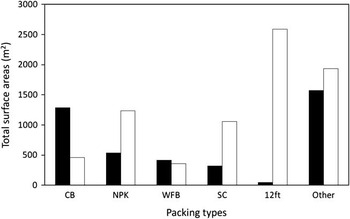
The five most frequently used packing types in terms of total surface area in the two JARE operations were cardboard boxes, non-packed items, wooden frames and boxes, medium-sized steel containers, and 12 ft steel containers (Table VI). The use of cardboard boxes in JARE 49 contributed by far the greatest proportion of cargo items, both in terms of total numbers and of surface area, but accounted for a much lower proportion in JARE 51. Conversely, the number of 12 ft containers increased greatly in JARE 51, accounting for a similar proportion of total surface area as that of cardboard boxes in JARE 49. There was also a clear reduction in numbers and surface area of wooden frames and boxes in JARE 51, while those of medium-sized steel containers increased. Non-packed items contributed the second largest total surface area of packing types both in JARE 49 and JARE 51. A similar shift was observed in surface areas of cargo items stored at NIPR from JARE 49 to JARE 51 among those in top five packing types (Fig. 5). A conspicuous change was the increase in the use of 12 ft steel containers, accounting for one third of the total surface areas of cargos stored at NIPR in JARE 51. While total surface areas of medium-sized steel containers and non-packed cargos tripled and doubled respectively, that of cardboard boxes decreased significantly.
Total number and surface area of cargo either stored at the National Institute of Polar Research (NIPR) prior to the loading or directly transferred to the port to be loaded on Shirase in the five most frequently used packing types in JARE 49 and JARE 51. Numbers in parentheses indicates the percentage of total surface area in each packing type for each transportation pathway.

Total surface area of cargo stored at the National Institute of Polar Research (NIPR) in five most frequently used packing types and others in JARE49 (black) and JARE51 (white), these being cardboard boxes (CB), non-packed (NPK), wooden frames and boxes (WFB), steel containers (SC), and 12 ft steel containers (12 ft).

Discussion
Approximately 1100 tonnes of cargo, with a volume of over 3000 m3, are now transported from Japan to Syowa Station in Antarctica through the JARE operation each year. The recent relocation of the NIPR cargo handling facilities, together with the entry into service of the new icebreaker 2nd Shirase, is intended to provide highly efficient facilities and systems to support the JARE transportation operation. However, the current study demonstrates that the operation of these new facilities and systems has inadvertently led to an elevated risk of transporting propagules of non-native species into Antarctica. Many of the national operators and independent tour operators that transport personnel and/or cargo into Antarctica have implemented various biosecurity procedures in recent years in order to reduce the risk of non-native species introductions (Potter Reference Potter2006, Reference Potter2009, United Kingdom 2009, IAATO 2011). However, to date no specific biosecurity policy or measure has been considered or adopted in the JARE operation. Based upon the evidence obtained in this study, there is clearly an urgent requirement for effective and practical mitigation measures to be developed in order to reduce the transfer risks associated with the current JARE cargo transport procedures.
Of the large quantities of biological propagules that were found attached to cargo items stored at the NIPR facility in Tokyo before transport to the Antarctic, the proportion which would reach the continent and be deposited on suitable habitats, and then be capable of survival and establishment under the environmental condition prevailing in the vicinity of Syowa Station is clearly unknown. However, the seeds found on JARE cargo items include invasive non-native species (Taraxacum officinale and Stellaria media) and persistent non-native species (Oxalis corniculata) that are already present in the sub-Antarctic (Frenot et al. Reference Frenot, Chown, Whinam, Selkirk, Convey, Skotnicki and Bergstrom2005). Moreover, Sonchus asper, S. oleraceus, S. media, Chenopodium album, and Persicaria lapathifolia are known from the Arctic (Polunin Reference Polunin1959, Tyge et al. Reference Tyge, Kjeld and Knud1968). These data therefore confirm the presence of propagules of several species known to be capable of establishing in polar environments. Additionally the presence of species already recognized as globally invasive amongst the collected propagules clearly indicates the potential pressure and risk of those propagules to the Antarctic ecosystem (ISSG 2011).
Although the mean numbers of propagules collected per unit surface area for each JARE 51 cargo type were greater than those for JARE 49 for each propagule type and storage location, the difference was not significant for seeds obtained from the outdoor-stored cargo. However, the large variation in numbers particularly for seeds attached on JARE 51 outdoor-stored cargo probably reduced sensitivity of the statistical analysis. Increasing the number of cargo items sampled would assist in resolving this issue in future studies.
The likelihood of propagules becoming attached to cargo items varies across packing types and storage locations. In this study, the highest risk both in frequency of attachment and diversity of propagules was clearly associated with the JARE SCs especially the larger 12 ft containers stored in the open air with their much greater surface area. Propagule attachment to particular types of cargo or packing, and the dependency of attachment frequency on cargo storage location, have also been noted in previous studies within other national Antarctic operations (Whinam et al. Reference Whinam, Chilcott and Bergstrom2005, Lee & Chown Reference Lee and Chown2009b).
A systematic change in the packing types used for JARE cargo was apparent between JARE 49 and JARE 51, with the proportion and contribution to total surface areas of the 12 ft steel containers and the medium-sized steel containers increasing substantially. While the use of 3.9 ft JARE SCs within the medium steel containers was 66.7% in JARE 49, all the steel containers including 12 ft used in JARE 51 were JARE SCs. The increased use of JARE SCs resulted in an increase in the total exposed cargo surface area. Given the identified association of these containers with large numbers and diversity of propagules, this operational change undoubtedly underlies a significantly elevated risk of non-native species propagule entrainment and transport in the current JARE logistic operation.
The substantial increase of the numbers of propagules attached, especially on the indoor-stored cargo for JARE 51 appears to be related to the structural features of the JARE SCs, which formed a considerable proportion of cargo transported in JARE 51. Both the 4.9 ft and 12 ft containers sampled in JARE 51 were newly obtained and brought into use in that season. Nonetheless, even the 4.9 ft containers that were stored within the warehouse were the source of numerous seeds and mites. The structure of these containers includes many small crevices and gaps on their outer surfaces where small particles can readily become trapped (Figs 3 & 4). Potentially this could include wind dispersed propagules.
A further important factor contributing to the large numbers of propagules obtained particularly from the indoor-stored cargo in JARE 51 is probably the location and structure of the storage facilities in Tachikawa-shi. The property in Itabashi-ku was situated in a built-up area including and surrounded by small buildings and houses. The cargo handling facilities were located by walls enclosing the property. Some weeds were present along with shrubs planted near the cargo handling area, but the species numbers and quantities were very limited. In contrast, at the Tachikawa property, the cargo handling area, the container yard, and shutters of the warehouse are all adjacent and open to areas with lush vegetation including a training field, small gardens and shrubberies (Fig. 1), as well as to the trees lining streets around the property and the National Government Park at a relatively short distance. These all provide large sources of potential propagules, in particular of anemochorous (wind dispersed) species. Indeed, various Asteraceae seeds with pappus (hair-like structures at the top of the seeds which often enable those seeds to be carried by the wind) were obtained from the 4.9 ft JARE SCs stored inside the warehouse at this location, while most species of plant identified in JARE 51 were observed to be present in the training field next to the 12 ft container yard and the warehouse, including Zoysia tenuifolia planted as a lawn on the training field. Similarly, Setaria viridis attached on the outdoor-stored cargo of JARE 49 was also observed growing by the side of the research building next to the cargo handling area in Itabashi-ku.
One consequence of the recent changes in cargo handling systems is that c. 70% of the total cargo is now placed under the control of NIPR, compared with roughly 30% in JARE 49. While we have demonstrated a negative consequence of this, in the high level of contamination of JARE SCs with biological propagules, the higher level of cargo control also potentially means that the adoption of effective cargo biosecurity measures by NIPR would immediately reduce the risks associated with the majority of JARE cargo.
Several practical mitigation measures would probably be effective based upon the data presented in this study. First, the isolation of the outdoor container handling yard from adjacent vegetated area, for instance using a wall, is clearly practicable. Second, the use of containers whose design does not include numerous gaps and crevices would reduce the availability of attachment sites. Third, the introduction of high-pressure steam washing of water-resistant cargo items such as steel containers and large-sized vehicles prior to the loading on Shirase would reduce the likelihood of viable propagules remaining attached. High-pressure steam washing is recommended and has been applied by several national operators especially for cleaning vehicles and machinery which are prone to contamination (Potter Reference Potter2006, United Kingdom 2009, Hughes et al. Reference Hughes, Convey, Maslen and Smith2010). Furthermore, visual inspection and certification of cargo subsequent to loading would provide a documented record of procedures being applied.
The current expansion of both national and commercial operations in the Antarctic region (Tin et al. Reference Tin, Fleming, Hughes, Ainley, Convey, Moreno, Pfeiffer, Scott and Snape2009), independently of any relation with climate change trends occurring in some parts of Antarctica (Turner et al. Reference Turner, Bindschadler, Convey, Di Prisco, Fahrbach, Gutt, Hodgson, Mayewski and Summerhayes2009), has led to non-native species invasions being identified as one of the greatest current threats to Antarctic biodiversity (Frenot et al. Reference Frenot, Chown, Whinam, Selkirk, Convey, Skotnicki and Bergstrom2005). The urgent application of appropriate and effective preventive biosecurity measures against this threat is required to minimize the possible impact of national governmental operations on the pristine terrestrial ecosystems of the region.
Acknowledgements
We thank the expedition members of JARE 49 and JARE 51 for access and permission to inspect cargos and Shinichi Nakamura for practical assistance in the cargo sampling. Yutaka Katsuta provided much helpful information on JARE cargo and logistic systems. Osamu Komori performed statistical tests on the propagules attachment. We also thank Jennifer Lee, Kevin Hughes, and Peter Convey for providing helpful comments on the manuscript.