Introduction
Following many years of speculation concerning how the law of the sea and Antarctic regimes would interrelate when it came to the continental shelf from the Antarctic continent and the surrounding islands, we are now witnessing these interactions as submissions are made by Antarctic claimants to the Commission on the Limits of the Continental Shelf (CLCS). This is but one example of many potential incompatibilities between the international legal regime operating in Antarctica and global regimes also applicable to the Southern Ocean that have attracted commentary (Rothwell Reference Rothwell1994). Given the fast pace of developments, a cut-off date of 1 October 2009 has been adopted in this article with regard to data and other information relating to Antarctic and sub-Antarctic continental shelf issues.
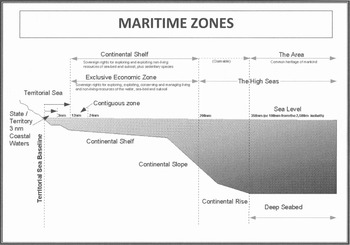
Under article 76 of the 1982 United Nations Convention on the Law of the Sea (UNCLOS) (United Nations 2001), coastal states possess a continental shelf, which gives them exclusive sovereign rights for the purposes of exploring and exploiting living and non-living natural resources (UNCLOS 1982: article 77). Article 76(1) sets the limits of this zone to either 200 nm from the coastal state's baselines, or to the outer edge of the continental margin if it extends beyond 200 nm (see Fig. 1). To establish what is often termed an extended continental shelf (ECS) seawards beyond the juridical 200 nm continental shelf, states must file a submission of delineation data with the CLCS, the technical body established by UNCLOS and charged with assessing submissions and making recommendations as to continental shelf limits. The limits established by a coastal state on the basis of these recommendations are final and binding (UNCLOS 1982: article 76(8)).
Maritime Zones Including the continental shelf beyond 200 nm. Source: Commonwealth of Australia. 1997. Australia's oceans – new horizons: oceans policy consultation paper. URL: http://www.environment.gov.au/coasts/oceans-policy/publications/new-horizons.html

All seven Antarctic claimants (Argentina, Australia, Chile, France, New Zealand, Norway and the United Kingdom) are also parties to UNCLOS, assert that they are coastal states on the basis of their Antarctic territorial claims, and therefore that they have the capacity under the law of the sea to define an ECS where the submerged landmass extends beyond 200 nm. This applies both to their claims to parts of the Antarctic continent, and also from any islands under their possession, unless the island in question is a rock incapable of sustaining human habitation or an economic life of its own (UNCLOS 1982: article 121(3)). Complicating matters is the fact that, south of 60°S, all such claims are subject not only to UNCLOS, but also to the 1959 Antarctic Treaty which constrains their realisation and imposes limits on the exercise of jurisdiction.
North of 60°S a different situation occurs in relation to the sub-Antarctic islands. These islands are not subject to the Antarctic Treaty, although several lie within the area of application of another instrument of the Antarctic Treaty system (ATS), the Convention on the Conservation of Antarctic Marine Living Resources (CCAMLR). Territorial sovereignty over the sub-Antarctic islands is, with two notable exceptions, not contested. These islands generate coastal state rights for the states concerned, including continental shelf rights. The two disputed sub-Antarctic groups are South Georgia and the South Sandwich Islands, claimed by the United Kingdom and Argentina, but with the former exercising effective control and jurisdiction, reinforced by the conclusion of the Falklands war of 1982 which saw military action at both groups (Freedman Reference Freedman2007: 226–260, 660).
The consistency of actual and potential ECS claims from the Antarctic continent and islands with the compromise on questions of sovereignty found in article IV of the Antarctic Treaty has been explored in depth by several commentators (see for example Kaye Reference Kaye, Oude-Elferink and Rothwell2001b; Oude Elferink Reference Oude Elferink2002; Baird Reference Baird2004). The analysis has turned on whether Antarctic maritime zones may be asserted given that article IV(2) of the Antarctic Treaty provides that ‘no new claim, or enlargement of an existing claim, to territorial sovereignty in Antarctica shall be asserted.’ In relation to the continental shelf from the continent, it may be argued in favour of claimants that their entitlement to this maritime zone predates the treaty, and is therefore not a new claim or the enlargement of an existing one. However, the potential ECS from sub-Antarctic islands projecting into the Antarctic Treaty area (ATA) has attracted no substantive attention, and it is this gap in the analysis that the authors seek to address here.
While the prospect of ECS claims in the sub-Antarctic has not provoked the same anxiety of a ‘land rush’ as it has in relation to the Arctic (International Herald Tribune (New York) 1 February 2008; see also Young Reference Young2009), nor the same level of concern as ECS areas from the Antarctic continent itself, the potential for an expansion of the maritime zones of sub-Antarctic islands none the less raises questions as to their consistency and workability with the ATS. In this article we question the prevailing assumption that since sub-Antarctic territories are not themselves subject to the sovereignty regime of the Antarctic Treaty any ECS areas generated from these islands, notwithstanding their penetration of the ATA, accordingly pose no Antarctic issues.
Antarctic islands
The Antarctic continent is fringed by a great number of coastal islands and a smaller number of offshore or oceanic islands and groups south of 60°S, and therefore within the ATA. With the exception of islands immediately adjacent to the non-claimed sector of Antarctica, all of these islands have, like the continent, been subject to territorial claims, sometimes by several states.
Within the ATA the main island territories are the Balleny Islands group and Scott Island (claimed by New Zealand), Peter I Island (Norway), the South Orkneys (Argentina and the United Kingdom), and the South Shetlands (Argentina, Chile and the United Kingdom). As they are located south of 60°S all of these islands are subject to the Antarctic Treaty, and as such any claims to an ECS must engage with the same legal issues as applicable to an ECS from the Antarctic continent.
Sub-Antarctic islands
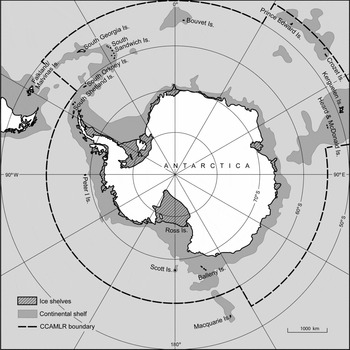
Defining the boundary for the category of sub-Antarctic islands is more difficult than for Antarctic islands, but they are generally considered to be those south of the Antarctic Convergence, the oceanic boundary, variably occurring between 45°S and 60°S, where colder Antarctic waters meet warmer northern waters (Drewry Reference Drewry and Triggs1987: 20; Orsi and others Reference Orsi, Whitworth and Nowlin1995). CCAMLR also takes its northern limit as the convergence, an approximation to which is legally defined in Article 1(4) of that agreement and is shown in Fig. 2.
The approximate extent of the continental margin of Antarctica and sub-Antarctic Islands.

In the sub-Antarctic zone between the Antarctic Convergence and ATA (and thus within the CCAMLR area) are found seven islands or island groups: Bouvet/Bouvetøya (Norway), Crozet (France), Heard and MacDonald (HIMI) (Australia), Kerguelen (France), Prince Edward and Marion (South Africa), South Georgia and the South Sandwich Islands (contested as noted above). An eighth island, Macquarie (Australia), lies just north of the Antarctic Convergence and will be treated as a sub-Antarctic island here. The offshore seabed geology of these islands varies considerably, with Kerguelen, HIMI, Macquarie, South Georgia and South Sandwich possessing the most extensive continental margins (see Fig. 2).
Submissions to the Commission on the Limits of the Continental Shelf
With the exception of Chile, which has submitted only ‘Preliminary Information’, all Antarctic claimants have now made substantive submissions to the CLCS. These deal with Antarctic issues in several different ways.
The first claimant to make a submission was Australia. Its 2004 submission included extensive bathymetric information for an ECS offshore the Australian Antarctic Territory (AAT) alongside the data for its metropolitan territory and external territories north of the ATA. However, mindful that few states recognise Australia's Antarctic claim, Australia requested the CLCS not to consider the information for the Antarctica component of its submission for the time being (Australia 2004). No such deference was considered necessary in relation to Australia's ECS areas from its sub-Antarctic islands, HIMI and Macquarie Island. And in the recommendations adopted by the CLCS in 2008 on the Australian submission, it endorsed the HIMI and Macquarie ECS, including shelf that extended south of 60°S and therefore into the ATA (CLCS 2008a: 14–15). This constituted an unprecedented (and, to date, unique) recognition by an international body of a coastal state's maritime zone within the ATA.
New Zealand took a different tack from Australia in its 2006 submission, which made no reference to ECS areas offshore the Ross Dependency. In an accompanying diplomatic note New Zealand identified the ‘special legal and political status of Antarctica’ and stated that it is open to states under UNCLOS to make a partial ECS submission, noting that a submission relating to Antarctic shelf ‘may be made later’ (New Zealand 2006).
The United Kingdom followed the same approach as New Zealand in reserving a right to make a submission in relation to Antarctica at a later date. It has lodged several partial submissions with the commission alone and in conjunction with other states, the most recent being its May 2009 partial submission in relation to Falkland Islands, South Georgia and the South Sandwich Islands. In this submission, which the United Kingdom has advised is the final partial submission it will make, it included data for ECS areas which entered the ATA, but not for ECS areas offshore the British Antarctic sector (United Kingdom 2009b). No specific mention was made of the potential for a submission in the future in relation to Antarctica, as the United Kingdom seeks to rely on the following statement in its diplomatic note which accompanied its 2008 partial submission in relation to Ascension Island (United Kingdom 2008):
[A]s regards Antarctica, the United Kingdom recalls the principles and objectives shared by the Antarctic Treaty and UNCLOS, and the importance of the Antarctic system and UNCLOS working in harmony, and thereby ensuring the continuing peaceful cooperation, security and stability in the Antarctic area. . .The United Kingdom has regard to the circumstances of the [Antarctic area] and the special legal and political status of Antarctica under the provisions of the Antarctic Treaty, including its article IV. . .It is open to the States concerned to submit information to the Commission which would not be examined by it for the time being, or to make a partial submission not including such areas of continental shelf, for which a submission may be made later, notwithstanding the provisions regarding the ten-year period established by article 4 of Annex II to UNCLOS and the subsequent decision on its application. . .Accordingly, in its partial submissions. . .the United Kingdom will not include areas of continental shelf appurtenant to Antarctica, for which a submission may be made later. . ..
France addressed its Antarctic territory, Adélie Land, in similar fashion to the United Kingdom in a February 2009 partial submission in relation to the subantarctic Kerguelen Island and the French Antilles, advising that it did not include areas of the continental shelf that adjoin Antarctica, ‘for which a submission may later be made’ (France 2009).
In its first partial submission to the commission in 2006, in relation to the northeast Atlantic and the Arctic, Norway preferred complete silence on Antarctic issues while expressly keeping open the possibility of further ECS submissions (Norway 2006). This was followed by Norway's May 2009 partial submission relating specifically to its Antarctic possessions, subantarctic Bouvetøya (often rendered as Bouvet) and its continental territory of Dronning Maud Land (Norway 2009). Interestingly, one part of Norway's Antarctic claim, Peter I Øy in the Bellingshausen Sea, was not mentioned (at least in the publicly available executive summary). Norway included data in relation to Dronning Maud Land but, as with Australia, requested the CLCS not to take any action for the time being in relation to the continental shelf appurtenant to Antarctica.
A third distinctive approach by Antarctic claimants to ECS issues is seen in that taken by Argentina in its April 2009 submission (Argentina 2009). Argentina made a full submission to the CLCS, including what it termed the ‘Argentine Antarctic Sector’ and the ‘Islas Malvinas, Georgias del Sur and Sandwich del Sur’. Not only did Argentina include data for the Antarctic, but Argentina did not (as Australia and Norway had done) request the CLCS not to consider the Antarctic area. The Argentine submission will be considered in more detail below in relation to its sub-Antarctic components.
We now await the Chilean position. Because of geographical and technical challenges faced in acquiring data, Chile has not made a submission, however the ‘Preliminary Information’ it has lodged with the Commission advises that ‘[the] Commission will be duly informed on the option to be taken by Chile regarding the Chilean Antarctic Territory’ (Chile 2009: 19). This statement occurs after a recitation of text in the same terms as that of the United Kingdom in its Ascension Island partial submission. Chile's preliminary information was submitted in conformity with a 2008 decision of the states party to UNCLOS that the ten year time period referred to in article 4 of annex II to UNCLOS may be satisfied by submitting preliminary information including an intended date for making a submission (SPLOS 2008). Chile ratified the LOS convention on 25 August 1998 and under article 4 of annex II of the convention the deadline for its ECS submission would have been 25 August 2008. However in May 2001 a meeting of state parties to the convention resolved that for those states for which the convention entered into force prior to 13 May 1999 the ten year period would begin to run from that date (SPLOS 2001).
In any event it may be questioned whether the procedural requirement to meet the original or extended deadline affects a coastal state's substantive and inherent right to a continental shelf as accorded by article 77 of UNCLOS (Suarez Reference Suarez2008: 183).
The extended continental shelf of Australia's sub-Antarctic islands
To date the CLCS has only made recommendations in relation to Australia's sub-Antarctic islands. Given the significant backlog of submissions before the CLCS it will be some time before the submissions made by other claimants are examined by the CLCS, let alone be the subject of recommendations.
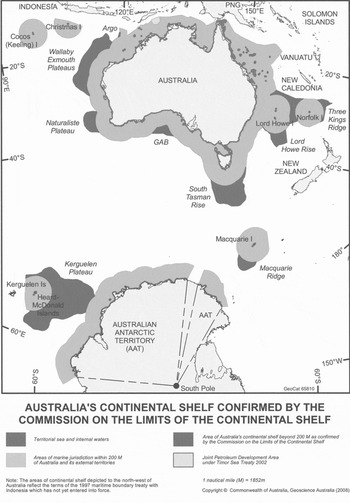
One of the more remarkable aspects of the Australian submission and the recommendations of the CLCS is the sizeable sub-Antarctic component of the ECS from HIMI and Macquarie Island. These sub-Antarctic territories comprise two of ten marine areas around the Australian continent and external territories in which the continental shelf extends beyond 200 nm that were submitted for consideration by the CLCS in Australia's 2004 submission (Australia 2004; Serdy Reference Serdy2005). In 2008 the CLCS accepted around 90% of the Australian ECS claim (see Fig. 3), finding that Australia is entitled to an additional 2.5 million km2 of continental shelf (an area about one third of the size of Australia's land area) (CLCS 2008a).
Australia's continental shelf as confirmed by the Commission on the Limits of the Continental Shelf. Reproduced with the permission of Geosciences Australia.

Significantly, the outer limits of the continental shelves of HIMI and Macquarie Island both enter the ATA. While the Macquarie Island ECS does so only to a small extent, the HIMI ECS, which at 1,185,038 km2 is the single largest area of the Australian ECS, projects substantially into the ATA, on an expansive underwater feature known as the Kerguelen Plateau, the world's largest mid-oceanic plateau (Quilty Reference Quilty1993). At its furthest extent the southern boundary is more than 400 nm south of the southern boundary of the 200 nm maritime zone around HIMI.
Under UNCLOS there are several methods that may be used in defining the outer limits of the continental shelf. The Kerguelen Plateau which includes HIMI is a large geological plateau with at least four geological provinces. In some places the continental margin as defined in article 76 of UNCLOS extends substantially beyond 350 nm, to a constraint line of 100 nm from the 2,500 m isobath (Green Reference Green2001: 10; Symonds Reference Symonds2001; Hutchinson and Rowland Reference Hutchinson and Rowland2006).
In submitting data for HIMI and Macquarie Island to the CLCS, Australia took a radically different approach from that taken in relation to potential ECS areas offshore the AAT. Although Australia included data for the outer limits of the ECS of the AAT in its submission to the CLCS, it asked the commission not to consider the information for the time being. This entreaty was made in recognition that most states do not recognise the sovereignty of territorial claimants in Antarctica, and that, accordingly, the CLCS would be likely to refuse to consider Australia's submission. This is because the commission's rules of procedure stipulate that it may not consider areas of ECS subject to dispute unless all states that are parties to the dispute consent (CLCS 2008b: annex I, rule 5(a)).
No such caution was shown in relation to the HIMI ECS and, as discussed below, no protest was made by Antarctic Treaty parties or others states in relation to the HIMI ECS intruding into the ATA, and the CLCS proceeded to consider the data.
Other potential sub-Antarctic island ECS areas
There is only one other island group with the potential for ECS areas to enter the ATA: the South Sandwich Islands.
The South Sandwich Islands pose additional challenges to HIMI or Macquarie Island in terms of the process under article 76 of UNCLOS as they are subject to competing claims by Argentina and the United Kingdom. Argentina's claim to these islands is generally regarded as being weaker than that of the United Kingdom, certainly in comparison with its claim to the Falkland Islands (Churchill Reference Churchill1997: 471). However it cannot seriously be doubted that there is a live dispute meeting the definition articulated by the International Court of Justice in the 1995 East Timor Case as ‘a dispute is a disagreement on a point of law or fact, a conflict of legal views or interests between parties’ (International Court of Justice 1995: 99). Accordingly the CLCS cannot consider the submissions made by Argentina and the United Kingdom because there is a dispute, and the states have not given their prior consent to the CLCS examining the data, as required by annex I of the rules of procedure for the CLCS (CLCS 2008b: rule 46 and annex I, rule 5). Having regard to this provision the United Kingdom initially sought negotiations with Argentina with a view to making a joint submission to the CLCS without prejudice to the underlying sovereignty dispute (United Kingdom 2009c). However, agreement could not be reached, leading each state to make an independent submission that drew attention to the sovereignty issue.
Neither the Argentine nor United Kingdom submission appears to entertain any doubt about the acceptability of sub-Antarctic ECS projection into the AAT. Yet from the South Sandwich group this intrusion is very considerable, as Fig. 6 in the Argentine Executive Summary and Fig. 1 in the United Kingdom's executive summary show. On the basis of the latter, the penetration below 60°S extends from almost 20°W to 40°W and as far south as about 63°S latitude.
Given that the CLCS acknowledged the ECS extensions southward from HIMI and Macquarie Island there would appear to be no obvious impediment to an ECS being asserted from the South Sandwich Islands extending into the ATA, assuming of course that Argentina and the United Kingdom had been able to put the sovereignty dispute to one side in favour of a cooperative approach. This could have paved the way not only for CLCS consideration of submissions, but potentially some form of joint management of the resources of the area without prejudice to a resolution of their claims to sovereignty. Plainly this option was not taken.
However, any developing trend in state practice initiated by the CLCS assessment of HIMI and Macquarie ECS, and any possible future consideration of the South Sandwich Islands ECS, does not resolve the more fundamental issue as to whether this practice is consistent with the Antarctic Treaty, and it is to this question that we now turn.
Sub-Antarctic islands and the Antarctic Treaty system
Reaction to submissions to the CLCS
The submissions of Australia, Argentina and Norway to the CLCS have attracted particular attention for including data for areas within the ATA.
Six ATCPs lodged an objection with the CLCS to Australia's submission of data with respect to an ECS from the AAT (Germany, India, Japan, Netherlands, the Russian Federation, and the United States). The United States response was typical of these in stating that it ‘does not recognize any State's claim to territory in Antarctica’, or to ‘the seabed and subsoil of the submarine areas beyond and adjacent to the continent of Antarctica’ (United States 2004). However the United States did note that it ‘acknowledges with appreciation Australia's request to the Commission that it not take any action on that portion of its submission relating to areas of the seabed and subsoil adjacent to Antarctica.’ The submission of Norway that included data for Dronning Maud Land attracted a similar response both in terms of the number of communications and their content.
The Argentine submission prompted a strong response by the United Kingdom in a August 2009 note in which it states that it has no doubt about its sovereignty over the Falklands, South Georgia and South Sandwich Islands and that it ‘rejects those parts of Argentina's submission which claim rights to the seabed and subsoil of the submarine areas appurtenant to the Falkland Islands, South Georgia and the South Sandwich Islands, and requests that the Commission does not examine those parts of the Argentine submission.’ (United Kingdom 2009a). Moreover because of the unqualified inclusion by Argentina of data in relation to the Antarctic mainland, India, the Russian Federation and the United States all reiterated the special status of Antarctica and expressed an expectation that the CLCS would not take any action in relation to that part of the submission (India 2009; Russian Federation 2009; United States 2009). It is up to the CLCS to decide how to proceed given that Argentina has not requested a deferral of consideration of its data, however the reactions to the Argentine submission can leave the CLCS in no doubt that there is a live territorial and maritime dispute within the meaning of article 5(a) of annex I of the CLCS's rules of procedure.
The communications are clear in so far as the continental shelf appurtenant to Antarctica is concerned, but by contrast there has been no mention made of the continental shelf extending into the ATA from HIMI, Macquarie Island or the South Sandwich Islands. Although the unique and complex legal situation pertaining throughout the ATA is notorious, and would be known to members of the CLCS (Rothwell Reference Rothwell2008: 190), in dealing with the Australian submission it was not open to the CLCS on its own motion to determine the existence of a ‘land or maritime dispute’. While other states may have some influence on the CLCS process (see Oude Elferink Reference Oude Elferink2009), the CLCS is essentially a technical body tasked with responding to submissions made to it in their terms even if they are silent on potential matters of controversy. As Australia's executive summary passed no comment on the fact that the continental shelf of HIMI extends up to 200 nm from Antarctica (Oude Elferink and Johnson Reference Oude Elferink and Johnson2006: 476), there was no reason for the CLCS not to proceed. The CLCS did nonetheless take a somewhat cautious approach in relation to some elements of the Australian data relating to HIMI which raised Antarctic sensitivities. Specifically it declined to endorse the two points of the HIMI ECS that intersected with the 200 nm line from the AAT (points KER-ECS732a and KER-ECS-960a: see CLCS 2008a: 18).
The legal status of sub-Antarctic islands
The apparent tolerance of the international community and the CLCS towards the HIMI and Macquarie Island continental shelves extending into the ATA is reflective of the distinctive position that has historically been taken with respect to sub-Antarctic islands (Oude Elferink Reference Oude Elferink2002: 495). The fundamental reason for this is that the sovereignty of states over these islands is generally accepted, whereas Antarctic claims are not (Vigni Reference Vigni, Oude Elferink and Rothwell2001: 89). From the acceptance of territorial sovereignty in respect of sub-Antarctic islands it follows that the applicable states possess, or may assert, adjacent maritime zones by operation of the law of the sea, as codified in UNCLOS. The continental shelf, as with the territorial sea, attaches inherently to coastal states and there is therefore no need to proclaim the area as such (although there has been a tendency to do so; continental shelves have been proclaimed in relation to all sub-Antarctic islands) (Kaye and Rothwell Reference Kaye and Rothwell2002: 380; Vigni Reference Vigni, Oude Elferink and Rothwell2001: 104).
The only lingering doubt that has been expressed in relation to maritime zones of sub-Antarctic islands stems from article 121 of UNCLOS. Although islands may normally generate the same maritime zones as continental landmasses (UNCLOS: article 121(2)), ‘rocks which cannot sustain human habitation or economic life of their own’ do not give rise to an exclusive economic zone or continental shelf (UNCLOS: article 121(3)). In several separate opinions in decisions of the International Tribunal for the Law of the Sea, Judge Vukas has advanced the argument that HIMI and Kerguelen islands are uninhabited and indeed uninhabitable and therefore not able to generate an exclusive economic zone (EEZ) or continental shelf (International Tribunal for the Law of the Sea 2000, 2003). If correct this would also mean that the South Sandwich Islands and Bouvet Island, which are inhabited only during infrequent and short-term scientific visitations, would also not be able to generate these zones. This is, however, a minority view that is open to dispute for its restrictive interpretation of UNCLOS, and is clearly contrary to the practice of states many of which have asserted and enforced, without attracting protest, a right to an EEZ and continental shelf in relation to ‘rocks’. Furthermore, from 1976–1982 a small station was maintained, despite British protest, by Argentina on Southern Thule, in the south of the South Sandwich group. The personnel of this station surrendered to, and were evacuated by, the Royal Navy in June 1982 (Freedman Reference Freedman2007: 660–661), and the station facilities subsequently destroyed by the United Kingdom.
Prior to the clear recognition of the capacity to claim an ECS under UNCLOS the maritime zones of most sub-Antarctic islands did not overlap with the ATA (the notable exception being the 200 nm EEZ and continental shelf of the South Sandwich Islands). However this situation has now changed and it is therefore necessary to look to how the ATS addresses the issue.
As is well known, the ATS adopts an ambiguous or ‘bifocal’ approach on issues of territorial sovereignty, allowing claimants and non-claimants alike to find support for their respective positions in the text of the Antarctic Treaty and the other instruments that make up the Antarctic regime (Oude-Elferink Reference Oude Elferink2002: 486–487). However, the position as regards sub-Antarctic islands has generally been regarded as supporting that of the claimants to these territories. One commentator has argued for the blanket application of the Antarctic Treaty throughout the ATA, with no distinction as to maritime claims made from north of the area (Oxman Reference Oxman1986: 227). However, the more widely held view is that the ATS allows sub-Antarctic islands to generate maritime zones (Kaye Reference Kaye2001a: 208).
Critical to supporting the latter conclusion is the ATS's main resource focussed instrument, CCAMLR, and the chairman's statement that accompanied its adoption in 1980 (Molenaar Reference Molenaar2001: 419). Article IV of CCAMLR seeks to preserve the rights of coastal states in adjacent maritime zones, in providing in paragraph 2 that nothing in the convention shall:
(b) be interpreted as a renunciation or diminution by any Contracting Party of, or as prejudicing, any right or claim or basis of claim to exercise coastal state jurisdiction under international law within the area to which this Convention applies; (c) be interpreted as prejudicing the position of any Contracting Party as regards its recognition or non-recognition of any such right, claim or basis of claim’ or ‘(d) affect the provision of Article IV, paragraph 2, of the Antarctic Treaty that no new claim, or enlargement of an existing claim, to territorial sovereignty in Antarctica shall be asserted while the Antarctic Treaty is in force (Antarctic Treaty 1959: article IV).
The apparent effect of this provision is that claims to coastal jurisdiction consistent with the law of the sea are not affected by the conclusion of CCAMLR. Reference is made in article IV in fairly general terms to ‘coastal state jurisdiction’ rather than the more expansive ‘sovereign rights’ which is the terminology adopted in UNCLOS when describing the rights of coastal states over the EEZ (UNCLOS 1982: article 56(1)(a)) and the continental shelf (UNCLOS 1982: article 77(1)). However, the chairman's statement adopted without objection in the final act of the CCAMLR conference suggests that the term was intended to embrace the exclusive economic or fishing zone. The statement expressly recognises France's claim to an EEZ around Crozet and Kerguelen Islands in 1978, and provides that France has exclusive rights to adopt conservation measures in this area, and that the same approach applies to other sub-Antarctic islands ‘over which the existence of State sovereignty is recognised by all Contracting Parties.’
These provisions speak to the general acceptance of the EEZs of sub-Antarctic islands overlapping with the CCAMLR area. However, they say nothing specific about the continental shelf, in particular those parts overlapping not only with the CCAMLR area of operation but also, and critically, extending into the ATA. The only provision precisely on this point is found in an Antarctic instrument that has not entered into force, and, according to the depository state (New Zealand) ‘is not expected to occur’ (New Zealand Ministry of Foreign Affairs and Trade 2009): the 1988 Convention on the Regulation of Antarctic Mineral Resource Activities (CRAMRA), which would have established an internationalised regime for Antarctic mineral exploitation.
The conclusion of the 1991 Protocol on Environmental Protection to the Antarctic Treaty (Madrid Protocol), which prohibits mining in Antarctica, effectively meant that CRAMRA would not enter into force. None the less, the negotiation of CRAMRA provided an opportunity for states to consider the position of maritime zones from sub-Antarctic islands. In this respect the final act adopted with CRAMRA made clear that the continental shelves from such islands would not be embraced by the regime: ‘the area of regulation of Antarctic mineral resource activities [encompassed by the convention] does not extend to any continental shelf appurtenant in accordance with international law to islands situated north of 60°S’ (New Zealand 1988: 39). Note here that the reference to the continental shelf is in general terms, rather than to any defined outer limit. However as CRAMRA was negotiated following the conclusion of UNCLOS it can reasonably be concluded that the term in CRAMRA has the same meaning as that given in UNCLOS.
The Madrid Protocol itself does not resolve the question. Its prohibition on mining applies throughout the ATA, and adherence to this proscription is without prejudice to any underlying claims to territory or adjacent maritime zones north or south of 60°S. Any interaction between coastal state rights under the law of the sea and obligations under the Madrid Protocol seem unlikely to be tested in the near-term given that as a practical matter (quite aside from the legal prohibition within the ATA) commercial mining around Antarctica and the sub-Antarctic islands presently remains uneconomic. However, while foresworn in the near term, the fact that the Antarctic claimants are engaged in the process of ascertaining the limits of the continental shelf in Antarctica suggests that they wish to retain the option of mining in the future. In this respect it must be observed that the hydrocarbon resources in some parts of the Southern Ocean are said to be substantial. It has been estimated, for instance, that up to 38.25 billion barrels of oil may be found on the southern Kerguelen plateau (Symonds and Wilcox Reference Symonds and Wilcox1989).
Implications for the Antarctic Treaty system
The precise legal nature of the continental shelves of islands extending into the ATA is therefore not entirely clear from the text of operative and non-operative elements of the ATS. The question arises therefore whether taking sub-Antarctic island ECS claims through the CLCS process effectively resolves the issue of sub-Antarctic island maritime zones once and for all. The difficulty in making this conclusion is that although the CLCS establishes an international process for assessing data on the extent of a coastal state's continental margin, its recommendations do not have legal force as regards the submitting state and other parties to UNCLOS.
The process for establishing the outer limit of the continental shelf beyond 200 nm is certainly unusual in international law in that an international body, the CLCS, is involved whereas the outer limits of other maritime zones are established by coastal states unilaterally or in consultation with their neighbours (Oude Elferink Reference Oude Elferink2009: 553–554). Coastal states are obliged to establish the outer limits of their continental shelf on the basis of the CLCS recommendations, and once established these limits are to be ‘final and binding’ (UNCLOS 1982: article 76(8)). However they will only be truly conclusive once publicised via submission to the Secretary-General of the United Nations (UNCLOS: Article 76(9)) and following a reasonable passage of time during which there is no objection by other states (McDorman Reference McDorman2002: 317). Although there has been no protest to the HIMI or Macquarie ECS this remains a possibility, and this may only follow the formal proclamation of the new limits of Australia's continental shelf through domestic legislation.
Moreover the practice of relevant states indicates that they have taken a cautious approach when extending jurisdiction over the maritime zones of sub-Antarctic islands intruding into the ATA, and a similar approach can be expected with respect to ECS areas. An example is the United Kingdom's jurisdictional regime for the 200 nm maritime zone around South Georgia and South Sandwich Islands. The South Georgia and South Sandwich Islands maritime zone was established by proclamation from baselines defined in 1989 (United Kingdom 1993; see also United Kingdom 2005). Within the water column, seabed and subsoil of the 200nm zone the United Kingdom claims ‘jurisdiction in accordance with the rules of international law over the exploration and exploitation and the conservation and management of the natural resources (whether living or non-living) and over the protection and preservation of the marine environment subject to such provision as may hereafter be made by law for such matters’ (United Kingdom 1993: paragraph 3). As Churchill (Reference Churchill1997) has pointed out, this proclamation establishes more than a traditional fishing zone, since jurisdiction is also claimed in respect of the non-living resources of the waters, seabed and subsoil and in respect of the protection of the marine environment and could be regarded as a claim to an EEZ.
To deal with potential Antarctic sensitivities the relevant United Kingdom fishing legislation for South Georgia and South Sandwich Islands does not apply south of 60°S (United Kingdom 2000; Molenaar Reference Molenaar2001: 478; Vigni Reference Vigni, Oude Elferink and Rothwell2001: 88). In this respect the United Kingdom has taken account of the peculiar legal status of Antarctica and preferred not to press rights that it enjoys under the law of the sea, and so avoided provoking an unwelcome diplomatic response from other Antarctic Treaty parties (Vigni Reference Vigni, Oude Elferink and Rothwell2001: 89).
In relation to the continental shelf, including the ECS, there is some indication in the policies and laws of the relevant states that a similarly deferential approach will be taken. Despite rash calls from some quarters to reconsider Australia's anti-mining stance in relation to Antarctica (The Sydney Morning Herald 17 July 2006), the Australian Government has ruled out mining in the ECS within the ATA, and this would therefore include most of the HIMI ECS (Australian Minister for Resources and Energy, quoted in The Sydney Morning Herald 22 April 2008). Indeed such mining would be contrary to Australian law. The Antarctic Treaty (Environment Protection) Act 1980 provides in section 19A(1) that a person must not engage in a mining activity not only in Antarctica or its continental shelf but also on the continental shelf of HIMI within the Antarctic. Section 3(1) of the act defines the ‘Antarctic’ as the area south of 60°S, including all ice shelves in the area. There can be no question therefore that the mining prohibition applies in respect of all continental shelf areas south of 60°S (Blay and Green Reference Blay and Green1994). Whether the act extends not only to Australian nationals but also to foreign nationals on the HIMI continental shelf is less clear however, given the drafting of section 4(1)(a) which states that it applies in the Australian Antarctic ‘Territory in relation to any persons and property, including foreign persons and property’ (emphasis added).
The United Kingdom legislation implementing the Madrid Protocol is also lacking in some clarity. The Antarctic Act 1994, in section 6, rules out mining in ‘Antarctica’ by British nationals, however the definition of ‘Antarctica’ in section 1 would not appear clearly to include the continental shelf of sub-Antarctic islands. Instead, reference is made to ‘all areas of continental shelf which are adjacent to that continent or those islands and which are south of 60° South latitude’. The reference in section 1(1)(d) to all ‘sea and airspace south of 60° South latitude’ could, for abundance of caution, be expanded also to include all seabed areas (United Kingdom 1994).
Complete clarity on Antarctic jurisdictional boundaries is important, as was demonstrated recently by litigation in the Federal Court of Australia in relation to special permit whaling by Japan in the AAT. This was made possible only because of an apparent oversight in Australian legislation, the Environment Protection and Biodiversity Conservation Act 1999, section 225, seeking to protect whales which extended to apply to all whaling activities in the EEZ adjacent to the AAT (Hemmings Reference Hemmings2008; Stephens Reference Stephens2008). This is in contrast to Australian management of Antarctic fisheries under section 3 of the Fisheries Management Act 1991 which exempts these waters from the Australian fisheries zone and therefore from Australian regulation (Australia 1991: section 3).
Implications for Antarctic governance
ECS claims from sub-Antarctic islands protruding into the ATA raise several significant issues as to the interaction of the ECS with the ATS. One initial issue confronting Australia in relation to the HIMI, and also Argentina and the United Kingdom in relation to the South Sandwich Islands, is how to delimit the overlap between these islands’ continental shelf and a continental shelf asserted from the Antarctic. Kaye has noted that given the potential for oil or gas resources on the Kerguelen Plateau it would be attractive to Australia to apportion the greatest possible shelf to HIMI, although this would have the ‘disadvantage of weakening Australia's Antarctic claim itself’ (Kaye Reference Kaye2001a, 209). The Australian government appears to have been mindful of this in its submission to the CLCS, in claiming an ECS southward from HIMI to the 200 nm line from the Antarctic continent. For its part the CLCS avoided endorsing this internal delimitation by refraining from making recommendations regarding the southern most points of the HIMI ECS that intersect with the 200 nm line from the AAT.
The fundamental question with respect to the ECS from sub-Antarctic islands is how rights accorded under UNCLOS are to be asserted and enjoyed consistently with the rights and duties under the ATS.
The CCAMLR area
Since many sub-Antarctic islands are either located within the CCAMLR area, or just beyond its northern boundary, plainly any ECS from these islands is likely to penetrate the CCAMLR area. Thus ECS areas from sub-Antarctic islands fall within the area of operation of the CCAMLR regime, which seeks to protect the marine ecosystem of the seas surrounding Antarctica. CCAMLR is very broad in its application not only to the water column, but also to living organisms found on and under the seabed. It applies to all Antarctic marine living resources found south of the Antarctic Convergence, including ‘fin fish, molluscs, crustaceans’ (CCAMLR 1982: article 1(2)). When it comes to EEZ areas from sub-Antarctic islands the effect of its article IV(2) together with the chairman's statement is to allow coastal states to adopt a management regime that is more stringent or more relaxed than conservation measures adopted by the CCAMLR commission. The issue that has not been resolved is whether this carving out of coastal state maritime zones applies not only to the EEZ but also to the continental shelf where it extends beyond 200 nm.
It must be remembered that under UNCLOS coastal states enjoy sovereign rights to exploit the natural resources of the continental shelf, including the ‘living organisms belonging to sedentary species’, that is ‘organisms which, at the harvestable state, either are immobile on or under the seabed or are unable to move except in constant physical contact with the seabed or the subsoil’ (UNCLOS 1982: article 77(4)). These rights are exclusive, in that if the coastal state does not exploit them then no other state may do so without the express consent of the coastal state (UNCLOS 1982: article 77(2)). Unless CCAMLR and the chairman's statement can be interpreted as excepting not only the EEZ but also the ECS then there is here a possible inconsistency between UNCLOS and CCAMLR.
This potential conflict has not been made manifest because ECS claims from sub-Antarctic islands have only recently been made. In addition CCAMLR itself has had little to say about regulating or protecting benthic organisms. One exception is with respect to conservation measures for Patagonian and Antarctic toothfish, important demersal species in relation to which fishing in waters shallower than 550 m has been restricted to protect benthic communities and the benthos (see for example CCAMLR Commission 2008: conservation measure 41–04 (2008)). A broader exception is the recent conservation measure that seeks to limit bottom trawling to protect ‘vulnerable marine ecosystems’ on the ocean floor, such as seamounts, hydrothermal vents, cold water corals and sponge fields (CCAMLR Commission 2008). Coastal states having sub-Antarctic possessions with extensive seafloor areas may decide that CCAMLR measures are not sufficiently stringent or effective in protecting sedentary species, or demersal fisheries which have an impact on the seabed, in relevant ECS areas and take further action. Alternatively they may seek to exempt their ECS areas from CCAMLR altogether.
The Antarctic Treaty area
South of 60°S not only is the CCAMLR regime confronted but also the Madrid Protocol and the Antarctic Treaty. As has been seen the Madrid Protocol is clear when it comes to the mining prohibition and there appears little near-term risk that this will be challenged in respect of those parts of sub-Antarctic island ECS areas that protrude into the ATA. However, the same cannot be said in relation to other activities that are consistent with coastal state continental shelf rights and which are either sanctioned regulated activities under the ATS (such as fishing) or legitimate activities without specific regulation (such as bioprospecting), albeit subject to the generic obligations of the Antarctic Treaty and Madrid Protocol. Is it lawful for a coastal state to authorise these activities within the ATA unilaterally, relying on its sovereign rights to the ECS, or must this matter be supervised by the Madrid Protocol and be subject to the jurisdictional regime of the Antarctic Treaty (or in the case of fishing for sedentary species, to CCAMLR)?
If coastal states consider that they alone may regulate these activities in sub-Antarctic ECS areas falling within the ATA, various scenarios present themselves. Where the entities seeking to conduct the activity hold the nationality of the coastal state, and in the absence of specific regulation under the ATS, the situation would be no more than an extension of the ATS status quo with parties entitled to exercise jurisdiction on a nationality basis. Where a non-national entity approaches the coastal state for authorisation to fish or bioprospect in the area we have a real operational conflict between the regional ATS and the global system of UNCLOS. Bioprospecting (or ‘biological prospecting’ in the terminology of the ATS) poses perhaps the most interesting challenge. So far, this emerging activity is subject to no specific legal obligation beyond the generic Antarctic Treaty and Madrid Protocol obligations, although some discussions about the activity are underway at the annual Antarctic Treaty Consultative Meetings (Hemmings and Rogan-Finnemore Reference Hemmings, Rogan-Finnemore, Jeffery, Firestone and Bubna-Litic2008). To the extent that better regulation of bioprospecting is desirable it could be argued that there were tangible benefits to coastal state control, even if this only applied in parts of the ATA. Here at least it might be possible to elaborate regulatory systems on the basis of the provisions of part XIII of UNCLOS relating to coastal state oversight of marine scientific research. If, on the other hand, a coastal state effectively declines to authorise foreign entities, new edge is given to the incipient problem of preferential access to parts of the ATA, particularly if the coastal state is at the same time authorising its own national entities to conduct such activities. This may not be geopolitically acceptable to other ATS members.
More problematic still may be a scenario in which a foreign entity decides not to seek coastal state authorisation, or following denial, proceeds anyway. This would raise the real possibility of an aggrieved coastal state looking at interdiction at sea, seizure of vessels and crews, escort back to coastal state ports and domestic legal action of the sort now familiar in relation to illegal unreported and unregulated (IUU) fishing. However unlike IUU fishing, in which enforcement action has, hitherto, taken place north of 60°S, policing activities on the ECS within the ATA may pose questions of compatibility with the demilitarisation obligations under the Antarctic Treaty, as well as substantial technical feasibility, maritime capacity and cost factors.
A further practical issue may present itself in the increased operational complexity of conducting real-world activities in Antarctica consistent with different legal regimes. While it may be hoped that it is always going to be clear which legal regime attaches to a particular activity, this will not necessarily be the case in an era of ‘regime complexity’ (Alter and Meunier Reference Alter and Meunier2009). In the bioprospecting case, responsibility for activity in the water column south of 60°S above the ECS will seemingly fall to both the Madrid Protocol and CCAMLR where generic or specific obligations apply (and as yet without any joint mechanisms in place), as well as to the responsible organising state (in relation to advance notification obligations under the Antarctic Treaty and environmental impact assessment under the Madrid Protocol), and the flag state of the vessel(s) involved. As soon as activity occurs on the continental shelf a coastal state's rights to regulate marine scientific research under part XIII of UNCLOS is also added to the mix. Further, real-world bioprospecting (and perhaps some real-world marine harvesting) may aim to sample across a range of zones. This promises some complexity, and although much of the complexity exists quite apart from any coastal state rights over the ECS (one sees here the internal ATS difficulty when activities emerge that cross the presumed terrestrial/marine divide that underlays the ATS), this clearly adds to it. Equally clearly, commercial entities are elsewhere obliged to thread their projects through complex multifaceted legal and contractual obligations. It is also possible to develop joint planning, or planning demarcation, mechanisms to reconcile different legal regimes. But the experience to date involving the ATS has not been without problems. CCAMLR and the Commission for the Conservation of Southern Bluefin Tuna are yet to commence the development of joint approaches to tuna fishing in the CCAMLR area despite the issue being on the agenda for some time (Hemmings Reference Hemmings2006). Even in the seemingly easier case of intra-ATS arrangements around the designation of marine areas as Antarctic Specially Protected or Managed Areas (ASPAs and ASMAs) and other environmental management issues, involving the Madrid Protocol's Committee for Environmental Protection, the Antarctic Treaty Consultative Meeting and the CCAMLR Scientific Committee and Commission, it has taken some years and ‘has focussed on sharing information and has rarely touched upon substantive aspects’ (Fabra and Gascón Reference Fabra and Gascón2009: 586).
Conclusion
One can view the ECS from sub-Antarctic islands as simply another example of claims to maritime zones in the Southern Ocean, a process that has been going on since the beginning of territorial claims in Antarctica. If one takes this view, a subsidiary question might be why the consideration of continental shelf issues is or should be different than for any other maritime zone possessed or asserted by individual states in the ATA. On the other hand one can view any ECS from sub-Antarctic islands which penetrates the ATA as effectively subtracting ocean space and resources within that area from the collective governance system of the ATS through a competing international institutional regime established by UNCLOS. Since this analysis would suggest a zero sum game as far as the Antarctic regime is concerned, one might then expect it to raise concerns amongst other Antarctic states, and invite discussion about its implications for collective governance of the Antarctic under the ATS.
In fact, to date, based on the three CLCS submissions in relation to sub-Antarctic islands with ECS areas projecting south into the ATA (those of Argentina, Australia and the United Kingdom), international reaction does not seem to be predicated on either of the formal views suggested above. It would be rash, in light of the fact that ATCPs have questioned the legitimacy of Antarctic claimants including of data for the ECS off the Antarctic continent, and earlier protests as to maritime claims in the area (such as United States protest at Australia's 1994 assertion of an EEZ off the AAT (United States Department of State 2000)), to see any general acceptance for the assertion of maritime zones in the area.
It would appear that there is a tacit willingness to allow ocean space and resources to be subtracted from the ATS, so long as this is grounded on territory that is itself located outside the ATA. At this point it is unclear whether this acceptance is general, that is whether any penetrating maritime zone, successfully asserted by any state, based on territory outside the ATA, would be acceptable, or contingent. The latter possibility is raised by the convenient, and perhaps not surprising, fact that all the sub-Antarctic coastal states are also ATCPs (indeed they are all original signatories to the Antarctic Treaty), and consequentially obliged to meet the general obligations of the system, including specifically the prohibition on mining found in article 7 of the Madrid Protocol.
In relation to any marine harvesting that might occur on the continental shelf, the precedent of the chairman's statement at the adoption of CCAMLR, and the generally uncontentious application of most CCAMLR conservation measures in the waters around those sub-Antarctic islands that fall within the CCAMLR area, may be seen as reassuring precedents. In relation to the other resource activity that we have identified: bioprospecting, existing ATS obligations are very undemanding. Under these circumstances, there may be very little practical ‘subtraction’ from ATS regulation to be concerned about.
Perhaps as compelling as the legal obligations, the fact of these states being ‘present at the creation’, so to speak, of the ATS, may suggest some confidence about their political commitment to maintenance of the system, notwithstanding any compulsion they may feel to formally realise rights as coastal states. Furthermore, it might be reasoned, the only likely sub-Antarctic ECS penetration to pass CLCS scrutiny is the Australian case, and large as the areas may appear, they remain a tiny percentage of the overall marine area within the ATA. Notwithstanding the fact of the six notes in relation to the Antarctic ECS component of the Australian submission, Australia went to considerable lengths to reassure other consultative parties, in the lead up to its CLCS submission, that it did not intend its action to threaten the status quo in Antarctica. It also addressed the caucus of fellow Antarctic claimants, so that this group would not be surprised by Australian approaches, and in turn would not itself be surprised by other claimants’ approach to CLCS submissions. The precise nature of the undertakings Australia may have given particular parties is unknown to the present authors, but we understand that there is at present little concern about the matter amongst ATCPs. However we are aware that the matter has been discussed between the claimants and the United States and Russia. It can also be noted that there is a significant similarity between the wording of the CLCS submissions by Antarctic claimants.
The reason for believing that only the Australian sub-Antarctic islands generate practical ECS issues in relation to the Antarctic is that the other generating territory, the South Sandwich Islands, are the subject of a much wider territorial dispute between the United Kingdom and Argentina in the South Atlantic, and will trigger CLCS's injunction against considering areas subject to dispute. In relation to these states’ submissions to the CLCS there has been the usual sound and fury associated with Anglo-Argentine disputation, but this will not be exacerbated by any action taken by CLCS. Dignity and process met, the issue in relation to the South Sandwich Islands will pass into a sort of limbo for the foreseeable future.
However the particularly complex situation with the South Sandwich Islands is resolved, the reality is that coastal states, whether in relation to sub-Antarctic territory or claimed Antarctic territory, seem unwilling to forsake rights entirely which, if realised, would give them preclusive access to continental shelf resources within the ATA. If this is the case, even given recognition that for the time being obligations under the ATS preclude realisation of these rights, it may say something about these states’ long-term resource intentions in the ATA.
In relation to the ECS from sub-Antarctic islands, it is not yet clear, even in the case of Australia, that the coastal state will refrain from exercising its rights under UNCLOS.
Taking Australia, and the situation obtaining in relation to the Heard and McDonald and Macquarie islands as a model, we suggest that Australia should not simply see itself as a coastal state entitled to exercise the full range of coastal state rights under UNCLOS. The ATS entails legal and political constraints upon Australia, and any other state with potential ECS in the area, which cannot be side-stepped. Opening up an area such as the Heard and McDonald Islands ECS, which is mostly within the ATA, to resource exploitation would in fact undercut the regional collective responsibility for resource management, and act as a stimulant to new resource interest in the greater Antarctic area. Whilst immediately grounded on sub-Antarctic territory, it would probably reinforce the growing pressures of nationalism evident within the ATA, particularly in relation to resource access. In a worst-case scenario this could destabilise the present Antarctic dispensation. There is, happily, nothing inevitable about this, and it should be noted that submissions to the CLCS south and east of South America and encompassing the Antarctica Peninsula are very likely to be more of a destabilising force than anything Australia has done or would likely do in the ATA. Moreover as suggested elsewhere (Hemmings and Stephens Reference Hemmings and Stephens2009; Jabour Reference Jabour2009), having now secured its rights under UNCLOS, it is open to Australia (and by extension any other sub-Antarctic coastal state) to seek consensus on a moratorium on realising resource rights on the ECS anywhere within the ATA for the lifetime of the ATS.
Acknowledgements
The authors thank Andrew Serdy, Don Rothwell, Gillian Triggs, Bill Campbell and Stuart Kaye for helpful discussions on the subject of the extended continental shelf in the Antarctic region. Particular thanks are also due to the referees, Alex Oude Elferink and Robert Rowland, both of whom provided extensive and exceptionally helpful comments on an earlier version of the article. Of course, none of these people should be implicated in the particular interpretations we make in this article.