In the days following the 9/11 terrorist attacks, Osama bin Laden quickly became America's leading enemy. But as the Bush administration prepared its case for war against Iraq in the first half of 2002, officials began to avoid mentioning Osama bin Laden's name in public. At the same time, administration officials increasingly linked Saddam Hussein with the threat of terrorism in an effort to build public support for war. By the first anniversary of the 9/11 attacks it appeared that this public relations effort had produced results beyond all expectations: several polls released around the time of the anniversary revealed that majorities of Americans believed Saddam Hussein was personally responsible for 9/11.
This was a completely unsubstantiated belief, and not even the Bush administration was willing to suggest such a direct connection. But it was a powerful rationale for going to war among those who held it. According to Gallup polls conducted on the eve of war in mid-March of 2003, between a quarter and a third of those believing Hussein was responsible for the 9/11 attacks cited this belief as the main reason why they would support invading Iraq.
How did the American public come to hold this misperception about Saddam Hussein? The popular view suggests that it was a byproduct of the information campaign waged by the Bush administration in making its case for war. However, we show that this popular view is wrong. By charting the changing levels of public attention given to Osama bin Laden and Saddam Hussein in American news coverage and in President Bush's public statements, our analysis provides a clear perspective on the timing and impact of the administration's communication efforts. By also systematically examining the full range of survey findings that appear to reveal widespread misperceptions about the link between Iraq and the 9/11 attacks, we show that mistaken beliefs about Saddam Hussein's culpability were less a product of the Bush administration's public relations campaign than of the 9/11 attacks themselves. Moreover, the apparently high levels of public misperception are in part an artifact of the wording and format of poll questions put to the American public.
When Osama became Saddam
To identify trends in news coverage given to Osama bin Laden and Saddam Hussein, we used the Nexis/Lexis news database to identify stories mentioning these names as well as stories mentioning the phrase “War on Terror” or “War on Terrorism.” We confine our present analysis to stories distributed by the Associated Press wire service, but a parallel analysis of New York Times coverage finds essentially the same patterns.1
We also searched for the term “Iraq,” which produced similar results as “Saddam Hussein.” For details on the “Iraq” patterns as well as the New York Times analysis, see Devon Largio (2004) Uncovering the Rationales for the War on Iraq, available at http://www.pol.uiuc.edu/news/largio.htm.
During the period from July 2001 to August 2003, a total of 17,531 Associated Press stories used the phrase “War on Terrorism” or “War on Terror”; 29,979 mentioned Osama bin Laden; and 31,907 mentioned Saddam Hussein.
2 Interestingly, only 2,299 AP stories included references to both bin Laden and Hussein.
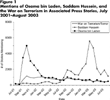
shows the changing frequency with which these terms appeared in Associated Press reports over time.
Mentions of Osama bin Laden, Saddam Hussein, and the War on Terrorism in Associated Press Stories, July 2001–August 2003
Osama bin Laden had been mentioned in nearly 300 stories during the two months prior to 9/11 before becoming the focus of public attention in September and especially October of 2001. But news attention to bin Laden began to wane in November, and as bin Laden's trail grew cold after the fall of the Taliban government, the amount of coverage mentioning his name continued to decline rapidly. By March of 2002 he was mentioned in fewer than 1,000 articles per month, a level that stabilized but which would continue gradually to decline over the next year and a half.
Likewise, Saddam Hussein had also been mentioned in nearly 300 stories over the two months before the attacks, but even following the attacks his name came up in just 200 to 400 stories per month through July of 2002. In August his coverage more than doubled to 956 stories, making him for the first time more widely covered than Osama bin Laden. News attention to Hussein doubled again in September to 1,919 stories as the Bush administration began pressing Congress to authorize the use of military force against Iraq. But it was not until March of 2003, with the start of the war against Iraq, that Saddam Hussein was mentioned in more stories per month than Osama bin Laden ever was in the aftermath of 9/11.
Thus, long before the war against Iraq actually commenced, and while Osama bin Laden was still on the run, news coverage came to focus squarely on Saddam Hussein and the situation in Iraq. What caused this shift in public attention?
Prompting by the Bush Administration
The Bush administration began preparing the American public for a war with Iraq soon after the 9/11 attacks—by late 2001 the Bush administration strategy was openly discussed as “Afghanistan first”—but the shift in media attention from Osama to Saddam was not merely due to the administration's initiative. As a complete accounting of this transformation is beyond the scope of this brief article, we encourage the interested reader to examine a detailed 200-page study of this case conducted by Devon Largio (available at http://www.pol.uiuc.edu/news/largio.htm). Here we will merely examine a small part of this larger story: the rhetorical shift from Osama to Saddam that occurred in the public statements of President Bush. For this analysis, we keyword-searched the public statements of the president3
These are available at www.whitehouse.gov, but we used the collection of “Speeches and Public Statements” maintained by Project Vote Smart at www.votesmart.org because of its superior keyword search engine.
for the same terms that were examined in Associated Press coverage.
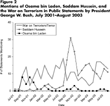
As shown in Figure 2, President Bush frequently discussed Osama bin Laden in his public statements between September and December of 2001, during the active phase of Operation Enduring Freedom in Afghanistan. In contrast, during this period he mentioned Saddam Hussein by name only once, in November. In January and February of 2002, Saddam and Osama were each mentioned once, but following President Bush's State of the Union speech in which Iraq was named as part of the “Axis of Evil,” his public references to Saddam Hussein became more frequent. Beginning in April, references to Saddam Hussein outnumbered mentions of Osama bin Laden. By this time, bin Laden had largely disappeared from the president's rhetorical field: between May of 2002 and August of 2003, President Bush mentioned bin Laden by name on only eight occasions, while referring to Saddam Hussein in 185 public statements.
Mentions of Osama bin Laden, Saddam Hussein, and the War on Terrorism in Public Statements by President George W. Bush, July 2001–August 2003
If April of 2002 marks the turn in presidential emphasis from Osama to Saddam, it is notable that the news trends in Figure 1 show no parallel shift until several months later. And when the Associated Press began mentioning Saddam more than Osama in August of 2002, this shift occurred before President Bush began his campaign for congressional authorization of force against Iraq in September of 2002. Beginning in that month, and continuing in every month until after the overthrow of the Iraqi regime in mid-2003, President Bush personalized his push against Iraq by naming Hussein more frequently than he had ever mentioned bin Laden. Presidential references to Hussein jumped from three in August of 2002 to 18 in September and 31 in October, the month of the congressional vote to authorize military action.
In short, Osama was the primary target in presidential rhetoric during the fall of 2001, but beginning in April of 2002, Saddam became the president's main rhetorical adversary. Yet there is an additional pattern in these trends that is especially revealing of the administration's public relations strategy. Figure 1 shows that journalistic use of the term “War on Terrorism” peaked in October of 2001 before declining steadily thereafter. The president's use of the term follows a very different pattern.
In Figure 2, the president's use of the term “War on Terrorism” first surfaces in the month of the 9/11 attacks, peaks in October, and then falls off in November. But following the collapse of the Taliban in December of 2001, President Bush begins using the term “War on Terrorism” with increasing frequency. President Bush's use of the term is particularly notable during June, July, and August of 2002, when this phrase is mentioned by the president between 13 and 19 times per month, the most intense and sustained use of the phrase in presidential rhetoric since it was first coined after the 9/11 attacks. Suddenly, in September of 2002, President Bush nearly stops using the term “War on Terrorism” and starts naming Hussein almost daily. Indeed, “War on Terrorism” declines steadily as a stock phrase in presidential rhetoric—its low point is March of 2003, the month in which the Iraqi invasion began. It is only resurrected in May of 2003 and for four months thereafter, when it had become clear that an active campaign of insurrection and resistance was occurring against the American occupation in Iraq.
This unusual pattern in the president's speeches—rising attention to the war on terror following the Afghan campaign coupled with a sudden focus on Saddam Hussein while Osama bin Laden is pushed rhetorically out of sight— becomes especially notable in light of a discovery trumpeted in the American media around this same time. In mid-August and September of 2002, a series of polls conducted by different survey organizations found that majorities of Americans believed Saddam Hussein was personally responsible for the 9/11 attacks. As journalists publicly marveled at the degree of misinformation revealed in these results—not even the Bush administration was asserting such a direct connection—the seemingly obvious implication was that political leaders had somehow deceived the American public.
Was the Public Duped?
Had the switch in administration rhetoric from bin Laden to Hussein, along with linking Saddam Hussein to the War on Terror, misled Americans into supporting a military campaign against Iraq? At first glance, the evidence in support of this conclusion seems compelling: American beliefs about Hussein's culpability surfaced only after the Bush administration shifted its attentions from Osama to Saddam and began discussing Saddam in connection with the War on Terrorism. Moreover, the only poll result bearing on Saddam's culpability that received public attention in the immediate aftermath of the attacks seemed to confirm that few Americans saw a direct connection between Hussein and 9/11. Appearing in a New York Times article two weeks after 9/11,4
Richard L. Berke and Janet Elder, “A Nation Challenged: The Poll; Poll Finds Support for War and Fear on Economy.” New York Times, Late Edition, A2 (September 25, 2001).
the CBS/
New York Times poll found that 45% of Americans laid sole blame for the attacks on Osama bin Laden, another 21% blamed Osama bin Laden and others, but only 2% said that Saddam Hussein was solely responsible, and another 6% said Hussein and bin Laden were jointly responsible.
However, this popular reading of the sequence of events is mistaken. While the Bush administration clearly aimed to link Saddam Hussein to Osama bin Laden and the War on Terrorism, our analysis of all available survey data reveals that the American public needed no convincing on this point. While it appeared from publicly-reported surveys that Americans initially blamed Osama and only later blamed Saddam, our analysis shows that Americans were willing to blame Saddam immediately after 9/11 when survey respondents were presented with that possibility. Indeed, rather than seeing a sudden spike in Saddam's culpability around the first anniversary of the 9/11 attacks, our analysis shows a steady decline in the percentage of Americans willing to blame Saddam, a percentage that has been dropping ever since the first days following 9/11.
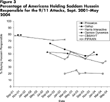
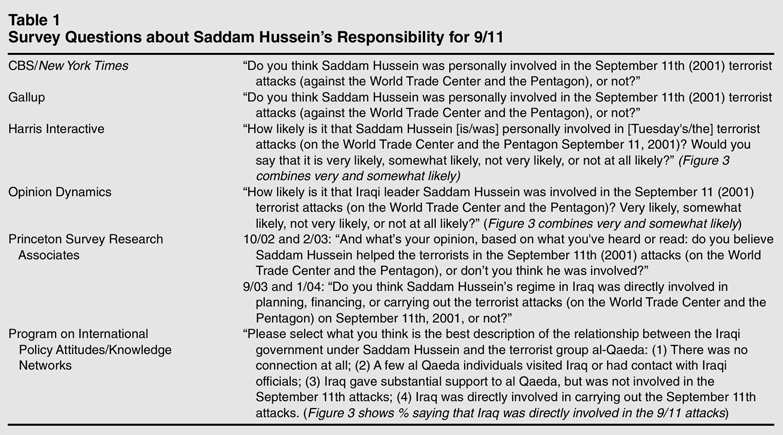
Using the iPOLL database maintained by the Roper Center for Public Opinion Research, we found every publiclyavailable survey question that asked Americans whether Saddam Hussein might be responsible for the 9/11 attacks. Six survey organizations asked relevant questions that were repeated at least once; the trends from these questions are shown in Figure 3 (the wording of questions posed by these organizations is given in Table 1).
Percentage of Americans Holding Saddam Hussein Responsible for the 9/11 Attacks, Sept. 2001–May 2004
The earliest polls were conducted two days after the 9/11 attacks by Harris Interactive and in October and November by Opinion Dynamics. Using similar questions, both organizations found that nearly 8 in 10 Americans believed Saddam Hussein was responsible for the terrorist attacks. By late 2002 and early 2003, belief in Hussein's responsibility had dropped to around 71% in the Harris polls, but as shown in Figure 3, other surveys using differently worded questions were registering lower levels of misperception. In early February of 2003, Princeton Survey Research Associates found that 57% of Americans believed Hussein “helped the terrorists in the September 11th attacks,” but CBS/New York Times found that only 42% of Americans thought Hussein “was personally involved in the September 11th attacks.” The first PIPA poll on misperceptions, the only poll that allowed respondents to choose among differing levels of culpability, was also conducted during this time. Using this more sensitive question format, PIPA found that only 20% believed “Iraq was directly involved in carrying out the September 11th attacks.” Another 36% believed that “Iraq gave substantial support to al Qaeda, but was not involved in the September 11th attacks”; 29% agreed that “a few al Qaeda individuals visited Iraq or had contact with Iraqi officials”; and the remaining 7% believed “there was no connection at all” between Iraq and al Qaeda.
When seemingly minor differences in question wording lead to such large disparities in survey results—the early February PIPA poll shows 8 in 10 Americans believing Saddam had no direct involvement, while the early February Harris polls shows 7 in 10 Americans believing Saddam was personally behind the attacks—survey researchers typically presume that the public's views are illformed and uncrystallized. However, the story in this case is more complicated and nuanced. Our interpretation of the available data suggests most Americans were inclined to believe that Saddam was behind the attacks when explicitly presented with this possibility in forcedchoice questions that required respondents to choose from a list of possible answers. But few spontaneously volunteered such a connection when presented with open-ended questions asking who they thought was responsible.
Open-ended questions that recorded the unprompted, verbatim answers given by survey respondents consistently revealed that Americans were more likely to blame Osama bin Laden for the terrorist strikes. The late September, 2001 CBS/New York Times poll that found only 8% believed Saddam Hussein might have had something to do with the attacks was using an open-ended question. Similar results were found with other open-ended questions in the early polls. Three days after the 9/11 attacks, Wirthlin Worldwide asked respondents “Who do you think is more responsible for the recent terrorist attacks on the New York World Trade Center and the Pentagon?” Without prompting, 57% named Osama bin Laden and only 3% named Saddam Hussein. However, when asked who “is the second most responsible,” 27% spontaneously mentioned Saddam Hussein. This suggests that in the immediate aftermath of 9/11, Americans primarily blamed bin Laden but were already willing to believe Hussein was involved. This pattern becomes even clearer in a Harris Interactive poll conducted two days after the 9/11 attacks. In an open-ended question which asked “If Congress were to declare war, who do you think it should declare war against or aren't you sure?” 61% said they were not sure. But 25% named either Afghanistan, the Taliban, or Osama bin Laden; while only 6% mentioned Iraq or Saddam Hussein. Yet when presented with a forced-choice question later in the same poll, fully 78% said that it was very or somewhat likely that “Saddam Hussein is personally involved in Tuesday's terrorist attacks.”
A few other early forced-choice questions that were never repeated reinforce the conclusion that Americans were predisposed to blame Saddam Hussein for the attacks. A Gallup poll on September 21, 2001 found that if the U.S. took military action to retaliate, 68% of Americans believed that “removing Saddam Hussein from power in Iraq” would be a very important goal, and another 22% said it would be a somewhat important goal. Likewise, during the first week of October, 2001, Techno Metrica Institute of Polling and Politics presented Americans with a list of “different things that the United States could do in its fight against terrorism.” When asked “How important is removing Saddam Hussein from power,” fully 62% said it was “extremely important,” and another 24% indicated that it was somewhat important.
Although the popular impression is that public misperceptions of Saddam Hussein's role in 9/11 must have grown in the year following the attacks, our analysis shows a general decline in the belief that Saddam was responsible. Most of the trends in Figure 3 tend to diminish over time. The main exceptions are the PIPA trend, which is low and stable, and the spike in culpability registered in the CBS/NYT trend around the start of the 2003 Iraq war. It appears that rather than becoming duped, as the popular account has it, the American public has gradually grown more critical of the idea that Hussein had a hand in 9/11.
Why wasn't this noticed before? Our scan through the Nexis/Lexis news database suggests that the early polls received almost no public attention. Indeed, the only relevant survey data reported in national newspapers and wire service reports was the open-ended CBS/New York Times question asked in late September of 2001. This lack of attention to the early polls is certainly understandable given the flood of coverage on the aftermath of the 9/11 attacks and the start of the Afghanistan campaign. But the lack of public attention to these early data made the levels of misperception “discovered” in the weeks surrounding the first anniversary of 9/11 seem a new and startling development. This was compounded by the finding that no open-ended versions of the “who's responsible” question were asked after late September of 2001. Since open-ended questions registered the lowest levels of culpability for Saddam Hussein, the universal switch to forcedchoice formats in the spate of polls that suddenly appeared in the weeks surrounding the first anniversary of the 9/11 attacks seems to have overstated the degree to which Americans laid the blame for 9/11 at the feet of Saddam Hussein.
Conclusion
The shift from Osama to Saddam occurred in media coverage during August of 2002, but began four months earlier in the public statements of President George Bush. As Osama bin Laden faded in news coverage and all but disappeared in President Bush's public statements, clear efforts were made by the Bush administration to replace Osama bin Laden as America's foremost enemy by linking Saddam Hussein to the War on Terror.
Yet the American public needed no convincing on the possibility that Hussein was involved in 9/11. In polls taken in the days immediately following the 9/11 attacks, open-ended questions showed that Americans were not spontaneously blaming Iraq for the attacks. But forced-choice questions showed that as many as 8 in 10 Americans thought that Hussein was probably behind them. When explicitly presented with the possibility in the immediate aftermath of the 9/11 attacks, Americans by wide margins were already prepared to believe that Saddam was to blame long before the administration began building popular support for the war.
The American public's apparently widespread belief that Saddam Hussein was responsible for the 9/11 terror attacks was no feat of misdirection by the Bush administration. Instead, the Bush administration inherited and played into a favorable climate of public opinion, which may have greatly facilitated its task of building public support for war against Iraq. The mistaken belief that Saddam Hussein was responsible for the 9/11 attacks was already widespread among Americans long before President Bush began publicly linking Saddam Hussein with the War on Terrorism. Indeed, nearly seven months before the 9/11 attacks, an Opinion Dynamics poll in late February of 2001 found that 73% of Americans said it was very or somewhat likely that “Saddam Hussein will organize terrorist attacks on United States [sic] targets to retaliate for the air strikes” that had recently been conducted in Iraq by American and British air forces.
Our analysis of surveys about the mistaken belief that Hussein was responsible for 9/11 also suggests that the degree of misperception was overstated in many polls. This was partly due to the universal switch to forced-choice survey questions after September, 2001, which exaggerated the degree to which Americans saw a connection between Hussein and the 9/11 attacks. The other reason was that most questions only permitted respondents to assess the likelihood that Hussein was involved in 9/11, rather than allowing them to choose from a range of alternative options featuring different degrees of involvement. The only survey to have done this, conducted by the Program on International Policy Attitudes and Knowledge Networks, found that fewer than a quarter of Americans saw a direct tie between Hussein and the terror attacks in New York and Washington, D.C.
News coverage and presidential rhetoric may have replaced Osama with Saddam over time, but Saddam was on the short list of most likely suspects from the beginning for most Americans. Rather than showing a gullible public blindly accepting the rationales offered by an administration bent on war, our analysis reveals a self-correcting public that has grown ever more doubtful of Hussein's culpability since the 9/11 attacks.