INTRODUCTION
One of the most efficient ways of preserving biodiversity is to establish conservation policies that set aside interconnected protected areas within each biome and protect ecosystems and hydrographic basins (Ganem & Drummond Reference Ganem, Drummond and Ganem2011). To facilitate correct conservation policy, decisions should be based on trusted scientific knowledge regarding habitats and ecosystems (Dybas Reference Dybas2006; Bean Reference Bean2009; Habel et al. Reference Habel, Gossner, Meyer, Eggermont, Lens, Dengler and Weisser2013). In fact, a policy decision that does not consider proper environmental knowledge can have serious consequences for environmental protection (see for example Metzger Reference Metzger2010; Metzger et al. Reference Metzger, Lewinsohn, Joly, Verdade, Martinelli and Rodrigues2010).
One biome that urgently needs protection is the Brazilian Cerrado, the most biodiverse and threatened savannah in the world. The vegetation types in the Cerrado (sensu Ribeiro & Walter Reference Ribeiro, Walter, Sano, Almeida and Ribeiro2008) include the veredas, which are found in saturated soils during most of the year, usually occupying minimally steep or flat areas near the headwaters or margins of the headwaters of gallery forests (Ribeiro & Walter Reference Ribeiro, Walter, Sano, Almeida and Ribeiro2008). The veredas represent important landing sites for birds, providing refuge, a food source and, consequently, favourable breeding sites, and thus play an important role in maintaining the ecological processes of the Cerrado (Carvalho Reference Carvalho1991; Barbosa Reference Barbosa and Almeida2005). According to Kuniy et al. (Reference Kuniy, Yamashita and Gomes2001), scarlet macaws (Ara ararauna L., Psittacidae) preferentially consume the fruits of ‘buriti’ (Mauritia flexuosa Lf, Arecaceae), an important veredas species. Furthermore, Juarez & Marinho-Filho (Reference Juarez and Marinho-Filho2002) stated that the fruits fall to the ground and are eaten by various rodents, including the large mammal Tapirus terrestris L. (Tapiridae). Other important ecological functions of the veredas include the maintenance of plant diversity (Hickman Reference Hickman1990) favoured by numerous microhabitats (Araújo et al. Reference Araújo, Barbosa, Arantes and Amaral2002); depuration of water (Ramos et al. Reference Ramos, Cury, Mota, Vitorino, Ferreira and Silva2006); and soil carbon storage (Ewel Reference Ewel and Money1991). Veredas are important for the persistence and regularity of water courses (Carvalho Reference Carvalho1991). The dense and continuous herbaceous vegetation in veredas protects the soil from erosion (Guimarães et al. Reference Guimarães, Araújo and Corrêa2002). However, urban and agricultural disturbances, water use (Meirelles et al. Reference Meirelles, Oliveira, Vivaldi, Santos and Correia2002), cattle husbandry and deforestation result in a lowering of the phreatic level, thus leading to vegetation changes and degradation of veredas (Guimarães et al. Reference Guimarães, Araújo and Corrêa2002). As part of the Cerrado vegetation, veredas are also expected to show shifts in their floristic patterns according to environmental gradients (see for example Oliveira-Filho & Ratter Reference Oliveira-Filho, Ratter, Oliveira and Marquis2002). In vegetation sciences, assessments of floristic and structural drivers have been widely recognized as essential tools that can be used to obtain accurate ecological knowledge (Kent Reference Kent2011), thereby providing a practical basis for conservation.
Veredas are defined by Law 12651 of the Brazilian National Council for Environment/Ministry of Environment as a ‘phytophysiognomy of savannah, found on hydromorphic soils, usually with the arboreal palm Mauritia flexuosa -‘buriti’, emergent, without forming canopy, within assemblages of shrubby-herbaceous species’ (CONAMA [Conselho Nacional do Meio Ambiente] 2012). Legislation focuses on the M. flexuosa veredas, most likely because this palm facilitates recognition, and therefore protection, of the habitat, but textbooks (see Ribeiro & Walter Reference Ribeiro, Walter, Sano, Almeida and Ribeiro2008) also associate veredas with this palm. In central-western Brazil, many wetlands do not include M. flexuosa as a component of the vegetation. However, the species of the herbaceous stratum of these wetlands are very similar to those found in areas containing M. flexuosa (S. Moreira, unpublished data 2013). In law 12651, the single species cited to define this type of vegetation is M. flexuosa, followed by the vague expression ‘within assemblages of shrubby-herbaceous species.’ Wetlands without M. flexuosa are excluded, and are thus threatened.
Because veredas provide environmental services and illustrate the implications of ecological knowledge for legal protection, we sought to understand environmental management policies concerning Brazilian wetlands and similar ecosystems. Therefore, based on the collection of floristic and structural data in central Brazil, our objective was to answer the following question: are wetlands with and without Mauritia flexuosa similar regarding floristic composition, structure and diversity, and their response to environmental predictors? We discuss the implications of our results for conservation of this important Neotropical ecosystem.
METHODS
Study area
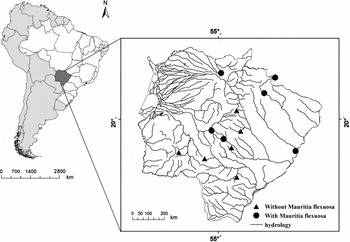
We conducted fieldwork between March 2012 and April 2013 in 12 wetlands in central-western Brazil, six with and six without M. flexuosa, hereafter referred to as MP (Mauritia present) and MA (Mauritia absent), respectively (Fig. 1). The climate is Koeppen's Aw, which indicates a dry winter. In certain cases, veredas are located near each other but belong to different watersheds. According to the relief, the water will be drained by different basins or watersheds. We selected these areas based on our field experience and on satellite images, choosing regions previously known by the staff. This selection also assumed that climatic variables can be a structuring factor for plant communities, thus we sought to sample environments exhibiting distinct temperatures (warmer in the north and cooler in the south). The soil is characterized as a swamp, exhibiting puddles and organic material undergoing slow decomposition.
Locations of the 12 wetlands with (MP) and without Mauritia flexuosa (MA) in central-western Brazil.

Vegetation sampling
In each of the 12 wetlands, we established six 50 m transects perpendicular to the slope. The transects were arranged 50 m apart in a zigzag pattern. In all, 72 sampling units were included in the field study. Along each transect, we placed a quadrat of 1 m × 1 m every 5 m and estimated the percentage of cover per species according to the scale of Braun-Blanquet (Reference Braun-Blanquet1979). Transects were placed approximately in the middle of the wetland, starting from the outer limit of the moist and/or waterlogged ground down to the drainage line in each wetland. The inventoried wetlands generally presented a substrate composed of organic mud. It was not possible to collect adequate samples of this substrate with our equipment. Therefore, the substrate was not included as a predictor variable for vegetation.
We collected, dried and identified fertile botanical material up to the most exclusive possible level based on a comparison with material in the Belo Horizonte Ciências Biológicas (BHCB), Campo Grande Mato Grosso do Sul (CGMS) and San Isidro (SI) herbaria (Thiers Reference Thiers2015) and through consulting specific bibliographies and taxonomists. We followed the Angiosperm Phylogeny Group III (APG III 2009) and confirmed the spelling and validity of the names and authors using the W3-Tropicos database (MOBOT [Missouri Botanical Garden] 2013). The exsiccates were incorporated into the CGMS and BHCB herbaria.
Vegetation parameters
We determined the following attributes describing the plant community: (1) species occurrence; (2) community structure, expressed in terms of frequencies (absolute and relative), cover (absolute and relative) and cover value (CV) of the species; and (3) species diversity, measured based on richness, equability (Simpson's reciprocal index, 1/D) and heterogeneity (Shannon's H′ index). To calculate the 1/D and H′ indices, we adopted the percentage of cover of each species as a measure of abundance, as herbaceous species are difficult to count as individuals.
Abiotic parameters
We used 19 bioclimatic variables related to temperature and rainfall obtained from the WorldClim dataset (Hijmans et al. Reference Hijmans, Cameron, Parra, Jones and Jarvis2005), four topographic variables (drainage, elevation, inclination and orientation of the terrain) from Esri (2010), and two evapotranspiration variables (potential and real) and the aridity index from Trabucco and Zomer (Reference Trabucco and Zomer2010). We extracted the variables using ArcGIS 10 at a resolution of 1 km. Based on our field experience, we classified the areas according to the following drainage classes: (1) ‘worst drained’, including flat areas with a water table above the surface, (2) ‘intermediate’, including areas with a small declivity and superficial water table at certain points and (3) ‘best drained’, including areas with the greatest declivity and a discrete water table from the edges to the bottom zone where it emerges close to the stream. We standardized the values of all environmental variables based on a mean of 0 and a standard deviation of 1.
Preparation of matrices for numerical analyses
We prepared five types of matrices: (1) a binary matrix including species’ presence and absence data, (2) a matrix of the species’ relative frequency, (3) a matrix of the species’ relative cover, (4) a matrix of environmental variables extracted from the central point of each area, and (5) a matrix of geographical coordinates (latitude and longitude). Matrices 1–3 were prepared containing data for each of the 12 wetlands (n = 12) and each transect (n = 72), with the aim of identifying floristic patterns among and within areas, respectively. For matrices 4–5, we only created n = 12 matrices because the focus was on the environmental and spatial patterns shown by the two types of veredas. From matrix 5, we obtained the spatial eigenvectors known as Moran's eigenvector maps (MEMs; Dray et al. Reference Dray, Legendre and Peres-Neto2006).
Numerical analyses
We prepared graphs of gradients of the variation of the frequency and cover of the 20 species showing the highest values for these parameters in each set (MP and MA). Because the 20 selected species in each set showed a degree of overlap, the total number of species represented in the graphs did not equal 40.
We performed an ordination analysis using the non-metric multidimensional scaling (NMS) method (McCune & Grace Reference McCune and Grace2002; Legendre & Legendre Reference Legendre and Legendre2012) based on the matrices of the occurrence, frequency and cover of the species (n = 72), to examine the floristic and structural relationships that existed among the wetland areas. We used the Sørensen/Bray-Curtis index in this analysis (McCune & Grace Reference McCune and Grace2002), and calculated the final stress, the significance for each axis (based on 999 Monte Carlo permutations) and the adjustments (R²) between the floristic or structural distances reproduced along each NMS axis and the original distances (McCune & Grace Reference McCune and Grace2002). We used PC-ORD 6.25 software (McCune & Mefford Reference McCune and Mefford2011) for all steps.
We prepared diversity profiles (Tóthmérész Reference Tóthmérész1995) using the Rényi series in the program PAST 2.0 (Hammer et al. Reference Hammer, Harper and Rian2001). This method allows accurate comparison of species diversity between two or more communities and enables conclusions to be drawn based on eventual differences independently of the index used (Melo Reference Melo2008). The indices considered in the Rényi series were richness, Shannon's index (H′) and Simpson's reciprocal index (1/D).
We prepared linear models (multiple regressions and their extensions for multiple response variables, such as canonical redundancy analysis; Anderson & Legendre Reference Anderson and Legendre1999) to evaluate the influence of the environmental and spatial variables on the matrices of the occurrence, frequency and cover of the species, as well as on the diversity indices (n = 12). The occurrence, frequency and cover data were Hellinger-transformed (Legendre & Gallagher Reference Legendre and Gallagher2001). We progressively selected the environmental and spatial variables based on the function ‘forward.sel’ (Blanchet et al. Reference Blanchet, Legendre and Borcard2008) of the package ‘packfor’ in the R environment (R Development Core Team 2013). Following Peres-Neto & Legendre (Reference Peres-Neto and Legendre2010), we then partitioned the variance to generate partial models to control the type I error.
Because the three diversity indices used here are closely correlated, we decided to prepare a single predictive model for all three indices. However, the predictor variables were only selected when we separated the indices in independent models, which occurred only for 1/D. Therefore, among these diversity indices, we only present the results for this model. In all models, we confirmed the approximate linearity of the relationship between the predictor variables and variable responses based on a graph of residuals, in which we plotted the values estimated by the model along the x axis and the residuals along the y axis.
RESULTS
The species occurrences in the two sampled sets (MP and MA) showed a greater number of shared species (130) than exclusive species, with the MP wetlands presenting 54 exclusive species and the MA wetlands presenting 63. In both the MP and MA wetlands, the herbaceous vegetation was 0.5–1.2 m tall, with very dense tussocks of long filiform leaves, including not only grass species, but also other graminoids, such as Cyperaceae, Iridaceae and Xyridaceae. In intermingled puddles and trickles, rosulate herbs such as Eryngium, Alismataceae and Eriocaulaceae, and small hydrophytes, such as Bacopa, Drosera, Mayaca and Utricularia were present in both MP and MA wetlands (Table S1, see Supplementary material).
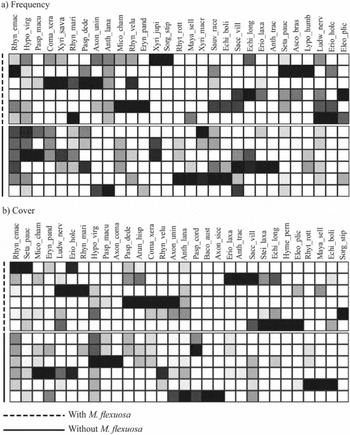
The species occurred in both the MP and MA wetlands without a clearly defined pattern (Fig. 2). For example, Hypogynium virgatum, Paspalum dedeccae, Rhynchospora emaciata, R. marisculus and Comanthera xeranthemoides showed high frequencies in MA, as well as in MP wetlands (Fig. 2 a). Anthaenantia lanata, Axonopus uninodis, Eriochrysis holcoides, H. virgatum and R. emaciata showed high cover independent of the wetland, demonstrating that these communities are very similar (Fig. 2 b). Nevertheless, some species, such as Sorghastrum setosum, E. holcoides and Eleocharis plicarhachis, showed high frequencies only in MP wetlands, whereas Rhytachne rottboelioides, Xyris macrocephala and Anthaenatiopsis trachystachya showed high frequencies specifically in MA wetlands (Fig. 2 a). In terms of cover, we observed that R. emaciata, Ludwigia nervosa, E. holcoides, H. virgatum, R. velutina, A. lanata and Saccharum villosum exhibited a similar high cover pattern in both studied sets, whereas certain species were preferentially found in MA wetlands, such as Paspalum cordatum, Axonopus siccus and R. rottboelioides, and others in MP wetlands, such as Steinchisma laxum, Hymenachne pernambucensis and S. setosum (Fig. 2 b; see also Table S1, see Supplementary material).
(a) Frequency and (b) cover of the sampled species (the first four letters refer to genus and the last four to specific epithet) in the studied MP (with Mauritia flexuosa) and MA (without M. flexuosa) wetlands of central-western Brazil. Black indicates highest values.

When we examined the floristic and/or structural relationships existing between the wetlands, namely without including the influence of environmental variables, we found no consistent pattern of separation between MP and MA wetlands. NMS axes 1, 2 and 3 demonstrated a strong floristic and structural affinity between both types of wetlands (Figs S1 and S2, see Supplementary material). The final NMS stress (Table S2, see Supplementary material) remained within the expected range (McCune & Grace Reference McCune and Grace2002), although values such as those obtained for occurrence, which were very close to 20, indicate that the results might be difficult to interpret ecologically (Clarke Reference Clarke1993). Even subject to this limitation, the stress remained stable in the final iterations (results not shown), indicating a stable solution, and the three axes were significant (p ≤ 0.05), as in the NMS analyses of frequency and cover. Furthermore, the three axes in each ordination together reproduced c. 70% of the original distances (Table S2, see Supplementary material).
The variations in occurrence, frequency and cover observed in the 12 wetlands were modelled by the temperature amplitude (Bio 4), annual temperature amplitude (Bio 7), aridity index and two spatial variables (Table S3, see Supplementary material). However, only Bio 7 was significant, and its influence on the variation in species frequency was insufficient to separate the wetlands into groups based on the presence or absence of M. flexuosa (Fig. S3, see Supplementary material). Furthermore, variations in diversity, specifically those shown by Simpson's reciprocal index (1/D), were modelled exclusively based on spatial variables. However, these variables also did not suggest the possible separation of the areas into physiognomic groups related to M. flexuosa (Fig. S4, see Supplementary material).
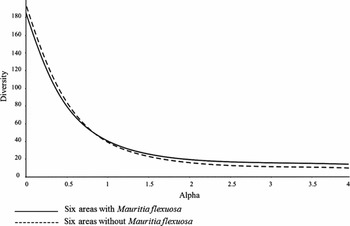
While species richness was higher in the MA areas (Fig. 3), the MP areas had greater values for the Shannon and reciprocal Simpson indices. Therefore, when different weights were attributed to rare species, there was no appreciable difference in species diversity between MP and MA wetlands.
Diversity profile using the Renyi series for the 12 wetlands in central-western Brazil. For alpha = 0, the value of diversity is equal to the number of species in the sample (richness); for alpha = 1, the value of diversity is equivalent to Shannon's index (H′); for alpha = 2, the value corresponds to the inverse of Simpson's index (1/D).

DISCUSSION
Ecological knowledge is essential to legal protection (Defra [UK Department for Environment, Food and Rural Affairs] 2003), although the importance of scientific evidence has not resulted in more coherent policies regarding environmental laws (Sutherland et al. Reference Sutherland, Armstrong-Brown, Armsworth, Tom, Brickland, Campbell, Chamberlain, Cooke, Dulvy and Dusic2006; Metzger Reference Metzger2010). In Brazilian wetlands, if floristic and structural data are considered, then there is no apparent reason to treat MP (M. flexuosa present) areas as protected ecosystems while leaving MA (M. flexuosa absent) areas unprotected. However, to conclusively show that MP and MA areas do not differ ecologically, the burden of proof would have to be extended beyond the quantitative vegetation analysis of this study. Ideally, there should be evidence supporting the similarity of other conservation attributes in MP and MA veredas, including values such as wildlife habitat. Despite the limitations of this study, it is clear that the definition of veredas should be reconsidered.
The lack of consistent patterns of separation between the structural attributes of the plant communities of the MP and MA areas, coupled with the high floristic connection between the areas, is important for conservationists; the wetlands are part of a continuum in which a gradual replacement of species and community structure occurs without a pattern related to physiognomy. This continuum indicates that protection of areas without M. flexuosa should be considered, particularly in terms of the fragmentation of habitats, which is a matter of great concern. We observed that several species had preferentially high frequencies or cover within either MP or MA areas, but not in both. However, even considering the particularities of each wetland, namely the presence of some selective species, our results indicate that the MP and MA areas are not ecologically independent and, probably more importantly, that M. flexuosa is not the unique element associated with the few differences that exist between these two areas.
In addition, the environmental and spatial variables employed to identify patterns in the wetlands in this work do not reveal new clues in relation to the other analyses; there were still no notable differences between the MP and MA areas. For example, across the study area, the temperature amplitude, which was a significant predictor in one of our statistical models, varied most notably between the west (lowest values) and east (highest values). Because this west-east variation does not depend on the presence or absence of M. flexuosa, it is a phytogeographic pattern that is not related to physiognomic aspects or linked to M. flexuosa. These results clearly show that ecological patterns have not been considered in the legal protection of veredas, and may alert researchers and conservationists to similar situations in other ecosystems around the world.
Important studies of the characteristics and dynamics of these wetlands and their representative taxa (see Araújo et al. Reference Araújo, Barbosa, Arantes and Amaral2002; Guimarães et al. Reference Guimarães, Araújo and Corrêa2002; Meirelles et al. Reference Meirelles, Guimarães, Oliveira, Araújo, Walter, Aguiar and Camargo2004; Munhoz & Felfili Reference Munhoz and Felfili2008; Oliveira et al. Reference Oliveira, Araujo and Barbosa2009; Santos & Munhoz Reference Santos and Munhoz2012) are not incorporated in the current legislation. Such studies have also noted a dominance of Poaceae, Cyperaceae, Asteraceae, Eriocaulaceae and Xyridaceae; the ‘herbaceous assemblages’ described in the legislation generally correspond to these families, and this information should be included in the definition of veredas. We also recommend that the most representative genera and species with the highest cover and frequency be employed as additional attributes for the recognition of veredas in areas without M. flexuosa. We believe that additional information with respect to the most representative families and/or genera that correspond to the shrubby-herbaceous stratum should be specifically included in the law. Such information will have enduring characteristics and will be feasible for inclusion in an improved resolution, although we recognize that scientific knowledge should be refined over time. Moreover, other ecological factors that are equally important must be considered in the definition of this ecosystem, such as the conditions of drainage, temperature amplitude, presence of a superficial water table for most of the year and, in particular, the typical herbaceous vegetation (Araújo et al. Reference Araújo, Barbosa, Arantes and Amaral2002; Meirelles et al. Reference Meirelles, Oliveira, Vivaldi, Santos and Correia2002; Ramos et al. Reference Ramos, Cury, Mota, Vitorino, Ferreira and Silva2006; Oliveira et al. Reference Oliveira, Araujo and Barbosa2009). Considering such additional issues when legally defining the ecosystem would promote a more comprehensive and realistic view of the ecosystem's characteristics and functions, and result in laws with a stronger scientific support.
The question that we aimed to discuss in the present article is that of the double interpretation of law 12651 (CONAMA 2012), defining veredas as a phytophysiognomy that usually includes M. flexuosa. Although the term ‘usually’ appears to indicate that areas without this palm may also fall under the vereda definition, what we have observed in practice is that this ambiguity has permitted damage to wetlands and to adjacent systems. Landowners and officers of the Environment Secretariat use the easiest attribute cited in the law to identify veredas, namely the presence of the M. flexuosa palm in the landscape. In veredas, the herbaceous stratum is always predominant; therefore, additionally listing the species of this stratum would be helpful and ensure more reliable identification of these wetlands. We have observed that the shrubby-herbaceous vegetation of the Cerrado is rarely addressed in publications, and this is even more apparent in terms of wetlands, which are difficult to access for research and for environmental control. Hence, while citing herbaceous representative species, we call attention to the most relevant layer of this vegetation type.
Because our results regarding the occurrence, frequency, cover and diversity of species were extremely similar between the MP and MA wetlands, showing that there is no formation of specific groups related to the physiognomy of the vegetation, we believe that this important issue should be reconsidered to promote a correct interpretation of law 12651 (CONAMA 2012). We therefore propose that veredas be redefined, so that wetlands without the palm M. flexuosa are also included in the legal permanent preservation areas of Central Brazil. Similar situations may exist for other types of vegetation elsewhere in the world, such as the aguajales and morichales of Colombia, Peru and Venezuela (Rull Reference Rull1998), which may also require reliable ecological support to redirect conservation-related decisions. Other questions will likely arise, for example, the probable increase in legally protected area under new legislation. Such issues necessitate a discussion of the costs that may be imposed on society if policymakers extend the protection of veredas to include MA wetlands. We believe that protection will be improved and the uncertainty of the present definition overcome by including more elements on which to base the identification of veredas.
ACKNOWLEDGEMENTS
We thank the ‘Conselho Nacional de Desenvolvimento Científico e Tecnológico’ (CNPq) for financing the project (Edital Universal 477675/2011-5) and for grants provided to Pedro Eisenlohr and Arnildo Pott; the ‘Coordenação de Aperfeiçoamento de Pessoal de Nível Superior’ (CAPES) for a doctoral scholarship awarded to Suzana Moreira and a Senior Visiting Professor grant to Arnildo Pott; the Graduate Programme in Plant Biology of the Universidade Federal de Mato Grosso do Sul (UFMS) for laboratory space and a vehicle for field work; the Graduate Programme in Plant Biology of the Universidade Federal de Minas Gerais (UFMG) for laboratory and office space, as well as financial support; J.M. Costa, who helped us with the illustrations; and the specialists who contributed to the identification of species, including A.C. Fernandes and E. Hattori (Asteraceae), N. Furtado (Xyridaceae), R. Harley (Lamiaceae), A. Salino (Ferns and Lycophytes), P. Sano and L. Echternacht (Eriocaulaceae), S. Hefler, R. Trevisan and W. Thomas (Cyperaceae) and F. Zuloaga, J.F.M. Valls, R.C. Oliveira and A. Guglieri-Caporal (Poaceae).
Supplementary material
To view supplementary material for this article, please visit http://dx.doi.org/10.1017/S0376892915000107.