Introduction
Bemisia tabaci is a cryptic species complex (De Barro et al., Reference De Barro, Liu, Boykin and Dinsdale2011), considered the most common and important pest of a wide range of crops belonging to many different botanical families, due to its wide distribution and the serious damage it causes to host plants (Brown et al., Reference Brown, Frohlich and Rosell1995; Oliveira et al., Reference Oliveira, Henneberry and Anderson2001). It is a polyphagous and invasive species, colonizing more than 1000 different plant species and causing important direct losses by feeding or acting as a vector for more than 300 plant viruses (Navas-Castillo et al., Reference Navas-Castillo, Fiallo-Olive´ and Sanchez-Campos2011). B. tabaci is one of the most damaging pests in tropical and subtropical regions (Byrne and Bellows, Reference Byrne and Bellows1991), affecting the yield of various agricultural and horticultural crops (Cahill et al., Reference Cahill, Denholm, Ross, Gorman and Johnston1996). The broad range of hosts of B. tabaci for feeding and/or reproducing include horticultural crops such as potato (S. tuberosum L.), sweet potato (Ipomoea batatas L.), eggplant (Solanum melongena L.), and other horticultural extensive crops (Brown et al., Reference Brown, Frohlich and Rosell1995).
In South America, the B. tabaci species complex is one of the few whitefly species damaging crops, directly by feeding, or by virus transmission (Krause-Sakate et al., Reference Krause-Sakate, Watanabe, Gorayeb, da Silva, Alvarez, Bello, Nogueira, de Marchi, Vicentin, Ribeiro-Junior, Marubayashi, Rojas-Bertini, Muller, Oliveira de Freitas Bueno, Rosales, Ghanim and Agenor Pavan2020). Direct damage occurs by phloem feeding and the excretion of the honeydew on leaves and fruits, which serves as a substrate for the growth of sooty mould that covers the surface, interfering with photosynthesis and causing losses in plant productivity (Kanakala and Ghanim, Reference Kanakala and Ghanim2015). However, the most important damage caused by whiteflies to agriculture is virus transmission, particularly by the B. tabaci species complex, which can transmit viruses of the genera Begomovirus, Carlavirus, Crinivirus, Ipomovirus, Torradovirus, and Polerovirus (Navas-Castillo et al., Reference Navas-Castillo, Fiallo-Olive´ and Sanchez-Campos2011). In Argentina, since 1986, B. tabaci is recognized as the vector of a geminivirus of the Bean golden mosaic virus group on soybean (Ploper et al., Reference Ploper, Laguna, Truol, Rodríguez Pardina and Pascale1989).
Among the different members of the complex, two of the cryptic species, the putative species Middle East-Asia Minor 1 (MEAM1) and Mediterranean (usually referred to in the literature as B and Q biotypes, respectively) are known to be the most invasive species of the complex (Perring, Reference Perring2001). In many areas, MEAM1 and Mediterranean are associated with the displacement of local whitefly species (Liu et al., Reference Liu, De Barro, Xu, Luan, Zang, Ruan and Wan2007). The invasion of MEAM1 and the Mediterranean in many regions of the world led to epidemics of plant disease caused by begomovirus transmitted through B. tabaci (Hogenhout et al., Reference Hogenhout, Ammar, Whitfield and Redinbaugh2008). In Argentina, MEAM1 was first detected on horticultural crops, weeds, and cotton (Viscarret et al., Reference Viscarret, Torres-Jerez, Agostini de Manero, Lopez, Botto and Brown2003), and the putative Mediterranean species was detected in sweet pepper and melon (Grille et al., Reference Grille, Gauthier, Buenahora, Basso and Bonato2011). Coexisting with these two invading species, recent studies showed two indigenous species, one that belongs to the New World putative species, and a second one referred to as New World 2 (Alemandri et al., Reference Alemandri, Vaghi, Dumón, Argüello, Mattio, García, López and Truol2015). MEAM1 has been able to displace the New World putative species (Perring and Symmes, Reference Perring and Symmes2006), but the presence and persistence of New World 2 in areas invaded by MEAM1 suggest that this species retains the capacity to resist displacement or interbreeding (Alemandri et al., Reference Alemandri, De Barro, Bejerman, Arguello-Caro, Dumon, Mattio, Rodriguez and Truol2012).
The spatial pattern of vegetation affects the distribution and abundance of herbivorous insects within agroecosystems (Grilli and Bruno, Reference Grilli and Bruno2007; Grilli and Fachinetti, Reference Grilli and Fachinetti2017). Habitat patch area, habitat patch isolation, and characteristics of the landscape surrounding the patch define the habitat configuration and affect direct or indirectly the insect population between and within patches (Grilli and Fachinetti, Reference Grilli and Fachinetti2019). However, the role of habitat amount and configuration on species occurrence and abundance is one of the major focuses of research in ecology and biogeography (Saura, Reference Saura2021). There is intense debate on the relative importance of habitat quantity (total area of habitat) and the spatial configuration of that habitat (the spatial arrangement of habitat) for biodiversity patterns and persistence (Fahrig, Reference Fahrig2013; Fahrig et al., Reference Fahrig, Girard, Duro, Pasher, Smith, Javorek, King, Freemark Lidsay, Mitchel and Tischendorf2015; Haddad et al., Reference Haddad, Brudvig, Clobert, Davies, Gonzalez, Holt, Lovejoy, Sexton, Austin, Collins, Cook, Damschen, Ewers, Foster, Jenkins, King, Laurance, Levey, Margules, Melbourne, Nicholls, Orrock, Song and Townshend2015; Martin, Reference Martin2018). The most widely accepted conceptual model, and the prevailing consensus among ecologists, has been that both habitat quantity and habitat configuration (e.g., fragmentation) are important and should be considered in conservation management (e.g., Haddad et al., Reference Haddad, Brudvig, Clobert, Davies, Gonzalez, Holt, Lovejoy, Sexton, Austin, Collins, Cook, Damschen, Ewers, Foster, Jenkins, King, Laurance, Levey, Margules, Melbourne, Nicholls, Orrock, Song and Townshend2015).
The spatial configuration of habitat components (e.g., fragmentation and isolation of habitat types) is often important because individuals moving between patches are key to accessing resources in different habitats (Thies et al., Reference Thies, Steffan-Dewenter and Tscharntke2003). Furthermore, the effects of the landscape configuration on individual species may depend upon the extent to which a species uses one or multiple habitat types within a landscape (Ewers and Didham, Reference Ewers and Didham2006). The relationship between host patches and insect density within the patch is very variable and depends on the species and its life history. Steffan-Dewenter and Tscharntke (Reference Steffan-Dewenter and Tscharntke2000) showed that population densities of monophagous species increased, but oligophagous and polyphagous species decreased, with habitat area. In the case of B. tabaci, their abundance and growth in a crop field is affected by many factors, such as the intercropping distance within the field, and the spatial arrangement of hosts around the crop field (Macfadyen et al., Reference Macfadyen, Paull, Boykin, De Barro, Maruthi, Otim, Kalyebi, Vassão, Sseruwagi, Tay, Delatte, Seguni, Colvin and Omongo2018).
In Córdoba, the main area of potato production is placed in the central area of the province. Because of the climate of the area, there are two seasons, an early season by the end of winter when seed potato is produced, and a late season during autumn when consumption potato is produced. In this area, all the produced potatoes are of the same variety, S. tuberosum L. var. Spunta (Huarte and Capezio, Reference Huarte and Capezio2013), and in particular during autumn, potato is the only crop present in the field.
Research on the distribution of B. tabaci has been limited in Argentina, despite its status as a pest increasing in recent years (Alemandri et al., Reference Alemandri, De Barro, Bejerman, Arguello-Caro, Dumon, Mattio, Rodriguez and Truol2012, Reference Alemandri, Martino, Di Feo and Truol2014, Reference Alemandri, Vaghi, Dumón, Argüello, Mattio, García, López and Truol2015). In this paper, we analyse the effect of host patch configuration on the distribution and abundance of B. tabaci on consumption potato fields during autumn in central Argentina.
Materials and methods
Study area
The study was conducted in potato plots (S. tuberosum L.) in the central area of Córdoba province, Argentina (fig. 1). In this area, potato is planted by the end of the summer and harvested in autumn. The study area is one of the most important production areas provincially and nationally (Quattrini, Reference Quattrini2005).
Study area showing the distribution of the potato plots sampled in the central area of Córdoba, Argentina.

Insect sampling
Adult individuals of B. tabaci were collected using yellow sticky traps, ten of which were placed within each potato patch (focal patches). The traps were made from a yellow cylinder supporting plastic film coated with adhesive and were placed at 1 m above the ground level. The plastic film was replaced with a clean one every 15 days during the sampling periods in two consecutive years. The films were taken to the laboratory, where B. tabaci were identified. Adults and nymphs of B. tabaci were identified in the fields and in the traps by their morphology according to Caballero (Reference Caballero and Hilje1996).
Host patch assessment
For the sampling, we selected a total of 15 potato patches each year. The spatial position of each host patch was established using a GPS, identified on scenes path/row 229/82 on Landsat TM5 and Landsat ETM7 images. The images were georeferenced to the latitude/longitude reference system and atmospheric and radiometrically corrected.
Host patch identification by supervised classification
A supervised classification was employed to determine land use, based on spectral brightness for six spectral bands in the visible and reflected infrared regions of the electromagnetic spectrum for each crop. To identify potato patches, four classes of land cover were considered in the analysis: bare soil, potato (host patches), woodlands, and pastures and weeds. Training site areas were digitized and signatures were created describing each informational class. Images were classified using Fisher's linear discriminant classifier (Landgrebe, Reference Landgrebe2003). Finally, accuracy was assessed by generating a random set of locations for verifying the true land cover type. An error matrix was applied a posteriori to compare the classes obtained with the real classes found in the field, and to obtain the kappa index of agreement for each class (Congalton and Green, Reference Congalton and Green2019). All the image processing was performed using Terrset software (Eastman, Reference Eastman2020). Once the potato patches were identified, patch metrics of these were obtained from each scene with Fragstats 4.2 software (Mcgarigal and Ene, Reference Mcgarigal and Ene2015).
Landscape metrics
Considering the average dispersal distance of B. tabaci as reviewed by Byrne (Reference Byrne1999), a 2000 m diameter area around each insect sampling site was extracted from each classified image to estimate host patch metrics. A total of four patch metrics representing the three basic patch configuration properties was obtained for each focal potato patch: two patch size-related metrics: Patch Area and Patch Perimeter; one patch shape complexity metric: Patch Perimeter-to-area ratio; and a patch isolation metric: Patch Euclidean Nearest Neighbour Distance.
Patch area (AREA)
The area in hectares of the focal patch containing the sticky traps.
Patch perimeter (PERIMETER)
The perimeter in metres of the potato focal patch from which samples were collected.
Perimeter-to-area ratio (PARA)
The ratio of the patch perimeter (m) to its area (m2).
Euclidean nearest neighbour distance (ENN)
The distance (m) to the nearest neighbouring patch of the same type, based on shortest edge-to-edge distance.
Data analysis
First, we recorded whitefly abundance per trap in every host patch during the study period. Generalized linear mixed models (GLMMs) were employed to analyse the relationships between the numbers of whiteflies collected in each potato field and the set of preselected patch metrics as independent variables. A multi-model inference approach (Grueber et al., Reference Grueber, Nakagawa, Laws and Jamieson2011) was employed to classify models and select the best model of the set. As sampling was longitudinal throughout the sampling period, sampling dates were set as a random effect. A set of GLMMs was pre-defined representing specific versions of the hypotheses proposed, based on the four patch configuration metrics (table 1). GLMMs were fitted using maximum likelihood and the relative performance of each model, evaluated with Akaike's information criteria (AICc) (Burnham and Anderson, Reference Burnham and Anderson2002). Negative binomial was preferred over the Poisson distribution, based on the AICc of the models. The set of models to compare included a null model representing the null hypothesis of random variation of B. tabaci abundance in host patches. Models were fitted using lme4 and MASS packages in R 4.0.4 (R Core Team, 2019). Inference was based on the full results of each model set's analysis, and specifically on the covariate structure of better- vs. worse-performing models, as assessed by AICc (with lower scores signalling a better compromise between model fit and model complexity) (Burnham and Anderson, Reference Burnham and Anderson2002). Once the best model was identified, the relationship between B. tabaci abundance and patch metric was estimated. Confidence intervals for each independent variable included in the model and the variance inflation factor (VIF) were also estimated to test the autocorrelation of the independent variables. Finally, to clearly represent the effect of the selected variables on the full model, effects plots were performed using the package Effects from R, following the method described by Fox (Reference Fox2003).
Main a priori hypotheses (and predictions) about the effects of patch metric covariates on the abundance of B. tabaci in potato patches

Results
B. tabaci abundance was variable between patches, with a maximum mean value of 389 (±117) individuals in plot 4 and a minimum mean value of 20 (±1) individuals collected in plot 11 (fig. 2).
Mean number of B. tabaci collected in each sampled potato plot.

Classification of land use by Fisher's linear discriminant classifier proved to be very precise. The error matrix accounted for 0.84 overall kappa index of the land use classification for potato, with a kappa index of agreement of 0.97.
Host patch metrics
Focal potato patch metrics were also very variable in the study area, with areas (AREA) that ranged from 2.07 to 180.3 ha, focal patch perimeters (PERIMETER) ranging from 780 to 39,780 m, and perimeter-to-area ratios of focal patches (PARA) ranging from 115.07 to 571.43.
Euclidean nearest neighbour distance (ENN) of the focal patch to other potato patches also varied greatly, ranging from 60 to 480 m (table 2).
Mean, standard error (SE) and range values of the selected potato patch metrics in the study area

Multimodel inference of B. tabaci abundance in potato patches
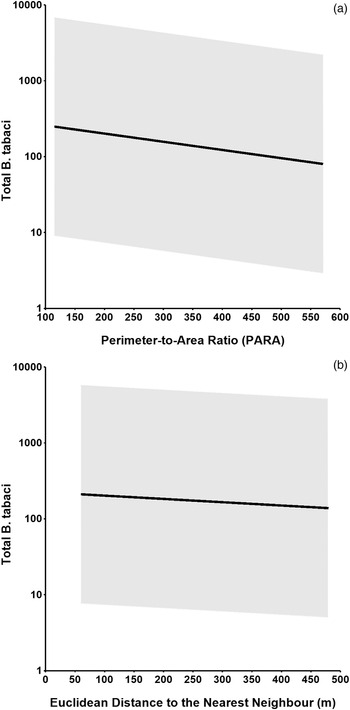
A ‘confidence set’ or ‘credibility set’ of models that were the most realistically likely to be the best approximating model was produced for each host patch variable. We ranked all the models from the best downwards and proceeded down the list until the cumulative Akaike's weight. This was done to explore which variables or combination of variables best explained the abundance of B. tabaci in the potato field. The results indicated that the best (most parsimonious) model that accounted for 99% of the cumulative weight was model 7 (M7), which includes perimeter-to-area ratio (PARA) and Euclidean distance to the nearest neighbour of the same class (ENN) as independent variables. This means that there is a 99% chance that M7 is the best approximating model describing the data, given the candidate set of models considered (table 3). We found that the two variables included in M7 were significant (Wald chi-square test). A confidence interval (95%) was estimated. The full model showed that both independent variables, perimeter-to-area ratio (PARA) of potato plots and Euclidean distance to the nearest neighbour (ENN), have a negative relationship with B. tabaci abundance and show no autocorrelation between them (table 4). Numerically this means that patches with a PARA of 115 have almost three times more whiteflies than patches with a PARA of 571 (fig. 3a). In the case of the isolation of the potato patch, as represented by ENN, patches with a separation of 60 m from the nearest potato patch have 1.5 times more whiteflies than patches separated by 480 m from other potato patches (fig. 3b).
Effect display of the covariates included in the best model (M7). Dependent variable is in logarithmic scale. (a) Effect of PARA on B. tabaci abundance in potato plots. (b) Effect of ENN on B. tabaci abundance in potato plots. Grey area indicates the confidence interval of the model. For details see Fox and Hong (Reference Fox and Hong2009).

Multimodel inference selection of all the candidate models for the abundance of B. tabaci in potato fields

AICc, Akaike's information criterion; Delta_AICc, difference between the best AICc model and the next AICc model; AICcWt, Akaike's weight.
GLMM of the best model explaining the abundance of B. tabaci in each sampling plot based on the two proposed metrics

AICc, Akaike's information criteria; VIF, variance inflation factor.
Values of VIF close to 1 indicate that there is no correlation among the predictor variables.
Discussion
To understand and explain which factors cause spatial variation in insect pest abundance, it is necessary to first understand the different processes occurring at multiple spatial scales (Andersson et al., Reference Andersson, Löfstedt and Hambäck2013), of which agricultural landscapes are good examples.
The study area was in a highly productive agricultural department of Córdoba province, with a developed gravity irrigation network. Potato (S. tuberosum) is one of the most important crops cultivated in the department (Sánchez and Barberis, Reference Sánchez and Barberis2013). Whitefly density was variable between potato plots.
The method employed to determine the land use and the presence and distribution of host patches (potato plots) proved to be a very accurate and reliable tool for establishing the spatio-temporal distribution of landscape suitable for the pest. Potato patches in the study area varied in size, shape, and spatial distribution. This variability was reflected other landscape metrics, e.g., small plots had higher perimeter-to-area ratios than large plots, and those with elongated shapes or irregular perimeters had higher perimeter-to-area ratios than plots of the same area with compact shapes and unbroken perimeters (Helzer and Jelinski, Reference Helzer and Jelinski1999). Cultivated patches in this area depend on the size of the farm and the farmer's decision about what to plant at each moment. This situation makes the distribution of crop patches very variable in space and time.
The multimodel inference method proved to be useful as a tool for model selection and to establish the role of the different covariates analysed (Burnham and Anderson, Reference Burnham and Anderson1998, Reference Burnham and Anderson2002; Anderson et al., Reference Anderson, Burnham and Thompson2000). Our results clearly indicate that the abundance of adult individuals in a particular potato patch was mostly affected by the shape of the patch and the distance to other patches in the nearby area. The model shows a negative relationship between perimeter-to-area ratio and the Euclidean distance of the focal patch to other potato patches and the abundance of dispersing individuals. Perimeter-to-area ratio (PARA) is a metric that quantifies the relationship between the patch size and its perimeter. In this case, a negative relationship between PARA and the abundance of whiteflies flying within the patch means that large patches, i.e., patches with lower PARA, will have more whiteflies than small patches, i.e., patches with higher PARA values. The same reasoning is valid for patches with a complex shape: more irregular potato patches will have higher PARA values, while regular patches will have lower PARA values. This means that large regular patches will have more flying whiteflies than small irregular ones.
Different insect species respond differently to host patch size (Bowers and Matter, Reference Bowers and Matter1997; Connor et al., Reference Connor, Courtney and Yoder2000; Bender et al., Reference Bender, Tischendorf and Fahrig2003). The most traditional approach to the effect of host patch size on insect pests was formulated by Root (Reference Root1973). This hypothesis predicts that specialist herbivores would reach higher densities in larger patches, which is considered an important guiding principle when studying the relationship between patch size and the population density of insect pests. The mechanism is based on the idea that there will be larger emigration rates out of smaller patches and larger immigration rates into larger patches (Hambäck and Englund, Reference Hambäck and Englund2005). Since the hypothesis was formulated, many studies have quantified the relationship between patch size and population density for different organisms but the results have been very variable (Bowers and Matter, Reference Bowers and Matter1997; Connor et al., Reference Connor, Courtney and Yoder2000; Bender et al., Reference Bender, Tischendorf and Fahrig2003). Some studies have found strong positive relationships between animal density and patch size, while others showed negative or no relationship at all (Bach, Reference Bach1988). Hambäck and Englund (Reference Hambäck and Englund2005) found that any study on the relation between animal density and patch size should start from a thorough understanding of species dispersal and host search mode. They concluded, as did Bukovinszky et al. (Reference Bukovinszky, Potting, Clough, van Lenteren and Vet2005), that providing information on a species search mode can greatly improve the predictability of a movement-based hypothesis for understanding density–area relations (Hambäck and Englund, Reference Hambäck and Englund2005).
On the other hand, the negative relationship between PARA and flying individuals within the patch may also be explained as an effect not only of the size of the patch, but of its shape. As we previously mentioned, large regular patches have lower PARA values, and low PARA values are related to higher B. tabaci abundance. And the opposite is also true; small irregular patches have higher PARA values, and higher PARA means patch values are related to lower amounts of flying B. tabaci within the patch. There are two key aspects of landscape boundaries that are predicted to influence the movement of insects: shape and contrast (Stamps et al., Reference Stamps, Buechner and Krishnan1987; Forman, Reference Forman1995). Among the various descriptors of patch shape, patch perimeter-to-area ratio has received the most attention regarding its effect on animal movement into and out of the patches. The general theory states that, as the perimeter-to-area ratio increases, emigration also increases (Turchin, Reference Turchin1998). When the patch perimeter-to-area ratio is high, boundaries are more easily encountered by individuals living within the patch, increasing emigration from those patches. And this seems to be the case in our results. In other words, patch shape will affect insect movements between habitat patches (Stamps et al., Reference Stamps, Buechner and Krishnan1987). We can conclude that the negative relationship between potato patch perimeter-to-area ratio and whitefly density within host patches is a result of the way whiteflies disperse and search for new host patches (Byrne and Bellows, Reference Byrne and Bellows1991).
The colonization of new host patches by herbivorous insects is mainly driven by the species' dispersal ability. Whiteflies are considered to be weak fliers, unable to actively fly more than 100 m (Byrne and Bellows, Reference Byrne and Bellows1991). This is why the availability of source habitats in the nearby landscape is a key factor for the successful colonization of new habitat patches and population build-up for herbivorous insects. For example, the cabbage whitefly (Aleyrodes proletella) can colonize oilseed rape fields up to 1000 m away (Ludwig et al., Reference Ludwig, Schlinkert and Meyhofer2018). Nevertheless, the role of more distant source habitats is not clear. Byrne et al. (Reference Byrne, Rathman, Orum and Palumbo1996) found that B. tabaci had a bimodal dispersal pattern, with peaks at 100 and 2000 m from the dispersal source. They concluded that these peaks in dispersal of B. tabaci were the result of two morphs that differ in their specific ability to fly. During migration flights, they are attracted by ultraviolet or skylight, ignoring host cues (Döring, Reference Döring2014), but afterwards, host finding is similar to the behaviour during trivial flights, characterized by attraction to green and yellow surfaces (Blackmer et al., Reference Blackmer, Byrne and Tu1994), followed by a response to olfactory cues (Döring, Reference Döring2014), and finally evaluating host suitability by probing the plant after landing (Noldus et al., Reference Noldus, Rumei and van Lenteren1986). It is evident that host patch geometry plays a central role, as observed in our results. The dispersal behaviour described by Byrne et al. (Reference Byrne, Rathman, Orum and Palumbo1996) is also the most obvious explanation of the role of potato patches in the surrounding landscape in the process of colonizing the local patch. We found that the mean Euclidean distance of potato patches within the study area was 207 m, clearly within the dispersal range described by Byrne et al. (Reference Byrne, Rathman, Orum and Palumbo1996). Based on our models, we were able to quantify the effect of PARA and ENN on B. tabaci abundance in a particular patch.
Potato is the only green crop during autumn in the study area. During this period B. tabaci has no other alternative than moving from one potato field to another. All the other classified land covers are of non-host: bare soil, woodlands that are mainly of Vachellia caven, Prosopis alba, and Lithraea molleoide, pastures and weeds. Based on this, to study the response of B. tabaci to host patch metrics and landscape configuration is valid, as no alternative hosts are present in the field during this time.
We concluded that there is a strong effect of the shape of the patch, with almost three times more whiteflies within the range of perimeter-to-area ratio observed, followed by the effect of the separation of the patches. The results obtained in this paper are a clear indication that effective management of whiteflies at a field scale would be viable only if addressed with an area-wide management approach.
Conflict of interest
The authors declare that they have no conflict of interests. This article does not contain any studies with human participants or animals performed by any of the authors.