Introduction
Malaria is caused by parasites of the plasmodium family and is transmitted by female Anopheles mosquitoes (WHO, 2018). Despite being preventable and treatable, malaria continues to have a devastating impact on people’s health and livelihood around the world. In 2017, an estimated 219 million cases of malaria occurred worldwide and 92% of these were in the African region (WHO, 2018). During the same period, there were an estimated 435,000 deaths from malaria globally and the African region accounted for 93% of these deaths (WHO, 2018). Thus, in malaria-endemic countries, malaria contributes significantly to maternal and infant morbidity and mortality (WHO, 2017), and women of reproductive age bear a relatively greater burden of malaria.
According to the World Health Organization an estimated US$3.1 billion were spent on malaria control and elimination efforts globally in 2017 (WHO, 2018). Due to the high prevalence of malaria in the African region, nearly three-quarters (US$2.2 billion) of this was spent in the African region. One of the most frequently used malaria control interventions is the use of insecticide-treated mosquito nets (ITNs), largely because this is cost-effective (Lengeler, Reference Lengeler2004; García-Basteiro et al., Reference García-Basteiro, Schwabe, Aragon, Baltazar and Rehman2011). Evidence suggests that ITNs are responsible for a 50% reduction in malaria incidence in malaria-endemic countries (Lengeler, Reference Lengeler2004). Between 2015 and 2017, an estimated 552 million ITNs were distributed globally, with 83% being in the sub-Saharan Africa (WHO, 2018).
Despite increased efforts to improve ITN accessibility and utilization, malaria is still a major public health concern in sub-Saharan Africa (WHO, 2014). Like in many countries in sub-Saharan Africa, malaria is a public health challenge in Malawi, where an estimated 4 million cases occur each year (Presidential Malaria Initiative, 2017). Meanwhile, there has been considerable progress in scaling up interventions and controlling malaria and hence a decline in malaria prevalence from 33% in 2014 to 24% in 2017 (Tizifa et al., Reference Tizifa, Kabaghe, McCann, van den Berg, Van Vugt and Phiri2018). Similarly, the ownership of ITNs increased from 70% in 2014 to 82% in 2017 (Presidential Malaria Initiative, 2017). Despite this notable progress, malaria remains endemic in Malawi.
Prior to the Malaria Indicator Survey in 2017, the Malawi government came up with the new Malaria Strategic Plan for 2011–15 aimed at achieving universal coverage of the prevention and treatment of malaria, reducing by half the 2010 levels of malaria morbidity and mortality in Malawi by the year 2015 with the help of the Presidential Malaria Initiative funding (Government of Malawi, 2011). Thus, as a cost-effective malaria prevention intervention, the Malawi government distributed ITNs for free. The focus was universal coverage and the target was 90% ownership and 80% utilization by 2015 from a 2010 baseline of 58.1%. Additionally, the private sector was subsidized to sell ITNs at low prices to compliment free public sector distribution. To ensure increased utilization, intensified campaigns within communities were conducted. Furthermore, there was promotion of community-based bylaws against the misuse of ITNs and advocating for investment incentives for the local manufacture of ITNs. The distributed ITNs were the long-lasting type and about 8.7 million nets were distributed between 2012 and 2015 with spillover to 2016 (Presidential Malaria Initiative, 2017). There has been a continuation of ITN distribution in Malawi with a two-pronged strategy: free routine distribution to pregnant women through antenatal care and to newborns and time-limited, intermittent mass campaigns targeting universal coverage every 3 years (Presidential Malaria Initiative, 2017).
There is a need to fully understand the factors associated with malaria prevalence in Malawi. This understanding is vital for the reduction of the physiological and economic burden malaria puts on people, as well as the health care system, including treatment costs. Identifying the ownership and utilization of ITNs in a low-income and limited-resource setting like Malawi will help in the development of health programmes targeting the reduction of the burden of malaria and also inform public health policy. This study aimed to explore the correlates of ownership and utilization of ITNs for malaria control among women of reproductive age in Malawi. These women were selected because they carry the physiological burden of pregnancy and the care of infants and under-5 children.
Methods
Study area
Malawi is in southern Africa and shares its borders with Zambia, Tanzania and Mozambique (Lowe et al., Reference Lowe, Chirombo and Tompkins2013). Malaria is hyper-endemic in Malawi and transmission occurs throughout the year in most places, except in the mountainous areas in the north and south (Government of Malawi, 2011). Transmission is greatest at high temperatures during the rainy season (October to April) and in low-lying areas, particularly along the lakeshore and lowland areas of the Shire Valley. High rainfall and population movement mean that a substantial portion of the Malawi population is at risk of malaria, and pregnant women and children aged 3 months to 5 years are at the greatest risk due to their lower immunity.
Data and study design
This study utilized secondary data derived from the nationally representative, cross-sectional household Malaria Indicator Survey (MIS) conducted from 15 April to 16 June 2017. Since malaria transmission is greatest during the rainy season (October to April) the MIS started in the last month when malaria was at peak. This would help in collecting reliable data on the use of ITNs. The survey was conducted soon after the Ministry of Health, in collaboration with its partners, started implementing the National Malaria Strategic Plan in 2011–2016. The main aim of this plan was to scale up malaria interventions towards attainment of the national vision of a malaria-free Malawi, specifically by achieving prompt and effective anti-malarial drug treatment, use of ITNs and indoor residual spraying and the prevention of malaria during pregnancy. The survey was designed to provide data for monitoring the malaria situation and interventions (Government of Malawi, 2017).
The sampling frame used for the 2017 MIS was that used by the Malawi Population and Housing Census conducted in 2008, provided by the National Statistical Office. A two-stage cluster sampling procedure was used to generate a nationally representative sample of households. In the first stage, enumeration areas or clusters (in urban areas and in rural areas) were selected with probability proportional to sample enumeration area size. A total of 150 clusters were selected from the EAs covered in the 2008 Population and Housing Census. Of these clusters, 60 were in urban areas and 90 in rural areas. Urban areas were oversampled within regions to produce robust estimates for each area or domain.
In the second stage, households in urban and rural clusters were selected using a systematic random sampling approach. Household sampling weights and individual sampling weights were obtained by adjusting the previous calculated weight to compensate household non-response and individual non-response, respectively. These weights were further normalized at the national level to produce un-weighted cases equal to weighted cases for both households and individuals at the national level. Twenty-five households were selected from each EA and a total of 3750 households (1500 for urban 2250 for rural areas) were selected for the sample, of which 3735 were occupied at the time of fieldwork. Among the occupied households, 3729 were successfully interviewed, yielding a total household response rate of 99.8%. In the interviewed households 3860 eligible women aged 15–49 years were identified and successfully interviewed.
Dependent variable
The outcome variables were ownership and utilization of ITNs. Ownership of ITNs was derived from the question, ‘Do you have a mosquito ITN for sleeping?’, while utilization was derived from the question ‘Did you sleep under an ITN last night?’ The final variables were coded: ownership of ITN (yes = 1, non-ownership = 0); and utilization of ITN (yes = 1, non-utilization = 0).
Independent variables
The independent variables used in the analysis were socioeconomic and demographic variables as collected during the MIS. Age in years was categorized as 15–19, 20–24, 25–29, 30–34, 35–39 and 40–49. Place of residence was aggregated as urban and rural, while education was categorized into no education, primary, secondary and tertiary education. Wealth status categories were combined, whereby the poorer and poorest quintiles were re-coded as ‘poor’, the middle quintile was maintained and the richer and richest categories were combined to derive the ‘rich’ wealth status category, as in previous studies (Zgambo, Reference Zgambo, Mbakaya and Kalembo2017; Gaston & Ramroop, Reference Gaston and Ramroop2020). Other variables were ownership of a radio, seen or heard a message about malaria in the last 6 months and knowledge of the benefits of mosquito nets. Ownership of a radio was used to indicate access to information on malaria, while having seen or heard a malaria message in the last 6 months and knowing that sleeping under a treated bed-net provides protection against malaria were used as measures of knowledge about malaria control.
Statistical analysis
Descriptive statistics were used to derive summarized univariate data and the results presented as percentages. Chi-squared tests were used to examine the relationship between correlates and outcome variables (ownership and utilization of ITNs) at the bivariate level. Multivariate level logistic regression analysis was employed to identify correlates of ownership and utilization of ITNs. Crude and adjusted odds ratios and their 95% confidence intervals (95% CIs) were estimated in the unadjusted and adjusted models, respectively. Significant variables at the bivariate level of the analysis were included in the multivariable logistic regression. All associations were considered to be statistically significant at p<0.05, with a 95% confidence interval. Data analyses were performed using SPSS version 25.
Results
Sample description
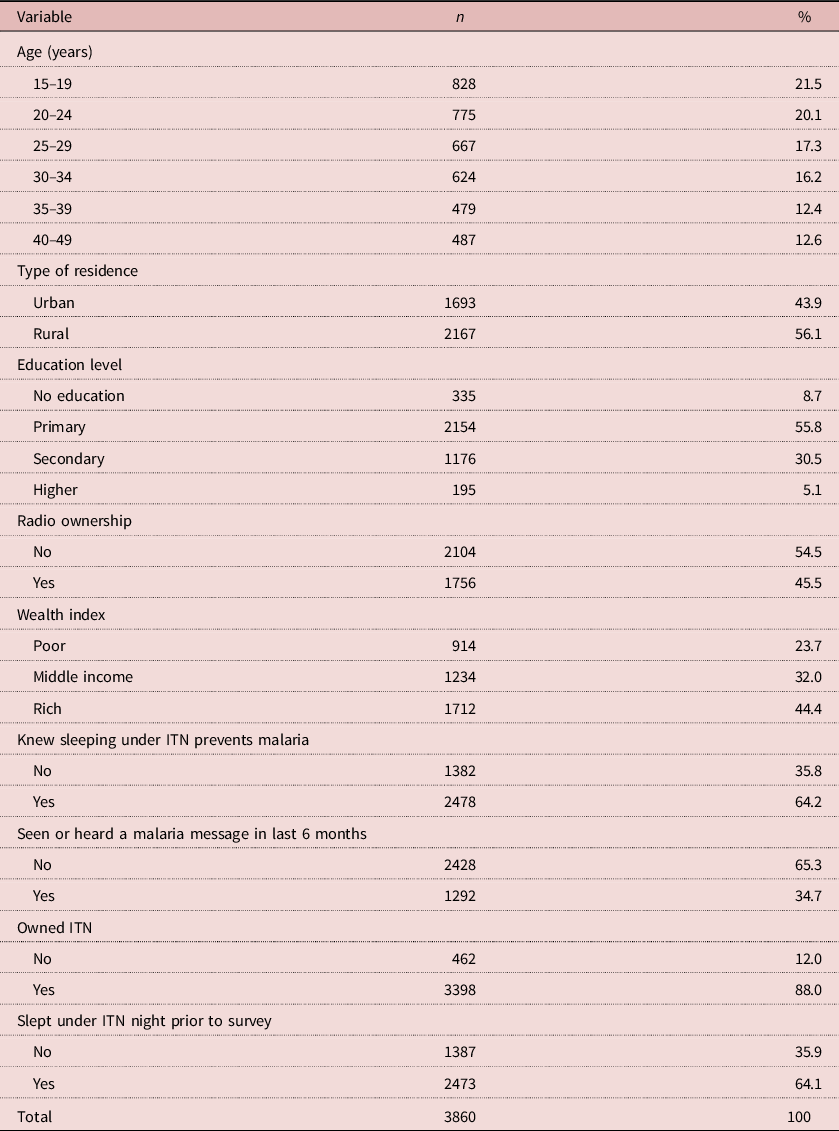
Table 1 gives the summary statistics of the study population. The proportion of sampled women declined with increasing age, with the highest proportions aged 15–19 years (21.5%) and the lowest aged 35–39 years (12.4%). The proportion of women aged 40–49 years was 12.6%. Most of the women resided in rural areas (56.1%), had primary education (55.8%) and were in the richest wealth quintile (44.4%).
Characteristics of sample women of reproductive age (15–49 years), 2017 MIS, N=3860

Of the sample women, 88% (3398/3860) of women owned ITNs and 64% (2473/3860) had slept under an ITN the night prior to the survey. About 55% (2071/3860) of the households had no radio, 36% (1304/3860) did not know that sleeping under an ITN protects against malaria, while 65% (2428/3860) of the respondents had not heard or seen a malaria message in the last 6 months prior to the survey period.
Association of independent variables with ownership and utilization of ITNs
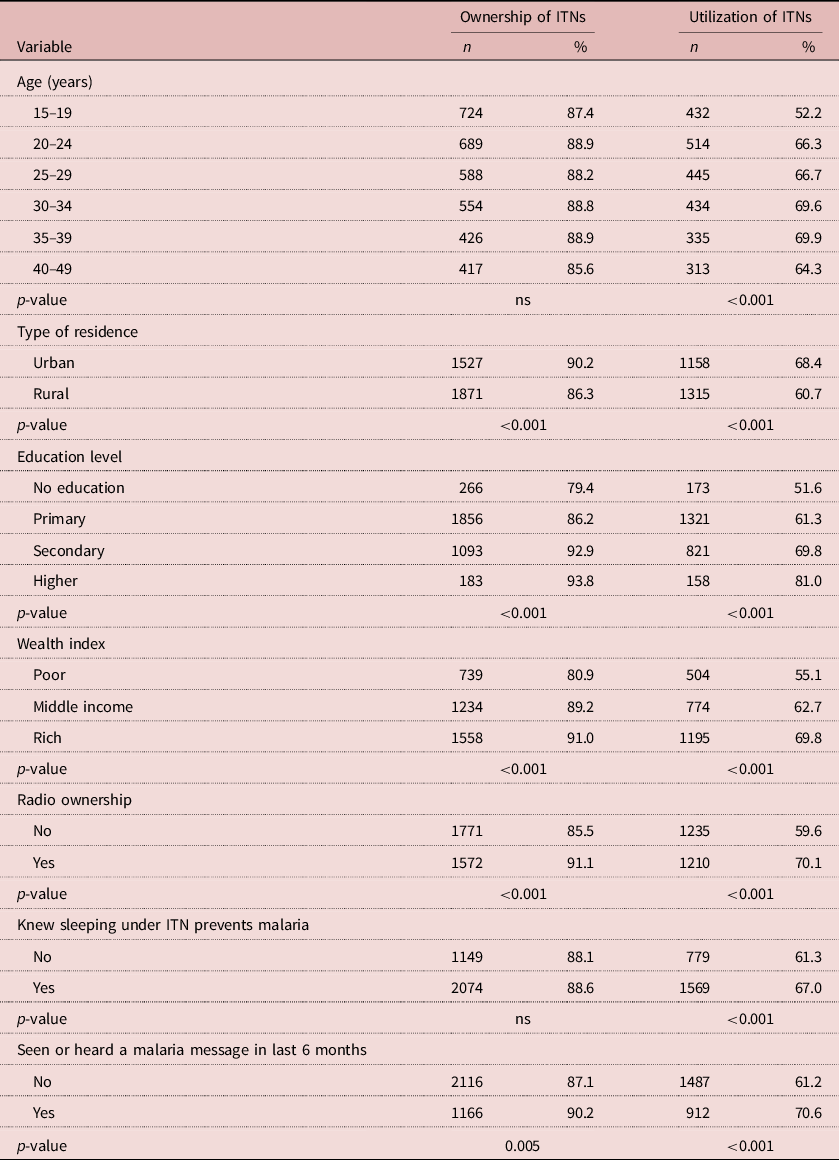
Ownership of ITNs was significantly associated with place of residence, education level, radio ownership, wealth status and having seen or heard a malaria message in the past 6 months (Table 2). A higher proportion of women with higher education (93.8%), who owned a radio (91.1%), were rich (91%) and who resided in urban areas (90.2%) reported possessing ITNs than did their counterparts. Furthermore, a higher proportion (90.2%) of women who had seen a malaria message in the past 6 months indicated that they possessed ITNs than did those who had not. Age and the knowledge that ITNs protects against malaria were not significant covariates of ownership of ITNs.
Ownership and utilization of ITNs by women’s socioeconomic demographic characteristics, 2017 MIS, N=3860

Statistical significance set at p<0.05; ns, not significant.
Utilization of ITNs was significantly associated with age, place of residence, education level, radio ownership, wealth status, knowledge that ITNs protect against malaria and having seen or heard a malaria message in the last 6 months. Utilization of ITNs was higher among women aged 30–34 and 35–39 years (69.6% and 69.9%, respectively), those residing in urban areas (68.4%), those with higher education (81%) and rich women (69.8%). Moreover, utilization of ITNs was higher among women who had radios (70.1%), knew that ITNs protect against malaria (67%) and who had seen or heard a malaria message in the last 6 months (70.6%).
Correlates of ownership and utilization of ITNs
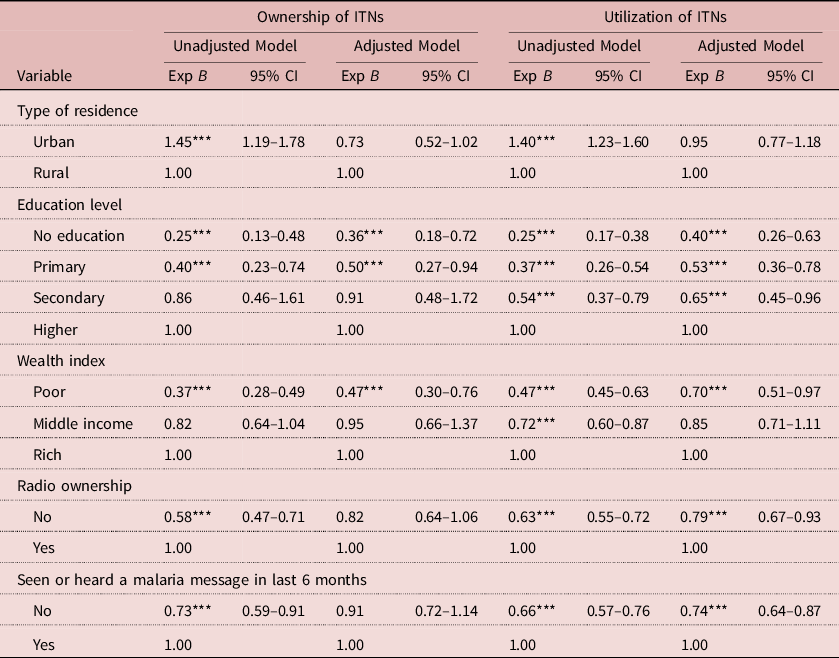
Table 3 shows the odds ratios for the likelihood of ownership and utilization of ITNs among the sample women. After adjusting for covariates, individuals who had no education (AOR = 0.36, CI = 0.18–0.72) or with a lower education level (AOR = 0.50, CI = 0.27–0.94) and who were poor (AOR = 0.47, CI = 0.30–0.76 0.56–0.97) were less likely to own ITNs than their counterparts. On the other hand, there was no variation in ownership of ITNs with type of residence, radio ownership and having seen or heard a message about malaria in the 6 months prior to the survey.
Adjusted odds ratios showing the likelihood of ownership and utilization of ITNs among women in Malawi

***p<0.05.
Women with no education (AOR = 0.40, CI = 0.26–0.63), primary education (AOR = 0.53, CI = 0.36–0.78) or secondary education (AOR = 0.65, CI = 0.45–0.96) and the poor (AOR = 0.70, CI = 0.51– 0.97) were less likely to utilize ITNs. Furthermore, the odds of utilization of ITNs were significantly low among women living in households without a radio (AOR = 0.79, CI = 0.67–0.93) and those who had not seen or heard a malaria message in the last 6 months (AOR = 0.74, CI = 0.64–0.87). Meanwhile, there were no differences in the utilization of ITNs among women by place of residence after adjusting for other covariates.
Discussion
The main aim of this study was to assess the patterns and correlates of ITNs ownership and utilization among women of reproductive age in Malawi. The findings show that a significantly high proportion (88.0%) of women owned ITNs in Malawi in 2017. This was an increase from the 2010 proportion of 58.1%, and only 2 percentage points lower than the 90% target set out in the 2011 Malawi Strategic Plan. Likewise, there was an increase in the proportion (64.1%) of women utilizing ITNs over this period. Moreover, the utilization rate was lower than the target 80% of the 2011 Malawi Strategic Plan.
The study results show a pattern of greater ownership and use of ITNs among women living in urban rather than rural areas. Despite increased efforts to improve ITN accessibility, utilization of ITNs is relatively low among women in Malawi. The study findings indicate that ownership of ITNs does not necessarily translate into utilization. Although four-fifths of women indicated that they owned ITNs, only three-fifths reported using them. There is therefore a need to design health promotion and social behaviour change interventions to close this ownership–use gap. Nonetheless, this gap was expected as the study’s findings concur those of previous studies. For instance, Diema et al. (Reference Dhiman2019), in their study in Ho municipality, Ghana, found that four-fifths of the target population owned ITNs, but only half used them. Likewise, Wanzira et al. (Reference Wanzira, Yeka, Kigozi, Rubahika, Nasr and Sserwanga2014), in their study in Uganda, found that more than three-fifths of target population owned ITNs, but only half used them.
Since the MIS took place in 2017, nearly 2 years after ITN distribution, the increase in rate of ownership of ITNs might not be due to the 2012–15 distribution, or because ITNs are considered to be ‘long-lasting’, but might be attributed to strategies put in place to promote community-based initiatives such as by-laws to discourage the misuse of ITNs and other continuation strategies (Presidential Malaria Initiative, 2017). These include: 1) routine free distribution of ITNs to children born in health facilities, children attending their first visit under the Expanded Program on Immunization (EPI) if an ITN was not received at birth and pregnant women at their first clinic antenatal care (ANC) visit; 2) periodic mass campaigns targeted at households in ‘hard to reach’ areas; 3) private sector outlets (Presidential Malaria Initiative, 2017). The private sector plays a role in filling the gaps in public campaigns: by replacing old ITNs through subsidized retail sales, workplace programmes and social marketing schemes. Customers with disposable income may opt to buy non-subsidized ITNs as they can choose the size, shape and colour etc. (unpublished).
After adjusting for covariates, the present study found that poor and uneducated women were less likely to own and utilize ITNs for protection against malaria. This finding corroborates previous studies, which found that despite the nationwide ITN distribution campaign in 2012 and the partial distribution campaign in early 2015, which were accompanied by awareness messages on the importance of using malaria interventions such as ITNs, there is general under-utilization of ITNs among the poor (Nkoka et al. Reference Nkoka, Chuang and Chuang2018, Reference Nkoka, Chipeta, Chuang, Fergus and Chuang2019). However, it is also plausible that at the time of the survey most of the ITNs given to women during the nationwide distribution were old and damaged. Studies have shown that even when ITNs are subsidized, the poorest of the poor cannot afford to buy replacement nets. This finding is also consistent with previous studies, which found that affordability is a key factor in the ownership and utilization of ITNs for protecting children against malaria among poor and uneducated women (Lengeler, Reference Lengeler2004; Baume & Franca-Koh, Reference Baume and Franca-Koh2011; Mathanga et al., Reference Mathanga, Walker, Wilson, Ali, Taylor and Laufer2012; Singh, Reference Singh, Brown and Rogerson2013; Sena et al., Reference Sena, Deressa and Ali2013; Eteng et al., Reference Eteng, Mitchell, Garba, Ana, Liman, Cockcroft and Anderson2014; Choonara et al., Reference Choonara, Odimegwu and Elwange2015; Muhumuza et al., Reference Muhumuza, Namuhani, Balugaba, Namata and Kiracho2016; Berthe et al., Reference Berthe, Harvey, Lynch, Koenker and Jumbe2019).
The present study found that ownership of a radio and having seen or heard a malaria message in the 6 months prior to the survey were significant correlates of utilization of ITNs, with these increasing the likelihood of women reporting utilizing ITNs. This finding is quite indicative and suggests that access to information about the benefits of ITNs for malaria prevention among women is vital in the design of health promotion programmes and social behaviour change interventions to improve ITN use and close the ownership–use gap. This is consistent with previous studies in Africa and other low-income settings, which have consistently emphasized the need to strengthen methods of communicating malaria prevention information (Spjeldnæs et al., Reference Spjeldnæs, Kitua and Blomberg2014; Malenga et al. Reference Malenga, Kabaghe, Manda-Taylor, Kadama and McCann2017; Dhiman, Reference Dhiman2019). It is worth noting that it is possible that households that own radios are wealthier, and radio ownership is often used as a measure of wealth (Tusting et al., Reference Tusting, Rek, Arinaitwe, Staedke and Kamya2016; Poirier et al., Reference Poirier, Grépin and Grignon2020).
The study has its limitations. First, the outcome variables were based on women’s reports, yet most women live with their husbands/partners, who are usually the heads of households. Therefore the effect of men on women’s possession and utilization of ITNs may not have been accounted for. Moreover, information was collected through self-reporting, which can distort the accuracy of results through social desirability and recall bias.
The main finding of this study was an increase in ownership and utilization of ITNs among women of reproductive age in Malawi. However, ownership and utilization of ITNs remain low among the poor and less educated, and utilization was particularly low among women living in households without a radio and those who have not seen or heard a malaria message in the last 6 months. Thus, interventions to ensure all households own a radio could be helpful. Community initiatives to promote social behaviour change could be introduced to encourage ITN use. For instance, community and religious leaders could be empowered to distribute malaria-specific messaging through community meetings, as in Uganda (Yaya et al., Reference Yaya, Uthman, Amouzou and Bishwajit2018; Taremwa et al., Reference Taremwa, Ashaba, Ayebazibwe, Kemeza and Adrama2020). Furthermore, Health Surveillance Assistants (HSAs) should include malaria messages during their daily work in the community. Finally, the Malawi government needs to continue the free distribution of ITNs to poor families. When implementing social behaviour change and continuation strategies, priority should be given to women who live in rural areas, who are poor and who have less than secondary education.
Acknowledgments
The authors thank the MEASURE DHS project for their support and for free access to the original data used in this study.
Funding
The authors received no financial support for the research, authorship or publication of this article.
Conflicts of Interest
The authors declare that they have no conflicts of interest.
Ethical Approval
The study data was obtained from MEASURE DHS, which is the monitoring and evaluation body of the Demographic and Health Survey (DHS) globally. The original study (MIS) obtained ethical clearance from Malawi’s National Health Sciences Research Committee (NHSRC) and all participants provided oral informed consent to participate in the survey.