Introduction
A considerable amount of evidence has confirmed that neuropsychological functioning is impaired in individuals with bipolar disorder, not only during acute episodes but also during periods of remission of affective symptoms, namely euthymic states (Torres et al. Reference Torres, Boudreau and Yatham2007). Despite current evidence, the neuropsychological profile during euthymia has not yet been well established and substantial heterogeneity has been reported (Mann-Wrobel et al. Reference Mann-Wrobel, Carreno and Dickinson2011). Emerging data suggest that patients with bipolar disorder exhibit cognitive impairment in attention, verbal memory and executive functioning during remission (Martínez-Arán et al. Reference Martínez-Arán, Vieta, Reinares, Colom, Torrent, Sánchez-Moreno, Benabarre, Goikolea, Comes and Salamero2004b; Mur et al. Reference Mur, Portella, Martínez-Arán, Pifarré and Vieta2007; Torres et al. Reference Torres, Boudreau and Yatham2007; Mann-Wrobel et al. Reference Mann-Wrobel, Carreno and Dickinson2011). Several studies reveal that it is important to examine cognitive performance in euthymic bipolar disorder patients since there is a strong association between neuropsychological impairment and poor psychosocial functioning outcome (Wingo et al. Reference Wingo, Harvey and Baldessarini2009).
Most of the previous studies on neurocognition and its functional impact in euthymic patients are cross-sectional. Since bipolar disorder is a chronic and recurrent disease it is necessary to proceed examining longitudinally the cognitive and functional course of these individuals in order to clarify the particular nature and specificity of the reported deficits and how these can change over time (Robinson & Ferrier, Reference Robinson and Ferrier2006). There is an actual lack of longitudinal studies in the current literature foreclosing the possibility to determine the evolution of cognition (Balanzá-Martínez et al. Reference Balanzá-Martínez, Tabarés-Seisdedos, Selva-Vera, Martínez-Arán, Torrent, Salazar-Fraile, Leal-Cercós, Vieta and Gómez-Beneyto2005; Burdick et al. Reference Burdick, Goldberg, Harrow, Faull and Malhotra2006; Mur et al. Reference Mur, Portella, Martínez-Arán, Pifarré and Vieta2008; Tabarés-Seisdedos et al. Reference Tabarés-Seisdedos, Balanzá-Martínez, Sanchez-Moreno, Martinez-Aran, Salazar-Fraile, Selva-Vera, Rubio, Mata, Gómez-Beneyto and Vieta2008) and psychosocial functioning (Martino et al. Reference Martino, Marengo, Igoa, Scapola, Ais, Perinot and Strejilevich2009; Bonnín et al. Reference Bonnín, Martínez-Arán, Torrent, Pacchiarotti, Rosa, Franco, Murru, Sanchez-Moreno and Vieta2010; Burdick et al. Reference Burdick, Goldberg and Harrow2010) in euthymic bipolar patients. Furthermore, the cognitive follow-up of these patients becomes crucial for providing tools to administer the most suitable pharmacological and psychosocial treatment strategies (Gildengers et al. Reference Gildengers, Mulsant, Begley, Mazumdar, Hyams, Reynolds, Kupfer and Butters2009).
The aim of the present study is to investigate the longitudinal neuropsychological profile of euthymic bipolar out-patients compared with healthy matched controls in a 6-year period of follow-up and to examine the psychosocial disabilities as related to cognitive deficits. An important methodological feature of this study, as compared with the very few previous studies that looked at this issue, is that healthy control subjects were also assessed at baseline and 6 years later, controlling for the effects of time and ageing. We hypothesized that the cognitive deficits would remain stable regardless of the clinical course of the illness, and this impairment would be related to the psychosocial adaptation at the end of the follow-up.
Method
Subjects
A total of 28 euthymic bipolar patients and 26 healthy matched controls were admitted into the study and were evaluated at baseline and 6 years later with a clinical interview, biochemical tests and a neuropsychological battery. On average, the endpoint (T2) occurred 6.1 years after baseline (T1) (range 8.2–4.9 years) and was conducted by the same neuropsychologist. The Local Ethics Committee approved the study, and written informed consent was obtained from all participants (patients and healthy controls).
The patient sample was obtained from the Lithium Clinic Program at Hospital Santa Maria, Lleida, in 2003. Inclusion criteria included being on lithium treatment at T1, aged between 18 and 65 years, fulfilling Diagnostic and Statistical Manual of Mental Disorders, fourth edition, text revision (DSM-IV-TR) criteria for bipolar disorder, and being in remission for at least 3 months (Mur et al. Reference Mur, Portella, Martínez-Arán, Pifarré and Vieta2007). Following previous studies (Robinson et al. Reference Robinson, Thompson, Gallagher, Goswami, Young, Ferrier and Moore2006), patients were characterized as euthymic if they had a total 17-item Hamilton Rating Scale for Depression (HAMD; Hamilton, Reference Hamilton1960) score below 8 and a total Young Mania Rating Scale (YMRS; Young et al. Reference Young, Biggs, Ziegler and Meyer1978) score below 6 for at least 3 months at the time of assessment. Exclusion criteria were the following: significant physical or neurological illness, substance abuse or dependence in the last 12 months, electroconvulsive therapy in the preceding year. At the endpoint, patients had to fulfil the same inclusion and exclusion criteria, except for medication that was allowed to be changed during the 6 years, if clinically needed. Therefore, at follow-up, all subjects were retested if they had been euthymic for at least 3 months, as confirmed by the criteria as at baseline.
A total of 26 healthy controls from the same geographic area, matched in terms of gender, age and years of education were recruited via advertisements and from non-medical hospital staff. Controls had no current or past psychiatric history, as determined by the Structured Clinical Interview for DSM-IV Axis I Disorders. They had no first-degree relatives with bipolar or psychotic diagnoses. Controls were subject to the same exclusion criteria and were assessed with the same full study protocol as the patients. They were also evaluated twice (at baseline and 6 years later).
Demographic, clinical and pharmacological data
Demographic variables for euthymic bipolar patients and healthy controls were age, gender, years of education and family history of mental illness. Clinical variables were obtained from the sample of bipolar patients, including: age at illness onset, number of prior manic episodes and hospitalizations, period of stabilization (years), history of psychotic symptoms, seasonal pattern, suicide attempts and bipolar subtype (I or II). Biochemical tests were performed on all patients, including for thyroid function, serum lithium levels and urine drug testing.
With respect to pharmacological variables, at baseline, T1, 14 patients were receiving lithium as monotherapy and the other 14 were on combination treatment (lithium plus antidepressants and/or antipsychotics). Lithium dosages at T1 were 820–1380 mg/day (serum lithium levels 0.46–0.86 mmol/l; treatment duration 1–10 years). At the study endpoint, T2, two patients were drug-free, 10 were receiving lithium monotherapy, 11 were on combination treatment (lithium dosage 916–1388 mg/day; serum lithium levels 0.51–0.71 mmol/l; treatment duration 5–15 years); and five were receiving other psychopharmacological treatments (two were receiving other mood stabilizers, one was on a combination of antidepressant and antipsychotic, another one was receiving another mood stabilizer plus antidepressant and the other was on another mood stabilizer plus antipsychotic).
Neuropsychological assessment
To provide a more general pattern of cognitive performance, this battery included neuropsychological tests that tapped into broad cognitive categories as documented in previous literature (Mur et al. Reference Mur, Portella, Martínez-Arán, Pifarré and Vieta2007). The estimated mean intelligence quotient (IQ) of the subjects was obtained from the weighted scores of the Vocabulary and Block Design subtests of the Wechsler Adult Intelligence Scale (WAIS-III; Wechsler, Reference Wechsler2001), because these two scores are the most highly correlated with total IQ. The instruments administered were:
(i) Vocabulary, Block Design and Digits Subtests from WAIS-III (Wechsler, Reference Wechsler2001);
(ii) Wisconsin Card Sorting Test (WCST; Heaton, Reference Heaton1981);
(iii) Stroop Colour and Word Test (Spreen & Strauss, Reference Spreen and Strauss1998);
(iv) Verbal fluency task of the Controlled Oral Word Association Test/Categories (FAS; Spreen & Strauss, Reference Spreen and Strauss1998);
(v) Trail Making Test (TMT), part A (TMT-A) and part B (TMT-B) (Reitan, Reference Reitan1958);
(vi) Conners' Continuous Performance Test II (CPT-II; Conners, Reference Conners2000);
(vii) California Verbal Learning Test (CVLT; Delis et al. Reference Delis, Kramer, Kaplan and Ober1987);
(viii) Rey Complex Figure Test (RCFT; Meyers & Meyers, Reference Meyers and Meyers1995).
Psychosocial functioning
At baseline, to obtain information about global activity, patients and controls were assessed with the Global Assessment of Functioning scale. Moreover, occupational functioning was specifically assessed and defined as follows: active (subjects with a full- or part-time job, students and housewives), inactive (unemployed subjects and those with temporary sick leave) and retired (permanent sick leave or retired subjects). At the endpoint, another scale was also administered in order to evaluate psychosocial functioning more accurately. The Functioning Assessment Short Test (FAST; Rosa et al. Reference Rosa, Sánchez-Moreno, Martínez-Aran, Salamero, Torrent, Reinares, Comes, Colom, Van Riel, Ayuso-Mateos, Kapczinski and Vieta2007) is more appropriate since it takes into consideration different domains and it is more specific for assessing different levels of functioning in bipolar disorder. Its 24 items of the scale are divided into six specific areas of functioning: autonomy, occupational functioning, cognitive functioning, financial issues, interpersonal relationships and leisure time. Therefore, subscores can be obtained from these areas as well as a total score.
Statistical procedures
Data analyses were carried out with the statistical package SPSS for Windows, version 15.0 (SPSS Inc., USA). Differences between groups in demographic, psychosocial and clinical variables were assessed with a univariate analysis of variance, by examining a single factor of group (out-patients versus healthy controls) at T1 and at T2; and paired two-sample t tests were used to assess time differences for such variables. Non-quantitative variables were examined by means of non-parametric tests.
Neuropsychological tasks were sorted by cognitive domains: executive functions, attention, processing speed, verbal memory and visual memory (Mur et al. Reference Mur, Portella, Martínez-Arán, Pifarré and Vieta2008). Performance on neuropsychological tasks was compared across the two groups by means of separate multivariate repeated-measures analyses of covariance (MANCOVA) for each cognitive domain. Estimated pre-morbid IQ, YMRS and HAMD scores were included as covariates since they showed significant differences between groups at T2, as shown in Table 2. The cognitive variables that did not meet the criterion of normality were excluded from the multivariate analyses: CVLT recognition, number of perseverative errors at CPT-II and number of categories of WCST. No other analyses were carried out with these latter variables as the cognitive domains were already sufficiently explored with other neuropsychological tests.
In order to establish correlations between cognitive changes in neuropsychological performance after 6 years in bipolar patients with clinical and functional variables, the difference between scores at T2 and T1 was calculated for those variables that showed significant differences between groups. Therefore new variables that reflected performance decrement or increment across time were obtained (ΔDigit backward, ΔTMT-B, ΔTMT-A, ΔCVLT immediate recall, ΔCVLT delayed recall, ΔStroop Inhibition and ΔHit Reaction Time in CPT-II). Then, associations between cognitive changes and clinical and functional variables were analysed with partial correlations by controlling for low-level depressive symptoms (HAMD) as shown in Table 3.
Results
Demographic, clinical and functional results
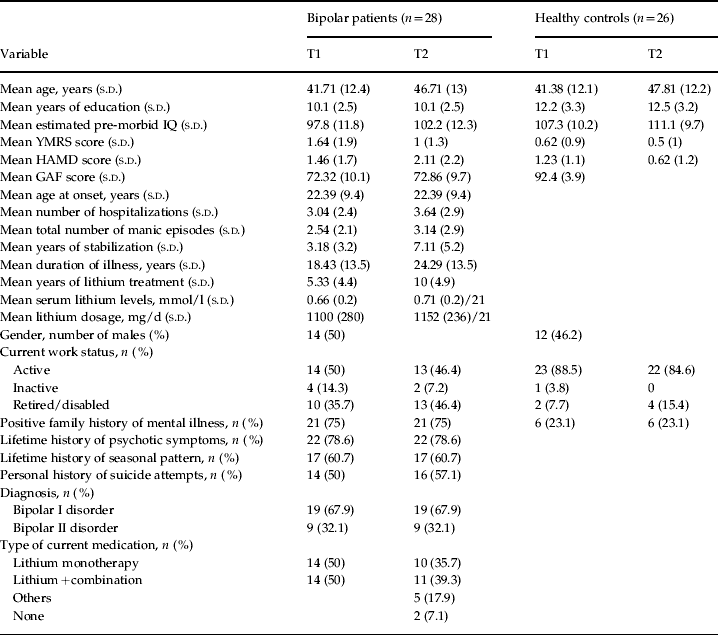
Demographic, clinical and pharmacological variables of the euthymic bipolar patients and healthy controls are displayed in Table 1 for the two time points (T1 and T2). Both groups of participants were matched in terms of age and gender. At T1, estimated pre-morbid IQ showed differences between the groups (F 1,52=10.06, p=0.003) although it was not clinically relevant as all scores were situated within the range of 100±15, not exceeding the limits of normality. In terms of work status, the groups displayed significant differences [χ2=8.4, degrees of freedom (df)=1, p=0.004]; the bipolar patients were less active and more retired than the healthy controls. With regard to subclinical symptomatology, YMRS score also differed between the two groups (F 1,52=6.24, p=0.016), but HAMD score did not differ (F 1,52=0.36, p>0.05). At T2, 6 years later, the bipolar euthymic patients and healthy controls also differed in estimated IQ (F 1,52=8.52, p=0.005) and work status (χ2=7.4, df=1, p=0.006). On this occasion, they differed in HAMD score (F 1,52=9.24, p=0.004), but not in YMRS score (F 1,52=2.49, p>0.05). None of the participants showed any evidence of clinical abnormality as checked with biochemical tests.
Demographic, clinical and pharmacological variables at T1 and T2

T1, Baseline; T2, 6-year endpoint; s.d., standard deviation; IQ, intelligence quotient; YMRS, Young Mania Rating Scale; HAMD, Hamilton Rating Scale for Depression; GAF, Global Assessment of Functioning.
The group of bipolar patients exhibited significant worsening along the 6-year follow-up in their work status (χ2=11.3, df=1, p=0.001) and in subsyndromal depressive symptoms, measured by HAMD score (t=0.45, p=0.016). At the endpoint, illness duration was of 24 years and patients had been stable for 7 years on average. However, during the study period 12 out of 28 patients (42.9%) suffered relapses: six patients (21.4%) suffered one or two episodes and the rest (21.4%) suffered more than two episodes. These episodes were clinically characterized as follows: 16 were depressive, seven mixed, 10 manic and two hypomanic.
Neuropsychological performance
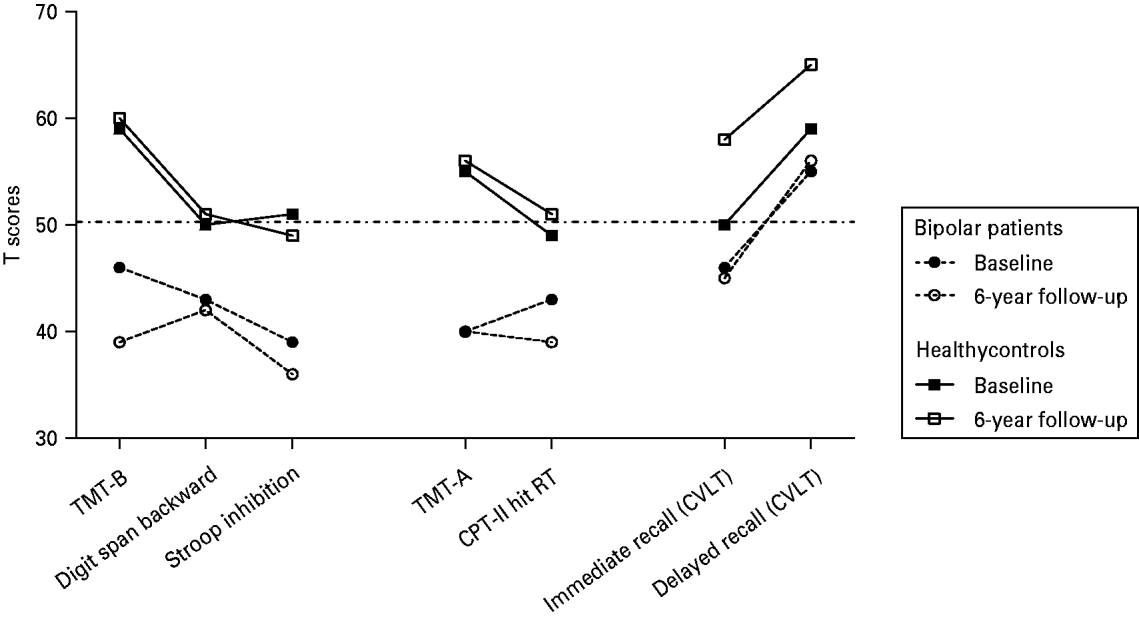
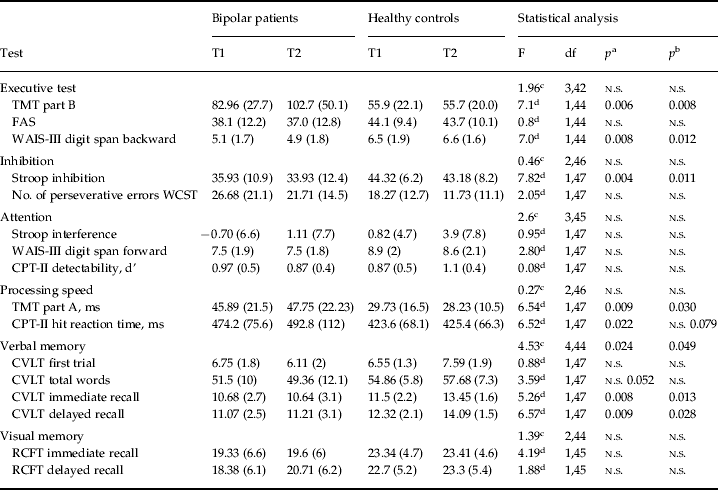
All neuropsychological variables included in each cognitive domain are listed in Table 2. As can be observed, after controlling for estimated pre-morbid IQ, the repeated-measures MANCOVA showed no significant interactions of time (T1 versus T2) by group (patients versus healthy controls) except in the verbal memory domain. By contrast, there were main effects of group in the executive domain (TMT-B and digit span backward), in the inhibition domain (Stroop inhibition), in the processing speed domain (TMT-A and hit reaction time of CPT-II), and finally in the verbal memory domain (immediate and delayed recall). Since previous studies (Clark et al. Reference Clark, Iversen and Goodwin2002; Martínez-Arán et al. Reference Martínez-Arán, Vieta, Colom, Torrent, Sánchez-Moreno, Reinares, Benabarre, Goikolea, Brugué, Daban and Salamero2004a; Savitz et al. Reference Savitz, Solms and Ramesar2005; Kurtz & Gerraty, Reference Kurtz and Gerraty2009) have already established the impact of residual mood symptoms, a repeated-measures MANCOVA was also performed, controlling for pre-morbid IQ and by YMRS and HAMD score. Even including these covariates, the results showed again the same effects, except for the interaction in the hit reaction time of CPT-II (although it depicted a similar trend), which did not reach the significance threshold. Significant group effects are presented in Fig. 1. Given that five patients were not on lithium treatment at T2, data were reanalysed excluding those individuals and the results were statistically similar to the whole sample results (data not shown) which might indicate that even when the medication regimen is less homogeneous, cognitive performance is statistically equivalent.
Neuropsychological performance of the two groups (patients and healthy controls) at two time points (baseline and 6-year endpoint) for those tests that showed group effects in the multivariate repeated-measures analyses. Raw scores were transformed into t scores from normative data for adult subjects. Transformation makes the comparison among tests more easily understandable. TMT, Trail Making Test; CPT-II, Continuous Performance Test II; RT, reaction time; CVLT, California Verbal Learning Test.
Neuropsychological results at T1 and T2 for all participants
Data are given as mean (standard deviation). T1, Baseline; T2, 6-year endpoint; df, degrees of freedom; n.s., not significant; TMT, Trail Making Test; FAS, verbal fluency task of the Controlled Oral Word Association Test; WAIS-III, Wechsler Adult Intelligence Scale-III; WCST, Wisconsin Card Sorting Test; CPT-II, Continuous Performance Test II; CVLT, California Verbal Learning Test; RCFT, Rey Complex Figure Test; MANCOVA, multivariate repeated-measures analyses of covariance; IQ, intelligence quotient; HAMD, Hamilton Rating Scale for Depression; YMRS, Young Mania Rating Scale.
a Probability of repeated-measures MANCOVA controlling for IQ.
b Probability of repeated-measures MANCOVA controlling for IQ, HAMD and YMRS.
c Repeated-measures MANCOVA multivariate effects for each cognitive domain (group×time interactions).
d Repeated-measures MANCOVA main effects of group (test of between-subjects effects).
Association results
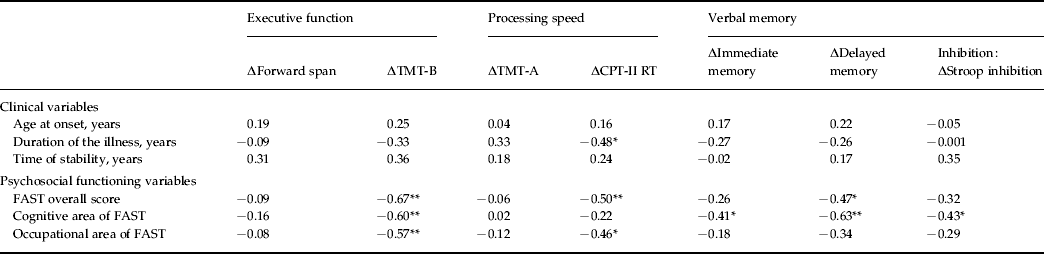
Relationships between cognitive impairment across time and clinical and functional variables in bipolar patients can be seen in Table 3. Clinical characteristics at the endpoint were not related to a worsening in neuropsychological results, with the exception of duration of illness that showed a significant correlation with hit reaction time of CPT-II (p=0.01). In respect of FAST total score, partial correlations displayed strong relationships between poorer psychosocial functioning and a worsening of cognition. Interestingly, some of the neuropsychological tests (TMT-B, hit reaction time of CPT-II, immediate and delayed recall of CLVT and Stroop inhibition) that were more impaired at T2 also correlated with worse cognitive and occupational areas and total score of the FAST.
Association of neuropsychological delta scores (follow-up minus baseline) between clinical and psychosocial functioning variables in bipolar patients
Data are given as partial correlations controlling for affective low-level symptomatology (HAMD score). TMT, Trail Making Test; CPT-II, Continuous Performance Test II; RT, reaction time; FAST, Functioning Assessment Short Test; HAMD, Hamilton Rating Scale for Depression.
* p<0.05, ** p<0.01.
Discussion
The present findings show that the cognitive functioning of euthymic bipolar patients remains, on average, steadily affected in 6 years of follow-up. Interestingly, psychosocial impairment was more evident in those patients showing a neuropsychological decline. The cognitive domains found to be affected in the present study (executive functioning, inhibition, processing speed and verbal memory) are in congruence with the reported data in recent meta-analyses (Robinson et al. Reference Robinson, Thompson, Gallagher, Goswami, Young, Ferrier and Moore2006; Torres et al. Reference Torres, Boudreau and Yatham2007; Mur et al. Reference Mur, Portella, Martínez-Arán, Pifarré and Vieta2008; Arts et al. Reference Arts, Jabben, Krabbendam and van Os2008; Bora et al. Reference Bora, Yucel and Pantelis2009; Kurtz & Gerraty, Reference Kurtz and Gerraty2009). Furthermore, our results indicate that these particular cognitive domains are linked with psychosocial functioning.
As has already been mentioned, there are very few data regarding follow-up studies on neurocognition in bipolar disorder (Robinson & Ferrier, Reference Robinson and Ferrier2006; Mann-Wrobel et al. Reference Mann-Wrobel, Carreno and Dickinson2011). Our investigation had a unique design because the cognitive performance was assessed at two time points in a 6-year period of follow-up in euthymic bipolar patients and in the same healthy controls. Indeed, only five longitudinal studies on bipolar disorder and neurocognition have been published so far. Among these previous studies, four of them detected persistent cognitive impairment along time (Engelsmann et al. Reference Engelsmann, Katz, Ghadirian and Schachter1988; Balanzá-Martínez et al. Reference Balanzá-Martínez, Tabarés-Seisdedos, Selva-Vera, Martínez-Arán, Torrent, Salazar-Fraile, Leal-Cercós, Vieta and Gómez-Beneyto2005; Mur et al. Reference Mur, Portella, Martínez-Arán, Pifarré and Vieta2008; Tabarés-Seisdedos et al. Reference Tabarés-Seisdedos, Balanzá-Martínez, Sanchez-Moreno, Martinez-Aran, Salazar-Fraile, Selva-Vera, Rubio, Mata, Gómez-Beneyto and Vieta2008), whereas one of them (Burdick et al. Reference Burdick, Goldberg, Harrow, Faull and Malhotra2006) reported that executive and memory functioning suffered more variations over time.
In the present study, extending the re-examination until 6 years has demonstrated that cognitive dysfunction persists even during longer periods of clinical remission. What is more relevant, however, is that the changes in cognitive performance in 6 years affect directly the psychosocial adaptation of these patients as observed in the correlations with the FAST (Rosa et al. Reference Rosa, Sánchez-Moreno, Martínez-Aran, Salamero, Torrent, Reinares, Comes, Colom, Van Riel, Ayuso-Mateos, Kapczinski and Vieta2007). In particular, the areas that appear to be associated with the neuropsychological changes were the cognitive and occupational areas of the FAST. This latter area deserves a comment, since patients with bipolar disorder tend to have high rates of unemployment (Dean et al. Reference Dean, Gerner and Gerner2004; Mur et al. Reference Mur, Portella, Martinez-Aran, Pifarre and Vieta2009), and it may reflect the impact of the disorder on the psychosocial adaptation of patients. In this regard, previous studies have reported that unemployment would be particularly impaired in those with processing speed deficits (Mur et al. Reference Mur, Portella, Martínez-Arán, Pifarré and Vieta2008) or with attention deficits (O'Shea et al. Reference O'Shea, Poz, Michael, Berrios, Evans and Rubinsztein2010).
Previous longitudinal studies evaluating clinical and neurocognitive predictors of functional outcome by means of the FAST (Martino et al. Reference Martino, Marengo, Igoa, Scapola, Ais, Perinot and Strejilevich2009; Bonnín et al. Reference Bonnín, Martínez-Arán, Torrent, Pacchiarotti, Rosa, Franco, Murru, Sanchez-Moreno and Vieta2010) or other scales (Burdick et al. Reference Burdick, Goldberg and Harrow2010) have demonstrated the strong relationship of neuropsychological performance and the daily functioning of patients. The cognitive variables that appeared to be related with poor functional outcome were processing speed (Burdick et al. Reference Burdick, Goldberg and Harrow2010), verbal memory and executive functions (Bonnín et al. Reference Bonnín, Martínez-Arán, Torrent, Pacchiarotti, Rosa, Franco, Murru, Sanchez-Moreno and Vieta2010), and verbal memory and attention (Martino et al. Reference Martino, Marengo, Igoa, Scapola, Ais, Perinot and Strejilevich2009). However, the neuropsychological performance of patients in these studies was obtained only once, and was used as a predictor of psychosocial adaptation, so the actual impact of cognitive changes on functioning could not be evaluated. This present study suggests that patients with changes in some cognitive domains (executive function, inhibition domain, processing speed and verbal memory) also exhibited poorer psychosocial functioning.
The linkage between clinical variables of severity and cognitive impairment has been evaluated in several studies in terms of age at illness onset (Bora et al. Reference Bora, Yucel and Pantelis2009), age (Arts et al. Reference Arts, Jabben, Krabbendam and van Os2008; Gildengers et al. Reference Gildengers, Mulsant, Begley, Mazumdar, Hyams, Reynolds, Kupfer and Butters2009), number of episodes (Robinson & Ferrier, Reference Robinson and Ferrier2006), years of stabilization and psychotic symptoms (Bora et al. Reference Bora, Vahip, Akdeniz, Gonul, Eryavuz, Ogut and Alkan2007; Mann-Wrobel et al. Reference Mann-Wrobel, Carreno and Dickinson2011). In our study the only relevant clinical variable related to cognitive impairment was illness duration, where the longer the duration of illness the slower the processing speed. In the same line as other studies, analysing the moderator effect of aspects of illness progression is imprecise and not well defined.
The presumable impact of psychopharmacological treatment on cognitive dysfunction was not directly assessed because it was not the primary aim of the study. Medication can be a confounder (Robinson et al. Reference Robinson, Thompson, Gallagher, Goswami, Young, Ferrier and Moore2006) and can have a negative impact on cognitive performance; effects on psychomotor speed have been described (Bora et al. Reference Bora, Yucel and Pantelis2009). Nonetheless, cognitive deficits are still evident in euthymic medication-free patients (Goswami et al. Reference Goswami, Sharma, Khastigir, Ferrier, Young, Gallagher, Thompson and Moore2006) and our sample was not excessively medicated (two or fewer drug classes for most of them), which possibly may have reduced the effect on cognition (Donaldson et al. Reference Donaldson, Goldstein, Landau, Raymont and Frangou2003; Martínez-Arán et al. Reference Martínez-Arán, Vieta, Colom, Torrent, Reinares, Goikolea, Benabarre, Comes and Sánchez-Moreno2005). Moreover, a previous study (López-Jaramillo et al. Reference López-Jaramillo, Lopera-Vásquez, Ospina-Duque, García, Gallo, Cortez, Palacio, Torrent, Martínez-Arán and Vieta2010) reported minimal effects of lithium on cognitive performance.
In spite of the growing number of studies about neurocognition in bipolar disorder, the neurobiological underpinnings of bipolar disorder remain unknown (Berk et al. Reference Berk, Kapczinski, Andreazza, Dean, Giorlando, Maes, Yucel, Gama, Dodd, Dean, Magalhaes, Amminger, McGorry and Malhi2011). The present study helps to elucidate the evolution of cognitive dysfunction in a sample of patients with bipolar disorder. The reported stability of cognitive impairment in the mid–late stages of the illness may contrast with recent evidence which supports the notion of neuroprogressive changes over time (Moorhead et al. Reference Moorhead, McKirdy, Sussmann, Hall, Lawrie, Johnstone and McIntosh2007; Kauer-Sant'Anna et al. Reference Kauer-Sant'Anna, Kapczinski, Andreazza, Bond, Lam, Young and Yatham2009; Berk et al. Reference Berk, Kapczinski, Andreazza, Dean, Giorlando, Maes, Yucel, Gama, Dodd, Dean, Magalhaes, Amminger, McGorry and Malhi2011). Our results are not completely inconsistent with this hypothesis because at the same time that the cognitive deficit persists across time in our sample, the findings also point out that a longer duration of illness is related to progressive changes associated with the illness itself. Future studies focused on cognition in unaffected first-degree relatives, drug-naive patients, early and late stage in bipolar disorder or on measurement of neurobiological biomarkers could answer the question of whether cognitive impairment is a part of neurodevelopmental abnormalities and clarify the pathophysiology and the links between cognitive dysfunction and disease progression (Dias et al. Reference Dias, Brissos, Frey, Andreazza, Cardoso and Kapczinski2009; Kapczinski et al. Reference Kapczinski, Dal-Pizzol, Teixeira, Magalhaes, Kauer-Sant'Anna, Klamt, Moreira, de Bittencourt Pasquali, Fries, Quevedo, Gama and Post2011).
Some limitations warrant acknowledgement in the current study. First, the sample size is relatively small and there is a need of replication with larger samples; even though this is an extended follow-up of a sample published elsewhere (Mur et al. Reference Mur, Portella, Martínez-Arán, Pifarré and Vieta2008), it is worth mentioning that the drop-out rate at 6 years later was only 15%. An additional weakness of this extended follow-up is that some of the key demographics were not matched any more (e.g. estimated pre-morbid IQ which was included as a covariate). Second, this considerably homogeneous sample with low rates of recurrence might not be representative of the majority of bipolar patients, being biased to patients with better outcomes (Maj et al. Reference Maj, Pirozzi, Magliano and Bartoli1998; Goodwin & Vieta, Reference Goodwin and Vieta2005). However, the good clinical outcome of our sample has allowed us to demonstrate the continuity of neuropsychological deficits across a long period of time. Finally, our sample included both bipolar I and II patients; the sample size did not allow enough statistical power to conduct separate analyses for the two groups, but previous studies have reported similar rates of cognitive dysfunction and disability in both subtypes (Rosa et al. Reference Rosa, Bonnín, Vázquez, Reinares, Solé, Tabarés-Seisdedos, Balanzá-Martínez, González-Pinto, Sánchez-Moreno and Vieta2010; Solé et al. Reference Solé, Martínez-Aran, Torrent, Bonnin, Reinares, Popovic, Sánchez-Moreno and Vieta2011, Reference Solé, Bonnin, Torrent, Balanzá-Martinez, Tabarés-Seisdedos, Popovic, Martínez-Arán and Vieta2012).
In conclusion, cognitive performance is impaired in euthymic bipolar patients and this deficit remains stable on average over time. In spite of this, there was individual variability where some patients displayed a greater neuropsychological decline, which was associated with a poorer psychosocial adaptation at the end of the follow-up. This finding endorses the fact that longitudinal studies are needed to shed more light on the relative progression of cognitive impairment in subjects with bipolar disorder (Mann-Wrobel et al. Reference Mann-Wrobel, Carreno and Dickinson2011). The results of the follow-up studies provide clues about the disease process involved as they may contribute to the development of psychosocial and neuropsychological programmes for improving the currently low functional recovery rates in treated bipolar disorder patients (Gildengers et al. Reference Gildengers, Mulsant, Begley, Mazumdar, Hyams, Reynolds, Kupfer and Butters2009; Martínez-Arán et al. Reference Martínez-Arán, Torrent, Solé, Bonnín, Rosa, Sánchez-Moreno and Vieta2011).
Acknowledgements
This study was financially supported by the following: a Fundació Marató de TV3 Grant (15231/01); an IRBLleida (Biomedicine Research Institute) Contest for a research project for Medical Registers (P10062); and a Spanish FIS-MSC Grant (PI11/01956). M.J.P. is funded by the Ministerio de Ciencia e Innovación of the Spanish Government and by the Instituto de Salud Carlos III through a ‘Miguel Servet’ research contract (no. CP10-00393), co-financed by the European Regional Development Fund (ERDF) (no. 2007–2013).
We thank the staff of the Department of Psychiatry of Hospital Santa Maria, Lleida; the neuropsychologist, Núria Vidal; and also thank the patients and healthy controls who participated in the study for their kind cooperation.
Declaration of Interest
E.V. has received research grants and served as consultant, advisor or speaker for the following companies: Almirall, AstraZeneca, Bristol-Myers Squibb, Eli Lilly, Forest Research Institute, Geodon Richter, Glaxo-Smith-Kline, Janssen-Cilag, Jazz, Lundbeck, Merck, Novartis, Organon, Otsuka, Pfizer Inc., Sanofi-Aventis, Servier, Solvay, Schering-Plough, Takeda, United Biosource Corporation, and Wyeth. E.V. has received research funding from the Spanish Ministry of Science and Innovation, the Stanley Medical Research Institute and the 7th Framework Programme of the European Union.