INTRODUCTION
The genus Clinostomum Leidy, 1856 (Digenea: Clinostomidae) has been reported in all ecozones of the world and a clear separation between the species of the ‘Old World’ and ‘New World’ has been recognized based on molecular studies (Caffara et al. Reference Caffara, Locke, Gustinelli, Marcogliese and Fioravanti2011; Locke et al. Reference Locke, Caffara, Marcogliese and Fioravanti2015b ; Pérez-Ponce de León et al. Reference Pérez-Ponce de León, García-Varela, Pinacho-Pinacho, Sereno-Uribe and Poulin2016; Rosser et al. Reference Rosser, Alberson, Woodyard, Cunningham, Pote and Griffin2017). As stated by several authors (Matthews and Cribb, Reference Matthews and Cribb1998; Gustinelli et al. Reference Gustinelli, Caffara, Florio, Otachi, Wathuta and Fioravanti2010; Caffara et al. Reference Caffara, Locke, Gustinelli, Marcogliese and Fioravanti2011; Sereno-Uribe et al. Reference Sereno-Uribe, Pinacho-Pinacho, García-Varela and Pérez-Ponce de León2013; Rosser et al. Reference Rosser, Alberson, Woodyard, Cunningham, Pote and Griffin2017), the taxonomy of this genus remains in need of revision with morphological and molecular data. Ukoli (Reference Ukoli1966) recognized 13 species, of which seven have been supported in studies using both molecular and morphological approaches, namely C. complanatum Rudolphi, 1814, C. cutaneum Paperna, 1964, C. phalacrocoracis Dubois, Reference Dubois1930, C. marginatum Rudolphi, 1819, C. attenuatum Cort, 1913, C. detruncatum Braun, 1899 and C. philippinensis Velazquez, 1959 (Gustinelli et al. Reference Gustinelli, Caffara, Florio, Otachi, Wathuta and Fioravanti2010; Caffara et al. Reference Caffara, Locke, Gustinelli, Marcogliese and Fioravanti2011, Reference Caffara, Davidovich, Falk, Smirnov, Ofek, Cummings, Gustinelli and Fioravanti2014b ; Locke et al. Reference Locke, Caffara, Marcogliese and Fioravanti2015b ; Acosta et al. Reference Acosta, Caffara, Fioravanti, Utsunomia, Zago, Franceschini and Josè da Silva2016), while two more C. tataxumui Sereno-Uribe et al. Reference Sereno-Uribe, Pinacho-Pinacho, García-Varela and Pérez-Ponce de León2013 and C. album Rosser et al. Reference Rosser, Alberson, Woodyard, Cunningham, Pote and Griffin2017, have recently been described (Sereno-Uribe et al. Reference Sereno-Uribe, Pinacho-Pinacho, García-Varela and Pérez-Ponce de León2013; Rosser et al. Reference Rosser, Alberson, Woodyard, Cunningham, Pote and Griffin2017).
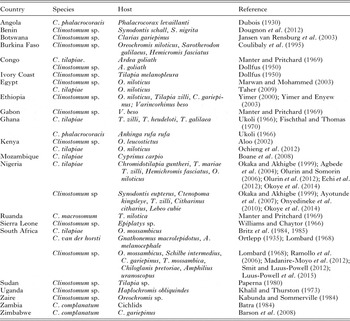
Since the 1930s, five Clinostomum spp. have been described or reported from the African continent, but few studies include complete morphological description (Dubois, Reference Dubois1930; Ukoli, Reference Ukoli1966), and reports of unidentified metacercariae of Clinostomum are numerous (see Table 1). Recent work on Afrotropical species includes redescriptions of C. cutaneum (Gustinelli et al. Reference Gustinelli, Caffara, Florio, Otachi, Wathuta and Fioravanti2010) and C. phalacrocoracis (Caffara et al. Reference Caffara, Davidovich, Falk, Smirnov, Ofek, Cummings, Gustinelli and Fioravanti2014b ). However, Clinostomum tilapiae has yet to be studied using the molecular and morphological methods of Matthews and Cribb (Reference Matthews and Cribb1998) and later authors. This species was erected by Ukoli (Reference Ukoli1966), who described metacercariae encysted in the branchial region and eye sockets of naturally infected Tilapia spp. (Perciformes: Cichlidae) sampled in Ghana, as well as adults from experimentally infected cattle egret (Bubulcus ibis). Clinostomum tilapiae was subsequently reported again from Tilapia spp. in the type locality in Ghana (Fischthal and Thomas, Reference Fischthal and Thomas1970), as well as from the oesophagus and crop of Ardea goliath in Congo (Manter and Pritchard, Reference Manter and Pritchard1969). Fischthal and Thomas (Reference Fischthal and Thomas1970) also considered that unidentified metacercariae described and drawn by Williams and Chaytor (Reference Williams and Chaytor1966), from Epiplatys spp. (Cyprinodontiformes: Aplocheilidae) from Sierra Leone, belonged to C. tilapiae. Later Britz et al. (Reference Britz, Van As and Saayman1984) described adults of C. tilapiae obtained from experimentally infected A. cinerea, in Transvaal (South Africa), and in 1985, the same authors reported C. tilapiae encysted in the gills of Oreochromis mossambicus (Cichlidae). Finkelman (Reference Finkelman1988) described C. tilapiae from Pelecanus onocrotalus (Aves: Pelicanidae) and Sarotherodon galilaeus (Cichlidae) and O. aureus (Cichlidae) sampled in Lake Kinneret, Israel, with a full description of all developmental stages. A number of other studies have reported Clinostomum spp. or C. tilapiae from various African localities without morphological data (Table 1).
Reports of Clinostomum spp. from Africa

In the present study, we redescribe the metacercaria of C. tilapiae from a new host, Synodontis batensoda (Siluriformes: Mochokidae), sampled at Anambra River Basin, Nigeria, supporting this with sequences of nuclear internal transcribed spacer (ITS) DNA and cytochrome c oxidase 1 (COI) from the mitochondrion. We compare the morphological and molecular data to other Clinostomum spp. metacercariae collected in the same sampling site and other areas/hosts in South Africa.
MATERIALS AND METHODS
Twenty-six metacercariae of Clinostomum spp., of which eight were C. tilapiae, were removed from fresh skin tissue of three S. batensoda collected in the Anambra River Basin, Nigeria, and 33 were taken from the abdominal cavity or gill chambers of fishes sampled in different areas of Limpopo and Mpumalanga provinces, South Africa, and the Bubiana River, Zimbabwe, namely Barbus trimaculatus and B. unitaeniatus (Cypriniformes: Cyprinidae); Marcusenius macrolepidotus and M. pongolensis (Osteoglossiformes: Mormyridae); O. mossambicus (Perciformes: Cichlidae), Amphilius uranoscopus (Siluriformes: Amphiliidae), Clarias gariepinus (Siluriformes: Clariidae), Chiloglanis pretoriae (Siluriformes: Mochokidae) and Schilbe intermedius (Siluriformes: Schilbeidae). The parasites were excysted, washed in saline and preserved in 70% ethanol for morphological and molecular analysis. Morphometrics were taken after clarification with Amman's lactophenol and staining by Malzacher's method (Pritchard and Kruse, Reference Pritchard and Kruse1982). Line drawings were made with the aid of a drawing tube, and measurements are given in micrometers following Matthews and Cribb (Reference Matthews and Cribb1998). In 40 of these specimens, morphometric variation was visualized with principal components analysis (PCA) of 14 morphometrics normalized to range from −1 to 1. The ordination was overlaid with a minimum spanning tree (MST) based on Euclidean distances among the specimens.
The posterior end of 59 specimens was removed for DNA extraction using a PureLink Genomic DNA Kit (Invitrogen) following the manufacturer's protocol. Amplification of ITS rDNA employed protocols and primers of Gustinelli et al. (Reference Gustinelli, Caffara, Florio, Otachi, Wathuta and Fioravanti2010); COI mtDNA those of Moszczynska et al. (Reference Moszczynska, Locke, McLaughlin, Marcogliese and Crease2009). Amplified products were resolved on a 1% agarose gel stained with SYBR Safe DNA Gel Stain in 0·5× TBE (Molecular Probes – Life Technologies). For sequencing of both ITS and COI, bands were excised and purified by NucleoSpin Gel and PCR Clean-up (Mackerey-Nagel) and sequenced with an ABI 3730 DNA analyser at StarSEQ GmbH (Mainz, Germany). Contigs were assembled with Vector NTI AdvanceTM 11 software (Invitrogen) and sequences published in GenBank (COI: KJ786967-74, KY649357-64, KY865627-43, KY865661-81, KY906227-38; ITS: KJ786975-82, KY649349-56, KY865609-26, KY865644-60).
Three alignments were generated using default parameters with MAFFT (Katoh et al. Reference Katoh, Misawa, Kuma and Miyata2002) including a subset of previously published data from clinostomids (Supplementary Table S1). One consisted of COI sequences, one of ITS sequences, and one was based on a concatenated subset of these COI and ITS sequences. Pairwise distances and models of nucleotide evolution were calculated using MEGA (Tamura et al. Reference Tamura, Stecher, Peterson, Filipski and Kumar2013). Bayesian inference (Ronquist et al. Reference Ronquist, Teslenko, Van Der Mark, Ayres, Darling, Höhna, Larget, Liu, Suchard and Huelsenbeck2012) was used to construct evolutionary trees in MrBayes. The Bayesian Information Criterion indicated the Kimura-2-parameter model with gamma-distributed rates of variation to be the best for nucleotide evolution in ITS sequences (in MrBayes, nst = 2), and a binary model was used to model evolution of gaps in the ITS alignment (lset coding = variable) that were coded using FastGap (Borchsenius, Reference Borchsenius2009). For the three codon positions of COI, the best models (and corresponding settings in MrBayes) were Tamura–Nei 93 + Gamma (nst = 6 rates = gamma), Hasegawa–Kishino–Yano (nst = 2) and Tamura-Nei 93 +G+I (nst = 6 rates = invgamma) with two random perturbations to starting trees and four search chains sampled every 100 generations, with the initial 25% of trees discarded.
RESULTS
Morphological description
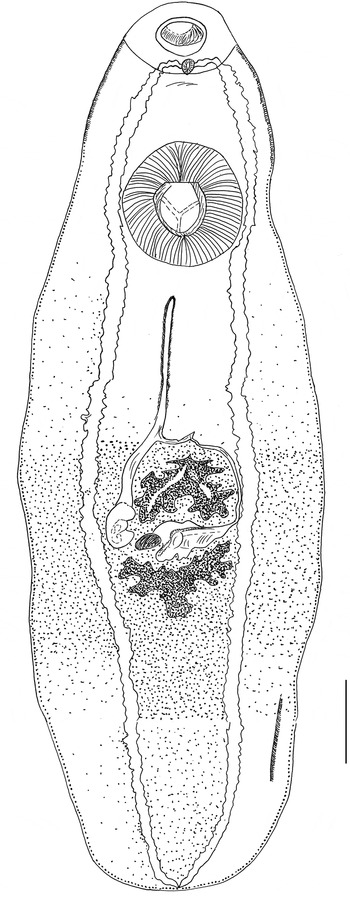
Clinostomum tilapiae Ukoli, Reference Ukoli1966 (Fig. 1, Table 2) eight specimens, Anambra River Basin, Nigeria.
Line drawing of Clinostomum tilapiae metacercaria. Scale bar = 300 µm.

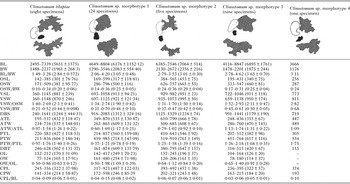
Morphological data and line drawings of the genital complex of C. tilapiae and the four Clinostomum sp. morphotypes (1–4) [Min–Max (Mean ± s.d.)] described in this study
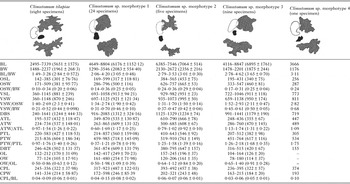
BL = Body Length, BW = Body Width, Body length/width = BL/BW, Oral Sucker length = OSL, Oral Sucker Width = OSW, OS width/body width = OSW/OSW, Ventral Sucker length = VSL, Ventral Sucker width = VSW, VS width/OS width = VSW/OSW, VS width/body width = VSW/BW, Distance between Sucker = DBS, Anterior Testis Length = ATL, Anterior Testis Width = ATW, AT width/length = ATW/ATL, Posterior Testis Length = PTL, Posterior Testis Width = PTW, PT width/length = PTW/PTL, Distance between Testes = DBT, Ovary Length = OL, Ovary Width = OW, Ovary width/length = OW/OL, Cirrus Pouch Length = CPL, Cirrus Pouch Width = CPW, CP length/Body length = CPL/BL.
Body stout, widest in gonadic region. Oral sucker small, surrounded by oral collar (not always visible). Pharynx small, opening into pharyngeal bulb. Ventral sucker larger than oral sucker. Intestinal caeca provided with small lateral pouches lateral to ventral sucker, run to posterior end of body. Testes strongly digitated. Anterior testis in middle third of body, irregularly lobed, slightly displaced to left. Posterior testis in posterior part of middle third of body with posterior lobe protruding in anterior part of posterior third, symmetrical, triangular, with two lateral and one posterior lobes, each subdivided into smaller lobes. Cirrus pouch oval with slight cleft, in intertesticular space on right, between left margin of anterior testis and right caecum. Genital pore position medial to cirrus sac, close to right anterior margin of anterior testis. Ovary small, ovoid, not median, in intertesticular space dextrally alongside cirrus pouch. Uterus runs straight from ventral sucker to anterior testis. Uteroduct runs around left margin of anterior testis, forming knee-like folding before opening into uterine sac close to anterior testis. Metraterm muscular and connecting uterus to genital atrium. Tegument armed by numerous spines.
Morphological study of metacercariae other than C. tilapiae allowed recognition of four morphotypes, distinguished based on the structure of the genital complex and DNA sequences, as described below.
Clinostomum sp. morphotype 1 (Table 2): 18 metacercariae from Nigeria (S. batensoda) and six from South Africa (S. intermedius). Genital complex between middle and posterior third of body. Cirrus pouch bean-shaped near right margin of anterior testis, overlapping it. Testes slightly lobed. Posterior testis more digitated. Ovary at left side of cirrus pouch. Caeca clearly digitated. Tegument completely covered with minute spines.
Clinostomum sp. morphotype 2 (Table 2): Five metacercariae from South Africa (four from M. macrolepidotus and one from M. pongolensis). Genital complex between middle and posterior third; cirrus pouch reniform, at right lateral side of anterior testis. Testes strongly digitated. Ovary posterior to cirrus pouch. Caeca slightly digitated. Tegument completely covered with thin papillae.
Clinostomum sp. morphotype 3 (Table 2): Nine metacercariae from South Africa (seven from A. uranoscopus and two from C. pretoriae). Genital complex in middle third of body. Cirrus pouch oval, at right margin of anterior testis. Testes lobed. Ovary in intertesticular space at left side of cirrus pouch. Caeca digitated. Tegument completely covered with minute spines and papillae.
Clinostomum sp. morphotype 4 (Table 2): One metacercariae from South Africa (B. trimaculatus). Genital complex between middle and posterior third of body. Cirrus pouch reniform, close to right posterior margin of anterior testis. Testes strongly digitated. Ovary posterior to cirrus pouch. Caeca strongly digitated. Tegument completely covered with minute spines.
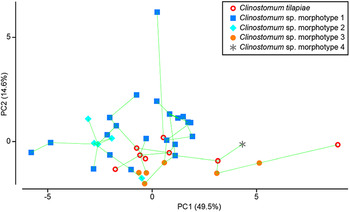
The first two axes of PCA explained 64% of variation among 14 measurements in 40 specimens, but yielded incomplete separation among C. tilapiae and the four morphotypes (Fig. 2). The strongest distinction was between morphotypes 2 and 3, in which there was little overlap along both axes. Morphotype 2 was also mostly distinct from C. tilapiae along PC1. The MST indicated morphometrically similar specimens were usually close together in the ordination, with some exceptions. Notably, specimens of Clinostomum morphotype sp. 2 were always joined by the MST, including the individual placed next to C. tilapiae and Clinostomum morphotype sp. 3 in the ordination. In other words, even the small overlap along PC1 between morphotype 2 vs morphotype 3 and C. tilapiae was a result of distortion in the ordination. This first axis, PC1, explained 49·5% of morphometric variation, and was defined by − 0·326 (body length) − 0·316 (posterior testis width) − 0·314 (ventral sucker length) − 0·311 (distance between suckers) − 0·305 (ventral sucker width) − 0·289 (body width) − 0·278 (oral sucker width) − 0·261 (anterior testis length) − 0·256 (anterior testis width) − 0·251 (posterior testis length) − 0·245 (distance between testes) − 0·242 (oral sucker length) − 0·149 (cirrus sac length) − 0·086 (cirrus sac width). The results of the analysis were essentially the same if an outlier (a specimen in morphotype 1, see square at the top of Fig. 2) was excluded.
PCA. Principal components analysis of 14 morphometrics from 40 metacercariae of Clinostomum spp. from Nigeria and South Africa (body length and width, oral and ventral sucker lengths and widths, distance between suckers, lengths and widths and distance between testes, and cirrus sac length and width). As indicated by the axis labels, the first principal component explained 49·5% of morphometric variation, the second, 14·6%. The MST is based on Euclidean distances among the 14 normalized morphometrics.

Molecular results
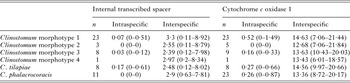
In both ITS rDNA and COI, intraspecific divergences generally did not exceed interspecific divergences (Table 3), except for Clinostomum morphotypes 1 and 3, for which variation in ITS overlapped within and between species. Table 3 summarizes genetic distances among species in the present study as well as representatives of major clades, species and putative species in prior studies. BLAST searches of public data on GenBank yielded essentially the same results. For example, ITS rDNA sequences from eight C. tilapiae differ by >1% and COI mtDNA were >10% different from other published sequences from Clinostomum.
Mean uncorrected p-distances (range) (%) within and among Clinostomum tilapiae, C. phalacrocoracis and four putative species collected in Nigeria and South Africa, including comparisons with data from other studies (79 ITS and 93 COI sequences; GB accessions in legends of Fig. 3)

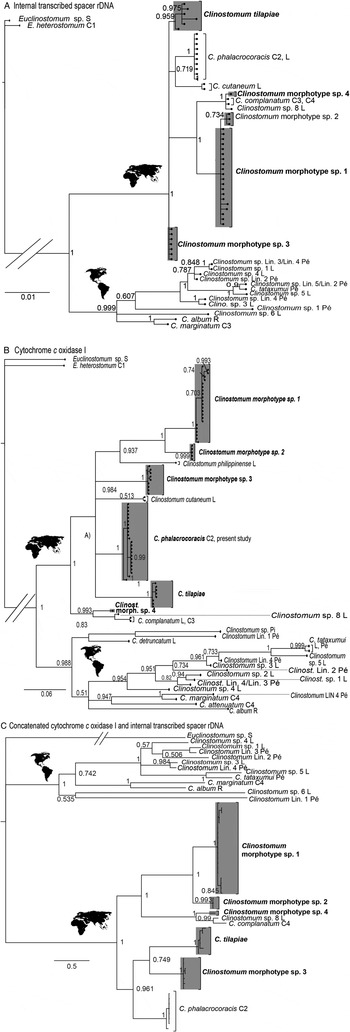
In phylogenetic analysis of ITS, Clinostomum morphotypes 1 and 2 clustered with C. complanatum and morphotype 4 in a well-supported clade, and Clinostomum morphotype 1 was paraphyletic with respect to morphotype 2 (Fig. 3A). This clade was in turn nested within a clade including C. tilapiae, morphotype 3, C. cutaneum and C. phalacrocoracis, among which relationships were unresolved. In the latter, more basal and inclusive clade, Clinostomum morphotype 3 was paraphyletic or unresolved with respect to other clade members. The COI sequences of C. tilapiae and all morphotypes formed well-supported monophyletic groups (Fig. 3B), and this also occurred in analysis of concatenated markers (Fig. 3C). In addition, COI sequences of 12 South African specimens from O. mossambicus identified as C. phalacrocoracis based on morphology grouped with previously published data from this species (Fig. 3B). In all three phylogenetic analyses, the species of the New World and Old World fell into separate, strongly supported clades.
Consensus topologies from Bayesian inference of mitochondrial and nuclear markers from clinostomids from Nigeria, South Africa and elsewhere. Data from the present study are indicated by shaded boxes and bold labels. Data from other studies are indicated by abbreviations: S = Senapin et al. (Reference Senapin, Phiwsaiya, Laosinchai, Kowasupat, Ruenwongsa and Panijpan2014); C1 = Caffara et al. (Reference Caffara, Locke, Cristanini, Davidovich, Markovich and Fioravanti2016); C2 = Caffara et al. (Reference Caffara, Davidovich, Falk, Smirnov, Ofek, Cummings, Gustinelli and Fioravanti2014b ); C3 = Caffara et al. (Reference Caffara, Bruni, Paoletti, Gustinelli and Fioravanti2014a ); C4 = Caffara et al. (Reference Caffara, Locke, Gustinelli, Marcogliese and Fioravanti2011); L = Locke et al. (Reference Locke, Caffara, Marcogliese and Fioravanti2015b ); Pi = Pinto et al. (Reference Pinto, Caffara, Fioravanti and Melo2015); Pé = Pérez-Ponce de León et al. (Reference Pérez-Ponce de León, García-Varela, Pinacho-Pinacho, Sereno-Uribe and Poulin2016); R = Rosser et al. (Reference Rosser, Alberson, Woodyard, Cunningham, Pote and Griffin2017). GenBank accessions are listed in Supplementary Table S1. Provisional names separated by forward slash indicate different names in paper/in GenBank record. Two clades containing only New World or Old World species are indicated. (A) Tree based on 861 common sites and 16 alignment gaps in 67 sequences of ITS rDNA. Posterior probabilities at nodes reflect 6122 trees. (B) Tree based on 474 common sites in 93 sequences of COI mtDNA. Posterior probabilities reflect 32 432 trees. (C) Tree based on 1271 common sites in 59 concatenated sequences of COI (468 bp), ITS (803 bp) and 13 gaps in the ITS alignment. Posterior probabilities reflect 16 638 trees.

DISCUSSION
Three Clinostomum species have been validated in Palearctic/Afrotropic areas using a combined morphological and molecular approach (Nolan and Cribb, Reference Nolan and Cribb2005), namely C. complanatum, C. cutaneum and C. phalacrocoracis (Gustinelli et al. Reference Gustinelli, Caffara, Florio, Otachi, Wathuta and Fioravanti2010; Caffara et al. Reference Caffara, Locke, Gustinelli, Marcogliese and Fioravanti2011, Reference Caffara, Davidovich, Falk, Smirnov, Ofek, Cummings, Gustinelli and Fioravanti2014b ). Here, based on metacercariae collected in Nigeria, we add C. tilapiae to the list of Old World species supported by this approach. We also provide morphological and molecular data from four unidentified species of Clinostomum from Africa, as well as the first report of C. phalacrocoracis in South Africa.
The specimens we here identify as C. tilapiae are similar to those described by Ukoli (Reference Ukoli1966), except that our specimens are slightly bigger. In C. tilapiae, the genital complex is in the posterior portion of the middle third of the body, with the posterior lobe of the posterior testis extending into the posterior third of body, while in C. cutaneum (Gustinelli et al. Reference Gustinelli, Caffara, Florio, Otachi, Wathuta and Fioravanti2010) and Clinostomum sp. morphotype 3 it is entirely in the middle third, and in C. phalacrocoracis (Caffara et al. Reference Caffara, Davidovich, Falk, Smirnov, Ofek, Cummings, Gustinelli and Fioravanti2014b ), C. complanatum (Caffara et al. Reference Caffara, Locke, Gustinelli, Marcogliese and Fioravanti2011) and Clinostomum sp. morphotypes 1 and 2, it is between the middle and posterior third of the body. The anterior testis of C. tilapiae is irregularly lobed, and asymmetric to the longitudinal axis of the body, while the posterior testis has two main lateral lobes and one posterior lobe, almost completely filling the intracecal space. In contrast, in C. complanatum, the anterior testis is strongly left-dislocated by the cirrus pouch; in C. phalacrocoracis, it is fan-shaped; in C. cutaneum and Clinostomum sp. morphotype 2, testes are triangular and clearly digitated; and in Clinostomum sp. morphotypes 1 and 3, the testes are slightly lobed. The tegument of the metacercariae of C. tilapiae is completely covered with spines that are absent in African species except Clinostomum sp. morphotypes 1, 3 and 4. The cirrus pouch of C. tilapiae is oval, between the testes, and almost in contact with the right caeca, while in C. phalacrocoracis it is reniform in the dextral intertesticular space; in C. cutaneum it is round with a deep cleft forming two lobes, and in C. complanatum, it is wide, extending from the intertesticular space to the posterior right margin of the anterior testis. In Clinostomum sp. morphotypes 1–3, the cirrus pouch is in close contact with the right margin of the anterior testis, while in Clinostomum sp. morphotype 4, the cirrus pouch is in the intertesticular space close to the right posterior margin of anterior testis.
The validation of C. tilapiae as distinct species has relevance for prior records of this species and other regional reports. Clinostomum tilapiae was described by Ukoli (Reference Ukoli1966) from metacercariae in Tilapia zilli, T. heudeloti and T. galilaea from Ghana, and from adults in experimentally infected B. ibis. Subsequent epidemiological reports of C. tilapiae in Africa often lacked morphological support (Manter and Pritchard, Reference Manter and Pritchard1969; Fischthal and Thomas, Reference Fischthal and Thomas1970; Okaka and Akhigbe, Reference Okaka and Akhigbe1999; Olurin and Somorin, Reference Olurin and Somorin2006; Boane et al. Reference Boane, Cruz and Saraiva2008; Taher, Reference Taher2009; Echi et al. Reference Echi, Eyo, Okafor, Onyishi and Ivoke2012; Ochieng et al. Reference Ochieng, Matolla and Khyria2012; Olurin et al. Reference Olurin, Okafor, Alade, Asiru, Ademiluwa, Owonifari and Oronay2012; see also Table 1). Agbede et al. (Reference Agbede, Adeyemo and Taiwo2004) used s.e.m. description to study metacercariae of C. tilapiae from O. niloticus but did not mention its spiny surface, although tegumental spines are visible with light microscopy in C. tilapiae (Ukoli, Reference Ukoli1966) and were observed in our specimens. The identity of the species in many African reports of Clinostomum sp. cannot be determined (Khalil and Thurston, Reference Khalil and Thurston1973; Paperna, Reference Paperna1980; Coulibaly et al. Reference Coulibaly, Salembere and Bessin1995; Yimer, Reference Yimer2000; Aloo, Reference Aloo2002; Yimer and Enyew, Reference Yimer and Enyew2003; Jansen van Rensburg et al. Reference Jansen van Rensburg, van As and King2003; Marwan and Mohammed, Reference Marwan and Mohammed2003; Ramollo et al. Reference Ramollo, Luus-Powell and Jooste2006; Ayotunde et al. Reference Ayotunde, Ochang and Okey2007; Onyedineke et al. Reference Onyedineke, Obi, Ofoegbu and Ukogo2010; Madanire-Moyo et al. Reference Madanire-Moyo, Luus-Powell and Olivier2012 see also Table 1). However, in some studies in which specimens were not identified, authors provided drawings. In particular, Dollfus (Reference Dollfus1950) drew Clinostomum sp. from A. goliath (Fig. 57) and from T. melanopleura (Fig. 62) that Ukoli (Reference Ukoli1966) synonymized with C. tilapiae. In our opinion, the genital complex of the adult of Clinostomum sp. from A. goliath reported by Dollfus (Reference Dollfus1950, see Fig. 55) indicates that it does correspond to C. tilapiae. Onyedineke et al. (Reference Onyedineke, Obi, Ofoegbu and Ukogo2010) and Dougnon et al. (Reference Dougnon, Montchowui, Daga, Houessionon, Laleye and Sakiti2012) reported Clinostomum sp. from Synodontis eupterus, S. schall and S. nigrita collected, respectively in Nigeria and South Benin, but without any information relevant to species identification; we cannot identify these as belonging to C. tilapiae.
The genetic and morphological comparisons among the African species strongly support the validity of C. tilapiae. Among the evidence supporting four further putative species (morphotypes 1–4) in our samples are genetic distances that generally do not overlap within and between species and morphotypes. However, divergence values should be carefully evaluated to avoid over or underestimation of species diversity (Pérez-Ponce de León et al. Reference Pérez-Ponce de León, García-Varela, Pinacho-Pinacho, Sereno-Uribe and Poulin2016). Key aspects of genetic divergence within and between species are influenced by sampling effort (Locke et al. Reference Locke, Al-Nasiri, Caffara, Drago, Kalbe, Lapierre, McLaughlin, Nie, Overstreet, Souza and Takemoto2015a and references therein), which can make conclusions difficult during the initial stages of populating molecular databases. However, early errors are likely to be corrected with additional samples. In Mexico, for example, two putative species of Clinostomum were tentatively distinguished by Locke et al. (Reference Locke, Caffara, Marcogliese and Fioravanti2015b ) based on mitochondrial sequences from five specimens, and rDNA sequences from two, but this distinction was not maintained in the subsequent, expanded sampling in the same region by Pérez-Ponce de León et al. (Reference Pérez-Ponce de León, García-Varela, Pinacho-Pinacho, Sereno-Uribe and Poulin2016). With this in mind, it is well to note that C. tilapiae and the four morphotypes distinguished herein are also supported by differences in the genital complex and by the monophyly of their mitochondrial and combined nuclear and mitochondrial sequences. Interestingly, the phylogenetic relationships of these five species are consistent with their morphometric similarity. The most strongly partitioned species in PCA (morphotype 2 vs morphotype 3 and C. tilapiae) are found in different clades in phylogenetic trees, and morphometrically overlapping species (morphotype 3 and C. tilapiae; morphotypes 1 and 2) occur in the same clades. The present phylogenetic analysis also reaffirms a previously observed separation of Old and New world species of Clinostomum, both in terms of the geographic ranges of the species, and a deep evolutionary division between species found in both regions. This was noted in an analysis of 16 species and putative species (Locke et al. Reference Locke, Caffara, Marcogliese and Fioravanti2015b ); its emergence here is notable because the analysis includes eight additional lineages or species (morphotypes 1–4, C. album, and three lineages distinguished by Pérez-Ponce de León et al. (Reference Pérez-Ponce de León, García-Varela, Pinacho-Pinacho, Sereno-Uribe and Poulin2016)).
SUPPLEMENTARY MATERIAL
The supplementary material for this article can be found at https://doi.org/10.1017/S0031182017001068.
ACKNOWLEDGEMENTS
Thanks are extended to Willem J. Smit, David Kunutu and Hendrik Hattingh for assisting with field work in South Africa.
FINANCIAL SUPPORT
Part of the research done in South Africa by AH was supported by the VLIR-IUC (Vlaamse Interuniversitaire Raad – University Development Cooperation) Funding Programme (Belgium) and the South African Research Chairs Initiative (SARChI) of the Department of Science and Technology and National Research Foundation (NRF) of South Africa (Grant no. 101054). Any opinion, finding and conclusion or recommendation expressed in this material is that of the authors and the NRF does not accept any liability in this regard. SL was supported by the Puerto Rico Science, Technology & Research Trust.