In transparent orthographies, most letters are assigned the same pronunciation, regardless of the surrounding letter context. Consequently, accurate pronunciation is easily obtained by translating each letter into its corresponding phoneme. In principle, children learning to read a transparent orthography rely on small grain-size linguistic units (single letters and phonemes) even when larger reading units are available to them (Goswami, Ziegler, Dalton, & Schneider, Reference Goswami, Ziegler, Dalton and Schneider2003). They may achieve high levels of accuracy after only a few months of learning to read and are typically close to ceiling by the end of first grade. By contrast, children learning to read an irregular orthography achieve good reading accuracy much later (Goswami, Gombert, & Fraca de Barrera, Reference Goswami, Gombert and Fraca de Barrera1998; Seymour, Aro, & Erskine, Reference Seymour, Aro and Erskine2003) and probably never reach the same accuracy level as readers of a transparent orthography.
However, acquiring transcoding accuracy is only part of becoming a mature skilled reader and reading fluency is a crucial component in this process (Wimmer, Reference Wimmer2006). Reading based on small linguistic units may be correct in a transparent orthography, but it is very slow (Zoccolotti et al., Reference Zoccolotti, De Luca, Di Pace, Gasperini, Judica and Spinelli2005) and access to meaning is not efficient. What facilitates fluency is the adoption of reading units that are larger than single graphemes. Although adopting larger reading units is seldom necessary for accurate pronunciation in a transparent script, it is necessary to become a fast and fluent reader.
Reading based on whole words develops early not only in deep but also in transparent orthographies (see, e.g., Marcolini, Burani, & Colombo, Reference Marcolini, Burani and Colombo2009; Orsolini, Fanari, Tosi, De Nigris, & Carrieri, Reference Orsolini, Fanari, Tosi, De Nigris and Carrieri2006). In Italian, the use of whole-word reading units may speed up lexical access and reading aloud in typically developing readers and in children with developmental dyslexia (Barca, Burani, Di Filippo, & Zoccolotti, Reference Barca, Burani, Di Filippo and Zoccolotti2006; Paizi, Zoccolotti, & Burani, Reference Paizi, Zoccolotti, Burani, Brunswick, McDougall and de Mornay Davies2010). However, as children do not know all words, using them as reading units may prove difficult. Thus, morphemes (roots and affixes) may be useful in fostering reading, because they are larger linguistic units than graphemes but shorter than most words. Studies on opaque orthographies, such as English, Danish, and French, focus on reading accuracy. In these languages, word spelling is to some degree governed morphologically and knowledge of morphemes may help the child to assign the correct word pronunciation (Seymour, Reference Seymour, Perfetti, Rieben and Fayol1997; Verhoeven & Perfetti, Reference Verhoeven and Perfetti2003). The presence of known morphemes, such as stems and affixes, affects young readers’ accuracy in reading aloud, mainly when polymorphemic words are phonologically and semantically transparent with respect to the base word (Carlisle & Stone, Reference Carlisle, Stone, Assink and Sandra2003; Elbrö & Arnbak, Reference Elbrö and Arnbak1996; Laxon, Rickard, & Coltheart, 1989) or when suffixes are frequent and productive (Mann & Singson, Reference Mann, Singson, Assink and Sandra2003).
In Italian, as well as in other transparent orthographies, knowledge of morphemes is not necessary to assign the correct phonemes to graphemes; that is, there are no cases like the English word SHEPHERD, where the pronunciation of PH does not obey the usual print to sound conversion but is dictated by morphology, namely, by its constituents SHEEP and HERD. However, morphemes may have a role in speeding up reading, especially of newly encountered words, for which the whole-word orthographic representation is unavailable. Second- to sixth-grade Italian children benefited from the presence of morphemes in reading new polymorphemic stimuli similarly to adult readers (Burani, Marcolini, De Luca, & Zoccolotti, Reference Burani, Marcolini, De Luca and Zoccolotti2008; Burani, Marcolini, & Stella, Reference Burani, Marcolini and Stella2002). Pseudowords made up of a root and a derivational suffix in a combination that does not exist in Italian (e.g., DONNISTA, “womanist”) were read faster than simple pseudowords matched for orthographic familiarity (e.g., DENNOSTO).
An advantage in reading pseudowords composed of morphemes was reported by Burani et al. (Reference Burani, Marcolini, De Luca and Zoccolotti2008) also for sixth-grade children with dyslexia. In the same study, developmental dyslexic and younger (second-grade) readers also benefited from the presence of morphemes in reading polymorphemic words, that is, words composed of a root and a derivational suffix (e.g., CASS-IERE, “cashier”) were read faster than simple words not parsable into a root and derivational suffix (e.g., CAMMELLO, “camel”). By contrast, sixth-grade and adult-skilled readers showed no difference in reading polymorphemic versus simple words.
There may be a number of reasons why morphemes have similar facilitating effects on pseudoword reading across groups of readers while they have a differential impact on word reading depending on reading ability. Because letters (and phonemes) are assembled within morphemes, this should speed up the reading process with respect to the more analytical process of segmenting, transcoding, and reassembling smaller units (letters, graphemes, phonemes) into larger ones (Burani et al., Reference Burani, Marcolini, De Luca and Zoccolotti2008). Consequently, morphemic units may increase reading speed when the alternative reading procedure consists of relying on smaller reading units (i.e., single letters, graphemes, and phonemes), which are the only ones available for strings of letters never encountered in print. However, when a unit larger than the morpheme (i.e., the whole word) is available, morphemic parsing does not necessarily speed up processing. For experienced readers, morphemic parsing may be an efficient strategy only when the word is new or not familiar enough, that is, when the alternative is adopting smaller reading units. If a whole-word representation is present in the reader's lexicon and can be obtained in a single fixation (Rayner & McConkie, Reference Rayner and McConkie1976), morphemic parsing may not be necessary. This raises the question of whether the orthographic familiarity of the word constrains morpholexical reading.
Models of adult word recognition assume that recourse to higher frequency constituents (morphemes) becomes increasingly important as whole-word frequency decreases, with morphemic processing maximally facilitating low-frequency (LF) words (Alegre & Gordon, Reference Alegre and Gordon1999; Baayen, Wurm, & Aycock, Reference Baayen, Wurm and Aycock2007; Burani & Laudanna, Reference Burani, Laudanna, Frost and Katz1992; Chialant & Caramazza, Reference Chialant, Caramazza and Feldman1995; Schreuder & Baayen, Reference Schreuder, Baayen and Feldman1995). In a race model of word processing (e.g., Schreuder & Baayen, Reference Schreuder, Baayen and Feldman1995), there are two routes for identifying a word: a direct lookup and a compositional route. Which one predominates depends on the relative speed of the two processes. Each can be constrained by word frequency, with the direct lookup route predominating for high-frequency (HF) words and the compositional one predominating for LF polymorphemic words. For Italian, root frequency effects on LF words have been reported for lexical decision (Burani & Caramazza, Reference Burani and Caramazza1987; Burani & Thornton, Reference Burani, Thornton, Baayen and Schreuder2003) and word naming (Colombo & Burani, Reference Colombo and Burani2002). Converging evidence stems from eye movement studies. Holmes and O'Reagan (Reference Holmes and O'Reagan1992) varied the whole-word frequencies of French suffixed and monomorphemic words matched for length and frequency to the derived words. Gaze durations differed little between HF suffixed words and their monomorphemic controls, whereas they were shorter for the LF suffixed words, especially when the initial fixation was in a good position for viewing the root morpheme.
Theoretical accounts of reading acquisition also predict that the facilitation obtained by morpheme-based processing may be particularly relevant for unfamiliar words and for poor or less-skilled readers. According to Reichle and Perfetti (Reference Reichle and Perfetti2003), acquiring reading skill requires several encounters with printed words to build up orthographic representations that reflect familiarity and knowledge of the word. Because of insufficient reading practice, developing readers, and especially poor readers, may not have established the orthographic knowledge required for word-specific (whole-word) representations. Thus, rarely encountered LF words will have a low probability of being represented and processed as whole words. However, unfamiliar words that include a HF root will still be easily recognizable based on their familiar root. Two lexical decision studies support this expectation. Gordon (Reference Gordon1989) showed that HF base words influenced the accuracy of 5- to 9-year-old children's decisions on LF derived words. Burani et al. (Reference Burani, Marcolini and Stella2002) reported that 8- and 10-year-old children were prone to accept as existing words new root + suffix combinations that included HF morphemes.
Overall, the relative probability of the two reading procedures may depend both on word frequency and the reader's processing ability. This is the main issue addressed in the present study. In our previous study (Burani et al., Reference Burani, Marcolini, De Luca and Zoccolotti2008), which showed that morphemic decomposition of words is limited to less skilled readers, the polymorphemic-suffixed words were selected from the medium-frequency to LF range (mean frequency = 27.4 out of 1 million) in a child-written frequency count (Marconi, Ott, Pesenti, Ratti, & Tavella, Reference Marconi, Ott, Pesenti, Ratti and Tavella1993). Very HF and very LF words were not included in the experimental sets. In the present experiment, highly familiar (polymorphemic and simple) words were contrasted with LF (polymorphemic and simple) words to assess whether readers’ reliance on morphemic reading would differ for HF versus LF root + suffix combinations, and whether this interacted with reading skill (care was taken that the present set of LF words had a lower frequency than the words used in our preceding study; Burani et al., Reference Burani, Marcolini, De Luca and Zoccolotti2008). Based on previous results, we expected all groups of readers to show word frequency effects, with HF words read faster than LF ones (see review in Paizi et al., Reference Paizi, Zoccolotti, Burani, Brunswick, McDougall and de Mornay Davies2010). However, poor readers were also expected to show faster naming latencies to polymorphemic than to simple words, irrespective of word frequency. By contrast, young and adult-skilled readers should read morphologically complex and simple HF words equally fast and accurately, because of their capacity to process familiar words as whole units, but might show an advantage of morphemic parsing for LF words that are less likely to be present in their lexicon.
METHOD
Participants
Three groups of participants were included in the study: poor young readers, chronologically matched skilled readers, and adult readers.
The young participants were recruited from sixth-grade classes of a junior high school in Milan. The reading level of 270 students was assessed and two groups were selected for the experiment: 21 poor readers (7 girls, 14 boys) and 42 skilled children (13 girls, 29 boys).
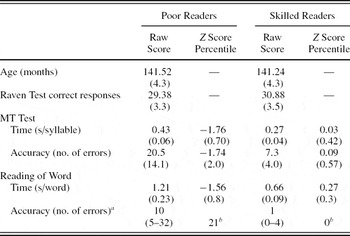
To evaluate reading deficiency, we used two standard reading tests. In the MT Reading Test (Cornoldi & Colpo, Reference Cornoldi and Colpo1995) a meaningful passage is presented and the participant has to read it aloud (within a 4-min time limit). Time (in seconds/syllable) and accuracy (number of errors, adjusted for the amount of text read) are measured. Stimulus materials (and related reference norms) vary depending on school level. The passage used for sixth graders is called “Dreams at Hiroshima” and is 592 syllables long. Raw scores are converted to z scores according to recent reference data (Tressoldi, Reference Tressoldi2008). The reading disturbance was also examined using subtest 4 (reading of words) from the Developmental Dyslexia and Dysorthography Battery (Sartori, Job, & Tressoldi, Reference Sartori, Job and Tressoldi1995). A list of 112 words is presented and the child is required to read them aloud. Number of errors and reading time (seconds/word) are scored. Time is converted to z scores. Because, in the case of errors, the distribution of controls’ data is highly skewed, percentiles are used in the case of accuracy (Sartori et al., Reference Sartori, Job and Tressoldi1995).
We included in the study children who scored at least 1.65 z scores below the normative values and/or at or below the fifth percentile (in the case of accuracy for the Reading of words subtest) in at least one reading measure. However, most children (13 out of 21) were impaired in at least two parameters (or more). Table 1 reports (raw and z score) data for the reading tests. As to reading fluency (the critical parameter for the present study), poor readers were 59% slower than controls in the MT test and 83% slower in the Reading of words subtest. Poor readers were compared to 42 skilled children of the same chronological age, whose performances on the MT test were well within the normal limits (with mean z scores near zero) for both reading time and accuracy (Table 1). The two groups were matched for gender, age, and nonverbal intelligence (Raven's Coloured Progressive Matrices: Italian norms by Pruneti, Reference Pruneti1985; see Table 1). All children had normal vision or vision corrected to normal.
Means (standard deviations) for age and performance on the Raven Test, MT Reading Test, and reading of words subtest from the Developmental Dyslexia and Dysorthography Battery

Note: Data are presented separately for poor and skilled readers.
aMedians (range) are reported for this parameter.
bNumber of children with a score at or below the fifth percentile.
Thirty adult students at universities in Rome (20–32 years old, 15 male, 15 female) also participated in the experiment.
Materials
Four sets of 20 words each were selected. Word frequency (high and low in the child written frequency count; Marconi et al., Reference Marconi, Ott, Pesenti, Ratti and Tavella1993) was varied orthogonally with morphological type (derived and simple). Words were 7–12 letters long, with a mean length of 8.65. Derived words were composed of a root and a derivational suffix (e.g., CANT-ANTE, “singer”). They were phonologically and semantically transparent with respect to their base word and included highly familiar roots and suffixes. The derived words in the two frequency sets were matched for morphological variables possibly affecting the likelihood of morphemic parsing, that is, root family size (Baayen et al., Reference Baayen, Wurm and Aycock2007; Baayen, Feldman, & Schreuder, Reference Baayen, Feldman and Schreuder2006; Carlisle & Katz, Reference Carlisle and Katz2006; Perdijk, Schreuder, & Verhoeven, Reference Perdijk, Schreuder and Verhoeven2005), suffix frequency and productivity (Baayen et al., Reference Baayen, Wurm and Aycock2007; Mann & Singson, Reference Mann, Singson, Assink and Sandra2003). Note that the present set of LF words had a significantly lower frequency (p < .001) than the medium-low frequency set used in our previous study (Burani et al., Reference Burani, Marcolini, De Luca and Zoccolotti2008); however, they did not differ for any frequency/productivity measure of roots or suffixes (all ps > .1).
Roots and suffixes in the two derived sets had the same mean length. Root frequency was allowed to differ between the two derived sets and was higher for HF derived words (see also Carlisle & Stone, Reference Carlisle, Stone, Assink and Sandra2003). The simple words were not parsable into root + derivational suffix (e.g., CARNEVALE, “carnival”). The two HF sets (derived and simple), as well as the two LF sets (derived and simple), were matched for whole-word frequency. All words had the most frequent Italian stress, that is, on the penultimate syllable. The four sets (Appendix A) were matched for length in letters and syllables, bigram frequency, orthographic neighborhood size and orthographic complexity (Barca, Ellis, & Burani, Reference Barca, Ellis and Burani2007). The sets were also matched for initial phoneme characteristics (voicing and manner) and number of double letters (which lengthen the corresponding phoneme). In order to balance the number of repetitions of suffixes and simple word endings in the list and increase the variety of suffixes, 16 word fillers (half HF and half LF; half derived and half simple) were presented along with the experimental stimuli. As a result of filler insertion, the suffixes included in the experimental derived words had a similar number of repetitions in the total list as the final nonsuffix sequences that occurred in experimental simple words. The final list comprised half HF words and half LF words, half derived and half simple, for a total of 96 stimuli.
Procedure
The stimuli were presented in black lowercase (18 point bold Courier New) in the center of the computer screen. A fixation point (300 ms), followed by a brief interval (250 ms) preceded each stimulus. Each word remained on the screen until the onset of pronunciation or for a maximum of 6000 or 1000 ms for children and adults, respectively. The interstimulus interval was 1400 ms. The 96 test items were presented in four blocks of 24 trials each, preceded by a practice block of 10 items with the same characteristics as the experimental items. Order of presentation was randomized both within and between blocks. A short pause followed each block. Participants were instructed to read aloud the words appearing on the computer screen as fast and accurately as possible. The children were tested individually in a quiet room at their school. Responses were recorded using a microphone connected to a voice key. Naming reaction times (RTs) were measured in milliseconds using E-Prime software. The experimenter noted mispronunciation errors.
RESULTS
Young readers
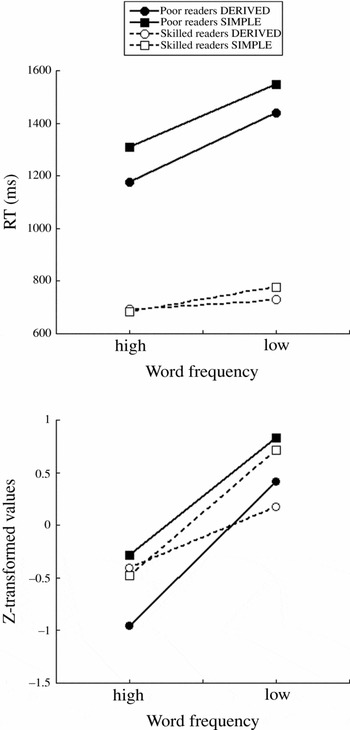
Invalid trials due to technical failures were 1.6% and 1.2% for poor and skilled children, respectively, and were treated as missing data. Pronunciation errors were excluded from the analyses on RTs and were 8% and 1.9% for poor and skilled readers, respectively. Vocal RTs for correctly named items are presented in Figure 1 (top panel). An inspection of the figure illustrates the large difference in RTs between poor and skilled readers.
Young reader by-participant mean naming times (ms) as a function of frequency (high vs. low) and morphological type (derived vs. simple) of the words and of reader's ability (poor vs. skilled readers). The top panel shows the mean raw reaction times, and the bottom panel shows z-transformed data. RT, reaction time.

For young readers, by-participants analyses of variance (ANOVAs) with group (poor readers and skilled readers) as unrepeated factor and morphological type (derived vs. simple) and frequency (high vs. low) of the words as repeated factors were carried out on both RTs (raw and z-transformed scores) and errors (arcsine-transformed scores). Motivation for these data transformations is given below. In the by-items ANOVAs, morphological type and frequency of the words were the unrepeated factors and readers’ group was the repeated factor.
Young readers: RTs
The ANOVA on raw RTs showed significant main effects of word type, F1 (1, 61) = 19.89, p < .0001, mean square error (MSE) = 13351.7, d = 0.12; F2 (1, 76) = 7.08, p = .009, MSE = 32737.4, d = 0.20, frequency, F1 (1, 61) = 63.20, p < .0001, MSE = 21849, d = 0.32; F2 (1, 76) = 33.78, p < .0001, MSE = 32737.4, d = 0.44, and group, F1 (1, 61) = 93.41, p < .0001, MSE = 250188.2, d = 2.02; F2 (1, 76) = 835.2, p < .0001, MSE = 20630, d = 3.39. Two two-way interactions were significant: Group × Word type, F1 (1, 61) = 10.69, p = .002, MSE = 13351.7; F2 (1, 76) = 5.72, p = .02, MSE = 20630, and Group × Frequency, F1 (1, 61) = 22.09, p < .001, MSE = 21849; F2 (1, 76) = 19.32, p < .001, MSE = 20630.
Considering that poor readers were much slower across conditions than skilled readers, these interactions could be spurious because they are overadditive, with the slower group showing disproportionately larger effects than the faster group (Faust, Balota, Spieler, & Ferraro, Reference Faust, Balota, Spieler and Ferraro1999). In the case of groups characterized by different general levels of performance, Faust et al. (Reference Faust, Balota, Spieler and Ferraro1999) suggested running
ANOVAs on z-transformed RTs (see also Zoccolotti, De Luca, Judica, & Spinelli, Reference Zoccolotti, De Luca, Judica and Spinelli2008). By-participant z scores are obtained by taking each individual's condition means, subtracting the overall mean averaged across conditions and dividing it by the standard deviation of their condition means. By-item z scores are obtained by standardizing RTs within each group of participants and represent the response latency to a given item relative to all others. The z scores indicate an individual participant's performance in a given condition relative to all other conditions based on the individual means of all conditions. This transformation rescales individual performances to a common reference; hence, it allows controlling for global group differences while it preserves the information regarding individual variability across experimental conditions. Mean z-transformed values are presented in Figure 1 (bottom panel) as a function of morphological type, word frequency, and reader's ability. The ANOVA on these values indicated main effects of word type, F1 (1, 61) = 14.74, p < .0001, MSE = 0.57, d = 0.39; F2 (1, 76) = 5.70, p = .02, MSE = 1.04, d = 0.39, and frequency, F1 (1, 61) = 98.06, p < .0001, MSE = 0.65, d = 1.43; F2 (1, 76) = 32.69, p < .0001, MSE = 1.04, d = 1.04. Note that, because of the effect of the data transformation in this type of analysis the main effect of group is by definition null. The three-way Group × Type × Frequency interaction, F1 (1, 61) = 4.48, p = .03, MSE = 0.59; F2 (1, 76) = 3.78, p = .05, MSE = 0.46, was significant (see Figure 1, bottom panel). A posteriori Duncan tests indicated that the poor readers took significant advantage of morphological structure of both HF- and LF-derived words in both the by-participants and by-items analyses (at least p < .05); skilled children read derived words faster than simple words only in the LF condition (by-participants, p = .01; by items, p = .005).
Young readers: Errors
Error scores were transformed by the arcsine function of the squared root of the error proportions. This nonlinear transformation is useful to stabilize error variability across score points but it does not fully compensate for absolute differences in performance between two groups. Therefore, transformed scores may still be sensitive to overadditivity effects and Group × Condition interactions must be interpreted with caution. However, the analysis of transformed error scores can be informative about the possible presence of trade-off effects in performance between speed and accuracy.
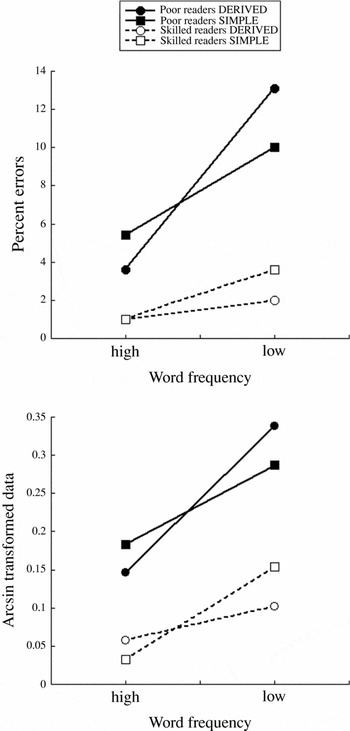
The ANOVA on these values showed significant main effects of group, F1 (1, 61) = 36.95, p < .0001, MSE = 0.04, d = 1.01; F2 (1, 76) = 64.31, p < .0001, MSE = 0.01, d = 1.08, and frequency, F1 (1, 61) = 41.59, p < .0001, MSE = 0.01, d = .55; F2 (1, 76) = 28.94, p < .0001, MSE = 0.02, d = 0.77, with skilled readers more accurate than poor readers and HF words less error prone than LF words. Relevant means are shown in Figure 2, both as raw percentages of errors and arcsin transformed values. There was no effect of morphological type (both Fs < 1). The Group × Frequency interaction was significant by-participants only, F1 (1, 61) = 5.63, p = .02, MSE = 0.01; F2 (1, 76) = 2.96, p = .09, MSE = 0.01: both groups of children read HF words more accurately than LF words (at least p < .005), but the difference was larger for poor readers (7%) than skilled readers (1.8%). This interaction could be interpreted as an overadditivity effect. The Group × Frequency × Type interaction was significant in the by-items analysis only, F1 (1, 61) = 2.68, p > .1, MSE = 0.01; F2 (1, 76) = 4.75, p = .03. The difference between HF and LF words was significant in all cases (at least p < .005) but for skilled children in the case of derived words (presumably because of the very low level of errors). All comparisons by morphological type were not significant.
Young reader percentages of errors as a function of frequency (high vs. low) and morphological type (derived vs. simple) of the words and of reader's ability (poor vs. skilled readers). The top panel shows the percentage of errors, and the bottom panel shows the arcsine-transformed data.

Adults
Invalid trials due to technical failures accounted for 1% of total data points and were treated as missing data. Pronunciation errors were excluded from the analyses on reaction times and accounted for 0.29% of total data points.
Based on their nearly flawless performance, in adult readers only RTs were analyzed. Adults exhibited the following mean RTs: HF derived = 610 ms, HF simple = 613 ms, LF derived = 629 ms, and LF simple = 623 ms. The ANOVA on RTs showed a main effect of word frequency only, F1 (1, 29) = 29.02, MSE = 229.64, p < .0001, d = 0.22; F2 (1, 76) = 3.97, MSE = 1225.26, p < .05, d = 0.22, with HF words read faster than LF words. There was no effect of morphological word type (both Fs < 1). There was a word Type × Frequency interaction only in the by-participants analysis, F1 (1, 29) = 4,43, MSE = 153.44, p < .05; F2 < 1.
DISCUSSION
Poor readers read words composed of morphemes (roots and suffixes) faster than simple words, irrespective of word frequency. By contrast, young skilled readers read polymorphemic words faster than simple words only when they were of low frequency; HF polymorphemic words were read as fast as HF simple words. Adult readers never showed a significant morphological effect. They read polymorphemic words as fast as matched simple words, irrespective of frequency. It was interesting that the presence of morphemes never led to better accuracy in reading polymorphemic versus simple words. Finally, all groups showed effects of word frequency, with HF words being read aloud faster and more accurately than LF words, confirming previous results in both adult and young skilled readers and in children with dyslexia (Barca et al., Reference Barca, Burani, Di Filippo and Zoccolotti2006, Reference Barca, Ellis and Burani2007; Burani et al., Reference Burani, Marcolini and Stella2002, Burani, Arduino, & Barca, Reference Burani, Arduino and Barca2007).
Poor readers’ results confirmed previous data showing facilitation of morphological structure on dyslexics’ reading of pseudowords and medium-frequency to LF words (Burani et al., Reference Burani, Marcolini, De Luca and Zoccolotti2008) and extended the evidence for facilitation due to morphological composition to both HF and LF words. As to young skilled readers, the morphological effect on LF derived words in the present experiment was unlike what we observed in our previous study (Burani et al., Reference Burani, Marcolini, De Luca and Zoccolotti2008). We propose that the different results are due to the lower frequency of the words used in the present study than in the preceding one. Note that the presence of a facilitative morphological effect on young skilled readers in the present experiment (vs. its absence in the previous study) cannot be ascribed to differences in the quantitative properties of morphemic constituents likely to affect LF word processing; that is, it is not due to higher root frequency, root family size, suffix frequency, or suffix numerosity (productivity) in the present set of words.
The finding that only poor readers benefited from morphological structure in reading HF words aloud is in line with other reading fluency results obtained in deeper orthographies. For both English and Danish, only younger and dyslexic readers showed faster reading times for derived than monomorphemic words; reading speed did not differ between word types in the older skilled children (Carlisle & Stone, Reference Carlisle and Stone2005; Elbrö & Arnbak, Reference Elbrö and Arnbak1996). In the study by Carlisle and Stone (Reference Carlisle and Stone2005), English-speaking second and third graders had faster reading times on HF-derived than monomorphemic words, whereas speed of reading the two word types did not differ for fifth and sixth graders. Elbrö and Arnbak (Reference Elbrö and Arnbak1996) found that Danish adolescent dyslexics read words with a semantically transparent morphological structure (e.g., SUNBURN) faster than words with an opaque structure (e.g., WINDOW), an advantage not found in the control group.
The present findings indicate that reading based on familiar morphemes (roots and affixes) is efficient for both poor and skilled young readers when a whole-word representation is not firmly established in the reader's orthographic lexicon. It is noteworthy that even though poor readers may not yet have fully mastered whole-word processing, when the word is longer than its constituent morphemes they can rely on lexical units smaller than whole words, that is, morphemes, to enhance their reading performance.
The finding that morpheme-based reading is more useful for poor than skilled readers may appear to contradict some developmental accounts. According to Seymour (Reference Seymour, Perfetti, Rieben and Fayol1997), the morphographic level of representation is an advanced phase of literacy development that is established on top of orthographic knowledge; thus, it should be available to skilled more than to poor readers. In our experiment, both groups of young readers showed word-frequency effects in reading that demonstrate the presence of whole-word reading for both groups in addition to morphemic reading (see also Barca et al., Reference Barca, Burani, Di Filippo and Zoccolotti2006, Reference Barca, Ellis and Burani2007). However, a different balance of whole-word based and morpheme-based reading aloud is evident for skilled and poor readers, respectively. In skilled children, whole-word processing is faster than morphemic reading in the case of familiar words, with consequent similar processing times for HF morphologically complex and simple words; morpheme-based processing becomes convenient only for processing LF words that are not sufficiently familiar in print as whole forms. By contrast, for poor readers morpheme-based reading aloud is on average faster than whole-word based processing for both HF and LF words.
In young skilled readers, the lack of morphological facilitation for HF words indicates that when a larger reading unit (the whole word) is available, parsing a word into smaller reading units (morpheme) may entail costs as well as benefits. In a parallel race model of visual word processing (Schreuder & Baayen, Reference Schreuder, Baayen and Feldman1995), the decomposed route does not always provide faster output than the whole-word route. Parsing a familiar word into morphemic subparts can be more laborious and time-consuming than full-form activation, entailing processing costs at several stages, such as morpheme segmentation and composition (Laine, Vainio, & Hyönä, Reference Laine, Vainio and Hyönä1999; Schreuder & Baayen, Reference Schreuder, Baayen and Feldman1995; Traficante & Burani, Reference Traficante, Burani, Baayen and Schreuder2003). Additional processing costs consequent to morphemic parsing are present at the speech production stage, which is specifically involved in reading aloud. In Italian, assembling the pronunciation of a (bound) root and a suffix to obtain whole-word pronunciation implies assigning a different stress to the root + suffix combination than the stress of the root alone and planning a new coarticulation of the morphemic combination. Thus, word-based reading may avoid the parsing and assembling costs associated with morpheme-based reading. Overall, for skilled readers a headstart to the morphological reading route may occur only in cases in which the advantages associated with parsing prevail over the parsing costs (Bertram & Hyönä, Reference Bertram and Hyönä2003; Burani, Arduino, & Marcolini, Reference Burani, Arduino and Marcolini2006). By contrast, for poor readers the advantages of computing morphemes instead of whole-words seem to prevail in all cases.
Confirming previous findings (Burani et al., Reference Burani, Marcolini, De Luca and Zoccolotti2008), adult Italian readers did not show any morphological facilitation in reading polymorphemic suffixed words. This result might seem to contrast with findings reported for other languages. English-speaking adult readers, for example, may show faster naming latencies for compound than monomorphemic words (Inhoff, Briihl, & Schwartz, Reference Inhoff, Briihl and Schwartz1996) or for compounds with a HF (rather than LF) second constituent (Juhasz, Starr, & Inhoff, Reference Juhasz, Starr, Inhoff and Placke2003). However, as argued above, morphemic parsing does not necessarily speed up reading aloud in languages such as Italian in which root morphemes are bound and the assembly of morphemes entails coarticulation at the speech production stage. By contrast, reading English compounds aloud does not necessarily entail reassigning stress to the free word-constituent morphemes. Therefore, morphemic reading can be convenient for English-speaking adult readers because they can avoid the additional processing costs involved in phonologically reassembling bound morphemes.
Similar to our previous study (Burani et al., Reference Burani, Marcolini, De Luca and Zoccolotti2008), we found no effect of morphemic constituency on word-reading accuracy. This is unlike other studies (e.g., Carlisle & Stone, Reference Carlisle and Stone2005) that reported significantly higher accuracy in reading derived words than monomorphemic words in groups of children with different reading skills and in studies on dyslexics (Elbrö & Arnbak, Reference Elbrö and Arnbak1996). The lack of morphological facilitation on word pronunciation accuracy confirms that, in a transparent orthography, knowledge of word morphology is not necessary for correctly transcoding graphemes into phonemes, although it may affect stress assignment (for a similar view reporting how the transparent Finnish orthography does not contain morphologically based spelling rules see Lehtonen & Bryant, Reference Lehtonen and Bryant2005).
Some authors (e.g., Casalis, Colé, & Sopo, Reference Casalis, Colé and Sopo2004; Elbrö & Arnbak, Reference Elbrö and Arnbak1996) have argued that the morphemic analysis adopted by dyslexic or less skilled readers has the advantage that morphemes have a direct bearing on the meaning of the word. According to the authors, morpheme recognition is a semantic compensatory strategy in word decoding and comprehension in dyslexia; it entails extracting meaning from the smallest units (roots and affixes) constituting morphologically complex words. In the present study, both poor and skilled young readers benefited from the presence of a familiar root and suffix in the case of polymorphemic LF words. Whether early availability of the root indicates early access to the meaning of the word has still not been demonstrated. Although morphemes allow understanding the meaning of a morphologically complex word in word comprehension tasks (see Bertram, Laine, & Virkkala, Reference Bertram, Laine and Virkkala2000; Burani, Bimonte, Barca, & Vicari, Reference Burani, Bimonte, Barca and Vicari2006), studies on reading aloud in adults (e.g., Baayen et al., Reference Baayen, Feldman and Schreuder2006, Reference Baayen, Wurm and Aycock2007; Balota, Cortese, Sergent-Marshall, Spieler, & Yap, Reference Balota, Cortese, Sergent-Marshall, Spieler and Yap2004; Burani et al., Reference Burani, Arduino and Barca2007), dyslexic and skilled young readers (De Luca, Barca, Burani, & Zoccolotti, Reference De Luca, Barca, Burani and Zoccolotti2008) indicate a general insensitivity of word naming to semantic variables. Furthermore, in both adult and young Italian readers the degree of semantic interpretability of new root–suffix combinations affects lexical decision but has no impact on reading aloud (Burani, Dovetto, Spuntarelli, & Thornton, Reference Burani, Dovetto, Spuntarelli and Thornton1999; Burani et al., Reference Burani, Marcolini and Stella2002).
In conclusion, the present study demonstrates that morphemic units are important for young readers of transparent orthographies to facilitate lexical access and thus increase reading fluency. Morpheme-based reading is useful in those conditions in which whole-word processing is less likely, namely, when the whole word is new or not very familiar because it has not been encountered frequently enough in print or because of poor reading skills.
APPENDIX A
Words used in Experiment 1 (Part 1)

Words used in Experiment 1 (Part 2)
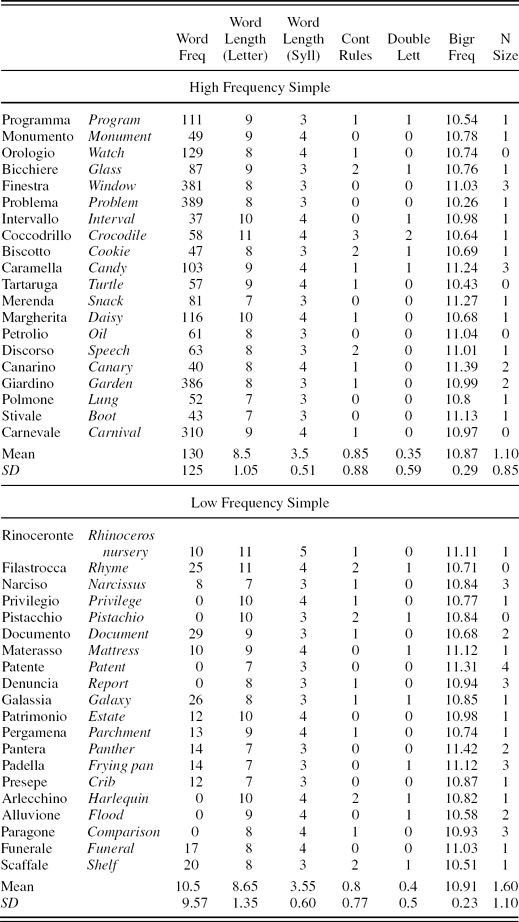
Note: Word Freq, word frequency out of 1 million occurrences; Root Freq, root frequency out of 1 million occurrences; Root N Type (Fam Size), number of different word types that contain the root (family size); Suff Freq, suffix frequency out of 1 million occurrences; Suff N Type (Prod), number of different word types that contain the suffix (suffix productivity); Word Length (Letters), word length in letters; Word Length (Syllables), word length in syllables; Root Length, root length in letters; Suff Length, suffix length in letters; Cont Rules, number of c, g, and sc letters that need the following letter context to assign the correct pronunciation; Double Lett, number of double letters; Bigr Freq, word's mean bigram frequency, log transformed (natural logarithm); N Size, word's orthographic neighborhood size.
ACKNOWLEDGMENTS
This study was supported by PRIN Grant 2005111248_001 from MIUR (to P.Z.). The authors thank Maximiliano Wilson for his useful comments.