Introduction
There are different methods available to measure taste perception in human subjects. These include: assessing the intensity of solutions of different strengths and taste qualities, used as a whole mouth wash or applied on parts of the oral mucosa;Reference Bartoshuk1 and assessing threshold levels, using solutions introduced into the mouth,Reference Yamauchi, Endo, Sakai and Yoshimura2 or solutions on filter paper discsReference Tsuruoka, Wakaumi, Araki, Ioka, Sugimoto and Fujimura3 or strips.Reference Mueller, Kallert, Renner, Stiassny, Temmel and Hummel4
Electrogustometry uses electric current as the stimulus. It has been used for studies of taste loss due to various causes,Reference Tomita and Ikeda5 such as middle-ear surgery,Reference Nin, Sakagami, Sone-Okunaka, Muto, Mishiro and Fukazawa6 tonsillectomy and laryngomicrosurgery,Reference Tomofuji, Sakagami, Kushida, Terada, Mori and Kakibuchi7 extraction of molar teeth,Reference Morton, Hay, Goldsmith and Stillman8 drug side effects,Reference Tsuruoka, Wakaumi, Araki, Ioka, Sugimoto and Fujimura3 and age.Reference Murphy, Quinonez and Nordin9 All these methods have relied on subjects' subjective responses. However, objective measurement of taste pathways is possible, and involves assessment of gustatory evoked potentials; this can also be used together with positron emission tomography and functional magnetic resonance imaging.Reference Ikui10 The subject's concomitant taste experience is not evaluated.
Taste examinations are performed to varying degrees in different parts of the world. In Japan, such examinations have become increasingly common, and around 250 000 patients are tested every year. Electrogustometry and the filter paper disc method are very popular, and have become routine procedures in the otorhinolaryngological institutions of almost all Japanese university hospitals, and many private clinics.Reference Ikeda, Aiba, Ikui, Inokuchi, Kurono and Sakagami11 Thus, the research tools of psychophysicists have become the clinical tools of otorhinolaryngologists. However, chemical assessment methods are time-consuming, and it would be of great value to have a screening test for taste disturbance.
The aim of this study was to evaluate how electrogustometry relates to chemical testing of taste in the clinical setting, and to what extent it may be used as an initial or generalised test to detect underlying taste dysfunction.
Subjects and methods
Subjects
Data from 66 women and 48 men aged 23–92 years (mean 60 years) were included in the study. Subjects comprised 10 healthy individuals, 34 patients who had undergone radiotherapy for head and neck cancer, 31 patients with Sjögren's syndrome, and 39 patients with burning mouth syndrome or oral dysaesthesia.
Self-assessment of taste
Before taste testing, subjects rated their present overall ability to taste, as a whole number on a scale from zero to 10. They were also asked whether or not they had experienced any abnormal taste sensations at the time.
Electrogustometry
All subjects were tested by automated electrogustometry, using a computer-controlled, two-alternative, forced-choice technique previously described,Reference Stillman, Morton and Goldsmith12, Reference Stillman, Morton, Hay, Ahmad and Goldsmith13 with a stimulating anode diameter of 5 mm. This method can measure electrogustometric thresholds of less than 3 µA;Reference Lobb, Elliffe and Stillman14 thresholds greater than 30 µA are considered pathological.Reference Stillman, Morton, Hay, Ahmad and Goldsmith13
Chemical testing
Solutions of different concentrations, representing each of the four basic taste qualities (sweet, sour, salty and bitter), were used to elicit subjects' perceptions of taste, using a method we have described elsewhere.Reference Morton, Hay, Goldsmith and Stillman8 The solutions were sucrose (1 M, 0.3 M, 0.1 M and 0.03 M), citric acid (0.032 M, 0.01 M, 0.003 M and 0.001 M), sodium chloride (1 M, 0.3 M, 0.1 M and 0.03 M) and caffeine (0.1 M, 0.03 M, 0.01 M and 0.003 M). A water control was included in each set.
The order of presentation of each taste quality was randomised, as was the side of the tongue first tested and the order of presentation of concentrations. Cotton buds dipped in the respective solutions were applied to the lateral border of the anterior tongue. The subject was aware of which taste quality was being used. After each presentation, the subject was asked to score the intensity of the taste by making a cross on a visual analogue scale (VAS), which was presented as a simple line scale, with the word anchors ‘no taste’ at the left end and ‘greatest imaginable taste’ at the right. After each VAS scoring, the subject's mouth was rinsed with distilled water. Finally, the procedure was repeated with whole mouth solutions, using 4 ml samples of the same concentrations as above, taken as mouth rinses and then expectorated.
Data
For the purposes of analysis, the VAS scoring was considered to be zero at the left end and 100 at the right end; subjects' markings were scored accordingly. At the strongest whole mouth concentrations, all subjects registered above the detection threshold (i.e. greater than zero), so we used the results from those concentrations for statistical analyses, with a VAS score of <50 being used as a cut-off level to identify ‘poor tasters’. An electrogustometric threshold of 30 µA was taken as the upper limit of normal. We defined subjects as ‘normal’ when they reported no abnormal taste experiences and rated their overall ability to taste as greater than five, as this was the range in our group of healthy subjects. Subjects who did not meet these criteria were labelled ‘aberrant tasters’.
Statistics
For electrogustometric testing versus testing each of the four basic tastes, we calculated the sensitivity (i.e. the proportion of ‘poor tasters’ having an abnormally high electrogustometric threshold), specificity (i.e. the proportion of ‘good tasters’ having a normal electrogustometric threshold), as well as the positive predictive value (i.e. the proportion of those with a high electrogustometric threshold who were ‘poor tasters’) and the negative predictive value (i.e. the proportion of those with a normal electrogustometric threshold who were ‘good tasters’). This was performed for each of the taste qualities on each side of the tongue separately, and for the whole mouth.
Ninety-five per cent confidence intervals (CI), taken from binominal distribution, were calculated for the values of sensitivity, specificity, positive predictive value and negative predictive value. Sensitivity and specificity was also calculated for the four whole mouth solutions (VAS < 50) and for electrogustometry, in order to detect ‘aberrant tasters’. We considered p < 0.05 to be statistically significant.
Ethical considerations
All participants gave their informed consent, and the Auckland Ethics Committee ‘X’ approved the study.
Results
Five subjects did not perform the whole mouth tests. Three of the cancer patients were tested before radiotherapy. Three subjects were ‘poor tasters’ for all four taste qualities, six for three qualities, five for two qualities and 12 for one quality.
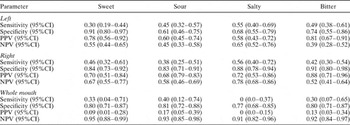
The sensitivity and specificity of electrogustometry in identifying ‘poor tasters’, with corresponding CIs, are shown in Table I. The positive and negative predictive values for electrogustometry are also shown in Table I.
Capacity of elevated electrogustometry thresholds to detect ‘poor tasters’ in qualitative taste testing on the left or right side of the tongue, or as a whole-mouth rinse*

Tastant perception scoring less than 50 on a 0–100 visual analogue scale was considered ‘poor’. CI = confidence interval; PPV = positive predictive value; NPV = negative predictive value
The negative predictive value for whole mouth solution testing was over 90 per cent for all four taste qualities; however, the negative predictive value of taste testing on the left and right sides of the tongue was much lower. The positive predictive value for whole mouth solution testing was very low, in contradistinction to lateral tongue testing, for which the positive predictive values were noticeably higher.
Twenty-nine subjects met our criteria for rating themselves as ‘normal’.
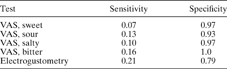
The sensitivity and specificity for whole mouth solution testing of the four tastes, and for electrogustometry, in the detection of ‘aberrant tasters’ are shown in Table II.
Sensitivity and specificity for whole mouth VAS scoring of <50 for the 4 taste qualities, and for electrogustometry, in detecting ‘aberrant tasters’

VAS = visual analogue scale
Discussion
Our analyses of data from 114 subjects, some healthy but most with various medical conditions which could impair their taste ability, revealed that electrogustometry cannot be used as a screening test to detect taste disturbance in similar populations. The overall sensitivity of electrogustometry was low, and the specificity, while better, was still not at clinically useful levels.
If a patient had an abnormally high electrogustometric threshold (i.e. >30 µA) – even on the better side – there was a low probability (i.e. a low positive predictive value) that this person was a ‘poor taster’ (Table I). A similar situation pertained in respect of unilateral taste testing, although the positive predictive values were somewhat higher. Chemical tests would be needed to confirm qualitative taste performance. If, on the other hand, the electrogustometric threshold was normal, there was an approximately 90 per cent probability that the subject was a ‘good taster’ in all whole mouth solution tests (i.e. high negative predictive value), and chemical testing may not be needed. Unilateral values were not useful in the same way, although the specificity values were generally >80 per cent, suggesting that most subjects with ‘normal’ electrogustometry results were likely to have a good appreciation of the four taste qualities.
Assessment of whole mouth solution VAS scores (using a VAS score of <50 to define ‘poor tasters’) showed a pattern similar to electrogustometry, but with a much more impressive specificity, in that almost all subjects with a VAS score of <50 were also ‘aberrant tasters’ (Table II). However, as the sensitivity was very low, those who had higher VAS scores were also just as likely to be ‘aberrant tasters’.
It may be more relevant to compare electrogustometry thresholds with chemical thresholds rather than suprathreshold VAS scores, because chemical thresholds may not correlate well with suprathreshold profiles, as taste loss can occur over part of the concentration range to which an individual is sensitive.Reference Bartoshuk1 However, in our evaluation, we chose a strong concentration in order to provide a more complete comparison between all subjects.
We chose to use VAS scores as indicators of poor taste ability, and we set a VAS score of 50 as the arbitrary cut-off level for poor tasters. A lower VAS cut-off only marginally affected the results; in any event, too few subjects would have been in some of the groups to make relevant calculations, despite our large, varied study group.
• A screening test for abnormalities of taste would be of great value
• Electrogustometry is a widely used clinical tool
• This study shows that electrogustometry cannot be used as a screening test for taste disturbance in a population likely to contact a taste clinic
We also chose to define 30 µA as the normal cut-off for electrogustometry, rather than 40 µA, as suggested earlier by Grant et al. Reference Grant, Ferguson, Strang, Turner and Bone15 This was because we had previously shown 30 µA to be an appropriate level for the automated version of electrogustometry, in which the computer produces a repeatable, predetermined level of performance with minimal subject bias.Reference Stillman, Morton and Goldsmith12 Electrogustometric current density is thought to correlate better with the true electrical taste stimulus than current intensity; therefore, it is important to note the size of the stimulus electrode when comparing data obtained by electrogustometry.Reference Ajdukovic16 We used the same electrode size in all measurements.
We have earlier shown a significant correlation between electrogustometry and whole mouth solution testing only for the salt taste. In comparison, on the left and right tongue sides, electrogustometry correlated significantly but weakly for all four taste qualities.Reference Ellegård, Goldsmith, Hay and Morton17 The reliability of unilateral electrogustometric assessmentReference Stillman, Morton and Goldsmith12 makes it a relevant tool in the quantification and follow up of injuries to the taste pathway, due to, for example, middle-ear disease, surgery or Bell's palsy. Unilateral taste loss is often not obvious to the patient in the course of everyday experience.
Conclusion
The results of the present study show that electrogustometry cannot be used to screen for taste disturbance. As there is no strong correlation between eletrogustometry results and those of chemical taste perception tests, electrogustometry seems to complement chemical taste tests, rather than substitute for them.
Acknowledgements
We are grateful to David Goldsmith, who performed the taste testing. He was supported by financial assistance from the Head and Neck Trust, The Green Lane Research and Education Trust Fund, and the Maurice and Phyllis Paykel Trust. Dr Ellegård's time in New Zealand was supported financially by the Swedish Association of Otorhinolaryngology Head and Neck Surgery, the Swedish Society of Medicine, the Göteborg Medical Society, and the Acta Otolaryngologica Foundation, Sweden.