Introduction
Since 1994, organic farming has been promoted EU-wide through public funding. Subsequently, the entire sector has exhibited very dynamic developmentReference Willer and Yussefi1–Reference Tuson and Lampkin4 and an increasing number of countries have implemented organic farming action plansReference Nieberg and Kuhnert5, Reference Stolze, Stolz and Schmid6. These plans follow an integrated approach to varying degrees, including support in the areas of production, processing and marketing, consumer information and other measures. Nevertheless, despite these ‘holistic’ concepts, area payments for the introduction and maintenance of organic farming remain the predominant support measure in terms of government expenditure in almost all European countries. High policy dependency implies high risk when organic farming support decreases. Against the background of heightened discussion concerning the shape and level of organic payments, and their relevance for economic success, the question arises of their impact on the sustainable development of organic farming in Europe.
In this paper, first, the main features of organic payments are briefly presented. Following a description of the methodological approach adopted, the importance that farmers from different European countries attach to such payments is discussed, with regard to their decision to convert and the economic viability of their farms. On the basis of farm accounting data and farm models, the relevance of organic payments for economic success is subsequently analyzed. The results are then discussed within the framework of international competitiveness and the sustainability of organic farming development.
Organic Farming Payments in the European Union
Environmental goals constitute the primary aims of government support for organic farming. In addition, the contribution of organic agriculture to rural development, a reduction of production surpluses, consumer satisfaction and the exploitation of market opportunities are also regarded as highly significant and worthy of financial support7–Reference Dabbert, Häring and Zanoli10.
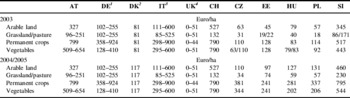
Support for organically farmed area is one of various agri-environmental measures and is a part of the second pillar of the Common Agricultural Policy (CAP) of the EU. The relevance of these payments needs to be seen against the importance of total government support for agriculture in the EU countries. In terms of the EU agricultural budget, 90% went to the first pillar in 2003 and market support is generally the most important type of support to farmers11. For organic farming, however, price support accounts for a lower proportion of total transfers to producers than direct paymentsReference Gay and Offermann12. In most countries, area support is offered for conversion to organic farming and for the maintenance of this production system. As products cannot be sold as organic with price premiums in the first two to three years of conversion, payment rates for conversion are higher than those for maintenance in most countriesReference Tuson and Lampkin4. According to the EU Regulation (EEC) 1257/199913 (Programme for Rural Development) payment rates per hectare are calculated on the basis of income foregone, additional costs resulting from the commitment given and the need to provide an incentive (maximum 20%). Due to the diverse natural, socio-economic and political conditions across Europe, both the design of measures and the level of payments vary widely between countries (see Table 1). In 2003, for example, maintenance payments for arable land varied from 44 Euro ha−1 in some parts of the UK, to more than 300 Euro ha−1 in Austria and Slovenia. The organic farming payments offered in Switzerland, the non-EU country, were even higher.
Organic farming area payments (for maintenance) in selected European countries (2003 and 2004/2005).

Source: Own compilation followingReference Hrabalova, Handlova, Koutna and Zhadral3–Reference Nieberg and Kuhnert5.
AT, Austria; DE, Germany; DK, Denmark; IT, Italy; UK, United Kingdom; CH, Switzerland; CZ, Czech Republic; EE, Estonia; HU, Hungary; PL, Poland; SI, Slovenia.
1 Payments in DE vary according to ‘Bundesland’.
2 DK has not offered specific organic farming maintenance payments since 2004. Instead, alternative agri-environmental support measures were introduced, in which mainly organic farms participate. The numbers presented here for 2004/2005 belong to this measure.
3 Payments in IT vary according to region. In some cases there exist other (additional) classification, so that these numbers only can serve as an approximation.
4 Payments in UK vary according to region (England, Scotland, Wales and Northern Ireland).
While changes between 2003 and 2004 were of minor relevance in Western European countries, the increase in payments in the new member states after EU accession is quite marked. In some countries, per hectare payments more than doubled. Thus, there is increased incentive for Eastern European farmers to convert to organic farming and statistics show that farmers did, and do, react to these incentives, set by policy-makers. All of the new member states have revealed notable growth rates in organic area over recent yearsReference Willer and Yussefi1.
Materials and Methods
The results presented here are based on a survey of organic farms, on information from national Farm Accountancy Data Networks (FADNs) and on the modeling of ‘typical’ organic farms in different European countries.
1. In the winter and spring of 2004, face-to-face interviews were conducted with 550 organic farmers from 11 European countries (Austria, Czech Republic, Denmark, Estonia, Germany, United Kingdom, Hungary, Italy, Poland, Slovenia and Switzerland). The farms were chosen at random on the basis of lists of all organic farms (Czech Republic, Denmark, Estonia and Poland) or datasets from certification bodies, ministries and farmers' associations, in most cases covering more than 90% of organic farms (Germany, Hungary, Slovenia and Switzerland). In Austria, Italy and the United Kingdom, a regional focus was created. All of the farms visited had started to convert to organic production before 2001 and had thus completed their conversion periods. For the most part, survey data were analyzed using descriptive statistical methods.
2. FADNs provide extensive information on economic indicators, including very detailed information about direct payments and revenues. As farm accounts provide data on the actual payments received, this data source implicitly allows analyses, for individual farms, of factors influencing eligibility for support and payment levels. With the exception of the UK, where data were available only for the year 2001, the availability of accountancy data for organic farms was good for the Western European countries analyzed. Generally, information was drawn from significantly more than 100 farms for five to eight consecutive years, thus allowing further stratification and the analysis of developments over time.
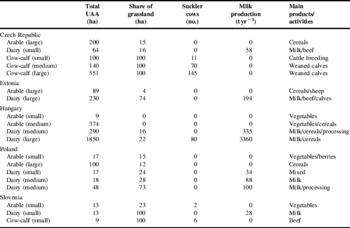
3. In the new member states, national databases like FADN data are still scarce for organic farms. This is why the typical farm approach was chosen in the analysis of organic farms for these countriesReference Häring14–Reference Izquierdo Lopez, Davier and Deblitz16. According to this methodological approach, a small number of organic farms was selected, each of them representing a group of similarly structured farms. The typical organic farms reflect a large share of organic farming in their country. Following this concept, and depending on the structure of organic farming in the countries studied (Czech Republic, Estonia, Hungary, Poland and Slovenia), two to five typical organic farm models for the year 2003 were set up, based on the statistical data and expert knowledge (Table 2). Data collection took place on real farms and the scientists were always accompanied by local experts on organic farming, e.g., advisors, so that farm-specific data could be leveled out in such a way as to show the likely situation for a group of farms. Results for 2005 were generated through the inclusion of actual data concerning support payments, and general increases in costs for labor and other inputs into the models.
Main characteristics of typical organic farms analyzed in selected Eastern European countries (2003).

Source: Own compilation.
UAA, utilizable agricultural area.
Several indicators exist for measuring economic success. In the EU, one of the measures of farm profits most widely used is family farm income (FFI) which provides information on the returns to land, labor and capital resources owned by the farm family. It is calculated as the difference between all farm returns and all incurred costs including depreciation. On family farms, most of the labor is supplied by the farmer and unpaid family members and thus has to be remunerated by profit. On farms organized as limited companies or cooperatives, which are of particular relevance in some of the new member states, employed labor dominates and related wage expenses are part of costs. It would be misleading to compare FFI between farms of different legal structures so, consequently, FFI plus wages (FFI+W) was chosen for the following comparisons.
In order to evaluate the relevance of organic farming payments to the economic success of organic farms, two main indicators were used:
• the relationship between payments and gross output, providing an impression of the contribution of payments compared with other revenues, e.g., from sales. This measure can be seen as an indication of the level of ‘organic farming policy’ dependency as compared with ‘market’ and ‘other policy’ dependency;
• the ratio of payments relative to FFI, or to FFI+W, which quantifies the dependency of profits on organic payments. This measure can be seen as an indicator of farm vulnerability to changes in specific support policies.
However, when evaluating the importance of organic support payments, it must be noted that abolition of maintenance payments for organic farming does not automatically imply that the income of organic farms will be correspondingly reduced. In many European countries, organic farms are likely to be eligible—and apply—for other agri-environmental payments, e.g., for the extensive use of grasslands or the elimination of fertilizers and/or pesticides on arable land, without having to change their farm organization. The extent of the resulting payments is difficult to assess, as programme availability, eligibility criteria and payment levels show a very high regional variationReference Hrabalova, Handlova, Koutna and Zhadral3, Reference Tuson and Lampkin4. In this study, as an approximation, it is assumed that organic farms would be eligible to receive at least the same amount of agri-environmental payments as comparable conventional farms, if no specific support for organic farming existed. Thus, the benefit of specific support to farms for organic farming, dubbed ‘extra payments for organic farming’ in the following analysis, is given by the difference between agri-environmental payments to organic and comparable conventional farms (see Reference Nieberg, Offermann and Zander17 for the notion of ‘comparable conventional farms’). This approach actually provides an upper estimate of the importance of extra payments for organic farming, as it seems likely that organic farms may often be eligible for more agri-environmental funds than comparable conventional farms, without needing to change their production system. Due to limited data availability in Eastern Europe and the less widespread occurrence of agri-environmental measures which are non-combinable with organic farming support, this concept for the assessment of extra organic payments was restricted to the analysis of Western European countries.
While the methodology employed in the farm survey was exactly the same in every country and all farmers received the same questionnaire, the analysis of farm financial data in Eastern and Western countries used different databases and methodological approaches although employing the same economic indicators.
Farmers' Perception of Organic Farming Payments
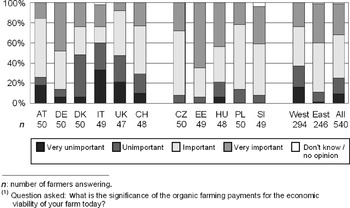
Farmers were asked to assess the importance of organic farming payments to the economic viability of their farms. The majority of farmers indicated that organic support payments were ‘important’, with 30% saying they were ‘very important’ (Fig. 1). Organic farming payments were considered to be important for farm viability more frequently in new member states than in the West. However, there were significant variations within the group of Western European countries, with German farmers attaching the greatest importance to payments overall. In line with the relatively low payment levels in the UK and Denmark, approximately half of the farmers in these countries indicated that such support was not important to economic viability. Somewhat surprisingly though, 60% of the farmers surveyed in Italy went along with this assessment, the reason being that, Italian farmers cultivate a high share of permanent crops [37% of utilizable agricultural area (UAA) on average of the farms] with a high gross output, such as olives, wine and citrus fruits, thus rendering payments less significant.
Farmers' perception of the significance of organic farming payments for the economic viability of their farm today(1).

Among Eastern European countries variations were much smaller, with less than 10% of farmers assessing organic farming payments as ‘unimportant’ or ‘very unimportant’.
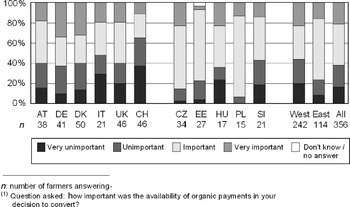
Asked about the importance of the availability of organic farming payments in their decision to convert, farmers from the West and the East who received such payments when they converted gave different responses. At least 56% of the Western European farmers felt that organic farming payments had been important or very important, compared with 76% of their Eastern European counterparts (Fig. 2). In the West, the proportion of farmers describing organic farming payments as being either unimportant or very unimportant in their move towards conversion was highest in Switzerland (65%) and lowest in Germany (37%). Among Eastern European farmers, organic payments were felt to be most important by Polish farmers (93%) in the decision to convert. In Poland organic farming payments were the only area payment available to farmers before accession.
Farmers' assessment of the importance of the availability of organic payments in their decision to convert(1).

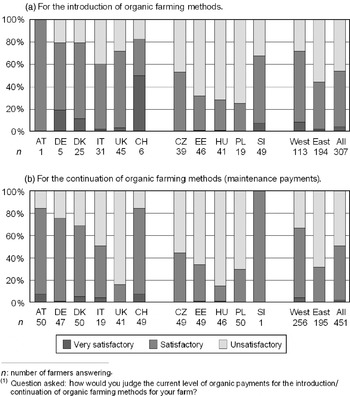
Assessment of current levels of support to organic farming was mixed, with approximately half of farmers saying that it was ‘satisfactory’ or even ‘very satisfactory’, and the other half registering dissatisfaction (Fig. 3). Particularly with regard to this question, strategic responses could be expected on the grounds that assessing payment levels as being too low might help foster an increase in, or at least a continuation of, current payment levels. Thus, the high overall level of satisfaction with actual payments (56%) is remarkable. With the exception of the UK, where maintenance payments are much lower than those for conversion, there were no large differences between evaluation of payment levels for the introduction and maintenance of organic farming. There are, however, considerable differences between countries. In general, farmers in Western Europe appear to be more satisfied than those in the new member states, where low approval ratings with respect to payment levels prevail, especially in Estonia, Poland and Hungary. However, these results were obtained from a survey conducted in early 2004, before EU accession of the Eastern European countries and before the increase of organic farming payments.
Farmers' assessment of the current level of organic payments(1).

Farms' Dependency on Organic Farming Payments
This section will analyze the relevance of organic farming payments according to different farm types and time periods. For organic farms in Western European countries, time series data from national FADNs were analyzed, enabling the impacts of different policy decisions and economic circumstances to be described. In the Eastern European study countries, analyses are based on typical farm modeling and concentrate on a comparison of the situation before and after EU accession.
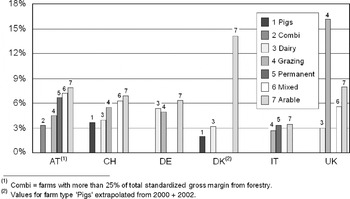
Generally, the indicators for policy dependency show great variation between farms. This depends not only on the payments received, but also on the respective levels of gross output and profits which, in turn, vary with farm type and size (Table 3, Figs. 4 and 5, and Table 4).
Share of extra payments for organic farming in gross output by farm type in the selected Western European countries, 2001.

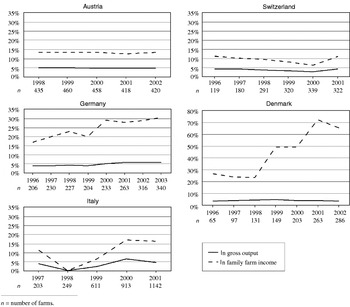
Development of the share of extra payments for organic farming in gross output and FFI in the selected Western European countries, all farms.

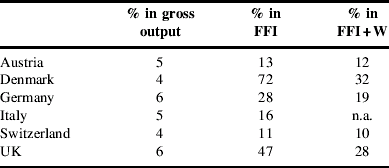
Share of extra payments for organic farming in gross output, FFI and FFI+W in selected Western European countries, 2001.
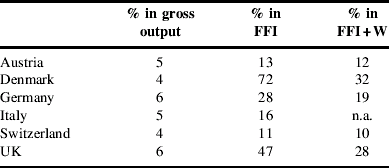
Source: own calculations based on national FADNs.
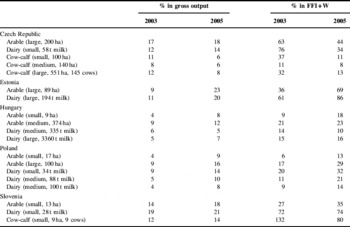
Share of organic farming payments in gross output and in FFI+W in selected Eastern European countries, 2003 and 2005.

Source: own calculations based on typical farm modeling.
Consequently, a generalized comparison can only be made between Western European countries, where the large farm samples from FADNs allow aggregation. Table 3 provides an overview of the importance of the extra payments for organic farming in these countries, measured as the contribution to gross output. In some countries, even though the absolute level of specific support to organic farms is highReference Tuson and Lampkin4, the relative preference for organic agriculture is low and remarkably similar across countries, ranging from 4% in Denmark to 6% in the UK. This is because of the existence of other agri-environmental programmes with high payment levels, for which organic farms would be eligible if the specific organic support measures did not exist. However, if measured as a percentage of FFI, the importance of specific support to organic farming is high in Germany, and very high in the UK and Denmark, highlighting the vulnerability of the organic farms in these samples to changes in specific support policies.
The ranking of farm types according to the share of extra support payments for organic farming in gross output is remarkably similar in all Western countries (Fig. 4). The only exception is the very high value for organic grazing livestock farms in the UK, which is a result of the comparatively low level of gross output on these farms while, at the same time, the level of agri-environmental payments is relatively high due to the combination of those from the Organic Farming Scheme and other agri-environmental schemes. The contribution of such support to gross output is highest for arable farms, due partly to the fact that the participation of conventional arable farms in agri-environmental programmes is still the exception. In combination with the approach chosen in this study to approximate the extra value of organic support programmes, this leads to high values. Where non-organic agri-environmental programmes support the extensification of arable farming, the relevance of specific support to organic arable farming in the respective regions will be correspondingly reduced. The importance of extra support payments for organic farming is lowest for the pig farms, highlighting the high degree of market-orientation of organic pig production.
For Western European countries, analysis of the historical development of the importance of specific support payments for organic farming was possible, based on national FADN data for several years. According to the results given in Figure 5, the share of extra payments for organic farming in gross output and FFI in Austria is comparatively stable for the years 1998–2002, reflecting the continuity of support policies and sample composition. The share of specific support in gross output even decreases slightly. In Switzerland, the importance of specific support payments declines until 2000, reflecting the continuously improving market situation for organic products since the beginning of the 1990s, and an increasing share of market revenues in total output. In 2001, the share of extra support payments increased, as the level of support payments for organic farming was raised. In Germany, the importance of support has been growing significantly over the years, reflecting increased payment rates for organic farming within the agri-environmental programmes. In Denmark, the share of payments in gross output remains stable, while the contribution to FFI rises quite dramatically over the period. This development is due to the decline in average FFI over the years. In Italy, the time series data reveal a drop to zero in the share of extra payments for organic farming in 1998. This can be attributed to the difficulties experienced by many farms with respect to the transition from the first five-year contracts, according to the EU Regulation (EEC) 2078/92, to new contracts. The importance of specific organic farming support in farm performance has been increasing since then.
The focus of analysis for the Eastern European countries is the significance of payments before and after accession to the EU. Organic farming payments accounted for 4–19% of gross output in the selected new member states before accession (Table 4). There are large differences between countries, however, the share being notably lowest in Poland, corresponding to low organic area payments for arable and grassland. On almost all typical farms, the share of organic farming payments in gross output increased after accession.
There are some typical farms, particularly in the Czech Republic where the importance of organic farming payments to total farm returns decreases over the time period under consideration. The reason is a marked increase in direct payments other than those for organic farming, in the course of the adoption of the CAP. The declining relevance of organic payments is thus a relative, rather than an absolute, phenomenon. By 2005, the significance of organic payments in the gross output of Polish farms is about as high as that of other countries. Looking at the share of such payments in farm profit (FFI+W), it is clear that many typical organic farms were already highly vulnerable to changes in organic farming policy before accession. This holds true particularly for organic farms in the Czech Republic, Estonia and Slovenia. Following EU accession and higher payment rates, there is increasing vulnerability to policy changes on farms in Estonia, Hungary and Poland. In the Czech Republic and Slovenia, changes in vulnerability to organic farming policy depend on farm type.
In discussing these results, changes in overall agricultural policy caused by the adoption of the CAP must be stressed (for background information seeReference Gay, Osterburg, Baldock and Zdanowicz18–Reference Popp, Brosig and Hockmann20); other than organic farming, direct payments increased more than organic payments in all of the typical farms after EU accession, and thus their relevance for the economic success of typical organic farmsReference Nieberg, Offermann and Zander17.
Discussion and Conclusions
The results show that organic farming payments are important in all European study countries and that policy dependency has increased over recent years. Generally, the degree of policy dependency in the Eastern countries (Table 4) is equal to or higher than that observed in the Western countries (Table 3) even before accession to the EU and this is reflected in farmers' assessment of the significance of organic farming payments for the economic viability of their farms (Fig. 1).
However, these findings put the level of specific support for organic farming into perspective, as other support payments and market returns contribute larger shares to total farm revenue in all the countries analyzed. In this respect, a further important outcome is confirmation that high organic payment levels do not, automatically, imply a strong preference for this farming system. Particularly in the Western European countries, there are often attractive, competitive and non-organic schemes within agri-environmental programmes which reduce the incentive for conversion. Looking at the future, organic farming payments will continue to play an important role in the profitability of organic farms in Western Europe after implementation of the 2003 CAP reforms. In the East, the importance of organic farming payments is likely to remain at a high level, as long as organic farming payment rates remain unchanged.
The different development of payments and costs in the countries analyzed is likely to affect the international competitiveness of organic farms. Future organic market shares could therefore be distributed quite differently, in comparison with today. There still remain marked differences in absolute levels of support—referring not only to organic farming payments—for organic farms in different countries, which may significantly influence the competitiveness of organic farms on the international markets. Higher payments may foster investment in production technology, thus improving productivity and also, perhaps, quality; therefore, those organic farms benefiting from more generous support will be able to gain market shares at the international level. Additionally, farmers receiving relatively high payments might possibly be able to offer their products at lower prices.
Nevertheless, it must be stressed that organic farming payments are granted to organic farmers because they offer environmental services to society. These services amount to positive external effects (e.g., protection of water, biodiversity)Reference Stolze, Piorr, Häring and Dabbert21–Reference Hole, Perkins, Wilson, Alexander, Grice and Evans25 compared with mainstream agriculture. Different payment rates between countries may reflect different social priorities, and could be argued to be the consequence of variations in the value placed on environmental goods by different countries. An argument therefore exists for treating the varying organic farming payments as a consequence of different socio-economic conditions, and for accepting them in the same way as, for example, different wage levels.
Future support for organic farms is likely to be different from today, although the direction of change is far from certain. On the one hand, continuing CAP reform, intended to strengthen sustainability and the second pillar of the CAP, will offer a wider range of opportunities to support organic farming. On the other hand, whether these opportunities will be matched by corresponding funds or not is an open question; despite modulation, cash-strapped public finances may prevent a more widespread support of organic farming via the second pillar.
Improvement of the economic situation on organic farms in the new member states will give farmers the opportunity to invest in production technology and to catch up with their Western colleagues with respect to quality standards. However, in the face of ongoing discussions concerning support payments, farmers run a high risk when undertaking far-reaching investments. Rather than merely relying on area support, policy should supplement organic farming area payments with a mix of additional support, including measures for the improvement of processing and marketing facilities, the support of farm cooperation and for enhancing demand.
Acknowledgements
The work underlying this paper has been carried out with financial support from the Commission of the European Community under Key Action 5 of the Fifth Framework Research and Technological Development Programme for the project ‘Further Development of Organic Farming Policy in Europe, with Particular Emphasis on EU Enlargement’. We are grateful for this support. This paper does not necessarily reflect the views of the European Commission, and in no way anticipates the Commission's future policy in this area. Its content is the sole responsibility of the authors. We are grateful to two anonymous referees for their helpful comments.