Introduction
Acute administration of cannabis or Δ-9-tetrahydrocannabinol (THC) can produce transient psychotic-like effects in occasional and frequent cannabis users, and in patients with schizophrenia (D'Souza et al., Reference D'Souza, Perry, MacDougall, Ammerman, Cooper, Wu and Krystal2004; D'Souza et al., Reference D'Souza, Abi-Saab, Madonick, Forselius-Bielen, Doersch, Braley and Krystal2005; Morgan, Schafer, Freeman, & Curran, Reference Morgan, Schafer, Freeman and Curran2010; Morrison et al., Reference Morrison, Zois, McKeown, Lee, Holt, Powell and Murray2009). Previous work has also shown that THC leads to altered binocular depth inversion (Leweke, Schneider, Thies, Münte, & Emrich, Reference Leweke, Schneider, Thies, Münte and Emrich1999), a visual illusion shown to be impaired in patients with psychosis (Schmeider, Leweke, Sternemann, Emrich, & Weber, Reference Schmeider, Leweke, Sternemann, Emrich and Weber1996), but whether cannabis leads to auditory speech illusion is unknown.
The white noise (WN) task was developed by Galdos and colleagues to investigate the experience of speech illusion in patients with psychosis (Galdos et al., Reference Galdos, Simons, Fernandez-Rivas, Wichers, Peralta, Lataster and Gonzalez-Torres2011). The task aims to provoke the experience of hearing speech in neutral random auditory signals (WN), in the absence of actual speech (i.e. speech illusion). Higher incidence of speech illusion has been found in patients with schizophrenia (Catalan et al., Reference Catalan, Simons, Bustamante, Drukker, Madrazo, de Artaza and Gonzalez-Torres2014; Galdos et al., Reference Galdos, Simons, Fernandez-Rivas, Wichers, Peralta, Lataster and Gonzalez-Torres2011) and those with familial-vulnerability (Galdos et al., Reference Galdos, Simons, Fernandez-Rivas, Wichers, Peralta, Lataster and Gonzalez-Torres2011). Speech illusion is also associated with positive psychotic symptoms in patients (Catalan et al., Reference Catalan, Simons, Bustamante, Drukker, Madrazo, de Artaza and Gonzalez-Torres2014) and children (Rimvall et al., Reference Rimvall, Clemmensen, Munkholm, Rask, Larsen, Skovgaard and Jeppesen2016) but not in a non-clinical adult sample (Schepers, van Os, & Lousberg, Reference Schepers, van Os and Lousberg2019), and may (Galdos et al., Reference Galdos, Simons, Fernandez-Rivas, Wichers, Peralta, Lataster and Gonzalez-Torres2011) or may not (Catalan et al., Reference Catalan, Simons, Bustamante, Drukker, Madrazo, de Artaza and Gonzalez-Torres2014) be related to positive schizotypy in non-clinical populations.
The mechanisms through which acute psychotic-like effects of cannabis occur and which factors predict vulnerability remain unclear. Two factors which may influence psychotic-like effects are cannabidiol (CBD) and adolescence. A recent systematic review of controlled cannabinoid administration studies found evidence that CBD moderates effects of THC across a broad range of outcomes (Freeman et al., Reference Freeman, Petrilli, Lees, Hindocha, Mokrysz, Curran and Freeman2019), however, there are contrasting results to date regarding whether CBD has a protective role specifically against psychotic-like symptoms. Englund et al. (Reference Englund, Morrison, Nottage, Hague, Kane, Bonaccorso and Holt2013) demonstrated an oral dose of CBD prior to intravenous THC reduced the incidence of clinically significant increases in psychotic-like symptoms (Englund et al., Reference Englund, Morrison, Nottage, Hague, Kane, Bonaccorso and Holt2013). Moreover, Leweke and colleagues found oral CBD somewhat reduced effects of nabilone (a synthetic THC analogue) on binocular depth inversion (Leweke, Schneider, Radwan, Schmidt, & Emrich, Reference Leweke, Schneider, Radwan, Schmidt and Emrich2000). In contrast, no effect of CBD on psychotic-like effects was found when inhaled via a vaporiser with THC (Morgan et al., Reference Morgan, Freeman, Hindocha, Schafer, Gardner and Curran2018). Further, in a naturalistic study in which participants smoked their own cannabis, Morgan and colleagues found no association between CBD content of the cannabis and psychotic-like effects (Morgan et al., Reference Morgan, Schafer, Freeman and Curran2010). There is also evidence to suggest CBD may be protective against negative effects of cannabis in the long-term, for instance, cannabis users with traces of CBD in their hair (indicating use of cannabis containing CBD) were found to have lower off-drug psychotic-like symptoms relative to those without traces (Morgan et al., Reference Morgan, Gardener, Schafer, Swan, Demarchi, Freeman and Tan2012; Morgan & Curran, Reference Morgan and Curran2008).
While CBD may have a protective effect in the short- and long-term, younger age of cannabis use may confer heightened vulnerability to psychotic symptoms and disorder (Arseneault et al., Reference Arseneault, Cannon, Poulton, Murray, Caspi and Moffitt2002; Konings, Henquet, Maharajh, Hutchinson, & Van Os, Reference Konings, Henquet, Maharajh, Hutchinson and Van Os2008; Stefanis et al., Reference Stefanis, Delespaul, Henquet, Bakoula, Stefanis and Van Os2004). Whether adolescents are at increased risk of acute psychotic-like effects remains unclear. A mixed picture emerges from preclinical work, with some demonstrating heightened acute effects of cannabinoids on learning and recognition in adolescent rodents compared to adult (Acheson, Moore, Kuhn, Wilson, & Swartzwelder, Reference Acheson, Moore, Kuhn, Wilson and Swartzwelder2011; Cha, Jones, Kuhn, Wilson, & Swartzwelder, Reference Cha, Jones, Kuhn, Wilson and Swartzwelder2007; Cha, White, Kuhn, Wilson, & Swartzwelder, Reference Cha, White, Kuhn, Wilson and Swartzwelder2006; Fox, Sterling, & Van Bockstaele, Reference Fox, Sterling and Van Bockstaele2009; Schneider, Schömig, & Leweke, Reference Schneider, Schömig and Leweke2008). To our knowledge, no studies have investigated acute effects of cannabinoids in adolescent animals on psychotic-related behaviour, such as prepulse inhibition, and chronic administration studies have had very mixed results (Rubino & Parolaro, Reference Rubino and Parolaro2016). Previously we reported blunted acute psychotic-like effects in adolescents (in the same sample as described in study 2 below), but whether acute effects on speech illusion are moderated by younger age has not been reported.
In the present paper, we describe two studies, in which we test the hypothesis of whether cannabis increases the incidence of speech illusion, in healthy individuals who use cannabis. Additionally, the studies individually investigate whether two factors – CBD and adolescence – influence the acute psychotic-like and speech illusion effects of cannabis: Study 1 additionally investigates the hypothesis that higher levels of CBD in cannabis can offset the psychotic-like and speech illusion effects of cannabis; Study 2 additionally investigates the hypothesis that adolescents are more vulnerable to the psychotic-like and speech illusion effects of cannabis than adults.
Methods
Study 1
Design and participants
A within-subjects, double-blind, cross-over design was used to compare acute effects of (i) cannabis with high levels of THC and negligible levels of CBD (Cann-CBD), (ii) cannabis with high levels of THC and high levels of CBD (Cann+CBD), and (iii) placebo cannabis, on adult cannabis users. Drug order was randomised within gender [for further details see (Lawn et al., Reference Lawn, Freeman, Pope, Joye, Harvey, Hindocha and Curran2016)].
We recruited adult cannabis users through word-of-mouth. The following inclusion criteria were assessed at telephone screening: aged between 18 and 70 years; current cannabis use 3 days/week or fewer; have smoked cannabis 4 or more times in the past year; alcohol use on fewer than 5 days per week; no other illicit drug use more than 2 times per month, no current or history of psychosis; no MRI contraindications, right-handed (for additional fMRI assessments). Participants were asked to remain abstinent from all drugs including alcohol (but not cigarettes) for 24 h before each testing session.
The study was approved by the UCL Research Ethics Committee. All participants provided written informed consent. Participants were reimbursed for their time (£7.50 per hour).
Drug administration
Medicinal-grade cannabis (Bedrobinol®, THC 12.0% CBD <0.1%; Bediol®; THC 6% CBD 7.5%) and placebo (THC <0.3% CBD <1%) cannabis were administered. Active and placebo cannabis types contained terpenes, providing the distinctive taste and smell of cannabis, and active types may contain low levels of other cannabinoids. On each session participants received one of the following: (1) Cann-CBD: 66.7 mg of Bedrobinol® plus 66.7 mg of placebo (equivalent to approximately 8.0 mg THC and 0.0 mg CBD); (2) Cann+CBD: 133.4 mg of Bediol® (approximately 8.0 mg THC and 10.0 mg CBD); (3) Placebo: 134.4 mg placebo; followed by a 50% top-up dose (for Cann-CBD the top-up was equivalent to 4.0 mg THC and 0.0 mg; for Cann+CBD the top-up was equivalent to 4.0 mg THC and 5.0 mg CBD), approximately 120 min later. The top-dose was provided due to the long duration of the session, so as to maintain steady drug and intoxication levels throughout.
The THC dose corresponds to that contained in a quarter of a typical UK joint (Freeman et al., Reference Freeman, Morgan, Hindocha, Schafer, Das and Curran2014). Doses were chosen according to previous vaporised THC/CBD studies (Bossong et al., Reference Bossong, van Berckel, Boellaard, Zuurman, Schuit, Windhorst and Kahn2009; Hindocha et al., Reference Hindocha, Freeman, Schafer, Gardener, Das, Morgan and Curran2015), consideration of the typical 1:1 ratio of THC:CBD seen in UK hash (Hardwick & King, Reference Hardwick, King and H2008), and product potencies available from Bedrocan®. As reported elsewhere, active drug administration resulted in reliable increases in participant ratings of feeling ‘stoned’, with no difference between Cann-CBD and Cann+CBD conditions, and no difference between ratings provided immediately following the initial dose and those provided immediately following the top-up dose (Lawn et al., Reference Lawn, Freeman, Pope, Joye, Harvey, Hindocha and Curran2016).
The drug was administered via Volcano Medic vaporiser (Storz and Bickel GmbH & Co., Germany), operating at 210 °C, according to a previously described protocol of dosing and drug administration (Lawn et al., Reference Lawn, Freeman, Pope, Joye, Harvey, Hindocha and Curran2016).
Measures
Demographics
Age in years and gender were self-reported at screening.
Baseline questionnaires
Depression and anxiety were assessed with the Beck Depression Inventory (BDI-II) (Beck, Steer, & Brown, Reference Beck, Steer and Brown1996) and Beck Anxiety Inventory (BAI) (Beck, Epstein, Brown, & Steer, Reference Beck, Epstein, Brown and Steer1988). Schizotypy was assessed with the Schizotypal Personality Questionnaire (SPQ) (Raine, Reference Raine1991) (Vollema & Hoijtink, Reference Vollema and Hoijtink2000).
Cannabis use
A structured interview recorded: lifetime use (yes/no); time since last use (days); duration of use (years); frequency (days/month). Instant urine drug screens assessed for the presence of THC, as an indicator of recent cannabis use.
Psychotic-like symptoms
Participants completed the Psychotomimetic States Inventory (PSI), a self-report questionnaire sensitive to the acute psychotic-like effects of cannabis (Mason, Morgan, Stefanovic, & Curran, Reference Mason, Morgan, Stefanovic and Curran2008).
White noise task
The WN task provokes the experience of hearing speech in WN in the absence of actual speech (i.e. provokes speech illusion).
The task was delivered via E-prime 1.1. (Psychology Software Tools, Pittsburgh, Pennsylvania), and was kindly provided by Galdos and colleagues (Galdos et al., Reference Galdos, Simons, Fernandez-Rivas, Wichers, Peralta, Lataster and Gonzalez-Torres2011).
Participants were presented (via headphones) with one of three auditory stimuli types, sequentially in a randomised order. Stimuli were fragments of either:
• WN-only;
• WN plus clearly audible speech (WN simultaneously overlaid with clear speech);
• WN plus barely audible speech (WN simultaneously overlaid with barely audible speech).
There were 25 trials for each of the stimuli, resulting in a total of 75 trials. Following each fragment participants indicated their opinion about what they just heard, selecting one of the following responses reflecting whether they heard speech or not and whether the speech had positive, negative or neutral emotional valence (numbers refer to required keyboard response); 1 = ‘I heard something positive’, 2 = ‘I heard something negative’, 3 = ‘I heard something neutral’, 4 = ‘I heard nothing’, 5 = ‘Don't know’. Reminders of the response options and associated statements appeared on screen following each clip, until the participant responded (no time limit). The incidence of reporting speech heard (i.e. keyboard response 1, 2 or 3) on the WN-only trials was the key variable of interest. Responses on trials containing WN plus clearly or barely audible speech were presented only to create an expectancy of hearing speech, aiming to increase the likelihood of hearing speech on WN-only trials. The original fragments from (Galdos et al., Reference Galdos, Simons, Fernandez-Rivas, Wichers, Peralta, Lataster and Gonzalez-Torres2011) were shortened to a duration of 1 s, with the aim of increasing uncertainty in the task and thus increasing the base-rate of experiencing speech illusion.
Procedure
Following screening, participants attended a baseline session during which they provided informed consent, completed baseline measures, and drug histories.
Participants then completed three test sessions separated by at least 7 days. Participants first provided a urine sample for an instant drug screen and for females a pregnancy test. Cann-CBD, Cann+CBD or placebo was then administered. Participants next completed an MRI scanning session for 1 h [findings reported elsewhere (Freeman et al., Reference Freeman, Pope, Wall, Bisby, Luijten, Hindocha and Bloomfield2017; Lawn et al., Reference Lawn, Freeman, Pope, Joye, Harvey, Hindocha and Curran2016)], followed by a top-up drug administration. Participants then completed the WN task and PSI. Subjective intoxication ratings for ‘Stoned’ were collected throughout the test sessions, with data reported elsewhere (Lawn et al., Reference Lawn, Freeman, Pope, Joye, Harvey, Hindocha and Curran2016).
Study 2
Design and participants
A mixed within- and between-subjects, double-blind, cross-over design was used to compare acute effects of Cann-CBD and placebo cannabis in adult and adolescent cannabis users. Drug order was randomised within each age group.
We recruited 20 adolescent (aged 16–17 years) and 20 adult (24–28 years) male cannabis users, via local and online (social media) advertising and word-of-mouth. The following inclusion criteria were assessed at telephone screening: male sex; current cannabis use between 1 and 3 days per week; at least 6 months of regular (at least once per week) cannabis use; no extended period (>1 month) of daily use; no other illicit drug was used more than twice per month; no current mental health problem or history (personal or immediate family) of psychosis-related disorders; healthy-range body mass index and blood pressure (BP). Participants were asked to remain abstinent from all drugs including alcohol but not cigarettes for 24 h before each testing session.
The study was approved by UCL Research Ethics Committee. All participants provided written informed consent. Participants were reimbursed for their time (£7.50 per hour).
Drug administration
Medicinal-grade cannabis (Bedrobinol®; THC 12.0% CBD <0.1%) and placebo (THC <0.3% CBD <1%) cannabis were administered. As detailed elsewhere (Mokrysz, Freeman, Korkki, Griffiths, & Curran, Reference Mokrysz, Freeman, Korkki, Griffiths and Curran2016), on each session participants received either (1) Cann-CBD: 0.89 mg/kg of Bedrobinol® (equivalent to approximately 8.0 mg THC and 0.0 mg CBD for an individual weighing 75 kg); or (2) Placebo: 66.7 mg of placebo. No top-up dose was administered in study 2, due to a shorter overall testing session. THC dose was chosen to correspond with that of study 1, though weight-adjusted due to expected age group differences in body weight.
Drug was administered via Volcano Medic vaporiser (Storz and Bickel GmbH & Co., Germany), operating at 210 °C, according to a similar protocol to study 1 and which is previously described (Mokrysz et al., Reference Mokrysz, Freeman, Korkki, Griffiths and Curran2016).
Measures
All measures were the same as for study 1, though additionally participants were weighed at baseline as cannabis dose was weight-adjusted. PSI data from this sample have been previously published elsewhere (Mokrysz et al., Reference Mokrysz, Freeman, Korkki, Griffiths and Curran2016), but are presented again here for consistency with study 1.
Procedure
Following screening, participants attended a baseline session during which they provided informed consent, completed baseline measures, and drug histories.
Participants then completed two test sessions separated by at least 7 days. Participants first provided a urine sample for an instant drug screen. Cann-CBD or placebo was then administered. A task battery was then completed, including the WN task and PSI. Subjective intoxication ratings for ‘Stoned’ were also collected throughout the test sessions, with data reported elsewhere (Mokrysz et al., Reference Mokrysz, Freeman, Korkki, Griffiths and Curran2016).
Statistical analysis
All analyses were conducted with SPSS 24.0. Outliers and normality were assessed via diagnostic plots for all analyses.
White noise
Generalised estimating equation (GEE) models were used to assess the odds of experiencing speech illusion after placebo and cannabis. The dichotomous outcome was speech illusion (did or did not experience speech illusion), modelled using a binary logistic distribution. We used an unstructured working correlation matrix. Following previous work, a participant was defined as experiencing speech illusion if they reported hearing speech on at least two out of 25 WN-only trials (Catalan et al., Reference Catalan, Simons, Bustamante, Drukker, Madrazo, de Artaza and Gonzalez-Torres2014; Rimvall et al., Reference Rimvall, Clemmensen, Munkholm, Rask, Larsen, Skovgaard and Jeppesen2016). This cut-off ensured our outcome was sensitive to subtle increases in the propensity to experience speech illusion, and allows for comparison with previous work.
Study 1
For Study 1, the GEE model (Model 1) included the main effect of drug (placebo, Cann-CBD, Cann+CBD), with Cann-CBD as the reference category. The categories of drug were coded as placebo = 1, Cann+CBD = 2, Cann-CBD = 3.
Study 2
For Study 2, two GEE models were tested. The initial model (Model 2a) included main effects of drug (placebo, Cann-CBD) and age group (adolescent, adult), with the reference categories of Cann-CBD and adult. The second model (Model 2b) included both main effects and the interaction of drug × group. The categories of drug were coded as placebo = 0, Cann-CBD = 1. The categories of age were coded as adolescent = 1, adult = 2.
Other analyses
Repeated measures ANOVA was conducted for PSI, with the within-subjects factors of drug (for study 1: placebo, Cann-CBD, Cann+CBD; for study 2: placebo, Cann-CBD) and subscale (thought distortion, perceptual distortion, anhedonia, cognitive disorganisation, manic experience, paranoia), and for study 2 additionally the between-subjects factor of age group (adolescent, adult). For study 2, Mann–Whitney or χ2 analyses were conducted as appropriate to compare groups (adolescent, adult) on demographic and baseline measures. All interactions were explored via pairwise comparisons.
Results
Study 1
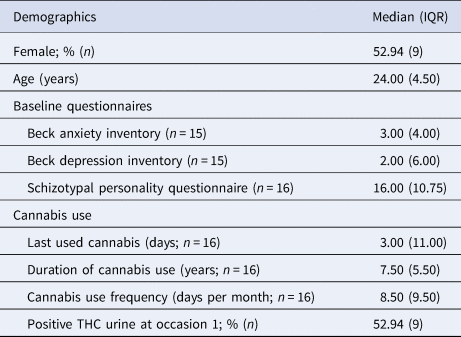
Demographic and baseline data are displayed in Table 1. The 17 participants (nine female) had a median age of 24.0 years. The median duration of cannabis use was 7.5 years. Participants reported cannabis use on a median of 8.5 days per month and a median time since last use of 3.0 days, with 52.9% testing positive for THC at occasion 1.
Demographic and baseline variables for Study 1 participants; values reflect median (interquartile range, IQR) unless otherwise stated

White noise task
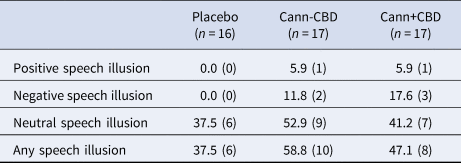
Incidence of speech illusion on placebo, Cann-CBD and Cann+CBD are displayed in Table 2.
Study 1 incidence % (n) of speech illusion on placebo, Cann-CBD and Cann+CBD

Due to technical error, one participant's data was missing for placebo.
Drug did not predict the experience of speech illusion in Model 1 (p = 0.348). Relative to Cann-CBD, placebo did not lead to a lower odds of experiencing speech illusion (b = −0.945, s.e. = 0.680, OR = 0.389, p = 0.164, 95% CIs 0.102–1.473), nor did Cann+CBD (b = −0.474, s.e. = 0.667, OR = 0.622, p = 0.477, 95% CIs 0.168–2.301). Additional model details are presented in online Supplementary Table S1.
Psychotic-like symptoms
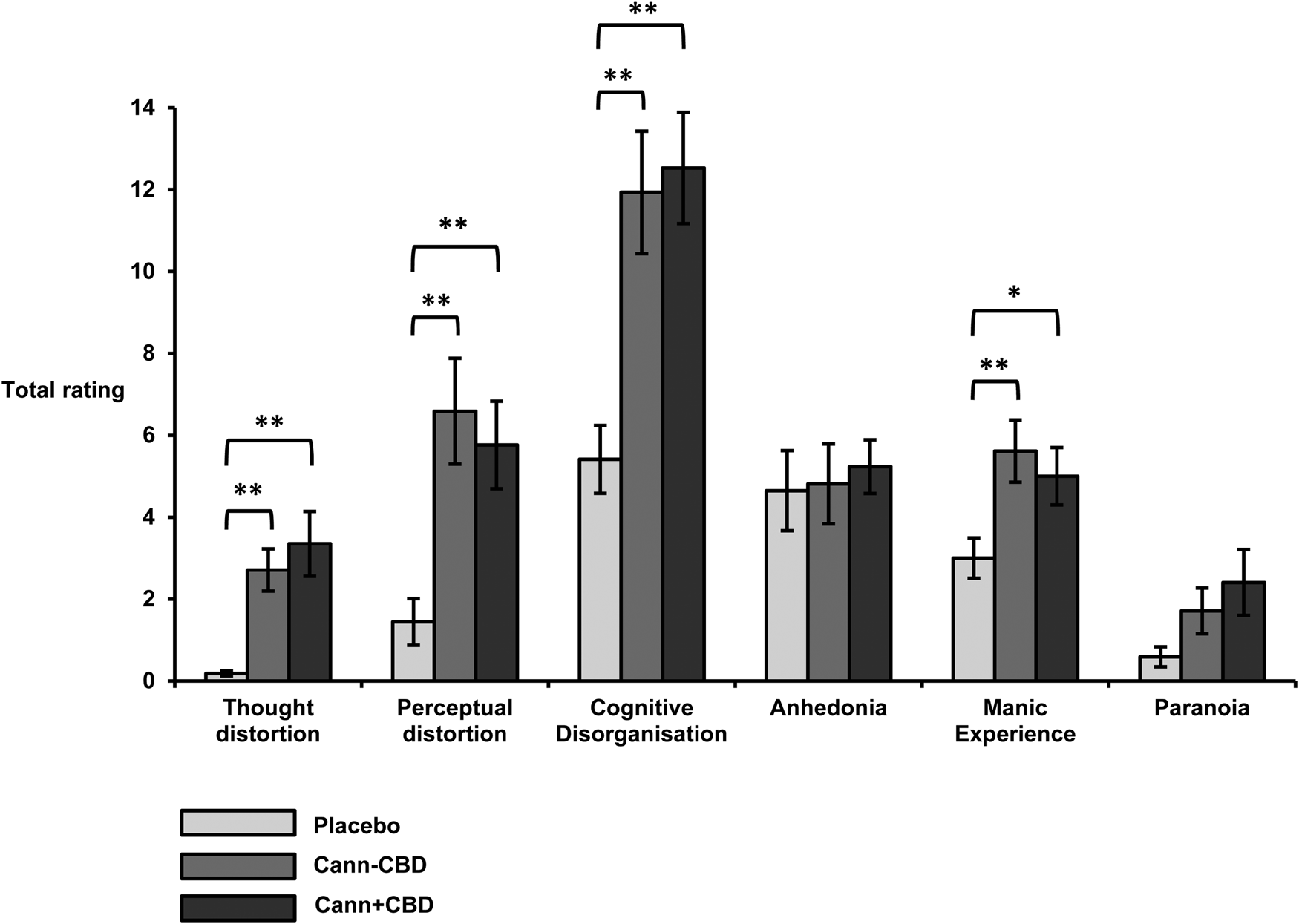
PSI (Fig. 1)
Study 1 mean (s.e.) values for total ratings of each subscale of the Psychotomimetic States Inventory (PSI), on placebo, Cann-CBD and Cann + CBD; * p < 0.05; ** p < 0.01.

There was an interaction of drug × subscale (F 4,69 = 6.195, p < 0.001, η 2p = 0.28). Compared to placebo ratings were higher on both Cann-CBD and Cann + CBD for the subscales of thought distortion (p < 0.001 and p = 0.002), perceptual distortion (p = 0.001 and p = 0.003), cognitive disorganisation (p = 0.001 and p < 0.001) and manic experiences (p = 0.002 and p = 0.032). There were no differences between placebo and Cann-CBD or Cann+CBD for anhedonia or paranoia (all ps ⩾ 0.107). There were no differences between Cann-CBD and Cann+CBD on any of the subscales (all ps ⩾ 0.824). There were also main effects of drug (F 2,32 = 15.804, p < 0.001, η 2p = 0.50) and subscale (F 3,47 = 38.757, p < 0.001, η 2p = 0.71).
Speech illusion and perceptual distortion
To investigate whether self-rated perceptual distortion was associated with the experience of speech illusion following cannabis, we conducted a series of logistic regressions. The perceptual distortion subscale of the PSI did not predict increased odds of speech illusion following Cann-CBD (b = −0.068, s.e. = 0.102, OR = 1.070, p = 0.503) or Cann + CBD (b = 0.151, s.e. = 0.127, OR = 1.162, p = 0.236).
Study 2
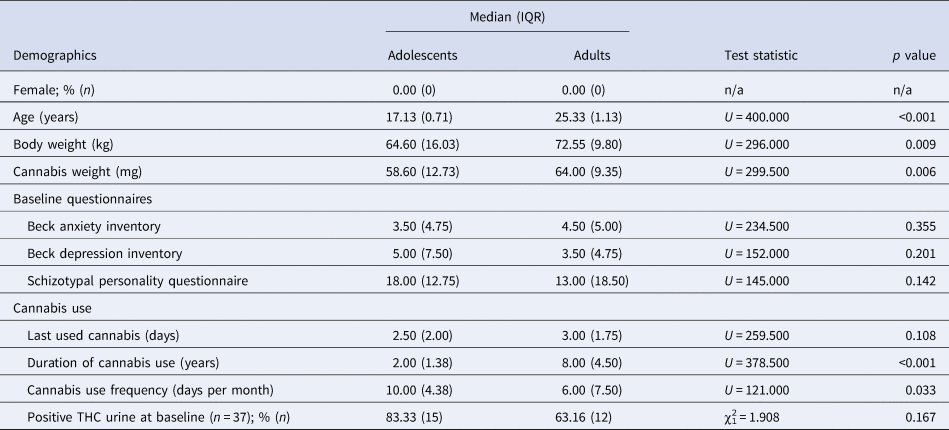
Demographic and baseline data are displayed in Table 3. Adolescents were younger and had a lower body weight. Groups did not differ on BAI, BDI-II or SPQ. Adolescents reported cannabis use on more days per month than the adults, while the adults had been using cannabis for longer than adolescents. Groups did not differ on time since last use or likelihood of a positive THC urine screen at baseline.
Demographic and baseline variables for Study 2 adolescents and adults; values reflect median (interquartile range, IQR) unless otherwise stated; p values reflect Mann–Whitney U test comparing median, or χ2 comparing frequency (as appropriate), by age group

White noise task
Incidence of speech illusion for adolescents and adults on placebo and Cann-CBD are displayed in Table 4.
Study 2 incidence % (n) of speech illusion on placebo and Cann-CBD, for adolescents and adults

Drug predicted the experience of speech illusion in Model 2a (p = 0.009). Relative to Cann-CBD, placebo led to lower odds of experiencing speech illusion (b = −1.128, s.e. = 0.433, OR = 0.324, p = 0.009, 95% CIs 0.139–0.757). This reflects a 3.1 times greater odds of experiencing speech illusion after taking Cann-CBD compared to placebo. Group did not predict the experience of speech illusion in Model 2a (p = 0.200). Relative to adults, adolescents did not have an increased odds of experiencing speech illusion (b = 0.680, s.e. = 0.531, OR = 1.975, p = 0.200, 95% CIs 0.698–5.586). There was no interaction of drug × group in Model 2b (p = 0.428). Additional model details are presented in online Supplementary Table S2.
Psychotic-like symptoms
PSI (Fig. 2)
Study 2 mean (s.e.) values for total ratings of each subscale of the Psychotomimetic Symptoms Inventory (PSI), for adolescents and adults on placebo and Cann-CBD; ** p < 0.001.
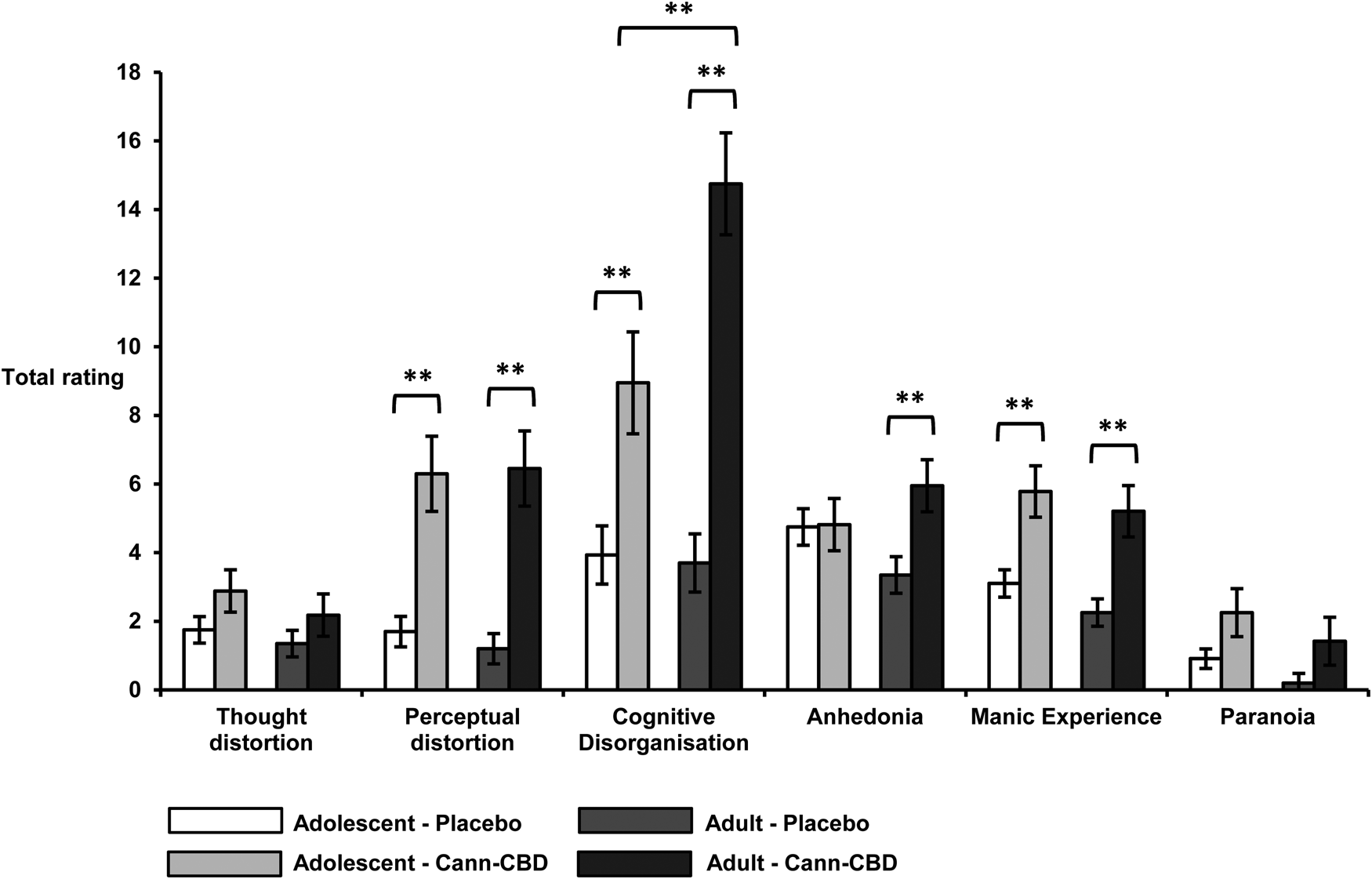
There were interactions of drug × subscale × group (F 5,190 = 6.114, p < 0.001, η 2p = 0.14), subscale × group (F 5,190 = 4.768, p < 0.001, η 2p = 0.11) and drug × subscale (F 3,132 = 31.762, p < 0.001, η 2p = 0.46). Neither group had greater thought distortion or paranoia following Cann-CBD compared to placebo (all p's ⩾ 0.065, all η 2p ⩽ 0.09). Both groups had greater perceptual distortion, manic experience and cognitive disorganisation on Cann-CBD compared to placebo (all p's ⩽ 0.001, all η 2p ⩾ 0.27). On Cann-CBD adults reported greater cognitive disorganisation than adolescents (p = 0.009, η 2p = 0.17). Lastly, Cann-CBD increased anhedonia in adults (p = 0.001, η 2p = 0.25) but not adolescents (p = 0.925, η 2p < 0.01). Main effects of drug (F 1,38 = 57.871, p < 0.001, η 2p = 0.60) and subscale (F 3,114 = 55.961, p<0.001, η 2p = 0.60) also emerged.
Speech illusion and perceptual distortion
The perceptual distortion subscale of the PSI did not predict increased odds of speech illusion following Cann-CBD (b = 0.153, s.e. = 0.080, OR = 1.165, p = 0.057).
Correlations
Total and within-group correlations were conducted between variables showing baseline group differences (at p < 0.10; Table 3) and cannabis session variables for outcomes showing group differences: PSI total score, PSI cognitive disorganisation, and PSI anhedonia. No correlations were found, and as such baseline variables were not entered into models.
Discussion
Here we present two studies investigating whether inhaled cannabis can produce acute psychotic-like symptoms and speech illusion, in healthy individuals who use cannabis. As predicted, both studies demonstrated increased self-rated psychotic-like symptoms following cannabis administration relative to placebo. Our first study found no significant effect of cannabis on the incidence of speech illusion, while our second study found that the odds of speech illusion was three times higher after consuming cannabis relative to placebo. Notably, odds ratios were similar across both studies for the comparison between placebo and Cann-CBD, increasing confidence in a true effect of cannabis on speech illusion. Contrary to our additional hypotheses, however, in the first study, we found no evidence to suggest that concurrent CBD administration mitigated the impact of cannabis nor in the second study that adolescents show heightened acute effects of cannabis.
CBD and psychotic-like symptoms
In study 1, both Cann-CBD and Cann+CBD increased self-rated psychotic-like symptoms relative to placebo, but no differences between Cann-CBD and Cann+CBD were found. Additionally, no differences in the likelihood of speech illusion between placebo, Cann-CBD and Cann+CBD were found. Together with findings from a previous naturalistic study of users smoking their own cannabis (Morgan et al., Reference Morgan, Schafer, Freeman and Curran2010) and a previous controlled study comparing THC inhaled alone with THC inhaled with CBD (Morgan et al., Reference Morgan, Freeman, Hindocha, Schafer, Gardner and Curran2018), these findings suggest that CBD may not protect against acute psychotic-like effects of cannabis.
This conclusion is in contrast to previous work suggesting anti-psychotic properties of CBD in cannabis users. Englund et al. (Reference Englund, Morrison, Nottage, Hague, Kane, Bonaccorso and Holt2013) found CBD reduced clinically significant psychotic-like effects when administered orally prior to an IV dose of THC. Importantly, however, Englund et al. (Reference Englund, Morrison, Nottage, Hague, Kane, Bonaccorso and Holt2013) administered a considerably larger CBD dose (600 mg, orally) than the present study (approximately 10 mg, inhaled). Given different routes of administration, dosages are not directly comparable, however, it seems likely that Englund et al. (Reference Englund, Morrison, Nottage, Hague, Kane, Bonaccorso and Holt2013) will have achieved greater overall absorption of CBD and this may explain our contrasting findings. Future work should compare effects at different dosages and routes of administration, collecting plasma samples to assess drug absorption.
Adolescence and psychotic-like symptoms
In study 2, Cann-CBD increased self-rated psychotic-like symptoms and the incidence of speech illusion, relative to placebo. However, we found no difference between the age groups for the effect of Cann-CBD on speech illusion, but, as also previously reported in Mokrysz et al. (Reference Mokrysz, Freeman, Korkki, Griffiths and Curran2016), we found that adults experienced heightened effects on cognitive disorganisation and anhedonia. Contrary to predictions, therefore, we found increased vulnerability to acute psychotic-like effects of cannabis in adults rather than adolescents.
Whether heightened psychotic-like effects of cannabis in adolescents are causally related to their age is difficult to determine, and alternative explanations must be considered. Firstly, the adolescents on average received a lower dose of cannabis than the adults, since the dose was weight-adjusted and the adolescents on average had a lower body weight than the adults. It, therefore, is possible that blunted adolescent effects could be related to the lower dosage. Though, notably, we found no correlations between administered cannabis weight and psychotic-like symptoms from cannabis.
Secondly, there were baseline differences in cannabis use between adolescents and adults, including that the adolescents reported more frequent current cannabis use (10 v. 6 days per month). Past work has demonstrated blunted psychotic-like effects of THC in frequent relative to infrequent cannabis users (D'Souza et al., Reference D'Souza, Ranganathan, Braley, Gueorguieva, Zimolo, Cooper and Krystal2008). Blunted psychotic-like effects in the adolescents may, therefore, result from their heavier recent use, conferring greater tolerance to these effects. Importantly, however, there were no correlations between psychotic-like symptoms after consuming cannabis and any cannabis use indicators, including frequency of use. Alternatively, blunted psychotic-effects in the adolescents may instead reflect some innate resilience to these effects, due to underlying differences between the groups. Studies tracking acute effects of cannabis in the same individuals longitudinally would be beneficial to address this issue.
Strengths and limitations
Both studies have clear strengths in their use of randomised, placebo-controlled designs, administering known doses under laboratory conditions and via inhalation – an ecologically valid method of administration. Utilising the task-based measure of speech illusion allows a more objective assessment of psychotic-like effects of cannabis than previous studies reliant on self-rated questionnaires, though notably experiencing speech illusion after consuming cannabis was not associated with self-rated perceptual distortion in either study. The studies also had some limitations. Study 1 had a small sample size, which may account for different speech illusion results between studies. Study 2 included only males. The decision to include only one sex was based on evidence of sex differences in the timing of adolescent brain development, and evidence of the higher prevalence of both cannabis use and psychotic disorder in males (Ochoa, Usall, Cobo, Labad, & Kulkarni, Reference Ochoa, Usall, Cobo, Labad and Kulkarni2012). Future work must also focus on psychotic-like effects in females, given recent evidence of sex differences in acute physiological and subjective effects of cannabis (Crocker & Tibbo, Reference Crocker and Tibbo2018).
Finally, to reduce the risk of adverse events from drug administration, we excluded those with a personal or family history of psychosis. Psychotic-like effects of cannabis may be heightened in patients with a psychotic disorder (D'Souza et al., Reference D'Souza, Abi-Saab, Madonick, Forselius-Bielen, Doersch, Braley and Krystal2005) so our results may underestimate effects in individuals with these risk factors. Relatedly, in both studies, we recruited current cannabis users, rather than drug-naïve or ex-user populations, as we were specifically interested in effects and moderators in this ecologically relevant population. Given past evidence of blunted psychotic-like effects in frequent cannabis users (D'Souza et al., Reference D'Souza, Ranganathan, Braley, Gueorguieva, Zimolo, Cooper and Krystal2008), our results may underestimate effects in non-user populations.
Implications and conclusions
It has been suggested that increasing the amount of CBD present in cannabis may reduce potential harms associated with the use of the drug (Englund, Freeman, Murray, & McGuire, Reference Englund, Freeman, Murray and McGuire2017). However, results here do not appear to support the effectiveness of such a strategy in reducing acute psychotic-like effects of cannabis. Given opportunities for evidence-based regulation of cannabis products presented by global trends for cannabis legalisation, there is an urgent demand for well-powered studies using ecologically valid drug administration and a range of CBD doses to better understand the mixed findings to date.
In summary, we demonstrated that inhalation of cannabis can induce speech illusion in healthy individuals who use cannabis, though with contrasting findings across the two studies. We found no evidence that CBD reduces acute psychotic-like effects of cannabis. We also found no evidence that adolescents are more vulnerable to acute psychotic-like effects of cannabis. Indeed, no age group differences were apparent for the incidence of speech illusion, while adults reported heightened cognitive disorganisation and anhedonia effects of cannabis. Though, whether these findings are causally related to age cannot be determined. In conclusion, CBD did not blunt and adolescence did not heighten acute psychotic-like effects of cannabis.
Supplementary material
The supplementary material for this article can be found at https://doi.org/10.1017/S0033291720001038
Acknowledgements
Study 1 was funded by Drug Science, Channel 4 Television and the Beckley Foundation. Study 2 was funded by an MRC Studentship awarded to the first author.
Conflict of interest
None.
Ethical standards
The authors assert that all procedures contributing to this work comply with the ethical standards of the relevant national and institutional committees on human experimentation and with the Helsinki Declaration of 1975, as revised in 2008.