INTRODUCTION
Aphasia treatments traditionally have focused on linguistic, semantic, and pragmatic communication elements. Yet, intention and attention, basic functions supporting all cognition, also influence language (Crosson, 2000a, 2000b). They are affected in aphasia (e.g., Petry et al., 1994), interface with language in aphasia (McNeil & Doyle, 2000; Murray et al., 1997; Tseng et al., 1993), and can be manipulated to improve language performance (Anderson, 1996; Coslett, 1999; Coslett et al., 1993). We report a Phase 1 trial for chronic nonfluent aphasia comparing one treatment focused on intention and another focused on attention.
Intention is the ability to select one among several competing actions for execution and initiation of that action. Fuster (2003) referred to this construct as “executive attention.” Because intention regulates action, intention mechanisms are closely associated with frontal action systems (Heilman et al., 2003). Attention is the ability to select one source of information among multiple competing sources for further processing. Because attention regulates processing of incoming information, it is closely associated with posterior sensory cortices (Heilman et al., 2003). Intention and attention affect neural components within and between hemispheres that are engaged to perform an activity (e.g., Crosson et al., 2003). Limb (right, left), side of body (right, left), and direction of action (rightward, leftward) affect the hemisphere in which intention mechanisms are engaged. Side of body, head, and gaze midline in which stimuli occur affects the hemisphere in which attention mechanisms are engaged (Heilman et al., 2003).
Indeed, spatial attention affects language performance in some stroke patients. Coslett et al. (1993) described a patient with left temporoparietal and medial frontal lesions. On different language tasks (auditory comprehension, visual naming, oral reading, narrative production, and word fluency), that patient improved performance when stimuli were presented on his left, engaging attention in left hemispace, as opposed to when stimuli were on his right. Similarly, Anderson (1996) described an aphasia patient with left temporoparietal and right parietal infarcts who had difficulty canceling pictures representing objects named by an examiner when the pictures were on his right but not his left side. This problem was specific to linguistic input, because the patient successfully canceled pictures on both sides when targets were presented visually. Finally, Coslett (1999) found that stroke patients whose language improved when stimuli were moved into ipsilesional hemispace had parietal damage. The fact that these parietal lesions could be either left- or right-sided suggested that language performance was affected by attention deficits even when no aphasia was present.
Regarding intention, akinetic mutism, a syndrome in which little spoken language is initiated, was defined in the 1950s (Barris & Schuman, 1953; Nielsen & Jacobs, 1951). Lack of spontaneous behaviors in this syndrome indicates that it is a disorder of intention rather than of language per se. Medial frontal lesions cause akinetic mutism (Barris & Schuman, 1953; Jonas, 1981; Nielsen & Jacobs, 1951; Tijssen et al., 1984). During word generation, medial frontal activity precedes the left lateral frontal activity involved in language production (Abdullaev & Posner, 1998), supporting the concept that medial frontal cortex is involved in intention. Although lesion studies have not lent themselves to medial frontal localization, imaging studies indicate that pre-SMA is involved in complex hand movements and word generation (Picard & Strick, 1996). Whereas activity for complex hand movements and word generation differ in peak location within pre-SMA (Picard & Strick, 1996), evaluation of the full extent of left pre-SMA activity during word generation (e.g., Crosson et al., 1999, 2001, 2003) indicate that it overlaps with the region involved in complex hand movements. Pre-SMA is known to be connected to lateral prefrontal cortex (Picard & Strick, 1996). All of these facts suggest that it might be involved in engaging lateral frontal cortex during word generation.
Data from the Wada test (Kinsbourne, 1971) and aphasic patients whose language deteriorated after subsequent right-hemisphere lesion (Basso et al., 1989) indicate that the right hemisphere plays a role in language production for at least some chronic aphasia patients. Although good recoveries from acute aphasias generally appear driven by left-hemisphere activity, left hemisphere activity is less prominent or even absent in some brain regions in patients with significant and persistent aphasias (Heiss et al., 1997). In short, these data suggest that cortex of the left hemisphere may be inadequate to support substantial recovery of language production alone in patients with persistent aphasias and that some attention should be given to how to maximize right-hemisphere participation in the service of rehabilitation. This goal might involve encouraging a shift of production mechanisms to the right hemisphere, but it also could involve increasing the efficiency of right-hemisphere mechanisms already engaged in production. Regarding the latter, in preliminary studies for their rTMS study, Naeser et al. (2005) noted that inactivating right pars trangularis with rTMS improved naming accuracy and decreased naming latency but that inactivating right pars opercularis decreased naming accuracy and increased latency. Thus, selection of those right hemisphere mechanisms able to contribute and suppressing those that interfere could help optimize right-hemisphere participation in word production. Because selective engagement of the proper mechanisms for a task is a function of intention (Nadeau & Crosson, 1997), engaging right-hemisphere intention functions may be critical to rehabilitation in persistent aphasias. Specifically, given that pre-SMA areas governing intention for complex hand movements and word generation overlap to some degree (Picard & Strick, 1996), it might be possible to prime right pre-SMA activity during word generation with a complex left-hand movement, which in turn could lead to increased or more efficient engagement of right lateral frontal regions that contribute to word production in aphasia. Previous research showed that pairing left-hand symbolic gestures with picture naming led to improved naming, whereas neither symbolic gestures nor naming alone produced such changes (Hoodin & Thompson, 1983; Kearns et al., 1982; Pashek, 1997; Rose & Douglas, 2001; Skelly et al., 1974). However, use of a nonsymbolic complex left-hand movement in naming therapy would be a better test of whether the movement per se is of therapeutic value as opposed to the symbolic component of gestures.
We developed picture-naming treatments for aphasia involving manipulation of either intention or attention. The intention manipulation involved initiating picture-naming trials with a complex, non-symbolic left-hand movement. The conceptual motivation was that the left-hand movement would activate intention mechanisms in the right hemisphere that could either facilitate transfer of language production to right frontal cortex or facilitate efficiency in right-hemisphere mechanisms most critical for word production. Preliminary data (Richards et al., 2002) indicated that the therapy improved picture naming performance in three nonfluent aphasia patients. The attention manipulation involved placing pictures in the left hemispace during picture-naming trials. The motivation was that viewing pictures in the left hemispace would activate right-hemisphere attention mechanisms that either facilitate processing of language in right posterior perisylvian cortex or facilitate efficiency in right-hemisphere mechanisms most critical for word processing. Preliminary data (Dotson et al., in press) showed that this treatment improved picture naming in two of three fluent aphasia patients.
In a larger phase 1 trial clinical trial, these novel treatments were administered to 34 chronic nonfluent aphasia patients with varying severity of naming deficits using a crossover design. Although many symptoms can be associated with nonfluent aphasia (see Greenwald et al., 2000 for review), for the purposes of this study, we defined nonfluent aphasia as difficulty initiating and maintaining the flow of spoken output. Because difficulties initiating and maintaining spoken output involve processes within the realm of action, the intention manipulation should be more efficacious in re-acquiring picture naming than the attention manipulation. If these manipulations actually change neural substrates for language processing to the right hemisphere and/or increase right-hemisphere efficiency during word production, then benefits should generalize from trained to untrained words. Thus, hypotheses were as follows: (1) the intention and attention treatments would evoke significant improvement in picture naming; (2) treatment response would be greater for the intention than the attention treatment; and (3) improvement in picture naming would generalize from trained to untrained items.
METHODS
Participants
Participants were 34 aphasia patients with moderate to profound word-finding impairment from left-hemisphere ischemic or hemorrhagic stroke. Patients were four or more months post-stroke. Multiple strokes were allowed only if all events were in the left cerebral hemisphere. All patients were premorbidly right handed as determined by interview of patients or relatives knowing patients pre-stroke. All patients had nonfluent aphasias at two to four weeks post-stroke onset as determined from medical records, aphasia treatment records, or in some cases, interview of a relative. For purposes of this study, nonfluent aphasia was defined as difficulty initiating and maintaining spoken language output (i.e., hesitations in initiating spoken output, and frequent pauses between words and short phrases). Agrammatism was not required for this diagnosis. Although patients were not required to be nonfluent at the time of treatment, almost all were. Written informed consent was obtained from each participant according to procedures of the University of Florida Institutional Review Board, and research was completed in accordance with guidelines of the Helsinki Declaration.
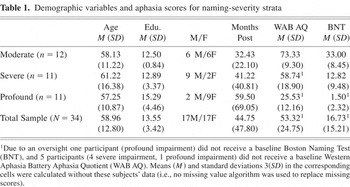
Patients were stratified by severity of word-finding impairment using picture-naming performance on a list of 40 words with 12 high frequency (21 or more occurrences/million; Francis & Kucera, 1982), 12 medium frequency (4 to 20 occurrences/million), and 16 low frequency (3 or fewer occurrences/million) items. This list was used in preference to the Boston Naming Test (BNT: Kaplan et al., 2001), which was also given, because the BNT consists of mostly low frequency items and limits the number of items that can be used to discriminate between the groups, particularly at the lower end of word-finding ability (see BNT means, Table 1). Cut-off scores that would divide the patients into three roughly equal strata were established after the first several patients completed the protocol. Patients with moderate word-finding impairment scored above 70% correct, patients with severe word-finding impairment scored 20% to 70% correct, and patients with profound word-finding impairment scored less than 20% correct. Table 1 shows demographic variables, months post onset, Aphasia Quotients (Western Aphasia Battery: Kertesz, 1982), and BNT scores for the entire sample and for each naming-impairment stratum. For moderately, severely, and profoundly impaired patients, one, two, and two patients, respectively, were less than 12 months post onset of their most recent stroke; the remainder of the patients were more than 12 months post onset.
Demographic variables and aphasia scores for naming-severity strata

Treatments
Each treatment was administered in three phases designed gradually to reduce treatment manipulations to a level that could be transferred to daily interactions in future treatment iterations.
Intention Treatment
The intention treatment involved initiating picture-naming trials and correction procedures, when necessary, with a complex left-hand movement. A complex left-hand movement was chosen because complex hand movements engage pre-SMA, the medial frontal area most important for intention in word generation (Picard & Strick, 1996). In this application, “complex” refers to multi-stage movements. Although category member generation evokes a greater extent of pre-SMA activity than more constrained naming tasks in young normals, more constrained naming tasks (similar to picture naming) still evoke substantial pre-SMA activity (Crosson et al., 2001) and are easier for many patients to perform. Thus, we decided to train participants on picture naming rather than on less constrained forms of word retrieval.
During Phase 1, patients sat directly in front of a computer monitor. The therapist was seated behind and to the patient's left. A flashing star (1 × 1 inch) appeared at the monitor's center and a 1000 Hz tone sounded. To initiate presentation of a picture, subjects lifted, with the left hand, a lid on a box located to his/her left, and pressed a specific button on a device within the box. Then, the tone and star disappeared, and after two seconds, a black and white line drawing appeared at the monitor's center. Patients had 20 seconds to name the picture. If they named it correctly, the therapist pressed the left mouse button, removing the drawing from the monitor and recording a correct response. If patients did not correctly name the picture, the therapist provided the correct name while making a non-meaningful circular left-hand gesture. The subject repeated the correct picture name aloud while making this gesture three times. Up to three correction attempts were allowed. The subject was trained on the same set of 50 pictures each day.
During phase 2, the patient and therapist were positioned the same way as in phase 1. The star appeared at the monitor's center (the tone was eliminated in this phase). The patient lifted the lid on the box and pressed the button with the left hand, removing the star from the monitor. After 2 seconds, a drawing appeared at the monitor's center, which the patient attempted to name. Incorrect responses were corrected using the method described for phase 1. The patient was trained on a different set of 50 line drawings from phase 1.
During phase 3, the patient and therapist were positioned as in previous phases. A star appeared at the monitor's center. Patients performed a non-meaningful circular left-hand gesture. The therapist initiated picture presentation once the patient repeated this gesture three times. Correction of incorrect responses remained the same as in previous phases. The subject was trained on 50 different line drawings than in other phases. The rationale for introducing the gesture to initiate naming trials was that the patient could use it outside of the therapy session to assist in word retrieval.
Attention treatment
The attention treatment involved presentation of pictures in left hemispace. In phase 1, the computer monitor was 45 degrees to the left of the patients' body midline, as Coslett (1999) found this manipulation improved language performance in patients with parietal lesions. The therapist sat behind and to the patient's left. A 1000 Hz tone sounded and firework-like display appeared somewhere to the left of center on the monitor for 4 seconds. At the onset of the tone, patients turned their head and eyes to the left to view the monitor. When the tone and fireworks disappeared, a picture immediately appeared on the upper, lower, or middle portion of the monitor's left side. The picture was presented on the left side of the monitor because Anderson (1996) demonstrated that side of presentation in a working visual space can affect language-related performance. Patients had 20 seconds to name pictures. If they could not do so correctly, the therapist provided the correct name up to three times per picture. The patient was trained on the same set of 50 line drawings each day.
During phase 2, the patient and therapist were positioned in the same way as in phase 1. The tone sounded at the beginning of a trial, but the fireworks display was eliminated. Otherwise, trials were identical to phase 1, except that 50 different line drawings from phase 1 were used.
In phase 3, the warning tone was .5 seconds. After the tone stopped, the computer monitor remained blank for 4 seconds before a picture appeared in the monitor's center. Otherwise the procedure was the same as in Phases 1 and 2, except that 50 unique line drawings were used.
Treatment Stimuli
Six sets of 50 black and white line drawings (total = 300), 10.2 × 10.2 cm were used for naming trials, a different set for each phase of each treatment. For severe or profound word-finding impairments, each set contained 15 high-frequency, 15 medium-frequency, and 20 low-frequency items. Because patients with moderate word-finding impairments scored too close to ceiling to use these picture sets, all 50 pictures from each of the six sets used for their treatment consisted only of low frequency items. Each set of items for all levels of word-finding impairments contained pictures of 9 living objects and 41 nonliving objects. Two groups of three picture sets were established, and a different group was used with each treatment.
Daily Probes
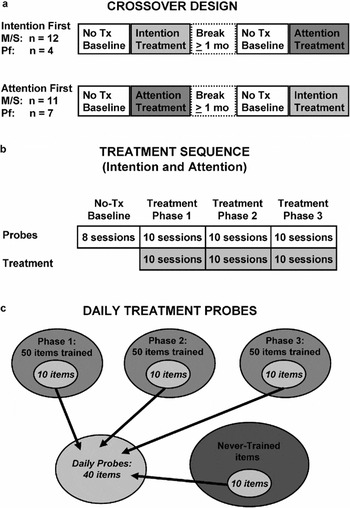
During pretreatment baseline sessions and prior to each treatment session for both treatments, patients performed a naming task to establish pre-treatment baseline performance and to monitor treatment progress, respectively. To avoid fatiguing patients prior to treatment sessions, only a portion of trained items were selected as probes. During probes, patients sat directly in front of the computer monitor. Each naming probe set contained 40 black and white line drawings, 10 pictures from each of the three treatment phases and 10 pictures not trained in any treatment phase (Fig. 1c). For patients with severe or profound word-finding impairments, each probe set contained 12 high frequency, 12 medium frequency, and 16 low frequency words, paralleling the frequency distribution of treatment sets. For patients with moderate word-finding impairments, probe sets consisted of 40 low frequency words. Each probe set had similar proportions of living and nonliving items to the treatment sets but varied slightly (6 or 7 living items) between probe sets to maintain the desired frequency distribution.

Design elements of the study. a: Crossover design. Each subject received both the intention treatment and the attention (comparison) treatment in a crossover design. Some received the intention treatment first, and the others received the attention treatment first. A break of at least 1 month occurred between treatments. M/S = moderate and severe word-finding impairment group; Pf = profound word-finding impairment group. b: During a no-treatment baseline period of at least 8 sessions, probes were given to establish baseline picture-naming performance. Subsequently, treatment was divided into 3 phases of 10 sessions each. Prior to treatment in each session, picture-naming probes were administered to monitor treatment progress; no treatment manipulation was performed during probes. This structure was used for both the intention and attention (comparison) treatments. c: Daily treatment probes. During each treatment phase, a unique set of items were used to train picture naming. The daily probes, used during baseline and treatment, consisted of 40 items: 10 from each of the 3 phases, and 10 never-trained items.
During each probe trial, a black and white line drawing appeared in the monitor's center, and the patient named the picture as quickly as possible. He/she was not given any instruction regarding whether to use the intention or attention manipulations. The therapist recorded correct and incorrect responses by pressing the left or right mouse button, respectively. Alternative responses to the main target for pictures were accepted. Potentially correct answers not on the list of correct alternatives were discussed in weekly meetings of therapists and the principal investigator, and acceptability was decided by consensus. If patients were unable to name pictures within 20 seconds, the program recorded incorrect responses and advanced to the next item. Feedback was not provided about accuracy during probe trials.
Although BNT scores were collected pre- and post-treatment, they were not used in data analyses because the BNT consists primarily of low frequency items and is therefore insensitive to change in severe and profound word-finding impairments and because there was no balancing of the BNT items that appeared in various treatment and probe sets.
Procedures
Each treatment consisted of three phases, 10-treatment sessions/phase (Fig. 1b). Sessions lasted approximately 45 minutes. Generally, treatment sessions were given once daily, five days/week. Occasionally, for patients living outside the area, treatments were given 2–3 times/day to minimize living costs. In such cases, at least 30 minutes elapsed between treatment sessions. Prior to treatment initiation, patients participated in at least eight baseline sessions (Fig. 1b). Generally, baseline sessions continued until the patient had no significant upward trend in the last eight sessions according to the C statistic (Tryon, 1982). However, this criterion was not used for the first few patients, and two patients did not have stable baselines in the attention treatment and one did not have stable baselines for either treatment. These three patients' data were not used for individual-patient analyses but were included in group analyses. For other patients, treatment commenced in the session following the one during which a stable baseline was established. In one additional patient, the ninth probe session given just before the first intention treatment session drove the C statistic to significance, and the subsequent three data points did not return to the level of the eight previous baseline sessions. This patient too was eliminated from individual subject analyses. Each patient in the study received both treatments in a crossover design (Fig. 1a). At least one month elapsed between treatments. Order of treatment was counterbalanced across subjects. Picture groups and picture sets within picture groups were counterbalanced within subjects and across treatments.
RESULTS
Group Analyses
Initially, a 2 treatments (intention, attention) ×2 orders (intention first, attention first) ×3 phases analysis of variance (ANOVA) with repeated measures across treatments and phases was conducted for each level of naming deficit (moderate, severe, and profound) to determine if there were main effects or interactions involving order. The dependent variable was the difference between average percent correct at each treatment phase and average percent correct at baseline for daily probes; all 40 items were used for these analyses. Because it was hypothesized that treatment would generalize to untrained items, the untrained items were included in analyses of treatment effects. (Had the assumption that patients would improve on untrained items not proved correct, the inclusion of the untrained items would have been a conservative approach to analyzing treatment effects.) There were no main effects or interactions for order in the initial analysis; therefore, further analyses were collapsed across order. Next, a 2-treatments × 3 phases ANOVA was conducted for each level of naming deficit to ascertain if there were any differences in pattern of response to treatment between deficit levels. The ANOVAs for the patients with moderate or severe word-finding impairments yielded identical results, and, therefore, were combined into a single analysis. Because pattern of findings was different for profoundly impaired patients, their results were analyzed separately. Ideally, a group × treatment × phase ANOVA would be desirable to examine group effects and the interaction of group with treatment and/or phase effects. However, the grossly unequal sample size compromises the interaction effects. Thus, each a priori hypothesis is addressed separately for each of the two groups: the moderate and severe impairment group and the profound impairment group.
Moderate and severe word-finding impairment
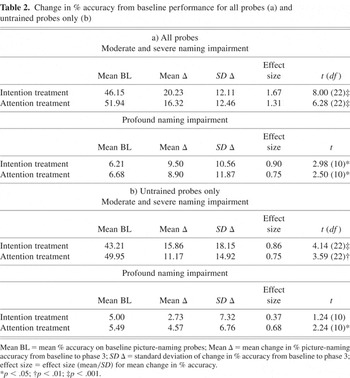
The hypothesis that both treatments would evoke significant change in picture naming was assessed separately for each treatment using two-tailed repeated measures t-tests comparing average performance during the third treatment phase to average baseline performance. Patients with moderate and severe word-finding impairment showed significantly higher naming performance during phase 3 than baseline of the intention treatment t(22) = 8.00, p < .001and significantly higher performance during phase 3 than baseline of the attention treatment t(22) = 6.28, p < .001. The following parameters, relevant to these t-tests, are presented in Table 2 for both treatments: mean percent correct at baseline, mean change in percent correct from baseline to phase 3, standard deviation of change in percent correct, and effect size for change in percent correct from baseline to phase 3. The mean difference in average performance at baseline between the two treatments was not significant, t(22) = 1.62, p > .05. Thus, both the intention and attention treatments evoked significant increases in naming performance.
Change in % accuracy from baseline performance for all probes (a) and untrained probes only (b)

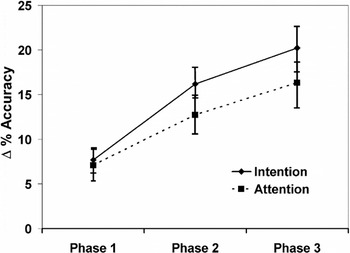
The hypothesis that the intention treatment would yield greater treatment response than the attention treatment was assessed using a 2-treatments × 3 phases ANOVA with repeated measures on both factors. The main effect for treatment was not significant, F(1 / 22) = 1.28, p > .05, but the main effect for phase, F(2 / 44) = 49.27, p < .001, and the treatment × phase interaction (Fig. 2), F(2 / 44) = 3.79, p < .05, were significant. Although differences between treatments at each phase were not significant, the difference in linear trends was significant, F(1 / 22) = 4.67, p < .05, indicating a greater increment in performance from phase to phase for the intention than the attention treatment.

Average change in percent accuracy from baseline performance for picture naming probes. The change in percent accuracy from baseline for both the intention and attention treatments is shown. Change in percent accuracy was calculated as the difference between average performance on daily picture-naming probes for each phase minus average baseline performance. During the intention treatment, patients showed a faster rate of gain (p < .05) in performance than in the attention treatment. Error bars represent the standard errors of the mean.
The hypothesis that these treatments would produce generalization to untrained items was assessed by comparing average percent correct on never-trained items during phase 3 to the average baseline performance on never-trained items. For the intention treatment, performance on never-trained items during phase 3 was significantly above baseline, t(22) = 4.14, p < .001 as it was for the attention treatment, t(22) = 3.59, p < .01. The following relevant parameters are presented in Table 2 for both treatments: average percent correct for untrained items during baseline, average improvement in percent correct over baseline performance, standard deviation for improvement in percent correct, and effect size for this change. Thus, patients with moderate and severe word-finding impairments showed generalization to untrained items for both treatments, with a larger effect size for the intention treatment.
Profound word-finding impairment
Analyses for the profound word-finding impairment group followed the same scheme as for the moderately and severely impaired group. They showed significantly higher naming performance during phase 3 than baseline for the intention treatment, t(10) = 2.98, p < .05, and for the attention treatment, t(10) = 2.50, p < .05. The relevant parameters for these analyses are presented in Table 2. The mean difference in performance at baseline between the two treatments was not significant, t(10) = −0.28, p > .05. Thus, both the intention and attention treatments evoked significant increases in performance, though effect sizes were less robust than for patients with moderate and severe word-finding impairments.
For the 2 treatments × 3 phases ANOVA, the main effect for treatment, F(1 / 10) = 0.02, p > .05, and the treatment × phase interaction, F(2 / 20) = 0.11, p > .05, were not significant. However, the main effect for phase was significant, F(2 / 20) = 10.31, p < .001. Thus, the intention and attention treatments both produced significant increases in naming accuracy, and the rate of increase in naming performance was similar between the treatments.
Regarding generalization, for the intention treatment, profoundly impaired patients' performance on never-trained items during phase 3 did not differ from baseline, t(10) = 1.24, p > .05. For the attention treatment, patients' performance on never-trained items during phase 3 was greater than baseline, t(10) = 2.24, p < .05. Parameters relevant to these analyses are presented in Table 2. Thus, on the average, profoundly impaired patients showed no generalization to untrained items for the intention treatment but did for the attention treatment.
Individual-patient Analyses
Individual-subject analyses also were conducted. Specifically, they addressed the hypotheses (a) that the two treatments would lead to significant gains and (b) that generalization of treatment effects would occur. Given that this phase I trial deals with proof of principle regarding the intention treatment, a statistical approach was selected for individual-patient analyses. This approach deals with whether a reliable effect can be produced rather than clinical significance of the effect. The basis for these analyses was a modified C statistic1
The C statistic can be inordinately sensitive to small changes in a few points when there is little variance in the time series and to larger changes in a single point when there are a small number of time points in the time series. Procedures were developed to overcome these weaknesses. (a) When a time series consisted almost entirely of very low accuracy (0 to 5%), with minimal changes in correct responses toward the end of the time series, such time series were not considered indicative of significant improvement. (b) In general, patients were given 8 baseline sessions, and if there was no significant upward trend in baseline, treatment was initiated. On the day treatment was initiated, probe trials were given prior to the first treatment session, per experimental protocol. Because treatment was initiated only after these probes were given they constituted a ninth baseline point. Occasionally, a large increase in performance at the ninth data point would make the C statistic significant because of the small number of points. In these cases, data were inspected by two investigators with experience in this protocol. In cases where performance was judged by both investigators to return to previous levels for the next three probe sessions (i.e., the first three probe sessions after initiation of treatment phase 1), the baseline was considered to be stable and subjects were included in individual patient analyses. There were two subjects whose data met these criteria for one of their treatments. In cases where performance was judged by both investigators, not to return to previous levels for the next three probe sessions, the baseline was considered not to be stable, and the patient's data were not considered for individual patient analyses. There was one patient whose data were not considered for this reason. With the three subjects mentioned earlier, this makes four patients whose data were excluded from individual patient analyses because of unstable baselines.
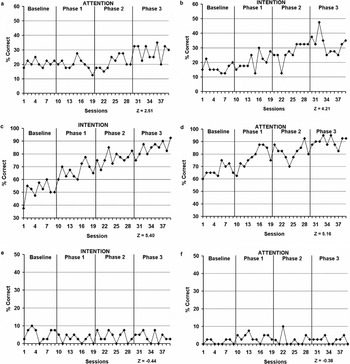
All patients whose data were considered in individual-subject analyses demonstrated stable baseline performance for both treatments. The C statistic was then applied to all probe sessions (baseline and treatment) to determine if there was significant improvement in naming accuracy across the time series (p < .05) that was attributable to treatment. Figure 3 shows daily picture-naming probe performance for both treatments of three representative participants.

Individual daily naming probes for three representative participants. Treatment order (left to right) is the order in which treatments were administered. For all graphs, the C statistic for baseline data indicated no significant increase in performance (i.e., a stable baseline). Z-scores derived from the C statistic for the entire time series are presented to the lower right of each graph. Participant 104 (a, b) demonstrated improvement on the attention treatment (a) but demonstrated a greater rate of improvement on the intention treatment (b). This pattern is representative of the group analysis for the moderately/severely impaired group but occurred in the profoundly impaired group as well. The opposite pattern (greater improvement on the attention than the intention treatment) also occurred on occasion. Participant 118 (c, d) showed relatively equal improvement on the intention and attention treatments. This pattern was common among the moderately/severely and the profoundly impaired groups. Participant 123 (e, f) showed improvement on neither the intention nor the attention treatment. This pattern occurred only in the profoundly impaired group.
Moderate and severe word-finding impairment
Nineteen of 23 moderately and severely impaired patients had stable baselines on both treatments. Seventeen of 19 patients (89%) demonstrated significant improvement during the intention treatment; 16 of 19 patients (84%) demonstrated significant improvement during the attention treatment. In short, both treatments were efficacious for a majority of patients, with one more patient showing improvement in the intention than the attention treatment.
C statistics also were calculated to determine if treatment effects extended to items that had not been trained. For this analysis, average percent correct was determined for each phase using all items that were not trained during that phase or a previous phase. All probe items were used in the baseline calculation because no items had been trained then. For the intention treatment, 16 of 19 patients (85%) showed significant improvement in untrained items relative to baseline performance. For the attention treatment, 13 of 19 patients (68%) demonstrated significant improvement on untrained items. Thus, for both treatments, the majority of patients showed significant generalization to untrained items, but three more patients showed significant generalization in the intention than the attention treatment. These findings were generally consistent with group analyses showing generalization for both treatments, only with a larger effect size for the intention treatment.
Profound word-finding impairment
All profoundly impaired patients had stable baselines on both treatments. Six of eleven patients (55%) demonstrated significant improvement during the intention treatment; 7 of 11 patients (64%) demonstrated significant improvement during the attention treatment. Thus, both treatments were efficacious for a smaller percentage of patients than in the moderately and severely impaired group. Regarding generalization, 6 of 11 patients (55%) showed significant improvement on untrained items relative to baseline for the intention treatment, and 6 of 11 patients (55%) demonstrated significant improvement on untrained items for the attention treatment. In short, patients who improved on either treatment usually showed significant generalization to untrained items.
DISCUSSION
Nonfluent patients with moderate to severe impairment improved naming performance during both intention and attention treatments. Although probe performance between the treatments did not differ during the three treatment phases, moderately to severely impaired patients did show significantly greater increments from one phase to the next on the intention than the attention treatment. Both treatments demonstrated generalization to untrained stimuli, but more patients demonstrated significant generalization to untrained items on the intention than the attention treatment. Nonfluent patients with profound word-finding impairments did not show a differential response to the intention and attention treatments, and fewer patients showed treatment gains and generalization to untrained stimuli than for the moderately to severely impaired group. Below, we address implications for hypotheses regarding treatment effects, the intention versus the attention component, and generalization, respectively.
Treatment Effects and Differential Improvement
Moderate and severe word-finding impairment
We conclude that the complex left-hand movement (the intention component) is an active treatment constituent. The foundation for this conclusion rests on the greater incremental improvement from one treatment phase to the next for the intention than the attention treatment and on the assumption that the attention component of the attention treatment had either no effect or a beneficial effect on naming performance. Regarding the former, it can be concluded that the greater rate of improvement would not have occurred in the intention treatment unless the intention as opposed to the attention treatment differentially impacted patients' ability to re-acquire naming responses. Regarding the latter, consistent with current findings for the attention treatment, Coslett (1999) did not find a similar attention manipulation to have adverse effects on language performance for any of his subjects, and it had a positive effect on performance for some.
However, without functional neuroimaging data, we cannot conclude that the complex left-hand movement led to greater right frontal lateralization of language production and/or more efficient utilization of such mechanisms. A functional MRI study of two patients (Crosson et al., 2005) suggested this might be the case. One patient showed increased lateralization of word production to right frontal mechanisms after as opposed to before the intention treatment. The second patient showed an increased focus of right frontal activity after as opposed to before the intention treatment, but no left frontal activity either before or after treatment. Nonetheless, a larger number of patients must be studied with fMRI to yield definitive support for the conceptual model.
It is of interest that the attention treatment led to greater improvement than expected. There are several possible reasons for this finding. First, Coslett (1999) found that patients with parietal lesions responded to a similar manipulation with improved language performance. Patients with chronic nonfluent aphasias most commonly demonstrate lesions extending into the parietal lobe (Alexander, 2003). Unfortunately, CT or MRI scans were not available in many of our patients to test this assumption. Second, the attention treatment involved an intention component at the onset of naming trials (turning the head and eyes to the left) that could have had a therapeutic effect. Third, the basic structure of both therapies may be more potent than we had estimated. Fourth, the length of treatment (i.e., 30 sessions) was longer than many studies in the literature and may have enhanced treatment. Whatever the reason, the attention as well as the intention treatment demonstrated potential utility for nonfluent aphasia patients, and both treatments should be studied further.
Profound word-finding impairment
In contrast to moderately and severely impaired patients, profoundly impaired patients did not demonstrate differential response to the two treatments and demonstrated significant responses to treatment less often than less severely impaired patients, though some profoundly impaired patients demonstrated gains for each treatment. The WAB AQs for the profoundly impaired patients were substantially below those of the moderately to severely impaired patients (Table 1), indicating broader language deficits. For the right hemisphere to assume word production functions, it may be necessary to preserve lexical code in some form within the left hemisphere. Although some believe that production and comprehension are subserved by different lexicons (e.g., Ellis & Young, 1988), there is reason to believe that codes for comprehension and production are shared to some extent. For example, if we think a thought to ourselves using words, we can “hear” those words even though we do not speak them, indicating that the words we produce are comprehended. Without speaking the words, this kind of comprehension would necessitate understanding the production code. Thus, the preservation of linguistic codes for comprehension may be necessary for optimal shift of production functions to the right hemisphere. This idea is consistent with preliminary evidence that patients with better comprehension demonstrate better response to the intention treatment (Cato et al., 2004b).
Generalization
Moderate and severe word-finding impairments
The rate of generalization to untrained stimuli in the current treatments (85% for intention, 68% for attention) was considerably above that of previous studies (e.g., Deloche et al., 1997; Hillis, 1989; Thompson & Kearns, 1981). In a treatment study of written picture naming, Deloche et al. (1997) found that 16 of 18 aphasia patients showed improvement during treatment, but only 4 of those 16 patients demonstrated generalization to untrained items, even though a generalization effect was present on group analyses (Deloche et al., 1992). Kiran and Thompson (2003) found generalization to untrained stimuli within semantic categories for three Wernicke's aphasia patients when atypical members of a semantic category were trained. However, generalization did not occur for items outside the trained categories (birds or vegetables). Further, when typical items from the category were trained in one of those three patients and in a fourth patient, no generalization to untrained atypical items occurred. In our study, items were classified according to broad semantic categories (living, nonliving). Because both vegetables and birds fell into the living category, and Kiran and Thompson did not find generalization between these two categories, it is unlikely that generalization of common semantic attributes within the broader categories of living and nonliving items could account for generalization in the current study. It also might be argued that repeated exposure to probe items could account for improvement on untrained items. Administration of never-probed, untrained items pre- and post-treatment would answer this question definitively. Nevertheless, there is good reason to believe that improvement on untrained probe items represents generalization rather than the effects of repeated exposure. In particular, among the moderately and severely impaired patients a vast majority of patients who showed stable baseline performance demonstrated improvement on never trained items (16 of 19 for the intention treatment; 13 of 19 for the attention treatment). If repeated exposure accounted for improvement on untrained items, patients likely would have demonstrated increased performance on baseline probes. Thus, we conclude that improvement on untrained items most likely represents generalization. Whether or not generalization in the current study was the result of the proposed mechanisms can only be ascertained by determining if the rate of generalization correlates with measures of change in right frontal activity during word finding. Functional imaging studies will be important to resolve this question.
Profound word-finding impairments
The rate of gains from treatment was less in patients with profound impairments. Nonetheless, most patients who benefited from either treatment showed generalization to untrained items, even though there was no group effect for generalization in the intention treatment.
Two additional issues should be addressed in future studies. First, is the relationship of lesion site to treatment response. Although structural CT or MRI scans were not consistently available for subjects in this study, analyses on a small subsample with volumetric MRI scans (n = 9) were reported elsewhere. Larger posterior perisylvian (Wernicke's area, supramarginal gyrus) and posterior periventricular white matter lesions predicted smaller treatment gains (Cato et al., 2004a). These correlations were consistent with the fact that high auditory-verbal comprehension scores predicted positive treatment outcome (Cato et al., 2004b) and suggest that lexical knowledge supported by these regions acted as a platform for improved word production, but these findings must be confirmed in a larger study to assure their accuracy. Second, this study was not designed to address if treatment effects persisted once treatment ended. This issue also should be addressed in future studies.
In summary, comparison of two novel treatments in chronic nonfluent aphasia patients with moderate or severe word-finding impairments demonstrated greater incremental improvement for the intention than the attention treatment. This finding is consistent with the concept that the intention component is an active treatment constituent. Improvement during the attention treatment makes it difficult to estimate how much of the treatment effect from the intention treatment was because of the intention manipulation. This question could be answered by comparing the intention treatment to a treatment identical in every respect except for the inclusion of the intention component. The attention treatment also produced significant treatment gains and deserves further study. Finally, the current study dealt only with the effects of intention on word retrieval. Alexander (2006) noted how the executive substrates for more complex language (syntax, discourse) may differ from those of word retrieval. Thus, it cannot be guaranteed that the current results are generalizable to syntax or discourse production. Raymer et al. (2002) performed a single-subject study suggesting that a left-hand movement might facilitate sentence production, but further work is needed to determine if this finding is applicable to a significant proportion of cases with sentence production problems.
ACKNOWLEDGMENTS
This research was supported by grants # P50 DC03888 and # R01 DC007387 from the National Institute on Deafness and Other Communication Disorders, by Center of Excellence grant # F2182C and Research Career Scientist Award # B3470S from the Department of Veterans Affairs Rehabilitation Research and Development Service, and by a grant from the Brooks Health Foundation. No other conflicts of interest exist, financial or otherwise. The information in this manuscript is new and original, is not currently under review by any other publication, and has not previously been published either electronically or in print.