I. INTRODUCTION
The reciprocal lattice (RL) [Also named in different languages as: شبکۀ معکوس (Fa), Réseau réciproque (Fr), Reziprokes Gitter (Ge), Reticolo reciproco (It), 逆格子 (Ja), Red recíproca (Sp).], which was developed over nearly two centuries, has become an essential tool in fundamental crystallography for description of diffraction experiments from matter with ordered arrangements of atoms. Relationships of the incident wave vectors of electrons, neutrons, photons, and especially X-rays with the RL will draw a fascinating and illustrative picture of the diffraction experiment beyond the Bragg equation. Beyond the use of RL for ideal crystals, deviations from RL or by specific RL's versions find use for different types of imperfect crystals, crystalline nano-particles, photonic arrays, etc. Because of its extensive use and importance, the RL is discussed in crystallography tutorials or educational books, so that: “As is well known, the RL occupies a rather prominent position in crystallography and there are nearly as many accounts of its importance as there are crystallographic texts” (Shmueli, Reference Shmueli2010).
Despite its broad and general uses, even in standard books or educational booklets of crystallography or related materials, the RL's meaning and application for crystal calculations is presented without discussion of its history (Landau and Lifshitz, Reference Landau and Lifshitz1963; Ashcroft and Mermin, Reference Ashcroft and Mermin1976; Burns, Reference Burns1985; Kittel, Reference Kittel2004), or at most, a history of development of the RL is briefly outlined (Authier, Reference Authier1981). This history can demonstrate the professional approach to the discipline of the scientific subject and is useful in promoting to students how ideas evolve. Even Ewald, the key figure of this concept in crystallography, narrated only a narrow story (three pages) of the introduction to the RL in crystallography (Ewald, Reference Ewald1936), although he and other contributors believed that manipulating Fourier series for the purposes of X-ray analysis had become established (Ewald, Reference Ewald1962).On the other hand, since the history of the RL is interwoven into other breakthroughs in the field of crystallography, such as the discovery of the X-ray diffraction or Laue's intuition of diffraction gratings, it has not been discussed separately even in historical books (such as Authier, Reference Authier2013). The present work tries to provide a historical perspective on the essential contributions into the development of the RL.
The concept of the RL, which appears usually along with the topics of diffraction experiments, also occurs frequently in band theories and interestingly in almost all mathematical models for quantum problems requiring the Fourier transformation of a periodic structure. Gibbs, in his speeches to the students, coined the name RL for the first time as a new concept that “they merit a distinctive name and notation” (Gibbs and Wilson, Reference Gibbs and Wilson1901, p. 112). He was aware of the importance and value of this lattice, but he never highlighted its relationship with the Fourier transform of the real lattice. The history of the RL is interlaced, as will be addressed below, closely with the Fourier transform, especially after the work of Ewald. Many excellent mathematical books give detailed explanations of the RLs for different lattices and try to describe their relationships with the Fourier transform, but again they do not cover the history of the RL's development via Fourier transform (Ruddin, Reference Ruddin1962; Titchmarsh, Reference Titchmarsh1967; Sneddon, Reference Sneddon1969; Berberian, Reference Berberian1973; Champeney, Reference Champeney1973; Gaskill, Reference Gaskill1978; Brown and Churchill, Reference Brown and Churchill2009). The concepts clarifying these relationships will be given.
Many authors have contributed to the evolution of our perception of the RL and there are several adaptations and applications of this useful tool in categories other than crystallography that merit outlining. However, among them only the pioneers, who made revolutionary changes or essential proofs, are mentioned here. Specifically, some brief ideas about the Brillouin zone as a physical realization of the RL in band theory of materials are given.
The lack of a history of the RL in reference books and a lack of knowledge by many in the community motivated writing this article. I hope that this history helps us take a step closer to a deeper understanding of the RL concept and its applications.
II. DEFINITIONS
First, some definitions are compiled and reviewed.
A. Direct lattice
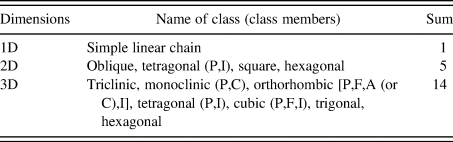
In crystallography, the lattice in real space that describes the atomic positions is called the direct lattice. The types of direct lattices are categorized as Bravais lattices, of which there are one in 1D, five in 2D, and 14 in 3D. This lattice is defined as: “a lattice which all its points are equal and where the lattice can be produced fully by one point and the corresponding lattice basis vectors” (Fathi, Reference Fathi2015). Table I summarizes the classes of Bravais lattices and their types.
Bravais lattices in different dimensions; P, I, A, B, C stand for simple (P), body-centered (I), face-centered (F, A, B, C), respectively (for simple lattices the class member notations are not written).

Among the Bravais lattices, manipulating face- and body-centered lattices are more laborious than the others, since their primitive unit cells (PUC) present a visualization challenge.
According to IUCr (Aroyo, Reference Aroyo2016):
Definition 1 (Lattice):
“For vectors a, b, c forming a basis of the three-dimensional vector space V 3, the set L = {l a + m b + n c|l, m, n ∈ Z} of all integral linear combinations of a, b, c is called a lattice in V 3 and the vectors a, b, c are called a lattice basis of L.”
Note that for every lattice an infinite number of choices of lattice bases are allowed.
B. Fourier transform
There are many collections of complete sets for expanding periodic functions, but amongst them, the plane waves are of special importance, owing to their simplicity in numerical calculations. Usually (if you can ignore the large wavenumbers) plane waves are the most appropriate functions to expand the physical quantities and thermodynamic functions of periodic structures (even non-periodic structures). In addition, with plane waves, the translational and point symmetries of the crystal can be introduced into the calculations, without any need to add extra or redundant preconditions (Evarestov and Smirnov, Reference Evarestov and Smirnov1983). These functions are defined using complex exponential functions and provide us a complete basis to produce Fourier series expansion. The Fourier transform is defined as (Brillouin, Reference Brillouin1962, p. 109):
Definition 2 (Fourier Transform):
Suppose that the function f(x) is periodic with period L, then the expansion
 $$f\,(x) = \mathop \sum \limits_{m = -\infty} ^\infty A_me^{ixk_m},\; \quad k_m = m\displaystyle{{2\pi} \over L} = mQ$$
is called the Fourier series of f(x). The period L is known as the fundamental component.
In this relation, k ms and A ms are called Fourier components and Fourier coefficients, respectively. The fundamental component defines the fundamental frequency Q = 2π/L, where its dimension is reciprocal to the dimension of the fundamental component. In diffraction experiments, the periodic function is defined in length space and so the dimension of Q is the reciprocal of length. In general, each of the plane waves carries with itself the magnitude and phase in its assigned complex amplitude.
The most important feature of Fourier transform is that a periodic function of period L is expanded vs. plane waves of period L. Immediately, the RL is born: a space with period Q = 2π/L; some authors name it Fourier space (Kittel, Reference Kittel2004) [Note that nothing necessarily periodic is produced in the reciprocal space till now, unless the condition from Eq. (5) is imposed.].
The Fourier series can be easily generalized to higher dimensions. Suppose that f(r) is periodic in three-dimensional space, so that:
 $$f\,({\bi r} + {\bi R}) = f\,({\bi r})$$
where, R is a set of translation vectors composed of integral multiples of basis vectors a, b, c i.e.:
 $$R = n_1{\bi a} + n_2{\bi b} + n_3{\bi c}\; \quad (n_1,n_2,n_3)\in {\rm \opf Z} $$
then
 $$f\,({\bi r}) = \mathop \sum \limits_m A_me^{i{\bi K}_m\cdot {\bi r}}\leftrightarrow A_m = \int_v {\displaystyle{{d{\bi r}} \over v}} f\,({\bi r})e^{-i{\bi K}_m\cdot {\bi r}}$$
where, v = |a · (b × c)| is the volume of the unit cell (UC). Here, the Fourier components of the RL are obtained from a condition recycling the periodicity of physical quantities in the real space:
 $$e^{i{\bi K}_m\cdot {\bi R}} = 1$$
The wave-vectors Km are the solutions of this vector equation and m is an integer index, which comprises the periodicity of the real lattice. This equation could be written simply as e i K·R = 1 since the Km wave numbers are the solutions of this equation and enumerate inherently m indices.
C. The reciprocal lattice
Consider a periodic quantity n(r) in real space, especially the electronic charge density ρ(r). Since this periodic function in real space has the property n(r + R) = n(r), after Fourier transforming this quantity, we can obtain the condition for producing the Fourier components, Km, namely Eq. (5). It is stated repeatedly in the literature that Eq. (5) produces the RL (Brillouin, Reference Brillouin1962; Ashcroft and Mermin, Reference Ashcroft and Mermin1976; Kittel, Reference Kittel2004, and many other references).
In 2010, the International Union of Crystallography re-stated the basis vectors bi (i = 1, 2, 3) reciprocal to real basis vectors ai(i = 1, 2, 3), using their mutual scalar products (Shmueli, Reference Shmueli2010),
 $${\bi b}_i\cdot {\bi a}_i = \delta _{ij},\quad \; i,j = 1,2,3$$
According to a newer restatement of definition from IUCr (Aroyo, Reference Aroyo2016), the RL was defined as:
Definition 3 (Reciprocal lattice):
“Let L ⊂ V 3 be a lattice with lattice basis a, b, c. Then the reciprocal basis a*, b*, c* is defined by the properties a · a* = b · b* = c · c* = 1 and b · a* = c · a* = c · b* = a · b* = a · c* = b · c* = 0, which can conveniently be written as the matrix equation  $\left( {\matrix{ {{\bi a}\cdot {\bi a}^*} & {{\bi a}\cdot {\bi b}^*} & {{\bi a}\cdot {\bi c}^*} \cr {{\bi b}\cdot {\bi a}^*} & {{\bi b}\cdot {\bi b}^*} & {{\bi b}\cdot {\bi c}^*} \cr {{\bi c}\cdot {\bi a}^*} & {{\bi c}\cdot {\bi b}^*} & {{\bi c}\cdot {\bi c}^*} \cr}} \right) = \left( {\matrix{ 1 & 0 & 0 \cr 0 & 1 & 0 \cr 0 & 0 & 1 \cr}} \right) = {\rm I}{\rm I}_3$.”
Therefore, a* is perpendicular to the plane spanned by b and c, and its length along a is 1/|a| (analogously, for b* and c*). The RL L* of L is defined as the lattice with the basis composed of a*, b*, c*.
Notice that these reciprocal vectors satisfy the relation (5) (e i K·R = 1). The resultant Fourier components from Eq. (5) differ from that of Eq. (6) in some aspects: (1) The wave-vectors Km from (5) depend critically upon the selection of R, so that completely different results are obtained on selecting either conventional or primitive UCs. (2) If more than one atom exists in the basis, e.g. m different atoms in the UC, one can ascribe via Eq. (5) a handful of wave-vectors to every atom in the basis,  $e^{i{\bi k}_j\cdot {\bi R}} = 1,\; \quad \; j = 1,2,\cdots, M$, and so the reciprocal vectors obtained from Eq. (5) depend upon the choice of real vectors without a unique result [Some authors prefer to assign the RL, because of these inconveniences, merely to Bravais lattices (Ashcroft and Mermin, Reference Ashcroft and Mermin1976).].
III. PREHISTORY
A. Fourier space
The concept of RL is tied strongly to that of Fourier space, which is the locus of points, in which the Fourier transform lives. In 1807, Jean-Baptiste Joseph Fourier showed that many functions could be written as an infinite sum of trigonometric series. Previously, Leonhard Euler, Jean le Rond d'Alembert, and Daniel Bernoulli had been investigated the infinite sums of trigonometric series. Fourier applied the series of harmonics for solving the partial differential equation of heat in a metal plate (Fourier, Reference Fourier1807).
He announced his analysis, specifically Fourier series in 1822: “The equations of heat conduction like those of sound or small oscillations for liquids belong to one of the most recently discovered branches of science which it is important to extend” (Fourier, Reference Fourier1822). The Fourier transformation concept had been first applied to describing harmonics or harmonic series, for modeling physical phenomena especially sound. This relationship between different aspects of harmonic functions, vs. time, in space etc., is very interesting. The applicability of harmonics is vast enough that the imagination of any structured analysis is almost impossible without making use of Fourier space. Fourier transform spectroscopy, nuclear magnetic resonance, Fourier transformed infrared, magnetic resonance imaging, and mass spectroscopy are a few examples that depend critically upon Fourier transform use.
In the case of periodic functions, the Fourier space shows some obvious discrete points, each of which contains average information about a specific summation of a series of points in the real space. The RL, as one of many Fourier spaces attributed to a periodic lattice of points in real space, constructs the living space for diffraction intensities collected from the scattering of beams, e.g. X-rays, by crystals.
B. Polar lattice
In mineralogy, a physical concept that is directly related to the concept of the RL is that of the polar lattice (PL). This lattice should be accounted as the great ancestor of the RL. According to Steno's law, the angles between intercepting planes are constant, but the size or even the existence of crystal planes depend critically on the conditions of crystal growth. Therefore, the magnitude of the area of the planes is a secondary and specimen-dependent feature of the crystal and does not reflect the interior symmetry of the crystal. An exterior lattice plane is the last member of (hkl) planes and its orientation (not its magnitude) reflects the crystal symmetry. When a set of perpendicular bisectors of all possible (hkl) planes is drawn, their intersections with the stereographic sphere form a set of poles, which beautifully contains some inherent information about the metric of the crystal.
In December 1848, Auguste Bravais introduced a sagacious method for extracting information about the metric of the crystal from this set of stereographic poles (Bravais, Reference Bravais1848). Assume three faces of the UC in the crystal, namely (001), (010), and (100) planes, which have a common point at the origin and their area is represented by S(001), S(010), and S(100), respectively. We call these three faces conjugate planes. Draw a perpendicular vector on each face and mark equally spaced spots on each of these vectors with the intervals S(hkl)/V 1/3, where V is the volume of the UC. With this normalization, a UC of the same volume of the real UC is formed. This lattice can be considered as a new lattice with the basis vectors of the magnitudes S(100)/V 1/3, S(010)/V 1/3, S(001)/V 1/3. Mineralogists who study the morphology of minerals popularly employ this type of lattice.
The lattice, formed in the previous paragraph, is called PL and has the dimensions of the real lattice. The only, but important, difference between PL and RL relies on their dimensions. A similar type of construction for PL is used in some textbooks for construction of the RL, only with the difference that the RL's basis vectors are defined in the reciprocal space with the dimensions of inverse length. The vectors of PL are coincident with those of the RL for Bravais lattices. At the conceptual level, the PL is the direct consequence of Steno's law and the RL is the direct consequence of Fraunhofer diffraction.
IV. HISTORY
In this section, the history of the development of the RL as an essential part of the crystallography is explained.
A. Making coin of the name
In 1881, Gibbs in his lectures on vector analysis gave a definition of the reciprocal vectors in a section named “Reciprocal Systems of Three Vectors. Solution of Equations”, as the first announcement of the RL, starting by “The problem of expressing any vector r in terms of three non-coplanar vectors a, b, c …” (Gibbs and Wilson, Reference Gibbs and Wilson1901, p. 81). According to Gibbs:
“The three vectors which appear [t]here multiplied by r, namely
 $$\displaystyle{{{\bi b} \times {\bi c}} \over {[{\bi abc}]}},\; \displaystyle{{{\bi c} \times {\bi a}} \over {[{\bi abc}]}},\; \displaystyle{{{\bi a} \times {\bi b}} \over {[{\bi abc}]}}$$
are very important. They are perpendicular respectively to the planes of b and c, c and a, a and b.”
He insists on the very importance of this reciprocal system of three vectors “They occur over and over again in a large number of important relations. For this reason they merit a distinctive name and notation.” He draws the reader's attention to “Hereafter when the term reciprocal system is used, it will be understood that the three vectors a,b, c are not coplanar.” Again, a few pages later, he insists that the coplanar vectors have no reciprocal system. The first application of the reciprocal vectors mentioned in Gibbs’ lectures is the application of this theory to the solution of scalar and vector equations of the first degree (Gibbs and Wilson, Reference Gibbs and Wilson1901, p. 112). Gibbs makes use of the reciprocal systems of three non-coplanar vectors repeatedly for discussing or proving some properties of dyadic tensors (Gibbs and Wilson, Reference Gibbs and Wilson1901, pp. 282).
Related to crystallography, Gibbs in his lectures on Vector Analysis (chapter VII, pp. 392) adds the title “Miscellaneous Applications” to discuss the “Propagation of Light in Crystals” as purely “mathematical not physical” and shows the application of vector analysis on writing and solving “The electromagnetic equations of the ether or of any infinite isotropic medium which is transparent to electromagnetic waves” (Gibbs and Wilson, Reference Gibbs and Wilson1901, 392). He defines a vector s in the direction of propagation of wave, which has the magnitude of the inverse of wave velocity and calls it the “wave-slowness” (Gibbs and Wilson, Reference Gibbs and Wilson1901, 395): “The vector s represents the wave-slowness. Suppose that a plane wave polarized in the direction a passes the origin at a certain instant of time with this slowness. At the end of a unit of time, it will have travelled in the direction s, a distance equal to the reciprocal of the magnitude of s. The plane will be in this position represented by the vector s (page 108). If s = u i + v j + w k the plane at the expiration of the unit time cuts off intercepts upon the axes equal to the reciprocals of u, v, w … .” A very similar argument is used by Buerger to derive “a reasonable notation for rational planes” using the intercept form of the equation of a plane which has a non-orthogonal axis (Buerger, Reference Buerger1956).
Although Gibbs was aware of the usefulness and importance of the reciprocal vectors system, he did not offer a connection to the Fourier transform.
Some authors such as Léon Nicolas Brillouin noticed some of the RL's definitions and its utilizations in areas other than crystallography, especially its connection with the Fourier transform. In his book named Science and Information Theory under the title “Fourier analysis and the sampling method in three dimensions”, Brillouin introduced the reciprocal space as made up of wave vectors K, which satisfy the relation e i K·R = 1 (Brillouin, Reference Brillouin1962). All his subsequent explanations were all about their applications and meaning of the Fourier components. Interestingly, he was the first to notice the connection between such spaces and X-ray reflection (Brillouin, Reference Brillouin1931).
B. Adaption for application in the crystallography
Applications of the reciprocal space in the crystallography (if we ignore the “miscellaneous Application” of Gibbs for the “Propagation of Light in Crystals”) took for decades until the work of Ewald on the “dispersion and double refraction in lattices of electrons” to be announced (although Brillouin first mentioned the RL's relationship with the reflection of X-rays). In their progress steadily toward structural analysis, Ewald and Laue in 1913, utilized the RL in analytical calculations on the geometry of linear forms in non-orthogonal coordinates, and so, by this methodology, the relevant calculation processes became much easier. Since then, this lattice has become heavily utilized in solid-state physics and crystallography.
C. Ewald's contribution
P. P. Ewald (January 23, 1888 in Berlin, Germany–August 22, 1985 in Ithaca, New York) was the first who introduced the relation of direct lattice and RL through the Fourier transform. The interpretation of diffraction patterns of an orthorhombic crystal was the problem. Until 1910, “there was no quantitative proof for the internal periodicity of crystals” (Ewald, Reference Ewald1979). In 1912, Reference EwaldEwald adapted the RL (reziprokes Gitter) concept to describe the diffraction pattern of such an orthorhombic crystal, in attempts in his doctoral thesis to develop the laws of propagation of X-rays in single crystals under Sommerfeld. His teacher “Sommerfeld had the idea that a proof might be obtainable by investigating whether oscillating electrons or dipoles, when placed in an anisotropic periodic array, a lattice, would produce observable double refraction by the mere fact of that arrangement. It was hoped that if this were so, then the observed double refraction could be used to gain information on the internal structure of the crystals” (Ewald, Reference Ewald1979). A slight rearranging of his Munich PhD thesis of 1912 Dispersion und Doppelbrechung in Elektronengittern (Kristallen) [Dispersion and Double Refraction in Lattices of Electrons (Crystals)] was given in Ewald (Reference Ewald1913).
He soon found out that the sum of all wavelets from a dipole that emits a spherical wavelet is “a purely wave-kinematical exercise” (Ewald, Reference Ewald1979). After a year of keeping busy, “a first helpful suggestion” from Sommerfeld of the development of a spherical wave into an integral over the product of Bessel functions showed him “that if it were possible to linearize ρ [the planar distance] by using a similar integral technique, then it would be easy to sum the wavelets.” After weeks, he discovered the proper integral technique and when he “met Sommerfeld to show him this result, he said ‘Wait, I also have to show you something’ – and with that he showed” him the same integral he had found. They were seeking for components of Bessel expansion of the function, and surprisingly the Fourier transform was ignored by both of them at that time: “At that time one spoke of Fourier developments, mainly in cosine and sine series, and the Fourier integral, in spite of its having been known for a long time, was still a bit strange; the term Fourier transform had yet to be invented… The field generated by the dipoles was now easily calculated; it kept step with the ‘wave of dipole excitation’.”
During 1913 through 1921, Ewald worked intensely on the reciprocal approach as a new way to investigate 3D properties of crystals under X-ray irradiation (Ewald, Reference Ewald1916a). The explicit manifest of the RL came true only by analyzing the X-ray diffraction. This was done on “the simplest model of a crystal for clarifying the optics, namely a simple orthorhombic lattice” (Ewald, Reference Ewald1916b). In 1916, Ewald generalized the RL concept to non-orthogonal axes, but only one dipole per cell was retained (Ewald, Reference Ewald1916b): “Up to this point the dynamical theory had been able to deal in a general way only with crystals having a basis of a single dipole.”
In 1925, Ewald solved the case of a general basis having two atoms (Ewald, Reference Ewald1925; corrected 1926), but without any “detailed derivation”. In 1937, he solved, with detailed derivation, the general case having an arbitrary basis (Ewald, Reference Ewald1937). This approach is very difficult because of its new definition of “vectorial structure amplitude
 $${\bi S}_h = \mathop \sum \limits_s {\bi p}^s\,{\rm exp}[-j({\bi h}{\bi x}^s)]\; \quad (\,j\equiv 2\pi i);$$
[where,] the summation goes over all dipole in the cell, each sort marked by an index s and shifted by xs from the origin of the cell” (Ewald, Reference Ewald1979). Because of this difficulty, some authors prefer to define the RL only for Bravais lattices (Ashcroft and Mermin, Reference Ashcroft and Mermin1976).
D. Two Braggs’ contributions
The famous Braggs’ law (Bragg and Bragg, Reference Bragg and Bragg1913) can be expressed in terms of the reciprocal vectors of the lattice:  $\nabla {\bi k} = {\bi G}$, where
 $\nabla {\bi k}$ is the change of the wave-vector through the reflection process and G is an RL vector. This relation is known as the Braggs’ law in vector form and can be visually illustrated in three dimensions by a sphere of the corresponding radius via the Ewald construction. This well-known Braggs’ method is simpler than the dynamic theory of Ewald, but some authors believe that the Ewald's approach provides deeper insight into the diffraction of X-rays by crystals.
In 1915, W. H. Bragg suggested to use Fourier transform and its coefficients for determining the crystal structure (Bragg, Reference Bragg1915): “If we know the nature of the periodic variation of the density of the medium we can analyze it by Fourier's method into a series of harmonic terms”, so let “us imagine then that the periodic variation of density has been analyzed into a series of harmonic terms. The coefficient of any term will be proportional to the intensity of the reflection to which it corresponds.” His son (W. L. Bragg) and West in 1929 tried this method out on diopside CaMg(SiO3)2 and topaz (AlF)2SiO4, to show its usefulness for determining crystal structures with many parameters (Bragg and West, Reference Bragg and West1929). In their paper, which can be considered as a rapid pocket tutorial for X-ray diffraction analysis, they gave the results of analyses of a few sample structures. They were looking for some answers to this question: “is a direct method of analysis possible?” They responded at last: “Fourier analysis has claims to be called direct because observed values of F(hkl) are substituted in a series which when evaluated gives a faithful image of the distribution of scattering matter in the crystal” (Bragg and West, Reference Bragg and West1929).
Bragg and West emphasized repeatedly on the Fourier coefficients, but the relationship with the RL was never explained. As it was stated explicitly in their paper, “Measurements of F for complex crystals, and their use in finding the positions of atoms in the crystalline structure, have not been so widely studied.” Their main consequences of this analysis “have shown that the F values have a precise physical significance and may be measured with accuracy”. Most of their work was based on the investigations of other researchers especially on the work of Darwin (Reference Darwin1914a; Reference Darwin1914b).
In 1934, the Bragg's method became more vastly popular when Beevers and Lipson introduced the technique of the summing up the Fourier series in two dimensions.
E. Laue's contribution
In those days, the crystallographers generally believed that the crystal is a regular array of something, and accounts of Ewald's and Laue's discussion were essentially in agreement (Authier, Reference Authier2013). In a real lattice, every site is representative of an atom or a physical entity, but Laue and Ewald did not know exactly what were these things that were regularly arranged. The distances between the particles could be simply calculated from the density of the material and they are thousandth of light's wavelength, which is typical of X-rays. Laue soon was searching for wavelengths much shorter than that of light and left believed from discussion by Ewald that Ewald's coherent summation of wavelets is also valid for the suggested shorter wavelengths.
Although Laue did not contribute directly into the initiation and compilation of the concept of the RL, he made three essential steps toward the structural analysis of crystals and finally to the establishment of the concept of the RL:
1. Laue's intuition of diffraction gratings depended critically on the closeness of the period of the gratings and the wavelength: “the ratio of wavelengths and lattice constants was extremely favorable if X-rays were to be transmitted through a crystal” (Laue, Reference Laue1920). This stroke of genius led Ewald to the description of coherent summation of waves employing X-rays instead of light, so that “without it the work of the Braggs and X-ray analysis, Moseley's pioneering work on X-ray spectroscopy, and the experimental study of atomic structure would have been delayed” (Authier, Reference Authier2013).
2. He himself derived three relations that are well known now as the Laue's relations, believed to be more general than that of Braggs’ and are based on the concepts common in the diffraction patterns in the reciprocal space.
3. Although, Ewald did not progress to describe the RL for lattices other than orthorhombic lattice, Laue, in 1914, generalized the RL to any type of symmetry, without mentioning the PL of Bravais (Laue, Reference Laue1914).
Before the end, it is worth mentioning that since the RL is directly related to the translational symmetry properties of a given periodic structure, every place in physics or mathematics utilizing discrete Fourier transformation is at least partly the territory of the RL. The most troubleshooting graphical technique in semiconductor materials and band theory of metals, for instance, is the Brillouin zone, which can be also applied to describe any electromagnetic waves and elastic vibrations, or waves arising in describing elementary particles in a space benefitted from the existence of a periodic structure (Brillouin, Reference Brillouin1962). This zone can be created by the Wigner–Seitz method and hides the RL in the guise of electronic structure. For an extended text on the theory of Brillouin zones and electronic states in crystals, the interested reader is referred to Jones (Reference Jones1960).
V. SUMMARY AND CONCLUSION
In summary, the standard definitions of the RL were compiled and its relationship with the real lattice was discussed. The locus of allowed points in diffraction experiments is called Reciprocal space or the Fourier space. The RL is some (usually small) part of the locus of points produced by satisfying the periodicity of physical quantities in the real space. When the Fourier transform of a quantity, periodic in the real space, is evaluated, this periodicity leads to a condition that produces all points of the RL. Gibbs was the first who coined the name “reciprocal lattice” and made use of it in a “Miscellaneous Application” on “Propagation of Light in Crystals”.
The vectors of the RL form a special collection of vectors and can be introduced historically as the heritage of Bravais’ PL, which is the collection of points constructed by a similar condition for constructing the RL but has dimensions of length. Therefore, the RL can be better understood, especially for pedagogical purposes, based on the definition of the PL. The law of constancy of angles (Steno's law) states that the angles between the crossing planes are constant. Therefore, the growing size of a plane and even the existence of that plane depend critically upon the conditions of crystal growth, and the magnitude of the plane is a redundant and non-necessary feature for a crystalline object. The direct result of this property is that the macroscopic outer view of the crystal does not reflect the fundamental inner symmetries of the system at a glance. What represents the symmetry are directions of planes, not lengths. The PL was deduced from such kinds of observations.
In view of pedagogy, the PL deserves to be introduced as the grandfather of the RL. What we really see on the screen after the diffraction is a mapping of the PL, which has the dimensions of length. In other words: The diffraction experiments depict the PL in real space. In addition, the Bragg's law can be re-stated in a vector form using the RL and then immediately the Ewald construction is appeared and removes the ambiguity arising from choosing different UCs for the definition of the RL.
Brillouin first noticed the connection between the reciprocal space and X-ray reflection. Ewald adapted the RL for analyzing the diffraction patterns from crystals and so established a deep insight into the interaction of X-rays with charge density in periodic arrays. This approach is deeper than Braggs’, since the Ewald's approach stresses on the interaction of the X-rays with charge density, making use of the equation of motion of a single isolated dipole and including many effects such as the damping of oscillations because of the loss of energy by radiation (this damping is cancelled out, according to H. A. Lorentz, for an individual dipole in a lattice by radiation from the other dipoles in the lattice). In addition, his approach included the continuity of all parts of the electromagnetic spectrum. Max von Laue made a breakthrough via his idea of making use of shorter wavelengths for analyzing the internal structure of crystals and generalizing the RL calculations to any type of symmetry other than the simple orthorhombic crystal structure, which was performed by Ewald (Laue, Reference Laue1914; Ewald, Reference Ewald1917). They do not refer to the PL.
Because of Ewald's theory, the diffracted X-rays in coherent scattering theory form the RL on the screen by depicting the constructing parts of interfering plane waves. In crystals, it is important that X-rays are diffracted from the electronic density ρ(r) and carry with themselves the periodicity of the lattice. In other words, the periodic nature of ρ(r) causes that the intensity focuses on the PL points and maximum intensity spots appear on the screen. In fact, the nature of constructing interference of waves scattered by the parallel planes in the real lattice dominates the appearance of these spots. Therefore, what is formed on the detector originates from: (1) the Fourier transformation of electronic density, (2) placing a motif of intensities on the diffraction spots (re-scaled PL points).
The diffraction spots on the detector form a rescaled PL and we may loosely name this locus of diffraction spots, the RL or Fourier space (since, the detector is actually located in real space and has dimensions of length, while the RL lives in a Fourier space with dimensions of inverse length). The Fourier space, experienced by diffraction experiments, means that for any quantity n(r) periodic in direct lattice its Fourier transform n(k) is concentrated in Fourier component points in RL. Some points in reciprocal space are not seen in diffraction experiments; this feature is called the extinction rule and is a matter of the cell content that may or may not have translational elements that cause extinctions of the diffraction.
The RL is not specific to the crystallography, although it is knotted tightly to this specific but vast literature. The band structure calculations in semiconductor materials and band theory of metals, for example, are indebted certainly to the Brillouin zones, which directly resemble the RL.
ACKNOWLEDGEMENTS
The author would like to thank Prof. S. S. Gousheh (from Shahid Beheshti University, Tehran, Iran) for reading the manuscript. The author gratefully acknowledges Prof. Brian H. Toby and Nicole Ernst Boris who have generously given up valuable time to review and edit the manuscript.