

1. Introduction
Norms in individual post-Soviet countries’ criminal legislation that provide for criminal wrongdoing, the extent of criminal liability, and punishment for the commission of crimes, particularly in the Republics of Azerbaijan, Kyrgyzstan, and Tajikistan, form an independent, main component of the crime (criminal offense). The analysis of sanctions leads to the conclusion that to improve the current Criminal Code (CC) of Ukraine, it is necessary to include an additional type of punishment (deprivation of the right to hold certain positions or engage in certain activities) in articles 372 and 373 of the CC.
Known illegal detention, pretext, house arrest or custody, introducing a known innocent person to criminal responsibility, and coercion to testify are all considered separate types of criminal acts in Australia, Argentina, Bulgaria, the Netherlands, Denmark, Spain, San Marino, France, and Japan. Special regulations are also included in the CCs of Denmark and France. On the other hand, certain countries’ laws (the CCs of Argentina, Australia, the Netherlands, Spain, San Marino, Bulgaria, and Lithuania) have no special regulations for the crimes listed above; consequently, an official who commits such acts, according to those nations’ legislation, is subject to criminal liability for abuse of office or excess of powerFootnote 1.
The problematic issues concerning criminal liability for committing criminal offenses have been investigated by researchers such as M.I. Bazhanov, O.M. Bandurka, Yu. V. Baulin, V.O. Glushkov, M.Y. Korzhanskyi, O.M. Kostenko, V.O. Navrotskyi, V.I. Osadchyi, V.V. Stashis, E.L. Streltsov, M.I. Havronyuk, and other scholars. In 2009, M.V. Siyploka defended a PhD dissertation titled “Criminal-legal Characteristics of Holding a Known Innocent Person Criminally Responsible.” In 2011, O.S. Vakulyk defended a PhD dissertation titled “Criminal-legal Characteristics of Coercion to Testify.” In 2017, O.S. Shnypko defended a PhD dissertation called “Criminal-legal Investigation of the Crime of Known Unlawful Detention, Coercion, House Arrest, or Custody (Article 371 of the CC of Ukraine).” Lastly, in 2021, L.M. Palyuk successfully defended a doctoral dissertation entitled “Criminal Responsibility for Criminal Offenses against Justice.”
The aforementioned scientists’ works are an essential contribution to the science of criminal law for the practice of qualification and prevention of certain types of criminal offenses, as well as the provision of a significant scientific basis for further research and improvement.
The subject of this study is criminal responsibility for the following criminal offenses: known illegal detention, pretext, house arrest or custody (article 371 of the CC), introducing a known innocent person to criminal responsibility (article 372 of the CC), and coercion to testify (article 373 of the CC) regarding officials of pre-trial investigation bodies who commit this type of criminal wrongdoing and certain foreign countries’ criminal legislation.
The purpose of the article is to conduct a legal analysis of criminal responsibility for known illegal detention, pretext, house arrest or custody, introducing a known innocent to criminal responsibility, and coercion of testimony, developing recommendations based on the results of this analysis to improve current legislation and increase the effectiveness of law enforcement, taking into account the experiences of foreign countries.
To accomplish this objective, the following interconnected tasks were defined:
• conduct a comparative legal analysis of the areas of known illegal detention, pretext, house arrest or custody, introduction of a known innocent person to criminal liability, and coercion of testimony in terms of responsibility and punishment, following the current CC of Ukraine and the legislation of certain foreign countries; and
• determine the limits of criminal responsibility for the investigated criminal offenses and formulate scientifically based recommendations for improving the current Ukrainian national legislation, particularly the CC.
The scientific novelty of the research lies in formulating several conceptual provisions regarding criminal liability and criminal offenses committed by officials of inquiry and pre-trial investigation bodies, taking into account the experiences of individual post-Soviet and foreign countries.
2. Methods
The following methods were used in the study: the comparative legal method was used to analyze and compare national, post-Soviet, and foreign legislation regarding responsibility for criminal offenses; the systemic-structural method was used for an in-depth study of regulatory provisions that establish the responsibility of officials of inquiry and pre-trial investigation bodies for committing criminal offenses, comparing them to other provisions of Ukraine's current CC and criminal legislation norms of certain post-Soviet and foreign countries; the survey method was used to survey law enforcement officers; the statistical method provided justification, analysis, and generalization of empirical information concerning the researched topic; and the modelling method assisted in the development of draft dispositions of articles of the Ukrainian CC regarding responsibility for known illegal detention, pretext, house arrest or custody, introducing a known innocent to criminal responsibility, and coercion to testify.
3. Results
The statistical reports for the last five years from the Judiciary of Ukraine, the Office of the Prosecutor General of Ukraine, and the Department of Information of the Ministry of Internal Affairs of Ukraine demonstrate the following: During the period 2018–2022, only thirty-two criminal proceedings were initiated under articles 371–73 of the CC, the majority of which were closed and did not reach the court. Thus, as of June 2023, not a single official had been held criminally liable, demonstrating their high level of latency.
In terms of statistical data on criminal offenses in general, they reveal the following, as shown in Figure 1:
The number of individuals whose court decisions became legally binding during the reporting period under articles 371–400 of the CC of Ukraine (2018–2022).Footnote 2

Thus, an examination of statistical data describing law enforcement agencies’ activities related to crime detection and disclosure, the practice of the European Court of Human Rights (ECtHR), the annual reports of the Commissioner for Human Rights in the Verkhovna RadaFootnote 3, and mass media materials reveal that, while cases of torture and other cruel, inhuman, or degrading treatment are not isolated incidents, the number of criminal proceedings instituted is extremely low, and the number of individuals charged with crimes is negligible.Footnote 4, Footnote 5, Footnote 6
The latency of the investigated criminal offenses is caused by the fact that victims do not always inform law enforcement agencies about groundless detention, house arrests, custody, illegal pretexts, and coercion to testify. This is due to a lack of faith in justice and legality, the complexity and procrastination of considering such applications, and sometimes the absence of an opportunity to prove innocence and guilt concerning the criminal offense an individual is accused of.
As previously stated, judicial practice in such criminal proceedings is limited, making it difficult to fully analyze the effectiveness of the application of criminal legal measures provided for criminal wrongdoing and the characterization of the circumstances that mitigate or aggravate the punishment. In this regard, we will confine ourselves to some general conclusions and particular recommendations for improving national criminal laws.
The analysis of criminal offenses under the CC should also consider international experience. After all, focusing on such experience while also investigating the problems of criminal law doctrine is beneficial both for familiarization with legislation and possible consideration in national legislation, as well as for the development of conceptual approaches to criminal offense prevention. The legal comparison can provide a lawyer with ideas and arguments that cannot be obtained only by applying national legal norms without considering foreign legislation's experiencesFootnote 7.
The legal analysis of foreign criminal law norms results in the conclusion that these norms, which regulate criminal liability for the commission of known illegal detention, pretext, house arrest or custody, introducing a known innocent to criminal responsibility, and coercion of testimony, are enshrined in the criminal legislation of the vast majority of countries.
The main features of establishing criminal liability for crimes in post-Soviet countries’ CCs (Republics of Azerbaijan, Belarus, Moldova, Kazakhstan, Kyrgyzstan, Tajikistan, Armenia, and others) encroach on the established procedure of judicial proceedings at all stages—pre-trial, judicial, and the order of execution of court decisions, which typically belong to a single structural part of the criminal law. In the sections (chapters) on criminal offenses (crimes) of most post-Soviet countries, special norms are set out that provide for criminal liability for unlawful influence, including encroachment on the personal property of judges, prosecutors, and persons conducting pre-trial investigations in connection with their activities in the judiciaryFootnote 8, Footnote 9, Footnote 10. As a result, it is necessary to examine several criminal laws in force in both post-Soviet (Azerbaijan, Kyrgyzstan, and Tajikistan) and foreign countries (Australia, Argentina, Bulgaria, the Netherlands, Denmark, Spain, Lithuania, San Marino, Germany, France, and Japan)Footnote 11.
Undoubtedly, the legislative experience of the CIS (Commonwealth of Independent States) Inter-Parliamentary Assembly influenced the formation of the CCs of the former USSR republics. Thus, the Model CC was approved as a legislative advisory act for CIS member countries following its resolution (adopted at the 7th plenary session on February 17, 1996, no. 7–5). The Model CC in Ch. 34, “Crimes against Justice,” provides for liability for known illegal detention, incitement, arrest or custody, introducing a known innocent to criminal responsibility, and coercing a witness to testifyFootnote 12.
The legal analysis of individual post-Soviet countries’ criminal legislation demonstrates the unconditional influence of the specified model standards on the formatting of national norms that regulate criminal responsibility for the analyzed socially dangerous offenses.
Criminal law norms of criminal offenses are provided for in articles 371–73 of the Ukrainian CC, with similar wording regarding the main components of crimes in the CCs of Azerbaijan, Kyrgyzstan, Tajikistan, and other republics (Table 1).
Comparison of dispositions for known illegal detention, pretext, or house arrest under the CCs of Ukraine and the post-Soviet countries.

Source: Compiled by the authors based on data.Footnote 13
Justice is, in general, the genitive object of the composition of crimes for known illegal detention, pretext, arrest or custody, introducing a known innocent person to criminal responsibility, and coercion to testify. This categorization of crimes suggests a cognation between the genitive objects of the analyzed criminal law norms under national and international law. However, it is still impossible to agree on the provisions that, both nationally and in the analyzed individual CCs of the post-Soviet countries, justice should be considered in both a broad and narrow sense. This interpretation emphasizes the importance of further developing both the concept of ‘justice’ and the generic object of criminal offensesFootnote 14.
Analyzing the sanctions for known illegal detention, arrest, house arrest or custody, introducing a known innocent person to criminal liability, and coercion to testify leads us to conclude that the main components of these criminal offenses are not regulated by a sufficiently high degree of public danger. This conclusion was drawn given that the legislator deemed it necessary to apply punishments for these types of violations in the forms of deprivation of the right to hold certain positions or engage in certain activities, restriction of freedom, and deprivation of liberty for a specific period, and classify them as criminal misdemeanors and minor crimes (CC of Ukraine).
When the specified sanctions are compared to the sanctions of the provisions of the articles of the CCs of the post-Soviet countries, it is worth noting that their content differs slightly in terms of the scope of criminal punishment. So, when it comes to known illegal detention, pretext, house arrest, or custody, as shown in Table 2, the following types and terms of punishment are defined.
Comparison of sanctions for known illegal detention, pretext, house arrest, or custody in the CCs of Ukraine and the post-Soviet countries.

Source: Compiled by the authors based on data.Footnote 15
The following types and terms of punishment are defined regarding criminal responsibility for introducing an innocent person to criminal responsibility as shown in Table 3.
Comparison of dispositions and sanctions for introducing a known innocent to criminal responsibility in the CCs of Ukraine and the post-Soviet countries.

Source: Compiled by the authors based on data.Footnote 16
In the analyzed criminal laws (Table 4), the following provisions are made for the coercion to testify.
Comparison of dispositions and sanctions for coercion to testify in the CCs of Ukraine and the post-Soviet countries.

Source: Compiled by the authors based on data.Footnote 17
Based on the provided comparison of the dispositions of the articles and sanctions, it is possible to conclude that there are no significant differences in the scopes of punishment for known illegal detention, pretext, house arrest or custody, introducing a known innocent person to criminal responsibility, and coercion to testify between the CCs of Ukraine and the post-Soviet countries. This is primarily related to the historical origins of the genesis of criminal law, as well as conceptual approaches to the criminal law protection of social relations that have developed in the judicial process. Accordingly, there is no need for significant changes in the main components of the analyzed criminal offenses in terms of an increased severity of criminal punishment. It should also be noted that an additional type of punishment (deprivation of the right to hold certain positions or engage in certain activities) is allocated in the sanctions of the corresponding norms of the CCs of these post-Soviet countries (e.g., the Republic of Tajikistan). The sanctions contained in articles 372 and 373 of Ukraine's CC should also include this type of punishment.
However, there may be objections that, according to part 2 of article 55 of the CC of Ukraine, the specified type of punishment can be imposed as an additional one in cases where it is not provided for in the sanction contained in the article (sanctions in part of the article) of the Special Part of the CC. The court considers the nature of the criminal offense committed in the position or connection with a certain activity's execution, the traits of the convicted person, and other circumstances of the case, recognizing that those individuals can't retain the right to hold certain positions or engage in certain activities. However, such an argument cannot withstand an examination. If we consider the stated provision to be the only option for resolving the specific issue, it appears illogical to include such an additional type of punishment in the vast majority of sanctions contained in the articles (sanctions in parts of articles) of Ukraine's CC. In particular, it is ill-advised to anticipate additional types of punishment for certain types of criminal offenses in the field of official and professional activities related to the provision of public services (articles 364–68 of the CC) and crimes (articles 371, 374, 376, 382, 387–89, and 397 of the CC). Therefore, if introducing an innocent person to criminal responsibility and coercing them to testify is considered a manifestation of special official abuse, then the types of punishment for such similar actions should be appropriate. Thus, the legislator undervalues the importance of implementing and regulating such a new type of punishment in the articles of the investigated criminal offenses.
Concerning part 3 of article 371 of Ukraine's CC (actions provided for by parts 1 or 2 of this article, if the crimes caused serious consequences or were committed for selfish motives or in other personal interests), part 2 of article 373 of the CC (combined with the charge of committing a grave or particularly grave crime), and part 2 of article 373 of the CC (the same actions combined with the use of violence or bullying in the absence of signs of torture), then these criminal offenses are considered qualified. These actions also constitute qualified components of known illegal detention, incitement, arrest or custody, introducing a known innocent person to criminal responsibility, and coercing them to testify in the CCs of the specified republics of the post-Soviet countries. At the same time, the CCs of Azerbaijan, Kyrgyzstan, and Tajikistan do not specifically provide for liability for known illegal detention, incitement, arrest, or custody combined with a selfish motive or other personal interests concerning introducing a known innocent person to criminal responsibility combined with falsification of evidence and form an independent component of the crime rather than a qualifying feature as such. Accordingly, in cases where the prosecution of an innocent person is combined with the artificial creation of prosecution evidence or other falsification, such actions are classified as crimes in the CCs of Azerbaijan, Kyrgyzstan, and Tajikistan.
According to the degree of severity, the qualified criminal law norms of post-Soviet countries contain the following sanctions as the degree of punishment increases:
1. For known unlawful detention, pretext, house arrest, or custody, as shown in Table 5:
Comparison of sanctions in Ukraine's CC and the CCs of post-Soviet countries for known illegal detention, pretext, house arrest, or custody.

Source: Compiled by the authors based on data.Footnote 18
In comparison to part 3 of article 371 of the Ukrainian CC, the CCs of Azerbaijan, Kyrgyzstan, and Tajikistan provide slightly milder sanctions for known illegal detention, pretext, house arrest, or custody. However, such a statement may be recognized as debatable and disputable.
2. Regarding the prosecution of a known innocent person, see Table 6:
Comparison of sanctions in the CCs of Ukraine and the post-Soviet countries for introducing a known innocent to criminal responsibility.

Source: Compiled by the authors based on data.Footnote 19
The legal analysis demonstrates that sanctions for introducing a known innocent person to criminal responsibility in Ukraine's CC and the CCs of the observed post-Soviet countries share common and distinguishing characteristics; however, they do not differ significantly in terms of punishment. Such sanctions have also been regularly examined and updated through changes and additions.
We believe that significant changes and additions to the sanctions imposed on those guilty of criminal offenses for introducing a known innocent to criminal responsibility are not required. However, in the case of implementing legislative changes and additions to article 372 of Ukraine's CC, other types of punishments should be provided.
3. Concerning the coercion to testify, in Table 7:
Comparison of sanctions for coercion to testify in the CCs of Ukraine and the post-Soviet countries.

Source: Compiled by the authors based on data.Footnote 20
According to the results of the legal analysis, the sanctions of the above criminal law norms in the CCs of Azerbaijan and Kyrgyzstan are among the most severe types of punishment when compared to part 2 of article 354 of the CC of Tajikistan, which is classified as a particularly serious crime.
The issue of legality in law enforcement activities is always relevant, not only for Ukraine but for the entire world community. This is supported by the presence of documents such as the Convention for the Protection of Human Rights and Fundamental Freedoms (1950), the International Covenant on Civil and Political Rights (1966), the European Convention for the Prevention of Torture and Other Cruel, Inhuman or Degrading Treatment or Punishment (1987), and the United Nations Convention against Torture and Other Cruel, Inhuman or Degrading Treatment or Punishment (1988), which together draw attention to existing problems in justice administration.Footnote 21
In recent years, against the backdrop of Europe's integration processes, the legal systems of European countries, in particular EU member countries and candidate EU member countries, have converged significantly, affecting their national criminal legislation. Based on Council of Europe and EU legislation, a pan-European CC with a national character has been established. At the same time, different European countries’ CCs regulate the issue of responsibility for specific types of crimes. In light of the foregoing, it is thought worthwhile to examine the legislation of various foreign countries to learn from positive experiences in resolving issues of criminal responsibility for committing known illegal detention, pretext, house arrest or custody, introducing a known innocent person to criminal responsibility, and coercion to testify.
There is no section in Argentina's or France's CC for criminal liability for these types of crimes (criminal offenses). However, we believe that known illegal detention, incitement, arrest, or custody committed by the perpetrator can be considered crimes of encroachment on human freedom. According to article 224 of the French CC, such actions are punishable by at least five years in prison, a fine, or life imprisonment. With regard to introducing a known innocent person to criminal responsibility, an official's actions can be considered official crimes (see chapter X of the French CC), and according to articles 271–72 of the CC of Argentina, the prosecutor, judicial mandate holder, and other officials who intentionally harm the judicial case entrusted to them are punished with a fine and a special impairment of rights for a period of one to six years.
The experience of the French legislator in the field of criminal justice deserves special attention. The French CC contains a paragraph “On encroachment on the activity of the court” (par. 4, chapter III), which unites three illegalities: 1) creating obstacles to prosecution; 2) creating obstacles to the administration of justice; and 3) encroaching on judicial power. This approach to solving the problem of criminal law protection of relevant social relations is, without a doubt, not novel. The French CC, on the other hand, contains one of the few laws that structure norms aimed at protecting justice based on the specific target of the crime.
Crimes against justice do not have their own sections in the Danish CC. The regulations on responsibility for known illegal detention, incitement, arrest or custody, introducing a known innocent person to criminal responsibility, and coercion to testify are contained in chapter XIV, “Crimes committed in the exercise of [the] country's functions,” in which, following paragraphs 146, 147, and 154, the legislator recognizes as punishable such actions committed by an official while exercising their own country's powers.
In the Bulgarian CC, the norms determining criminal liability for committing crimes against justice are contained in chapter III, “Crimes against justice” (articles 286–99). However, an examination of this section's criminal law norms leads us to conclude that it has no special norms that would provide for criminal liability for known illegal detention, incitement, arrest or custody, introducing a known innocent person to criminal responsibility, or coercing a person to testify. They do not contain similar or comparable criminal law protections of social relations in the administration of justice, criminal liability, and punishment for criminal illegality, as provided in articles 371–73 of the Ukrainian CC and the CCs of Australia, the Netherlands, Spain, and San Marino. The CC of Lithuania, for example, contains chapter XXXIV on “Crimes and criminal offenses against justice” (articles 231–48), but there is no provision on the criminal liability of officials who commit criminal acts while administering justice and are under investigation. Instead, an official who commits similar or comparable acts will face criminal responsibility for abusing their official powers (see chapter XXXIII, “Crimes and misdemeanors against public service and public interests”—article 228 of the CC).
The CC of the Federal Republic of Germany contains provisions in paragraphs 343 “Coercion to testify,” and 344, “Persecution of the innocent,” which provide for the responsibility of introducing an innocent person to criminal responsibility and the coercion to testify. Simultaneously, the German legislator differentiates responsibility for these actions based on the seriousness of the offense. According to part 1, paragraph 343, and part 1, paragraph 344, of the German CC, any official appointed to participate in a criminal case who knowingly commits the specified actions shall be imprisoned for a term ranging from one to ten years. So, it can be concluded that the German legislator has brought the interests of justice under criminal law protection in proceedings not only in criminal cases but also in administrative and disciplinary ones.
Finally, it should be noted that the CC of Japan contains no special norms defining criminal liability for known illegal detention, incitement, house arrest or custody, introducing a known innocent to criminal liability, or coercion to testify. In Japan, the guilty person's actions could be qualified as abuse or an excessive use of power by this country's law enforcement agencies.
At the same time, it should be mentioned that in Western and Central European countries, a fully codified CC is the exception rather than the rule. Thus, the criminal legal systems of Australia, Andorra, Belgium, the Netherlands, Denmark, Italy, Cyprus, Finland, France, Germany, Sweden, Switzerland, and others are comprised of a plethora of criminal legal norms (laws). However, Turkey, Spain, and Norway are prone to monism and have separate CCs.
It is also necessary to consider the importance of judicial precedent in the criminal law of European countries belonging to the Anglo-Saxon legal family. As a result, the qualification of the guilty party's actions regarding known illegal detention, incitement, arrest or custody, introducing a known innocent person to criminal responsibility, and coercion to testify may differ from what was previously indicated.
The conducted legal analysis of the sanctions of the criminal law norms for the commission of these crimes is not distinguished by the seriousness of the punishment concerning the criminal responsibility and punishment of the analyzed crimes in the post-Soviet countries of Azerbaijan and Kyrgyzstan's criminal legislation. At the same time, the Tajikistan CC imposes softer criminal sanctions. Separate sanctions of the relevant norms of the CCs of the post-Soviet countries of Azerbaijan, Kyrgyzstan, and Tajikistan establish additional types of punishment (deprivation of the right to hold certain positions or engage in certain activities).
4. Discussion
In Ukraine, for many years, the most pressing problems have been those related to the deprivation of the rule of law, legality in the procedural activities of law enforcement agencies, and legality in the activities of bodies and institutions entrusted with the execution of court decisions. The scientifically supported provision of criminal law protection for the specified activity is essential for resolving this set of issues. Numerous international legal acts ratified by Ukraine emphasize the importance of ensuring that national legislation and practice guarantee the independence of the courts as well as the bodies responsible for pre-trial investigations. In this context, it is also worth noting article 6 of the 1950 Convention for the Protection of Human Rights and Fundamental Freedoms (ECHR), which enshrines the right to a fair trial. At the same time, it is important to point out that, according to European Court of Human Rights (ECtHR) statistics, Ukraine ranks third in terms of the number of decisions in which a violation of article 6 of the ECHR was established.
Changes and additions to chapter XVIII of Ukraine's Special Part of the CC, “Criminal Offenses against Justice,” which was introduced in recent years, have frequently elicited criticism from scientists; they are referred to as situational and occasionally cause unjustified competition with other current criminal law norms. Some of the specified changes and additions are accompanied by an expansion of the range of social relations protected by the norms of this section—specifically, the inclusion of administrative-legal relationships.
It is also noteworthy that statistics from the Office of the Prosecutor General show a significant difference between the number of criminal proceedings initiated for certain types of criminal offenses against justice and the number of proceedings for the corresponding types of criminal offenses that are sent to the court with an indictment. This may indicate an imperfection in the criminal-law regulation of the specified social relations and/or the ineffectiveness of pre-trial investigation (inquiry, pre-trial investigation) in this category of criminal offenses.Footnote 22
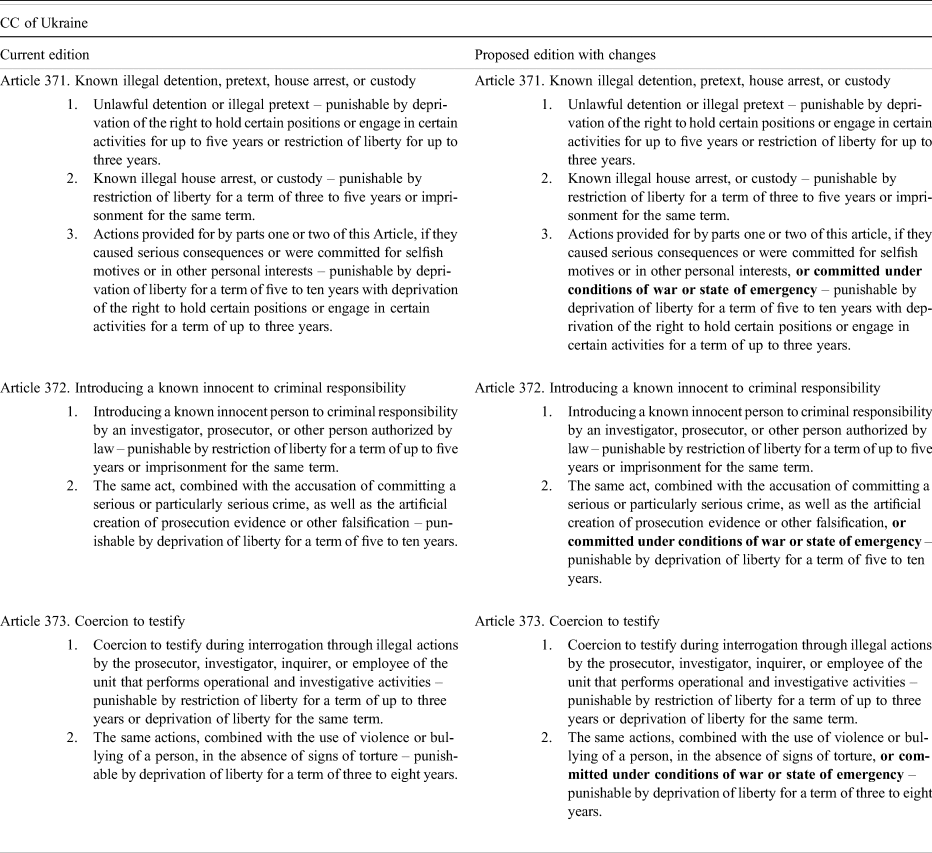
In 2023, to address the latter issue, A.V. Yatsenko, People's Deputy of the Verkhovna Rada of Ukraine, and the Law Enforcement Committee developed a project of the Law of Ukraine “On Amendments to the CC of Ukraine and the Code of Ukraine on Administrative Offenses to Increase Liability for the Commission of Property and Some Other Offenses in Conditions of War or State of Emergency,” which will provide for several legislative changes and additions to criminal liability for the commission of criminal offenses specified in articles 371–73 of the СС (Tables 8 and 9).

Survey table

Source: Compiled by the authors based on survey data.
4.1 Summarized survey data of law enforcement officers (prosecutors, heads of district offices, heads of investigative offices, investigators, investigators, and other officials) of Ukraine (in percentages, out of 370 people)
The survey's topic was “Your Opinion on the Problematic Issues of the Implementation of Criminal Liability of Officials of the Bodies of Inquiry and Pre-trial Investigation for the Commission of Criminal Offenses provided for in Articles 371–73 of the CC of Ukraine.” The survey was conducted between November 2022 and March 2023 in the cities of Kyiv and Odesa, as well as in Vinnytsia, Mykolaiv, Dnipropetrovsk, Ivano-Frankivsk, Kirovohrad, Zhytomyr, Lviv, Poltava, Chernihiv, and the Cherkasy regions.
The purpose of the survey was to ascertain respondents’ opinions on the problematic issues of the implementation of criminal responsibility of officials of inquiry and pre-trial investigation bodies for committing known illegal detention, pretext, house arrest or custody, introducing a known innocent person to criminal responsibility, and coercion to testify (articles 371–73 of the CC). Thus, the research findings should be confirmed or refuted, and the collected data can be used to draw conclusions and develop proposals (recommendations) to improve the doctrine's provisions and current criminal legislation.
The survey results are organized into figures (Figures 2–13). Respondents’ answers are analyzed and presented as a yes/no percentage ratio. For ease of understanding, the survey results are presented as diagrams.
Are you aware of any cases of criminal wrongdoing committed by officials of these bodies during an inquiry or pre-trial investigation, such as known illegal detention, pretext, house arrest or custody (article 371 of the CC of Ukraine), introducing a known innocent person to criminal responsibility (article 372 of the CC of Ukraine), or coercion to testify (article 373 of the CC of Ukraine)?
Yes (109 people, 29.45% of all interviewed people).
No (261 people, 70.55% of all interviewed people).

Are you aware of any cases of criminal offenses committed by officials of these bodies during the inquiry or pre-trial investigation, such as known illegal detention, pretext, house arrest or custody (article 371 of the CC of Ukraine), introducing a known innocent person to criminal responsibility (article 372 of the CC of Ukraine), or coercion to testify (article 373 of the CC of Ukraine)?
Yes (278 people, 75.13% of all interviewed people).
No (92 people, 24.87% of all interviewed people).

Do you believe that the process of inquiry or pre-trial investigation into the commission of criminal offenses, the responsibility for which is provided by articles 371–73 of the Ukrainian CC, can be organically combined?
Yes (316 people, 58.37% of all interviewed people). (It should be 316 in the graph.)
No (54 people, 41.63% of all interviewed people).

Do you believe the concept of justice is not fully correlated with the definition of the generic object of criminal offenses specified in chapter XVIII of Ukraine's Code of Criminal Procedure, “Criminal Offences against Justice”?
Yes (291 people, 78.6% of all interviewed people).
No (79 people, 21.36% of all interviewed people).

Do you believe that the commission of criminal offenses specified in articles 371–73 of the CC of Ukraine constitutes a crime against justice with a high degree of public danger?
Yes (302 people, 81.62% of all interviewed people).
No (68 people, 18.38% of all interviewed people).

Do you believe that the criminal offenses specified in articles 371–73 of the Ukrainian CC should be considered completed precisely from the moment of illegal (unreasonable) detention, charge, house arrest, issuance of a resolution on the application of a preventive measure regarding detention or introducing an innocent person to criminal responsibility as an accused, or obtaining evidence against the will of a person interrogated?
Yes (276 people, 74.59% of all interviewed people).
No (94 people, 25.41% of all interviewed people).

Do you believe it is necessary to provide (justify) that committing a criminal offense under article 372 of the CC of Ukraine foresees the occurrence of “severe or particularly serious consequences,” and “especially serious consequences” as a qualified sign of a criminal offense under article 371 of the CC of Ukraine?
Yes (284 people, 76.75% of all interviewed people).
No (86 people, 23.25% of all interviewed people).

Do you believe that coercion to testify, combined with the threat of violence or bullying of a person, should be included in the qualified part of part 3 of article 373 of the Ukrainian CC?
Yes (271 people, 73.24% of all interviewed people).
No (99 people, 26.76% of all interviewed people).

Do you agree with the following legislative changes to the Ukrainian CC:
1) The Special Part of the CC of Ukraine's chapter XVIII, “Criminal Offenses against Justice” shall be amended as follows:
а) subsection XVIII-I of the CC of Ukraine, “Criminal offenses against the normal activity of judicial authorities and the judicial process”;
b) subsection XVIII-II of the CC of Ukraine, “Criminal offenses against the activities of other subjects in the field of assistance and implementation of justice tasks,” to which should be attributed the composition of criminal offenses provided for in articles 371–73 of the Ukrainian CC and other crimes (articles 374–76, 382–97 of the CC of Ukraine) that contribute to the achievement of the purpose and implementation of the criminal justice tasks?
Yes (284 people, 76.75% of all interviewed people).
No (86 people, 23.25% of all interviewed people).

Do you agree with the following editing of part 3 of article 371 of the CC of Ukraine: 3. Actions covered by parts one or two of this article, if they resulted in serious or particularly serious consequences or were committed for selfish motives or other personal interests –punishable by imprisonment for five to ten years with deprivation of the right to hold certain positions or engage in certain activities for up to five years? Yes (291 people, 78.64% of all interviewed people). No (79 people, 21.36% of all interviewed people).

Do you agree with the following editing of article 372 of the CC of Ukraine:
1. Introducing an innocent person to criminal responsibility by an investigator, prosecutor, or other person authorised by law – punishable by restriction of freedom for a term of up to five years or deprivation of liberty for the same term, with a three-year restriction on holding certain positions or engaging in certain activities.
2. The same actions, combined with the accusation of committing a serious or particularly serious crime, as well as the artificial creation of evidence of the accusation or other falsification – punishable by imprisonment for three to seven years, with deprivation of the right to hold certain positions or engage in certain activities for up to five years, and property confiscation.
3. Actions specified in the first or second parts of an article, if they resulted in serious or particularly serious consequences or were committed for selfish or other personal interests – punishable by deprivation of liberty for seven to twelve years, with deprivation of the right to hold certain positions or engage in certain activities for up to five years, and confiscation of property?
Yes (273 people, 29.45% of all interviewed people).
No (97 people, 70.55% of all interviewed people).

Do you agree with the following editing of part 2 of article 373 of the CC of Ukraine:
2. The same actions, combined with the use of violence or bullying of a person, in the absence of signs of torture – punishable by deprivation of liberty for three to eight years, with deprivation of the right to hold certain positions or engage in certain activities for up to five years?
Yes (301 people, 81.35% of all interviewed people).
No (69 people, 18.65% of all interviewed people).

Conclusions
In the criminal legislation of several countries belonging to the Romano-Germanic legal tradition, criminal offenses against justice are combined into paragraphs (chapters). There are regulations on encroachment on public relations regarding the implementation of judicial proceedings and the execution of court decisions in the corresponding structural parts of the CCs. A number of norms on responsibility for encroachment on the established order of justice and execution of court decisions are contained in other structural subdivisions in the CCs of certain foreign countries (on criminal offenses in the field of official activity against the established order of administration, against citizens’ constitutional rights and freedoms, etc.). As a positive, it should be noted that the issue of the extension of norms to the jurisdictional activity of international judicial bodies and constitutional courts is regulated in the structural units on responsibility for criminal offenses against justice in the criminal legislation of certain foreign countries. In the paragraphs (chapters) on criminal offenses (crimes) against justice of most post-Soviet countries’ criminal laws, special norms have been defined that provide for the criminal liability of persons who conduct pre-trial investigations (inquiry bodies or pre-trial investigations) in connection with their activities in the administration of justice.
Recommendations
Summarizing the above, we consider it necessary to recommend:
1) Divide chapter XVIII, “Criminal Offenses against Justice” of the Special Part of the CC of Ukraine into subsections XVIII-I, “Criminal Offenses against the Normal Activity of Judicial Authorities and the Judicial Process,” to which articles 371–76 and 382–97 of the CC of Ukraine should be placed; and XVIII-II, “Criminal offenses against the activities of other subjects in the field of assistance and implementation of the tasks of justice,” to which articles 377–81 and 398–400 of the CC of Ukraine should be placed.
2) Part 3 of article 371 of the CC of Ukraine should be amended as follows:
3. Actions covered by parts one or two of this article, if they resulted in serious or particularly serious consequences or were committed for selfish motives or other personal interests – punishable by deprivation of liberty for seven to twelve years with deprivation of the right to hold certain positions or engage in certain activities for up to five years.
3) Taking into account previous scientific studies on the improvement of article 372 of the CC (“Introducing a known innocent to criminal responsibility”), we believe it necessary to detail and clarify the text of the proposed article editing, as well as explain it in such wording:
1. Introducing an innocent person to criminal responsibility by an investigator, prosecutor, or other legally authorised person, –punishable by restriction of freedom for a term of up to five years or deprivation of liberty for the same term with deprivation of the right to hold certain positions or engage in certain activities for up to three years;
2. The same act, combined with the accusation of committing a serious or particularly serious crime, as well as the artificial creation of evidence of the accusation or other falsification, – punishable by deprivation of liberty for three to seven years with deprivation of the right to hold certain positions or engage in certain activities for up to four years;
3. Actions covered by parts one or two of this article, if they resulted in serious or particularly serious consequences or were committed for selfish motives or other personal interests, – punishable by imprisonment for seven to twelve years with deprivation of the right to hold certain positions or engage in certain activities for up to five years with confiscation of property.
4) Part 2 of article 373 of the CC of Ukraine should be published as follows:
2. The same actions, combined with the use of violence or bullying of a person, in the absence of signs of torture, –punishable by deprivation of liberty for three to eight years, with deprivation of the right to hold certain positions or engage in certain activities for up to five years.