Introduction
The establishment of interactions between plants and hummingbirds evolved in several lineages of angiosperms (Fleming & Muchhala Reference Fleming and Muchhala2008) mainly derived from bee-pollinated plants (Cronk & Ojeda Reference Cronk and Ojeda2008; Thomson & Wilson Reference Thomson and Wilson2008). This transition in pollination systems apparently involved a series of morphological–physiological adaptations of flowers, either increasing the attractiveness for hummingbirds or reducing the participation of bees in interactions, as for the presence of attributes such as tubular corollas, predominance of red colour and diluted nectar production (Cronk & Ojeda Reference Cronk and Ojeda2008; Lunau et al. Reference Lunau, Papiorek, Eltz and Sazima2011; Thomson & Wilson Reference Thomson and Wilson2008). Such adaptations led to the occurrence of interactions where it is possible to recognise both the occurrence of complementary traits as well as trait convergence (Guimarães et al. Reference Guimarães, Jordano and Thompson2011; Thompson Reference Thompson2005).
Niche partitioning of interactions between hummingbirds and plants is the highest among nectarivorous birds (Zanata et al. Reference Zanata, Dalsgaard, Passos, Cotton, Roper, Maruyama, Fischer, Schleuning, Martín González, Vizentin-Bugoni, Franklin, Abrahamczyk, Alárcon, Araujo, Araújo, Azevedo-Junior, Baquero, Böhning-Gaese, Carstensen, Chupil, Coelho, Faria, Hořák, Ingversen, Janeček, Kohler, Lara, Las-Casas, Lopes, Machado, Machado, Machado, Maglianesi, Malucelli, Mohd-Azlan, Moura, Oliveira, Oliveira, Ornelas, Riegert, Rodrigues, Rosero-Lasprilla, Rui, Sazima, Schmid, Sedláček, Timmermann, Vollstädt, Wang, Watts, Rahbek and Varassin2017). Especially for tropical hummingbirds, which are inserted in communities with a greater diversity of floral resources and more specialised niches (Dalsgaard et al. Reference Dalsgaard, Magard, Fjeldsa, Martın Gonzalez, Rahbek, Olesen and Svenning2011; Fleming & Muchhala Reference Fleming and Muchhala2008). Such species-rich communities, in general, present large variation in morphological traits (Berns & Adams Reference Berns and Adams2010) where flowers with more specialised phenotypes, such as long and curved corollas, can filter their floral visitors (Cronk & Ojeda Reference Cronk and Ojeda2008; Sonne et al. Reference Sonne, Zanata, Martín González, Torres, Fjeldså, Colwell, Tinoco, Rahbek and Dalsgaard2019) leading to a reduction in interspecific competition and increasing niche partitioning (Brown & Bowers Reference Brown and Bowers1985; Maglianesi et al. Reference Maglianesi, Blüthgen, Bohning-Gaese and Schleuning2015; Maruyama et al. Reference Maruyama, Vizentin-Bugoni, Oliveira, Oliveira and Dalsgaard2014). Specialised interactions seem to predominate in plant-hummingbird interactions despite changes in corolla traits and flower abundance throughout the year with hummingbirds maintaining their preferences for morphological well-matched resources (Weinstein & Graham Reference Weinstein and Graham2017). This preference can be explained by the lower handling time required by morphological well-matched flowers in comparison to less well-matched ones (Maglianesi et al. Reference Maglianesi, Blüthgen, Bohning-Gaese and Schleuning2014). Besides this, the variability on the morphology of hummingbirds bills and corolla lengths and curvatures can contribute to reducing niche overlap and increasing specialisation at the community-level (Abrahamczyk & Kessler Reference Abrahamczyk and Kessler2010; Maglianesi et al. Reference Maglianesi, Blüthgen, Bohning-Gaese and Schleuning2015; Maruyama et al. Reference Maruyama, Vizentin-Bugoni, Oliveira, Oliveira and Dalsgaard2014). As a result, hummingbirds of different bill lengths and curvatures visit different subsets of plants (Kaehler et al. Reference Kaehler, Varassin and Goldenberg2005; Maruyama et al. Reference Maruyama, Vizentin-Bugoni, Oliveira, Oliveira and Dalsgaard2014). Therefore, morphological traits are an important factor structuring the pattern of interactions between hummingbirds and their floral resources (Maruyama et al. Reference Maruyama, Vizentin-Bugoni, Oliveira, Oliveira and Dalsgaard2014). In addition, the variability in these traits determine the niche amplitude of the interacting partner species (Maglianesi et al. Reference Maglianesi, Blüthgen, Bohning-Gaese and Schleuning2014; Maruyama et al. Reference Maruyama, Vizentin-Bugoni, Oliveira, Oliveira and Dalsgaard2014).
Usually, interaction niche partitioning is evaluated considering both ornithophilous and non-ornithophilous plants (Maglianesi et al. Reference Maglianesi, Blüthgen, Bohning-Gaese and Schleuning2014; Maruyama et al. Reference Maruyama, Sonne, Vizentin-Bugoni, Martín González, Zanata, Abrahamczyk, Alarcón, Araujo, Araújo, Baquero, Chávez-González, Coelho, Cotton, Dehling, Fischer, Kohler, Lara, Las-Casas, Machado, Machado, Maglianesi, Malucelli, Marín-Gómez, Oliveira, Ornelas, Ortiz-Pulido, Ramírez-Burbano, Rocca, Rodrigues, Rosero-Lasprilla, Rui, Sandel, Svenning, Tinoco, Varassin, Watts, Rahbek, Sazima, Schleuning and Dalsgaard2018; Tinoco et al. Reference Tinoco, Graham, Aguilar and Schleuning2017; Zanata et al. Reference Zanata, Dalsgaard, Passos, Cotton, Roper, Maruyama, Fischer, Schleuning, Martín González, Vizentin-Bugoni, Franklin, Abrahamczyk, Alárcon, Araujo, Araújo, Azevedo-Junior, Baquero, Böhning-Gaese, Carstensen, Chupil, Coelho, Faria, Hořák, Ingversen, Janeček, Kohler, Lara, Las-Casas, Lopes, Machado, Machado, Machado, Maglianesi, Malucelli, Mohd-Azlan, Moura, Oliveira, Oliveira, Ornelas, Riegert, Rodrigues, Rosero-Lasprilla, Rui, Sazima, Schmid, Sedláček, Timmermann, Vollstädt, Wang, Watts, Rahbek and Varassin2017). In this study, our goal was to understand whether the high resource partitioning in hummingbird-plant interactions is also observed among species sharing similar traits, i.e. ornithophilous species, and whether the pattern of niche partitioning is predicted by the morphological traits of interacting species. We expected a high-niche partitioning in this scenario due to a strong trait-matching between species, as it occurs with morphologically specialised hummingbirds with long or curved bills (Sonne et al. Reference Sonne, Zanata, Martín González, Torres, Fjeldså, Colwell, Tinoco, Rahbek and Dalsgaard2019). Therefore, we expected that morphology of hummingbirds would be able to predict their interactions with ornithophilous plants (Maglianesi et al. Reference Maglianesi, Blüthgen, Bohning-Gaese and Schleuning2014; Weinstein & Graham Reference Weinstein and Graham2017). Furthermore, we also expected that niche partitioning in our network would be lower than niche partitioning in interaction networks between hummingbirds and the entire plant community, because the higher morphological diversity of interaction partners in the latter scenarios tend to increase partition in resource use (Maruyama et al. Reference Maruyama, Vizentin-Bugoni, Oliveira, Oliveira and Dalsgaard2014; Rodríguez-Flores et al. Reference Rodríguez-Flores, Ornelas, Wethington and Arizmendi2019).
Methods
Study site
We conducted this study at Lago Azul State Park (LASP) located in the municipalities of Campo Mourão and Luiziana, Paraná state (52° 20'W and 24° 04'S). LASP has 670 ha covered with vegetation. Rainfall tends to occur in the months corresponding to the summer season, without a defined dry season. The annual average temperature is 17.2oC and rainfall around 1,450 mm per year (IAP/DIBAP 2005). The native vegetation of the region consists of semi-deciduous montane forest (Roderjan et al. Reference Roderjan, Galvão, Kuniyoshi and Hatschback2002), presenting also small fragments of Cerrado, a savanna physiognomy (Hatschbach & Ziller Reference Hatschbach and Ziller1995), and Araucaria angustifolia trees.
Hummingbird-plant network
To construct the hummingbird-plant network, we recorded interactions of the most abundant ornithophilous species, selected based on their floral traits: diurnal anthesis, vivid colours, tubular flowers, absence of odours (Faegri and van der Pijl Reference Faegri and van der Pijl1971): Aechmea distichantha, Erythrina crista-galli, Erythrina falcata, Erythrina speciosa, Helicteres brevispira, Justicia brasiliana and Pyrostegia venusta, occurring in existing trails and edges of LASP between 18 months (January 2010 to September 2011). We focused on the most abundant species because a high number of flowers was required for measurements of nectar and traits. According to the local herbarium, there are about 32 ornithophilous species registered in the LASP (HCF 2021). We observed interactions in the morning, from 6 am to 12 pm, with the help of Nikon 10x50 binoculars when necessary. Hummingbirds were identified using identification guides (Sick Reference Sick2001; Souza Reference Souza2004). To describe the recorded interactions, we built an adjacency matrix of hummingbirds and plants. In this matrix, hummingbird species were included as columns, plant species as rows, whereas the frequency of interaction between each pair of species was described in the cells. Interaction frequencies were reported as the number of visits made by each hummingbird species to a given ornithophilous plant. Whenever necessary, we converted this weighted matrix in a binary matrix, which describes only the presence and absence of pairwise interactions.
Interaction niche partitioning
To assess interaction partitioning among hummingbirds and ornithophilous plants at the community-level, we selected two binary network metrics, connectance (C, Blüthgen Reference Blüthgen2010) and binary modularity (Q b , Olesen et al. Reference Olesen, Bascompte, Dupont and Jordano2007), as well as two weighted metrics, complementary specialisation (H 2 ’, Blüthgen et al. Reference Blüthgen, Menzel and Blüthgen2006) and weighted modularity (Q, Dormann & Strauss Reference Dormann and Strauss2014). Connectance quantifies the proportion of observed pairwise interactions among all possible pairwise interactions in the community, which is obtained by the multiplication of the number of hummingbird and plant species in the matrix (Blüthgen Reference Blüthgen2010). To be confident that our assessment of connectance was not biased by sampling effects, we calculate interaction sampling completeness based on the Chao1 estimator of species richness (Chao Reference Chao1984; Colwell & Coddington Reference Colwell and Coddington1994) adapted to estimate interaction richness (Chacoff et al. Reference Chacoff, Vazquez, Lomascolo, Stevani, Dorado and Padron2012). We calculated sampling completeness as the ratio of the observed and estimated richness of interactions (Chacoff et al. Reference Chacoff, Vazquez, Lomascolo, Stevani, Dorado and Padron2012). The Chao1 estimator was computed using the ‘iNEXT’ package (Hsieh et al. Reference Hsieh, Ma and Chao2014) in R (R Development Core Team 2019). Modularity detects the occurrence of groups of species, i.e. modules, which tend to interact more among each other than with the remaining species in the community (Dormann & Strauss Reference Dormann and Strauss2014; Olesen et al. Reference Olesen, Bascompte, Dupont and Jordano2007). To detect modules, we took into account occurrence of pairwise interactions only, for binary networks (Q b , Olesen et al. Reference Olesen, Bascompte, Dupont and Jordano2007), or the frequency of interaction, for weighted networks (Q, Dormann & Strauss Reference Dormann and Strauss2014). Binary and weighted modularity were quantified through the algorithm proposed by Dormann & Strauss (Reference Dormann and Strauss2014). Finally, complementary specialisation evaluates the exclusiveness of interactions by describing the deviation from a neutral interaction structure expected only by the frequency of interaction between pairwise species (Blüthgen Reference Blüthgen2010; Blüthgen et al. Reference Blüthgen, Menzel and Blüthgen2006). Therefore, these different network metrics can describe complementary interaction niche partitioning at the community-level. We also explored niche partitioning using the complementary specialisation index at the species-level for hummingbirds (d’, Blüthgen et al. Reference Blüthgen, Menzel and Blüthgen2006). By the same method as its community counterpart, d’ describes exclusiveness of interactions from the deviation of an interaction pattern expected solely by species interaction frequencies (Blüthgen Reference Blüthgen2010; Blüthgen et al. Reference Blüthgen, Menzel and Blüthgen2006). Thus, species with high-interaction exclusiveness are those that interact regularly with a infrequently visited plant species (Blüthgen Reference Blüthgen2010). Metric values vary from 0 to 1, with 0 reflecting extremely generalised interactions and 1 describing a highly specialised resource use (Blüthgen Reference Blüthgen2010; Blüthgen et al. Reference Blüthgen, Menzel and Blüthgen2006; Dormann & Strauss Reference Dormann and Strauss2014), with opposite values for connectance (Blüthgen Reference Blüthgen2010). However, except for connectance, values close to 1 are rarely detected in hummingbird-plant interaction networks (Zanata et al. Reference Zanata, Dalsgaard, Passos, Cotton, Roper, Maruyama, Fischer, Schleuning, Martín González, Vizentin-Bugoni, Franklin, Abrahamczyk, Alárcon, Araujo, Araújo, Azevedo-Junior, Baquero, Böhning-Gaese, Carstensen, Chupil, Coelho, Faria, Hořák, Ingversen, Janeček, Kohler, Lara, Las-Casas, Lopes, Machado, Machado, Machado, Maglianesi, Malucelli, Mohd-Azlan, Moura, Oliveira, Oliveira, Ornelas, Riegert, Rodrigues, Rosero-Lasprilla, Rui, Sazima, Schmid, Sedláček, Timmermann, Vollstädt, Wang, Watts, Rahbek and Varassin2017), as well as in other pollination systems (Schleuning et al. Reference Schleuning, Fründ, Klein, Abrahamczyk, Alarcón, Albrecht, Andersson, Bazarian, Böhning-Gaese, Bommarco, Dalsgaard, Dehling, Gotlieb, Hagen, Hickler, Holzschuh, Kaiser-Bunbury, Kreft, Morris, Sandel, Sutherland, Svenning, Tscharntke, Watts, Weiner, Werner, Williams, Winqvist, Dormann and Blüthgen2012).
To evaluate if network structure significantly deviates from a pattern expected by chance due to species interaction frequencies (Patefield Reference Patefield1981), we generated 1,000 random matrices for C, H 2 ’ and d’ and 100 for Q b and Q. To generate randomised matrices, we fixed matrix size, which biologically represents community richness, as well as matrix marginal totals, which biologically represents the interaction frequencies of each species (method r2dtable in nullmodel function, ‘bipartite’ package, Dormann et al. Reference Dormann, Frueund, Blüthgen and Gruber2009). After fixing these network parameters, pairwise interactions were randomly distributed along the matrix (Patefield Reference Patefield1981). Randomised weighted matrices were transformed to binary matrices before quantifying connectance and binary modularity. We built fewer random matrices for modularity because they are highly computationally intensive algorithms (Dormann & Strauss Reference Dormann and Strauss2014). To detect the highest modularity values, we re-ran the analyses five times for both observed and each randomised matrix. To detect if the observed niche partitioning in the interaction network between hummingbirds and ornithophilous plants is similar while considering the entire plant community, i.e. interactions with ornithophilous and non-ornithophilous species, we used a published database of interaction partitioning of hummingbirds and entire plant communities (Maruyama et al. Reference Maruyama, Sonne, Vizentin-Bugoni, Martín González, Zanata, Abrahamczyk, Alarcón, Araujo, Araújo, Baquero, Chávez-González, Coelho, Cotton, Dehling, Fischer, Kohler, Lara, Las-Casas, Machado, Machado, Maglianesi, Malucelli, Marín-Gómez, Oliveira, Ornelas, Ortiz-Pulido, Ramírez-Burbano, Rocca, Rodrigues, Rosero-Lasprilla, Rui, Sandel, Svenning, Tinoco, Varassin, Watts, Rahbek, Sazima, Schleuning and Dalsgaard2018). First, we selected only those networks sampled in the Atlantic Forest (n = 16; Maruyama et al. Reference Maruyama, Sonne, Vizentin-Bugoni, Martín González, Zanata, Abrahamczyk, Alarcón, Araujo, Araújo, Baquero, Chávez-González, Coelho, Cotton, Dehling, Fischer, Kohler, Lara, Las-Casas, Machado, Machado, Maglianesi, Malucelli, Marín-Gómez, Oliveira, Ornelas, Ortiz-Pulido, Ramírez-Burbano, Rocca, Rodrigues, Rosero-Lasprilla, Rui, Sandel, Svenning, Tinoco, Varassin, Watts, Rahbek, Sazima, Schleuning and Dalsgaard2018). Then, we quantified the mean and standard deviation values of the available metrics (H 2 ’ and Q) and compared with the values obtained in our study. Network indexes were quantified through the ‘bipartite’ package in R (Dormann et al. Reference Dormann, Frueund, Blüthgen and Gruber2009).
Effects of traits on hummingbird-plant interactions
To detect the influence of hummingbirds’ traits in their foraging preferences, we applied the methodological framework proposed by Dehling et al. (Reference Dehling, Jordano, Schaefer, Böhning-Gaese and Schleuning2016), which combines analytical tools from the fields of functional and network ecology. First, we plotted hummingbird and plant species into their functional space. For this, we selected hummingbird traits that are known to affect flower visitation: bill length, bill curvature and wing chord (Maglianesi et al. Reference Maglianesi, Blüthgen, Bohning-Gaese and Schleuning2014). Bird traits were measured on 10 museum specimens (details about measurements can be found in Zanata et al. (Reference Zanata, Dalsgaard, Rahbek and Varassin2019), whereas species values are available in Table S2). For plant species, we also selected traits that are known to influence flower visitation by hummingbirds: corolla functional length, corolla base diameter and nectar volume (Temeles et al. Reference Temeles, Linhart, Masonjones and Masonjones2002). The variation found around the measurements of floral species (measured by coefficients of variation [CV]) show enough amplitude to detect the preference of hummingbirds for flowers with similar traits. Plant traits were measured in the field, with exception to nectar volume of Erythrina falcata, which was obtained from literature (Etcheverry & Alemán Reference Etcheverry and Alemán2005, details about plant measurements and species values are available in Table S3). To detect trait differences between species, we have calculated the Euclidean distances of standardised traits, zero mean and unit variance. Then, we have plotted species into their three-dimensional functional space using principal component analysis (PCA) (Borcard et al. Reference Borcard, Gillet and Legendre2011). The analyses were performed separately for hummingbirds and plants.
To determine if hummingbird traits are associated with the traits of flowers they visit, we projected each hummingbird species into the functional space of its nectar resources. Then, we calculated the weighted functional centroid of the set of plants visited by each hummingbird. The weighting was done by the interaction strength between each pair of hummingbird and plant species. Interaction strength represents the proportion of interactions recorded by a given hummingbird species and each plant species it visited in relation to the total number of interactions recorded by this hummingbird species. Finally, to assess the influence of hummingbird traits into their foraging preferences, we compared the position of hummingbird species in their functional space and the functional space of the plants they visited through Procrustes analysis (Dehling et al. Reference Dehling, Jordano, Schaefer, Böhning-Gaese and Schleuning2016). All analyses were performed in R (R Development Core Team 2019).
Results
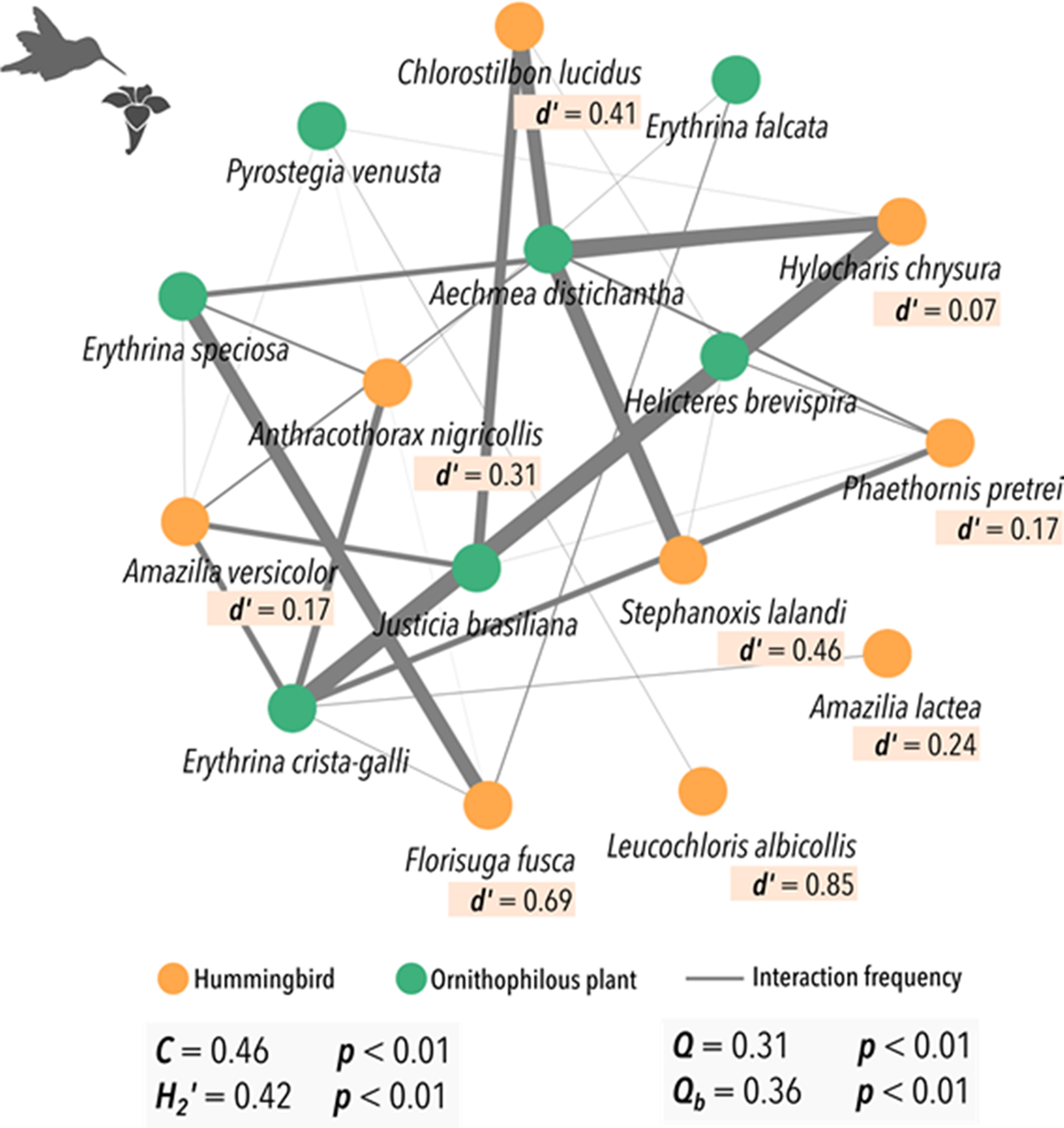
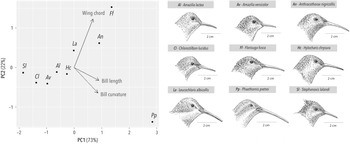
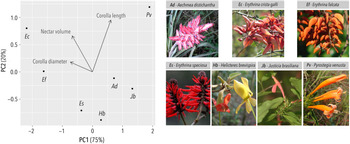
We recorded 948 visits between nine hummingbird and seven ornithophilous plant species belonging to five families, with Fabaceae being the richer family (three species) (Figure 1, Table S3). Sampling completeness indicates that we recorded 99.4% of the interactions (Figure S1). Interaction niche partitioning among hummingbirds and plants are more specialised than expected by species interaction frequencies (C = 0.46, p < 0.01; Q b = 0.31, p < 0.01; H 2 ’ = 0.42, p < 0.01; Q = 0.36, p < 0.01, Figure 1). The observed values are similar to the mean value detected in hummingbird-plant networks including ornithophilous and non-ornithophilous species at the Atlantic Forest (H 2 ’: μ = 0.48, σ = 0.19; Q: μ = 0.37, σ = 0.15, data from Maruyama et al. Reference Maruyama, Sonne, Vizentin-Bugoni, Martín González, Zanata, Abrahamczyk, Alarcón, Araujo, Araújo, Baquero, Chávez-González, Coelho, Cotton, Dehling, Fischer, Kohler, Lara, Las-Casas, Machado, Machado, Maglianesi, Malucelli, Marín-Gómez, Oliveira, Ornelas, Ortiz-Pulido, Ramírez-Burbano, Rocca, Rodrigues, Rosero-Lasprilla, Rui, Sandel, Svenning, Tinoco, Varassin, Watts, Rahbek, Sazima, Schleuning and Dalsgaard2018). We also detected niche partitioning at the species-level, with interaction exclusiveness higher than expected by frequency of interaction for all hummingbird species (d’ = 0.07–0.85, p < 0.001, Figure 1). Plant and hummingbird species varied across the functional space of their traits. The floral trait that most varied was nectar volume (CV = 114.9%) and for hummingbirds, bill curvature (CV = 60.7%) (Tables S2 and S3). For hummingbirds, the first axis of the functional space was mostly related to bill length and curvature (Figure 2), and for plants, corolla diameter (Figure 3). There was no influence of hummingbird traits into their foraging preferences on ornithophilous plants (Procrustes SS = 0.80, Procrustes r = 0.44, p > 0.05).
Niche partitioning between hummingbirds and ornithophilous plants in a semi-deciduous seasonal forest in Paraná, Brazil. All network metric values deviated from a neutral configuration based solely on species interaction frequencies. The density of lines describes the frequency of interaction between species, with thicker lines representing higher interaction frequencies. Network metrics: connectance (C), complementary specialisation (H 2 ’ and d’), and binary and weighted modularity (Q b and Q).

Functional space of nine species of hummingbirds recorded visiting ornithophilous species in a semi-deciduous seasonal forest in Paraná, Brazil. Drawings by Diana Carneiro.

Functional space of seven ornithophilous species of plants in semi-deciduous seasonal forest in Paraná, Brazil.

Discussion
The pattern of niche partitioning between hummingbirds and ornithophilous plants at the community and species-level supports our hypothesis that between well-matched flowers there is specialisation in the use of resources. Surprisingly, different to our expectation, we found the same levels of niche partitioning as detected for hummingbird networks encompassing both ornithophilous and non-ornithophilous plants. Contrary to expected, hummingbirds’ traits were not able to predict their interactions with ornithophilous plants.
Although there is niche partitioning between hummingbirds and ornithophilous plants, the pattern detected indicates that plants with the same pollination syndrome, i.e. morphological convergence, are able to interact with several hummingbirds in the community. This pattern is similar to the interactions of a hummingbird-ornithophilous plant network recorded in forest fragments of Cerrado in Brazil (Matias et al. Reference Matias, Maruyama and Consolaro2016). Nevertheless, generalisation can be even higher in a temperate community of hummingbirds and ornithophilous plants in Arizona, EUA, where almost all hummingbird species tend to interact with red and tubular flowers (Brown & Kodric-Brown Reference Brown and Kodric-Brown1979). In this area, the mechanism that decreases interspecific competition among plant species is a trait displacement in the position and orientation of anthers and stigma resulting in pollen deposition in different parts of the hummingbird (Brown & Kodric-Brown Reference Brown and Kodric-Brown1979). Trait displacement of anthers and stigma is also described for tropical communities of hummingbirds and morphologically well-matched flowers (Bergamo et al. Reference Bergamo, Wolowski, Maruyama, Vizentin-Bugoni and Sazima2018; Stiles Reference Stiles1975), and could be one of the mechanisms allowing the co-occurrence of ornithophilous plants in our system.
We also found that the specialisation that we detected is similar to the mean values described for niche partitioning in plant-hummingbird interactions for several communities (Zanata et al. Reference Zanata, Dalsgaard, Passos, Cotton, Roper, Maruyama, Fischer, Schleuning, Martín González, Vizentin-Bugoni, Franklin, Abrahamczyk, Alárcon, Araujo, Araújo, Azevedo-Junior, Baquero, Böhning-Gaese, Carstensen, Chupil, Coelho, Faria, Hořák, Ingversen, Janeček, Kohler, Lara, Las-Casas, Lopes, Machado, Machado, Machado, Maglianesi, Malucelli, Mohd-Azlan, Moura, Oliveira, Oliveira, Ornelas, Riegert, Rodrigues, Rosero-Lasprilla, Rui, Sazima, Schmid, Sedláček, Timmermann, Vollstädt, Wang, Watts, Rahbek and Varassin2017), and close to the mean for plant-hummingbird interactions at the Atlantic Forest (Maruyama et al. Reference Maruyama, Sonne, Vizentin-Bugoni, Martín González, Zanata, Abrahamczyk, Alarcón, Araujo, Araújo, Baquero, Chávez-González, Coelho, Cotton, Dehling, Fischer, Kohler, Lara, Las-Casas, Machado, Machado, Maglianesi, Malucelli, Marín-Gómez, Oliveira, Ornelas, Ortiz-Pulido, Ramírez-Burbano, Rocca, Rodrigues, Rosero-Lasprilla, Rui, Sandel, Svenning, Tinoco, Varassin, Watts, Rahbek, Sazima, Schleuning and Dalsgaard2018). Therefore, the specialisation in plant-hummingbird interactions, described for several communities (Zanata et al. Reference Zanata, Dalsgaard, Passos, Cotton, Roper, Maruyama, Fischer, Schleuning, Martín González, Vizentin-Bugoni, Franklin, Abrahamczyk, Alárcon, Araujo, Araújo, Azevedo-Junior, Baquero, Böhning-Gaese, Carstensen, Chupil, Coelho, Faria, Hořák, Ingversen, Janeček, Kohler, Lara, Las-Casas, Lopes, Machado, Machado, Machado, Maglianesi, Malucelli, Mohd-Azlan, Moura, Oliveira, Oliveira, Ornelas, Riegert, Rodrigues, Rosero-Lasprilla, Rui, Sazima, Schmid, Sedláček, Timmermann, Vollstädt, Wang, Watts, Rahbek and Varassin2017), is maintained when we consider only ornithophilous plants. Niche partitioning between hummingbirds and ornithophilous flowers was also detected at the species-level, where all hummingbirds showed a higher exclusiveness of interactions than expected by frequency of interactions alone. This result indicates that there is a preference in resource use at the species-level that is not explained by neutral factors, such as abundance of interactions (Blüthgen et al. Reference Blüthgen, Menzel and Blüthgen2006). Our system holds four clades of hummingbirds: Emeralds, Mangoes, Topazes and Hermits (McGuire et al. Reference McGuire, Witt, Remsen, Corl, Rabosky, Altshuler and Dudley2014). Emerald clade was represented by six out of nine species recorded. Emeralds, a recent and generalist clade (Tripp & MacDade Reference Tripp and McDade2013), are known to interact with a great diversity of distantly-related plant families and are less morphologically specialised (Rodríguez-Flores et al. Reference Rodríguez-Flores, Ornelas, Wethington and Arizmendi2019). On the other hand, hummingbirds belonging to the oldest clades (Mangoes, Topazes, and Hermits; Tripp & MacDade Reference Tripp and McDade2013) tend to be more specialised in their interactions (Rodríguez-Flores et al. Reference Rodríguez-Flores, Ornelas, Wethington and Arizmendi2019). However, in our system an Emerald, Leucochloris albicollis, showed the most specialised interaction, whereas Phaethornis petrei, a Hermit, exhibited a higher generalisation in resource use. This result indicates that, although community-level of specialisation can be similar when we investigate resource use of ornithophilous plants only or the entire plant community, as discussed above, the relationship between hummingbird clades and their level of interaction specialisation is dependent on the biological scale investigated. In the scenario where both ornithophilous and entomophilous plants are evaluated, Mangoes, Topazes and Hermits show higher levels of specialisation because they tend to visit higher well-matched resources, such as ornithophilous plants, whereas Emeralds visit both entomophilous and ornithophilous plants, but only those ornithophilous plants that have less restrictive morphologies (Maruyama et al. Reference Maruyama, Vizentin-Bugoni, Oliveira, Oliveira and Dalsgaard2014; Stiles Reference Stiles1975). Therefore, this infrequent visits of Emeralds on ornithophilous flowers will reflect on higher levels of interaction specialisation when we focus on ornithophilous flowers only.
Among the non-neutral factors structuring interactions between hummingbird and plants, morphology is one of the most prevalent processes predicting the pattern of interactions in this system (Bergamo et al. Reference Bergamo, Wolowski, Maruyama, Vizentin-Bugoni and Sazima2018; Maglianesi et al. Reference Maglianesi, Blüthgen, Bohning-Gaese and Schleuning2014; Maruyama et al. Reference Maruyama, Vizentin-Bugoni, Oliveira, Oliveira and Dalsgaard2014; Vizentin-Bugoni et al. Reference Vizentin-Bugoni, Maruyama and Sazima2014). However, curiously, hummingbird traits are not correlated with the phenotypic features of the array of floral resources visited by each species in our network. This results indicates that corolla length and diameter, as well as nectar volume are not constraints for hummingbird visits on ornithophilous plant species. Plant species that share pollinators may face competitive exclusion due to decrease in fitness by reduction in rates of pollinator visits or increase of heterospecific pollen (Sargent & Ackerly Reference Sargent and Ackerly2008). On the other hand, these plants can also facilitate their reproductive success through co-flowering patterns, increasing the chance to attract and maintain pollinators in the area (Moeller Reference Moeller2004). Therefore, the occurrence of these different processes, such as facilitation and competition, in the same assemblage may hinder the likelihood to predict the interactions based on floral traits. Indeed, for hummingbird pollination systems, within the same pollination niche, the structure of floral traits – similarity or divergence – is associated with the balance of facilitative and competitive interactions (Bergamo et al. Reference Bergamo, Wolowski, Maruyama, Vizentin-Bugoni and Sazima2018). Besides that, in systems where the entire plant community is analysed, it is expected an expansion in the morphological space of both plants and hummingbirds, including also clades with small and straight bills that tend to visit entomophilous flowers (Rodriguez-Flores et al. Reference Rodríguez-Flores, Ornelas, Wethington and Arizmendi2019), such as Bees and Coquettes (McGuire et al. Reference McGuire, Witt, Remsen, Corl, Rabosky, Altshuler and Dudley2014). This may increase the importance of morphology in predicting interaction patterns (Maglianesi et al. Reference Maglianesi, Blüthgen, Bohning-Gaese and Schleuning2014; Maruyama et al. Reference Maruyama, Vizentin-Bugoni, Oliveira, Oliveira and Dalsgaard2014; Vizentin-Bugoni et al. Reference Vizentin-Bugoni, Maruyama and Sazima2014). Therefore, as discussed above for the patterns of level of specialisation at the species-level, our findings suggest that the importance of phenotypic traits in predicting hummingbird-plant interactions is dependent on the biological scale of the plant community evaluated in each system.
In conclusion, our results show that the local pattern of interaction network among ornithophilous plants replicates the pattern from the whole system, but the level of specialisation of hummingbirds’ species is dependent on the biological scale of the plant community evaluated. This indicates that we cannot downscale the patterns from biological large-grained to fine-grained scales. Besides that, because the traits of hummingbirds was not able to predict their interactions with ornithophilous plants, we expect that a balance between facilitative and competitive interactions might be occurring, leading to some trait mismatching and maintaining some partitioning among species.
Supplementary material
To view supplementary material for this article, please visit https://doi.org/10.1017/S026646742100033X.
Acknowledgements
We thank Matthias Dehling for sharing R code for morphological analysis and CNPq for financial support (TBZ, PDSE n. 8105/2014-6; IGV, ‘Projeto Universal’ n. 445405/2014-7; PQ grant n. 313801/2017-7). This study was financed in part by the Coordenação de Aperfeiçoamento de Pessoal de Nível Superior - Brasil (CAPES) – Finance Code 001 (to TBZ and ROB). Competing interests: The authors declare none.