INTRODUCTION
Habitat structure plays a very important role in marine benthic ecosystems. Benthic organisms depend on substrates, not only for physical support, but also for food supply and shelter (Sebens, Reference Sebens, Bell, McCoy and Mushinsky1991). The increase of habitat structural complexity enhances the availability of microhabitats and trophic niches which, in turn, affects species interaction and diversity (Huston, Reference Huston1979). Affecting the processes that shape the presence, abundance and distribution of species (Orth et al., Reference Orth, Heck and von Montfrans1984; Beck, Reference Beck2000), habitat structure may also influence the functioning of food webs. Consumers will feed on prey depending on: (i) their trophic guilds and the ability to capture the prey; (ii) their preferences for a particular prey; and (iii) the abundance of each prey in their habitat. Moreover, in shallow rocky marine habitats, the particular predator–prey combinations will be strongly influenced by vegetation characteristics (Heck & Crowder, Reference Heck, Crowder, Bell, McCoy and Mushinsky1991), with marine algae being important contributors to structure the habitat in terms of complexity and heterogeneity. Indeed, macrophytes act as ecosystem engineers, creating or modifying the habitat and, consequently, influencing the associated epifauna.
Therefore disturbance events, such as the introduction of invasive seaweed species can modify habitat structure and consequently, result in large ecological effects (see a review in Williams & Smith, Reference Williams and Smith2007). Such species can restructure and radically change the functioning of the recipient habitat (Crooks, Reference Crooks2002), determining the biota that will become associated with the habitat. For instance, some studies have shown negative effects on feeding habits of herbivorous, such as littorine snails, sea urchins and fishes, caused by different invasive seaweeds in the Atlantic and Pacific Oceans (Stimson et al., Reference Stimson, Larned and Conklin2001; Britton-Simmons, Reference Britton-Simmons2004; Chavanich & Harris, Reference Chavanich and Harris2004). In the Mediterranean Sea, which is the most heavily invaded marine region in the world with respect to introduced seaweeds (Williams & Smith, Reference Williams and Smith2007), it was found that the invasive alga Caulerpa taxifolia is not a suitable diet for the widespread sea urchin Paracentrotus lividus (Boudouresque et al., Reference Boudouresque, Lemee, Mari and Meinesz1996).
Caulerpa racemosa var. cylindracea (hereafter C. racemosa) is one of the most invasive seaweeds in the Mediterranean Sea. Some studies have demonstrated negative effects of C. racemosa on native seaweeds (Piazzi et al., Reference Piazzi, Ceccherelli and Cinelli2001, Reference Piazzi, Balata, Cecchi and Cinelli2003; Balata et al., Reference Balata, Piazzi and Cinelli2004), on invertebrate assemblages (Vázquez-Luis et al., Reference Vázquez-Luis, Sanchez-Jerez and Bayle-Sempere2008, Reference Vázquez-Luis, Guerra-García, Sanchez-Jerez and Bayle-Sempere2009a), on food choice of invertebrates (gastropods) (Gianguzza et al., Reference Gianguzza, Airoldi, Chemello, Todd and Riggio2002) and on prey availability for fish (Vázquez-Luis et al., Reference Vázquez-Luis, Sanchez-Jerez and Bayle-Sempere2010). Other studies have found positive effects by increasing abundances of polychaete assemblages (Argyrou et al., Reference Argyrou, Demetropoulos and Hadjichristophorou1999; Box et al., Reference Box, Martin and Deudero2010). In addition, recent studies have demonstrated that some fish species, such as Sarpa salpa and Spondyliosoma cantharus, consume C. racemosa (Box et al., Reference Box, Deudero, Sureda, Blanco, Alos, Terrados, Grau and Riera2009; Tomas et al., Reference Tomas, Box and Terrados2010, Reference Tomas, Cebrian and Ballesteros2011); although the first one suggested that this ingestion might be unintentional. In the case of seagrass density no consistent pattern was found (Ceccherelli & Cinelli, Reference Ceccherelli and Cinelli1997; Ceccherelli & Campo, Reference Ceccherelli and Campo2002). Therefore, the possibility that positive or negative effects happen cannot be ruled out (Dumay et al., Reference Dumay, Fernandez and Pergent2002).
Amphipods are one of the most ubiquitous and abundant invertebrate groups in marine vegetated habitats, with densities often reaching several thousands of individuals per square metre (Brawley, Reference Brawley, John, Hawkins and Price1992; Vázquez-Luis et al., Reference Vázquez-Luis, Sanchez-Jerez and Bayle-Sempere2008). They are important secondary producers and exhibit diverse feeding strategies: grazing, filter and detritic feeding, predation and scavenging (macrophagy and microphagy) (Carrasco & Arcos, Reference Carrasco and Arcos1984; Highsmith & Coyle, Reference Highsmith and Coyle1990; Sarvala & Uitto, Reference Sarvala and Uitto1991). These various feeding modes are sometimes used simultaneously or successively according to ambient conditions (Ruffo, Reference Ruffo1998). Morever, amphipods are a food source for a large variety of marine predators (Stoner, Reference Stoner1979; Beare & Moore, Reference Beare and Moore1997; Sanchez-Jerez et al., Reference Sanchez-Jerez, Barberá-Cebrián and Ramos-Esplá1999; Stål et al., Reference Stål, Pihl and Wennhage2007), hence playing a key role in energy flow through food webs (Vázquez-Luis et al., Reference Vázquez-Luis, Sanchez-Jerez and Bayle-Sempere2010).
Amphipods are also known to respond to habitat modification (Sanchez-Jerez et al., Reference Sanchez-Jerez, Barberá-Cebrián and Ramos-Esplá1999); some species exhibit high habitat specificity while others tolerate a range of habitat alteration that may result from pollution, invasion by alien species and other disturbance. Therefore some species of amphipods are good indicators of environmental impacts on vegetated habitats (Bellan-Santini, Reference Bellan-Santini1980; Virnstein, Reference Virnstein1987; Conradi et al., Reference Conradi, López-González and García-Gómez1997; Sanchez-Jerez et al., Reference Sanchez-Jerez, Barberá-Cebrián and Ramos-Esplá2000; Carvalho et al., Reference Carvalho, Moura and Sprung2006). It is known that C. racemosa changes the amphipod community in terms of abundance and species richness, and some amphipod species exist in both native and invaded habitats (Vázquez-Luis et al., Reference Vázquez-Luis, Sanchez-Jerez and Bayle-Sempere2008, Reference Vázquez-Luis, Sanchez-Jerez and Bayle-Sempere2009b). However, it is still poorly known if these species are using the same trophic resources. The main objective of this study is to asses if the feeding habits of amphipods associated with coastal seaweeds are affected by the spread of the invasive C. racemosa, through stomach content analysis of amphipods living in both native and invaded seaweed assemblages.
MATERIALS AND METHODS
Based on a previous study (Vázquez-Luis et al., Reference Vázquez-Luis, Sanchez-Jerez and Bayle-Sempere2008) we selected 10 species of amphipods that were common to the studied habitats (native algae and C. racemosa). Additionally, 4 other species (2 exclusive of each habitat) were also selected. Ten individuals per species and habitat were used in the present study (for further details on distribution and characteristics of habitats see Vázquez-Luis et al., Reference Vázquez-Luis, Sanchez-Jerez and Bayle-Sempere2008). Therefore, the gut contents of a total of 240 specimens of 14 amphipod species were examined following the methodology proposed by Bello & Cabrera (Reference Bello and Cabrera1999) with slight variations (Tierno de Figueroa et al., Reference Tierno de Figueroa, Vera and López-Rodríguez2006; Guerra-García & Tierno de Figueroa, Reference Guerra-García and Tierno de Figueroa2009). Each individual was added to a vial with Hertwig's liquid (consisting of 270 g of chloral hydrate, 19 ml of chloridric acid 1 N, 150 ml of distilled water and 60 ml of glycerin) and heated in an oven at 65°C for 3 to 6 hours, depending on the cuticle thickness of the specimens. After this, they were mounted on slides for examination under the microscope, equipped with an ocular micrometer.
The relevance of stomach contents in the amphipods studied was evaluated by calculating the percentage of the absolute gut content (%GC = total area occupied by the content in the whole digestive tract), and vacuity index (VI = 100 × [number of empty stomachs/total number of stomachs analysed]); both values will help to evaluate the importance of gut contents. The importance of different prey types was evaluated by calculating the relative gut content (Ab = area occupied for each component within the total gut content), and the frequency of occurrence (Oc = 100 × [number of stomachs containing prey i/total number of stomachs containing prey]) of each prey item. A permutational multivariate analysis of variance (PRIMER 6 and PERMANOVA: Clarke & Gorley, Reference Clarke and Gorley2006) was used to test differences in amphipod gut content composition between the two habitats studied. When factors showed significant differences, a pairwise test was carried out to test differences among groups. The PERMANOVA analyses incorporated two factors: (i) ‘Habitat' (fixed and orthogonal) with two levels: native algae and C. racemosa; and (ii) ‘Species' (fixed and orthogonal) with ten levels (the ten species presented in both habitat types): Apocorophium acutum, Ampithoe ramondi, Caprella grandimana, Caprella hirsuta, Dexamine spiniventris, Elasmopus brasiliensis, Elasmopus pocillimanus, Lysianassa costae, Microdeutopus obtusatus and Stenothoe monoculoides. Non-parametric multidimensional scaling (MDS) was used as the ordination method for exploring affinities among species and habitats according to the dietary analysis (PRIMER software: Clarke, Reference Clarke1993). The similarity matrix, which was calculated using the Bray–Curtis index and using fourth-root transformed data, was used to construct bivariate MDS plots.
RESULTS
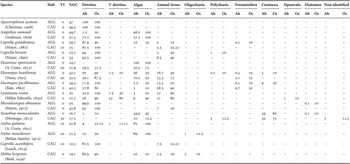
Two hundred and forty specimens of 14 species and from two habitats were examined (Table 1). The VI or percentage of empty stomachs ranged from 0 to 30 (Table 1). For the species common to both habitats, the higher proportions of empty guts were observed in specimens collected within C. racemosa when compared to native habitats, more specifically in species Stenothoe monoculoides (VI = 30), Dexamine spiniventris (VI = 20), Elasmopus brasiliensis (VI = 20) and Caprella grandimana (VI = 10). Among the species exclusive of a single habitat, only Melita hergensis showed VI = 0 (Table 1). Digestive contents were found in 229 specimens (95.4%) belonging to all species.
Gut contents of the species studied in the different habitats. Hab, habitat; VI, vacuity index; %GC, total gut content occupied in the whole digestive tract; V detritus, vegetal detritus; Ab, mean abundance of each item (%); Oc, frequency of occurrence of each item (%); ALG, native seaweeds; CAU, Caulerpa racemosa.

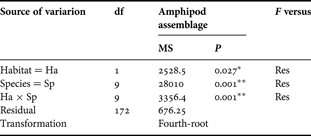
The total area occupied by the content in the whole digestive tract ranged from 16.7% for S. monoculoides to 55% for Microdeutopus obtusatus, both in native algae. Gut contents of the studied amphipod species included 11 items: detritus (organic and inorganic thin particles); vegetal detritus (vegetal debris); algae; animal tissue; oligochaeta; polychaeta; foraminifera; crustacea (mainly copepods); sipuncula; diatoms; and non-identified items. Food items for each species and by habitat are described in Table 1. The multivariate response of amphipod gut content composition showed significant differences between the two habitats studied (PERMANOVA, Ha × Sp, P < 0.01: Table 2). After the pair-wise test, A. ramondi, E. pocillimanus and L. costae present different feeding habits in the two habitat types. For the rest of the species no significant differences were found.
Results of the multivariate analysis PERMANOVA for gut contents of amphipods among habitats. MS, mean square; P, level of significance; df, degrees of freedom; **, significant (P < 0.01).
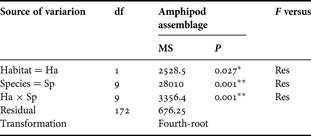
Post-hoc test: Ampithoe ramondi, Elasmopus pocillimanus and Lysianassa costae: Caulerpa racemosa≠native algae.
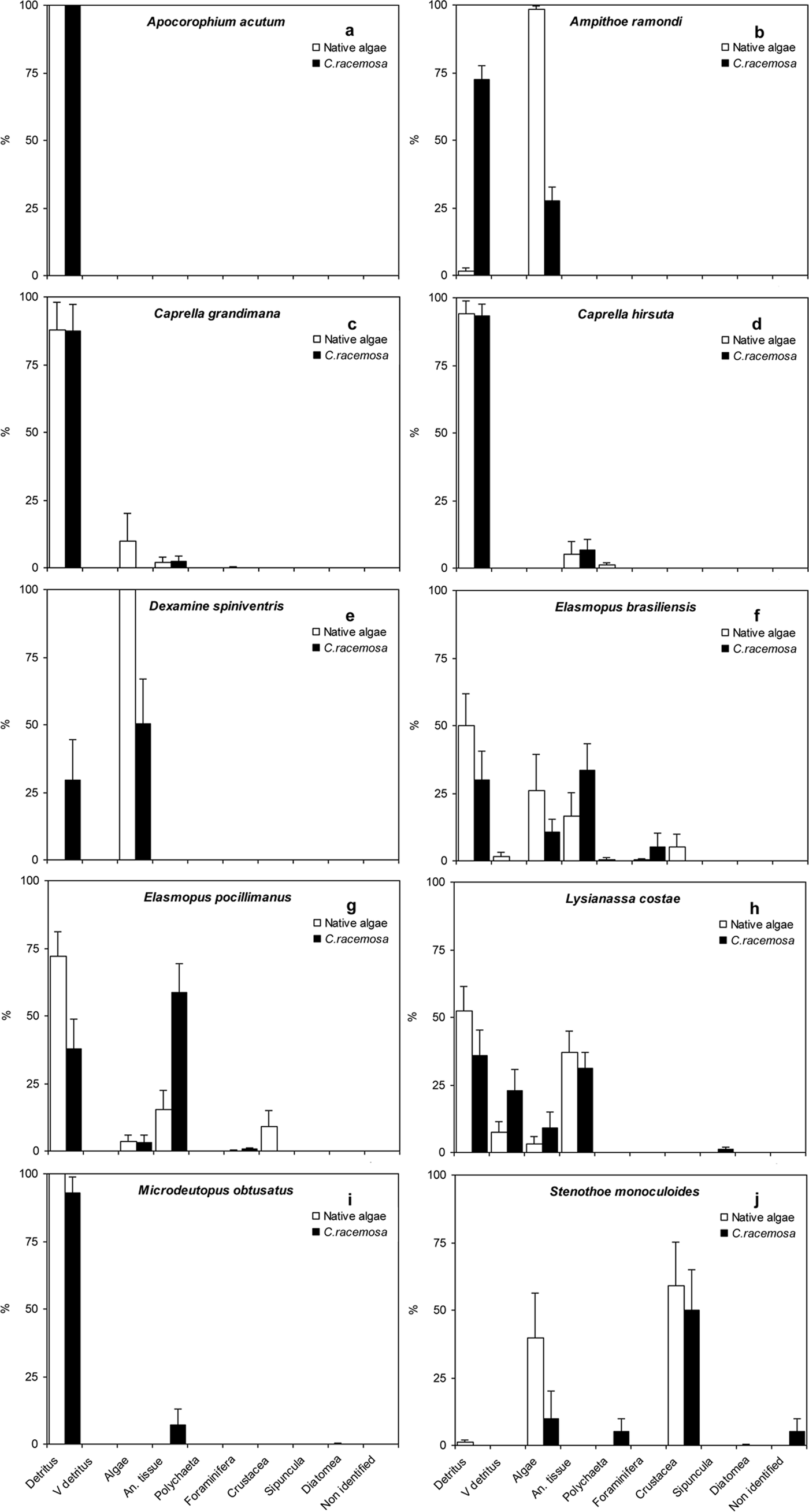
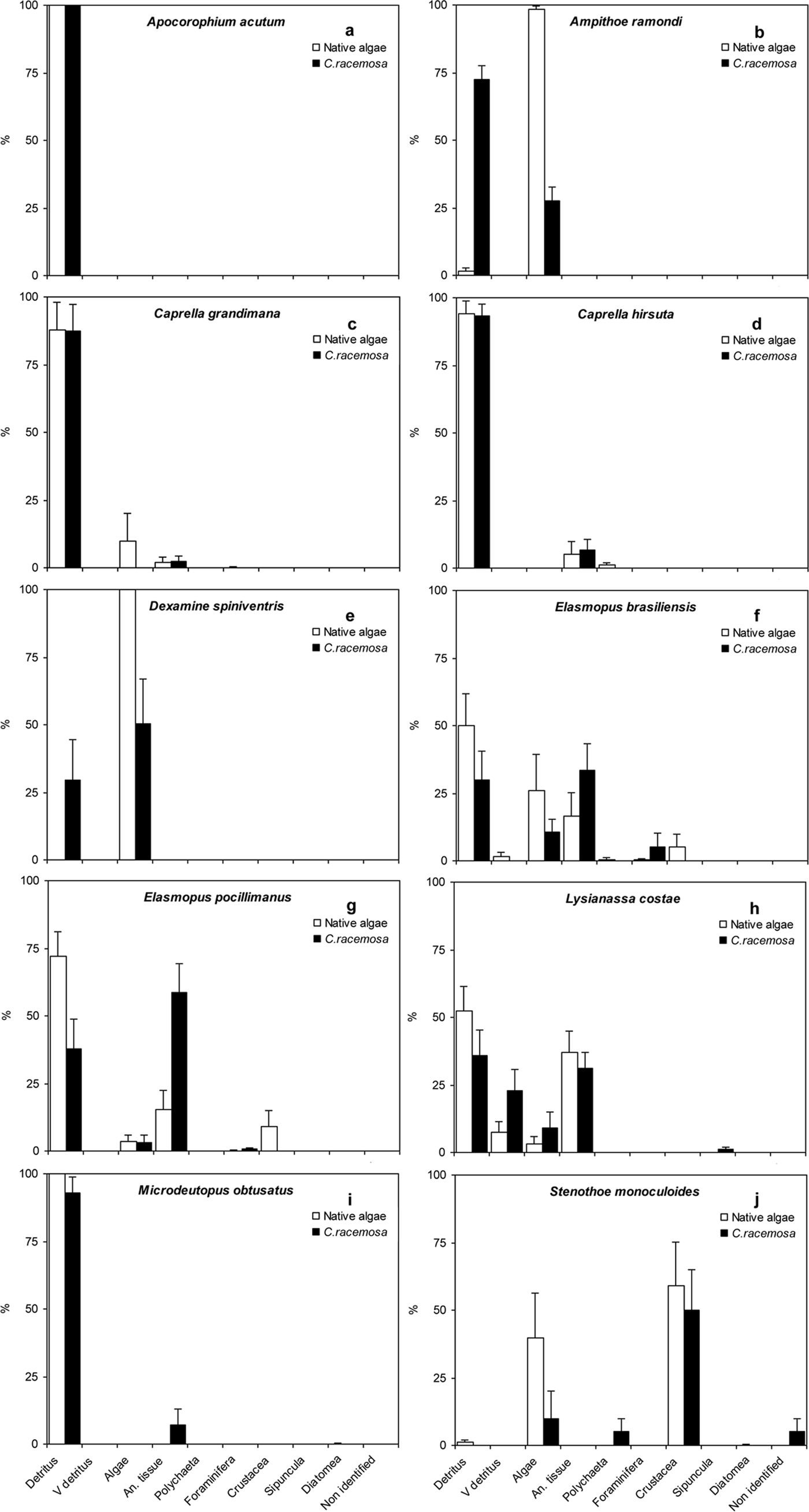
Apocorophium acutum in both habitats fed exclusively on detritus (Figure 1A). Ampithoe ramondi consumed mainly epiphytic algae (family Rhodomelacea, genera Polysiphonia or Neosiphonia) living in algae, while in C. racemosa showed higher values of detritus consumption (Figure 1B), those differences being significant (Ha × Sp, P < 0.01: Table 2). Caprella grandimana showed similar diet across habitats feeding mainly on detritus and some algal fragments when living on native algae (Figure 1C). Caprella hirsuta showed similar feeding habits among habitats, with detritus being the most important item (Figure 1D). Dexamine spiniventris living in native algae consumed mainly epiphytic algae (family Rhodomelaceae, family Ulvaceae and family Sphacelariaceae), while those in C. racemosa showed higher values of detritus consumption (Figure 1E). Elasmopus brasiliensis and Elasmopus pocillimanus showed a wide diversity of items in their gut contents, feeding on detritus, algae and different animal prey (Figure 1F, G). In the case of E. pocillimanus significant differences were detected by PERMANOVA showing that the diet was different for this species in both habitat types (Ha × Sp, P < 0.01: Table 2). Lysianassa costae had a higher presence of vegetal detritus in each habitat, but detritus, animal tissue and algae were also found in their guts (Figure 1H), and the diet was also different for this species in both habitat types (Ha × Sp, P < 0.01: Table 2). Microdeutopus obtusatus fed mainly on detritus and some animal prey in both habitats (Figure 1I). Stenothoe monoculoides showed the highest values of consumed crustaceans, but fed also on algae in native algae habitats and Polychaeta in C. racemosa habitats (Figure 1J). Regarding the gut content of the species that appeared only in one habitat, those living on algae (Atylus guttatus and A. massiliensis) showed high percentages of consumed algae tissues; and those species living in C. racemosa (Caprella acanthifera and Melita hergensis) fed mainly on detritus and animal tissues (Table 1).
Values of mean abundance (percentage of item ± standard error) of ten amphipods: Apocorophium acutum (a), Ampithoe ramondi (b), Caprella grandimana (c), Caprella hirsuta (d), Dexamine spiniventris (e), Elasmopus brasiliensis (f), Elasmopus pocillimanus (g), Lysianassa costae (h), Microdeutopus obtusatus (i) and Stenothoe monoculoides (j).
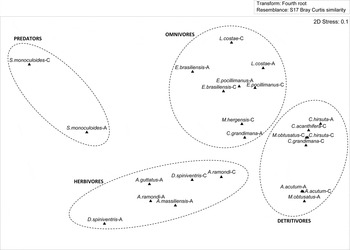
The two-dimensional MDS plot showed segregation of sampling stations mainly by trophic groups; at 70% of similarity four groups can be distinguished represented by dtritivores, herbivores, omnivores and predators (Figure 2). The dietary composition of detritivores and omnivores was relatively similar, showing a clear segregation from the herbivorous group and further from the predators' group.
Two-dimensional multidimensional scaling plot for the different species among different habitats according to the dietary analysis. A, native seaweeds; C, Caulerpa racemosa.

DISCUSSION
With respect to feeding habits some species are not affected by the presence of the alien algae, nevertheless for a few species some differences become apparent depending on the habitat they lived in. Changes of feeding habits were more significant on herbivorous amphipods, since their preferred food (epiphytic algae) was not available in the habitat colonized by C. racemosa and they fed on detritus as an alternative. On the other hand, detritivore species showed the least differences with respect to habitat type because their main food source remains available.
The changes in the ecological niche due to C. racemosa do not seem to affect some species, but others need to look for new trophic resources. The higher availability of detritus found within invaded habitats compared to native algae meadows, has consequences for amphipod assemblages (Vázquez-Luis et al., Reference Vázquez-Luis, Sanchez-Jerez and Bayle-Sempere2008). Therefore, it is not surprising that detritivores were the least negatively affected by the proliferation of C. racemosa. Indeed, A. acutum, a fine-particle suspension feeder, was more abundant in C. racemosa than in native seaweeds (Vázquez-Luis et al., Reference Vázquez-Luis, Sanchez-Jerez and Bayle-Sempere2008). The detritus accumulated within C. racemosa habitats seems to favour the construction of tubes where they live, while population growth is further supported by the amounts of preferred food resource within this habitat. Similar findings had already been reported for C. sextonae (Casu et al., Reference Casu, Ceccherelli, Sechi, Rumolo and Sarà2009). The feeding habits of other detritivore species such as M. obtusatus were not highly affected by the spread of C. racemosa. Similar patterns have been found in three caprellid species, C. grandimana, C. hirsuta and C. acanthifera, which feed mostly on detritus (Guerra-García & Tierno de Figueroa, Reference Guerra-García and Tierno de Figueroa2009).
The herbivorous species, such as A. ramondi and D. spiniventris, are scarce in C. racemosa habitat and when using this habitat, they slightly modify their feeding habits due to changes in the availability of food. However, the possibility cannot be ruled out that those individuals could be recent immigrants. They usually feed on epiphytic algae that are absent in C. racemosa because of the presence of caulerpenes (Léeme et al., Reference Léeme, Pesando, Issanchou and Amade1997). Thus, apart from habitat structure, the availability of food is crucial for those species to live in one habitat or another. Some individuals of herbivorous species were found living in C. racemosa (Vázquez-Luis et al., Reference Vázquez-Luis, Sanchez-Jerez and Bayle-Sempere2008), but probably the scarce food for them on this habitat could generate metabolic problems and may lead to survivorship problems for the juveniles. Probably for this reason A. guttatus and A. massiliensis were not found in C. racemosa habitats; indeed more than 75% of their gut contents were epiphytic algae.
It should be noticed that within the same trophic guild, the feeding habits of some species were more similar according to the type of habitat than the species itself, such as the herbivorous A. ramondi and D. spiniventris and the omnivorous E. brasiliensis and E. pocillimanus. Regarding other omnivores, M. hergensis appeared only in C. racemosa, probably benefiting from the spread of the invasive algae. However, the abundance of this species in C. racemosa was very low (Vázquez-Luis et al., Reference Vázquez-Luis, Sanchez-Jerez and Bayle-Sempere2008). It must be taken into account that within the omnivorous species some, such as L. costae, show scavenging habits. It was the most different species in this group and seemed little affected by the spread of C. racemosa. The only predator found in the present study, S. monoculoides, does not seem to have changed or modified their feeding habits by the spread of C. racemosa, since it is able to find prey in both habitats.
Vegetal content of C. racemosa has not been found in any of the analysed guts of amphipods. Our results are similar to those found on other invasive seaweeds where amphipods and other herbivores and omnivores fed very little on the invasive species, and therefore the spread of introduced seaweeds is not under herbivore control (Trowbridge, Reference Trowbridge1995; Levin et al., Reference Levin, Coyer, Petrik and Good2002; Britton-Simmons, Reference Britton-Simmons2004; Chavanich & Harris, Reference Chavanich and Harris2004; Conklin & Smith, Reference Conklin and Smith2005; Davis et al., Reference Davis, Benkendorff and Ward2005; Sumi & Scheibling, Reference Sumi and Scheibling2005; Gollan & Wright, Reference Gollan and Wright2006; Box et al., Reference Box, Deudero, Sureda, Blanco, Alos, Terrados, Grau and Riera2009). Low herbivore diversity and abundance, combined with very little feeding on and weak habitat preference for invasive algae result in limited grazing pressure, as has been reported for the amphipod Cymadusa setosa on C. taxifolia (Gollan & Wright, Reference Gollan and Wright2006). Therefore, primary production generated by the spread of C. racemosa appears not to be exploited by herbivores or primary consumers, but rather acts by activating the detritivore pathway. Recent experimental studies reveal that species richness and total abundance of amphipods increased with an increase in detrital content. The same applies to species abundance since values of this attribute increased with an increase in detritus content (Vázquez-Luis et al., Reference Vázquez-Luis, Borg, Sanchez-Jerez, Png, Cavallo and Bayle-Sempere2009c). Detritus plays a very important role as a trophic resource for marine invertebrates and serves as one of the main trophic pathways in marine ecosystems (Valiela, Reference Valiela1995); it is also one of the most important features of habitat structure in vegetated habitats (Allesina et al., Reference Allesina, Bondavalli and Scharler2005). It was already suggested that some amphipods did not consume algal biomass directly, but feed on associated resources such as detritus (Enequist, Reference Enequist1949). Caprellids feed clearly on detritus (Guerra-García & Tierno de Figueroa, Reference Guerra-García and Tierno de Figueroa2009) and some zoobenthic taxa feed significantly on detritus accumulated by C. racemosa (Casu et al., Reference Casu, Ceccherelli, Sechi, Rumolo and Sarà2009). Such results support the findings of the present study. Therefore, detritus appears to play a very key role for amphipods as a food source and the detritus stock associated with C. racemosa is playing an important role in trophic dynamics of littoral habitats.
As we can see, trophic preferences of amphipods can change if the trophic resources are modified by environmental factors, such as the establishment of an invasive species. Traditionally, species have been classified into specific trophic guilds, usually based on mouthpart morphology. However a recent study on caprellid amphipods found no relationships between gut contents and features of the mouthpart structure (Guerra-García & Tierno de Figueroa, Reference Guerra-García and Tierno de Figueroa2009). The only relationship that they found is that a predatory way of life is directly related to the absence of the mandibular molar. In our study we found a single predator, Stenothoe monoculoides, which lacks a molar on the mandible. Therefore, in most cases mouthpart structure (mostly mandibular features) on its own is not a good tool to determine the feeding habits of amphipods. Gut content analyses are widely used to show the feeding habits of species. Moreover, the results obtained from gut contents are usually correlated with those from other analyses investigating over longer times, such as fatty acid composition (Graeve et al., Reference Graeve, Dauby and Scailteur2001) and stable isotope analyses (Kelly & Hawes, Reference Kelly and Hawes2005). However, it is necessary to include a combination of mouthpart studies with behavioural observations, gut contents, feeding assays, fatty acids and stable isotopes analyses to draw a complete knowledge about the feeding habits of amphipods and food-web interactions in the ecosystems affected by invasive species.
We conclude that the expansion of C. racemosa on native algal community changes the feeding habits of herbivorous amphipods, which stop using plant tissues because of the lack of an epiphytic community. In addition, the detritus accumulated by the rhizoid network of C. racemosa plays an important role in the plasticity of the diet of herbivores, changing greatly their trophic strategy. Nevertheless, other species are not affected and some are benefited by the invasion, such as detritivorous species. Altogether, slight changes in the trophodynamism of amphipod assemblages have been noted, which are not detected as important in an initial stage. However, they might be promoting some indirect effects in the benthic community and in the life history of the species, with further unknown consequences in the marine trophic net.
ACKNOWLEDGEMENTS
We are very grateful to Estibaliz Berecibar and José Manuel Guerra-García for helping in the identification of gut contents. We thank Ed Hendrycks for improving the English version. This work was supported by Instituto Alicantino de Cultura Juan Gil Albert, Excma. Diputación de Alicante.