Introduction
Autistic spectrum disorder (ASD) is the most heritable of childhood-onset neurodevelopmental disorders. ASD heritability has been variously measured at 64–91% in recent studies (Bai et al., Reference Bai, Yip, Windham, Sourander, Francis, Yoffe and Sandin2019; Sandin et al., Reference Sandin, Lichtenstein, Kuja-Halkola, Hultman, Larsson and Reichenberg2017; Tick, Bolton, Happe, Rutter, & Rijsdijk, Reference Tick, Bolton, Happe, Rutter and Rijsdijk2016; Yip et al., Reference Yip, Bai, Mahjani, Klei, Pawitan, Hultman and Sandin2018). ASD manifests with complex and pervasive symptoms of restrictive interests, repetitive behaviors and deficits in social communication and interaction. In 2013, the Diagnostic and Statistical Manual of Mental Disorders, Fifth Edition (DSM-5) diagnostic criteria consolidated five developmental diagnoses with marked clinical and etiologic heterogeneity into autistic spectrum disorder (American Psychiatric Association, 2013). In 1977, Folstein and Rutter studied 21 twin pairs of autism and demonstrated striking evidence that concordance differs for autism and cognitive abnormalities in monozygotic and dizygotic twins (Folstein & Rutter, Reference Folstein and Rutter1977). Their results suggested genetic and environmental underpinnings of ASD. ASD is known to aggregate in families with a concordance rate of around 10% in siblings of individuals with autism, compared with the general population (Risch et al., Reference Risch, Hoffmann, Anderson, Croen, Grether and Windham2014). Historic research attempting to differentiate between genetic and environmental contributions to ASD were typically limited to the evaluation of one or two predefined familial relationships (e.g. parent, sibling, etc.) (Folstein & Rutter, Reference Folstein and Rutter1977; Piven et al., Reference Piven, Chase, Landa, Wzorek, Gayle, Cloud and Folstein1991). Furthermore, these studies were performed prior to publication of DSM-5 criteria, largely using DSM-IV diagnostic criteria for ASD (Daniels et al., Reference Daniels, Forssen, Hultman, Cnattingius, Savitz, Feychting and Sparen2008; Eriksson, Westerlund, Anderlid, Gillberg, & Fernell, Reference Eriksson, Westerlund, Anderlid, Gillberg and Fernell2012). Modern genomics studies have identified single nucleotide polymorphisms (SNPs), copy number variants (CNVs) and other genetic variations such as insertions and deletions associated with ASD and potentially affect learning and memory, neuronal development and synaptic plasticity (Cukier et al., Reference Cukier, Dueker, Slifer, Lee, Whitehead, Lalanne and Pericak-Vance2014; Doherty & Owen, Reference Doherty and Owen2014; Lee, Ripke, Neale, Faraone, & Purcell, Reference Lee, Ripke, Neale, Faraone, Purcell, Perlis and Wray2013; Malhotra & Sebat, Reference Malhotra and Sebat2012). However, it is challenging to demonstrate the degree of clinical expression of each genetic variant, as there are varied degrees of clinical implications (Cukier et al., Reference Cukier, Dueker, Slifer, Lee, Whitehead, Lalanne and Pericak-Vance2014).
In recent years, population-based studies using nationwide databases in Sweden, Finland and Denmark revealed the hereditary associations of ASD with affective, psychotic and neurodevelopmental disorders. By using Swedish registries to identify 14 516 children with autism, Sandin et al. reported a higher risk of ASD in relatives of individuals with ASD, including twins, full and half-siblings and cousins; this supports etiologic hypotheses of additive genetic effect and nonshared environmental influences (Sandin et al., Reference Sandin, Lichtenstein, Kuja-Halkola, Larsson, Hultman and Reichenberg2014). Daniels et al. using Swedish registries to identify 1227 cases with autism, found that parents of children with autism have higher risks for psychiatric disorders. Schizophrenia was associated with both mothers (OR 1.9; 95% CI 0.8–4.7) and fathers (OR 2.1; 95% CI 0.9–4.9), and depression was associated with mothers of children with autism (OR 1.7; 95% CI 1.0 −2.6) (Daniels et al., Reference Daniels, Forssen, Hultman, Cnattingius, Savitz, Feychting and Sparen2008). Jokiranta et al. identified 3578 cases with ASD through the Finnish national birth cohort and reported increased relative risks (RRs) of ASD (11.8; 95% CI 9.4–14.7), attention-deficit/hyperactivity disorder (ADHD) (3.7; 95% CI 2.9–4.7), intellectual disability (ID) (3.1; 95% CI 2.3–4.2) and other psychiatric disorders in siblings of ASD, with and without ID probands (Jokiranta-Olkoniemi et al., Reference Jokiranta-Olkoniemi, Cheslack-Postava, Sucksdorff, Suominen, Gyllenberg, Chudal and Sourander2016). ASD and ID are neurodevelopmental conditions that co-occur in close to one-third of individuals with ASD (ID defined as IQ ⩽70) (Baio et al., Reference Baio, Wiggins, Christensen, Maenner, Daniels, Warren and Dowling2018). Several large but rare CNVs had been associated with epilepsy, ASD, schizophrenia and ADHD (Owen, Reference Owen2012). Previous studies reported that perinatal complications associated with both ASD and ID, however, an individual association of perinatal adverse factors with ASD or ID was not clearly established (Schieve, Clayton, Durkin, Wingate, & Drews-Botsch, Reference Schieve, Clayton, Durkin, Wingate and Drews-Botsch2015). While prior familial studies examined the influence of genetics using one or few predefined relationship linkages, we used the Taiwan national healthcare database, consisting of Han Chinese population (Executive Yuan, 2013), to explore the genetic influence on ASD and major psychiatric disorders by examining all FDR types. ADHD, ASD, bipolar disorder (BD), major depressive disorder (MDD) and schizophrenia were considered to be major psychiatric disorders by the Psychiatric Genomics Consortium (Cross-Disorder Group of the Psychiatric Genomics, 2013). Furthermore, we aim to examine ID, a common comorbidity of ASD, as it may be a moderating factor for ASD in terms of elevated familial risks of major psychiatric disorders.
Methods
Data acquisition
The Taiwan National Health Insurance (NHI) system is a compulsory, single-payer health insurance plan established in 1995; it provides comprehensive medical coverage, including but not limited to preventive medicine, inpatient, outpatient and dental services to all residents of Taiwan. NHI covers 99.6% of the national population (Chen, Chen, Chen, & Ma, Reference Chen, Chen, Chen and Ma2014), approximately 23.2 million residents of Taiwan, as of 2010 (National Statistical Bureau, 2019). To ensure privacy, all claims data were de-identified before release to the National Health Insurance Research Database (NHIRD). NHIRD is the largest nationally representative cohort in Taiwan; it has been extensively used in epidemiological studies (Cheng et al., Reference Cheng, Chang, Chen, Tsai, Su, Li and Bai2018; Reference Chen, Hsu, Huang, Su, Li, Lin and BaiM. H. Chen et al., Reference Chen, Hsu, Huang, Su, Li, Lin and Bai2019). Comprehensive healthcare data in NHIRD include demographics, clinic visit information and disease diagnoses; these data are accessible to researchers in Taiwan under supervision of the National Health Research Institute (NHRI), once research activities gained approval from the Institutional Review Board (IRB). A 32-digit anonymous identifier was assigned to each subject, allowing them to be followed continuously. A specialized subset of NHIRD data on mental disorders that includes psychiatric medical records of insured subjects served between 1 January 2001 and 31 December 2010 was utilized. These records were the basis for identifying individual diagnoses of the subjects. NHIRD used the International Classification of Diseases, 9th Revision, Clinical Modification (ICD-9-CM) for psychiatric diagnoses. The protocol was reviewed and approved by the Taipei Veterans General Hospital Institutional Review Board (2018-07-016AC).
Study population
This study target population was 23 258 175 Taiwanese residents registered in the NHIRD between 2001 and 2010. Subjects without valid insurance status or known sex status (n = 2, <0.01%) were excluded. We identified individuals with ASD, and FDRs of individuals with ASD as a parent, offspring, sibling or twin respectively, from the target population; they were then assigned to the group: ‘individuals with ASD’ and ‘FDRs of individuals with ASD.’ A total of 26 667 individuals were identified with the diagnosis of ASD, and 67 998 individuals were identified through linkages as FDRs of individuals with ASD. Given ASD is more prevalent in males and less likely to be diagnosed after adulthood, we used exact matching to match the cohort ‘FDRs of individuals with ASD’ to controls in 1:4 fashion based on age at enrollment, sex and familial relationships. For example, a 31-year-old father of a son with ASD would be matched with four 31-year-old fathers of sons without ASD.
Identification of family relationships
Family relationships were identified, and family lineages were reconstructed through NHIRD by using the protocol established by Kuo et al. (Reference Kuo, Grainge, Valdes, See, Luo, Yu and Doherty2015). Following the protocol, parent-offspring and spouse relationships were directly identified given that only spouses and blood relatives could be qualified dependents of the insured individuals covered by Taiwan NHI. By using the 32-digit anonymous identifier and a developed algorithm, sibling and twin relationships were thereafter reconstructed. Sibling relationships were confirmed by having the same birth father or mother, and twin relationships were confirmed by siblings having the same date of birth. Given that NHIRD does not contain data differentiating monozygotic and dizygotic twins, zygosity was not identifiable in this study.
Disease classification
Five major psychiatric disorders: ADHD (ICD-9-CM code: 314), ASD (ICD-9-CM code: 299), BD (ICD-9-CM codes: 296, except 296.2, 296.3, 296.9, and 296.82), MDD (ICD-9-CM codes: 296.2 and 296.3) and schizophrenia (ICD-9-CM code: 295) were examined in FDRs of individuals with ASD group with matched controls. ICD-9-CM code 299 encompasses autistic disorder, childhood disintegrative disorder, pervasive developmental disorder, unspecified pervasive developmental disorder and other specified pervasive developmental disorder. ICD-9-CM codes: 317–319 were used to define ID. A psychiatric disorder would only be identified when a consistent psychiatric diagnosis was documented at least twice by board-certified psychiatrists between 1 January 2001 and 31 December 2010.
Assessment of confounders
Age, sex, place of residence and income status were controlled for in this study. Monthly Income was divided into three levels: ≤15 840 New Taiwanese Dollars (NTD) or 528 US Dollars (USD), 15 841– 25 000 NTD or 528–833 USD, and ≥25 000 NTD or ≥833 USD). Monthly income of 528 USD (NT$ 15 840) was the government designated cut-off for a minimum income of full-time employment in Taiwan during the research period. Level of urbanization, used as a proxy for the availability of healthcare in Taiwan, was stratified based on place of residence on a scale from 1 to 5, from the most to least urbanized (Liu et al., Reference Liu, H, Chuang, Chen, Weng and Liu2006).
Statistical methods
The primary analysis was to compare RRs and 95% confidence intervals (CIs) of five major psychiatric disorders in FDRs of individuals with ASD v. controls. A secondary analysis was conducted to compare RRs and 95% CIs of five major psychiatric disorders in FDRs of individuals with ASD and ID, v. in FDRs of individuals with ASD only. The analyses were carried out at the group level. Age at enrollment, sex, place of residence and income status were adjusted in analyses. If an FDR had multiple familial relationships with an individual with ASD, for example, father-daughter and sister-brother relationships, the FDR would be counted for each of these relationships and matched for more than once. To account for the effects of kinship clustering in which each family cluster could contain more than one relationship with the individual with ASD, modified Poisson regression analysis with robust variance estimation was used to approximate the RRs for clustered data: log [πi] = β0 + β1X1i + β2X2i + …… + βkXki, in which πi represents the probability of experiencing the outcome of interest for subject i, and X1i, X2i, … Xki are predictor variables. The RR was then given by exp(β). The application of Poisson distribution produces consistent estimates of the identified parameters, but inconsistent variances since the variance under the Poisson model is larger than the binomial model except with rare outcomes. Therefore, robust variance estimation was used to avoid overestimating the standard errors of the identified parameters (Yelland, Salter, & Ryan, Reference Yelland, Salter and Ryan2011; Zou, Reference Zou2004). The secondary analysis compared RRs of all five major psychiatric disorders in FDRs of individuals with ASD with and without ID to assess the role of ID in familial risks of major psychiatric disorders with ASD. Finally, sub-analysis was conducted in each stratified relationship (parent, offspring, sibling, and twin) to further investigate the risk of each of the five psychiatric disorders in FDRs of individuals with ASD compared with control groups. Statistical Analysis System (SAS) 9.2 (SAS Institute, Cary, NC, USA) was used for all statistical analyses and PROC GENMOD in SAS was used to estimate the adjusted RRs. Statistical tests were two-tailed with p < 0.05 as the cutoff for statistical significance.
Sensitivity analyses
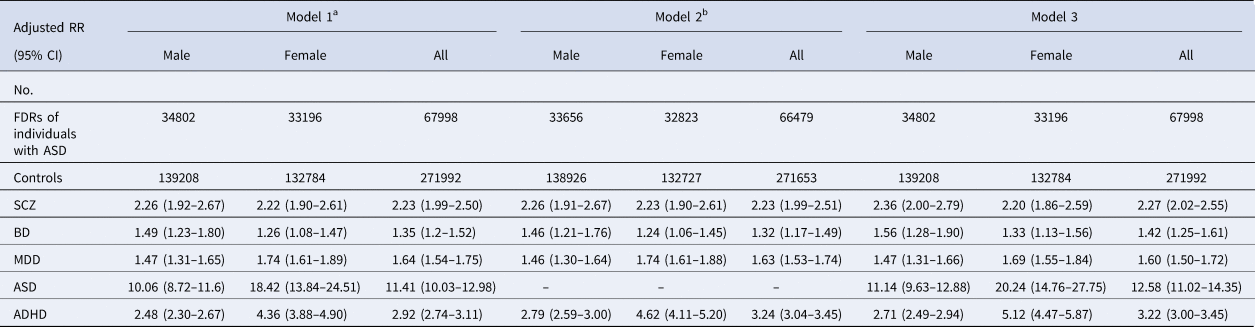
Three models of sensitivity analysis were conducted in a case-controlled, matched design to ascertain potential biases and strengthen the validity of our data as shown in Table 1. In model 1, a multivariate analysis was conducted in both FDRs and matched control groups with adjustment of age, sex, place of residence, income levels and other major psychiatric disorders to control for confounding factors from other major psychiatric disorders. In model 2, individuals with ASD were excluded from both groups to eliminate the impact of having more than one psychiatric disorder comorbid in an individual, such as ASD and schizophrenia, to assess the familial risk of a single psychiatric disorder independently. In model 3, the diagnostic threshold for a psychiatric disorder was increased from the diagnosis being documented for at least two to three times by board-certified psychiatrists for all psychiatric disorders.
Sensitivity analyses of relative risk major psychiatric disorders between FDRs of individuals with ASD and matched controls
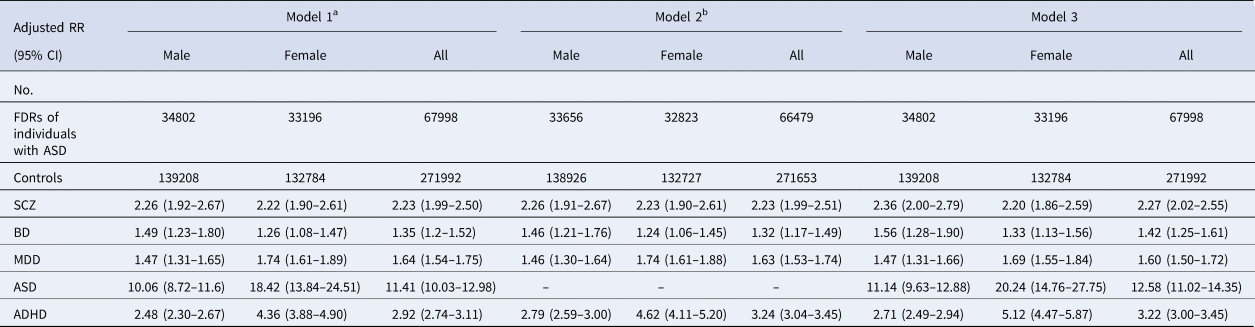
a Model 1: Adjusted for age, sex, urbanization, income level and other major psychiatric disorders.
b Model 2: Excluding individuals with ASD and adjusted for age, sex, residence, income level.
Model 3: Diagnostic threshold for a psychiatric disorder increased from being diagnosed for two to three times.
SCZ, schizophrenia; BD, bipolar disorder; MDD, major depressive disorder; ASD, autism spectrum disorder; ADHD, attention-deficit/ hyperactivity disorder; FDRs, first-degree relatives; No., number; RR, relative risk; CI, confidence interval.
Results
Baseline characteristics
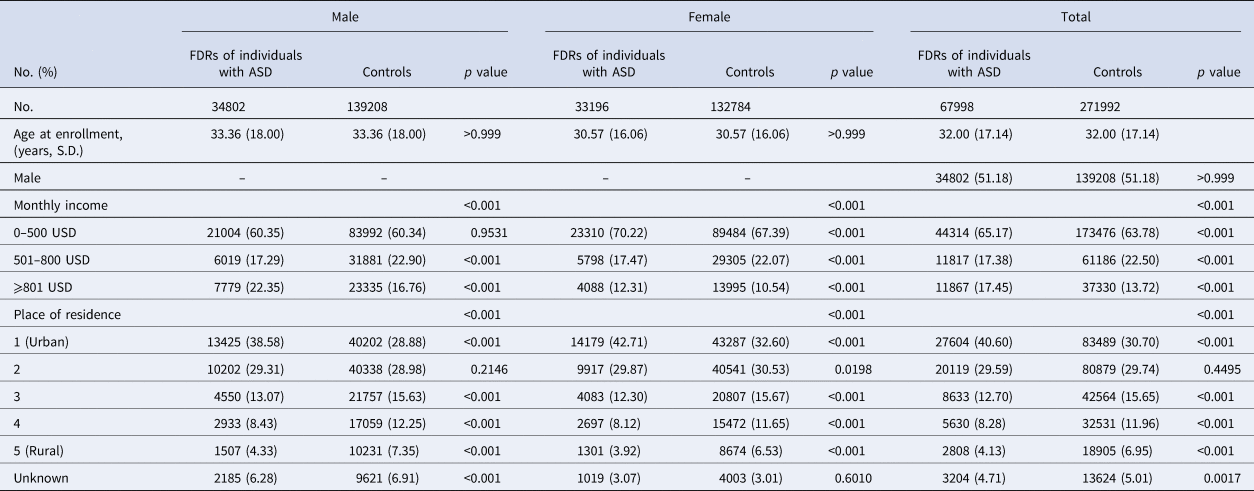
Among 23 258 175 individuals (99.6% of the population of Taiwan), 26 667 were identified with the diagnosis of ASD and 67 998 were identified as FDRs of individuals with ASD. There were 36 203 cases who were diagnosed once with ASD; within this group, 27 731 cases were diagnosed twice and 23 060 cases were diagnosed more than twice. Table 2 summarizes demographic data, including age, sex, place of residence and income status of the participants in 2010. Compared with the control group, the FDRs of individuals with ASD had lower incomes and were more likely to reside in urban areas.
Demographic characteristics of FDRs of individuals with ASD and controls
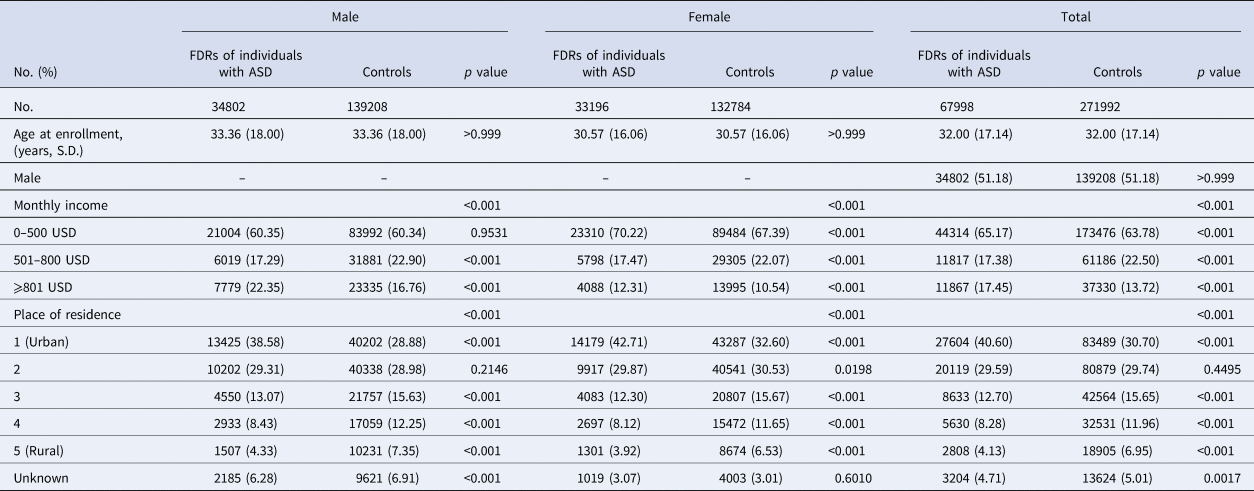
FDRs, first-degree relatives; ASD, autism spectrum disorder; USD, United State Dollar; No., number; S.D., standard deviation.
Chi-square and independent t tests were used to compare categorical and continuous variables respectively.
Major psychiatric disorders in FDRs of individuals with ASD
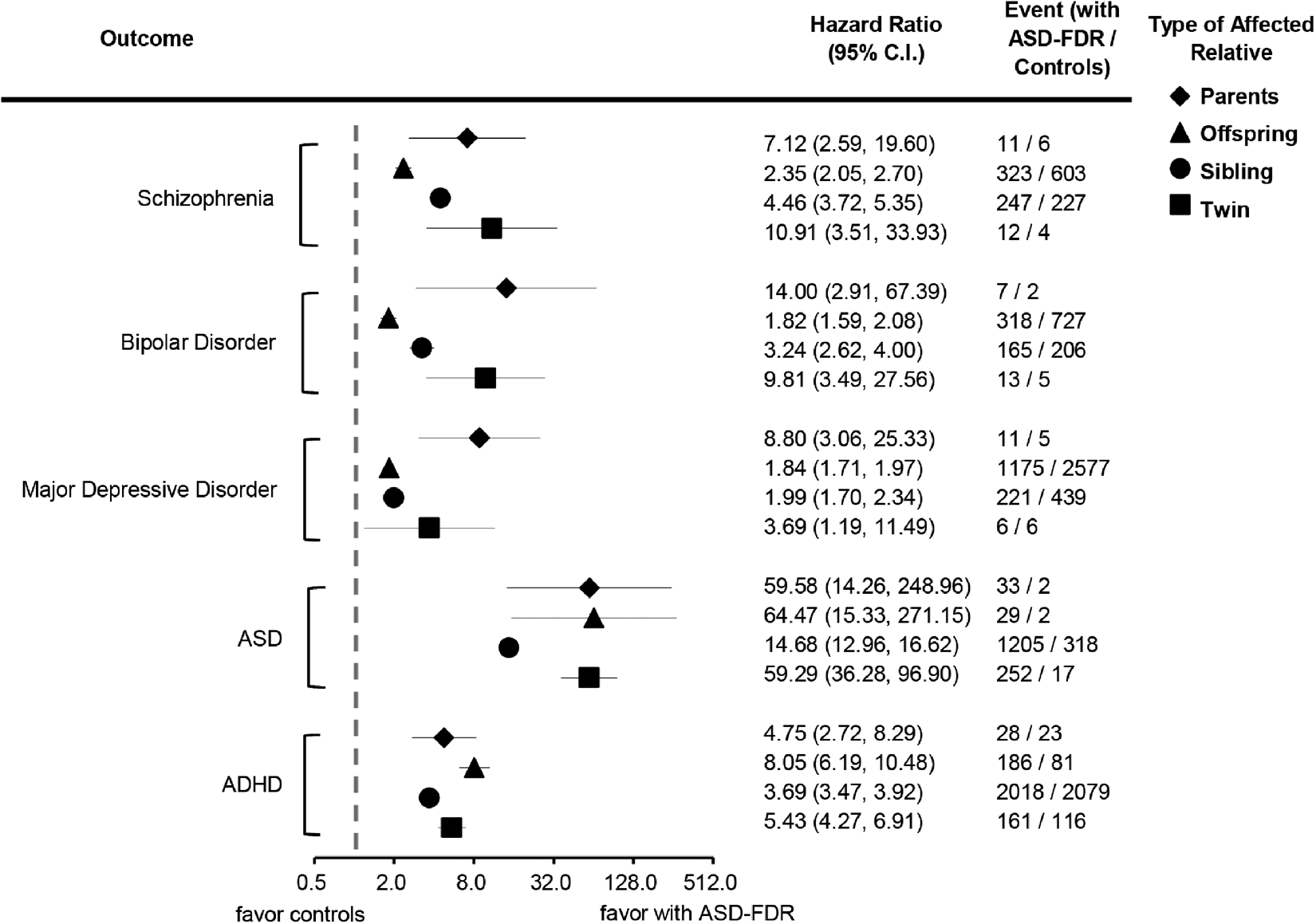
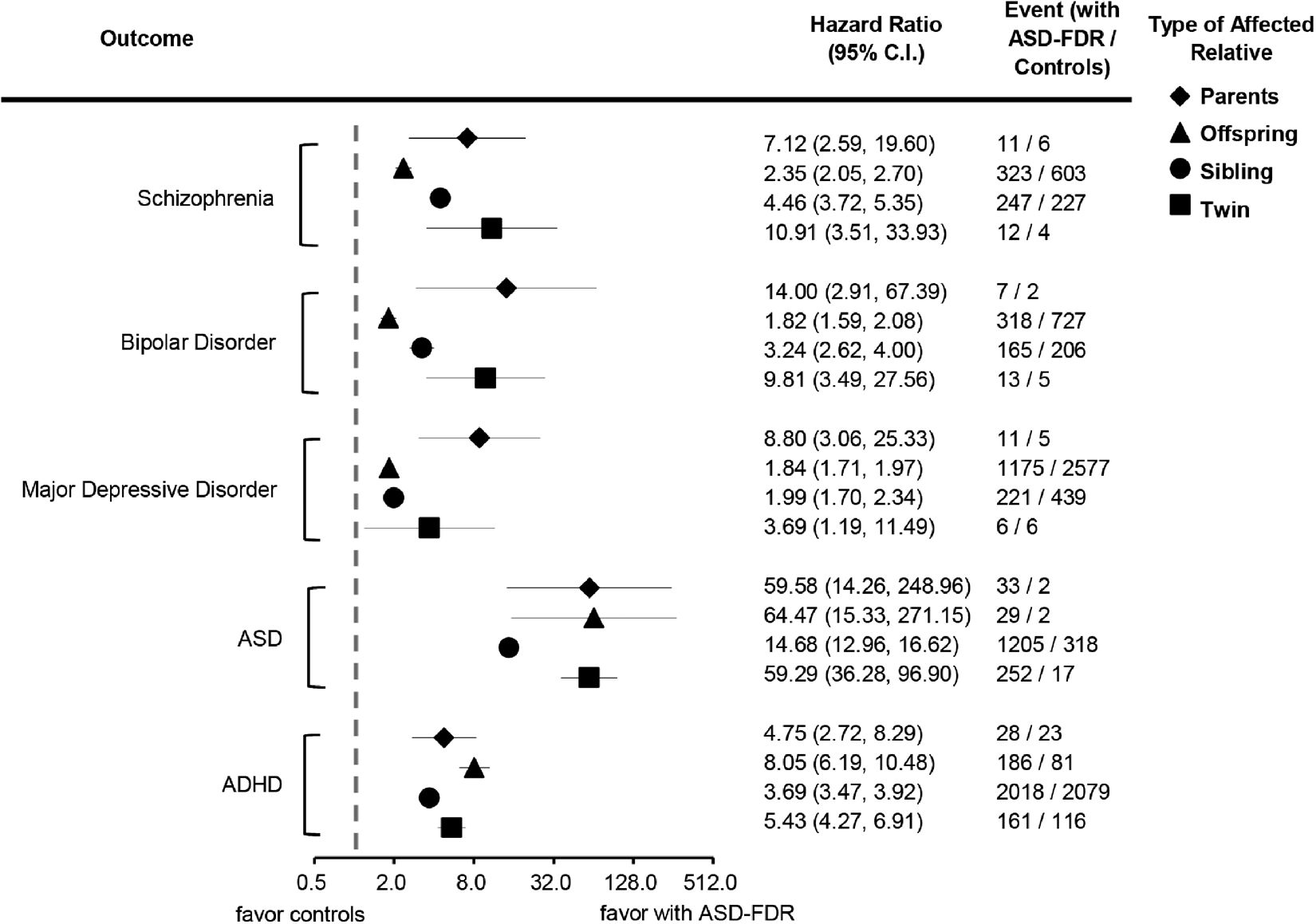
The primary analysis examined RRs and 95% CIs of major psychiatric disorders in FDRs of individuals with ASD compared with controls. FDRs of individuals with ASD had a higher risk (RRs, 95% CI) for five major psychiatric disorders when compared to controls: ADHD 3.94 (3.72–4.17), ASD 17.46 (15.50–19.67), BD 2.22 (1.98–2.48), MDD 1.88 (1.76–2.00) and schizophrenia 3.05 (2.74–3.40) (See Table 3). Sub-analysis was conducted to determine if the RRs of having major psychiatric disorders in FDRs of individuals with ASD were dependent upon familial relationships: parent, offspring, sibling or twin. This was completed using a case-control matched design. Stratified RR (95% CI) of each psychiatric disorder was consistently elevated in FDRs of individuals with ASD when compared to controls, irrespective of the relationship. (See online Supplementary tables 1–5 and forest plots in Fig. 1.)
Relative risk of major psychiatric disorders between FDRs of individuals with ASD and matched controls

SCZ, schizophrenia; BD, bipolar disorder; MDD, major depressive disorder; ASD, autism spectrum disorder; ADHD, attention-deficit/hyperactivity disorder; FDRs, first-degree relatives; No., number; RR, relative risk; CI, confidence interval.
aAdjusted for age, sex, residence and income level.
Relative risk of major psychiatric disorders between FDRs of individuals with ASD and matched controls, stratified by kinships. SCZ, schizophrenia; BD, bipolar disorder; MDD, major depressive disorder; ASD, autism spectrum disorder; ADHD, attention-deficit hyperactivity disorder; FDRs, first-degree relatives; CI, confidence interval.
Major psychiatric disorders in FDRs of individuals with ASD-ID
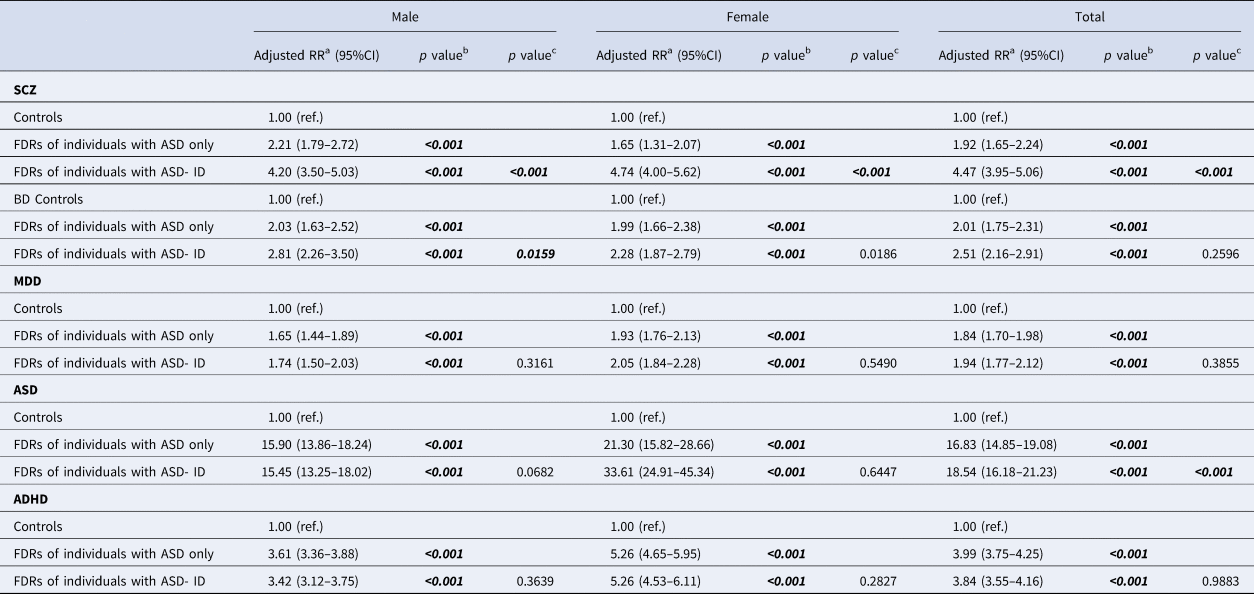
The secondary analysis was conducted to examine RRs of major psychiatric disorders in FDRs of individuals with ASD-ID, compared with the control group and FDRs of individuals with ASD only. The FDRs of individuals with ASD-ID have elevated risk for five major psychiatric disorders, ADHD 3.84 (3.55–4.16), ASD 18.54 (16.18–21.23), BD 2.51 (2.16–2.91), MDD 1.94 (1.77–2.12) and schizophrenia 4.47 (3.95–5.06) compared with the control group, p < 0.001 (See Table 4). Furthermore, FDRs of individuals with ASD-ID have significantly higher RRs for schizophrenia [4.47 (3.95–5.06) v. 1.92 (1.65–2.24), p < 0.001] and ASD [18.54 (16.18–21.23) v. 16.83 (14.85–19.08), p < 0.001], but neither MDD nor ADHD, when compared with FDRs of individuals with ASD only. The increased risks of BD in FDRs of individuals with ASD-ID compared with FDRs of individuals with ASD only was observed in males [2.81, (2.25–3.50), p = 0.0159] but not in females [2.28 (1.87–2.79), p = 0.0186]. Owing to multi-comparison in the secondary analysis, post-hoc correction was used and 0.0168 (0.05/3) was set as a revised p value.
Relative risk of major psychiatric disorders between FDRs of individuals with ASD with and without ID and matched controls
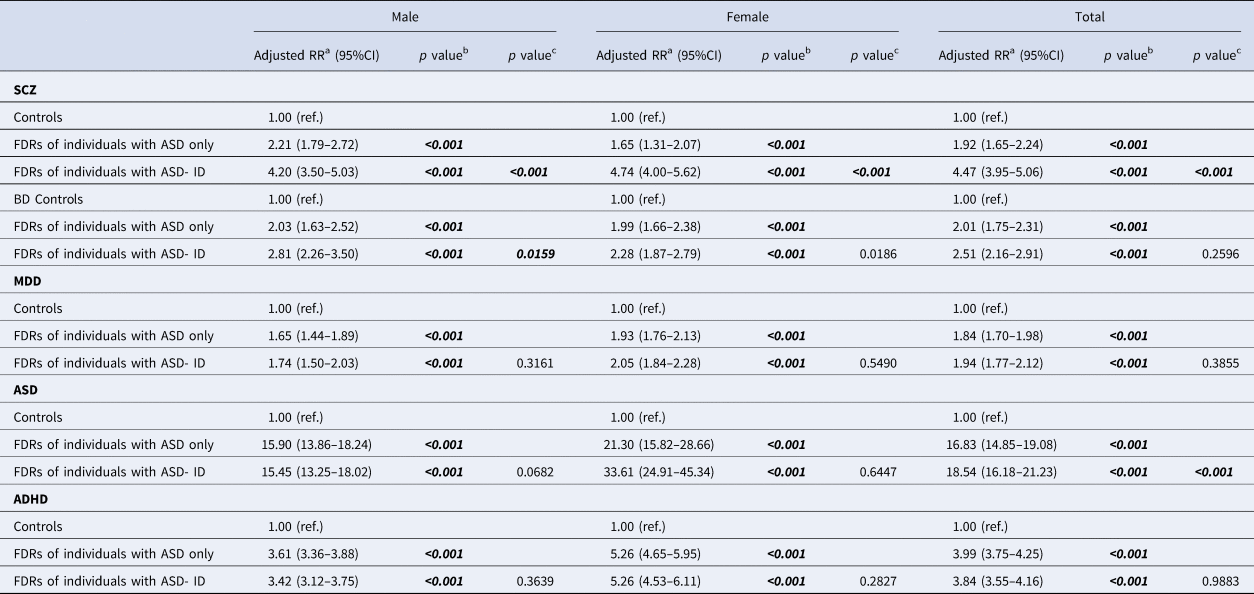
SCZ, schizophrenia; BD, bipolar disorder; MDD, major depressive disorder; ASD, autism spectrum disorder; ADHD, attention-deficit hyperactivity disorder; ID, intellectual disability; FDRs, first-degree relatives; RR, relative risk; CI, confidence interval; ref., reference.
a Adjusted for age, sex, place of residence and income level.
b FDRs of individuals with ASD only v. control, FDRs of individuals with ASD-ID v. control.
c FDRs of individuals with ASD-ID v. FDRs of individuals with ASD only.
p < 0.0168 was defined as significant, marked in bold type.
Sensitivity analysis
Sensitivity analysis was performed with three models (See Table 1). Consistently elevated risks for major psychiatric disorders in FDRs of individuals with ASD were observed in all models. In model 1, after adjusting for age, sex, place of residence, income level and other major psychiatric disorders, RRs in FDRs of individuals with ASD were mildly attenuated compared to primary analysis across ADHD 2.92 (2.74–3.11), ASD 11.41 (10.03–12.98), BD 1.35 (1.2–1.52), MDD 1.64 (1.54–1.75) and schizophrenia 2.23 (1.99–2.50). In model 2, ASD was excluded to eliminate the effect of comorbidity with ASD in any given individual and to assess familial risks of each psychiatric disorders independently. Adjusted RRs were as follows: schizophrenia 2.23 (1.99–2.51), BD 1.32 (1.17–1.49), MDD 1.63 (1.53–1.74) and slightly increased for ADHD 3.24 (3.04–3.45). In model 3, the diagnostic threshold for any given psychiatric disorder was raised to a diagnosis having been made at least three times by board-certified psychiatrists. Adjusted RRs slightly increased for all major psychiatric disorders except for MDD: ADHD 3.22 (3.00–3.45), ASD 12.58 (11.02–14.35), BD 1.42 (1.25–1.61), MDD 1.60 (1.50–1.72) and schizophrenia 2.27 (2.02–2.55).
Discussion
The present report supports familial coaggregation of ASD with major psychiatric disorders, including ADHD, ASD, BD, MDD and schizophrenia. The familial risk for psychiatric disorders was highest for ASD, followed by ADHD, schizophrenia, BD and MDD. Our results further point to an elevated relative risk for ASD and schizophrenia in FDRs of individuals with ASD-ID compared with FDRs of individuals with ASD only. Our findings confirm previous studies suggesting that there is a possible etiologic relationship between ASD and other major psychiatric disorders by virtue of the fact that they have a significant tendency to coaggregate within families. Additionally, ASD-ID and its familial coaggregation with schizophrenia and ASD suggests a potential etiological pathway that may be distinct from ASD only. The difference between patterns of familial coaggregation in FDRs of individuals with ASD v. ASD-ID, and the significantly elevated risk of ASD and schizophrenia in FDRs of individuals with ASD-ID compared with ASD only reflect potential pathways of susceptibility shared among ASD, ID and schizophrenia.
Accumulating evidence of genetic, shared and non-shared environmental factors of ASD pathogenesis have formed hypotheses of pathological mechanisms of ASD (Doherty & Owen, Reference Doherty and Owen2014; Mandy & Lai, Reference Mandy and Lai2016; Sullivan et al., Reference Sullivan, Magnusson, Reichenberg, Boman, Dalman, Davidson and Lichtenstein2012). DeLong et al., reported that family history of affective disorders was found to particularly associate with a subgroup of individuals with high-functioning ASD (defined as ASD only, without ID) (DeLong & Nohria, Reference DeLong and Nohria1994). A recent review discussed the heightened risk of ASD in offspring from parents with affective, depressive and bipolar disorders, particularly maternal affective and depressive disorders (Ayano, Maravilla, & Alati, Reference Ayano, Maravilla and Alati2019). There has been an ongoing debate over the cause of familial coaggregation of mood disorders with ASD being related to parental stress or genetic influences (Cohrs & Leslie, Reference Cohrs and Leslie2017; Daniels et al., Reference Daniels, Forssen, Hultman, Cnattingius, Savitz, Feychting and Sparen2008). Previous reports suggested parents of autistic children were more likely to be diagnosed with depression when compared to parents with neurotypical children due to life stressors (Scherer, Verhey, & Kuper, Reference Scherer, Verhey and Kuper2019). Depression in mothers but not fathers being associated with ASD diagnoses in offspring was reported in another study (Daniels et al., Reference Daniels, Forssen, Hultman, Cnattingius, Savitz, Feychting and Sparen2008). Eriksson et al., presented data on elevated risk for ASD in fathers and brothers of individuals with ASD, and higher rates of depression in mothers of individuals with ASD (Eriksson et al., Reference Eriksson, Westerlund, Anderlid, Gillberg and Fernell2012). Recent research proposed that the mechanism underlying ASD prevalence in offspring of individuals with a mood disorder was associated with prenatal maternal medication use, i.e. neuronal nicotinic acetylcholine receptor antagonists, regardless of maternal mental health conditions (Hisle-Gorman et al., Reference Hisle-Gorman, Susi, Stokes, Gorman, Erdie-Lalena and Nylund2018; Janecka et al., Reference Janecka, Kodesh, Levine, Lusskin, Viktorin, Rahman and Reichenberg2018); the authors suggested that prenatal medication exposure, but not psychiatric disorders, may contribute to ASD. Our results concur with previous findings that risks of BD and MDD increased in FDRs of individuals with ASD. FDRs of ASD-ID male probands were more likely to have BD diagnosis compared to those of ASD-only male probands, while FDRs of ASD-ID female probands trended towards higher BD risk compared to FDRs of ASD-only female probands. FDRs of ASD-ID probands exhibited similar MDD risk compared to FDRs of ASD-only probands regardless of sex. The risks of BD and MDD were the highest among parents followed by twins, siblings and then offspring. The highest risk among parents but not offspring or twins echo the findings of previous studies that parents of autistic children were more likely to be diagnosed with affective disorders, which may imply the role of environmental factors in the familial coaggregation of ASD with BD and MDD. Furthermore, the risk of MDD for mothers of individuals with ASD (adjusted RR 1.96, CI 1.8–2.13) appeared to be higher than fathers of individuals with ASD (adjusted RR 1.59, CI 1.41–1.8). Our findings resonate with previous studies that mothers of individuals with ASD are at highest risk of MDD among all FDRs, and environmental factors may contribute to this phenomenon, especially, parenting stress that is distinct to ASD diagnosis resulting in emotional problems including depression. In our study, elevated risk of BD was observed in male FDRs of individuals with ASD-ID, v. trending risk in female FDRs, and the significance disappeared after pooling both sexes. We suspected that the sample size of female FDRs was too small to yield significance. Several genetic polymorphisms were known to be associated with BD in Asian males (Fan et al., Reference Fan, Liu, Jiang, Jiang, Zhao and Zhang2010), but it is unclear whether these genetic variants were associated with ASD and ID. Future genetic studies looking at whether specific BD inheritance patterns associated with sex is needed.
Despite distinct clinical features between ASD and ADHD, their coaggregation have been long observed in twin studies (Taylor, Charman, & Ronald, Reference Taylor, Charman and Ronald2015). Genetic studies detected several common and rare variants that disrupted common biological processes such as neurotransmission and neurodevelopmental pathways in ADHD and ASD samples (Akutagava-Martins, Rohde, & Hutz, Reference Akutagava-Martins, Rohde and Hutz2016). Our team recently reported familial coaggregation of ASD in all types of FDRs of individuals with ADHD (Chen et al., Reference Chen, Pan, Huang, Hsu, Bai, Su and Chen2019). Another population-based study found a higher risk of ADHD in twins and siblings of individuals with ASD, especially high-functioning ASD, defined as ASD without ID by the authors (Ghirardi et al., Reference Ghirardi, Brikell, Kuja-Halkola, Freitag, Franke, Asherson and Larsson2018). High-functioning ASD has been suggested to have a stronger association with familial psychiatric disorders, while ASD-ID is more likely associated with sporadic morbidities (Robinson et al., Reference Robinson, Samocha, Kosmicki, McGrath, Neale, Perlis and Daly2014). We observed comparably higher risk of ADHD in both female FDRs of individuals with ASD [5.26 (4.70–5.88) v. 3.54 (3.32–3.78)] and with ASD-ID [5.26 (4.53–6.11) v. 3.42 (3.12–3.75)] than in their male counterparts. Similarly, comparably higher risk of ASD was observed in female FDRs of individuals with ASD [21.30 (15.82–28.66) v. 15.90 (13.86–18.24)] and with ASD-ID [33.61 (24.91–45.34) v. 15.45 (13.25–18.02)] than in their male counterparts. A genetic study observed that female ASD cases present with higher ‘mutational burden’ for neurodevelopmental disorders (Jacquemont et al., Reference Jacquemont, Coe, Hersch, Duyzend, Krumm, Bergmann and Eichler2014), however, the hypothesis was not supported by population-based studies. Perhaps certain ASD and ADHD clinical features transmitted genetically are enhanced in female individuals with ASD family history making their ASD and ADHD more detectable. This hypothesis requires future research designed from the gender aspect to gain insights into ASD and ADHD shared genetics that impact clinical characteristics of ASD and ADHD.
Pervasive symptoms of autism have been identified as highly heritable (Sandin et al., Reference Sandin, Lichtenstein, Kuja-Halkola, Larsson, Hultman and Reichenberg2014). The ‘Broad Autism Phenotype’ (BAP) was identified in several family studies amongst first-degree relatives of autistic probands (Pickles et al., Reference Pickles, Starr, Kazak, Bolton, Papanikolaou, Bailey and Rutter2000; Piven, Palmer, Jacobi, Childress, & Arndt, Reference Piven, Palmer, Jacobi, Childress and Arndt1997) which provided evidence that genetic influences may be linked with a broader range of social impairments. The de novo mutations have been connected with a more severe form of ASD with a sporadic hereditary pattern (Cook & Scherer, Reference Cook and Scherer2008). As presented in Fig. 1, FDRs of individuals with ASD were at the highest overall risk for ASD among all major psychiatric disorders. In order, the familial risk was the highest in parent, offspring and twin, followed by a sibling. This is different from the patterns for ADHD, BD, MDD and schizophrenia and suggests the heterogeneity of transmission pathways among major psychiatric disorders. The established genetic findings for ASD are heterogenous, ranging from de novo mutations to heritable SNPs and CNVs, and only contributed to a minority of the overall disease liability in the general population (Robinson et al., Reference Robinson, St Pourcain, Anttila, Kosmicki, Bulik-Sullivan, Grove and Daly2016). By demonstrating a pattern of elevated risk for major psychiatric disorders within FDRs of the individuals with ASD, our findings highlight the underlying genetic and environmental factors shared among ASD and other psychiatric disorders.
Abundant shared genetic variants, either de novo or inherited, have been observed in neurodevelopmental disorders including ASD, schizophrenia and ID despite a wide range of variations in the pattern and severity of symptoms. (Rees et al., Reference Rees, Han, Morgan, Carrera, Escott-Price, Pocklington and Owen2020; Singh et al., Reference Singh, Walters, Johnstone, Curtis, Suvisaari, Torniainen and Barrett2017). A GWAS study from a European ancestry population reported significant genetic associations between ASD, BD (p < 0.05) and schizophrenia (minimum p < 10−4), and suggested SNPs shared among these disorders (Lee et al., Reference Lee, Ripke, Neale, Faraone, Purcell, Perlis and Wray2013). ASD and schizophrenia were found to share similar etiological factors from population-based studies (Cheng et al., Reference Cheng, Chang, Chen, Tsai, Su, Li and Bai2018; Sullivan et al., Reference Sullivan, Magnusson, Reichenberg, Boman, Dalman, Davidson and Lichtenstein2012). Our results endorsed elevated risks of schizophrenia in FDRs of individuals with ASD and further elevated risks in FDRs of individuals with ASD-ID. Increasing knowledge of genetic heterogeneity led to the recognition of genetic and epigenetic etiological pathways shared by ID, ASD and schizophrenia (McCarthy et al., Reference McCarthy, Gillis, Kramer, Lihm, Yoon, Berstein and Corvin2014). Several genetic variants have been identified in ASD-ID and separate genetic networks for ASD with or without ID were highlighted (Matson & Shoemaker, Reference Matson and Shoemaker2009; Stessman et al., Reference Stessman, Xiong, Coe, Wang, Hoekzema, Fenckova and Eichler2017). Future genetic studies may elucidate specific heritable traits that separate the diagnoses of ASD and ASD-ID, as well as identify shared genetic components contributing to the development of ASD, ASD-ID and schizophrenia.
This is a large-scale, national population-based study examining familial coaggregation of ASD and other major psychiatric disorders concurrently in all types of FDRs. With the utilization of Taiwan NHIRD, our findings provide robust and valuable insights into familial coaggregation of ASD with major psychiatric disorders. Given that Taiwan NHI is a mandatory, single-payer system providing affordable healthcare, individuals with complicated conditions are encouraged to access healthcare. The extensive coverage of Taiwan NHIRD allowed us to examine the entire population, and our data are likely to accurately reflect the healthcare-seeking population, and the full span of the demographic variability in Taiwan population. The target population of Han Chinese contributes to the variety of current population-based studies, of which prior publications predominantly focused on populations of European origin.
This study has the following limitations: first, the prevalence of each major psychiatric disorder was lower than global averages of prevalence. Prevalence cannot be correctly estimated given our data collection was restricted between year 2001 and 2010. Second, to mitigate diagnostic biases which could be a concern in population-based studies, we selectively included individuals who were diagnosed twice with a psychiatric disorder at a minimum. The difference in the number of times an individual was diagnosed could be a limitation; however, to ensure diagnostic validity, sensitivity analysis showed that the risks of major psychiatric disorders in FDRs of individual with ASD were consistent between groups of individuals being diagnosed ASD twice v. three-time. Third, detection of cases may vary; individuals who are acutely ill may have limited insight and may not present to clinics for care; however, severe cases voluntarily or involuntarily admitted for inpatient care are captured by NHIRD and considered in this sample since we included both inpatient and outpatient data to address the limitation. Relatives of ASD probands may more likely be exposed to mental health services and diagnosed with similar or other mental health conditions. Fourth, besides ID, we did not exclude other ASD comorbidities, including congenital disorders, epilepsy, neurological disorders and obstetric optimality score, etc. However, it allows for a closer look into the moderating power of ID exclusively on familial penetration of major psychiatric disorders. Lastly, the NHIRD does not distinguish data between half and full siblings, or dizygotic and monozygotic twins thus making it not possible to calculate the shared and non-shared genetic and environmental influence by controlling variations in liability to ASD.
The current study identified strong familial coaggregation of ASD with ADHD, ASD, BD, MDD and schizophrenia which suggests shared etiological factors among major psychiatric disorders. It offers insights into potential distinguishable genetic pathways for ASD and ASD-ID as ASD-ID particularly associates with elevated familial risks of disorders on the neurodevelopmental continuum. Our results help to identify the importance of delivering mental health services to at-risk families for early detection and interventions. Future genetic and population-based studies are needed for better understanding of the involvement of genetic and environmental risk factors in clinical manifestations of ASD, ID and major psychiatric disorders.
Supplementary material
The supplementary material for this article can be found at https://doi.org/10.1017/S0033291720003207
Acknowledgements
The study was funded by grants from Taipei Veterans General Hospital (V103E10-001, V104E10-002, V105E10-001-MY2-1, V105A-049, V106B-020, V107B-010, V107C-181) and Ministry of Science and Technology, Taiwan (107-2314-B-075-063-MY3, 108-2314-B-075 −037). The funding source had no role in any process of this study.
Conflict of interest
All authors report no financial interests or potential conflicts of interest relevant to this study.