Introduction
Rhabdochona Railliet, 1916 is genus that includes parasitic fish nematodes from the family Rhabdochonidae Skrjabin, 1946. It includes two subgenera and 139 nominal species, of which 86 are valid in the World Register of Marine Species (WoRMS) database, although Moravec et al. (Reference Moravec, Ermolenko, Besprozvannykh and Scholz2012) considered 95 valid species. The type species is the trans-Eurasian R. denudata (Dujardin, Reference Dujardin1845) Railliet, 1916, originally described from Scardinius erythrophthalmus in Rennes, France (Dujardin, Reference Dujardin1845) and also found in the Primorsky region of Russia (Moravec et al. Reference Moravec, Ermolenko, Besprozvannykh and Scholz2012) and Japan (Hirasawa and Urabe Reference Hirasawa and Urabe2003). In the USSR, up to 1987, 13 species were found; R. coronacauda (Belous, 1965), R. longispicula, R. chodukini (Osmanov, 1957), R. oncorhynhi (Fujita, 1921), R. denudata (Dujardin, Reference Dujardin1845), and R. zacconis (Yamaguti, 1935) were regularly observed in the rivers and lakes of the Russian Far East. Rhabdochona spp. can be found almost everywhere due to the widespread distribution of their intermediate hosts: Ephemeroptera (mayflies including Caenis, Ecdyonurus, Ephemera, Ephemerella, Heptagenia, Choroterpes, Potamanthus, Siphlonurus, and Tricorythodes) and Trichoptera (caddisflies, including Hydropsyche) (Moravec Reference Moravec2010). Among the intermediate hosts, the most frequently noted are mayflies, characteristic for R. denudata and R. phoxini in Europe; for R. coronacauda, R. denudata, and R. oncorhynchi in Asia; and R. cascadilla and R. kidderi in North America. Hirasawa and Urabe (Reference Hirasawa and Urabe2003) reported the following mayfly hosts of two Rhabdochona species in Japan: R. denudata – Siphlonurus binotatus, Choroterpes trifurcatus, Ephemerella setigera, Potamanthus formosus, and Ephemera strigata; R. coronacauda – E. setigera and E. strigata. At present, there is no information about intermediate hosts of Rhabdochona spp. from South America, Africa, and Australia (New Guinea) (Moravec Reference Moravec2010). Rhabdochona spp. adults mainly infect freshwater fish: many cyprinid representatives, 15 species of the order Siluriformes, seven species of Characiformes, seven Perciformes, five Cyprinodontiformes, and two Salmoniformes. There have also been reports of Anguilliformes, Atheriniformes, Beryciformes, Scorpaeniformes, Esociformes, and Osmeriformes. The association of Rhabdochona spp. with fish families was first presented in the cladogram (Mejía-Madrid et al. Reference Mejía-Madrid, Choudhury and Pérez-Ponce de León2007). Cases of fish being harmed by these nematodes have not been reported.
Nearly 50% of all valid Rhabdochona species have been described in Asian fish, in descending order from India, Pakistan, Iraq, China, Thailand, Japan, and the Russian Far East. Among these species, only three Indian Rhabdochona species (R. hospeti, R. mazeedi, and R. turkestanica) have been sequenced (Lebanan et al. Reference Lebanan, Singh and Mohilal2023; Moravec Reference Moravec2007). The endemic species of the Primorsky region include R. coronacauda and R. longispicula together with R. denudata found in the cyprinids of the Ilistaya River (Khanka Lake basin) (Moravec et al. Reference Moravec, Ermolenko, Besprozvannykh and Scholz2012). Skrjabin et al. (Reference Skrjabin, Sobolev, Ivashkin and Roitman1967) noted that R. coronacauda was found in the Primorsky region, specifically Khanka Lake, and the Melgunovka, Razdolnaya, Barabashevka, and Vysokogorskaya Rivers. Genetic data for Rhabdochona spp. from the Primorsky region have not been published.
To date, genetic data along with phylogenetic interpretations have been provided for 17 valid species of Rhabdochona (Choudhury and Nadler Reference Choudhury and Nadler2018; Laetsch et al. Reference Laetsch, Heitlinger, Taraschewski, Nadler and Blaxter2012; Mwita and Nkwengulila Reference Mwita and Nkwengulila2010; Santacruz et al. Reference Santacruz, Ornelas-García and Pérez-Ponce de León2020; Wijová et al. Reference Wijová, Moravec, Horák and Lukes2006). The resolution within and between families of different spiruromorph superfamilies on the phylogenetic tree does not correspond to the accepted classification of spiruromorph nematodes (Choudhury and Nadler Reference Choudhury and Nadler2018). Thus, there is a need for major taxonomic revision within Spiruromorpha. The aim of this study was to re-evaluate the phylogenetic position of R. coronacauda based on the morphological analysis and first and secondary sequencing data of the complete 18S ribosomal RNA (rRNA) gene. This paper provides phylogenetic reconstruction for Rhabdochonidae and some other Spiruromorpha families. The secondary structures of helix 39 (h39), expansion segment 9 (ES9), and helix 17 (h17) of the 18S rRNA gene were modelled to reveal the variability between rhabdochonid species.
Material and methods
Morphological analyses
Ichthyological material was represented with 14 individuals of cyprinids (genus Chanodichthys) from Khanka Lake, near the Continental Research Station of TINRO near the rural locality Kamen-Rybolov (Table 1). The whole sample included six individuals of C. erythropterus, four C. dabryi, and four C. mongolicus, which were infected with 62 intestinal nematodes of the species Rhabdochona coronacauda. The infestation was observed only in intestine as follows: 14 nematodes in three C. erythropterus, 34 nematodes in three C. dabryi, 14 nematodes in two C. mongolicus. For morphological and molecular genetic analyses, specimens were preserved in 70% (21 individuals) and 96% (three individuals) ethanol respectively. Zoological preparations were made according to the standard method of transferring the nematodes directly into the glycerine-jelly with preliminary preclearance in the lactic acid (Roskin and Levinson Reference Roskin and Levinson1957) and analysed under a light microscope using the CellSens Standard 1.6 software (Olympus, Japan).
Definitive fish hosts and number of isolated helminths

DNA extraction, amplification
The genomic DNA was extracted from rhabdochonids using the HotSHOT method of Truett et al. (Reference Truett, Heeger, Mynatt, Truett, Walker and Warman2000). The complete 18S rRNA gene of the studied nematodes (1789 bp length) was amplified by traditional polymerase chain reaction (PCR) using DreamTaq Green Master Mix (Thermo Scientific, Lithuania) and pairs of primers G18s4F+647R, 652F+136R (Callejón et al. Reference Callejón, Nadler, De Rojas, Zurita, Petrášová and Cutillas2013). All sequences were determined with genetic analyser ABI 3500 Genetic Analyzer (Thermo Scientific, USA) (in the Center for Collective Use of the Federal Scientific Center of the East Asia Terrestrial Biodiversity, Far Eastern Branch of the Russian Academy of Sciences, Vladivostok, Russia) using the BigDye Terminator v3.1 Cycle Sequencing Kit (Applied Biosystems) (as instructed by the manufacturer) and four internal primers (645R, 648F, 649R, 650F) as described by Callejon et al. (2013). Contiguous sequences were assembled using Finch TV and MEGA X (Kumar et al. Reference Kumar, Stecher, Li, Knyaz and Tamura2018) and submitted to GenBank under accession numbers: 18S rDNA – PQ066505–PQ066507.
Phylogenetic analyses
Genetic divergence was estimated using genetic p-distances, which were calculated by including all substitution types and considering gamma distribution and invariable sites in MEGA X. Phylogenetic analyses were carried out using Bayesian inference (BI) algorithm in MrBayes v. 3.1.2 software (Huelsenbeck et al. Reference Huelsenbeck, Ronquist, Nielsen and Bollback2001). Reconstruction was based on the gene fragment 1626 bp in length with the TrN+I+G model chosen according to the Bayesian information criteria (BIC), including gamma and invariant sites selected in jModeltest v. 2.1.5 (Darriba et al. Reference Darriba, Taboada, Doallo and Posada2012). The MCMC algorithm was performed using 500,000 generations and two independent runs (average standard deviation of split frequencies was less than 0.01), 25% of generations were discarded as burn-in in MrBayes v. 3.1.2 software (Huelsenbeck et al. Reference Huelsenbeck, Ronquist, Nielsen and Bollback2001). The phylogenetic analyses included 47 sequences of 34 species of the families Cystidicolidae, Spirocercidae, Pneumospiruridae, Thelaziidae, and Rhabdochonidae from the respective superfamilies Habronematoidea (11 species), Spiruroidea (two species), and Thelazioidea (21 species).
Secondary structure prediction
Domains h39- ES9 (helix 39 + expansion segment 9) and helix 17 of the 18S rRNA gene (following the ES nomenclature of Gerbi (Reference Gerbi, Zimmermann and Dahlberg1996)) was chosen for the modelling of secondary structures from primary sequences for 18 species of Rhabdochona and 17 species of other spiruromorphs from the Cystidicolidae, Spirocercidae, Thelaziidae and Pneumospiruridae using the MFOLD software version 2.3 based on the principle of minimising the free energy (dG) (Zuker Reference Zuker2003). The search of the 18S gene fragment containing the h39 + ES9 region was based on the previous study of Vainutis et al. (Reference Vainutis, Voronova, Andreev, Pankratov and Shchelkanov2023). The search of the fragment containing helix 17 was based on the studies of Aleshin et al. (Reference Aleshin, Kedrova, Milyutina, Vladychenskaya and Petrov1998) and Nyaku et al. (Reference Nyaku, Sripathi, Kantety, Gu, Lawrence and Sharma2013). The secondary structures of 18S were folded at temperature from 18°C to 25°C. Individual structure drawings were rendered as postscript and processed in GIMP.
Results
Three species of Chanodichthys from Khanka Lake (C. erythropterus (six individuals), C. dabryi (four individuals) and C. mongolicus (four individuals)) were infected with a total of 62 intestinal nematodes of Rhabdochona coronacauda. Among three species of Chanodichthys, C. dabryi was the most infected with 34 nematodes. Infestation rates were variable for each species of Chanodichthys as follows: prevalence of infestation – 50% for C. erythropterus and C. mongolicus, and 75% for C. dabryi; average intensity of infestation – four worms per one C. erythropterus, seven worms per one C. mongolicus, and 11 worms per one C. dabryi. To perform integrative taxonomic analysis worms were selected from the samples of each Chanodichthys species. In total, three worms, one from each fish, were used for the genetic studies.
Morphological description of Rhabdochona coronacauda (Figure 1)
Line drawings and photomicrographs of Rhabdochona coronacauda: A, cephalic region; B, caudal region of a female, lateral view; C, ventral view; D, caudal region of a male, with arrows indicating caudal papillae, lateral view; E, egg containing developing larva; F, middle body region of female with genital pore (fp) and uterus filled with eggs (e); G, anterior part of uterus (ut), anterior ovarian coil (ov) covering posterior margin of glandular oesophagus (gp) passing into intestine (int); H, posterior part of male body with left (ls) and right (rs) spicules, arrows indicating caudal papillae.

Taxonomic summary
Locality: Russia, Primorsky region, Khankaysky district, Khanka Lake (Continental Research Station of TINRO in the village Kamen-Rybolov).
Infestation rates and hosts: Amplitude of infestation intensity – 3–6 in Chanodichthys erythropterus, 4–10 in C. mongolicus, 2–29 in C. dabryi; average intensity of infestation was four worms per individual of C. erythropterus, seven worms per individual of C. mongolicus, and 11 worms per individual of C. dabryi; prevalence of infestation –50% for C. erythropterus and C. mongolicus and 75% for C. dabryi; abundance index – 2.3 in C. erythropterus, 3.5 in C. mongolicus, 8.5 in C. dabryi.
Site of infection: Intestine.
Zoobank registration: accession number LSID – urn:lsid:zoobank.org:act:DA1D5D8E-0181-4E3F-8535-024008E134D2.
Genetic data: Sequences of 18S were submitted to GenBank under accession numbers PQ066505 (from C. erythropterus), PQ066506 (from C. mongolicus), PQ066507 (from C. dabryi).
Description. Based on 21 mature individuals from Chanodichthys dabryi (seven males and 14 females). Small nematodes with finely cross-striated cuticle. Mouth oval, with four small submedian sublabia surrounded by four submedian cephalic papillae and pair of lateral amphids. Buccal capsule small, funnel-shaped, with widely separated basal ridges formed by chitinous bars. Six anterior teeth present: one dorsal, one ventral, and four lateral (two on each side). Vestibule relatively long. Deirids small, simple, unbranched, located near middle of vestibule or posterior to it.
Males. Body length 7.115–7.92 mm, body width 0.089–0.115 mm. Narrow lateral alae extending approximately from level of anterior margin of muscular oesophagus to phasmids. Buccal capsule 15.17–18.27 μm long by 11.22–12.29 μm width. Vestibule 0.098–0.125 mm length by 6.85–9.16 μm width. Muscular oesophagus 0.287–0.368 mm by 22.49–33.95 μm width; maximum width at posterior margin of muscular oesophagus. Glandular oesophagus 2.85–3.2 mm length. Number of caudal papillae: seven pre-cloacal and six post-cloacal pairs; 8.21–15.32 μm length by 4.36–9.15 μm width. Left spicule 0.612–0.742 mm length; right spicule 0.098–0.146 mm length.
Females. Body length 9.267–11.503 mm, body width 0.098–0.178 mm. Narrow lateral alae extending approximately from level of anterior margin of muscular oesophagus to level of cloacal pore. Buccal capsule 19.43–20.72 μm length by 14.82–15.18 μm width. Vestibule 0.099–0.142 mm length by 7.48–9.15 μm width. Muscular oesophagus 0.354–0.365 mm by 22.37–32.53 μm width; maximum width at posterior margin of muscular oesophagus. Glandular oesophagus 3.49–4.49 mm length. Anterior part of ovary at level of posterior margin of glandular oesophagus, and its posterior part nearly at posterior extremity not reaching the latter at 0.452–0.836 mm. Vulva postequatorial, 5.42–6.51 mm from anterior extremity. Uterus extensively filled with numerous eggs 0.026–0.033 mm long and 0.017–0.019 mm wide.
Remarks on morphology
The morphology of the observed ‘winter worms’ was completely consistent with that of Rhabdochona coronacauda described by Moravec et al. (Reference Moravec, Ermolenko, Besprozvannykh and Scholz2012) with the following features: the presence of cuticular wings at the anterior end of the body, an oval hexagonal mouth with rounded corners, the number of teeth, the presence of deirid – cervical papillae, the number of papillae at the caudal end in males. Rhabdochona coronacauda is well distinguished from other morphologically similar species described from Khanka Lake by Moravec et al. (Reference Moravec, Ermolenko, Besprozvannykh and Scholz2012): R. coronacauda with six teeth, small simple deirids, female tail carrying crown-like cuticular outgrowths at the end, males have seven preanal and five postanal papillae; R. denudata has 14 teeth, medium-sized bifurcated deirids, tail of both sexes is conical, with sharp cuticular spike at tip, males have 11 preanal and six postanal papillae; R. longispicula have 14 teeth, same sized and shaped deirids, tail of both sexes also conical with sharp cuticular spike at tip, males have eight preanal and six postanal papillae. Morphometric variability in R. coronacauda was observed comparing to R. coronacauda from the original description of Belous (1965) and recent finding in Khanka Lake of Moravec et al. (Reference Moravec, Ermolenko, Besprozvannykh and Scholz2012).
During the dissection of the gastrointestinal tracts of three Chanodichthys species caught in mid-December, we found undigested chitinous remains of the crustaceans and insects. According to literature data, caddisflies of the order Trichoptera (Hydropsyche) (Moravec Reference Moravec1995; Shtein Reference Shtein1959) and mayflies of the order Ephemeroptera (Caenis, Ecdyonurus, Ephemera, Ephemerella, Heptagenia) (Moravec Reference Moravec2010) serve as intermediate hosts for the Rhabdochona spp. Insects have perished in October, till the period when the air temperature in Primorsky region dropped to 0°C or lower in December. In that case, we suggest that fish was infected with larvae in autumn by eating insects containing Rhabdochona, and in winter rhabdochonids reached mature state. No juvenile individuals were found in the intestines of fish, and uterus of R. coronacauda contained numerous eggs with completely developed larvae.
Phylogenetic analysis
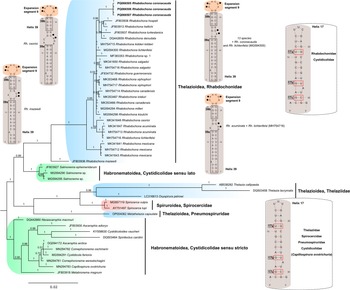
Three new complete identical sequences of the 18S rRNA gene (1789 base pairs (bp)) were obtained for R. coronacauda. Overall, the interspecific genetic p-distances within the genus Rhabdochona were 0.13%–3.06% (Supplementary Table 1). The phylogenetic tree was subdivided into two clades: the first included Cystidicolidae sensu stricto (a family of spirurian nematodes), and the second comprised the families from the superfamilies Thelazioidea sensu lato, Spiruroidea, and Habronematoidea sensu lato (Figure 2). The second clade was subdivided into two subclades: the first included the families Thelaziidae and Pneumospiruridae of Thelazioidea as well as Spirocercidae of Spiruroidea, and the second included Salmonema (Cystidicolidae sensu lato) and its sister group of Rhabdochonidae (Thelazioidea sensu lato). The Rhabdochonidae group comprised four major tightly clustered branches. The basal branch of the family included the only Indian species R. mazeedi, which presented the highest genetic divergence relative to the other rhabdochonids: 2.49%–3.06%. The second branch contained R. mexicana. The third branch contained three species, namely R. osorioi, R. acuminata, and R. lichtenfelsi (see the distances in Supplementary Table 1). The fourth branch was polytomic, containing 13 species, of which R. milleri, R. guerreroensis, and R. kidderi were the only ones with 0% genetic variability. The Khanka species R. coronacauda occupied an independent position in the fourth branch and was sister to a subgroup consisting of R. hospeti, R. hellichi, R. turkestanica, and the type species R. denudata. Rhabdochona coronacauda was more distant from R. hellichi and R. denudata (0.86%) as well as R. hospeti and R. turkestanica (1.06%) than from R. milleri, R. kidderi, and R. guerreroensis (0.73%). The latter three species were closer to R. hellichi (0.26%), R. denudata (0.39%), and R. hospeti (0.59%).
Unrooted phylogenetic tree resulting from BI method reconstructed for three superfamilies of the infraorder Spiruromorpha based on the fragment of the 18S rRNA gene. Newly sequences of Rhabdochona coronacauda are in bold. Sequences’ length used for the reconstruction was 1626 bp. Four types of the secondary structures of the h39+ES9 region were represented with the indication of the structure-associated species. Dotted boxes and black circles indicate identical nucleotides in all Rhabdochona spp. Two types of the secondary structures of h17 are showed with the indication of the structure-associated families.

The estimated interspecific divergence within Cystidicolidae sensu stricto was relatively similar: a minimum of 0.07% between Ascarophis arctica and Comephoronema werestschagini, and a maximum of 3.7% between Spinitectus carolini and Capillospirura ovotrichuria (Supplementary Table 2).
Secondary structures based on the 18S rRNA gene
The secondary structures of the 18S gene were reconstructed at different temperatures (18°C–25°C), but that did not affect the conformation. The reconstructed models of 18 Rhabdochona species comprised a fixed number of nucleotides (48 bp) and consisted of h39 and ES9 (Figure 2). The initial and terminal parts of h39 were constant in all species: 5’-CCUACUAAAUAG-3’ and 5’-CUUCUUAGAGG-3’, respectively. Both parts formed the first conserved domain, designated here as 39a. The second conserved domain 39b is located in ES9. Of note, h39 adjacent to ES9 was identical in length (40 bp) but varied in nucleotide composition. Thus, the architecture differed depending on the species or species group.
We found that h39 of Rhabdochonidae had four substructures of the same size (48 bp) but differing by the composition of the internal and bulge loops. The first substructure included two single-nucleotide bulge loops in 15 species. The second (R. acuminata and R. lichtenfelsi) and third (R. mazeedi) substructures had one single-nucleotide bulge loop and trinucleotide internal loop. The fourth substructure was present only in R. osorioi; it has one single-nucleotide bulge loop and a pentanucleotide internal loop. ES9 representing a single external loop had a fixed number of nucleotides (8 bp) in all sequences and varied by a compensatory single-nucleotide substitution at the seventh site depending on the species: adenine in the first substructure, guanine in the second and fourth substructures, and cytosine in the third substructure. Among all structures, the only exception was for R. lichtenfelsi, which had two different 18S rRNA sequences with minor variability in the h39+ES9 regions: h39 of the sequence MH754716 had one single-nucleotide bulge loop and one three-nucleotide internal loop, and h39 of MG594300 had two single-nucleotide bulge loops. Domain h39 in both sequences had one single-nucleotide replacement at the 14th site. ES9 in both sequences (MH754716 and MG594300) differed by a single nucleotide at the seventh site.
Secondary structures reconstructed for other spiruromorph families Cystidicolidae, Pneumospiruridae, Spirocercidae, Thelaziidae were characterised by higher variability in both h39 and expansion segment 9 (Figure 3). In these four families first conserved domain 39a comprised 25 nucleotides as well as in Rhabdochonidae. Domain 39b comprised eight complementary nucleotides differing from the Rhabdochonidae by composition – (TGGA) and (TCCA) except for Oxyspirura petrowi (Thelaziidae) with (TGAA) and (TTCA). Octonucleotide external loop was a common pattern in the structures of ES9 in Cystidicolidae sensu stricto and sensu lato (Salmonema). Exception is Ascarophis adioryx where octonucleotide ES9 had shorter external loop (6 bp). In the other families, ES9 significantly varied in size and structure: 15–23 bp in Thelaziidae; 31 bp in Pneumospiruridae; 14 bp in Spirocercidae.
Secondary structures of the h39 and ES9 of the 18S gene reconstructed for 17 species from Thelaziidae, Pneumospiruridae, Spirocercidae and Cystidicolidae of the order Spiruromorpha.

In the 18S rRNA gene, h17 was identical by size (32 bp) in Rhabdochonidae, Cystidicolidae, Thelaziidae, Pneumospiruridae, and Spirocercidae. There was a single substitution in the external loop (Figure 2). The first substructure characteristic for Rhabdochonidae and Cystidicolidae comprised cytosine at the 17th site of the external loop. The second substructure comprised uracil at the 17th site of Thelaziidae, Pneumospiruridae, Spirocercidae, and Cystidicolidae (C. ovotrichuria). Three positions – 17a, 17b, and 17c – were identified according to Nyaku et al. (Reference Nyaku, Sripathi, Kantety, Gu, Lawrence and Sharma2013) and were the same as that of other spiruromorph Brugia (Filarioidea, Onchocercidae).
Discussion
The problem of species divergence and taxonomy of parasitic nematodes have always been an inspiration and a topic of interest for more than 30 years after the molecular genetic methods were invented. The relatively recent assessment of species richness among parasitic nematodes suggested the number of nearly 25,000 species infecting vertebrates (Dobson et al. Reference Dobson, Lafferty, Kuris, Hechinger and Jetz2008), and less than a half of these parasites were provided with genetic data (Blaxter and Koutsovoulos Reference Blaxter and Koutsovoulos2015). The studies providing DNA barcoding involve nematode species of medical, agricultural, or ecological relevance (Gonçalves et al. Reference Gonçalves, Bianchi, Deprá and Marques2021) but it is not sufficient for the complete or at least broad genotyping. The family Rhabdochonidae is characterised by the scarce number of nucleotide sequences and their genetic characteristics. According to the WoRMS database, the genus Rhabdochona includes 86 valid and 20 uncertain species (taxon inquirendum). Despite that, Moravec et al. (Reference Moravec, Ermolenko, Besprozvannykh and Scholz2012) considered 95 valid species in Rhabdochona. To the date sequence data were provided only for 17 valid species (Choudhury and Nadler Reference Choudhury and Nadler2018; Laetsch et al. Reference Laetsch, Heitlinger, Taraschewski, Nadler and Blaxter2012; Mwita and Nkwengulila Reference Mwita and Nkwengulila2010; Santacruz et al. Reference Santacruz, Ornelas-García and Pérez-Ponce de León2020; Wijová et al. Reference Wijová, Moravec, Horák and Lukes2006). The sequencing data of the complete 18S rRNA gene were obtained for R. coronacauda for the first time in this study (Figure 2, Supplementary Table 1), however, only 18.95% of valid species were provided with sequencing data. Thereby, new phylogenetic interpretation of the interrelationships of Rhabdochona is required in the light of new data, because the phylogeny of Rhabdochona based on morphology (Mejía-Madrid Reference Mejía-Madrid2012) revealed inconsistency between the genetic and morphological data.
Genetic divergence and phylogeny
Rhabdochona coronacauda differs from other rhabdochonid species at a level that is acceptable for interspecies differentiation in nematodes, specifically 0.73%–2.99% based on the 18S rRNA gene (Vainutis et al. Reference Vainutis, Voronova, Andreev, Pankratov and Shchelkanov2023, Reference Vainutis, Voronova, Andreev and Zyumchenko2024). Interspecific genetic distances based on the 18S rRNA gene within Dictyocaulus and Philometroides were 0.45%–3.5% (Vainutis et al. Reference Vainutis, Voronova, Andreev, Pankratov and Shchelkanov2023) and 0.11%–0.56% (Vainutis et al. Reference Vainutis, Voronova, Andreev and Zyumchenko2024), respectively.
The provided genetic distances of Rhabdochonidae (Supplementary Table 1), Cystidicolidae sensu stricto (Supplementary Table 2), Dictyocaulidae (Vainutis et al. Reference Vainutis, Voronova, Andreev, Pankratov and Shchelkanov2023), and Philometridae (Vainutis et al. Reference Vainutis, Voronova, Andreev and Zyumchenko2024) are interspecific due to respective distance ranges with that of capillariid nematodes from the class Enoplea (Deng et al. Reference Deng, Suleman, Li, Li, Fu, Liu GH and Yao2022). The authors reported maximum genetic distances based on the 18S rRNA gene of less than 3% between the species of Capillaria, Aonchotheca and Eucoleus. There were lower distances of 1.1% and 1.5% between the species of Eucoleus and Aonchotheca, respectively. Based on these data, we consider the range of 1%–3% to be standard for nematodes from the classes Chromadorea and Enoplea.
On the phylogenetic tree, 18 species of Rhabdochona and Rhabdochona sp. 1 formed the common monophyletic clade with high statistical support (Figure 2). However, there was inconsistency at the superfamily level: Cystidicolidae is polyphyletic and one of its expected representatives (Salmonema) and rhabdochonid species are included in a common subclade. Choudhury and Nadler (Reference Choudhury and Nadler2018) provided extended phylogenetic analysis including 148 nematode species; they revealed sister relationships of Rhabdochonidae and Salmonema + Spinitectus (Cystidicolidae) and a tangled phylogeny of the families of Thelazioidea and Habronematoidea with other families of Acuaroidea, Diplotriaenoidea, Filarioidea, Physalopteroidea, and Spiruroidea. We suggest two explanations for this topology. This first involves the cystidicolid concept based on the earlier consideration of Rhabdochona along with Salmonema within Cystidicolidae. We exclude this explanation because the type genus of Cystidicolidae is included in another clade. Moreover, Spinitectus is a strongly supported representative of Cystidicolidae sensu stricto (Figure 2). We suppose that Salmonema forms a separate family that is sister to Rhabdochonidae, which can be newly established as monogeneric Salmonematidae. It is interesting that three Indian species – R. hospeti, R. turkestanica, and R. mazeedi – did not form a common monophyletic group and were polyphyletic regarding a common geographic region. They were rearranged in the tree as sister to R. coronacauda (R. hospeti + R. turkestanica + R. hellichi + R. denudata) and closer to a common ancestor of Rhabdochona (R. mazeedi). Preliminarily sequencing results indicate that R. mazeedi has the most ancient origin relative to Rhabdochona spp. According to Mejía-Madrid et al. (Reference Mejía-Madrid, Choudhury and Pérez-Ponce de León2007) and Mejía-Madrid (Reference Mejía-Madrid2012), the only centre of origin that can be claimed is the ancient Tethys Ocean, but until more species of Rhabdochona are sequenced nothing can be stated as to the centre of origin, if one actually existed.
Secondary structures
Aleshin et al. (Reference Aleshin, Kedrova, Milyutina, Vladychenskaya and Petrov1998) first analysed 18S rRNA secondary structures for 10 species of Rhabditida based on h17. They concluded that these structures may serve as markers of the evolutionary process. Later, Nyaku et al. (Reference Nyaku, Sripathi, Kantety, Gu, Lawrence and Sharma2013) showed h17 substructures that differed based on external and internal loops for 10 genera from seven orders of the classes Enoplea and Chromadorea. Of these, Plectus unexpectedly had the same structure as that of spiruromorphs from our study (Figure 2); the positions 17a, 17b, and 17c were completely consistent. These positions were the same in our structures and that of other spiruromorph Brugia (Filarioidea), but the external loop of the latter was different relative to Thelazioidea, Habronematoidea, and Spiruroidea. Given the unreliable use of h17 structures for differentiation of the superfamilies with tangled taxonomy (Thelazioidea and Habronematoidea), we believe that h17 should only be applied for the identification of the nematode orders.
There were four substructures of the h39–ES9 region of the 18S rRNA gene based on reconstruction for 18 species of Rhabdochona. Each substructure was associated with a single species or a group of species. We noted consistency of the secondary structures with the groups indicated on the tree and genetic distances, with R. mazeedi as the most differentiated relative to all Rhabdochona species. Interestingly, R. coronacauda had an identical h39–ES9 region as that of R. hellichi, R. hospeti, R. denudata, R. milleri, R. kidderi, and R. guerreroensis. Of them R. hellichi, R. hospeti, and R. denudata had a sister relationship to R. coronacauda in the phylogenetic tree (Figure 2). Rhabdochona lichtenfelsi presented two variable sequences. Of these, MH754716 was sister to R. acuminata, and MG594300 was nested within the polytomic group formed of 14 species, including the type species R. denudata and R. coronacauda. The intraspecific genetic variability within R. lichtenfelsi (10 divergent sites between MG594300 and MH754716) can depend on two factors: host – MG594300 (the goodeid Goodea atripinnis) and MH754716 (the atherinopsid Atherinella alvarezi); and habitat – MG594300 (Michoacan, Lake Cuitzeo in Central Mexico) and MH754716 (Chiapas, Lagartos River in South Mexico) (Caspeta-Mandujano et al. Reference Caspeta-Mandujano, Salinas-Ocampo, Suárez-Rodríguez, Martínez-Ramírez and Matamoros2021; Choudhury and Nadler Reference Choudhury and Nadler2018). There was a similar issue in the h39–ES9 structures of the nematode Dictyocaulys capreolus from different localities (Vainutis et al. Reference Vainutis, Voronova, Andreev, Pankratov and Shchelkanov2023). Specifically, ES9 of D. capreolus from the Czech Republic was reduced to a small external loop in the apical part of the entire domain. The structure for D. capreolus from Sweden and Poland had a single substitution in ES9, which did not result in a different model. In contrast to Dictyocaulus, where ES9 was suitable for the species differentiation (Vainutis et al. Reference Vainutis, Voronova, Andreev, Pankratov and Shchelkanov2023), in Rhabdochona h39 was revealed to be more reliable for this task.
Considering h17 and h39, h39 seems to be more promising; it allowed us to differentiate individual species (R. mazeedi and R. osorioi) or species groups of Rhabdochona (Figure 2). The structures of h39 in both Rhabdochonidae and Cystidicolidae with Salmonema had an identical 39a domain but differed in 39b and ES9 based on nucleotide composition that countered the sister resolution of Rhabdochonidae and Salmonema. Moreover, the structure of the h39–ES9 domain within and between families of different superfamilies and their resolution on the phylogenetic tree in combination do not correspond to the accepted classification of spiruromorph nematodes that denotes the necessity of major taxonomic revision within the Spiruromorpha. We found that h17 does not differ within the genus Rhabdochona or between the families Rhabdochonidae and Cystidicolidae. At the level of the superfamilies Thelazioidea, Spiruroidea, and Habronematoidea, h17 allows one to distinguish Rhabdochonidae and Cystidicolidae from Spirocercidae, Thelaziidae, and Pneumospiruridae. The search for promising marker candidates among secondary structures continues and this will certainly be of great importance for confirming the conclusions regarding the phylogeny of spiruromorph taxa.
Supplementary material
The supplementary material for this article can be found at http://doi.org/10.1017/S0022149X25100588.
Acknowledgements
Authors are very grateful to Dr. František Moravec for his helpful advice and valuable comments during the preparation of this manuscript.
Financial support
The research was carried out within the state assignment of Ministry of Science and Higher Education of the Russian Federation, Federal Project No. 124021900011-9 ‘Biodiversity of the World Ocean: taxonomy and evolution, reproductive biology, biogeography, and bioinvasions’.
Competing interests
The authors declare no competing interest.
Ethical standard
The research program using fishes of the genus Chanodichthys from Khanka Lake was approved by the Committee for the Control of the Care and Use of Experimental Animals of the Far Eastern State Technical Fisheries University. The committee’s establishment was formalized by order No. 491 on June 20, 2024.