On December 22, 2008, at approximately 1 am, the wall of a coal fly ash retaining pond failed at the Tennessee Valley Authority (TVA) Kingston Fossil Plant (KIF) in Harriman, Tennessee, releasing approximately 5.4 million cubic yards of coal fly ash that covered 300 acres of land and water. No injuries or deaths were reported; however, 26 homes were either damaged or destroyed, and many people were forced to leave their property. The landslide caused by the ash derailed a train, disrupted local utilities, and partially obstructed the flow of the Emory River. The disaster significantly affected the natural environment as well as the general well-being of the community.
The community and the press raised questions about the potential health effects of exposure to the coal ash. Concerns about the risks to public health were based on several factors, primarily water and air quality (coal combustion products, such as fly ash, are known to contain heavy metals, volatile organic compounds, and, in some cases, radioactive elements). Initial investigation by the Tennessee Department of Health (TDH), under the supervision of the Agency for Toxic Substances and Disease Registry (ATSDR), concluded that no health risk was expected from exposure to fly ash based on evaluations of the municipal drinking water, well/spring water, sampling of the particulate matter in the air, and analysis of the levels of metals found in the ash. 1
Although no adverse health effects were expected from the disaster, TVA believed that a uniform health assessment should be developed to address community members’ health concerns, and asked Oak Ridge Associated Universities (ORAU) to coordinate this effort. ORAU teamed with the Tennessee Poison Center (TPC) at Vanderbilt University Medical Center in Nashville, Tennessee, for its expertise in medical toxicology and with a local health care organization (Covenant Health) to provide facilities for medical examinations and testing. Very limited data existed regarding biological monitoring on a human population after an exposure to coal fly ash, especially after an event of this magnitude.
METHODS
Residents of Roane County, Tennessee, who thought that their health may have been affected by the spill, were eligible to participate in the screening program. The medical evaluation included the following: health history questionnaire, spirometry, chest x-ray, routine urinalysis, complete blood cell count, blood chemistry values, heavy metal/metalloid concentrations (blood/serum or first-morning void urine sample), and a physical examination.
Tool Development
A standard tool for evaluating the health of concerned citizens was developed. A health history questionnaire (available on request) was developed by a joint team from ORAU and the medical toxicologists from the TPC. A standard panel of laboratory evaluations for some heavy metals and metalloids was chosen for monitoring patients. Coal fly ash contains several heavy metals that could pose potential health problems, 1 so to determine which metals to evaluate in the Roane County residents, we compared the metals present in coal ash samples taken by the Tennessee Department of Environment and Conservation (TDEC) on January 6-7, 2009, 1 to those in background soil samples provided by the US Environmental Protection Agency (EPA) on January 2, 2009. 2 If the amount of a metal was higher in the ash compared with the soil, then we measured the biomarker for that metal; the metals included aluminum, arsenic, barium, beryllium, chromium, cobalt, copper, nickel, and vanadium. Although selenium and thallium did not exceed regional background soil measurements, they were included in the screening due to their potential health risks—selenium is susceptible to bioaccumulation, 3 a process in which small amounts of the substance gradually build up over time and accumulate in soil, plants, and human tissue, and thallium has a tendency to bioconcentrate in water sources. 4 General clinical laboratory tests, consisting of a complete blood cell count (CBC), comprehensive metabolic panel (CMP) [glucose, blood urea nitrogen (BUN), creatinine, sodium, potassium, chloride, carbon dioxide, total bilirubin, total protein, albumin, alanine aminotransferase (ALT), aspartate aminotransferase (AST), alkaline phosphatase, calcium, osmolality, and estimated glomerular filtration rate (eGFR)], and routine urinalysis (UA) were offered to all participants to assess secondary effects on organs.
A first morning urine sample was collected to screen for arsenic, barium, beryllium, thallium, and vanadium; whole blood was used to screen for cobalt and selenium; and serum was used to measure aluminum, chromium, copper, and nickel. Samples for heavy metal testing were sent to NMS Labs for analysis using inductively coupled plasma/optical emission spectrometry (ICP/OES) for copper, graphite furnace atomic absorption spectroscopy (GFAAS) for vanadium, and inductively coupled plasma/mass spectrometry (ICP/MS) for the remaining samples. Colorimetry was used to measure creatinine for creatinine-corrected urine values. Samples for CBC, CMP, and routine UA were collected and analyzed at Roane Medical Center (Harriman, Tennessee) according to the standard of care for clinical laboratories.
Because ash particles and other dusts due to increased activities around the plant were thought to be a potential respiratory hazard, spirometry was performed on all individuals aged 6 years and older (equipment limitations excluded younger children). Results were assessed using guidelines reported on by Knudson et alReference Knudson, Lebowitz, Holberg and Burrows 5 and Hsu and coworkers,Reference Hsu, Jenkins and His 6 as appropriate. In addition, a chest x-ray with 2 views (posteroanterior and lateral) was performed at Roane Medical Center on all consenting participants. The x-ray films were read by a board-certified radiologist.
Evaluation Procedure
Participants completed the health history questionnaire and then reported for medical testing at a local clinic for further evaluation. After the results from all of the medical tests were received, they were evaluated by the medical toxicologist (J.G.B.). Abnormal results were reported to affected participants, and copies of their medical records were made available for sharing with the participant’s primary care provider or an appropriate specialist, as needed.
Analysis
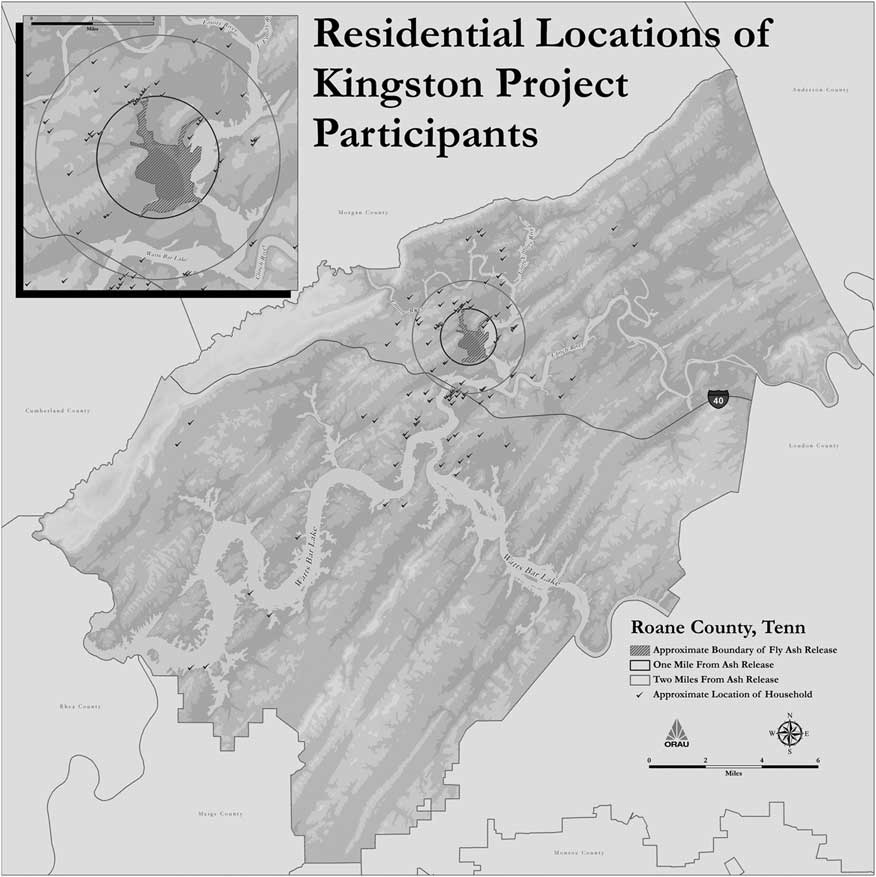
Data were collected and stored in an Access database and analyzed using simple descriptive techniques in Excel and SAS software. 7 In addition, the locations of the participants’ residences at the time of the spill were mapped using geographic information systems. As this sample was not randomized, no inferential analyses were performed.
Ethics/Privacy
This assessment was voluntary, participants were free to withdraw at any time, and they could choose to complete the entire testing or only part of it. Approval from the Oak Ridge Site-wide Institutional Review Board was obtained before any testing began. Participants were informed of their medical privacy rights provided by the Health Insurance Portability and Accountability Act of 1996.
Results
Between September 2009 and April 2010, a total of 214 self-identified individuals representing 112 households participated in the screening (Figure). Initially, 320 individuals registered for the screening, but 106 participants withdrew for a variety of reasons before the hospital phase of the process (67% participation). The participants ranged in age from younger than 1 year to 89 years. Of these participants, 53% were female and 98% were Caucasian. The most common symptoms reported by participants were related to upper airway irritation, including runny nose, cough, and congestion. The physical examination for most participants yielded essentially normal findings. Abnormalities or variations were judged to be due to preexisting conditions by the examining medical toxicologist.
Residential Locations of Study Participants in Roane County, Tennessee.

Based on the information provided from the questionnaire and discussion with the medical toxicologist, symptoms related to the head, eyes, ears, nose, and throat (HEENT) were present before the spill in 23% (n=48) of the participants, and pulmonary symptoms were identified in 38% (n=77). After the spill, 65% (n=133) of the participants reported having HEENT-related symptoms, and 52% (n=106) claimed they had pulmonary symptoms.
Pulmonary function tests (PFTs) were performed on 194 participants (Table 1). The majority (n=146; 75%) had normal lung function test results. The majority of abnormal results (63%) occurred among current or former smokers. Pulmonary function tests were not performed for children younger than age 6 years (n=20). Patients with abnormal test results were referred to their primary care physicians for further evaluation.
Results of Spirometry Testing

a FEV1, forced expiratory volume in 1 sec; FVC, forced vital capacity; LLNL, lower limit of normal range.
A total of 208 participants had a chest radiograph; 89% of the results were normal. The remaining 11% had findings of varying degrees of pathology, but it was unlikely that any of these findings were related to the fly ash. Two individuals had a mass in their lungs that needed further follow-up with their primary care physician, but these anomalies were not suspected to be related to exposure to fly ash. One patient was lost to follow-up, and the pathologic finding was never identified; the mass in the second patient was assessed to be of fungal origin.
Of the 214 participants, 212 underwent some or all of the blood and urine testing for metals. The majority of heavy metal results was within population-normal levels (Tables 2 and 3). No beryllium, cobalt, nickel, thallium, or vanadium was detected. Six individuals had serum aluminum values greater than 15 µg/L (the highest was 23 µg/L); however, none had a value high enough to cause medical problems or require additional treatment.
Results for Heavy Metal Content in Initial Blood Draws Only

Results for Heavy Metal Content in First Morning Void of Urine

a µg/g creat, micrograms per gram of creatinine.
Additional Screening for Metals
In 7 individuals, arsenic was detected in their first morning urine sample. The screening test did not differentiate between inorganic arsenic (ie, arsenite and arsenate) and organic arsenic varieties (methylarsonic acid [MMA] and dimethylarsinic acid [DMA]). 8 Because organic arsenic is found in a variety of common sources, primarily seafood, ingestion of large amounts of shellfish before testing can increase levels of total arsenic. 9 To accurately measure both forms of arsenic for the 24-hour urine sample, individuals were asked to refrain from eating seafood for 7 days before the collection. Following the 24-hour collection, all individuals had levels of inorganic arsenic that were within normal population ranges. The elevated screening levels likely were due to organic arsenic from seafood consumption.
Serum copper levels were tested in 204 individuals, and 17 had a value greater than 155 µg/L. None, however, exhibited signs or symptoms of copper toxicity, and most persons with elevated serum copper levels had explanations related to diet, medications, or underlying medical conditions.
Selenium was tested in whole blood for 203 individuals, and 55 (27%) had a value greater than the upper reference range of 230 µg/L. None was near a toxic concentration (600 µg/L), and all of these participants had unremarkable physical examinations. Some were taking health supplements that may have contained selenium. Also, diet can increase selenium concentrations. 10 Of those with elevated values, 40 returned for a repeat measurement after making modifications in their diet and avoiding selenium-containing supplements for 1 week before the test. All had subsequent values that were below or near the normal range. One participant had a selenium level that increased with subsequent measurement that reached 550 µg/L, but it was discovered that he was receiving chelation therapy and vitamin/nutrient supplementation from his primary care physician. He was instructed to discontinue therapy, and a third selenium level disclosed a selenium concentration that had decreased to near normal levels.
General Laboratory Analysis
General laboratory analysis was obtained in 212 individuals. Results were not available for all tests for all individuals; therefore, only percentages will be described here. Hemoglobin and/or hematocrit concentrations were below normal in 44% of the individuals tested, reflecting a possible underlying anemia (most likely unrelated to fly ash, as many had a history of anemia). Non-fasting blood glucose levels were elevated (>110 mg/dL) in 18% of the participants. Several of the individuals had eaten just before the test, so results were slightly elevated. The remaining persons were known to have diabetes with varying levels of poor control; these persons were referred for follow up to their primary care physician.
Liver function (ALT) was elevated in 1.5% of the patients. These elevations were minor in all cases, and the participants were referred to their primary care physician for further evaluation. Renal function tests (BUN and creatinine) were elevated in 1% of the patients, some with known preexisting disease; they too were referred to their physicians.
Distance from the spill appeared to have no effect in results. Because this was a voluntary examination, these findings have little bearing on a true exposure-response relationship; however, no evidence of heavy metal toxicity was found in any of the participants.
DISCUSSION
Based on data acquired from EPA and TDEC regarding ash and soil samples, the likelihood of illness that could be attributed to fly ash exposure was low. This observation was in part due to the absence of a completed exposure pathway, especially early in the course of the spill. Because no elevation of metal or metalloids was detected in the air and no water source was contaminated, no abnormalities related to fly ash metals and metalloids was expected. This medical screening was designed for voluntary participants to be evaluated and reassured; it was not a formal study to assess health impact by exposure-response. Health findings in a medical screening of this nature were not intended to determine causality for any abnormality or illness that may have been identified. However, if a high rate of disease was uncovered, then a more formal study would have ensued.
Most of the fly ash at Kingston contained particulate matter less than 2.5 µm (PM 2.5; 8.2%) and less than 10 µm (PM 10; 31.2%) from a 50/50 blend of Central Appalachian/Powder River Basin coal. 1 Particles less than 10 µm in diameter can enter the lower airway and cause inflammation and irritation. Because of particle aggregation, some fly ash particles were greater than 10 µm, but not all. For example, none of the settled dust particles that would be visible to people in the community was likely to be less than 10 µm.
Some individuals who have preexisting medical conditions, especially cardiopulmonary related, may be at increased risk of developing acute respiratory illness by inhaling particulate matter less than PM 2.5,Reference Brook, Rajagopalan and Pope 11 such as coal ash. In addition to the coal fly ash from the spill, thousands of trucks entered and left the cleanup site during the recovery effort, producing unusually high amounts of gravel dust, road dust, and diesel exhaust. However, any dust, including that with a large particle size, can be irritating to the eyes, nose, and throat when airborne, which most likely explains the increase in HEENT and pulmonary symptoms observed in the screened participants. The detected levels of PM 2.5 and PM 10 remained within the pre-spill range for particulate matter in this area, and they were less than national ambient air quality standards. 12
The potential for particulate matter from fly ash, road and rail reconstruction, and increased dust from truck traffic to contribute to diminished respiratory health was limited by keeping ash and roadways wet. In addition, TVA implemented a dust-suppression plan that included the use of dust control measures such as a flexible growth medium (Flexterra), grass-planting, and water spraying. 13 An above-average rainfall before the spill, which was more than 7 inches of rain in a 31-day period, not only added to the disaster but also contributed to reducing airborne particulate matter 14 ; however, the potential for fine particles to enter the air was possible, depending on changing atmospheric and environmental conditions during the disaster recovery operations. Moreover, it was difficult to conduct spirometry testing under the same conditions every time, as this screening program began in the fall of 2009 and finished in the spring of 2010; seasonal allergies most likely played a significant role in the increased number of HEENT symptoms reported.
Iron has been identified as an important nutrient for bacteria.Reference Andrews, Robinson and Rodriguez-Quinones 15 Because coal fly ash contains a high concentration of iron, it could have been a potential nutrient source for bacteria. Thus, bacterial infection could have been another cause of the increased number of HEENT complaints. In addition, coal fly ash has been known to impair pulmonary immune response function,Reference Smith, Veranth, Kodavanti, Aust and Pinkerton 16 contributing to a higher susceptibility to respiratory infection. A similar mechanism has been demonstrated experimentally using residual oil fly ashReference Antonini, Roberts, Jernigan, Yang, Ma and Clarke 17 , Reference Gao, Barchowsky, Nemec and Fabisiak 18 ; however, metal concentrations tend to be much higher in residual oil fly ash compared with coal fly ash.Reference Costa and Dreher 19 Given that the average concentration of iron in coal fly ash samples taken from the Kingston site (13 000 mg/kg) 2 was lower compared with background soil samples (16 050 mg/kg), 2 the possibility of excessive bacterial contamination as a result of this mechanism was less likely but still possible. Moreover, all of these data were derived from experimental animal data or human cell cultures, and no human or medical data have been available indicating how high levels of iron dusts might behave in humans. Unfortunately, we have no air-monitoring data specific to iron, as air-quality monitors capture some metals but not iron. Also, we have no data regarding bacterial counts. While data regarding medication use were collected, this information did not include the specific dates of usage. We therefore did not know if antibiotics were prescribed to treat respiratory infection immediately after the spill.
Some of the individuals who declined chest radiographs had recent x-rays and did not wish to undergo another radiological exposure. In many of the other cases, parents declined radiographs for their children. Little follow-up information was obtained on the 2 participants in whom lung masses were observed. For the first person, the reviewing radiologist noted a left hilar mass and suggested computed tomography (CT) for additional analysis. More specific details were not known, as the participant was referred to a pulmonologist and then lost to follow-up. This participant was a former heavy smoker with a history of cardiopulmonary issues. The other patient was originally diagnosed with lung cancer, which was later determined to be a fungal infection. Fungal infections can occur after events in which a major disruption of the soil occursReference Baumgardner 20 , Reference Schneider, Hajjeh and Spiegel 21 ; however, it is not clear in this case what was the specific etiology of the infection. No evidence of fungal infection was seen in any other participant.
Anemia (defined as a hemoglobin or hematocrit level below reference range) was noted in a high percentage of participants (44%). Approximately 14% of people aged 45 years or older living in Tennessee are anemicReference Zakai, McClure and Prineas 22 ; however, 47% of participants 45 years or older who had their blood drawn experienced a decreased hemoglobin and/or hematocrit level. The TDH was notified of these findings, but the cause was most likely related to diet and other determinants of health rather than exposure to coal fly ash. People with preexisting disease were more likely to request evaluation, and therefore may have contributed some recruitment bias. Also, subtle changes in hemoglobin or hematocrit levels were counted as anemia, and therefore a high percentage of anemia was found in participants. Biomarkers for liver and kidney function were generally unremarkable.
For the 17 people who originally experienced elevated copper levels, no evidence of toxicity was noted on physical examination. It is unlikely that any of these individuals would be at risk for chronic copper excess. Copper, a naturally available element, is a micronutrient in human diet that has been considered an essential metal.Reference de Romana, Olivares, Uauy and Araya 23 While daily intake varies according to diet, absorption of copper can vary among individuals. Serum levels of copper can be elevated beyond standard range because of underlying liver disease, anemias, inflammatory diseases, pregnancy, or use of oral contraceptives or estrogen hormones.Reference Buchwald 24 Acute poisoning from exposure to copper occurs after ingestion of large amounts of certain copper salts such as copper sulfate. Chronic ingestion of high levels of copper ultimately results in liver dysfunction, and liver damage is considered the most relevant endpoint in assessing copper toxicity.Reference Cockel, Bertinato and L’Abbe 25
No participants demonstrated clinically significant altered liver function, so it was not necessary to assess additional biomarkers such as ceruloplasmin. Clinical manifestations from acute or chronic copper poisoning were not evident in any patient with elevated serum copper levels. Typical symptoms of copper excess have included gastrointestinal upset, in which nausea has been the first symptom to appear. This symptom may be followed by vomiting and/or diarrhea; however, exposure to copper in the environment rarely causes disease in healthy adults.Reference de Romana, Olivares, Uauy and Araya 23 In addition, after exposure to fly ash, if significant exposure was occurring, one would expect not just one metal/metalloid to be elevated, but several.
As noted, elevated selenium and arsenic levels were most likely related to diet or nutritional supplements. Environmental causes of elevated selenium levels have been reported,Reference Longnecker, Taylor and Levander 26 but the area around the Kingston Fossil Plant is not a seleniferous area, so it was unlikely to be a toxic element for these participants. While coal fly ash does contain selenium, the concentrations in the samples taken by the EPA were not greater than background soil measurements. All but one of the participants experienced decreased levels after modifying their diet, and chelation therapy was believed to be the cause of high selenium levels in that patient. Very little data have been collected regarding human biomarkers after a coal fly ash spill. Urine and nail arsenic samples were collected on a small population in Allegheny County, Pennsylvania, following a much smaller exposure, but no detectable levels of arsenic were measured. 27
Limitations
Important limitations have occurred with this screening program. First, allowing individuals to volunteer for screening severely limited the ability to compare exposed and unexposed groups of residents. Second, organizing a complex screening program after a major disaster was compounded by the interaction of multiple agencies and organizations. Although the coal fly ash spill occurred in December 2008, the first participants were not screened until September 2009, thus testing began outside of the peak window of exposure. Third, although no evidence existed for air, soil, or water contamination with fly ash in the immediate vicinity of most of these residents, the screening measured the baseline health of participants to verify that they had no exposure to metals/metalloids. Finally, because no subsequent measurements were recorded of the residents’ health, we have been unable to track trends of worsening or increasing conditions, including the presence of metals/metalloids in their bodies.
It is important to mention that incorporating a uniform methodology and implementing an open process in difficult times helps to maintain a sense of calm and provides valuable background information for future events, if necessary. Should additional testing be needed due to disaster recovery efforts (prolonged exposure or repeated release of fly ash or other toxic materials) or to changing health patterns in the community, then this initial evaluation would serve as a baseline on which to compare future assessments.
The approach described serves as a screening model that can be used to set up a specific medical evaluation in the setting of hazardous material spills. Appropriate partnerships with industry, nongovernmental organizations, academia, governmental organizations, and the regional poison center can help assess the situation and provide comfort to those in need.
CONCLUSIONS
Since the spill occurred, a significant number of HEENT and breathing complaints were identified. These complaints likely represented general nuisance dust exposure from construction traffic. Little available data have been available regarding public health risk for nonoccupational exposure to fly ash. Even though the evaluation of the individuals was delayed 6 months after their exposure, no illness was found to be directly related to fly ash exposure.
The findings of this medical evaluation, as based on a single screening examination for the 214 participants, support the conclusions of the 2009 Public Health Assessment for the Coal Ash Release 1 prepared by the TDH. After careful consideration of all available data, the report concludes that they did, “not expect harm to health from touching, eating, drinking, or breathing the metals in coal fly ash. No harm is expected from breathing the air as long as adequate dust suppression measures are in place.” We believe that the current evaluation can serve as a model on which to base disaster-related health screenings for toxicity from spilled materials.
Funding and Support
Funding for this medical screening was provided by the Tennessee Valley Authority (TVA).
Acknowledgments
Roane Medical Center and Covenant Medical Management allowed the use of their facilities to conduct the examinations for this study. Fran Puckett provided assistance with the study participants, and Donna Seger, MD, assisted with the protocol and public presentation of the study results.