I. INTRODUCTION
Recently, magnesium alloys are considered to be a good candidate in automotive, aerospace, and defense industry owing to their low density and high specific strength. But their low impact toughness, ductility, and corrosion resistance properties mitigate the applications of them in the aforementioned industries as structural materials. Magnesium and its alloys are known to be the lightest among conventional metallic materials including aluminum alloys and steel.
On the other hand, aluminum alloys have been widely used especially in aerospace and automotive industries due to their high ductility and corrosion resistance properties. Since the density of the Al alloys is close to the density of magnesium alloys, producing aluminum–magnesium based laminar composites would be reasonable to obtain a material as light as magnesium alloys and as tough and corrosion resistant as aluminum alloys.
The most common ways to bond aluminum and magnesium alloys are known as hot press (HP) and accumulative roll bonding (ARB) processes. Reference Zhou and Li1–Reference Chen, Hsieh and Wu3 HP could be conducted at elevated temperatures, under pressure for a certain period of time and mechanism of bonding depends on diffusion. Reference Zhou and Li1 ARB is known as a severe plastic deformation technique at which deformation bonding is the main mechanism. Reference Chang, Zheng, Xu, Fan, Brokmeier and Wu4 Laminated sheets are deformed, thus adhesion is obtained. The process may consist of cutting, stacking, and multiple rolling operations. Therefore, bulk ultrafine grained structures can be obtained in addition to deformation bonding via conducting ARB process. Moreover, ARB is a relatively easy and a low-cost product and the method can be commercialized for conventional production. There are two options for ARB process such as hot ARB Reference Chen, Kuo, Chang, Hsieh, Chang and Wu5 and cold ARB. Reference Chang, Zheng, Xu, Fan, Brokmeier and Wu4 Using ARB process, Al/Al, Reference Slamova, Homola and Karlık6 Mg/Mg, Reference Chang, Zheng, Wu, Gan, Tong and Brokmeier2,Reference Liu, Wang, Jia, Jing, Zhang, Ma and Liu7 and Al/Mg/Al Reference Chen, Hsieh and Wu3,Reference Zhang, Yang, Castagne and Wang8–Reference Bing, Zhong-Wei, Shou-Qian and Tian-Li10 types of composites were produced and various features such as application of the technique, thermal stability, grain refinement, and mechanical properties of the produced composites and also the effect of reduction ratio and rolling temperature were investigated.
In rolling process, the stacked plates which have wedge-end geometry instead of flat end were preferred for the roller to grasp the sandwich samples. Reference Zhang, Castagne, Yang, Gu and Wang11 Additionally, rolling was defined with two time periods: forming period and post-bonded period. Reference Zhang, Yang, Castagne, Gu and Wang9 Furthermore, strain threshold and critical bonding strength were defined as a bond criterion in ARB, and their dependence to parameters like temperature, reduction ratio, and friction coefficient between the roller and the aluminum plate was represented. Reference Zhang, Yang, Castagne, Gu and Wang9 For instance, bonding strength threshold was decreased from 28 to 19 MPa with increasing rolling temperature from 400 to 475 °C for 60% of reduction rate of Al7075/AZ31B/Al7075 sandwich plates.
Zhang et al. studied the effect of rolling reduction on the microstructure and hardness of the AZ31 Mg alloy sheets and found that hardness of the AZ31 alloy reached the highest value of 90 HV after 97% of reduction. Before the rolling operations, the samples were always heated to a temperature of 350 °C since the low temperature deformation is not possible for Mg alloys having the crystal structure of hexagonal closed packed (HCP) crystal structure. Reference Zhang, Tu, Chen, Zhang, Kang and Suzuki12 Similarly, in another study, AA8006 Al alloy sheets were ARB-processed and after two cycles of the rolling operation at 200 °C, it was observed that microhardness of the alloy was increased from 28 to 60 HV. From these studies, it could be concluded that ARB has an advantage of achieving grain refinement and having higher hardness values for Mg, Al, and their alloys. Reference Chang, Zheng, Wu, Gan, Tong and Brokmeier2,Reference Slamova, Homola and Karlık6,Reference Zhang, Tu, Chen, Zhang, Kang and Suzuki12,Reference Wu, Chang, Maawad, Gan, Brokmeier and Zheng13
Aluminum alloys and pure Mg or AZ31 Mg alloys were roll bonded using ARB technique and it was observed that the intermetallic compounds of Al3Mg2 (β) and Al12Mg17 (γ) yielded at the interfaces of Al and Mg. Reference Chang, Zheng, Xu, Fan, Brokmeier and Wu4,Reference Chen, Kuo, Chang, Hsieh, Chang and Wu5 To better understand the nature of the intermetallics, theoretical and experimental studies were conducted and Al–Mg phase diagram was revised or some changes were reported. Reference Zuo and Chang14–Reference Ren, Qin, Li, Guo, Shu, Dong, Liu and Zhang16 Particularly, it was revealed in the study that the R intermetallic compound stably existed at 250 °C and its reported composition range is 51.2–54.5 at.% Al, which is completely different from the accepted Al–Mg phase diagram. Reference Ren, Qin, Li, Guo, Shu, Dong, Liu and Zhang16 Al–Mg intermetallics formed at the interface were reported as hard and brittle. Reference Brubaker, Liu and Luo15,Reference Wang, Luo, Zhang, Shen and Zhang17,Reference Lee, Kim, Jo, Lee, Heo, Chang and Lee18 Specifically, β phase is harder than γ phase and the two phases are harder than either aluminum or magnesium solid solutions. Reference Bing, Zhong-Wei, Shou-Qian and Tian-Li10 Furthermore, β phase (Al3Mg2) was reported as the most brittle phase in Al/Mg/Al laminated composite. Reference Zhou and Li1 Therefore, preventing the formation of β phase is vital to improve the mechanical behaviors of Al–Mg based composites.
Since the impact toughness of the composites is important considering the applications, impact tests were accomplished on many different types of composites such as the fiber metal laminates (FML) Reference Pärnänen, Alderliesten, Rans, Brander and Saarela19–Reference Sadighi, Pärnänen, Alderliesten, Sayeaftabi and Benedictus22 , magnesium–magnesium, Reference Altenhof, Raczy, Laframboise, Loscher and Alpas23 aluminum–aluminum, Reference Tajally, Huda and Masjuki24,Reference Merlin, Timelli, Bonollo and Garagnani25 steel wire embedded magnesium composite, Reference Hufenbach, Ullrich, Gude, Czulak, Malczyk and Geske26 SiC particle reinforced aluminum based metal matrix composite, Reference Ozden, Ekici and Nair27 acrylic/Al plate, Reference Liu and Liaw28 and also on aluminum foam, Reference Cho, Hong, Lee and Cho29 however, up to the authors’ best knowledge, impact toughness of the Al/Mg/Al composites had never been determined before.
According to the previous study that had been done on FML, it was observed that small size indenters used during drop testing mainly perforate the layers of the composite, whereas the large size indenters cause more energy to be absorbed due to large global deformation. Reference Liu and Liaw30
In another study, drop test experiments conducted on acrylic/aluminum bilayer plates showed that depending on the top surface (acrylic or aluminum), damage caused by the impact can be counted as partial or full delamination at the interface and radial cracks in the acrylic layer. More severe damage occurred when the aluminum side of the bilayer plate was impacted. Reference Liu and Liaw28
Drop mass effect was also investigated via conducting drop impact test on aluminum foams, and the drop test parameters were optimized as lower mass with higher velocity to avoid bending deformation mode for examining minimum energy absorption ability of the material. Reference Cho, Hong, Lee and Cho29 Additionally, the effects of the thickness of the composite plates on the energy absorption values were also investigated and it was reported that the thickness of the aluminum in FML explicitly increased the impact performance of the material. Reference Sadighi, Pärnänen, Alderliesten, Sayeaftabi and Benedictus22
In this study, Al6061 and AZ31 alloys were used and roll bonded using ARB process. One cycle and two cycles of passes were conducted to produce sandwich type Al6061/AZ31Mg/Al6061 composites and mechanical behavior under tensional loadings of the composites was examined and compared with Al6061 and AZ31 alloys. However, the main focus of this study was to concentrate, analyze, and compare the low velocity drop impact properties of Al6061/AZ31Mg/Al6061 sandwich type composites, Al6061, and AZ31 alloys.
II. EXPERIMENTAL PROCEDURE
Commercial alloys, used in the experiments, were Al6061 aluminum and AZ31 magnesium alloy. As-received sheet thicknesses were 1 mm for Al6061 and 2 mm for AZ31, and the chemical compositions of the commercial alloys provided by the suppliers are given in Table I.
Chemical composition of the alloys used in the experiments.

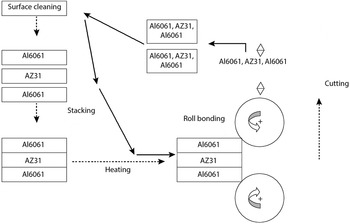
The plates were cut from Al6061 and AZ31 alloy sheets with a width of 2 cm and a length of 4.5 cm. The sheets were degreased by dipping the plates into acetone for 15 min and wire brushed. Al6061/AZ31/Al6061 plates were stacked in aluminum foil to be rolled without losing the contact in between the plates. Aluminum foils were also used to prevent severe oxidation during heating of the stacked plates in the furnace at elevated temperatures. The plates were shaped as wedge type for giving the stack to the roller mills without any problem. Reference Chen, Hsieh and Wu3 The sandwich stacks of Al6061/AZ31/Al6061 were held at 450 °C for 10 min in a cubical furnace and roll-bonded directly with reduction of 50% in one pass. 50% deformation was considered enough to break the possible oxidation layer which can be occurred on the surfaces of the individual plates during heating. After the rolling operation, the stacks were water quenched. One of the sandwich stacks was used for laminated structure, microstructure, and hardness analysis, and the two other stacks were used for mechanical and drop test experiments. For the second pass ARB operation, the bonded plates produced from the first pass were cut into half length. The half cut plates were stacked, degreased, wire brushed, and wrapped in aluminum foils again. Before the second pass of ARB operations, the sandwich stacks were reheated to 450 °C for 10 min, roll-bonded with reduction of 50% in the second pass and water quenched. The schematic of ARB process is represented in Fig. 1. The dotted lines in Fig. 1 represent the first pass and the solid lines represent the second pass of the ARB process. Laminated structure, microstructure, and hardness analysis as well as mechanical and drop experiments were also conducted on the second pass roll-bonded samples. Hereinafter, the roll-bonded stacks were referred to as the first pass and the second pass plates, respectively.
Schematic of accumulative roll bonding process of Al6061/AZ31/Al6061 sandwich type composites.

The first pass and second pass plates were cut and the longitudinal cross sections of the plates were mounted. The samples were ground, polished, and chemically etched using Keller's reagent and acetic picral respectively to better investigate the microstructure of Al6061 and AZ31. The microstructures were first examined using optical microscope and then QUANTA 400F field emission scanning electron microscope (FEI Corporate, Hillsboro, OR) was used to observe the Al6061/AZ31 interface structure.
The Vickers microhardness values were measured using Future-Tech Microhardness Tester FM-700e (Future-Tech Corp., Kawasaki City, Japan) with the application of 50 g load for 10 s through the thickness of the samples. Dog-bone shaped samples along the rolling direction, with a gauge section of 1 × 3 × 10 mm respectively, were cut using wire electro-discharge machining (EDM) from the first and second pass plates. The tensile tests were conducted with a loading rate of 0.2 mm/min up to failure and the axial strain values were measured using an extensometer with a gauge length of 10 mm by attaching the ceramic rods directly to the gauge section of the tensile samples.
In this study, impact tests were conducted using an Instron Dynatup Model 8200, pneumatic assisted, drop weight impact testing instrument (High Wycombe, UK). Impact test specimens with a width of 2 cm and a length of 6 cm were clamped circumferentially along a diameter of 40 mm in the specimen fixture. The impacting tup is a module such that the crosshead mass and the height of the tup can be varied.
III. RESULTS AND DISCUSSION
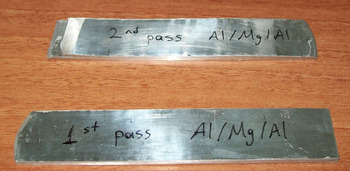
The digital images of the plates after the first pass and the second pass of the ARB process were represented in Fig. 2. These samples were also the typical samples used in drop impact experiments. The width and the length of the samples were at least 2 cm and 6 cm, respectively. Since the samples were deformed with 50% of thickness reduction at each pass, the final thickness of the samples was different.
Typical sandwich type samples produced using ARB process after the first pass and the second pass.

A. Microstructural investigation
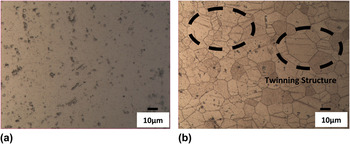
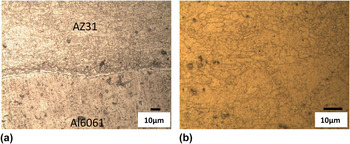
Figures 3(a) and 3(b) and showed the as-received microstructures of the Al6061 and AZ31 alloys and also optical microscope images were taken after the first pass and the second pass of ARB process and shown in Fig. 4 and Fig. 5, respectively. The twinning structures were observed and shown in Fig. 3(b) in the as-received AZ31 alloy, which is a very common deformation structure in this material.
Microstructures taken from the as-received (a) Al6061 (b) AZ31.

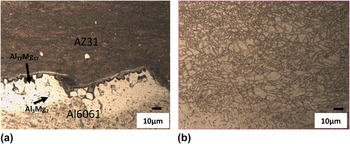
Microstructures which were taken after the first pass (a) showing the interface and Al6061 and AZ31 sections (b) AZ31 section.

Microstructures which were taken after the second pass (a) showing the interface and Al6061 and AZ31 sections (b) AZ31 section.

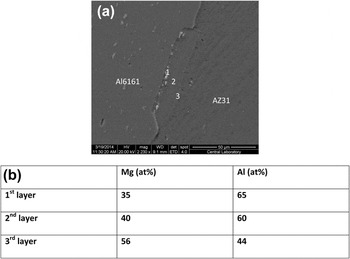
The microstructures were taken on the longitudinal cross sections of the ARB-processed samples. From Fig. 4(a), it can be seen from the interface that the deformation of Al6061 and AZ31 plates was homogeneous enough to obtain a linear interface. However, the interface after the second ARB cycle showed a wavy structure which can be seen in Fig. 5(a). The thickness of the bonding zone between Al6061 and AZ31 increased with increase in the number of ARB pass. However, on the other hand, as the bonding zone thickness increased, the amount of Al12Mg17 and Al3Mg2 intermetallics increased as well. The intermetallic structure image after the second pass and the approximate chemical compositions of the layers measured using energy dispersive x-ray spectroscopy (EDS) at the interface of the Al6061 and AZ31 are also shown in Fig. 6. The content of magnesium through the intermetallic layer increased as the region, from which composition analysis was taken, got closer to the AZ31 side. The third layer composition was determined quite similar to the Al12Mg17 intermetallic composition. The structures of these intermetallics were represented in previous diffusion couple studies. Reference Brubaker, Liu and Luo15 Since ARB process is a severe plastic deformation process, the decrease in the size of the grains would be expected. Reference Chang, Zheng, Wu, Gan, Tong and Brokmeier2 The grain size of AZ31 after the first pass showed a bimodal kind of distribution. The sizes of the small grains were around 1–2 µm and also elongated grains were represented in Fig. 4(b). The grain size distribution became relatively homogeneous and lamellar structures were often observed after the second cycle of ARB process as shown in Fig. 5(b). Recovery and recrystallization took place while heating the sample for the second pass roll bonding, therefore, further grain refinement was not realized.
Scanning electron microscopy image of the intermetallic structure at the interface taken after the second pass (a) showing the interface and (b) EDS analysis of the intermetallic layers.

B. Microhardness study
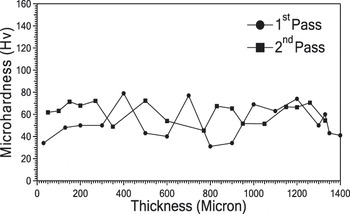
The microhardness distributions through the thickness of the ARB-processed samples were shown in Fig. 7. The microhardness values did not change dramatically after the first and second passes due to the ARB process, which was held at 450 °C. Before each pass, the samples were heated to 450 °C, therefore, the deformation structure from the first pass was relieved. Since the heating at 450 °C was kept for only 5–10 min, the annealing of the deformed structure was not enough such that there was a decrease in the grain size and a small increase in the average microhardness of the ARB-processed samples for 2 passes.
Microhardness distributions of the samples after the first and the second pass of ARB process.

C. Tensile properties
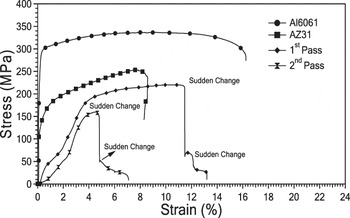
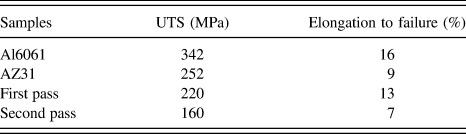
The stress–strain relationships obtained from tensile experiments are presented in Fig. 8. The ultimate tensile strength and the elongation to failure values are drawn from the experiments and presented in Table II.
Stress–strain curves of Al6061, AZ31, first, and second pass ARB-processed samples.

Ultimate tensile strength (UTS) and elongation to failure values which were drawn from the curves shown in Fig. 7.

It was observed from the tensile curves and the values represented in Table II that the strength and the elongation to failure values of the laminated composites decreased with increase in the number of passes. The decrease in the values was due to the failure of the brittle intermetallics at the interface. In addition to these observations, sudden changes of the tensile strength values were observed on the tensile curves of the first pass and the second pass ARB-processed samples. This can be attributed to the delamination of the individual plates and successive fractures of these plates, respectively. The first sudden change and the second sudden change of the first pass ARB-processed sample occurred at 218 MPa and 70 MPa, respectively. The second pass ARB-processed sample showed the first sudden change at 158 MPa and the second sudden change at 52 MPa. One another observation was the relative increase in the elongation to failure value of the first pass ARB-processed sample with respect to the elongation to failure value of AZ31 alloy. This might be due to the Al6061 plate that was used in the production of laminated composite. However, after the second pass, the elongation to failure value decreased due to the increase in the amount of intermetallics at the interfaces between Al6061 and AZ31 plates.
D. Drop weight impact studies
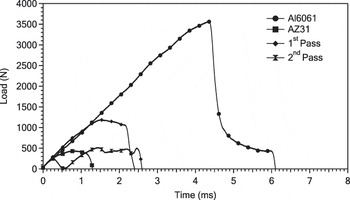
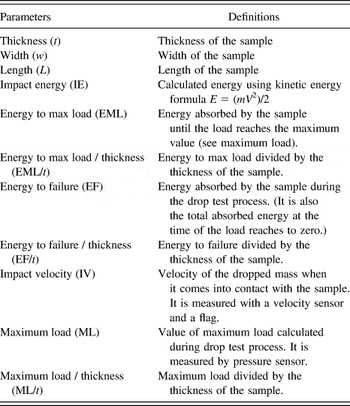
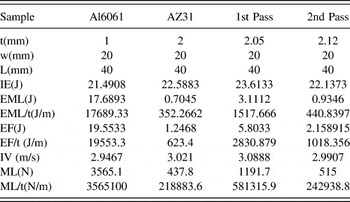
The drop weight impact test module and the impact test sample information were given in the experimental procedure section. Additionally, for this study, the total mass (m) and the release height of the impactor were chosen as 4.95 kg and 0.5 m, respectively. The tup velocity (V) was determined using a laser position sensor and the acceleration of the impactor was detected by a piezoelectric accelerometer. The experimental setup was connected to a data acquisition system such that the impact load versus time signals was recorded throughout the conduction of the experiments. The load versus time and energy versus time curves are represented in Fig. 9 and Fig. 10 using the data gathered from the signals and the definition of the impact values of the drop test experiments and their abbreviations are presented in Table III. These values drawn from the curves in Figs. 9 and 10 are shown in Table IV.
Load (N) versus time (ms) curves of the samples obtained from drop test results.

Energy (J) versus time (ms) curves of the samples obtained from the drop test results.

Definition of the impact values of the drop test experiments.

Impact values drawn from the curves obtained from drop test experiments.

Since the width and the length of the samples were kept constant, the energy to max load (EML), energy to failure (EF), and maximum load (ML) parameters were divided by the thickness of the samples.
The impact energy (IE) values were almost the same for all the experiments conducted on all samples due to the fact that the impact velocity was tried to maintain at a constant level. It can be observed from Table III that EML/t, EF/t, and ML/t values of the Al6061 alloys were higher than that of AZ31, first pass and second pass ARB-processed samples. The strength and ductility (elongation to failure) of this alloy were also determined to be the highest among all the other materials as shown in Fig. 8. On the other hand, AZ31 alloy showed the lowest EML/t, EF/t, and ML/t values. These results might be attributed to the low deformation capability of magnesium alloys at low temperatures and under relatively high strain rates.
ARB-processed sample for one pass and two passes represented higher EML/t, EF/t, and ML/t values than that of AZ31. ARB processing of AZ31 plate with Al6061 plate obviously increased the ductility under high strain rates. However, the values decreased after the second pass. This might be due to the increase in the total interface and the total amount of intermetallics at the interface of the laminated composites. One another reason in the decrease of these values can be due to the insufficient quality and adhesion of the interface in between the Al6061 and AZ31 plates.
IV. CONCLUSION
This study investigated the interface structure, mechanical properties, and drop impact resistance of ARB-processed Al6061/AZ31/Al6061 laminated composites. The following conclusions were drawn from this study:
-
(1) Al6061/AZ31/Al6061 alloys were accumulative roll bonded at 450 °C up to 2 passes successfully. The grains of especially AZ31 alloy were refined and elongated after the first pass of ARB process. The intermetallic formations were also visible after the ARB process.
-
(2) The strength and the elongation to failure values decreased with increase in the number of passes of ARB process due to the increase in the amount of the intermetallics at the interfaces between the Al6061 and AZ31 plates.
-
(3) Energy to ML/thickness, EF/thickness, and ML/thickness values drawn from the drop test results of the laminated composites were higher than that of AZ31 alloy. AZ31 alloy generally exhibits low deformation capability at low temperatures under relatively higher strain rates. Al6061, on the other hand, improved the deformation capability of AZ31 alloy with the production of laminated composites using ARB processing.
-
(4) The values mentioned above decreased after the second pass of ARB process due to the formation of more intermetallics at the interface and the mechanical bond strength and the nonuniform layers in between Al6061 and AZ31 plates played an important role in the properties of laminated composites.
ACKNOWLEDGMENT
This work was supported by TUBITAK (Scientific and Technological Council of Turkey) with the Project 110M719.