Introduction
The intrauterine environment is an important factor in the development of many diseases and adult health. Factors considered particularly important are birth weight, chorionicity/shared placenta and umbilical cord abnormalities.Reference Hoet and Hanson1–Reference Law, Barker, Bull and Osmond4 A key developmental outcome is intelligence. Intelligence can be thought of as a construct reflecting the ability for reasoning, problem solving and concept understanding.Reference Deary, Spinath and Bates5 Childhood intelligence is predictive of educational attainment and later socioeconomic status, which in turn have significant social and health implications.Reference Batty and Deary6–Reference Hart, Taylor and Davey Smith8 Given the impact of intelligence on the later life course, it is important to understand the underlying mechanisms behind variation in cognitive functioning.
Intellectual performance is influenced by a mixture of genetic and environmental effects.Reference Bouchard9–Reference Hoekstra, Bartels and Boomsma13 A reviewReference Nichols14 and meta analysis of 30 studies conducted in twins concluded that 44% of the variance in Intelligence Quotient (IQ) scores is explained by genetic factors. However, much higher heritability estimates (∼85%) have also been reported in familial studies.Reference Bouchard and McGue15 A meta-analysis examining the heritability of IQ have consistently found that genetic factors account for about 50% of the IQ variance,Reference Bergen, Gardner and Kendler16 but in single studies heritability estimates range from 20% to 80%.Reference Deary, Spinath and Bates5, Reference Breslau, DelDotto and Brown17
Intellectual development, including cognitive deficits such as learning disorders and delays in language have been linked to low birth weight.Reference Breslau, DelDotto and Brown17–Reference Botting, Powls, Cooke and Marlow20 Boomsma et al.Reference Boomsma, van Beijsterveldt, Rietveld, Bartels and van Baal21 have shown that genetic factors may mediate the relationship between low birth weight and intelligence. However, some studies suggest that environment in utero may be more important in explaining the relationship of birth weight with IQ, with these factors accounting for up to 20% of the variation in intelligence.Reference Devlin, Daniels and Roeder22
Several intrauterine factors have been implicated in poor outcomes including smaller placentas increasing the risk of limited fetal development.Reference Bleker, Buimer, van der Post and van der Veen23 Chorionicity is likely to also play an important role in intrauterine twin growth.Reference Ananth, Vintzileos, Shen-Schwarz, Smulian and Lai24–Reference Gielen, Derom, Derom, Vlietinck and Zeegers26 Twins who share the same placenta or chorion are known to have compromised intrauterine growth.Reference Knaus27–Reference Papageorghiou, Bakoulas, Sebire and Nicolaides29 Moreover,the site of the umbilical cord insertion on the placenta can restrict fetal development and could cause later abnormalities, such as lower birth weight.Reference Loos, Derom, Derom and Vlietinck30
Umbilical cord abnormalities are a third marker of poor intrauterine environment. Adverse perinatal outcomes have been reported with both abnormally long and abnormally short umbilical cords.Reference Sarwono, Disse, Oudesluys, Oosting and DeGroot31–Reference Adinma33 Infants with excessively long umbilical cords have a significantly higher likelihood of brain imaging abnormalities and abnormal neurological follow-up in later life.Reference Baergen, Malicki, Behling and Benirschke34, Reference Taweevisit and Thorner35 It has been reported that decreased cord length correlates with decreased IQ and a greater frequency of motor abnormalities and Down syndrome.Reference Heifetz36, Reference Naeye37 It has also been suggested that antenatal hypoxia is correlated to low IQ values.Reference Naeye and Peters38 Less common, but with potentially devastating consequences, is the occurrence of cord knotting. A knot can constrict the blood vessels and lead to fetal death. Cord knots appear to be associated with fetal growth and compromise the communication between the mother and the fetus causing subsequent obstructions in nutrients supply.Reference Sornes39 Cognitive development is influenced by the nutritional status in utero Reference Bhate, Deshpande and Bhat40 and anything that can constrict the normal flow of nutrients maybe be potentially influential to later outcomes. The full mechanism by which umbilical cord abnormalities produce intrauterine fetal growth restriction is not known and it is not clear to what degree they may affect later cognitive performance.
Individual differences between peoples’ IQ might be attributable to the intrauterine environment, genetic factors and the subsequent family environment.Reference Posthuma, De Geus, Bleichrodt and Boomsma41, Reference Ronalds, De Stavola and Leon42 An important question remains to be answered as to whether these individual differences seen between people's IQ have their origin in the intrauterine environment. The intrauterine environment has not yet proved to be as influential as the infant's genetic endowment regarding later cognitive development, but nevertheless is of considerable importance.Reference Gordon43 Previous research has shown that the association between birth weight and IQ can be explained by genetic factors,Reference Boomsma, van Beijsterveldt, Rietveld, Bartels and van Baal21 while others suggest that genetic factors do not account for the relationship between these two.Reference Devlin, Daniels and Roeder22 Although it is already known what is the impact of birth weight on cognitive development, it is not clear what is the contribution of the other intrauterine factors in explaining differences in the variation of cognition. Our hypothesis is that an adverse intrauterine environment will be associated with lower IQ scores.
With this study, we aim to examine the effect of genetics and intrauterine environment on intelligence using a genetically sensitive design. More specifically, the relationship between IQ and the following measures of intrauterine environment: birth weight, placental weight, placental morphology, cord knots, cord length and cord insertion is investigated.
Method
Sample
The East Flanders Prospective Twin Survey (EFPTS) has recorded multiple births in the province of East Flanders (Belgium) since 1964. All twin pairs (n = 867) born between 1 September 1982 and 31 December 1991 were invited to complete the WISC-R (Wechsler Intelligence Scale for Children-Revised) test on three IQ scales, the total, performance and verbal IQ. A total of 204 twin pairs refused to participate. That resulted in a sample of 663 twin pairs (76% participation rate), between the ages of 7 and 15 years old, with a mean age of 10.4 years old, which were included in this study: 289 monozygotic (MZ) male twins, 269 monozygotic (MZ) female twins, 168 dizygotic (DZ) male twins, 202 dizygotic (DZ) female twins and 370 unlike-sex twins. Of these 663 twin pairs, 28 were incomplete pairs (14 MZ twins, seven DZ liked-sexed and seven DZ unlike-sexed). For each of these twin pairs, one twin did not have information because of either perinatal death (n = 26) or severe mental retardation (n = 2). This meant a total sample size of 1298 twins. There were no differences between the twins who participated in this study and the ones who refused to participate in terms of gestational age (P = 0.94) and birth weight (P = 0.86). However, in the final sample used in this study, more MZ twins than DZ twins (P = 0.001) were present; thus, unlike-sex twins were underrepresented in the final sample (P = 0.002). The parents of the twins gave their written informed consent according to the local ethics committee guidelines.
The zygosity of the twins was determined by sequential sex, placentation, blood groups, and examination of five highly polymorphic DNA markers. Unlike-sex twins were classed as dizygotic as were same-sex twins with at least one different genetic marker; monochorionic twins were classified as monozygotic. For all the same-sex dichorionic twins with the same genetic markers, a probability of monozygosity was calculated using a lod-score method. After DNA fingerprinting, a probability of monozygosity of 0.999 was reached.Reference Derom, Vlietinck and Thiery44
Measures
All twins completed the WISC-R. This consists of six verbal and six performance subscales and has been validated for use in this population.Reference Wechsler45 The verbal subscales are Information (INF), Similarities (SIM), Arithmetic (ARI), Vocabulary (VOC), Comprehension (COM) and Digit Span (DS). The performance subscales are Picture Completion (PC), Picture Arrangement (PA), Block Design (BD), Object Assembly (OA), Coding (COD) and Mazes (MAZ). The scores on the subscales are standardized for age and added up to Verbal (VIQ), Performance (PIQ) and Total Intelligence Quotients (TIQ). In this study, the total scores of the subscales and the TIQ score were analysed.
The type of the placenta was determined within 48 h of delivery by a trained midwife at the same time as chorion type and the total weight of the placental mass was recorded based on a standardized protocol.Reference Derom, Derom and Vlietinck46 Cord insertion recorded as central, eccentric, paramarginal, marginal, on the surrounding membrane, or on the dividing membrane was recorded at delivery as was the umbilical cord length and knots. Birth weight and gestational age was obtained from the obstetric notes, relevant information was recorded within 24 h of delivery and gestational age was calculated as the number of complete weeks of pregnancy.
For the analysis undertaken in this paper, umbilical cord length was categorized as short (0–40 cm), average (41–69 cm) and long (70–100 cm) as well as analysed as a continuous trait. Cord knots were categorized as: (1) knots and (2) no knots. Tight and loose knots of the umbilical cord were combined in the first category. The cord insertion categories were divided into two groups: (1) central insertion (central, paracentral, paramarginal) and (2) peripheral insertion (marginal, membrane septum and membrane peripheral). There were five categories for the placental morphology, ordered in the following manner: (1) two separate placentas dichorionic diamniotic (DCDA) (2) two placentas connected with membranes (DCDA) (3) one fused placenta (DCDA) (4) one placenta monochorionic diamniotic (MCDA) and (5) one placenta monochorionic monoamniotic (MCMA).
Data analysis
Regression analyses
A random-effects regression model was used in STATA,47 where the intercept of each twin pair was modelled as a function of the population intercept plus a unique contribution of the twin pair. On the basis of these models, expected IQ scores and standard errors for each level/category of the markers for intrauterine nutrition were computed. Potential factors, including umbilical cord characteristics, birth weight and the type of chorionicity, which have been found to have an influence on the relationship between the intrauterine factors and IQ, were included in the analyses. It was found that the age of the twins at testing and the parental educational level did not have a significant effect on the relationship between the intrauterine factors under study and the IQ scores. The twins’ gestational age and gender were adjusted in the analysis. Only the significant associations from the regression analysis were further examined in the bivariate genetic analyses.
Bivariate genetic analyses
Bivariate genetic analysis was used to examine the relationship between the measures of IQ (Total, Performance and Verbal) and those intrauterine factors, which significantly associated with IQ (cord knots and birth weight). Variance decomposition was applied leading to an estimate of the correlation between the genetic, common environmental and non-shared environmental components between the two phenotypes.Reference Neale and Cardon48, Reference Neale49 To estimate how much of the phenotypic correlation between IQ and cord knots, and between IQ and birth weight was due to overlapping genetic and environmental factors, the genetic and environmental correlations were weighted by the square root of the heritabilities and the environmental influence on the traits and divided by the phenotypic correlation.Reference van Beijsterveldt, Felsenfeld and Boomsma50 On the basis of MZ and DZ ratios of the univariate correlations of the IQ scales, cord knots and birth weight, ACE factors were modelled in the bivariate analyses. Full models are only displayed in Table 4.
To enable the fitting of the models for the examination of the correlation between cord knots and IQ, the continuous IQ scores were used in the models as quintiles using threshold liability models. Gestational age and gender were adjusted for in the model of the means (IQ – birth weight) and in the threshold model (IQ – cord knots).
Results
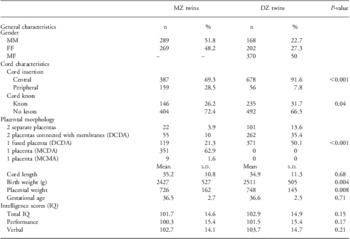
Table 1 presents descriptive characteristics for the entire twin sample. Monozygotic twins had significantly more peripheral cord insertions than dizygotic twins (P < 0.001). Dizygotic twins had significantly more knots (P = 0.04), more fused placentas (P < 0.001), higher placental weight (P < 0.01) and higher birth weight (P < 0.01) than monozygotic twins. In order to examine the possibility of placental insufficiency due to the DZ and MZ twin differences in birth and placental weight, we analysed the placenta: birth weight ratio and the results showed that there were no differences between the two groups (P = 0.77).
Phenotypic characteristics of the twins sample according to their zygosity

MZ, monozygotic; DZ, dizygotic; MM, male male; FF, female female; MF, male female; DCDA, dichorionic diamniotic; MC, monochorionic; MA, monoamniotic.
There were no significant differences between MZ and DZ twins in terms of gestational age and the IQ scores. Moreover, the IQ scores were just above 100, indicating that twins’ IQ scores can be compared with the general population's mean IQ scores.
Regression analyses
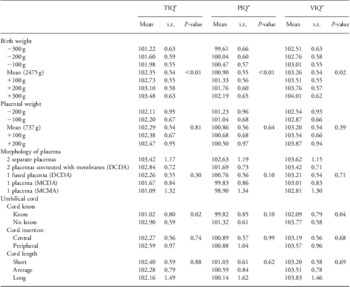
A significant effect of birth weight was seen for all IQ scales. Twins with higher birth weight performed better in the IQ scales: for each increase of 100 g in birth weight, there was a corresponding increase of 0.38 (P < 0.01) in the total IQ, an increase of 0.43 (P < 0.01) in the performance IQ and an increase of 0.25 points (P = 0.02) in the verbal IQ. When we performed the analysis excluding the twins with low birth weight (<1500 g) the effect of birth weight on IQ was still significant (P < 0.01).
Cord knotting had a significant effect on the total and verbal IQ scores. Twins with knots had lower (of 1.92 points, P = 0.02) total IQ and verbal IQ scores (of 1.70 points, P = 0.04) compared with twins with no knots. Placental weight and morphology did not have a statistically significant effect on IQ scores; neither did the other umbilical cord features. The expected means of the IQ scales for each intrauterine marker are displayed in Table 2.
Expected mean IQ scores for each intrauterine factor

IQ, intelligence quotient; TIQ, total IQ; PIQ, performance IQ; VIQ, verbal IQ; DCDA, dichorionic diamniotic; MC, monochorionic; MA, monoamniotic.
aAdjusted for gestational age and gender.
Bivariate genetic analyses
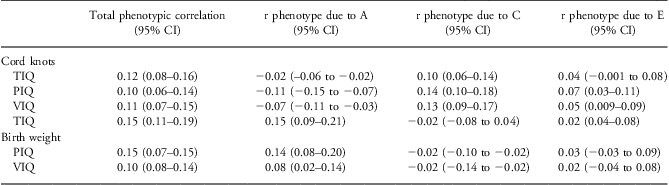
The significant association between cord knots and the three IQ scales and between birth weight and the three IQ scales were further investigated in six bivariate ACE models. The genetic and environmental components of cord knots, birth weight and the IQ scales and 95% confidence intervals are displayed in Table 4. In addition, the extent to which the A, C and E factors are correlated across the two traits are given in the last three columns. To estimate how much of the correlation between the two phenotypes in each analyses was due to genetic and environmental factors, the genetic and environmental correlations, respectively, were weighted by the square root of the heritabilities and environmental loading of the IQ scales, cord knots and birth weight (i.e. the contribution of the non-shared environment to the phenotypic correlation between birth weight and total IQ is √0.56 (E1) × 0.08 (rE) × √0.18 (E2) = 0.03. In like manner, the genetic and shared environment correlations in all bivariate analyses of knots and IQ, and birth weight and IQ, can be calculated. Because of the negative correlations, the proportions explained by genetic and environmental factors are not presented and the total phenotypic correlations and the correlations explained by genetic and environmental factors are displayed in Table 3.
Total phenotypic correlations and part of correlations explained by genetic, common and non-shared environment factors
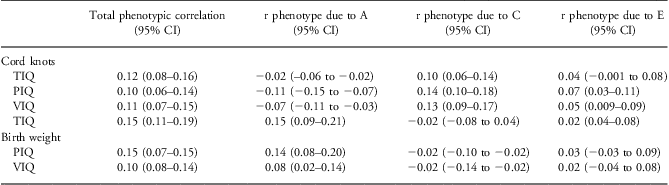
IQ, intelligence quotient; TIQ, total IQ; PIQ, performance IQ; VIQ, verbal IQ; CI, confidence intervals.
r phenotype due to A : phenotypic correlation between the two factors explained by genetic factors.
r phenotype due to C : phenotypic correlation between the two factors explained by common environment factors.
r phenotype due to E : phenotypic correlation between the two factors explained by non-shared environment factors.
Table 4 shows the results of the six bivariate models. The last three columns present the correlations between the phenotypes. For the three IQ scales and birth weight, a negative common environment correlation between the two traits is observed. The genetic factor (A) could be important in explaining the correlation between the two but with wide confidence intervals and A not being an important factor for birth weight but only for IQ the results should be interpreted with caution. For the other set of analyses between the three IQ scales and cord knots, a negative genetic correlation is observed. The common environment is a significant factor but because it is not an important factor for IQ a potential model would suggest that A explains all familial correlation. However, genetic effects cannot solely contribute to the explanation of the association between the two phenotypes and the non-shared environment should be taken into account.
Estimates and 95% confidence intervals for the models investigating the genetic association between either cord knots or birth weight with the IQ scales (the last used as quintiles in the bivariate analyses with cord knots)

IQ, intelligence Quotient; PIQ, performance IQ; VIQ, verbal IQ.
A1, C1, E1: Additive genetic, common and non-shared variance for cord knots and birth weight (univariate estimates from the bivariate analysis).
A2, C2, E2: Additive genetic, common and non-shared variance for total, Performance IQ and Verbal IQ (univariate estimates from the bivariate analysis).
rA, rC, rE: Additive genetic, common and non-shared correlations between IQ scales and cord knots and between IQ scales and birth weight.
aThe A2, C2, E2, estimates for the IQ scales may be slightly different from the continuous analyses with birth weight, because they are used as quintiles in the bivariate analyses with cord knots.
bModels are adjusted for gestational age and gender.
Discussion
The results of this study suggest that intelligence is highly heritable, with estimates ranging from 60% to 74% for all IQ scales on a continuous scale. These findings are consistent with previous research.Reference Bouchard9, Reference Bouchard and McGue15, Reference Luciano, Wright and Martin51 Previous studies have also suggested that early malnutrition has been associated with later developmental damage.Reference Gordon43, Reference Scrimshaw and Gordon52, Reference Gordon53 Inadequate nutrition in utero is important as the critical period of brain growth is before birth and during early postnatal life.Reference Winick54
The findings of this study support previous research suggesting that birth weight, as a marker of intrauterine environment, is associated with lower IQ scores. The negative effect of low birth weight on intellectual development is well documented in literature.Reference Breslau, DelDotto and Brown17, Reference Botting, Powls, Cooke and Marlow20, Reference Shenkin, Starr and Deary55–Reference Richards, Hardy, Kuh and Wadsworth57 For the whole sample of twin pairs, twins with an increase of 100 g in birth weight had a corresponding increase of 0.38 points in total IQ, 0.43 in performance IQ and 0.25 points in verbal IQ, respectively. As suggested by the bivariate analysis results, with non-shared environmental factors accounting for the majority of the correlation between birth weight and performance and verbal IQ, respectively, it can be speculated that situations in utero experienced in a unique way by the twin individuals might affect later cognitive development.
Heritability estimates of birth weight were moderate (∼4% of variance explained by genes), which is in agreement with previous studies.Reference Vlietinck, Derom and Neale58, Reference Morton59 Van Baal and BoomsmaReference van Baal and Boomsma60 suggested that monozygotic, and especially monochorionic twins who share the same chorion, may compete against each other for nutrients and therefore exhibiting differences in birth weight, which are not predicted by a genetic model. However, the variance of birth weight explained by genes reported in this study is not negligible and it can be speculated that only part of the relationship between birth weight and total IQ can be genetically mediated. Boomsma et al.Reference Boomsma, van Beijsterveldt, Rietveld, Bartels and van Baal21 showed an association of intrapair differences in birth weight and IQ. This association was positive for DZ twins and not for MZ twins at ages 7 and 10 years, suggesting that genetics may mediate this relationship. Nevertheless, Petersen et al.Reference Petersen, Jensen, McGue, Bingley and Christensen61 found no association between these two phenotypes. The findings of this study suggest that genetic factors may influence the relationship between birth weight and IQ, although the wide confidence intervals (CI: 0.03–1.00) of the correlation between birth weight and IQ suggest a more conservative interpretation of these results, which leaves us to consider other potential explanations of this association. There is evidence indicating that insulin-like growth factors (IGFs) play a critical role in determining overall body growth in addition to contributing to local tissue regulation.Reference van Dam, Aleman and de Vries63 IGFs are peptides that regulate the growth, metabolism, survival and differentiation of cells and are regulated by growth hormone. It has been suggested that early in life IGFs and growth hormone are important for the development of parts of the brain, which are responsible for learning and memory, which could explain the association between body size and cognitive functions.Reference Gunnell, Miller, Rogers and Holly64 For the interpretation of these results, it should be taken into account that birth weight may not be the most reliable intrauterine index. However, it is also known that genetic factors play an important role in the aetiology of birth weight. Thus, associations between low birth weight and poor children outcomes could be at least partly attributable to a shared inherited aetiology rather than to environmentally mediated programming effects. Studies that have examined the familial correlation for birth weight in parent–offspring pedigrees have illustrated that maternally provided genetic factors influence infant birth weight.Reference Lunde, Melve, Gjessing, Skjaerven and Irgens65 Differential maternal genetic and other contributions, such as maternal constraint in size to infant birth weight may also be important. Nevertheless, birth weight is an easily measured marker of the intrauterine environment and widely used in research.
The results for the effects of cord knots on IQ suggest that the twins with knots have statistically significant lower total (of 1.92 points) and verbal IQ (of 1.70) scores compared with twins with no knots. The performance IQ was also lower but not statistically different for twins with knots compared with twins with no knots. To the best of our knowledge, this is the first study to report on the significance of cord knotting regarding cognitive development using a genetically sensitive design. The results from the bivariate model suggest that non-shared prenatal influences may explain the relationship between knotting and IQ. Sornes,Reference Sornes66 while attempting to explain the mechanism by which knots cause growth limitations, has shown that it is more likely that there is a stage during pregnancy, within the intrauterine environment and while the fetus is moving randomly within a confined space, which gives rise to the formation of knots. The results of this study suggest that a sizeable proportion of the variance of knots can be attributed to genetic factors. However, the results of the bivariate analysis suggested that non-shared environment influences the relationship between cord knots and IQ scores, even though both phenotypes are highly heritable. Genes, often, express themselves through the environment. The first environment of the twins is the uterus where the parental genes and the genes of each twin operate. However, in the intrauterine environment the genetic influence is likely to be shared, which means that it will impact on both twins equally. The intrauterine-shared environment may alter the way the knotting is demonstrated in the uterus, and therefore, the consequences may be unique to individual twin members. It has been shown that genetic, common and non-shared environmental factors regulate the formation of the knots. Although twins may share some aspects of the intrauterine environment, such as the maternal oxygen and nutrient intake and in the case of the MC twins even the same placentas, which can make them more similar in their experiences, the presence of a tightening knot can occlude the circulation between the placenta and the fetus and thus obstruct the circulation of oxygen and food supply making the experiences of the fetal environment unique to each twin.
The umbilical cord knots may decrease the umbilical blood flow and induce intermittent and/or sustained periods of fetal hypoxaemia.Reference Chan and Baergen67 Fetal hypoxaemia in turn is associated with decreased fetal growth, altered brain growth and developmentReference Rees, Harding and Walker68 and may affect cognitive outcomes.Reference Anastario, Salafia, Fitzmaurice and Goldstein69
The non-shared environmental factors influencing IQ might as well relate to differences in activities in later life that foster cognitive growth.Reference Luciano, Smith and Wright70
In this study, other cord features did not seem to be associated with cognitive development. The site of the umbilical cord insertion, whether central or marginal to the placenta, the placental weight and its morphology did not have any effect on IQ scores. Neither was a significant relationship observed between cord length and IQ when cord length was analysed as continuous or categorical trait, which is contrary to previous research suggesting there is a link.Reference Naeye37
In our study, specific markers of the intrauterine environment were examined that may be associated with later cognitive development based on the hypothesis that a favourable intrauterine environment is an indicator of optimal fetal and later postnatal growth. The major sources of variance influencing birth weight, knotting and IQ were different, with non-shared environment showing a larger influence on cord knotting, shared and non-shared environment influencing birth weight and additive genes affecting IQ to a greater extent. Generally, these results suggest that aspects of the non-shared prenatal environment account for the correlation between birth weight and performance and verbal IQ and the correlation between knotting and IQ. The investigation of the genetic and environmental contribution in the relationship between cord knots and IQ could inform future research about the importance of the non-shared environment in this relationship. This study could lead the way to further and more elaborate research on the impact of the adverse intrauterine environment on later development. The association between cord knotting and cognitive development has not been studied before using a genetically sensitive design and perhaps future research could incorporate a more complex genetic design where information from mothers could also be included alongside intrauterine factors in order to disentagle their influence on cognitive development.
As this study is one of the very few to report on the influence of knotting on cognitive development, it can provide a valuable insight for a thorough exploration of the mechanisms responsible for the formation of knots in the intrauterine environment and the effect of the genetic and environmental factors on that, which may eventually influence the development of IQ.
Acknowledgments
None.
Conflict of Interest
None.
Financial Support
This study was funded by the University of Birmingham.
Ethical standard
The authors assert that all procedures contributing to this work comply with the ethical standards of the relevant national guidelines on human experimentation and with the Helsinki Declaration of 1975, as revised in 2008, and has been approved by the institutional committees of the University of Birmingham.