IntroductionFootnote 1
This article argues that funeral posters are an important lens through which we can view historical information on disputes about chieftaincy. Funeral posters are written with a local audience in mind and so are a very useful source for investigating how people communicated about relationships, particularly about cultural values pertaining to kinship and socio-political relations. We can see too how such posters were used to negotiate and re-negotiate relations among chiefs.
Funeral pamphlets have long been recognized as a useful historical source.Footnote 2 Joan Omoruyi, for instance, has described the value of the funeral programme as a historical source in Nigeria. Funeral programmes usually include a biographical sketch, picture, names and nicknames, date and place of birth and death, educational background, marital status, and survivors. She notes the importance of these, as well as the quality of the printed material.Footnote 3 Olive Adjah too has made similar examination of funeral posters in Ghana as sources of biographical information.Footnote 4 However, there has been no systematic consideration of how funeral posters and in particular the “chief mourners” shown on them might become an arena of contestation in kinship and socio-political relations. Nor has there been any investigation of how they shed light on chiefly relations and history.Footnote 5
Funerals are events during which various ideas and beliefs co-exist, conflict, merge, or converse with each other, and this article discusses the importance of contemporary funeral posters as a source for historical enquiry into such contestations and negotiations. It shares the approach of the ground breaking work by Jindra and Noret in their edited volume Funerals in Africa: Explorations of a Social Phenomenon. That work looked at funerary practice more generally as an evolving process and an arena of negotiation, contestation and conflicting views about them concerning such things as socio-political relations, economic relations and kinship.Footnote 6 De Witte’s and Roberts’s contributions to this volume, for instance, highlight changes and contestation over the processes as well as appropriations of the changing forms of funerary practices in Ghana.Footnote 7
This article shows how funeral posters have been appropriated for use in chiefly contestations. The posters shed light on responses to colonial legacies of indirect rule in Ghana and on international boundaries that bisected Ewe communities who found themselves living on the new Ghana-Togo boundary.
The article uses two case studies to show two different kinds of effects of funeral posters. First I consider posters as a source of conflict and dispute about relations between different chiefdoms in Ghana – Sokpoe and Tefle. Then I shall consider their function in affirming relations between groups in Ghana and Togo that have been divided by the boundary between those two countries – Nyive-Ghana and Nyive-Togo. First, I will look at the importance of funeral posters in Ghana, and then interrogate the contestation over the absence of Tefle from the fiaga (paramount chief) of Sokpoe’s funeral poster and the list of “chief mourners” on the funeral poster of a particular chief in Nyive-Ghana. Both aspects illuminate the importance of funeral posters as arenas of contestation and negotiation in chiefly relations.
Funeral Announcements and Funeral Posters
Funeral announcements among the Ewe in Ghana have been transformed as a result of the multiplicity of ideas and practices from a long history of colonial and postcolonial contact. Regarding the announcement of funerals, A.B. Ellis, writing about the Ewe in the late nineteenth century, noted that:
A death in a family is announced by an outbreak of shrieks and lamentations on the part of the women, who throw themselves on the ground, strike their heads against walls, and commit a variety of extravagances; calling upon the deceased the meanwhile not to desert them, and endeavouring, by all kinds of supplications, to induce the soul to return and reanimate the body.Footnote 8
Jakob Spieth, a German missionary writing in the early part of the twentieth century noted of the Ewe that if a sick person died two gun shots were fired in the evening to announce the death.Footnote 9 Technology has changed the face of funeral announcements in contemporary times, for besides mass media like radio, television, and newspapers there are funeral brochures, hoardings, banners, posters, and new social media platforms like Facebook and Twitter. There are however differences in the forms of announcements in those various media, and all of them usually differ from those of funeral posters. In comparison with new social media platforms such as Facebook and Whatsapp where funeral posters can be directly inserted, the information broadcast in other media tends to be an abridged version of a funeral poster. Funeral brochures might even contain funeral posters, although most do not. Of particular importance to this study is the fact that unlike funeral posters media for funeral announcements do not give lists of “chief mourners,” so that funeral posters are a unique source of information about chiefly contestations.
Posters, most of them printed in color, have become an integral part of funerals.Footnote 10 Considering the limitations of the traditional ways of spreading the information to a wider audience especially in an urban setting, and the prohibitive cost of radio, television, and newspaper announcements, funeral posters have become an important medium for funeral announcements. They can be found posted on walls, trees, electricity poles, motor vehicles or indeed on any strategically placed surface. As a result it is common to see the notice “Post no Bills” on walls all over Ghana due to these and other posters.
Funeral posters come in different sizes but are mostly printed on A2-size sheets (42.0cm x 59.4cm). Typically in Ghana the funeral poster has a heading, one or more photographs of the deceased and his or her age and date of death, along with the names of the chief mourners and family members. There will also be information about the funeral arrangements and dress code – whether red, black, white, or a combination of black and white or red and black, each color preference reflecting the age and status of the deceased.Footnote 11 The information on posters is given chronologically and in many cases in order of importance and includes the date, time, and place of burial, and other related activities such as wake-keeping before the burial or a thanksgiving service in church on the Sunday after the burial (see photo 2).Footnote 12
Professional accomplishments might be included on the funeral poster, as well as standing within various social and political hierarchies, and any awards received, all intended to emphasize the deceased’s accomplishments. A poster will include where the deceased had lived and the professions of any children or other kin will be mentioned, for they are important indicators of the deceased’s status especially if the children or family have moved abroad to the USA or Europe. Further status will be reflected on the deceased if children or family follow “prestigious” professions such as those of medical doctors, lecturers, army officers, lawyers, or engineers. Indeed it is usual for even an unemployed family member, if living abroad, to have his or her name mentioned before that of even a well-established professional or businessman in Ghana. That therefore shows that many people in Ghana still privilege the west over the rest of the world without regard to the unique and individual circumstances that exist abroad. The attitude may perhaps be traced to colonialism, or at least examined as one of the important legacies of colonial rule in Ghana.
An interesting element about funeral posters is the headings, which are designed to draw as much attention as possible. Some posters come with eye-catching headlines besides the standard “Obituary,” such as for example “Rapid Departure,” “Crash Landing,” “What a Shock,” “Gone too Soon,” “Celebration of Life,” “A Life Well Lived,” “Home Call,” “Call to Glory.” Such attention-grabbing headings also provide background to the relationship between the deceased and his or her family, the nature of the death and the achievements of the deceased. “Rapid Departure,” “Crash Landing,” “What a Shock,” and “Gone too Soon” are usually used for someone cut down in his or her prime; “Home Call” and “Call to Glory” are used for the elderly, and “Celebration of Life” and “A Life Well Lived” are for an adult who had led a successful life.
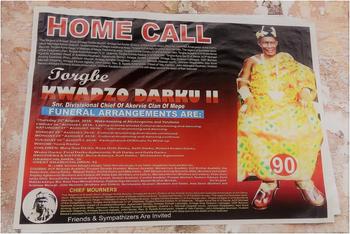
The announcements on the poster if the deceased was royal usually follow this template: “Togbe (title of a chief) X, the fiaga (paramount chief) or regent (if the stool is vacant) of A, … (followed by others) announces the death of Z” (see photo 1). If it is an ordinary person the order is: “The hlↄtatↄ (family head) of C, … (followed by others) announce the death of X.” The template seems to be a relic of the traditional responsibility of the paramount chief of a village or the head of family to announce the deaths of subordinate chiefs or family members.
Funeral poster of a chief indicating the order of announcement

An important section of a funeral poster which is of interest for this article is the section captioned “chief mourners.” The chief mourners are the principal overseers of the funeral and are usually the heads of lineage and heads of families. The chief mourners include the principal chiefs of the village if the deceased was a chief, and among them might be the deceased’s principal superiors at work, or if he or she was a national figure perhaps even the head of state. Pastors too might be included among the chief mourners.
Ebow Daniel makes an interesting list of chief mourners in a funeral brochure which also applies to the funeral poster as well:
The list of the chief mourners is becoming long indeed. They include whole Bishops (if the deceased had merely been a prominent member of the church), Vice-Chancellors (if the deceased had been a student). Family abroad always features: Mrs. A (London), Miss B (Germany), Mr. C (USA); a recent list also referred to Messrs. D, E and F (Returnees)! We have a chance to remind ourselves that we used to be somebody; Mr. G (Former Ambassador), Madam H (Ex-Deputy Minister): if we never were Minister of State in the First Republic. And we can demonstrate how forward-looking we are, which is what an entry in a recent list does: Mr. M (Managing-Director-Designate, name of company supplied)! A still more recent announcement lists among chief mourners a prominent Ghanaian himself dead: Mr. N (Deceased)!Footnote 13
De Witte refers to “wealth-in-people,” by which she means the numerous names of people on the funeral posters – and particularly the long list of “chief mourners.” De Witte sees them as an indication of social success, for the names reveal a network of dependents and influence.Footnote 14 However this may also be seen as a “liability-in-people.” The sense of liability comes from the deceased’s obligation or accountability to the people in the network, and might refer for example to political relationships, as in a subordinate chief to a superior one. I shall return to this subject here in due course.
While it might appear that the “chief mourners” are no more than a long more or less random list of people, within the list there is a definite order which provides important historical information. The key things to note in deconstructing a list of “chief mourners” on a funeral poster are first what names do or do not appear on the poster and second, the order in which the names appear.
“Chief mourners” are listed hierarchically to show relationships, social or political, with the deceased. Social relations are usually kin, while political relations, especially in the case of royalty, usually indicate the deceased’s position in the political structure of his or her village or town. The forms and order of authority given in specific domains serve as important checks on potential rivalries.
Disputing Relations – Sokpoe and Tefle
In a letter headed “Protest against poster published by Sokpoe Traditional Council regarding the funeral and interment of Togbe Zoga I devoid of Tefle” dated 29 March 2009, the Tefle Traditional Council protested against the omission of the names of chiefs and elders of Tefle from the funeral poster for the fiaga (paramount chief) of Sokpoe, the late Togbe Zogah I.Footnote 15 The protest was based on the Tefle claim that the Sokpoe stool (a symbol of chiefly authority) was subordinate to the Tefle stool, and highlights the importance of funeral posters in debates over chieftaincy relationships.
In the protest letter the Tefle chiefs and elders were arguing that their names should have been included because the Tefle stool was superior to the Sokpoe stool. In this section I shall examine the context of the dispute over the absence of Tefle names from the funeral poster of the paramount chief of Sokpoe and what their absence reveals about the effects on chieftaincy stools of contested legacies of British colonial rule.
Two competing historical narratives have been put forward in the disagreement over the origin and status of the Sokpoe stool. The Tefle maintain that the stool was split off from the Tefle stool by the British colonial administration, but the Sokpoe disagree, insisting instead that it was traditionally and historically a paramount stool.
The debate first surfaced in 1974 when the government of Ghana set up a committee to investigate which stools were paramount stools and who qualified to be paramount chiefs, according to customary law.Footnote 16 Nana Agyeman Badu chaired the committee’s sittings and the two competing histories were put forward in attempts to justify the right to paramountcy. According to Togbe Dugbazah IV, the fiaga of Tefle:
(…) the Sokpoes are Tefle people. They are the sons of the fiaga of Tefle. They are his servants. They do not serve any other fiaga except the Tefle fiaga (…) they still remain, as far as I am concerned, Tefle people according to customs, traditions and history. They should be under the Tefle stool.Footnote 17
Togbe Zogah I, the fiaga of Sokpoe, categorically denied any such familial relationship with the Tefle. He insisted that the Sokpoe stool was independent of Tefle.Footnote 18
In 2009 the arena of contestation had moved from committee meetings to funeral posters but the claims and counter claims were the same. This was the funeral of the first chief of Sokpoe so that inclusion on the Sokpoe chief’s funeral poster of the name of the paramount chief of Tefle would have meant acknowledgement of the Tefle’s version of the origin of the Sokpoe stool. In fact, Togbe Ganu, then acting head of Sokpoe, explained that the omission of the Tefle from the funeral poster was intended precisely as a categorical rejection of the Tefle claim.Footnote 19 The omission of the Tefle was therefore in effect a declaration of independence. Funeral posters had therefore become an arena for contested origins, status and allegiances to stools, and a platform to contest the British colonial policy of Indirect Rule and the legacies of the creation by the British of chieftaincy stools.
Affirming Relations – Nyive-Ghana and Nyive-Togo
Nyive was a part of the former German protectorate of Togo which after the First World War was divided between the British and French with the river Wutↄ set as the boundary under an agreement made in 1919. The smaller part and the seat of the traditional polity went to the French and became known as French Nyive, or Nyive-Togo; the other part across the river became British Nyive, or Nyive-Ghana.Footnote 20
In both Nyive-Ghana and Nyive-Togo there is a widely held belief that the inhabitants of the two communities are one people, irrespective of their division by an international boundary. The belief is popularly expressed in daily interactions as well as the joint performance of rites such as marriages, festivals and funerals. Chiefly functions too are performed across the international boundary. Indeed, Togbe Apasu, the mankralo of Nyive-Ghana, claims that the chiefs and elders of Togo-Nyive performed his enstoolment rites in 1986.Footnote 21
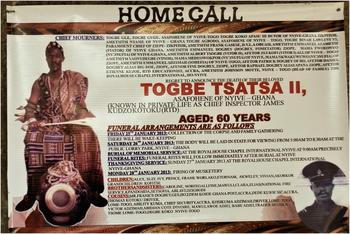
The funeral poster is an important arena for the negotiation and re-negotiation of relations between a community divided by a colonial boundary. The poster for Togbe Tsatsa II of Nyive-Ghana (photo 2) in 2013 nicely illustrates the relationship between Nyive-Ghana and Nyive-Togo stools.
Funeral poster of the late Togbe Tsatsa II, asafohene of Nyive-GhanaFootnote 22

Togbe Tsatsa had been the asafohene (warrior chief) of Nyive-Ghana. His funeral was the occasion for the bisected community to affirm their relationship and his funeral poster became a platform for the expression of that relationship. On the “chief mourners” list of the funeral poster were the names of the chiefs and elders of Nyive-Ghana and Nyive-Togo as well as other chiefs and relations.Footnote 23 Of importance to this article is the order of the first three names. First stood Togbe Gle, who was the acting head of Nyive-Togo; his name was followed by that of Togbe Gugu, who was the asafohene of Nyive-Togo, and then came Togbe Koko Apasu III, mankralo of Nyive-Ghana, who was then acting as the paramount chief of Nyive-Ghana.Footnote 24
Togbe Gugu VII explained that the order of “chief mourners” on the funeral poster was derived from the nature of the relationship between Nyive-Ghana and Nyive-Togo.Footnote 25 Nyive-Togo is the traditional seat of both Nyive-Ghana and Nyive-Togo and the chiefs and elders there are considered to be senior to those of Nyive-Ghana. Togbe Gle was the acting head of Nyive-Togo, and as such overall head of both towns. For his part Togbe Gugu VII as asafohene of Nyive-Togo was the overall commander of Nyive warriors. Togbe Tsatsa had been asafohene of Nyive-Ghana, which meant that Togbe Gle appeared first on the funeral poster because he was acting chief of Nyive-Togo and therefore head of both Nyive-Togo and Nyive-Ghana; Togbe Gle was then followed by Togbe Gugu VII who was asafohene of Nyive-Togo and therefore Togbe Tsatsa’s superior commander. Togbe Apasu III, mankralo of Nyive-Ghana, was at the time acting as the paramount chief of Nyive-Ghana to whom was Togbe Tsatsa II subordinate, appeared third on the list because he was subordinate to the paramount chief of Nyive-Togo.
The funeral poster of the late Togbe Tsatsa II reveals not only the relationship between the Nyive-Ghana and Nyive-Togo stools but most importantly the nature of that relationship. It shows that within the hierarchy of chiefs within the political structure of the two communities the Nyive-Ghana chief was subordinate to the chief of Nyive-Togo. For that reason at least, funeral posters are important sources of information about an aspect of the legacy of the partition of Africa. Clearly, chiefly relations continued in spite of the international boundary.
Conclusion
This article has explored that use of funeral posters to express nuances of the power-politics of chiefly relations. The two case studies referred to here have reinforced the point that funeral posters are important too as sources of information about the effects of the British colonial policy of indirect rule and the European partition of Africa. The article also shows the importance of funeral posters in examining contemporary cultural values surrounding kinship and political relations.
However, funeral posters must be approached with a degree of caution. The deliberate manipulation of names, status and titles means that information on funeral posters should be analysed in context and in conjunction with other sources, preferably archival. Interviews too should be carried out, to allow deeper understanding of matters and events making up the backgrounds to any particular poster. However, none of that diminishes the methodological importance of funeral posters, for they can provide rich and eloquent historical insights into the lives both of individuals and communities.
Edem Adotey is a Research Fellow in the History and Politics section of the Institute of African Studies, University of Ghana, Legon. E-mail: eadotey@ug.edu.gh