Introduction
Dragonet fish (Family Callionymidae Bonaparte, 1831) are bottom-dwelling fishes known from tropical to temperate marine waters (only a few species inhabit brackish and freshwater environments) over a wide depth range from coastal waters to deeper than 900 m (Fricke, Reference Fricke1983). Species of the family Callionymidae are characterized by (i) a dorsally compressed body; (ii) a head almost triangular dorsally with large eyes on the dorsal side; (iii) a distinct preopercular spine that bears serrations; and (iv) a small pore-like gill opening (Fricke, Reference Fricke1983). This family consists of 201 valid species in 11 genera (Fricke et al., Reference Fricke, Eschmeyer and Fong2024a), in which the genus Callionymus Linnaeus, 1758 comprises a maximum of about 111 valid species (Fricke et al., Reference Fricke, Eschmeyer and van der Laan2024b). Around 23 species belonging to the genus Callionymus are known from the Western Indian Ocean (WIO), i.e. C. aagilis Fricke, 1999; C. africanus Kotthaus, 1977; C. bentuviai Fricke, 1981; C. carebares Alcock, 1890; C. cooperi Regan, 1908; C. delicatulus Smith, 1963; C. gardineri Regan, 1908; C. hindsii Richardson, 1844; C. erythraeus Ninni, 1934; C. ilamentosus Valenciennes in Cuvier and Valenciennes, 1837; C. lavus Fricke, 1983; C. margaretae Regan, 1905; C. marleyi Regan, 1919; C. mascarenus Fricke, 1983; C. muscatensis Regan, 1905; C. omanensis; C. oxycephalus Fricke, 1980; C. persicus Regan, 1905; C. profundus Fricke and Golani, 2013; C. regani Nakabo, 1979; C. spiniceps Regan, 1908; C. stigmatopareius Fricke, 1981; and C. tenuis Fricke, 1981.
Among the above only two species, the Indian deepwater dragonet Callionymus carebares and Margaret’s dragonet C. margaretae are known to be distributed along the western coast of India. Longtail dragonet Callionymus gardineri Regan, 1908 occurs at depths of 30–180 m in tropical waters (Fricke, Reference Fricke1983), and Oman dragonet, Callionymus omanensis Fricke, Jawad, and Al-Mamry, 2014 is known from a depth of about 500 m (Fricke et al., Reference Fricke, Jawad and Al-Mamry2014). During investigations of the fish bycatch of the trawl fishery operating from Veraval (Ragul et al., Reference Ragul, Parmar, Mahadevan and Fricke2024a, b), two new distributional records of dragonets, namely C. gardineri and C. omanensis, have been confirmed. These species are reported and described herein.
Materials and methods
From December 2023 to November 2024, regular fishing surveys were conducted at Veraval Fishing Harbour (20°54ʹ27″N 70°23ʹ02″E), Gujarat, northwestern coast of India, to document the fish composition of trawl bycatch (Ragul et al., Reference Ragul, Parmar, Mahadevan and Fricke2024a, b). Dragonet specimens belonging to the genus Callionymus Linnaeus, 1758 were collected from the multiday trawler bycatch landed at Veraval. Specimens were brought to the laboratory, then cleaned and photographed. Species-level identification was made based on the key of Fricke et al. (Reference Fricke, Jawad and Al-Mamry2014). Morphometric measurements were obtained using a Mitutoyo 150 mm Vernier caliper (nearest 0.1 mm), while meristic counts and terminology followed the method of Fricke (Reference Fricke1983). The materials were preserved in 10% formalin and deposited in the fish collection at the Department of Fisheries Resource Management, College of Fisheries Science, Kamdhenu University, Veraval (KU/COFS/MUS) for future reference.
Results
Systematic position
Family Callionymidae Bonaparte, 1831
Genus Callionymus Linnaeus, 1758
Callionymus gardineri Regan, 1908
Longtail dragonet (Figure 1A–C; Table 1)
Callionymus gardineri from northwestern India, (A) fresh, (C) preserved, and (B) preopercle spine. Scale A and C = 10 mm.

Morphometric and meristic data of Callionymus gardineri and C. omanensis from India, compared with previously available data

Notes: M, male; F, female; U, unknown sex; *damaged. The proportions and counts of female C. omanensis were given in parentheses and brackets.
Type locality: Cargados Carajos Island, southwest Indian Ocean, depth 20–30 fathoms (35–55 m).
Callionymus gardineri Regan, 1908: 248, pl. 30, fig. 5
Callionymus maldivensis Regan, 1908: 247, pl. 30, fig. 3
Material examined. KU/COFS/MUS/010262 (79.4 mm standard length [SL], male), 1 ex., 29 October 2024 (Figure 1A and B), KU/COFS/MUS/010264 (117.2 and 159.0 mm SL, male), 2 ex., 5 November 2024, 20°54ʹ27″N 70°23ʹ02″E, Veraval Fishing Harbour, northwestern coast of India, collected by S. Ragul, trawled off Gujarat, Northeastern Arabian Sea.
Identification. First dorsal-fin spines IV; second dorsal-fin elements viii, 1; anal-fin elements vii, 1; pectoral-fin rays ii, 16–18, i = 19–21; pelvic-fin elements I, 5; caudal-fin rays (i), i, (6), ii, 2, (i); preopercular spine formula  $1\frac{{10}}{ - }1$. For a detailed comparison of meristic and morphometrics, see Table 1.
Body and head: Elongated body and head, ventrally flat. Male urogenital papilla small 13.2–13.6 in HL. Large eyes (2.5–3.0 in head length, HL) with a narrow interorbital space, 9.6–15.8 in eye diameter (ED). Head with almost a straight nape. Body more tapering at the tail, long caudal peduncle 6.2–6.8 in SL with the least depth, 22.6–22.7 in SL. Head, long preopercular spine (3.3–4.1 in SL) with a long main tip, smooth and straight; base with a single strong antrorse spine, 6–12 small antrorse serrae at its dorsal margin (Figure 1B). Mouth small, subterminal, maxilla reaching to a vertical through origin of eye, preorbital distance 3.1–3.3 in HL; small upper law, 2.6–2.8 in HL.
Fins: The first dorsal fin filamentous in males but as the specimen collected from trawl bycatch, the fin was damaged, 4.0–4.9 in SL even though slightly higher than the second dorsal fin, 5.7–6.1 in SL. Last ray of both second dorsal and anal fin: unbranched and divided at its base.
Colouration (fresh specimen) (Figure 1A). Body dorsally pale to dark brownish filled with black to brownish saddles above the midline, ventrally creamy to silvery white. First dorsal: yellowish circular spots with a brown outer rim and the third spine with a dark blotch at the posterior end. Second dorsal: ray membranes filled with a maximum of four dark yellowish oval spots with a brown outer rim in vertical rows, the gap between the spots with pale brownish comma streaks. Pectoral and pelvic fins: pale yellowish to light brownish; upper pectoral fin with vertical rows of dark spots and lower translucent. Anal fin (male): distally blackish with white bases. Branchiostegal membrane and pelvic fin base are bright yellowish. Causal fin: a series of vertical black bands flow throughout the fin, the inter-gap with yellowish spots and a blackish lower base.
Coloration (preserved specimen) (Figure 1B). Head and body paler than in fresh condition, black blotch and bars more prominent. Fins: grey to brownish. All other yellowish spots in dorsal fins faded.
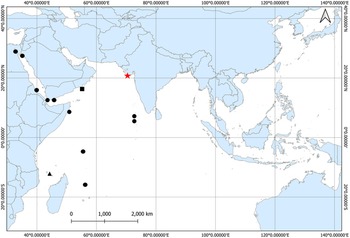
Distribution and habitat. Longtail dragonet, C. gardineri is known to be distributed in the Red Sea: Djibouti, Egypt, Eritrea, Israel (Fricke, Reference Fricke1983) and the WIO: Gulf of Aden (Yemen), East Africa, Natal (South Africa) to Comoro Islands, Seychelles, Saint Brandon’s Shoals (Cargados Carajos, Mauritius), Saya de Malha Bank, and the Maldives (Fricke, Reference Fricke1983, Reference Fricke, Smith and Heemstra1986; Regan, Reference Regan1908). The above species is known to inhabit soft bottoms in marine waters at depths of 20–174 m. A single specimen was recorded for the first time from the north-eastern Arabian Sea off Gujarat, northwestern India (Figure 3), which was collected at depths of 70–110 m (S. R., pers. comm., based on information from the fishing crew).
Remarks. Callionymus gardineri can be easily differentiated from its co-generic species C. margaretae Regan 1905 and C. persicus Regan 1905 by the presence of black blotch in the distal end of the first dorsal, third spine (vs. absent in C. margaretae); preopercular spine dorsal margin, 6–12 small antrorse serrae (vs. 3–6 in C. margaretae); second dorsal fin rays, viii, 1 (vs. vii, 1 in C. margaretae); and first dorsal, first spine long filamentous (vs. non-filamentous in C. persicus).
Callionymus omanensis Fricke, Jawad, and Al-Mamry, 2014)
Oman dragonet (Figure 2A–F; Table 1)
Callionymus omanensis from northwestern India, (A–C) male; (D–F) female; (A, C) fresh, (D, F) preserved, and (B, E) preopercle spine. Scale A, C, D, F = 10 mm.

Type locality: Off Salalah City, southern Oman, Western Arabian Sea, north-western Indian Ocean, depth 500 m.
Callionymus omanensis Fricke, Jawad, and Al-Mamry, 2014: 3, 1– figs. 2, 4a; Table 1
Material examined. KU/COFS/MUS/010260 (114.8 mm SL, male; Figure 2A–C), 1 ex., 24 September 2024; KU/COFS/MUS/010261 (116.5 and 122.1 mm SL, male), 2 ex., 14 October 2024; KU/COFS/MUS/010263 (113.6 mm SL, male), 1 ex., 5 November 2024; and KU/COFS/MUS/010263 (112.2 mm SL, female; Figure 2D–F), 1 ex., 5 November 2024, 20°54ʹ27″N 70°23ʹ02″E, Veraval Fishing Harbour, northwestern coast of India, collected by S. Ragul, trawled off Gujarat, Northeastern Arabian Sea.
Identification. First dorsal-fin spines IV–V (Figure 2A and D); second dorsal-fin elements viii, 1; anal-fin elements viii, 1; pectoral-fin rays ii–iii, 16–17, i = 19–20; pelvic-fin elements I, 5; caudal rays (i–ii), i, 3, ii, 2, (iii); preopercular spine formula  $1\frac{2}{ - }1$. For a detailed comparison of meristic and morphometrics, see Table 1.
Body and head: Elongated body and head, ventrally flat. Male urogenital papilla long 8.3–9.6 in HL. Large eyes (2.4–2.6 in HL) with a narrow interorbital space, male 8.2–8.7 (female 9.1) in ED. Head with almost a straight nape. Body more tapering at the tail, long caudal peduncle, male 5.3–5.6 (female 6.0) in SL with the least depth, male 22.2–23.4 (female 24.9) in SL. Head, preopercular spine (long in male 11.8–12.7 in SL and short in female 14.0 in SL) with a long, main tip upcurved, smooth ventral margin; base with a single strong antrorse spine, small antrorse barb, dorsal margin with a large curved point (Figure 2B and E). Mouth small, subterminal, maxilla reaching to a vertical through origin of eye, male 4.2–4.3 (female 4.0) in HL; small upper law, male 3.3–3.4 (female 2.9) in HL.
Fins: The first dorsal fin non-filamentous, in males 4.3–4.4 in SL (female 5.7) but slightly higher than the second dorsal fin, 5.1–5.4 in SL (female 6.4). Last ray of both second dorsal and anal fin: unbranched and divided at its base.
Colouration (fresh specimen) (Figure 2A and D). Male – head and body dorsally dark to pale brownish yellow filled with black to greyish to white spots above the midline, ventrally creamy to greyish white, a bright yellowish line flows from the pectoral base to the posterior end of the caudal fin. First dorsal: yellowish distal half of first three spines, a white streaky line at the middle of the yellow portion; a large black blotch at the membrane between the third and fourth spine with a black line connecting the first to the third spine, greyish below the black blotch. Second dorsal: yellowish, nine white wavy vertical lines with black blotch at every fin ray base. Pectoral and pelvic fins: pale yellowish to light brownish with white bases; upper pectoral fin with vertical rows of dark spots and lower translucent; distal end of pelvic fin darker than the spine portion. Anal fin: distally ½ portion blackish with white bases. Caudal fin: white, the yellow line that flows through the body also flows in between the mid elongated segmented unbranched caudal fin rays, ii; the upper part with yellow and black markings in membranes; the lower part next to the mid rays a black horizontal streak flows through the fin, the rest distal lower portion translucent. Whitish, branchiostegal membrane, and thorax. Bright yellowish, cheek and pelvic fin base (connecting membrane). Female – head and body dorsally dark to pale brownish filled with black to greyish comma-shaped markings above the midline, ventrally creamy to greyish white, a bright yellowish line flows in the midline absent. First dorsal: yellowish distal half of first three spines, a white streaky line at the middle of the yellow portion; a large black blotch at the membrane between the upper and lower half, greyish below the black line. Second dorsal: yellowish, seven black to dark yellow blotches at every fin ray base, midline, and light-yellow blotches at the distal end. Pectoral and pelvic fins: pale yellowish to light brownish with pale white bases; upper pectoral fin with vertical rows of dark spots and lower almost translucent; distal end of pelvic fin darker than the spine portion. Anal fin: distally ¼ portion blackish with white bases. Caudal fin: White, the upper part with yellow markings in membranes; the lower part next to the mid rays a yellow horizontal streak flows through the fin (black in males), the rest distal lower portion translucent. Whitish brown, branchiostegal membrane, and thorax. Pale brownish, cheek and pelvic fin base (connecting membrane).
Coloration (preserved specimen) (Figure 2C and F). Head and body paler than in fresh condition, black blotch and bars more prominent. Fins black to greyish. All other yellowish portions and the mid-yellow line faded out in males.
Distribution and habitat. Oman dragonet, Callionymus omanensis is only known from the type locality off Salalah City, Southern Oman, north-western Indian Ocean (Fricke et al., Reference Fricke, Jawad and Al-Mamry2014), where it was collected from a depth of 500 m. The present study records the occurrence of C. omanensis from the north-eastern Arabian Sea, off Gujarat, northwestern India (Figure 3), collected at the least depth range of 100–150 m (S. R., pers. comm., with the fishing crew).
Distribution in the Western Indian Ocean showing, Callionymus gardineri: (▲) type locality, (●) other records; (■) C. omanensis-type locality, (⋆) new record from Gujarat, India.

Remarks. Callionymus omanensis differs from its co-generic species C. africanus Kotthaus, 1977, C. bentuviai Fricke, 1981, and C. profundus Fricke and Golani, 2013 by having a sharp pointed preopercular spine (vs. comparatively a strong spine in C. profundus); absence of small points additional to small antrorse barb and main tip (vs. presence of two small points in C. africanus and C. bentuviai); plain white thorax (vs. dark grey in C. profundus); distal median filaments of caudal fin, short (vs. very long in C. bentuviai); and caudal fin dorsal half with four dark streaks even visible in preserved specimen (vs. pale, scattered dark spots in C. africanus; vs. one horizontal dark streak in C. bentuviai; and vs. pale and few dark spots in C. profundus).
Discussion
Longtail dragonet C. gardineri may be locally common and is known from widely scattered localities in the WIO (Fricke, Reference Fricke1983, Reference Fricke, Smith and Heemstra1986). Oman dragonet Callionymus omanensis is only known from its type locality off southern Oman, Western Arabian Sea (Fricke et al., Reference Fricke, Jawad and Al-Mamry2014), but this record seems to indicate that this species is more widespread in the WIO, especially in the northeastern Arabian Sea. Both C. gardineri and C. omanensis belong as a common member of the outer shelf and upper slope communities, present on sandy to muddy bottoms (Fricke, Reference Fricke1983; Fricke et al., Reference Fricke, Jawad and Al-Mamry2014), which is here confirmed by the sampled specimens from catches at Veraval Fishing Harbour. Fricke et al. (Reference Fricke, Jawad and Al-Mamry2014) collected the type specimen of Callionymus omanensis from a depth of 500 m, while the current specimens were trawled from shallower waters, between 100 and 150 m.
The meristic and morphometric data of the present specimens, as outlined in Table 1, exhibit a strong concordance with the descriptions previously published by Fricke (Reference Fricke1983) and Fricke et al. (Reference Fricke, Jawad and Al-Mamry2014). The observed variations in Callionymus omanensis were primarily attributable to sexual dimorphism, males bear an almost elongated urogenital papilla which is absent in females. Comparatively, males have higher median fin rays than females: first dorsal fin spines 22.5–22.9% of SL in males (vs. 17.3 in female); second dorsal first ray 18.4–19.2% of SL (vs. 15.5 in female), last ray 21.5–22.1% of SL (vs. 18.8 in female); anal fin first ray 10.7–10.9% of SL (vs. 10.2 in female), last ray 17.0–17.3% of SL (vs. 15.1 in female) and a notable difference in the colouration of the caudal fin, the lower part next to the mid rays bears a black horizontal streak through the fin in males (vs. yellow horizontal streak in female).
The observed distribution of these dragonets might be attributed to factors like habitat type, ecosystem productivity, salinity, temperature, and water currents, which may play a more significant role in their geographical spread than depth. Conversely, their feeding habits could also be a crucial determinant of their distribution and lack of research in the field of low-value deep sea trawl bycatch. To date, the western coast of India is home to only two Callionymus species, the Indian deepwater dragonet C. carebares and Margaret’s dragonet C. margaretae (Fricke, Reference Fricke1983). Only a few studies have been done on the distribution of Callionymus species from the Indian subcontinent, which strongly recommends the research gap, and hence more explorations are needed for better assessment of these species (Fricke, Reference Fricke1983). The current findings represent a range extension of approximately 1750 km to the north and east of the closest previously known region Maldives (C. gardineri) and from Southern Oman (C. omanensis). Both species are currently listed as ‘Not Evaluated (N.E.)’ by the Global IUCN Red List (date assessed: 12 December 2023). Further extensive studies are needed to unveil whether some other callionymid fishes reside in the coastal waters of India.
Acknowledgements
The authors are grateful to the Principal, College of Fisheries Science, Kamdhenu University, for providing facilities enabling this work. Both authors wish to extend their sincere gratitude to the anonymous reviewers and the associate editor, Dr. Jim Ellis for their valuable comments and suggestions to improve the manuscript.
Author contributions
S.R. wrote the first version of the manuscript. S.R. carried out field sampling and collected the specimens. Both authors contributed to the draft, provided critical feedback, and helped shape the research. Both authors read and approved the final manuscript.
Funding
This research received no specific grant from any funding agency, commercial, or not-for-profit sectors.
Competing interest
The authors declare none.