Use of feed additives can increase production efficiency and animal health. The use of some additives such as antibiotics and ionophores is limited due to the development of resistant strains of bacteria, the adaptation of the animals and inefficiency of the additives. Therefore, the use of new additives derived from natural source such as plant compounds is increasingly considered by livestock breeders. Inulin is one of the compounds that has these mentioned attributes and does not have harmful effects for livestock. Inulin is a mixture of natural fructan in which the fructose monomer is linked by a (2,1) glycoside bond preventing its hydrolysis by digestive enzymes in monogastric animals (Mudannayake et al., Reference Mudannayake, Wimalasiri, Silva and Ajlouni2015). Inulin cannot be digested or broken down in the mouth, stomach or small intestine and can only be fermented by rumen bacteria and partially by bifidobacteria in the large intestine. Inulin is widespread in nature occurring in over 36 000 types of plants, fruits and vegetables, especially chicory and Jerusalem artichoke (Csernus and Czeglédi, Reference Csernus and Czeglédi2020). This inexpensive material is commonly used as a prebiotic because of its availability in a variety of sources. As a soluble fiber, inulin has been extensively studied in monogastric animals and humans (Ayala-Monter et al., Reference Ayala-Monter, Hernández-Sánchez, González-Muñoz, Pinto-Ruiz, Martínez-Aispuro, Torres-Salado and Gloria-Trujillo2019; Ding et al., Reference Ding, Chen, Lin, Wang, Zhang, Ni, Pirone, Madigosky and Fronte2021). The use of inulin in ruminant nutrition has been suggested for several years, but it remains a lesser known and even less used component in the animal feed industry (Birmani et al., Reference Birmani, Nawab, Ghani, Li, Xiao and An2019). According to a recent study, inulin supplementation of 100, 200, 300 and 400 g per day for each dairy cow has reportedly altered the rumen fermentation process, increased production of rumen propionate, lactic acid and butyrate, improved production traits such as milk production, protein and lactose and reduced somatic milk cells (Wang et al., Reference Wang, Nan, Zhao, Jiang, Wang, Hua, Zhang, Wang, Liu, Yao and Xiong2020). These authors reported that using 300 g of inulin per day could increase the population of beneficial ruminal microorganisms (eg Prevotella, Butyrivibrio, Muribaculaceae, and Bifidobacterium spp.) with positive effects in energy and protein metabolism, as well as reducing the population of harmful bacteria (eg Clostridia UCG-014, Streptococcus, Escherichia and Shigella spp.) involved in the formation of compounds affecting inflammation. Tian et al. (Reference Tian, Liu, Sun, Wu, Chen, Zhang, He and Dong2019) reported that adding inulin to beef cattle feed could control the negative effects of high feed concentration such as acidosis and production of potentially toxic compounds such as lipopolysaccharides and, thereby, improve growth and production.
In-vitro experiments on rumen fermentation in sheep showed that adding 1.5 g of inulin to incubation bottles with 1 g of basal diet could significantly reduce the concentration of N-NH3, suggesting the ability of inulin to improve nitrogen utilization in the rumen (Özturk, Reference Özturk2009). Nonetheless, there is only limited information on the effects of dietary inulin on the performance of lactating ewes. The aim of the present study was, therefore, to investigate the effect of inulin supplementation to the feed on milk production, rumen fermentation parameters and the digestibility of nutrients in lactating ewes.
Materials and methods
Ethics statement
The methods used in this study were approved by the Biomedical Ethics Committee of the University of Tabriz (IR.TABRIZU.REC.1400.031).
Animals, diets, and experimental design
The study was carried out on 18 multiparous late stage of lactation Ghezel ewes (local dual-purpose breed for milk and meat production) with a starting weight of 48.8 ± 4.1 kg. The ewes were divided into three groups of equal size (n = 6) and kept in individual stalls with straw litter (1.5 × 1.5 m). All ewes were clinically healthy and free of internal and external parasites. The experimental diet was formulated to meet the nutrient requirements for the ewes according to NRC (2007) recommendations. The experimental feed treatments consisted of (1) control (basal diet without inulin), (2) 2% inulin (w/w) (basal diet with 2% inulin) and (3) 4% inulin (basal diet with 4% inulin). Inulin (natural inulin powder, CAS Number: 9005-80-5, molecular formula: C12H22O11.C6H12O6, Purity: 99%) was added to the basic diet as a top dress. The basal diet is reported in online Supplementary Table S1. The ewes were fed ad libitum and twice daily (8 : 00 a.m. and 3 : 00 p.m.) and had free access to water during the entire test period. The diet adaptation for the experimental diets for 21 d was followed by data recording and sampling for 5 d. Since the animals were fed individually, the amount of feed per ewe was recorded every 5 d.
Chemical composition and apparent digestibility determination
Samples of the feed consumed and the ort in each period were transferred to the laboratory to measure the DM (%) and chemical composition. To determine the chemical composition, feed and feces samples were first oven-dried for 72 h (70 °C) and then ground with a sieve (1 mm pore size) according to the methods proposed by AOAC (2005). Neutral detergent fibers (NDF) and acid detergent fibers (ADF) were determined using heat-resistant α-amylase according to the method of Van Soest et al. (Reference Van Soest, Robertson and Lewis1991). Apparent digestibility of organic matter (OM), NDF and ADF was determined using the acid-insoluble ash as an internal marker. For this purpose, feces samples were taken on the 5 d of rectal sampling, mixed to form a single sample and the digestibility of nutrients was determined according to the equation of Marais (Reference Marais and D'Mello2000). The equations are reported in the online Supplementary File.
Milk production and sampling
During the 5 d of sampling, milk production was recorded for each milking session (24-h periods). Ewes were milked by hand at 08 : 30 and lambs were separated from their dams 12 h before milking and bottle-fed. Milk samples were taken on the last 2 d to determine the milk composition. Immediately after sampling, potassium dichromate (K2Cr2O7), as the preservative, was added to the container and immediately cooled to 4 °C. Milk samples were submitted to Ideh Sazan Rojan Alvand Co. (Karaj, Alborz, Iran) for fat, protein, lactose, solids-not-fat, MUN and fatty acid profile analyses using Fourier transform infrared spectroscopy (FTIR) (Delta CombiScope FTIR 600 HP, Delta Instruments, BV, Drachten, Netherlands). The fat corrected milk (FCM) was calculated according to the equation of Nguyen et al. (Reference Nguyen, Le, Nguyen, Nish, Otto, Malau-Aduli, Nichols and Malau-Aduli2018) and the energy corrected milk (ECM) was calculated according to the equation of Sjaunja et al. (Reference Sjaunja, Baevre, Junkkarinen, Pedersen and Setala1990) and Tajaddini et al. (Reference Tajaddini, Dayani, Khezri, Tahmasbi and Sharifi-Hoseini2021). The equations are reported in online Supplementary File.
Rumen fluid sampling and analysis
To assess the effect of inulin feeding at 2 and 4% of DM intake on the rumen fermentation parameters (pH, volatile fatty acids (VFAs), N-NH3 and protozoal population) on the last day, rumen fluid was collected 3 h after feeding using an esophageal tube and immediately filtered with a 4-layer cheesecloth. Immediately after sampling, the pH was measured with a mobile pH meter calibrated on site. Thereafter, 20 μl of 1% sulfuric acid per ml of rumen fluid was added to the liquid in order to stop digestion and fermentation. For VFAs and N-NH3 measurements, the samples were stored at −20 °C until analysis.
N-NH3 was measured by spectrophotometry (550 nm wavelength) according to Broderick and Kang (Reference Broderick and Kang1980). VFAs in the rumen fluid sample were measured using gas chromatography (Fisons. Instruments, HRGC mega2, Milan, Italy). The injector and detector temperatures were 110 and 200 °C, respectively. In this device the carrier gas was helium and the detector was a flame ionization detector. The initial temperature of the device column was 110 °C, which was kept at this temperature for 2 min and then increased to 200 °C over 5 min and kept at this temperature for 1 min. The column type was Alltech capillary column, ECTM 1000, length 30 m, inner diameter 0.53 mm, film thickness 1 μm). Isocaproic acid was used as an internal standard.
In order to investigate the influence of different inulin concentrations on the protozoa population, the rumen fluid sample was immersed in a prepared and filtered formalin solution (100 ml of 40% formaldehyde and 8.5 g NaCl per 1 liter volume with distilled water) in a ratio of 1 to 4 (ruminal fluid: formalin). Protozoa were enumerated by a stereomicroscope at 40 × magnification in a Neubauer chamber. Each sample was counted four times and the count repeated if there was a large difference in the number of protozoa count (Ivan et al., Reference Ivan, Petit, Chiquette and Wright2013).
Statistical analysis
All experimental data were statistically analyzed with SAS 9.4 (SAS Institute, 2018) based on a fully randomized design using a statistical model: Yij = μ + Ti + eij, in which Yij was the dependent variable, μ was the total mean, Ti was the diet effect, and eij was the residual effect.
Results
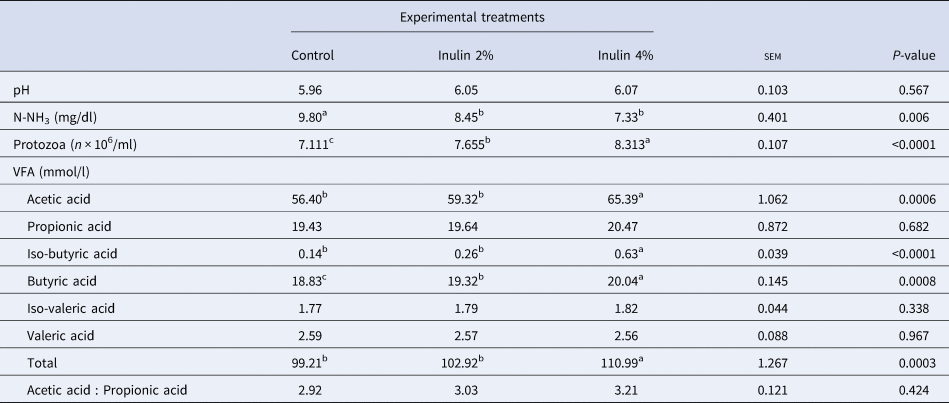
As shown in Table 1, the addition of 2 and 4% inulin to the basal diet had no significant effect on either feed intake or milk yield in lactating ewes, although there was numerical increase in the latter. Supplementation increased the milk fat content, the de novo synthesis of fatty acids and saturated fatty acids, while reducing the monounsaturated fatty acids in milk (P < 0.05). The addition of 4% inulin to the feed increased the milk protein content (P < 0.05), which could be due to increased synthesis of microbial protein and uptake of metabolizable protein in the intestine (Table 1). The dietary inulin supplement significantly reduced the MUN at tested concentrations (P < 0.01). This is likely due to higher microbial protein synthesis in the rumen resulting in lower N-NH3 in the rumen (Table 2) as well as lower MUN. The effects of dietary inulin addition on the rumen fermentation parameters are shown in Table 2. A main problem in high-performance animals is low rumen pH due to high concentrate feedstuff, the main cause of SARA in ruminants. The results showed no significant effects of the addition of inulin on the rumen pH, but the highest and lowest pH values were recorded for the feed with 4% inulin and the control group, respectively.
Effects of application of two levels of inulin on performances of ewes and milk composition

Means in the same row with different superscripts differ (P < 0.05).
Effects of application of two levels of inulin on rumen fermentation parameters

Means in the same row with different superscripts differ (P < 0.05).
Accumulation of lactic acid in the rumen as well as occurrence of SARA are perhaps minimized (Table 2). The results showed that inulin supplementation significantly reduced rumen N-NH3 (P < 0.05), with the highest values observed in control diet fed ewes compared with the 4% inulin fed animals. Inulin also significantly increased the rumen protozoal population (P < 0.0001), which was highest in 4% inulin diet fed ewes. However, 4% inulin supplemented animals had higher levels of total VFA concentration, acetate, butyrate and isobutyrate (P < 0.05). A numerical increase in the concentrations of propionate, valerate, isovalerate and acetate:propionate was also observed with this same diet.
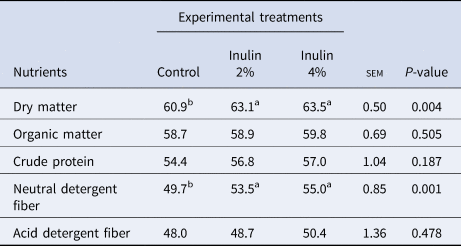
As shown in Table 3, the apparent digestibility results of nutrients from a diet supplemented with 2 and 4% inulin indicated that inulin increased the digestibility of the diet. The mean apparent digestibility coefficients of DM and NDF were significantly different between diets (P < 0.05), and the highest values belonged to the inulin-fed groups being significantly different from the control diet fed group (P < 0.05). The dietary inulin supplement had no significant impact on the digestibility of OM, crude protein or ADF, but the inulin-fed groups showed numerically better digestibility than the control group.
The effects of application of two levels of inulin on apparent digestibility of nutrients

Means in the same row with different superscripts differ (P < 0.05).
Discussion
There is limited information on the effect of inulin on feed intake in ewes, but DM intake often depends on the fiber digestion rate. It has been reported that feed additives with the ability to modulate rumen microorganisms and increase the efficiency of microbial protein synthesis lead to higher activity of fibrinolytic enzymes and thereby increase the rate of fiber digestion (Kafilzadeh et al., Reference Kafilzadeh, Payandeh, Gómez-Cortés, Ghadimi, Schiavone and Martínez Marín2019). Increasing fiber digestibility can decrease the effects of rumen filling, which can ultimately lead to increased feed intake, but we did not observe this. In addition, probiotic supplementation can increase the concentration of microbial digestive enzymes and amino acids by increasing the microbial population during rumen digestion, all of which can have positive effects on ruminant performance (Kafilzadeh et al., Reference Kafilzadeh, Payandeh, Gómez-Cortés, Ghadimi, Schiavone and Martínez Marín2019). The numerical increase of milk yield can be explained by the fact that propionate is the precursor of glucose in ruminants and its increase leads to an increase in the glucose available for lactose synthesis by the mammary secretory cell. Lactose is responsible for the osmotic equilibrium between blood and alveolar lumen in the mammary gland and has a high and positive correlation with milk production. Inulin supplementation, as expected, had no significant effect on milk lactose, although a small number of studies have shown that reducing the forage to concentrate ratio in the diet can slightly increase milk lactose (Sutton et al., Reference Sutton, Broster, Napper and Siviter1985; Paya and Taghizadeh, Reference Paya and Taghizadeh2020). Adding inulin also increased propionate numerically. Wang et al. (Reference Wang, Nan, Zhao, Jiang, Wang, Hua, Zhang, Wang, Liu, Yao and Xiong2020) showed that adding inulin to the feed of dairy cows increased net energy for lactation (NEl) leading to an increase in milk production. This is achieved by increasing the molar proportion of acetate, the ratio of acetate to propionate and by increasing the molar proportion of propionate in the rumen fluid of Holstein cows. Wang et al. (Reference Wang, Nan, Zhao, Jiang, Wang, Hua, Zhang, Wang, Liu, Yao and Xiong2021a) reported a significant increase in the milk production of Holstein cows through the addition of inulin, which is due, among other factors, to an increase in the production and concentration of rumen propionate. Short-chain fatty acids (6–14 carbon fatty acids) in milk are formed mainly by de novo synthesis from acetate and butyrate produced in mammary gland epithelial cells in the rumen, and 16 carbon fatty acids in milk are both produced by de novo synthesis and fatty acids absorbed from the blood (Liu et al., Reference Liu, Yang, Chen, Lin, Jiang, Zhao, Li and Dong2008). We observed that fiber digestion along with acetate and butyrate levels were higher in the rumen of inulin supplemented animals. Hence, milk fat and de novo synthesis of fatty acids were also higher in the same groups.
Previous reports have reported an improvement in rumen fermentation and increased microbial protein synthesis (Wang et al., Reference Wang, Nan, Zhao, Jiang, Wang, Hua, Zhang, Wang, Liu, Yao and Xiong2020, Reference Wang, Nan, Zhao, Jiang, Wang, Hua, Zhang, Wang, Liu, Yao and Xiong2021a) and milk protein content upon inulin consumption (Xue et al., Reference Xue, Sun, Wu, Guan and Liu2019). Erasmus et al. (Reference Erasmus, Botha and Kistner1992) reported that feed additives such as probiotics not only increase methionine flow, but also increase the flow of other amino acids into the intestine. The increased flow of methionine and lysine may explain the increased milk production and milk protein often observed in dietary supplemented ruminants.
Rumen pH is generally a function of feed intake, thus the rumen is more influenced by rapidly fermentable carbohydrates, which are generally found in cereals and concentrates. Despite the high proportion of concentrated feed in this study (60% of diet), the average rumen pH was well above the harmful value for cellulolytic bacteria. pH values below 5.9 and 6.0 are reported as harmful for this group of bacteria (Russell and Wilson, Reference Russell and Wilson1996; Moharrery et al., Reference Moharrery, Larsen and Weisbjerg2014). Tian et al. (Reference Tian, Liu, Sun, Wu, Chen, Zhang, He and Dong2019) and Wang et al. (Reference Wang, Nan, Zhao, Jiang, Wang, Hua, Zhang, Wang, Liu, Yao and Xiong2020) reported a significant decrease in rumen pH of dairy cows upon intake of 2% inulin supplemented feed and a significant increase in rumen pH due to feeding 200 g inulin per day per dairy cows. An important result of the present study, however, is the numerical increase in rumen pH with a simultaneous increase in rumen VFA production, which can be very positive. This is due to the activation of the acrylate pathway through which rumen bacteria convert lactic acid into propionate in the rumen (Gonzalez-Garcia et al., Reference Gonzalez-Garcia, McCubbin, Navone, Stowers, Nielsen and Marcellin2017). Also, a numerical increase in the ratio of acetate to propionate indicates an increase in acetate concentration.
Based on the results of the present study, a significant decrease in ruminal N-NH3 concentration was observed due to the addition of inulin. According to Tian et al. (Reference Tian, Liu, Sun, Wu, Chen, Zhang, He and Dong2019) and Wang et al. (Reference Wang, Nan, Zhao, Jiang, Wang, Zhang, Hua, Liu, Yao, Yang, Luo and Xiong2021b), inulin is used as a nutrient by hemicellulose-degrading bacteria in the rumen to support their growth and nitrogen utilization, so a decrease in ruminal N-NH3 concentration has been observed with inulin consumption. However, the reduction of ruminal nitrogen until it reaches less than 5 mg/dl is not a concern for the maximum microbial growth (Firkins et al., Reference Firkins, Yu and Morrison2007), and in this study, its concentration is above 5 mg/dl.
Rumen pH is one of the major factors in determining the rumen protozoal population. It has been suggested that increasing the concentration of rumen VFAs increases the rumen protozoa population, provided that the rumen pH does not drop below 5.5 (Martin et al., Reference Martin, Fonty, Michalet-Doreau and Martin2002). Therefore, the increased rumen VFA concentration, rather than a decrease in pH, justifies the increased rumen protozoal population in this study. Anaerobic microorganisms in the rumen, especially protozoa, play a key role in the breakdown of lignocellulosic compounds (Li et al., Reference Li, Deng, Liu, Yan, Li, Cao and Yao2018), and an increase in their population can increase both the rumen degradability of these feeds and ruminants' access to feed nutrients. Different results have been reported in experiments with inulin, and in general the addition of inulin to the diet of dairy cows significantly increased the total concentration of VFAs, acetate, propionate, butyrate, isobutyrate, valerate and isovalerate (Özturk, Reference Özturk2009; Tian et al., Reference Tian, Liu, Sun, Wu, Chen, Zhang, He and Dong2019; Wang et al., Reference Wang, Nan, Zhao, Jiang, Wang, Hua, Zhang, Wang, Liu, Yao and Xiong2021a). This discrepancy and the non-significance of some VFAs could be attributed to differences in experimental diet, feed-concentrate ratio, sampling time, DM intake level, and the type and amount of dietary inulin. Wang et al. (Reference Wang, Nan, Zhao, Jiang, Wang, Hua, Zhang, Wang, Liu, Yao and Xiong2021a) reported a direct and positive association between the frequency of Acetobacter and Christensenellaceae with acetate, Muribaculaceae and Bifidobacterium with propionate and Lachnospiraceae and Butyrivibrio with butyrate. The population of these types of bacteria increased as a result of supplementation with inulin (Tian et al., Reference Tian, Liu, Sun, Wu, Chen, Zhang, He and Dong2019).
Since there is very limited data on the effect of prebiotic additives on nutrient digestibility in ruminants, the effects of other feed additives, including probiotics, on digestibility were compared with the effects of adding inulin. One of the main mechanisms of feed additives, including probiotics, is to create anaerobic conditions and increase cellulolytic bacterial growth (Kafilzadeh et al., Reference Kafilzadeh, Payandeh, Gómez-Cortés, Ghadimi, Schiavone and Martínez Marín2019), which increases the digestibility of nutrients. Similarly, this mechanism was observed in the present study based on the results of the rumen VFA concentration (Table 2) and the increased nutrient digestibility (Table 3) due to the addition of inulin. Tian et al. (Reference Tian, Liu, Sun, Wu, Chen, Zhang, He and Dong2019) examined the effects of inulin on the digestibility of nutrients in feed with different amounts of concentrated feed and added inulin in beef cattle. They observed an increasing trend in digestibility and a significant upward trend in increasing the digestibility of CP and NDF. They also reported that adding inulin increased the population of proteolytic and cellulolytic bacteria in the rumen and made these two nutrients more digestible. On the other hand, experiments on sheep (Santoso et al., Reference Santoso, Mwenya, Sar, Gamo, Kobayashi and Morikawa2004) and cattle (Mwenya et al., Reference Mwenya, Santoso, Sar, Pen, Morikawa, Takaura, Umetsu, Kimura and Takahashi2005) showed that galactooligosaccharides (a prebiotic like inulin) did not affect nutrient digestibility. This difference can result from the type of experimental animal, the type of diet, the intake and the type of prebiotic consumed. The results of this study showed that 4% inulin supplement of the DM intake can have a positive influence on the performance of lactating ewes. Inulin intake increased the digestibility of nutrients, especially DM and NDF, by altering the rumen ecosystem, including preventing a decrease in rumen pH, while increasing the concentration of rumen VFAs, decreasing N-NH3 and the protozoal population.
In conclusion, the results of this study showed that 4% inulin supplementation could have a positive effect on the performance of lactating ewes. Inulin intake increased the digestibility of nutrients, especially DM and NDF, by altering the rumen ecosystem, including preventing a decrease in rumen pH, while increasing the concentration of rumen VFAs, decreasing ammonia nitrogen and increasing the protozoal population. Inulin intake changed milk composition, with 4% inulin supplementation increasing both milk fat and protein.
Supplementary material
The supplementary material for this article can be found at https://doi.org/10.1017/S0022029922000553.
Acknowledgements
This work has been supported by University of Tabriz, International and Academic Cooperation Directorate, in the framework of TabrizU-300 program.