INTRODUCTION
Much of early child–caregiver interaction in the immediate environments of children involves referring to external entities. Children build up their earliest linguistic knowledge and develop their communicative perspective-taking skills via these interactions. Recent research has evoked the importance of non-verbal content in children's referential interactions with adults (e.g., Baldwin, Reference Baldwin1991, 1993; Behne, Carpenter, & Tomasello, Reference Behne, Carpenter and Tomasello2005; Carpenter, Nagell, & Tomasello, Reference Carpenter, Nagell and Tomasello1998; Liebal, Behne, Carpenter, & Tomasello, Reference Liebal, Behne, Carpenter and Tomasello2009; Liszkowski, Brown, Callaghan, Takada, & De Vos, Reference Liszkowski, Brown, Callaghan, Takada and De Vos2012; Liszkowski, Carpenter, Henning, Striano, & Tomasello, Reference Liszkowski, Carpenter, Henning, Striano and Tomasello2004; Liszkowski, Carpenter, Striano, & Tomasello, Reference Liszkowski, Carpenter, Striano and Tomasello2006; Liszkowski, Carpenter, & Tomasello, Reference Liszkowski, Carpenter and Tomasello2007, Reference Liszkowski, Carpenter and Tomasello2008; Moll & Tomasello, Reference Moll and Tomasello2004). The present study examines how children younger than two years of age integrate different types of non-verbal devices (i.e., deictic gestures and communicative functional acts) with discourse status information (i.e., prior mention in discourse) in their referential speech while conversing about third-person entities with their caregivers. The data come from Turkish, a pro-drop language that allows (pro)noun omissions, where verb-only utterances are common in early conversations (Furman, Küntay, & Özyürek, Reference Furman, Küntay and Özyürek2014). We show how non-verbal devices contribute to the crux of communication early on before discourse-based referential skills are displayed and more complex argument structures are attested around two years of age. It is common for very young children to refer to external entities using gestures to complement what is said (Özçalışkan & Goldin-Meadow, Reference Özçalışkan and Goldin-Meadow2005). In example (1), while talking to his mother, a boy at age 1;09 suddenly shifts to a new topic about a referent in the room, ‘radio’, and uses a pointing gesture, complementing his otherwise inappropriate null form (i.e., omitting the object argument from the sentence).
-
(1)
-
1. child: Aç yaa [=! points to the radio]!
‘Turn on!’
-
2. mother: Açamayız.
‘We cannot turn (it) on.’
-
3. mother: Ablanın şeyi takılı oraya.
‘Your sister's stuff [ = the power adaptor of the recorder's camera] is plugged there.’
-
Development of discourse-pragmatic sensitivity involves learning to judge whether a referent is mentally accessible or clear to an addressee at the moment of interaction (Allen, Reference Allen2000; Clancy, Reference Clancy and Clark1993; Greenfield & Smith, Reference Greenfield and Smith1976). This sensitivity requires children to evaluate the discourse status of referents. Based on this judgment, children choose appropriate (i.e., sufficiently informative) referential forms from the repertoire of their language. Discourse status is about whether a referent is newly or previously mentioned in prior discourse (Bloom, Reference Bloom1990; Clancy, Reference Clancy and Clark1993; Valian, Reference Valian1991). A referent that is new to the discourse is assumed as not readily accessible to the listener since she does not yet have a clear mental knowledge or image of it. However, a referent that has been previously mentioned in discourse is thought to be already accessible to the addressee because of its previously built mental image. Adult speakers are expected to choose a referential form depending on the accessibility level of a referent. Lexical forms such as nouns are accepted as sufficiently informative in situations where a referent is inaccessible in the discourse context (e.g., new referents), or where a speaker needs to convey more information to help a listener to identify the referent easily. Non-lexical forms such as null forms are accepted as sufficiently informative in situations where a referent is highly accessible in the discourse context (e.g., given referents), or where a speaker does not need to convey as much further information as to make the listener identify the referent with ease. Demonstrative pronouns fall somewhere between lexical (e.g., nouns) and non-lexical (e.g., null) forms in terms of their level of informativeness (Ariel, Reference Ariel, Sanders, Schilperoord and Spooren2001; Gundel, Hedberg, & Zacharski, Reference Gundel, Hedberg and Zacharski1993). In the present study, we examine children's and their caregivers’ use of lexical and non-lexical forms depending on the accessibility level of a referent (i.e., new vs. given) in a discourse context. In this study, nouns are coded as lexical forms whereas null forms (i.e., omission of object arguments from the sentence) are coded as non-lexical forms. Although demonstrative pronouns are accepted in between in terms of their status of informativeness (Ariel, 2001; Gundel et al., Reference Gundel, Hedberg and Zacharski1993), most studies have adopted a binary coding scheme for referential forms (lexical vs. non-lexical) and thus grouped demonstrative pronouns either with lexical nouns (e.g., Allen, Reference Allen2000) or with null forms (e.g., Guerriero, Oshima-Takane, & Kuriyama, Reference Guerriero, Oshima-Takane and Kuriyama2006). In the present study, consistent with Guerriero and colleagues, demonstrative pronouns are coded under the category of non-lexical forms.
In example (1), the child initiates the interaction about a new entity (i.e., radio), which has not been previously mentioned in prior discourse, and is therefore potentially not mentally accessible to the caregiver. Discourse-pragmatic sensitivity requires the child to use a lexical form such as a noun when introducing this new entity into the discourse. Subsequently, the caregiver refers to the same entity by a non-lexical form such as a null form or a demonstrative pronoun, since it has already been mentioned by the child and is therefore presumably mentally accessible to him.
It has been demonstrated that children learning different languages show sensitivity to discourse status in their referential productions from two years of age onwards. Children around and older than two years of age tend to use non-lexical forms (either null forms or pronouns) to indicate previously mentioned referents, and to use lexical forms (nouns) to indicate new referents in discourse (Allen, Reference Allen2000; Allen & Schröder, Reference Allen, Schröder, Du Bois, Kumpf and Ashby2003; Campbell, Brooks, & Tomasello, Reference Campbell, Brooks and Tomasello2000; Clancy, Reference Clancy and Clark1993; Huang, Reference Huang2012; Matthews, Lieven, Theakston, & Tomasello, Reference Matthews, Lieven, Theakston and Tomasello2006; Narasimhan, Budwig, & Murty, Reference Narasimhan, Budwig and Murty2005; Paradis & Navarro, Reference Paradis and Navarro2003; Rozendaal & Baker, Reference Rozendaal and Baker2008, Reference Rozendaal and Baker2010; Salomo, Graf, & Lieven, Reference Salomo, Graf and Lieven2011; Salomo, Lieven, & Tomasello, Reference Salomo, Lieven and Tomasello2010; Serratrice, Reference Serratrice2005; So, Demir, & Goldin-Meadow, Reference So, Demir and Goldin-Meadow2010). Early emergence of sensitivity to discourse status is found in learners of languages such as English, which restrict the omission of nominal arguments (i.e., non-pro-drop languages) (Guerriero et al., Reference Guerriero, Oshima-Takane and Kuriyama2006) and in learners of languages such as Chinese (Wang, Lillo-Martin, Best, & Levitt, Reference Wang, Lillo-Martin, Best and Levitt1992), Inuktitut (Allen, Reference Allen2000), Italian (Serratrice, Reference Serratrice2005), Korean (Clancy, Reference Clancy and Clark1993), Japanese (Hirakawa, Reference Hirakawa1993), Spanish (Paradis & Navarro, Reference Paradis and Navarro2003), and Turkish (Demir, So, Özyürek, & Goldin-Meadow, Reference Demir, So, Özyürek and Goldin-Meadow2012; Gürcanlı, Nakipoğlu, & Özyürek, Reference Gürcanlı, Nakipoğlu, Özyürek, Caunt-Nulton, Kulatilake and Woo2007), which allow nominal arguments to be dropped in conversational discourse (i.e., pro-drop languages). We also know that children's speech samples do include violations of discourse-pragmatic principles. For example, 40% of four-year-old Chinese- and English-speaking children denote third-person new referents via non-lexical structures such as null forms and pronouns (So, Demir, & Goldin-Meadow, Reference So, Demir and Goldin-Meadow2010). A potential explanation for these inadequate referential forms is that children show sensitivity to the discourse status of referents using non-verbal devices because of their limited linguistic knowledge or immature linguistic processing skills (Guerriero et al., Reference Guerriero, Oshima-Takane and Kuriyama2006; Gürcanlı et al., Reference Gürcanlı, Nakipoğlu, Özyürek, Caunt-Nulton, Kulatilake and Woo2007). For example, in (1) above, to introduce a new referent, ‘radio’, to his mother, the child uses a non-verbal pointing gesture to accompany his utterance with an omitted direct object.
Infants aged 10 to 14 months, often before the onset of speech, begin to communicate with adults about external entities using non-verbal devices, mostly deictic gestures such as pointing and showing (Carpenter et al., Reference Carpenter, Nagell and Tomasello1998; Liszkowski et al., Reference Liszkowski, Brown, Callaghan, Takada and De Vos2012; Salomo & Liszkowski, Reference Salomo and Liszkowski2013), in different language environments such as English, Japanese, Spanish, Tzeltal, Yeli Dnye, and Yucatec. These infants produce pointing gestures to refer to objects, approximately 3 months before they produce lexical words corresponding to these objects (Iverson & Goldin-Meadow, Reference Iverson and Goldin-Meadow2005). One-year-old infants produce action gestures prior to the words representing these actions (Capirci, Contaldo, Caselli, & Volterra, Reference Capirci, Contaldo, Caselli and Volterra2005; Carpenter et al., Reference Carpenter, Nagell and Tomasello1998). Infants at age 1;06 combine a gesture and a word approximately 4 months before they construct two-word utterances (Özçalışkan & Goldin-Meadow, Reference Özçalışkan and Goldin-Meadow2005). After children begin to construct full sentences, they continue to use gestures to convey information or thoughts that cannot be fully expressed in speech. For example, children support the content in their verbal interactions with gestures when they interact with adults (Goldin-Meadow & Butcher, Reference Goldin-Meadow, Butcher and Kita2003; Iverson & Goldin-Meadow, Reference Iverson and Goldin-Meadow2005; Özçalışkan & Goldin-Meadow, Reference Özçalışkan and Goldin-Meadow2005), narrate a story (Demir & So, Reference Demir, So, Brugos, Clark-Cotton and Ha2006), or solve problems (Church & Goldin-Meadow, Reference Church and Goldin-Meadow1986; Garber, Alibali, & Goldin-Meadow, Reference Garber, Alibali and Goldin-Meadow1998; Goldin-Meadow, Reference Goldin-Meadow2005; Goldin-Meadow, Alibali, & Church, Reference Goldin-Meadow, Alibali and Church1993). Moreover, starting from two years of age, children use more gestures while talking about new rather than previously mentioned referents (Demir et al., Reference Demir, So, Özyürek and Goldin-Meadow2012; Guerriero et al., Reference Guerriero, Oshima-Takane and Kuriyama2006; So et al., Reference So, Demir and Goldin-Meadow2010; So & Lim, Reference So and Lim2012; So, Lim, & Tan, Reference So, Lim and Tan2014). Further, children's tendency to use gestures accompanying their speech is higher for new referents expressed by non-lexical forms rather than those expressed by nouns (So et al., Reference So, Demir and Goldin-Meadow2010).
Despite the recent accumulation of research on children's non-verbal communication, the question of how children younger than two years of age use non-verbal devices in relation to the discourse status of referents has not been studied (but see Guerriero et al., Reference Guerriero, Oshima-Takane and Kuriyama2006). In addition, non-verbal devices studied thus far only include deictic (i.e., points and shows) and iconic gestures. As an exception, Guerriero et al. included other referent-relevant actions such as touching, reaching, and moving objects as non-verbal devices. However, none of the studies examined children's choices of referential forms in association with different types of non-verbal devices.
A few studies explain children's inappropriate argument omissions (for example, for new referents) via the influence of caregiver input (Guerriero et al., Reference Guerriero, Oshima-Takane and Kuriyama2006; Huang, Reference Huang2012; Narasimhan et al., Reference Narasimhan, Budwig and Murty2005; Paradis & Navarro, Reference Paradis and Navarro2003; So & Lim, Reference So and Lim2012). The question in these studies is whether children and caregivers show similarity in their use of verbal devices in choosing linguistic referential forms. Most of these studies show that children's pattern of using discourse status information in choosing referential forms is similar to their caregivers’ (Huang, Reference Huang2012; Narasimhan et al., Reference Narasimhan, Budwig and Murty2005; Paradis & Navarro, Reference Paradis and Navarro2003). Only two of these studies (i.e., Guerriero et al., Reference Guerriero, Oshima-Takane and Kuriyama2006; So & Lim, Reference So and Lim2012), have examined whether children and their caregivers use similar non-verbal devices (e.g., referent-relevant gestures or actions) as well as verbal devices (e.g., discourse status of referents) in their referential speech. These two studies report similar results for the use of non-verbal devices by the child and adult speakers of a typical non-pro-drop language, English. English-speaking children consistently use referential gestures accompanying their non-lexical forms for new referents, following a similar pattern to their caregivers. However, the two studies offer different results in the use of non-verbal devices by child–caregiver dyads speaking pro-drop languages. Guerriero and colleagues (2006) show that Japanese-speaking children and mothers do not consistently supplement their inappropriate argument omissions by non-lexical devices that involve deictic gestures (e.g., points, shows) or referent-relevant actions (e.g., touches, reaches). However, So and Lim (Reference So and Lim2012) demonstrate that Chinese-speaking caregivers’ use of non-verbal devices such as deictic and iconic gestures that accompany questions is more frequent when the referent is new rather than previously introduced in the discourse; and Chinese-learning children are more likely to identify new referents in communicative forms that tend to be accompanied rather than unaccompanied by these gestures. There are at least three possible differences that may be responsible for the contradictory results between these two studies. First, Guerriero et al. (Reference Guerriero, Oshima-Takane and Kuriyama2006) report data based on the coding of the entire speech of the child–caregiver dyads, whereas So and Lim (Reference So and Lim2012) code speech samples which only include the caregivers’ labeling questions such as “What is this?” and the children's answers to these questions. Second, Guerriero et al.’s (2006) study is longitudinal in design and examines child-caregiver interactions beginning from an earlier time-point (i.e., around age 1;09); however, So and Lim's (Reference So and Lim2012) study was not longitudinal and focuses on an older age group, between 2;10 and 5;03 (with a mean age of four). Third, the two studies differ in terms of the type of non-verbal actions examined. Guerriero et al. (Reference Guerriero, Oshima-Takane and Kuriyama2006) code deictic gestures along with non-verbal actions such as touches and reaches; however, So and Lim (Reference So and Lim2012) code only gestures (deictics and iconics). For a clearer understanding of the role that non-verbal devices play in child–caregiver referential interactions, more studies with languages that allow for the omission of arguments need to be conducted.
In sum, the literature on children's referential interactions do not include longitudinal studies or do not involve children younger than two years of age. The relative absence of research for these younger ages is not surprising considering that many children do not produce much referential speech before their second birthday. However, referential communication includes non-verbal devices well before much linguistic sophistication is verbally displayed (Stephens & Matthews, Reference Stephens, Matthews and Matthews2014). Existing studies mostly covering older ages rarely focus on non-verbal devices in referential communication between child–caregiver dyads. Furthermore, we do not know much about how children (and caregivers) speaking pro-drop languages use non-verbal devices in their verbal referential interactions.
The primary aim of this study is to examine how children younger than two years of age integrate different types of non-verbal devices (i.e., deictic gestures and communicative functional acts) into discourse status information (i.e., prior mention in discourse) while communicating with their caregivers about physically available, third-person entities. First, to depict the nature of children's referential interactions before age two, we examine the pattern of verbal, vocal, and non-verbal communicative interchanges about an external entity (e.g., an object or a person) between child–caregiver dyads at three different age points (i.e., 1;00, 1;05, and 1;09). Second, we examine how children integrate different types of non-verbal devices (i.e., deictic gestures and communicative functional acts) into the discourse status of referents (i.e., previously mentioned vs. new) in choosing a lexical or a non-lexical form to refer to a specific entity at each of these age points. As a secondary aim, we address the same questions for the caregivers, and explore similarities between children's and caregivers’ use of non-verbal as well as verbal referential devices.
METHOD
Participants and corpus
Data come from the Koç University Longitudinal Language Development Database (KULLDD) (Küntay, Koçbaş, & Taşçı, Reference Küntay, Koçbaş and Taşçı2015). The database contains videotaped recordings of child–caregiver interactions between eight children (6 girls and 2 boys) and their regular caregivers in a home environment. Interactions are recorded as 60-minute sessions bi-weekly, presenting a longitudinal developmental window of children from 8 months to 3 years of age.
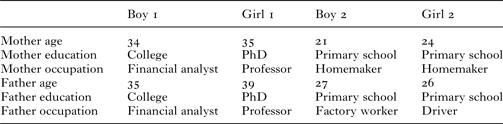
The caregivers in the database can be characterized as regular caregivers, such as mothers, fathers, grandparents, and babysitters. The participants are typically developing monolingual Turkish-speaking children who have lived in İstanbul as an only child throughout the entire data collection period. For this study, data from four of these children, two boys and two girls who come from similar socioeconomic backgrounds, are reported. The parents of one girl and one boy have a higher education level, whereas the parents of the other girl and other boy have a lower education level. Detailed demographic information about the caregivers is presented in Table 1.
Demographic information about the parents

Three different interaction sessions of child–caregiver dyads, specifically when the children are aged 1;00, 1;05, and 1;09, are reported. However, we report video-recordings of one child who was 0;10 in the first recording and 1;10 in the third recording, since the video-recordings at the ages of 1;00 and 1;09 are not available for her. We code the first 30 minutes of videotaped interactions of children with their caregivers in each session, totaling 6 hours of observation. The interactions of child–caregiver dyads mostly take place in the living rooms of the children's homes and include various activities such as dressing, eating, playing, reminiscing, and reading.
Data preparation and analysis
Trained research assistants who are all native speakers of Turkish transcribed three videotaped sessions of each child using the CHAT transcription format (MacWhinney, Reference MacWhinney2000). A second group of trained research assistants and the first author of the paper checked the accuracy of the transcribed data to ensure the reliability of the transcriptions, after importing the transcription to a coding program called the ELAN annotation tool (Hellwig, Reference Hellwig2008). The first author corrected inconsistencies in the transcriptions based on the principles of the CHAT transcription format.
The unit of analysis for this paper is ‘referent-relevant actions’, also called referential acts (Ateş-Şen, Reference Ateş-Şen2010), which are extracted from the interactive discourse between the children and their caregivers. Referential acts refer to children's and their caregivers’ verbal, vocal, and non-verbal interactions about a third-person entity (person or object). Verbal referential acts are utterances or phrases that refer to a third-person entity with a lexical (i.e., nouns and question forms; see line 6 in example (2)) or a non-lexical form (i.e., demonstrative pronouns and null forms; see lines 3 and 4 in example (2)). Vocal referential acts are mere vocalizations with a clear intention to refer to a third-person entity (see lines 1 and 5 in example (2)). Non-verbal referential acts include cases where only non-verbal devices, including gestures (e.g., pointing, showing) and communicative functional acts (e.g., reaching, placing) are employed with the aim of communicating about a third-person entity. In other words, these are the cases which include only non-verbal devices without any referent-relevant speech or vocalization while the children or the caregivers communicate about a third-person entity (see line 2 in example (2)). Non-verbal referential acts also include the cases of children's or caregivers’ referent-irrelevant speech (e.g., Teşekkür ederim ‘thank you’), which is accompanied by a non-verbal device.
-
(2)
-
1. child: Aaa [=! vocalizes while throwing a ball]!
-
2. father: [=! takes the ball]
-
3. father: Al [=! throws the ball back to the child].
‘Take.’
-
4. child: Al [=! picks up the ball on the floor].
‘Take.’
-
5. child: Ah [=! vocalizes while throwing the ball back to the father].
-
6. father: Aaa [=! vocalizes while throwing a ball] top!
Aaa [=! vocalizes] ‘ball’!
-
Coding
Consistent with our research questions, the coding scheme is restricted to physically present (or non-absent) third-person referents. We exclude songs, poems, and familiar stories from the coded data reiterations. Reference to first- (‘I’, ‘we’) and second-person (‘you’) referents are also not coded. In addition, we excluded locative terms such as bura ‘here’, ora ‘there’, and şura ‘there, when these terms represent a vague location.
The discourse status of referents for any type of referential act including verbal, vocal, and non-verbal attempts are coded. Types of non-verbal devices accompanying verbal and vocal referential acts and the type of linguistic forms that constitute the verbal referential acts are also coded.
Discourse status
Following Allen and colleagues (Allen, Reference Allen2000; Allen, Skarabela, & Hughes, Reference Allen, Skarabela, Hughes and Behrens2008; Hughes, Reference Hughes2011; Hughes & Allen, Reference Hughes and Allen2013, Reference Hughes and Allen2014; Skarabela & Allen, Reference Skarabela, Allen, Franich, Iserman and Lauren2010), the discourse status of each verbal, vocal, or non-verbal referential act takes a binary value, depending on its accessibility level in the discourse context. The discourse status of a referential act is coded as ‘previously mentioned’ when the referent is verbally mentioned in a lexical or non-lexical form within the preceding five utterances; otherwise it is coded as ‘new’.
Non-verbal devices: gestures and communicative functional acts
Initially, the children's and their caregivers’ deictic gestures, iconic gestures, and communicative functional acts which accompany their verbal or vocal referential acts were coded. Deictic gestures include speakers’ pointing and showing behaviors regarding a third-person referent. There are three distinct categories of pointing gestures. Index finger pointing requires a speaker to stretch out her/his arm in the direction of a distal or proximal referent object with an extended index finger. For whole-hand pointing, a whole hand rather than an index finger is used to point to a referent object. For body pointing, other parts of the body (such as head, legs, and chin) rather than hands are used to point at a referent object. Showing gestures require a person to hold or hold out a referent object with the aim of only showing (but not giving) it to the recipient. Iconic gestures are coded when the speakers’ hand or body movements resemble a referent object (e.g., keeping a forefinger in an upright position to represent a candle, or opening a palm upward to represent a glass), or when they depict actions produced by a referent object (e.g., waving hands to represent a butterfly or bringing a C-shaped hand towards the mouth to represent drinking from a glass). Communicative functional acts consist of the speakers’ requesting, reaching, giving, demonstrating, and placing behaviors; we have made sure that the behaviors coded as communicative functional acts involve the goal of communicating with an addressee about a third-person entity.
Referential forms of verbal referential acts
Initially, we coded referential forms under one of the categories including nouns, question forms, demonstrative pronouns, and null forms. Based on the coding schema of multiple previous studies (e.g., Allen, Reference Allen2000; Guerriero et al., Reference Guerriero, Oshima-Takane and Kuriyama2006), we treated the referential form as a binary variable (i.e., lexical vs. non-lexical forms). Nouns and question forms were treated as lexical forms, whereas null forms and demonstrative pronouns were treated as non-lexical forms. In the analyses, we excluded question forms from the lexical forms because they were rather few.
Reliability
To determine the reliability of the coding scheme, previously uncoded 3-minute interactions were chosen randomly from each video-recording session. These interactions were independently coded by the first author and a trained research assistant. As estimated by Cohen's kappa, the inter-rater reliability agreement is .99 for prior mention in discourse, .95 for accompanying non-verbal acts, and .99 for referential forms.
RESULTS
Nature of referential interactions: distribution of different types of referential acts at successive developmental points
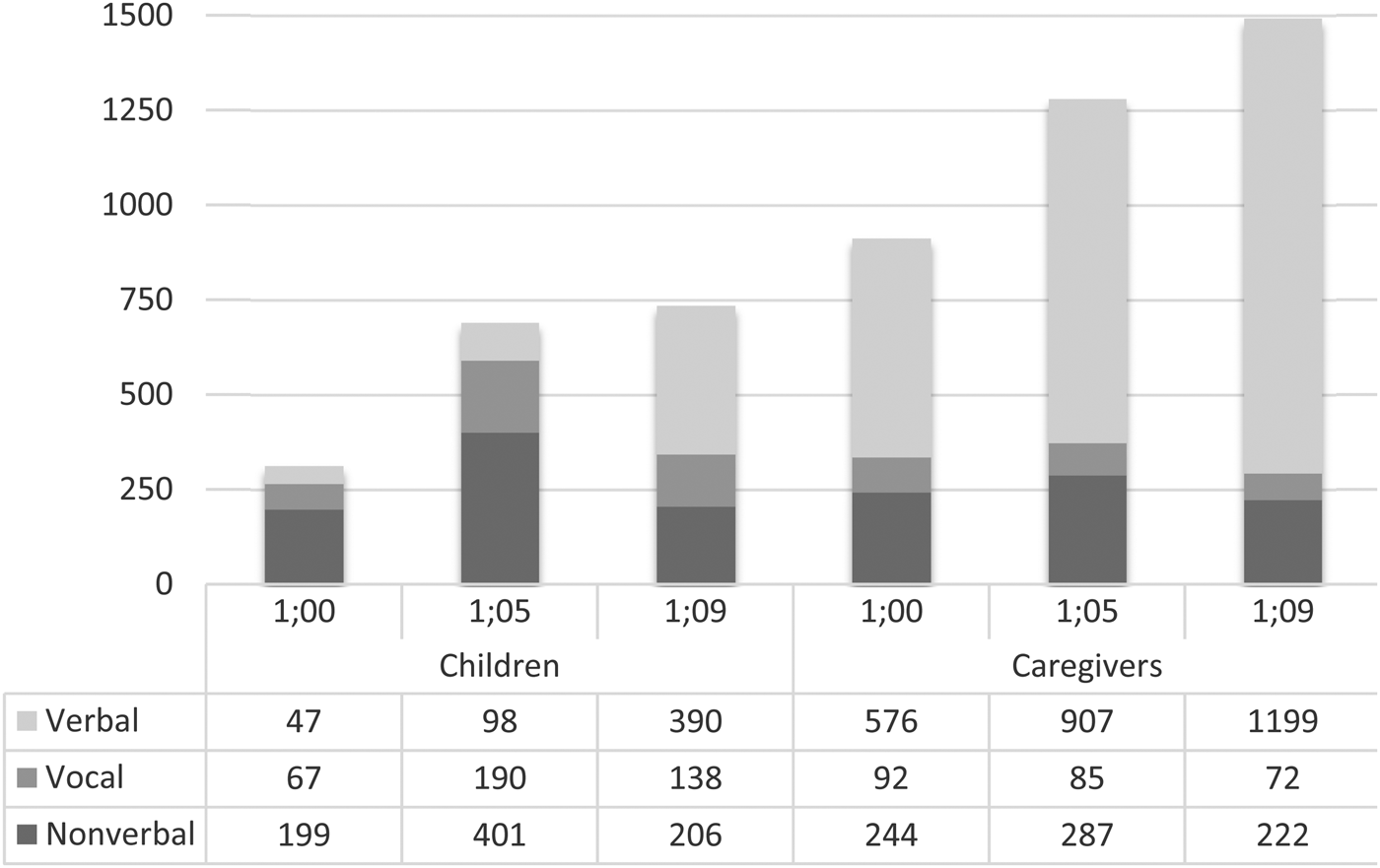
Our aim is to examine the nature of children's referential interactions with their caregivers before the age of two. We specifically investigate the distribution of the children's and the caregivers’ use of different types of referential acts (i.e., verbal, vocal, and non-verbal) about an external entity (e.g., an object or a person) across three developmental time-points (i.e., 1;00, 1;05, and 1;09). Our data include 5,420 referential acts which indicate physically present, third-person entities from the corpus: 3,217 of these referential acts are verbal, 644 are vocal, and 1,559 are non-verbal. Children's referential acts total 1,736 items, with 535 verbal, 395 vocal, and 806 non-verbal acts. Caregivers’ referential acts total 3,684 items, with 2,682 verbal, 249 vocal, and 753 non-verbal acts. Chi-square tests were conducted on the contingency tables to examine the association between ‘type of referential act’ and ‘developmental time-point’.
The results show a significant difference in the patterns of distribution of the different types of referential acts at different developmental time-points for both the children (χ 2(4) = 311·57, p < ·001) and their caregivers (χ 2(4) = 90·05, p < ·001). As Figure 1 shows, at ages 1;00 and 1;05, children's referential attempts are mainly non-verbal, followed by vocal and verbal referential attempts. However, at age 1;09 most of their referential attempts are verbal, followed by non-verbal and vocal attempts. The Marascuilo post-hoc comparison tests (at p = ·05; Marascuilo & McSweeney, Reference Marascuilo and McSweeney1977) indicate that the children's verbal acts stay constant between age 1;00 and age 1;05, and then significantly increase after age 1;05. Non-verbal attempts stay constant from age 1;00 to 1;05, but decrease at age 1;09. The number of vocal acts remain the same when the children are aged 1;00 and 1;05; however, they decline from age 1;05 to age 1;09.
Frequency of verbal, vocal, and non-verbal referential acts at ages 1;00, 1;05, and 1;09.

Figure 1 also presents the caregivers’ referential moves at each time-point. These moves are mostly verbal, followed by non-verbal and vocal ones. Marascuilo post-hoc comparison tests (p = ·05) show that the caregivers’ verbal acts increase significantly across all time-points. The non-verbal acts of the caregivers stay constant when children are aged from 1;00 to 1;05, but they are subject to a decline from ages 1;00 to 1;09 and from ages 1;05 to 1;09. The caregivers’ vocal acts significantly decrease from age 1;00 to 1;09, but do not change from 1;00 to 1;05 or from 1;05 to 1;09.
Role of non-verbal devices and discourse status information on choice of referential forms
Our main aim was to examine how the children and the caregivers integrate different types of non-verbal devices (i.e., deictic gestures vs. communicative functional acts) with discourse status information (i.e., previously mentioned vs. new) in choosing referential forms (i.e., lexical vs. non-lexical forms). Consistent with this aim, we investigated three questions.
First, we asked whether the children's and the caregivers’ tendency to use any type of non-verbal device (i.e., presence vs. absence of non-verbal devices) is associated with their choice of referential forms (i.e., lexical vs. non-lexical forms). We created a new dataset with only verbal referential acts including lexical forms (i.e., nouns) and non-lexical forms (i.e., null forms and demonstrative pronouns). Once we exclude vocal and non-verbal referential acts, our dataset comprises of 2,034 verbal referential acts, 407 of which come from the children, and the rest (1,627) from the caregivers. We conducted separate chi-square tests on the contingency tables, examining the association between ‘use of non-verbal devices’ and ‘choice of referential forms’ for the child and the caregiver data at each time-point.
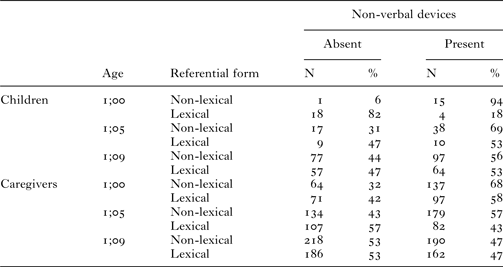
For the children, the results show a significant association only at the age of 1;00 (χ 2(1) = 21·16, p < ·001). As Table 2 shows, the children almost always use non-verbal devices in conjunction with non-lexical forms, whereas they do not use many non-verbal devices to go along with their lexical forms. At age 1;00, a non-verbal device is accompanied by non-lexical forms 94% of the time, while it is accompanied by lexical forms only 18% of the time. At age 1;05, non-verbal devices are used with non-lexical forms 69% of the time, but they are used with lexical forms 53% of the time. At age 1;09, the use of non-verbal devices accompanying non-lexical and lexical forms is almost equal, i.e., 56% and 53%, respectively. The children's non-verbal devices mostly include communicative functional acts and deictic gestures, except for a few iconic gestures.
Number of non-lexical vs. lexical forms in the absence vs. presence of non-verbal devices at ages 1;00, 1;05, and 1;09

For the caregivers, there exists a significant association between use of non-verbal devices and choice of referential forms at the ages of 1;00 (χ 2(1) = 4·28, p < ·05) and 1;05 (χ 2(1) = 8·99, p < ·01). As Table 2 shows, at age 1;00, caregivers utilize non-verbal devices to accompany 68% of their non-lexical forms and 58% of their lexical forms. At age 1;05, caregivers’ non-verbal devices co-occur with their non-lexical forms 57% of the time, and with their lexical forms 43% of the time. However, by age 1;09 the percentages of non-verbal devices that caregivers use to accompany their non-lexical and lexical forms are not different from each other (47%).
Next, we examined whether the children and the caregivers use different types of non-verbal devices (i.e., deictic gestures vs. communicative functional acts) to accompany their different choices of referential forms (i.e., lexical vs. non-lexical forms). We included only the cases where the children and the caregivers used a non-verbal device to accompany their referential forms. We excluded iconic gestures since they were very few in both the child and the caregiver data. After these eliminations, our new dataset included 1,048 verbal referential acts; 218 from the children, and 830 from the caregivers. We followed the same statistical procedure by applying separate chi-square tests on the contingency tables to investigate the association between ‘type of non-verbal device’ and ‘choice of referential form’ for the child and caregiver data at each age-point.
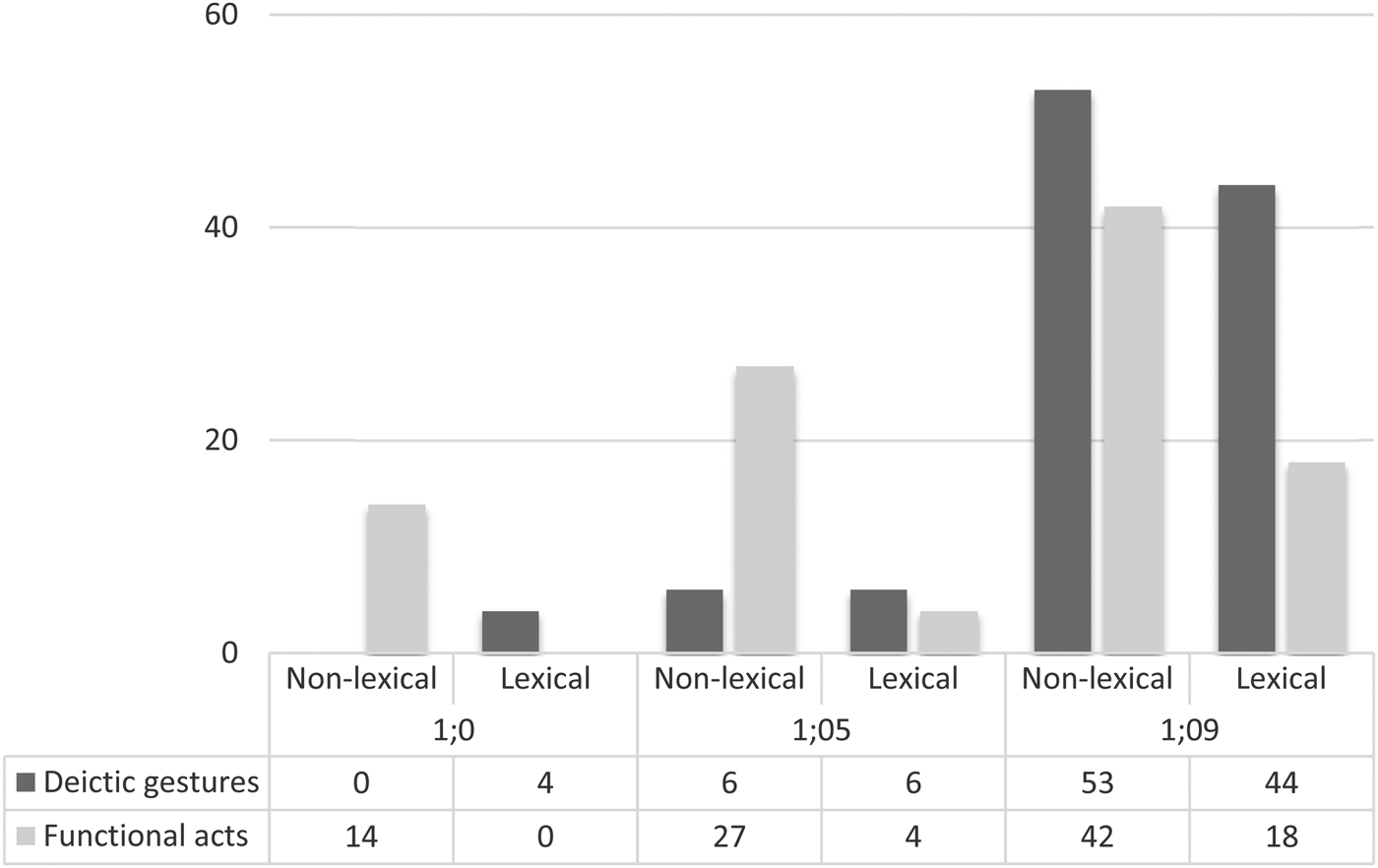
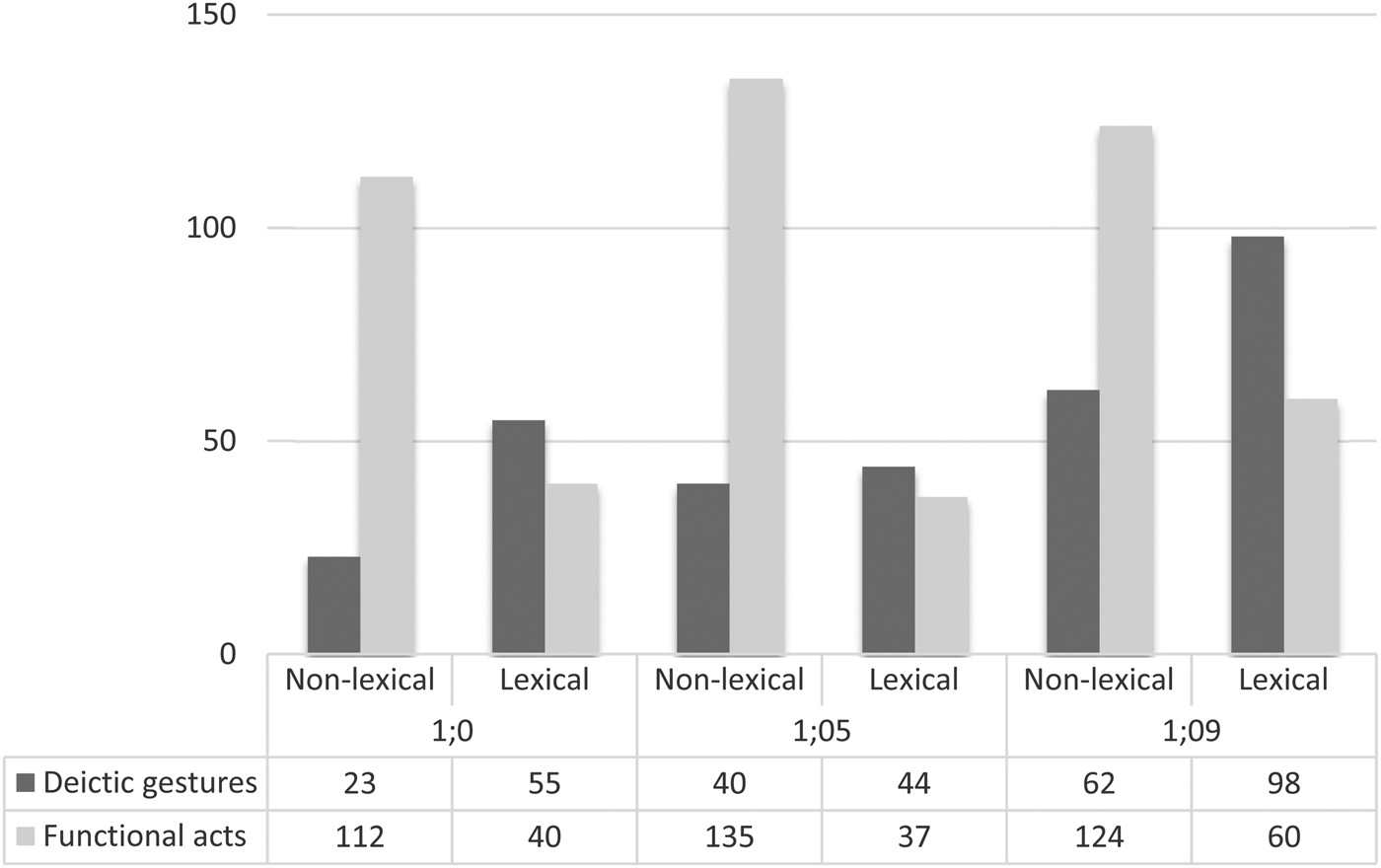
The results show a significant relationship for the children at ages 1;00 (Fisher's exact test, χ 2(1) = 0·00, p < ·001) and 1;05 (Fisher's exact test, χ 2(1) = 0·02, p < ·05). As Figure 2 shows, at age 1;00, the children always (100% of the time) use communicative functional acts to accompany their non-lexical forms, and deictic gestures to accompany their lexical forms. At age 1;05, they mostly used communicative functional acts to accompany their non-lexical forms and deictic gestures to accompany their lexical forms. However, at age 1;09, the association between type of non-verbal device and choice of referential form is not significant, since the children began to use mostly deictic gestures rather than communicative functional acts for both non-lexical and lexical forms.
Number of the children's referential forms accompanied by deictic gestures or communicative functional acts at ages 1;00, 1;05, and 1;09.

For the caregivers, we found a significant relationship between type of non-verbal device and choice of referential form at each time-point (χ 2(1) = 41·53, p < ·001 at age 1;00; χ 2(1) = 24·86, p < ·001 at age 1;05; χ 2(1) = 28·27, p < ·001 at age 1;09). As Figure 3 shows, at each time-point, the caregivers are more likely to use communicative functional acts to accompany their non-lexical forms but deictic gestures to accompany their lexical forms.
Number of the caregivers’ referential forms accompanied by deictic gestures or communicative functional acts at ages 1;00, 1;05, and 1;09.

Our last research question was to examine the relative contribution of different types of non-verbal devices (i.e., deictic gestures vs. communicative functional acts) and the discourse status of referents (i.e., new vs. given) to children's and caregivers’ choices of referential forms (i.e., lexical vs. non-lexical). We worked on a dataset of 2,002 verbal referential acts; 395 from the children, and 1,607 from the caregivers. The child data comprised of 37, 69, and 289 verbal referential acts and the caregivers’ data included 363, 496, and 748 such referential acts, respectively, at ages 1;00, 1;05, and 1;09. The reduction in our datapoints is a result of the exclusion of the cases with missing values in any of our predictor variables or outcome variable.
We conducted a set of binary logistic regressions separately for each developmental time-point in the child and the caregiver data. We employed two categorical predictor variables: ‘type of non-verbal device’ and ‘discourse status of referents’. The outcome variable (i.e., choice of referential forms), also a categorical one, included two distinct categories: ‘lexical forms’ (i.e., nouns) and ‘non-lexical forms’ (i.e., null forms and demonstrative pronouns). We compared the likelihood of using a non-lexical form with the likelihood of using a lexical form depending on the two predictor variables. For the first predictor variable (i.e., type of non-verbal device), we compared the likelihood of using a non-lexical form in the cases where a speaker did not use any non-verbal devices, with those where they used a deictic gesture and those where they used a communicative functional act. For the second predictor variable (discourse status of referents), we compared the likelihood of using a non-lexical form when a speaker talked about a new as opposed to a previously mentioned referent.
For the one-year-old children, the main-effect model with two predictor variables (i.e., type of non-verbal device and discourse status of referents) fits the data significantly better than the null model (χ 2(3) = 42·35, p < ·001). The model explained 92% of the variance in the children's referential forms (Nagelkerke R2 = ·92). Overall, the suggested model correctly classified 97·3% of the referential forms, whereas the null model did so for only 59·5% of these forms. At age 1;05, the interaction-effect model with the two predictor variables (i.e., type of non-verbal device and discourse status of referents) was significantly better than the null model (χ 2(5) = 14·07, p = ·01). The model explained 27% of the variance in the children's referential forms (Nagelkerke R2 = ·27). Overall, the classification power of the suggested model (78·3%) was higher than that of the null model (72·5%). At age 1;09, the interaction-effect model including the two predictor variables (i.e., type of non-verbal device and discourse status of referents) fits the data significantly better than the null model (χ 2(5) = 18·67, p < ·01). Overall, the suggested model correctly classified 63% of referential choices; but the null model correctly predicted 58·8% of these choices. The model explained 8% of the variance in the children's referential forms (Nagelkerke R2 = ·08).
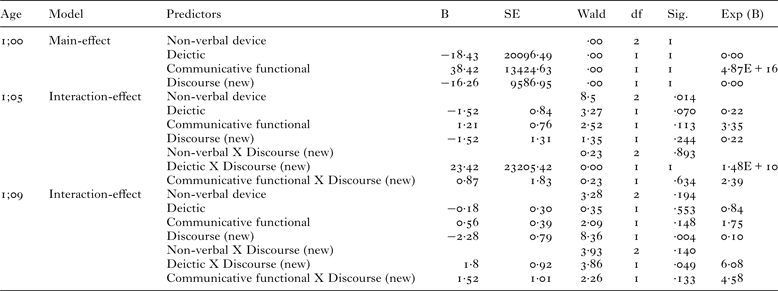
As Table 3 shows, the results of these logistic regression analyses indicate that, at the age of 1;00, neither type of non-verbal device nor discourse status of referents is significantly associated with the children's choices of referential forms. At age 1;05, only type of non-verbal device was significantly associated with the children's choices of referential forms (p = ·01). However, when deictic gestures and communicative functional acts were considered separately, this effect became insignificant. At age 1;09, we found a significant interaction between type of non-verbal device and the discourse status of referents, showing that the children are approximately six times more likely to use non-lexical forms for new referents when they use a deictic gesture to accompany their referential speech (eB = 6·08, p = ·05).
Binary logistic regressions for the relative effect of non-verbal devices and discourse status on the children's referential forms

For the caregivers, at age 1;00, the main-effect model with the two predictor variables (i.e., type of non-verbal device and discourse status of referents) is significantly more reliable than the null model (χ 2(3) = 89·55, p < ·001), explaining 29% of the variance in the caregivers’ referential forms (Nagelkerke R2 = ·29). Overall, the model successfully predicted 70·2% of referential forms, at a higher rate than the null model's classification success of 54·5%. At age 1;05, the main-effect model with two predictor variables (i.e., type of non-verbal device and discourse status of referents) fits the data significantly better than the null model (χ 2(3) = 80·22, p < ·001), and explains 20% of variance in the caregivers’ referential forms (Nagelkerke R2 = ·20). Overall, the model correctly classifies 70·8% of referential forms, whereas the null model correctly classifies 62·3% of these forms. At age 1;09, the main-effect model with two predictor variables (i.e., type of non-verbal device and discourse status of referents) was significantly more reliable than the null model (χ 2(3) = 56·17, p < ·001). The model explains almost 10% of the variance in the caregivers’ referential forms (Nagelkerke R2 = ·097). Overall, the model correctly classifies 61·9% of the caregivers’ referential forms, whereas the null model correctly predicts 54% of them.
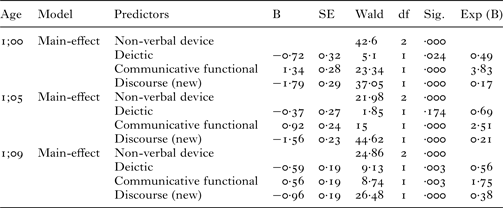
As Table 4 shows, we report that both types of non-verbal devices and the discourse status of referents are significantly associated with the caregivers’ choices of referential forms at all age-points. At age 1;00, the caregivers are more likely to use non-lexical forms if they use a communicative functional act to accompany their referential speech (p < ·001). That is, a referent is approximately four times more likely to be expressed by a non-lexical form in the presence of a communicative functional act rather than in the absence of any type of non-verbal device (eB = 3·833, p < ·001). However, the caregivers are less likely to use non-lexical forms if they use a deictic gesture accompanying their referential speech (p < ·05), or when the speech is about a new entity (p < ·001). Use of a deictic gesture decreased the odds of the caregivers’ use of non-lexical forms by 61% (eB = 0·49, p < ·05), and talking about a new referent decreased the odds of their use of non-lexical forms by 83% (eB = 0·17, p < ·001). At age 1;05, the caregivers’ likelihood of using non-lexical forms is significantly higher when they use a communicative functional act to accompany their speech, that is, the odds of using non-lexical forms is 2·5 times higher in the presence of a communicative functional act (eB = 2·51, p < ·001). However, the caregivers’ likelihood of using non-lexical forms is lower when they talk about a new referent (p < ·001). Talking about a new referent decreases the caregiver's probability of using non-lexical forms by 79% (eB = 0·21, p < ·001). At age 1;09, the caregivers’ likelihood of using a non-lexical form increases to almost twice when they use a communicative functional act to accompanyi their speech (eB = 1·75, p < ·01). However, using a deictic gesture (eB = 0·56, p < ·01) or talking about a new referent (eB = 0·38, p < ·001) lowers the caregivers’ probability of using non-lexical forms by 44% and 62%, respectively. As Table 4 shows, at each time-point, the Wald statistics showed that the discourse status of referents had a more important role than either the use of communicative functional acts or deictic gestures on the caregivers’ choices of referential forms.
Binary logistic regressions for the relative effect of non-verbal devices and discourse status on the caregivers’ referential forms

Effects of gender and socioeconomic background on choices of referential forms
We also examined whether the patterns in the children's choices of referential devices change depending on their gender (i.e., female vs. male) and socioeconomic (SES) background (i.e., low vs. high). We conducted a logistic regression analysis only at age 1;09 since we did not have sufficient datapoints to compare different genders or SES groups at the earlier time-points (1;00 and 1;05). Clearly with a total of four children, gender and SES cannot be treated as factors on their own. When we include gender and SES into the logistic regression, where we take children's choices of referential forms (lexical vs. non-lexical form) as the outcome, and gender, SES, type of non-verbal device, and discourse status as the predictors, there exists a significant interaction between gender and SES, showing that especially female (in comparison to male) children with higher (rather than lower) socioeconomic backgrounds are approximately thirteen times more likely to use non-lexical forms than lexical forms (eB = 12·72, p < ·001).
DISCUSSION
Children learn to develop their referential skills and language knowledge during interactions with their caregivers in everyday contexts. The earliest period of referential communication includes a lot of vocalizations and non-verbal actions, and relatively fewer verbal productions about external entities (Ateş-Şen & Küntay, Reference Ateş-Şen, Küntay, Serratrice and Shanley2015; Stephens & Matthews, Reference Stephens, Matthews and Matthews2014). To examine this relatively less studied early period regarding referential communication, we longitudinally examined semi-naturalistic interactions of four Turkish-speaking children with their caregivers at three different time-points before age two (i.e., ages 1;00, 1;05, and 1;09). The main aim of the present study was to investigate how young children use different types of non-verbal devices (i.e., deictic gestures and communicative functional acts) in a coordinated way with discourse status information (i.e., previously mentioned vs. new referents) to determine their referential forms about physically available entities. One potential source for children to learn about discourse-pragmatic principles of referential communication is through caregiver input. So, as a secondary aim, we examined whether children's patterns of use of verbal and non-verbal devices have similarities with those in the caregiver input.
The results show that, at very young ages such as 1;00 and 1;05, the children's referential interactions with their caregivers most frequently included non-verbal and vocal channels of communication. By age 1;09, children started using the verbal channel of communication. These findings are consistent with previous research indicating that non-verbal content at early ages (as early as age 0;10) forms the foundations of children's verbal referential skills (Capirci et al., Reference Capirci, Contaldo, Caselli and Volterra2005; Carpenter et al., Reference Carpenter, Nagell and Tomasello1998; Iverson & Goldin-Meadow, Reference Iverson and Goldin-Meadow2005; Liszkowski et al., Reference Liszkowski, Brown, Callaghan, Takada and De Vos2012; Özçalışkan & Goldin-Meadow, Reference Özçalışkan and Goldin-Meadow2005; Salomo & Liszkowski, Reference Salomo and Liszkowski2013). At each age-point of their children, the caregivers mostly used verbal along with non-verbal and vocal means of communication. As the children grew up, parallel with the pattern children followed, caregivers increasingly used verbal referential acts, while their use of the non-verbal and vocal ones decreased. Still, most referential expressions were verbal throughout.
The question then is how non-verbal devices are involved in introducing new referents into conversational discourse. Our findings show that children tend to use non-lexical forms for new referents only at the age of 1;09, and only when deictic gestures accompanied these forms. 91% of the children's non-lexical forms referring to new referents are accompanied by a non-verbal device at this age, and most of these non-verbal devices were deictic gestures in nature. The use of non-lexical forms for new referents is also well documented in previous research (e.g., Guerriero et al., Reference Guerriero, Oshima-Takane and Kuriyama2006; Skarabela & Allen, Reference Skarabela, Allen, Franich, Iserman and Lauren2010; Skarabela, Allen, & Scott-Philips, Reference Skarabela, Allen and Scott-Philips2013). The still unanswered key question is why young children tend to choose inadequately informative referential forms (i.e., using non-lexical forms referring to new referents). Existing studies, mostly on the verbal referential devices of children older than age two, offer explanations either by referring to common patterns in the adult input (Guerriero et al., Reference Guerriero, Oshima-Takane and Kuriyama2006) or by acknowledging children's limited understanding of discourse-pragmatic rules (Grinstead, Reference Grinstead2004). Our findings do not lend support for the former explanation, since the caregivers in our corpus do not show much of a tendency to use non-lexical forms while talking about new referents. That is, non-verbal devices including deictic gestures and communicative functional acts play a less important role than the discourse status of referents in determining caregivers’ choices of referential forms. Caregivers tend to use full lexical forms for new referents.
Our findings are not fully in line with the latter explanation, either. The children's tendency to use non-lexical forms for new referents increases only in cases where deictic gestures accompany speech. That is, non-verbal means of communication are effectively used to support otherwise ambiguous linguistic forms to introduce referents into speech. Young children's inappropriate argument omissions for new referents might have resulted from their limited linguistic knowledge rather than their limited understanding of discourse-pragmatic principles (Guerriero et al., Reference Guerriero, Oshima-Takane and Kuriyama2006; Gürcanlı et al., Reference Gürcanlı, Nakipoğlu, Özyürek, Caunt-Nulton, Kulatilake and Woo2007). The developmental nature of our data allowed us to track increasing sophistication in linguistic expression. At age 1;05 (in contrast to the earlier time-point of age 1;00), the children began to build sentences with some inflections (e.g., Ø gel-di [came] ‘my mother came’), but did not yet include noun and verb combinations in fuller argument constructions. Only at the age of 1;09 were relatively more complex argument structures attested, as in park-a git-ti-k [playground went] ‘we went to the playground’, or sabah gel-ecek [morning come] ‘the turtle will come in the morning’, which include nouns and verbs. These patterns suggest that children are aware of the discourse status of referents while choosing referential forms beginning at age 1;05; however, they do not possess the linguistic knowledge to display this knowledge in their referential speech until the age of 1;09. These results support previous research with older children, who use gestures to complement the content in their speech that cannot be fully expressed through verbal means (Demir & So, Reference Demir, So, Brugos, Clark-Cotton and Ha2006; Goldin-Meadow & Butcher, Reference Goldin-Meadow, Butcher and Kita2003; Iverson & Goldin-Meadow, Reference Iverson and Goldin-Meadow2005; Özçalışkan & Goldin-Meadow, Reference Özçalışkan and Goldin-Meadow2005; So et al., Reference So, Demir and Goldin-Meadow2010). There are also recent studies showing that, beginning at two years of age, children use more gestures for new rather than previously mentioned referents (Demir et al., Reference Demir, So, Özyürek and Goldin-Meadow2012; Guerriero et al., Reference Guerriero, Oshima-Takane and Kuriyama2006; So et al., Reference So, Demir and Goldin-Meadow2010; So & Lim, Reference So and Lim2012; So et al., Reference So, Lim and Tan2014). This tendency increases when children use a non-lexical rather than a lexical form to address these new referents (So et al., Reference So, Demir and Goldin-Meadow2010). Our study extends this line of research by showing that children start integrating non-verbal devices (especially deictic gestures) into their referential speech before age two.
It is possible that children learn such supplementary use of non-verbal devices from the caregiver input. To examine whether the caregivers use non-verbal devices as supplements to their referential speech, we investigated the cases where the caregivers used inadequate informative forms. 13%, 12%, and 14% of the caregivers’ non-lexical forms referred to new referents at the ages of 1;00, 1;05, and 1;09, respectively. Like the children, the caregivers used non-lexical forms for new referents mostly in the presence of non-verbal devices accompanying their speech. That is, 72%, 45%, and 51% of the caregivers’ non-lexical forms referring to new referents, at the ages of 1;00; 1;05, and 1;09, respectively, occurred in the presence of accompanying non-verbal behavior. However, unlike the children, the caregivers mostly used communicative functional acts in these situations. When we closely looked at the dataset, most of these cases occurred when the children and the caregivers interacted about an object, usually during playing with toys. For example, one caregiver picked up a new toy from the floor and demonstrated how the toy worked by saying buraya bas ‘press here [a button on the toy]’. In such interactions, the caregivers mostly focused on the activity itself by using communicative functional acts that depicted the actions expressed via verbs in their speech. In such expressions, the caregivers tended to drop nouns, and use non-lexical forms in their utterances. This is consistent with previous research showing that interactive contexts such as toy-play increased caregivers’ focus on verbs in their speech to their one- to two-year-old children (Choi, Reference Choi2000; Ogura, Dale, Yamashita, Murase, & Mahieu, Reference Ogura, Dale, Yamashita, Murase and Mahieu2006). There were also some cases where the caregivers used deictic gestures accompanying nouns. These cases mostly represented the caregivers’ active attempts to teach new words or direct children's attention to an entity, and mostly occurred during shared book-reading time. Caregivers use different types of non-verbal devices to accompany their referential forms in accordance with their changing communicative intent in different interactive situations.
Taken together, these results contribute to previous research (e.g., Campbell et al., Reference Campbell, Brooks and Tomasello2000; Huang, Reference Huang2011; Matthews et al., Reference Matthews, Lieven, Theakston and Tomasello2006; Rozendaal & Baker, Reference Rozendaal and Baker2008; Salomo et al., Reference Salomo, Graf and Lieven2011; Salomo et al., Reference Salomo, Lieven and Tomasello2010) by showing that, when we examined non-verbal behaviors accompanying referential speech, children's sensitivity to the discourse status of referents is apparent before age two, earlier than the time reported in previous studies. Our results are also in line with a limited number of studies examining how Turkish-speaking children use non-verbal devices to accompany their verbal interactions. Demir and colleagues (2012) found that four- to five-year old Turkish-speaking children tend to accompany their non-lexical forms (i.e., pronouns and null forms) with gestures. We extended Demir et al.’s findings by showing the same tendency for younger children. We also supported recent research pointing out that Turkish-speaking children use iconic gestures supplementing their verb-only utterances at earlier ages (between ages 1;02 and 2;03) (Furman et al., Reference Furman, Küntay and Özyürek2014) than English-speaking children (Göksun et al., Reference Göksun, Hirsh-Pasek and Golinkoff2010; Özçalışkan & Goldin-Meadow, Reference Özçalışkan and Goldin-Meadow2005, Reference Özçalışkan and Goldin-Meadow2009). Our results contribute to a limited number of studies (e.g., Guerriero et al., Reference Guerriero, Oshima-Takane and Kuriyama2006; So & Lim, Reference So and Lim2012) investigating whether children and caregivers speaking pro-drop languages use non-verbal devices sensitively to discourse-pragmatic rules. Our findings lend support to the findings of So and Lim (Reference So and Lim2012), rather than Guerriero and colleagues (Reference Guerriero, Oshima-Takane and Kuriyama2006), showing that caregivers (as well as children) speaking pro-drop languages employ non-verbal devices sensitively in relation to discourse status of referents.
There are multiple ways in making a new referent cognitively accessible to a listener (Skarabela, Reference Skarabela2007; Skarabela & Allen, Reference Skarabela, Allen, Franich, Iserman and Lauren2010; Skarabele et al., Reference Skarabela, Allen and Scott-Philips2013). By age 1;09, when they gain more mastery in their spoken language, children verbally show sensitivity to the discourse status of referents, indicating new referents through lexical means. Non-verbal devices, especially deictic gestures, on the other hand, are used by children to complement their limited linguistic knowledge from earlier ages. In fact, these devices are integrated into verbal referential interactions as early as the first year of life. Our study adds to a growing body of literature showing that before children develop referential skills of a linguistic nature, children and caregivers cooperate in their conversations by employing non-verbal pragmatic devices to make referents accessible to one another and to buttress their referential interactions.
Despite the reported contributions of the present study, we urge some caution in interpreting our results. First, our sample size was restricted to four children and our data were not normally distributed. To deal with the non-normally distributed data, we used chi-square tests and logistic regression analyses without requiring the assumptions of normality of errors and homogeneity of variance. However, we still have some problems, since our observations (i.e., choice of referential forms) are nested within the same units (i.e., child and time). One suggested method of handling such clustered or grouped data is using multilevel models that allow the examination of residual components at each level in the hierarchy by separating fixed effects of primary interest from random effects of group variables. However, multilevel modeling is not appropriate for this dataset since it requires quite a large sample size (at least 30) at both individual (i.e., referential forms) and group (i.e., child or time) level. Not including time as a predictor in our models (i.e., conducting logistic regressions separately at each time-point) prevents the dependency created by the longitudinal structure of the data. However, this limits us in interpreting time-related differences in children's and caregivers’ referential behaviors. Second, in both the child and the caregiver data, the predictive power of null models is already high (between 58·8% and 72·5% in the child, and between 54% and 62·3% in the caregiver data). A similar situation is also encountered in other pro-drop languages such as Inuktitut, and has been explained by the already common and default use of argument omission in these languages (Allen, Reference Allen2000).
The present study also suggests new directions for future research. Rohde and Frank (Reference Rohde and Frank2014) recently showed that caregivers’ choice of referential forms and non-verbal devices (e.g., hand and eye position) accompanying these forms change depending on the position of referents within an extended discourse (discourse position) and within a sentence (sentential position). Future studies can examine children's use of verbal and non-verbal devices depending on the discourse or sentential position of referents. Moreover, extended referential interactions include a lot of communicative breakdowns and repairs (Ateş-Şen & Küntay, Reference Ateş-Şen, Küntay, Serratrice and Shanley2015). We need a higher number of child–caregiver dyads to examine how different children develop to appropriately use verbal and non-verbal devices via communicatively transparent (and not so transparent) referential interactions.