Introduction
Based on existing knowledge, carbon dioxide, methane (CH4) and nitrous oxide (N2O) are the three main types of radiation-active greenhouse gases (GHGs) (Ren et al., Reference Ren, Zhang, Liu, Sun, Wu, Li and Xu2017; Shakoor et al., Reference Shakoor, Shakoor, Rehman, Ashraf, Abdullah, Shahzad, Farooq, Ashraf, Manzoor, Altaf and Altaf2021). Livestock, especially ruminants, are an important source of GHG emissions generated from both the enteric environment and excreta (Johnson and Johnson, Reference Johnson and Johnson1995; Patra, Reference Patra2012; Liu et al., Reference Liu, Guo, Chen, Meng, Zhu and Huang2018). In ruminant production systems, manure is the second largest factor in GHG emissions after gastrointestinal emissions. Outdoor manure storage is among the most critical aspects of global manure management prior to application in farms or the production of organic fertilizers. Most GHG emissions from manure are in the form of CH4 emissions during storage (Amon et al., Reference Amon, Kryvoruchko, Amon and Zechmeister-Boltenstern2006; Hristov et al., Reference Hristov, Oh, Firkins, Dijkstra, Kebreab, Waghorn, Makkar, Adesogan, Yang and Lee2013; Holly et al., Reference Holly, Larson, Powell, Ruark and Aguirre-Villegas2017; Im et al., Reference Im, Petersen, Lee and Kim2020). Many factors, including chemical composition, temperature and manure management practices, affect CH4 emissions during cattle manure storage (Chadwick, Reference Chadwick2005; Amon et al., Reference Amon, Kryvoruchko, Amon and Zechmeister-Boltenstern2006; Kreuzer and Hindrichsen, Reference Kreuzer and Hindrichsen2006; Ngwabie et al., Reference Ngwabie, Jeppsson, Gustafsson and Nimmermark2011; Mathot et al., Reference Mathot, Decruyenaere, Stilmant and Lambert2012; Popovic and Jensen, Reference Popovic and Jensen2012; Barret et al., Reference Barret, Gagnon, Topp, Masse, Massé and Talbot2013).
Furthermore, the impact of manure management on CH4 emissions is critical. To reduce the emissions of CH4, it is recommended that a strong acid (such as H2SO4) be added to liquid manure or slurry or the storage temperature lowered for solid manure (Im et al., Reference Im, Petersen, Lee and Kim2020). Also, reducing CH4 emissions of solid-type manure may involve mixing cattle manure with bedding materials. Researchers have explored the addition of sawdust, straw and phosphogypsum to manure or covering with expanded clay, pebbles and recycled polyethylene on solid manure heaps, but the results have been inconsistent (Hao et al., Reference Hao, Larney, Chang, Travis, Nichol and Bremer2005; Yamulki, Reference Yamulki2006; Vanderzaag et al., Reference Vanderzaag, Gordon, Jamieson, Burton and Stratton2009; Eunjong et al., Reference Eunjong, Seunghun, Hyeonsoo, Jihyeon, Walter, Shafiqur and Heekwon2018). Although determining the impact of all potential additives and materials may seem challenging, CH4 emissions from manure depend primarily on storage conditions, physicochemical properties of the manure, microbial communities and other complex factors (Mezzari et al., Reference Da Silva, Cantão, Mezzari and Ma2015).
In China, cattle manure is stored in the solid state, with natural accumulation over time. Plastic sheets are commonly used to cover manure during short-term storage to prevent run off when it rains or snows. The effect of the plastic sheets to cover manure on short-term CH4 emissions and the chemical properties of the manure is unclear. Therefore, the current study compared the manure CH4 emission rate and the changes in the physical and chemical properties of manure that was or was not covered by plastic film during four seasons in a warm temperate, continental climate.
Materials and methods
Experimental design and CH4 collection
All the experiments were conducted at Henan Dingyuan Cattle Breeding Company Limited, located in Zhengzhou city in Henan province (34°75′N 113°65′E), P.R. China. The farm contained 2000 Simmental beef cattle (18–19 months old, about 550 kg weight). The diet for the cattle (n = 500) on the farm comprised: concentrate (loose mix, 40.21%), alfalfa (hay, 31.32%) and Leymus chinensis (Chinese ryegrass) (hay, 28.47%). The concentrate contained corn (37%), wheat bran (25%), soybean meal (31%), NaHCO3 (1.5%), Ca(HCO3)2 (1.5%), salt (1%) and a vitamin and mineral premix (1%); premix contain per kg of dry matter (DM): Fe (2500 mg), Cu (600 mg), Mn (2000 mg), Zn (1667 mg), vitamin A (500 000 IU), vitamin D (50 000 IU), vitamin E (2500 IU) and vitamin H (500 IU).
Measurements were made in four separate 30-day periods as follows: winter (31 December to 29 January), spring (13 April to 12 May), summer (27 June to 26 July) and autumn (7 September to 6 October) at the farm. On the first day of each period, ~1200 kg of untreated fresh solid manure sample was obtained from the cattle by the dry and wet separators. The manure sample was subsequently mixed, homogenized and divided into six identical fresh replicate piles (the length, width and height of each pile were 200, 100 and 20 cm, respectively). Measurement data were obtained from two sites from each pile, with averages of these taken to reflect representative results for the pile. Two different treatments were included in the current experiment: (1) uncovered storage (treatment UNCOVERED) and (2) storage of the pile covered with a plastic sheet (polyethylene membrane, translucent, thickness: 0.1 mm) (treatment COVERED). Each treatment was replicated three times in each season, with six sampling sites. All piles were covered by a canopy to prevent interference from rain or snow during the experiment.
Air temperature (ambient temperature) and temperature of the centre point of the manure (at a depth of 10 cm below the surface of the manure) were continuously taken at a 5 min time-frequency continuously by using an automatic temperature recorder (L91-1, Hangzhou Logger Technology Company Limited, Zhejiang, China). The static chamber gas chromatography (GC) method was adopted to analyse CH4 emissions from the stored beef cattle manure. The static chamber consisted of two components (a cylindrical base of inner diameter and height of 60 and 50 cm, respectively), both made of 304 stainless steel (ZL. 2013 2 0289396.7). At one end of the base was a water seal tank, the other end was inserted into the manure to about 20 cm. The chamber was vented by inserting a pipe (inner diameter 1.59 mm, length 174 mm) on the flank to reduce the risk of pressure build-up in the headspace. To allow for air circulation in the chamber, two 3 V electric fans (4 cm [length] × 4 cm [width] × 1 cm [height]) and a storage battery (6.9 cm [length] × 4.6 cm [width] × 9.9 cm [height]) were placed vertically in the lid. Temperature measurement was taken using an automatic temperature recorder (8.7 cm [length] × 1.8 cm [width] × 5.3 cm [height]) inserted during gas sample collection. The headspace volume of the closed chambers used for determining CH4 emission rates was 140.87 L and area (A) was 0.2826 m2. A hole measuring 1.59 mm diameter was drilled on the flank at a distance of 25 cm from the top of the lid to allow insertion of a pipe (about 30 cm) equipped with a one-switch valve at the outer end for sampling. Cylindrical bases were inserted into the manure piles of the plastic sheet covering treatment, and the water seal tanks were exposed to the atmosphere. The lids of the chamber were put on the water seal tanks to sample the gas samples above the plastic sheet. The gas was sampled between 9:00 am and 10:00 am local time. CH4 was analysed on the same day using GC according to the following procedure: (1) the lid was closed; (2) gas samples were drawn from each treatment at 0, 10, 20 and 30 min intervals using a 50 ml glass syringe through the connected switch valve; and (3) the gas sample was transferred to 100 ml aluminium foil bags for storage before the GC analysis.
Chemical composition analysis of manure
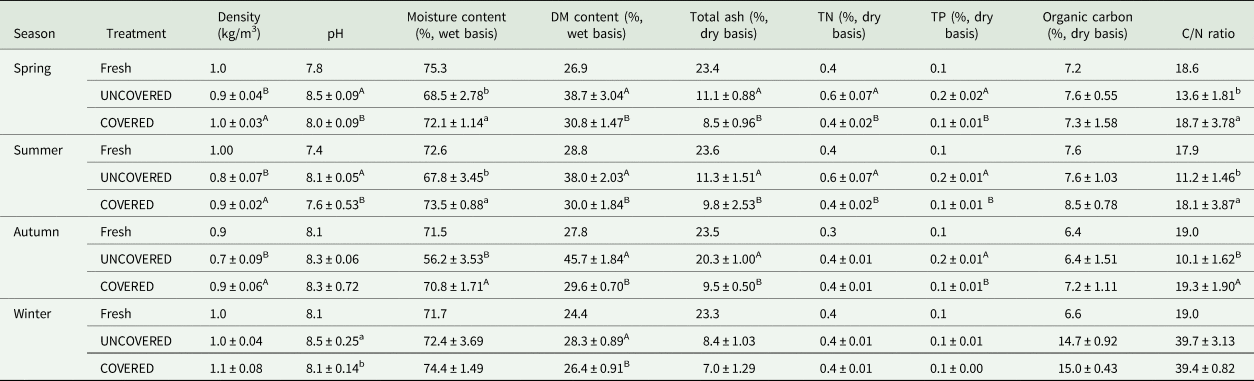
A manure sample of ~150 g was collected from untreated fresh solid manure with a Ziplock bag at the start of the experiment to analyse manure density, pH, moisture content, DM content, ash, total nitrogen (TN), total phosphorus (TP) and total organic carbon (TOC) using the following conventional analytical techniques. Manure density was determined through the cutting ring method (Lu et al., Reference Lu, Li, Wan, Liu and Jin2007). Moisture content was evaluated via the vacuum drying method (AOAC 1990). The pH meter, pHb-4 (Shanghai INESA Scientific Instrument Co., Ltd, China), was used. To analyse the DM, we heated samples in an electric oven at 105°C for 24 h. Ash was analysed by heating samples in a muffle furnace at 550°C for 4 h. TN and TP concentrations were analysed using the sulphate–hydrogen peroxide heating digestion method and vanadium ammonium molybdate spectrophotometry, respectively (AOAC 1990). The thermal potassium dichromate oxidation-capacity method was used for TOC. The characteristics of the fresh manure at the start of the experiment are summarized in Table 1.
Characteristics of solid manure used for the experiment (mean and standard deviation)

In the UNCOVERED treatment, the manure was not covered with a plastic sheet; in the COVERED treatment, it was covered with a plastic sheet. Within a season, the COVERED treatment compared with the UNCOVERED treatment, the capital letters in the same column denote obvious significant differences at P < 0.01, lower-case letters in the same column denote significant differences at P < 0.05.
CH4 analysis
CH4 concentration was measured by GC (GC-112A, Shanghai Suny Hengping Scientific Instrument Company, China), equipped with a flame ionization detector. This used a TP-porapak Q capillary column (15 m × 0.32 mm × 5 μm) with an operating temperature of 55 °C. Injector and detector temperatures were 150 and 200 °C, respectively. Nitrogen (99.999%) was the carrier gas, whereas the purging gas was high purity nitrogen (10 ml/min). The purging duration was 45 s, with 1 min as the total injection time. Manually injected 0.3 ml of gas sample each time and took measurements for two parallel injections. A CH4 calibration standard gas (14.36 mg/m3) was applied to calibrate the instrument at the beginning and end of the sample measurement. Based on the chromatogram's peak area, the percentage content of CH4 in the air sample was calculated via the standard external method. The CH4 emission rates from the manure were calculated using the equation of Sommer and Møller (Reference Sg and Møller2000):

where F (mg/m2/d) denotes the emission rate of CH4; ρ0 (0.717 kg/m3) is the CH4 density under standard conditions; V (m3) denotes the volume of the headspace in the bucket; dc/dt denotes the CH4 concentration variance in the bucket; T (°C) denotes the average gas temperature in the bucket during gas sampling; P represents the atmospheric pressure during gas sampling; and A (m2) represents the area of the beef cattle manure in each bucket.
Statistical analysis
Temperature data and CH4 emission rates for each heap were analysed by SPSS 19.0, results being presented as mean and standard deviation. Differences in temperature and CH4 emissions over the four seasons were compared using the one-way analysis of variance in SPSS 19.0. Effects of covering the heap on CH4 emission rate were evaluated using the t-test of SPSS 19.0. Using SPSS 19.0 (Pearson), we analysed the correlation between ambient temperature and manure centre point temperature, as well as temperature and CH4 emission rate.
Results
Environmental conditions in different seasons
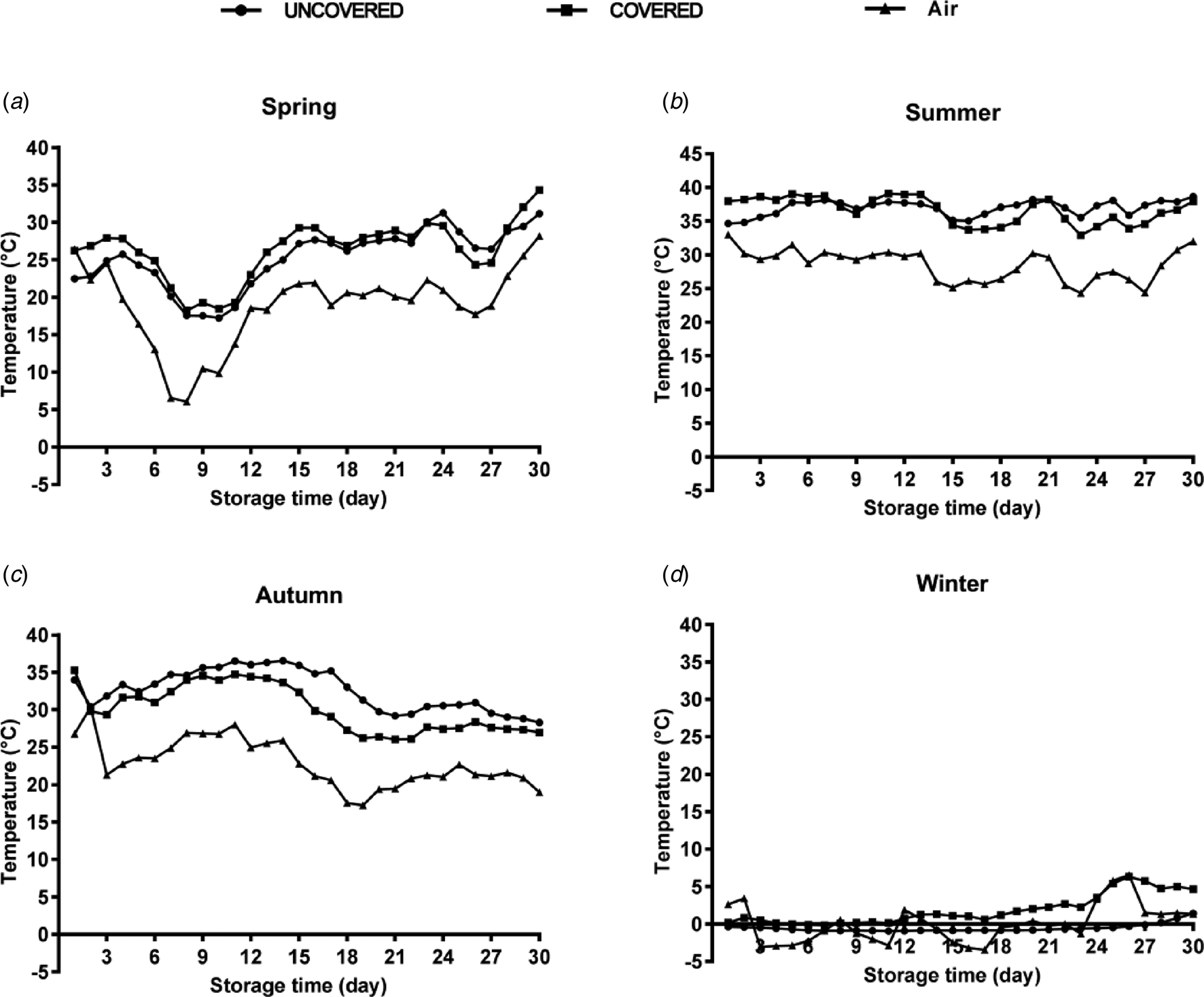
The air temperature (T air) and the temperature inside heaps (T inside) in different seasons are shown in Fig. 1. The central point temperature of manure in the UNCOVERED treatment and the COVERED treatment in spring, summer and autumn was higher than the air temperature, but the changing trend remained constant. In winter, the manure central portion temperature of the COVERED treatment was higher than that of the UNCOVERED treatment and the air temperature; notably, the change range was relatively stable.
Air temperature (T air) and temperature inside heaps (T inside) during the sampling period, taken continuously at 5-min intervals using an automatic temperature recorder. Lines connect the daily average values.

Changes of physicochemical characteristics of the solid manure
The physicochemical characteristics of manure before and after stacking in the four seasons are shown in Table 1. Compared to fresh faeces, after 30 days of open-air stacking, the pH of the manure in spring, summer, autumn and winter increased by 8.56, 9.73, 2.59 and 5.22%, respectively; whereas the density reduced in all seasons. Additionally, after stacking, DM mass fraction of manure in spring, summer, autumn and winter increased by 44.0, 32.1, 64.3 and 15.6%, respectively; the TN mass fraction increased by 46.2, 48.8, 88.2 and 5.71%, respectively; the TP increased by 54.6, 50, 100 and 22.2%, respectively; and the TOC increased by 5.86, 0.39, 0.16, and 123.6%, respectively.
The physical and chemical properties of the manure changed after 30 days of storage in the UNCOVERED and COVERED treatments. In spring and summer, the pH, DM content and TN of the COVERED treatment were significantly lower than that of the UNCOVERED treatment (P < 0.01). In contrast, the density was significantly higher than that of the UNCOVERED treatment (P < 0.01). In autumn, the density of manure in the COVERED treatment was extremely significantly higher than that in the UNCOVERED treatment (P < 0.01), while the DM content and TN were extremely significantly lower than those in the COVERED treatment (P < 0.01). In winter, the pH and DM mass fractions of the manure in the COVERED treatment were significantly (P < 0.05) and extremely significantly (P < 0.01) lower than those in the UNCOVERED treatment.
Effect of CH4 emission on manure covering plastic in different seasons
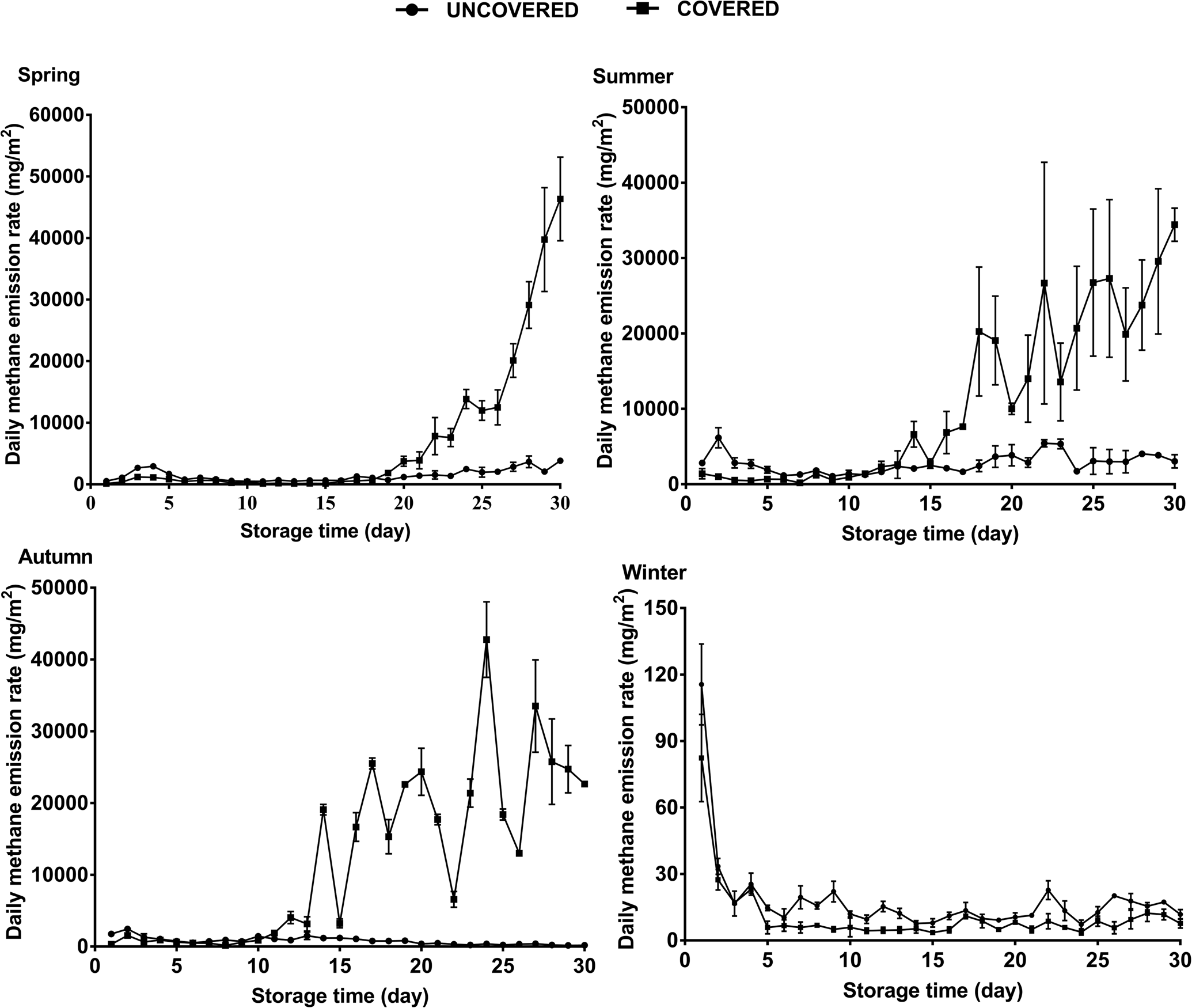
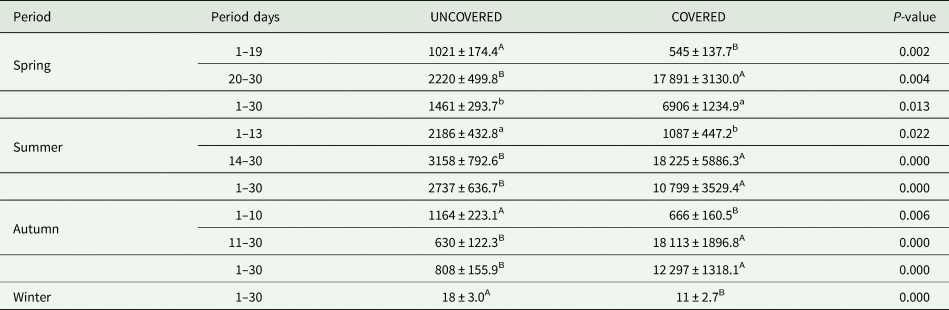
The effects of the plastic sheet covering on the daily average emission rate of CH4 from manure in different seasons are shown in Fig. 2 and Table 2. From Fig. 2, at the first 19 days of spring, 13 days of summer, 10 days of autumn and the entire winter, the daily average emission of CH4 in the COVERED treatment was lower than in the UNCOVERED treatment. From Table 2, the daily average emissions of CH4 in the UNCOVERED treatment were significantly different (P < 0.01) from the COVERED treatment, and in the four seasons, the CH4 emissions were summer > spring > autumn > winter.
The CH4 emission rates of beef cattle manure in spring, summer, autumn and winter.

Average daily CH4 emission rate in the first and second part of the 30 days of each period in the four seasons (mean and standard deviation, mg⋅m− ⋅d− )

Relationship between CH4 emission rate and temperature
The correlation analysis of ambient temperature and manure centre point temperature and CH4 emission rate are presented in Table 3. The ambient temperature was significantly positively correlated with the manure centre point temperature (R 2 > 0.95, P < 0.01). Besides, the ambient temperature was significantly positively correlated with the CH4 emission rate (R 2 > 0.50, P < 0.01). The manure centre point temperature exhibited a significant positive correlation with the CH4 emission rate (R 2 > 0.50, P < 0.01).
Correlation analysis of ambient temperature and central point temperature of manure and CH4 emission (two-sided)

T air is the air temperature, T inside is the central point temperature of manure and ‘**’ means P < 0.01.
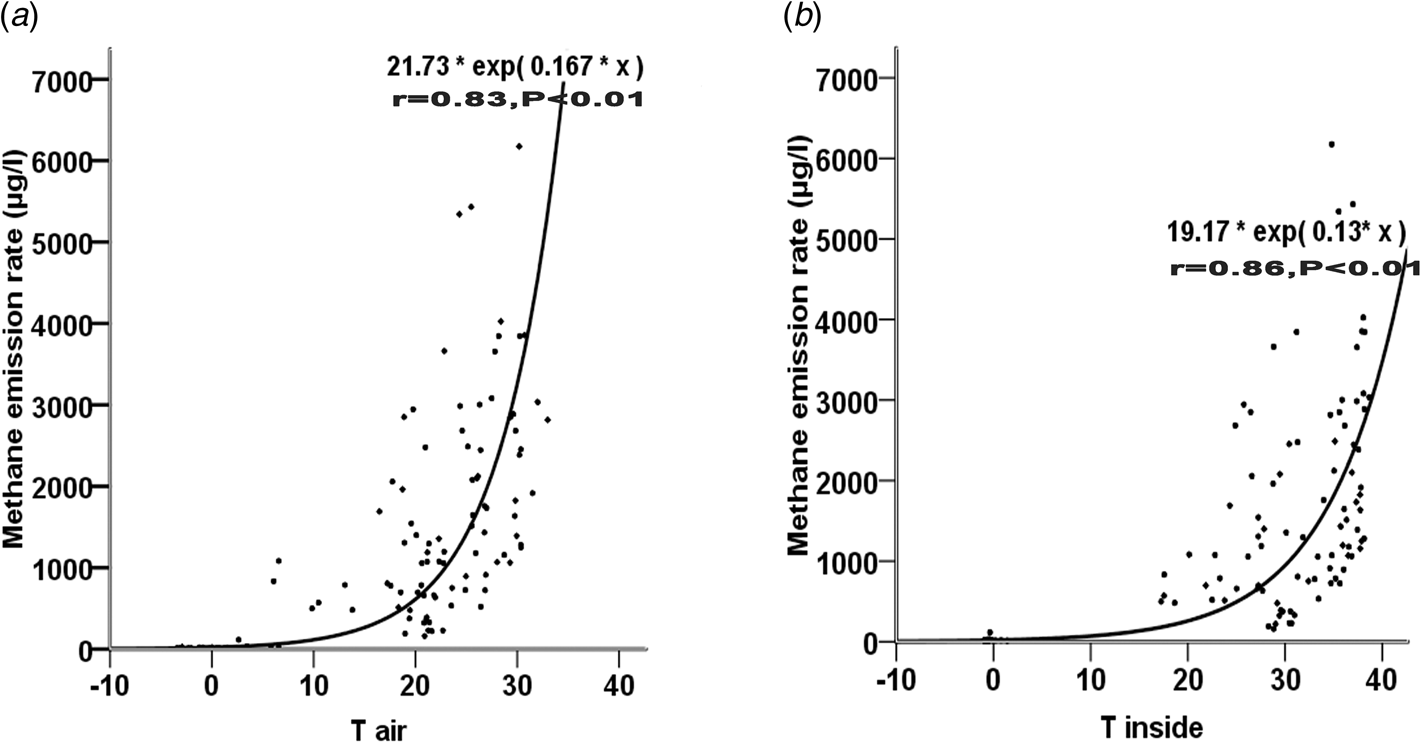
The nonlinear regression analysis of the CH4 emission rate and temperature found that there was an exponential correlation between the daily CH4 emission rate, the ambient temperature and the centre point temperature of manure (Fig. 3). The equations were as follows:


where y is the daily manure CH4 emission rate (mg/m2), x 1 is the ambient temperature (°C) and x 2 is the centre point temperature of manure.
Relationship between CH4 emission rate and air temperature (T air, a), and with temperature inside heaps (T inside, b). In the current experiment, the T air range was −3.43 to 32.99, and the T inside range was −0.93 to 38.65.

Discussion
CH4 production, as a complex biochemical process, is dependent on the interaction of environmental factors, the physical and chemical properties of manure and characteristics of microbial communities (Petersen, Reference Petersen2018). CH4 was produced through anaerobic fermentation of organic substrates in animal manure, whereas temperature influenced the growth of methanogenic bacteria contributing to CH4 formation (Gupta et al., Reference Gupta, Jha, Koul, Sharma, Pradhan, Gupta, Sharma and Singh2007). In the previous experiment, González-Avalos and Ruiz-Suárez (Reference González-Avalos and Ruiz-Suárez2001) simulated fermentation of beef cattle manure for cool, temperate, and warm climates in the laboratory, they found higher CH4 emissions at higher temperatures. Im et al. (Reference Im, Petersen, Lee and Kim2020) found the highest CH4 emission at 35 °C, when at ≤20 °C, the CH4 emission was reduced to less than half. In general, CH4 production was low at temperatures below 15 °C; however, above 15 °C, the emission of CH4 levels increased exponentially (Wagner-Riddle et al., Reference Wagner-Riddle, Park and Thurtell2006; Sommer et al., Reference Sommer, Petersen, Sorensen, Poulsen and Moller2007). Similar results were found in the current experiment, the CH4 emission rate has an exponential correlation with the ambient temperature and the temperature of the manure centre.
In the process of manure storage, part of the material will be lost due to the fermentation of microorganisms, and part of the material and water will be lost through evaporation and infiltration. In the four seasons, after 30 days of manure stacking, hard crusts were formed on the surface of the NS group, but no hard crusts were formed on the surface of the COVERED treatment; the DM content of the manure in the UNCOVERED treatment was significantly higher than in the COVERED treatment. That showed the plastic covering can reduce the evaporation of moisture during manure stacking. A wealth of studies have demonstrated that the moisture level is positively associated with CH4 emission (Fathi Aghdam et al., Reference Fathi Aghdam, Scheutz and Kjeldsen2017; Liu et al., Reference Liu, Guo, Chen, Meng, Zhu and Huang2018; Shakoor et al., Reference Shakoor, Shakoor, Rehman, Ashraf, Abdullah, Shahzad, Farooq, Ashraf, Manzoor, Altaf and Altaf2021). Husted (Reference Husted1994) found that the CH4 emission factor could be reduced by 11–12 due to the hard shell formed during natural stacking; however, in the absence of a hard shell, the emission of CH4 significantly increased. Compared to summer, in winter the hard shell formed by faeces was moist and compact, resulting in a more significant effect in reducing CH4 (Husted, Reference Husted1994). It is inferred that the CH4 emission of the COVERED treatment is higher than that of the UNCOVERED treatment. The inferred result was also consistent with the actual test result, the 30-day daily average CH4 emission rate of manure in the COVERED treatment was significantly higher than the UNCOVERED treatment. In addition, under high temperature, the higher C/N ratio of the COVERED treatment may be due to the decomposition rate of manure in the COVERED treatment was higher than the UNCOVERED treatment, resulting in a reducing environment that is more conducive to the methanogenic. In an anaerobic environment, abundant organic matter would lead to low CH4 absorption, which can also explain why CH4 emissions increase significantly in the late spring, summer and autumn.
However, why does plastic film covering the manure reduce the CH4 emission rate in winter? Notably, the soil condition to minimize CH4 emissions was required to promote methanotrophic rather than methanogenic activity, which was preferred by low temperature and high water-filled pore space (WFPS) (García-Marco et al., Reference García-Marco, Ravella, Chadwick, Vallejo, Gregory and Cárdenas2014; Shakoor et al., Reference Shakoor, Shakoor, Rehman, Ashraf, Abdullah, Shahzad, Farooq, Ashraf, Manzoor, Altaf and Altaf2021). Adamsen and King (Reference Adamsen and King1993) reported that temperature under −5 to −10°C has a significant influence on methanotrophy, but no significant influence under 20–30°C. In addition, under low-temperature conditions, the absorption of CH4 shows a clear dependence on WFPS (Sakabe et al., Reference Sakabe, Kosugi, Takahashi, Itoh, Kanazawa, Makita and Ataka2015). For the current test, the plastic film coverage reduced the evaporation of manure moisture, the WFPS of the COVERED treatment was higher than that of the NS group. Therefore, the CH4 production of the COVERED treatment in winter (low temperature, −3.43 to −6.56°C) was lower than that of the UNCOVERED treatment, as the COVERED treatment is more conducive to the activity of methanotrophs under low-temperature conditions with high WFPS.
Conclusion
The presented study evaluated CH4 emissions from beef cattle manure with or without plastic coverage in different seasons. Notably, it was revealed that CH4 emissions could be reduced by about two-fold during short-term storage. However, it seems better to avoid covering manure in long-term storage to prevent creating anaerobic conditions and reduce water evaporation, which may result in extremely high CH4 emissions. Of note, CH4 emissions from manure were exponentially related to temperature; and under high-temperature conditions, the formation of an anaerobic environment and moisture content are important factors affecting the CH4 production of manure. Consequently, storage temperature, moisture and anaerobic environment should be considered as main factors influencing the CH4 emissions rate from the stored manure. Judging from the current test results and the prospects for reducing CH4 emissions from stored beef cattle manure, plastic film covering in spring, summer and autumn was not suitable for long-term storage of manure; however, in winter, film coverage can significantly reduce CH4 emissions. Future research can focus on other remediation strategies (e.g. bioremediation), characterization of CH4 emissions from different manure types and larger scales.
Acknowledgements
The authors are sincerely grateful to every staff and manager from Henan Ding-yuan Cattle Breeding Company Limited for their technical assistance. We feel grateful to the students at Henan Agricultural University: Rui-yang Dong, Shun Fan and Le-tian Zhang. We are also very grateful to Dr Clive Phillips of Curtin University in Australia for carefully revising the paper.
Financial support
The experiment would not be done without the funding from ‘Non-profit Research Foundation for Agriculture (201103039)’ and ‘China Agriculture Research System (CARS-36)’, so we thankfully acknowledge their support.
Conflict of interest
The authors declare there are no conflicts of interest.
Ethical standards
Not applicable.