Introduction
Soils on vegetable farms are often compacted and have poor aggregation as a result of intensive tillage and traffic (Wolfe et al., Reference Wolfe, Topoleski, Gundersheim and Ingall1995; Haynes and Tregurtha, Reference Haynes and Tregurtha1999). Reducing tillage and planting cover crops are two strategies for improving soil aggregation, infiltration and organic matter retention. No-till seeding cash crops into terminated high-residue cover crops like winter rye (Secale cereale) and hairy vetch (Vicia villosa) has been researched extensively in both herbicide-based no-till and organic rotational no-till grain production systems (Clark et al., Reference Clark, Decker and Meisinger1994, Reference Clark, Decker, Meisinger and McIntosh1997; Mischler et al., Reference Mischler, Duiker, Curran and Wilson2010; Ryan et al., Reference Ryan, Curran, Grantham, Hunsberger, Mirsky, Mortensen, Nord and Wilson2011; Smith et al., Reference Smith, Reberg-Horton, Place, Meijer, Arellano and Mueller2011; Mirsky et al., Reference Mirsky, Ryan, Curran, Teasdale, Maul, Spargo, Moyer, Grantham, Weber, Way and Camargo2012; Reberg-Horton et al., Reference Reberg-Horton, Grossman, Kornecki, Meijer, Price, Place and Webster2012). Although similar high-residue cover crop systems for vegetable production were introduced in the 1990s (Morse, Reference Morse1999), implementing them has remained challenging, especially in organic vegetable systems, because of highly variable results.
While some researchers have reported vegetable yields in organic cover crop-based no-till comparable to conventional tillage (Ciaccia et al., Reference Ciaccia, Canali, Campanelli, Testani, Montemurro, Leteo and Delate2016; Jokela and Nair, Reference Jokela and Nair2016a, Reference Jokela and Nair2016b), others have reported reduced yields and/or profits (Leavitt et al., Reference Leavitt, Sheaffer, Wyse and Allan2011; Delate et al., Reference Delate, Cwach and Chase2012; Luna et al., Reference Luna, Mitchell and Shrestha2012). In order to reduce risk and make these systems viable for farmers, we must address the production constraints that have led to the observed variability in vegetable crop response. Furthermore, we must begin to address the lack of scale-appropriate equipment that limits adoption of reduced tillage practices by many vegetable growers (Lowry and Brainard, Reference Lowry and Brainard2017). Tarps may serve as a means to gain greater management control over high-residue cover crops, without the need for specialized or expensive equipment.
High-residue cover crop-based no-till
Implementing no-till with the use of high-residue cover crops can change the soil environment in multiple ways, with both positive and negative effects on cash crop growth. The presence of a high-residue mulch minimizes evaporative losses and generally leads to higher soil moisture content, which is a benefit during dry periods (Teasdale and Mohler, Reference Teasdale and Mohler1993). Even as little as 2 Mg ha−1 of surface residue can increase soil porosity, aggregation and moisture content (Mulumba and Lal, Reference Mulumba and Lal2008).
Mulch also lowers the maximum soil temperature, which can limit plant growth and nutrient mineralization. Lower soil temperatures in high-residue systems have been associated with reduced vegetable yields in northern climates. For example, zucchini, tomato and bell pepper yields were reduced 41–89% in Minnesota when grown under a rye–vetch mulch (Leavitt et al., Reference Leavitt, Sheaffer, Wyse and Allan2011). In Iowa, bell pepper yields in cover crop-based no-till were comparable in one season, but lower in another and the authors suggested that the difference between years was a result of temperature and nutrient availability in no-till (Jokela and Nair, Reference Jokela and Nair2016b). Cabbage is less temperature-sensitive than these other summer crops, but delayed cabbage growth as a result of cool soils under cover crop residue has been observed in cool spring and fall conditions in the southeastern USA (Hoyt, Reference Hoyt1999). In New York, soil temperatures under rye mulch were 2–3°C lower than bare soil, and cabbage yields were reduced 21%, although the authors speculated that temperature was not the limiting factor in cabbage yields (Mochizuki et al., Reference Mochizuki, Rangarajan, Bellinder, van Es and Björkman2008).
Previous research has demonstrated that 8–9 Mg ha−1 of cover crop biomass is needed prior to termination to obtain satisfactory weed suppression without additional weed control (Smith et al., Reference Smith, Reberg-Horton, Place, Meijer, Arellano and Mueller2011; Mirsky et al., Reference Mirsky, Ryan, Curran, Teasdale, Maul, Spargo, Moyer, Grantham, Weber, Way and Camargo2012). These biomass levels are hard to achieve without early seeding of cover crops, especially in northern climates (Lawson et al., Reference Lawson, Fortuna, Cogger, Bary and Stubbs2013). Hairy vetch, a popular legume cover crop to mix with rye, can itself become a weed if not effectively terminated (Boydston and Williams, Reference Boydston and Williams2017). However, asynchronous maturation of rye and vetch can present problems for mechanical termination, which is only effective for vetch after early podset (Mischler et al., Reference Mischler, Duiker, Curran and Wilson2010; Boydston and Williams, Reference Boydston and Williams2017).
Tarps for weed suppression
Reusable tarps are an emerging weed management technique for small-scale farmers that has been popularized by farming books such as The Market Gardener (Fortier and Bilodeau, Reference Fortier and Bilodeau2014). In the scientific literature, use of both clear and black tarps is often referred to as ‘solarization’, but the use of black tarps is often distinguished as ‘occultation’ within the farming literature. Most solarization research has employed clear tarps on bare soil and while weed control has been a focus of some studies, the primary goal has been pathogen control (Horowitz et al., Reference Horowitz, Regev and Herzlinger1983; Standifer et al., Reference Standifer, Wilson and Porche-Sorbet1984; Stapleton and DeVay, Reference Stapleton and DeVay1986; Stapleton, Reference Stapleton2000; El-Keblawy and Al-Hamadi, Reference El-Keblawy and Al-Hamadi2009). The efficacy of solarization as a weed management technique using clear tarps is dependent on the temperatures achieved, moisture and the weed species present. Increased temperatures can lead to direct thermal killing, a breakage in dormancy resulting in fatal germination, or the demise of weakened seeds through biological attack (Rubin and Benjamin, Reference Rubin and Benjamin1984). Most studies have occurred in hot climates such as Israel and parts of California and when used on bare soil in these climates, both clear and black plastic suppress most weeds as soil temperatures exceed 40–45°C (Horowitz et al., Reference Horowitz, Regev and Herzlinger1983; Standifer et al., Reference Standifer, Wilson and Porche-Sorbet1984). In cooler, less sunny climates, clear plastic can stimulate rather than kill weeds (Bond and Burch, Reference Bond and Burch1989). To the best of our knowledge, there are no reports in the scientific literature of using tarps on cover crops directly.
Tarps could be an effective tool for addressing some of the current limitations to organic no-till. Tarps eliminate the need for specialized mechanical termination equipment; simple, inexpensive lawn rollers or disengaged rototillers work to lay the cover crop down prior to tarp application. Tarps also provide flexibility in timing because they eliminate the requirement to terminate cover crops at a specific growth stage. Weed suppression via tarps could allow for no-till crop production even in the absence of high quantities of cover crop biomass (e.g., <8 Mg ha−1), thus allowing a broader range of cover crop species and productivity. Furthermore, if tarps increase nutrient mineralization as has been suggested (Stapleton, Reference Stapleton2000), they could help overcome some of the problems associated with cold soils and reduced nutrient availability observed in previous cover crop-based no-till studies.
Objectives
The objectives of this experiment were to investigate the effects of tarp type and time of crimping and tarp application on cabbage yields and weed growth within a cover crop-based no-till production system in a northern climate (New Hampshire). This experiment was conducted in a single site-year and will not be repeated; however, the results have been used to inform the design of further experiments.
Methods and materials
Experiment site
The experiment was conducted at the University of New Hampshire's Woodman Horticultural Farm (43°08′59″N, 70°56′28″W). The soil is classified as Charlton fine sandy loam (Coarse-loamy, mixed, superactive, mesic Typic Dystrudept). A single composite soil sample (0–20 cm) was taken on March 1, 2016 and analyzed at the Pennsylvania State University Soil Lab. Nutrients were extracted using Mehlich III. Soil pH was 5.9 and all nutrients were at or above optimum levels except K, which had a low soil test value (150 mg kg−1). The experimental field had a history of mixed vegetable and cover crop production and had been managed organically for at least the previous 3 yr.
Experimental design and treatment structure
Treatment structure was factorial with three crimp/tarp application dates [June 2 (‘early’, 5 weeks prior to planting cabbage), June 9 (‘mid’, 4 weeks prior to planting) and June 22 (‘late’, 2 weeks prior to planting)], and three tarp treatments (black, clear and no tarp). Treatments were imposed as a split-plot randomized complete block design with four blocks. The main plot factor was cover crop crimp/tarp application, hereafter referred to as ‘crimp date’. Main plots were 3 × 18 m. The sub-plot factor was tarp type and sub-plots were 3 × 6 m.
Field activities
After the field was disked, rye (S. cereale, VNS) and hairy vetch (V. villosa, VNS) were broadcast at a rate of 45 kg rye−1 ha−1 and 13 kg vetch−1 ha−1 on September 21, 2015.
Crimping was performed with a 3 m rear-mounted roller-crimper (I & J Manufacturing, Gordonville, PA, USA). Rye had reached >50% anthesis by the early crimp date and vetch had reached early flower, late flower and early podset on the early, mid and late crimp dates, respectively. Tarps, which were applied immediately after crimping, were new, 4 mil (0.10 mm) low-density polyethylene film (Visqueen) and were held in place by a combination of staples and sand bags on the edge of the tarps, placed at approximately 1 m intervals.
We removed the tarps on July 7, 2016 and transplanted cabbage (Brassica oleracea var. capitate ‘Farao’; Johnny's Selected Sees, Winslow, ME) by block on July 7, 8 and 10 into holes established manually with a pinch point bar. Prior to transplanting, cabbage seedlings were grown in potting media approved for organic production in 72-cell trays in a greenhouse for 6 weeks. We planted three rows of cabbage per plot, with 61 cm between rows and 41 cm between plants. Each plant received 70 g Pro-Gro fertilizer (3.0-1.7-4.2, N-P-K) in a separate hole at the time of transplanting. This rate is equal to 120 kg ha−1 N at a plant density of 34 600 ha−1.
We irrigated once after tarp removal and prior to transplanting on July 7, and once per week the following 2 weeks. Each irrigation delivered approximately 2 cm of water using a rain gun (Rainbird, Azusa, CA, USA). No weeding was performed.
Field measurements
We measured cover crop biomass immediately prior to crimping and tarp application in each sub-plot for early, mid and late crimp dates by clipping plants with stems originating within one 0.25 m2 quadrat. Rye and vetch were dried in an oven at 65°C until they reached a constant weight. After removing tarps on July 7 but prior to transplanting cabbage, we measured the mass of the dead cover crop mulch in each treatment by cutting around the interior edges of a 0.25 m2 quadrat in each sub-plot and drying to a constant weight. On September 14, we harvested cabbage, weeds, cover crop regrowth and dead cover crop mulch. Ten cabbages from the center row of each plot were harvested. Some cabbages had visible damage from animal herbivory and were not included; a minimum of seven cabbage heads was used to calculate mean head weight. Weeds and cover crop regrowth were clipped at the soil surface, separated to species and dried to a constant weight. Mulch was measured using the above method.
To understand environmental conditions that moderate the effects of tarps, soil volumetric water content and temperature were measured and logged hourly using GS3 capacitance sensors inserted horizontally at a depth of 3 cm and EC2O dataloggers (Decagon Devices, Pullman, WA, USA). Measurements were taken in three blocks in the three treatments of the ‘early’ main plots as well as a 0.25 m2 bare plot where the cover crop was removed after crimping.
Statistical analyses
We used linear mixed models to calculate treatment effects on cabbage weight, cover crop/mulch biomass and total weed biomass, all of which met the assumptions for analysis of variance (ANOVA). Crimp date, tarp treatment and their interaction were treated as fixed effects with block as a random effect. For these analyses, we used R package lme4 (Bates et al., Reference Bates, Mächler, Bolker and Walker2015). Pairwise comparisons were made using Tukey's HSD with α = 0.05.
To investigate treatment effects on individual weed species, which did not meet ANOVA assumptions, we performed an indicator species analysis (Dufrene and Legendre, Reference Dufrene and Legendre1997) using PC-ORD (Version 6) (McCune and Medford, Reference McCune and Medford2011). Indicator species analysis is unable to accommodate a factorial treatment structure and therefore only tarp treatment was considered. This decision was made on the basis of a non-metric multidimensional scaling ordination and permutational multivariate ANOVA performed using the R vegan package 2.3–5 (Oksanen et al., Reference Oksanen, Blanchet, Friendly, Kindt, Legendre, McGlinn, Minchin, O'Hara, Simpson, Solymos, Henry, Stevens, Szoecs and Wagner2016) that indicated tarp treatment, not crimp date, most strongly influenced weed communities. Only Digitaria spp. and vetch regrowth had indicator values with P values <0.05; therefore, for subsequent analyses and graphing, we kept these species separate. All other weed species were included in the category ‘other’.
Results and discussion
Cover crop
Cover crop biomass was 6.2 Mg ha−1 and did not increase with later crimp dates (P = 0.70). While some researchers have found that delaying rye termination increases biomass (Mirsky et al., Reference Mirsky, Curran, Mortenseny, Ryany and Shumway2011), others have not (Wayman et al., Reference Wayman, Cogger, Benedict, Burke, Collins and Bary2015). These results suggest that cover crop biomass had already peaked at the earliest crimp date in our study.
Yield
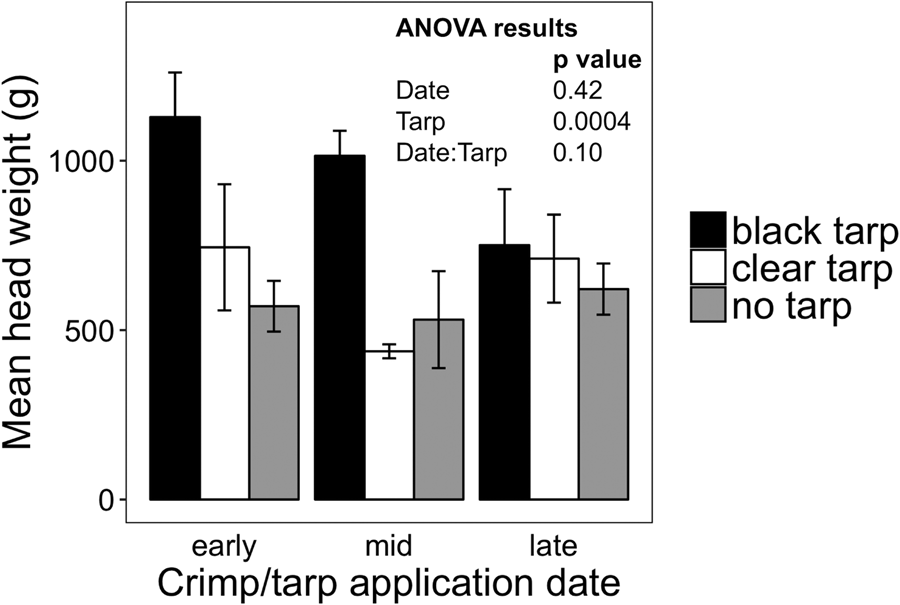
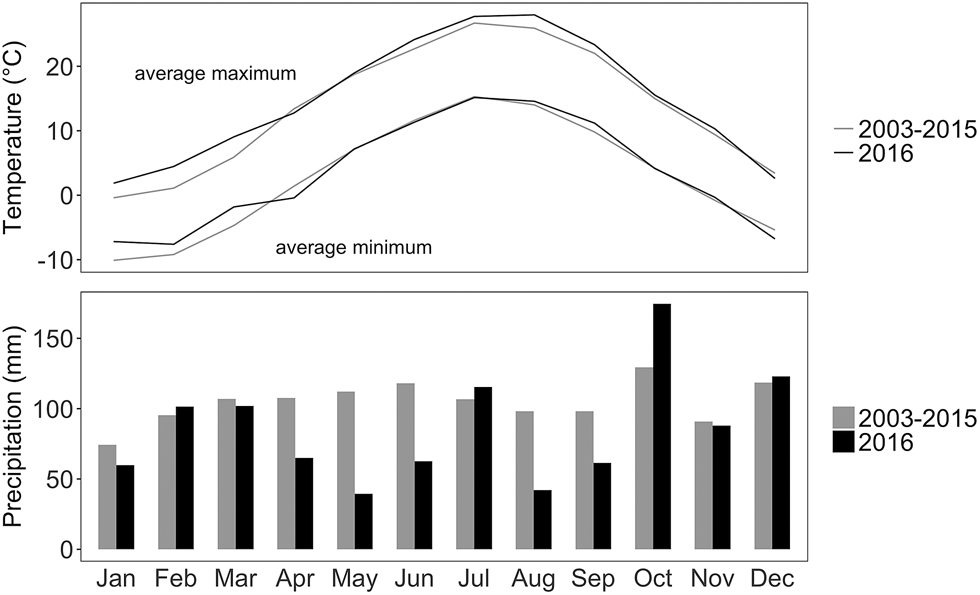
Average cabbage head weight was highest in the black tarp treatment and there was no difference between clear and no tarp treatments. This main effect was significant across all three crimp dates and cabbage following the black tarp treatment weighed 58% more than that following the no tarp treatment (Fig. 1). It is possible that differences in cabbage weight would not have been so great if cabbages in the no tarp treatment had been transplanted immediately after crimping instead of waiting to transplant all cabbages at the same time (after tarp removal), but we chose to standardize the crimping and transplanting days. Despite the main effect of tarp treatment on cabbage weight, a notable trend was apparent within the black tarp treatment of declining head weight with later time. This tarp treatment by crimp date interaction did not reach significance, but the marginal P value (P = 0.10) warrants mention and the simple means have been included in Figure 1. Precipitation was below average for August and September (Fig. 2), which likely contributed to low head weights.
Mean weight of cabbage heads that were no-till transplanted into a rye–vetch cover crop terminated with a roller-crimper. Tarp treatments (black, clear or no tarp) were applied immediately after crimping for a duration of 5 (‘early’), 4 (‘mid’) and 2 (‘late’) weeks prior to planting cabbage. There was a main effect of tarp type on cabbage weight (black > clear = none), but simple means are shown because of a trend of decreasing cabbage weight within the black tarp treatments. Data are means ± standard error (n = 4).

Average monthly minimum and maximum temperatures and precipitation in 2016 vs historical data (2003–2015) at the nearby UNH Kingman Research Farm weather station in Madbury, NH, USA (43.17°N, 70.93°W).

There are several potential mechanisms for the observed differences in yield (cabbage weight) across the tarp treatments, and while we did not directly test these mechanisms, the data suggest that a combination of weed dynamics and biological activity/nutrient mineralization may be responsible for the differences.
Weeds
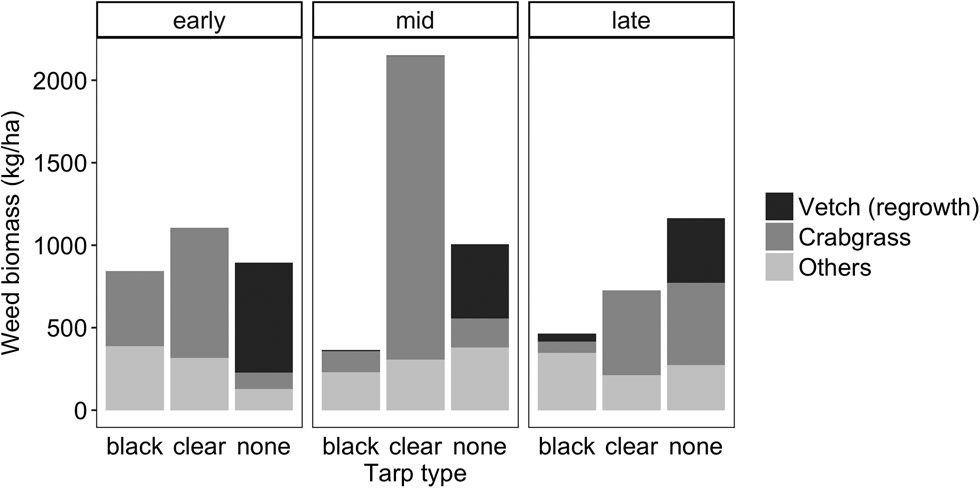
Weed biomass alone cannot explain differences in yield, as there was no correlation between weed biomass at cabbage harvest and cabbage weight (R 2 = 0.015). There were, however, differences in the weed communities in the different treatments. Vetch was strongly associated with the no tarp treatment (indicator value = 96, P = 0.0002). Living vetch was visible in the no tarp treatments after crimping, and the data clearly show that crimping alone did not kill vetch, even when crimping was delayed until late June (late) when early podset had begun (Fig. 3).
Weed biomass by species at the time of cabbage harvest in treatments in which black, clear or no tarps were applied to crimped cover crops. Early, mid and late are the timing of crimping/tarp application and correspond to durations of 5, 4 and 2 weeks, respectively, prior to planting cabbage. Data are means (n = 4).

No living plants were visible in either the clear or black tarp treatments when the tarps were removed. The weed community that emerged after the clear tarps were removed was dominated by large and smooth crabgrass (Digitaria sanguinalis and Digitaria ischaemum). Digitaria spp. were pooled when weeds were sorted and together they had an indicator value of 62 (P = 0.02) for the clear tarp treatment. This is strong evidence that the clear tarps stimulated crabgrass emergence. Large crabgrass emerges over a long period, with 10% emergence at 280 soil degree days (base 9°C) and 95% emergence at 1500° days under irrigated conditions (Myers et al., Reference Myers, Curran, VanGessel, Calvin, Mortensen, Majek, Karsten and Roth2004). It is possible that the higher temperatures under the clear tarp encouraged greater emergence over a shorter period of time once the tarps were removed. While there was no correlation overall between final weed biomass and cabbage weights, the treatment with the highest weed biomass (mid-clear) was >80% crabgrass and also had the lowest cabbage weights (Fig. 3).
Because of a significant tarp by crimp date interaction on weed biomass (P = 0.007), we are unable to draw broad conclusions about the effects of tarp treatment or crimp date on weed biomass. When simple means were analyzed within each crimp date, the only differences in weed biomass between tarp treatments were seen for the ‘mid’ tarp date, where weed biomass in the clear tarp treatment was significantly higher than the others (P = 0.002). However, the final weed biomass does not capture the timing of weed emergence and growth, which influences the level of competition with the crop. Significant crabgrass growth was observed in the clear treatments as early as 3 weeks after transplanting possibly during the critical period for crop–weed competition (Weaver, Reference Weaver1984), whereas weeds were not apparent in the black tarp treatments until later.
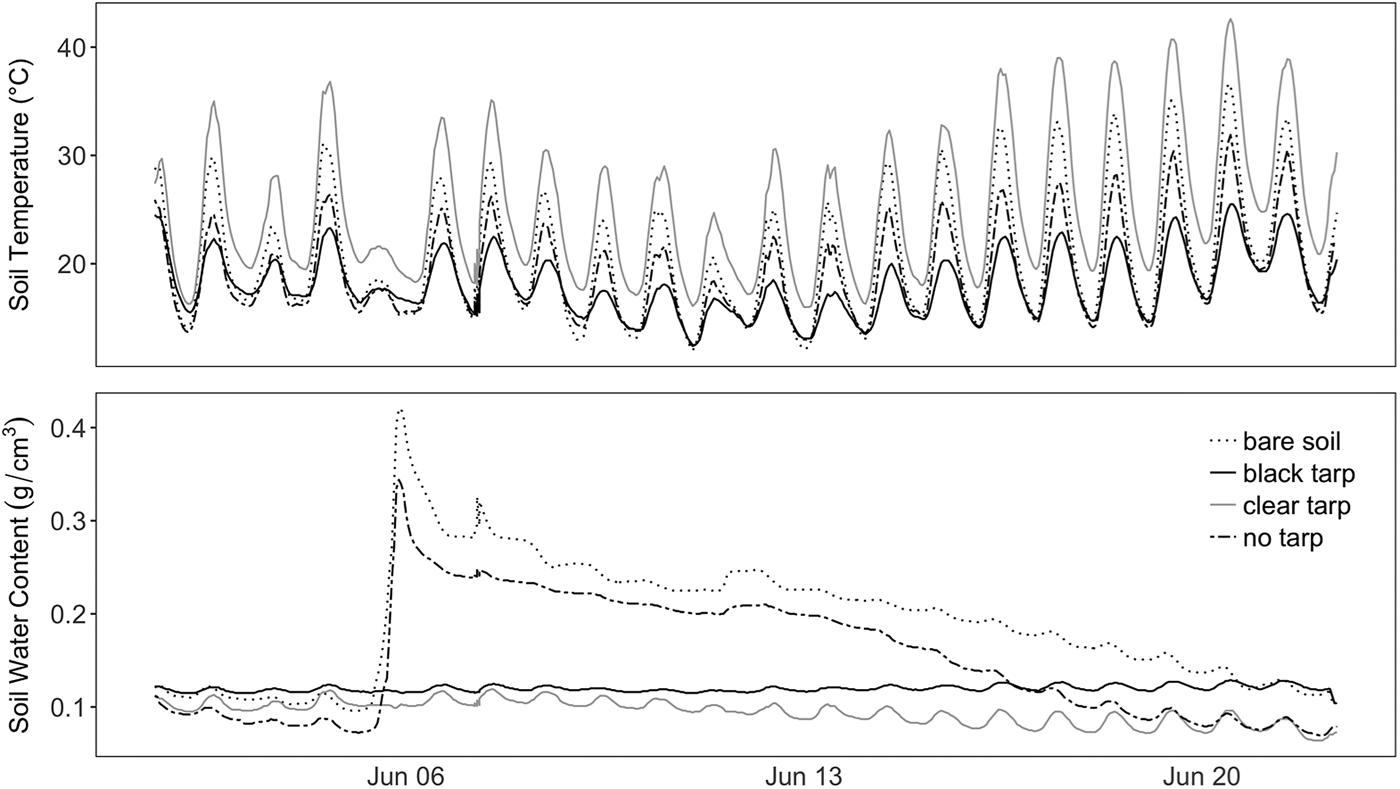
Tarps used for solarization are generally applied after irrigation or rain so that both soil moisture and temperature requirements can be met to induce fatal weed germination and direct thermal killing of weed seeds (Rubin and Benjamin, Reference Rubin and Benjamin1984). We did not irrigate prior to tarp application in this experiment. However, there was a rain event of 3.9 cm on June 5, 4 days before the ‘mid’ crimping and tarp application date that increased soil moisture (visible in Fig. 4). The higher initial soil water content did not lead to greater weed reduction under tarps; instead, this tarp date had the highest weed biomass under clear tarps of the three dates.
Average soil temperature and volumetric water content at 3 cm depth in the ‘early’ treatment in which crimping and tarp application occurred on June 2. Black, clear and no tarp treatments all had cover crop residue on the soil surface, but the residue was removed where the ‘bare soil’ sensor was placed. Data are means (n = 3).

Mulch, soil temperature and moisture
Another factor that could have influenced cabbage growth is nutrient availability. We did not directly quantify nutrient availability, but we measured the amount of cover crop mulch remaining on the soil surface by the time of harvest, which we interpret as an indirect measurement of biological activity.
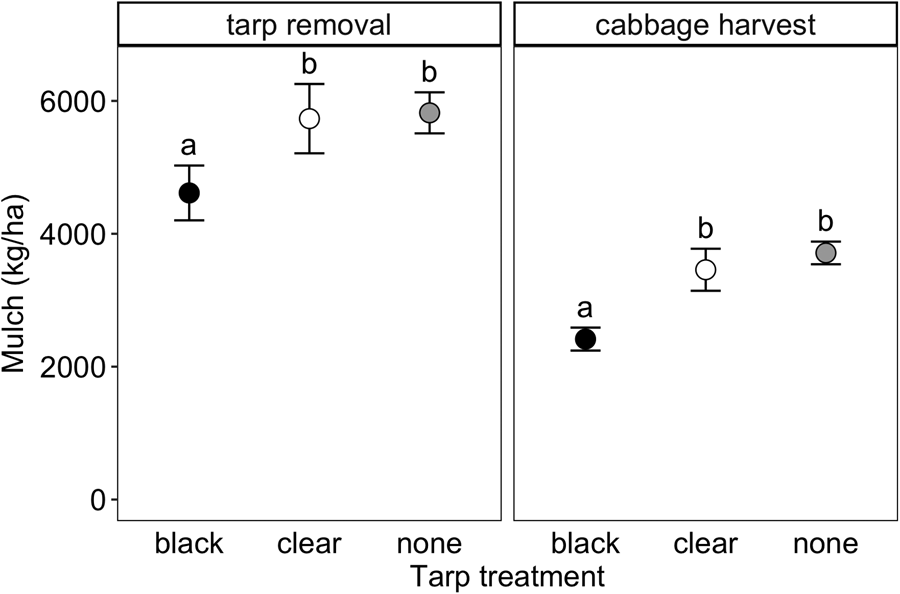
Although there were no differences in cover crop biomass between the plots prior to treatment application, there were differences in the amount of dead cover crop mulch remaining at tarp removal and cabbage harvest. At time of tarp removal, there was a main effect of tarp treatment, but not crimp date, on remaining mulch. Clear and no tarp treatments had >1100 kg ha−1 more mulch than where black tarps had been (P = 0.01) (Fig. 5). When mulch was measured again at cabbage harvest, the differences remained significant (P = 0.0004). Although the total amount of mulch decreased between the time of tarp removal in July and cabbage harvest in September, the magnitude of the difference between treatments appeared similar between these times, suggesting that the increased rate of decomposition of the mulch in the black tarp treatment occurred primarily during the tarping period, not after the tarps were removed.
Dead cover crop mulch remaining on the surface at tarp removal (July 7) and time of cabbage harvest (September 14). Black, clear or no tarp were applied to cover crops immediately after rolling with a roller-crimper. Means did not differ by crimp/tarp application date. Letters denote significance at P < 0.05 using Tukey's test within each sampling time point. Data are means ± standard error (n = 12).

Temperature, moisture and residue quality all influence surface residue decomposition rates, and black tarps appear to facilitate environmental conditions that encourage microbial activity. While laboratory experiments have elucidated relationships between either temperature, moisture or residue quality with decomposition rates (e.g., Quemada and Cabrera, Reference Quemada and Cabrera1997), the complex interactions among factors in field settings make modeling surface decomposition difficult (Findeling et al., Reference Findeling, Garnier, Coppens, Lafolie and Recous2007). While the patterns of soil temperature and moisture in the different treatments are obvious, how this led to greater mulch decomposition in the black tarp treatment is not.
Temperature alone is unlikely to have caused the accelerated mulch decomposition under black tarps, as daily maximum soil temperatures were lowest there in the early treatment for which we have data (Fig. 4). This highlights a key difference between using black tarps on bare soil where there is a direct tarp–soil contact, and on a cover crop, which creates an air gap between the soil surface and the tarp. It is possible, however, that the smaller daily temperature fluctuation under black tarps contributed to more stable conditions for biological activity despite the lower mean temperatures. The effect of fluctuating vs constant temperature is unclear, but there is evidence that temperature fluctuations can decrease biological activity in soil (Biederbeck and Campbell, Reference Biederbeck and Campbell1973; Lomander et al., Reference Lomander, Kätterer and Andrén1998). Neither clear nor black tarps achieved temperatures comparable to other solarization studies (>40°C) investigating weed suppression. Based on the temperatures under the black tarps in this study (Fig. 4), it is unlikely that direct thermal killing of weed seeds occurred.
It is possible that soil moisture had more of an effect on mulch decomposition and biological activity than temperature. All treatments began with relatively low water content, but soil moisture was maintained under the black tarps and declined steeply under the clear tarps (Fig. 4). There was visible condensation on the underside of the clear tarps, and the data show that this water was lost from the soil over time. The issue of moisture loss from the clear tarp treatments may have been alleviated if the edges had been buried. Moisture where there was no tarp was more variable and responded to rain events (Fig. 4). Under normal field conditions, surface residue decomposition occurs in pulses, not at a steady rate, in response to changing soil moisture (Findeling et al., Reference Findeling, Garnier, Coppens, Lafolie and Recous2007). Constant soil moisture conditions in conjunction with steadier temperatures under the black tarp may have facilitated more consistent and thus greater overall mulch decomposition. Because mulch provides weed suppression and moisture retention throughout the growing season, there is a tradeoff between increased residue decomposition that releases nutrients and decreased mulch. Additional research will be necessary to better understand how black tarps alter the biological and edaphic properties of the soil in these types of systems.
Conclusions
This experiment showed that tarps have promise in overcoming some of the constraints of current cover crop-based no-till systems for organic vegetable production in cold climates. Our data indicate that both black and clear tarps effectively terminate cover crops, but clear tarps increased crabgrass emergence after tarp removal. Different conditions (i.e., more rain or irrigation prior to tarp application), and burial of the tarp edges may produce different results than the ones we observed in this limited study. When averaged across all crimp dates, black tarps increased cabbage weight by 58% compared with rolling/crimping alone. The mechanisms for this are not completely clear, but likely involve a combination weed suppression and nutrient mineralization. We did not measure soil nutrients directly, but observed more rapid decomposition of cover crop mulch in the black tarp treatment, indicating greater biological activity and release of nutrients. Importantly, tarps are accessible to small-scale producers and may even offer advantages over other methods of mechanically killing cover crops. While we used a roller-crimper in all treatments, it is possible that alternative implements such as disengaged rototillers or lawn rollers, which temporarily lay down tall cover crops, could be used to prepare for tarping thus reducing the need for specialized equipment. Vetch is of particular importance to growers in cooler climates because it is a winter hardy legume, and was successfully terminated using tarps. Tarps appear to facilitate small-scale, no-till vegetable production by increasing flexibility for when cover crops can be terminated. Further research is necessary to understand the relationships between air temperature, tarp duration, weed dynamics and nutrient mineralization. This would allow farmers to optimize tarp duration depending on the weather and their individual production goals.
Acknowledgements
Partial funding was provided by the New Hampshire Agricultural Experiment Station. This is Scientific Contribution Number 2793. This work is/was supported by the USDA National Institute of Food and Agriculture Hatch Project 100682 and USDA Sustainable Agriculture Research and Education Project LNE18-371. The authors would like to thank John McLean, Evan Ford, Dorn Cox, Shenandoah Crook, Margo Clark, and Liza DeGenring for equipment and field assistance.