Prosody, which is the rhythm, stress, and intonation of speech, enjoys a unique status in language. Infants show an exceptional sensitivity to prosody (e.g., Soderstrom, Seidl, Kemler Nelson, & Jusczyk, Reference Soderstrom, Seidl, Nelson and Jusczyk2003), and this sensitivity remains relatively undisturbed even in the elderly (Hoyte, Brownell, & Wingfield, Reference Hoyte, Brownell and Wingfield2009). Broadly speaking, prosody performs a number of functions in language. These can be grammatical, affective, discourse related, or sociolinguistic in nature. One important grammatical function that it serves is the segmentation of the speech stream into sentences and into smaller units or phrases. This role is especially relevant in the disambiguation of globally ambiguous sentences, such as the following:
(1) Laura ran away with the man wearing a green robe.
Speakers who come across this sentence have two choices when they encounter the present participle wearing: Along with the material that follows, it may provide additional material about Laura or the man. If it is interpreted as attaching to Laura, one would expect a break between man and wearing, as well as emphasis on the word wearing; however, an interpretation in which the man is wearing the robe would involve no boundary between man and wearing, because wearing provides additional information about the man, which directly precedes it. Experiments probing first language (L1) comprehension have shown that listeners make use of prosodic cues to disambiguate globally ambiguous sentences, like (1) above (e.g., Beach, Katz, & Skowronski, Reference Beach, Katz and Skowronski1996; Streeter, Reference Streeter1978), and recent research by Dekydtspotter, Donaldson, Edmonds, Fultz, and Petrusch (Reference Dekydtspotter, Donaldson, Edmonds, Fultz and Petrusch2008) and Fultz (Reference Fultz, Chan, Jacob and Kapia2007) shows that even beginning-level second language (L2) learners use auditory cues to disambiguate syntactically ambiguous sentences.
However, investigations into L1 production show mixed results. In spite of an early sensitivity to prosody, Cruttenden (Reference Cruttenden1986) showed that children generally master prosody later than other aspects of speech production. Moreover, native speakers of a language can rely on different prosodic cues to convey their intended meaning of an utterance (e.g., Schafer, Speer, Warren, & White, Reference Schafer, Speer, Warren and White2000; Scuffil, Reference Scuffil1982). Therefore, it is not surprising that speakers’ consistency in using prosodic cues to disambiguation may depend on the discourse situation and their awareness of ambiguity in the first place (e.g., Lingel, Pappert, & Pechmann, Reference Lingel, Pappert and Pechman2006; Snedeker & Trueswell, Reference Snedeker and Trueswell2003; but, for counterevidence, see Kraljic & Brennan, Reference Kraljic and Brennen2005; Schafer, Speer, & Warren, Reference Schafer, Speer, Warren, Tanenhaus and Trueswell2005). To date, we know of only one study that has compared bilingual participants’ production of prosodic cues to disambiguation in their two languages (Fernández, Reference Fernández2005), and this was with early Spanish–English bilinguals. The question remains open as to whether and how late L2 learners will use prosodic cues to disambiguate utterances in each of their languages, especially considering research that suggest L2 prosody is acquired late (Pennington & Ellis, Reference Pennington and Ellis2000) and that it is rarely acquired to nativelike levels (Gut, Reference Gut2009; Mennen, Reference Mennen2004; Trofimovich & Baker, Reference Trofimovich and Baker2006).
The primary goal of the current study is to determine whether late English L2 learners of German and late German L2 learners of English reliably produce prosodic cues to disambiguate temporarily ambiguous prepositional phrase attachment (PP-attachment) sentences when producing sentences in their L1 and their L2. In addition, we seek to determine precisely which cues L2 learners use and whether these cues differ from those used by native speakers of the languages in question. As such, the present study speaks to broader questions regarding the ability of late L2 learners to acquire nativelike use of L2 prosody, and the issue of cross-language transfer of prosodic cues to syntactic disambiguation among speakers of more than one language.
PROSODIC CUES TO DISAMBIGUATION IN ENGLISH
The delimitation of speech into phrases is one central focus of prosody research (e.g., Selkirk, Reference Selkirk, Frota, Vigario and Freitas2005; Watson, Breen, & Gibson, Reference Watson and Gibson2006).Footnote 1 Prosody is used by speakers, among other things, to group syntactic constituents together and to provide additional structure within sentences (e.g., Nespor & Vogel, Reference Nespor and Vogel1986). Numerous studies have used explicit prosody to determine the extent to which listeners make use of various prosodic cues in their L1s. For example, the native English participants in Streeter's (Reference Streeter1978) study relied on duration and pitch contour in an additive fashion to locate the phrase boundaries in globally ambiguous algebraic expressions such as A plus (E times O) and (A plus E) times O. In a series of studies, the speech samples were manipulated from their original versions on the three variables of pitch, amplitude, and duration. Manipulations of pitch and duration, both alone and in combination, affected the listeners’ judgments, but amplitude manipulations did not produce cues that listeners could use reliably (see also Beach et al., Reference Beach, Katz and Skowronski1996; Hoyte et al., Reference Hoyte, Brownell and Wingfield2009; Scott, Reference Scott1982). The results of these and other comprehension studies show that listeners use prosodic cues to resolve syntactic ambiguity in their L1s (see also Kang & Speer, Reference Kang and Speer2005; Kjelgaard & Speer, Reference Kjelgaard and Speer1999; Lehiste, Olive, & Streeter, Reference Lehiste, Olive and Streeter1976; Schafer et al., Reference Schafer, Speer, Warren and White2000).
Recent investigations into PP-attachment show that listeners also rely on prosodic cues to determine which of the preceding elements the PP modifies. For example, without additional information, it is ambiguous whether one should interpret Example (2) to mean that one should tap the frog who is holding a flower, which is referred to here as noun phrase (NP)-attachment, or whether one should use the flower to tap the frog, which is referred to here as verb phrase (VP)-attachment.
(2) a. Tap the frog with the flower. (Ambiguous)
b. Tap | the frog with the flower. (NP-attachment)
c. Tap the frog | with the flower. (VP-attachment)
However, the insertion of phrasal boundaries (marked above with “|”) can disambiguate these two different interpretations for listeners in English (e.g., Kraljic & Brennan, Reference Kraljic and Brennen2005; Pynte & Prieur, Reference Pynte and Prieur1996; Schafer et al., Reference Schafer, Speer, Warren, Tanenhaus and Trueswell2005; Snedeker & Trueswell, Reference Snedeker and Trueswell2003; Snedeker & Yuan, Reference Snedeker and Yuan2008; Straub, Reference Straub1997). Thus, in example (2b), with a boundary between the verb and the DO, the preferred interpretation is that the frog is holding a flower, and in (2c), with a boundary between the DO and the PP, the preferred interpretation is that the tapping is being done with the assistance of the flower. Results of comprehension studies show that listeners do rely on cues to disambiguation in sentences such as (2) above, especially when the cues to disambiguation are robust (e.g., Kralijc & Brennen, Reference Kraljic and Brennen2005; Snedeker & Trueswell, Reference Snedeker and Trueswell2003; Snedeker & Yuan, Reference Snedeker and Yuan2008).
Complementing these results examining listening comprehension, PP-attachment production studies involving native speakers of English show variable results in terms of the strength and similarity of the cues produced across participants. Schafer et al. (Reference Schafer, Speer, Warren, Tanenhaus and Trueswell2005) found that their 16 native participants lengthened the DO noun and the following pause in VP-attachment sentences in a cooperative game task. Further, the authors found no effect of situational ambiguity, namely, whether the sentence to be produced was globally ambiguous, unambiguous, or biased toward NP- or VP-attachment (see also Kraljic & Brennan, Reference Kraljic and Brennen2005). Similarly, the four FM radio announcers who produced the stimuli in Price, Ostendorf, Shattuck-Hufnagel, and Fong (Reference Price, Ostendorf, Shattuck-Hufnagel and Fong1991) relied primarily on duration and pause as a cue to disambiguation in their PP-attachment sentences, four with each type of attachment. Although Price et al. investigated the role of an additional acoustic cue, pitch accent (i.e., the relative fundamental frequency [F0] prominence as related to the rest of the constituent), they did not find that participants used this cue consistently to disambiguate the target sentences.Footnote 2 Based on their findings, both studies concluded that speakers produced larger prosodic breaks for VP- than for NP-attachment sentences.
In contrast to Schafer et al. (Reference Schafer, Speer, Warren, Tanenhaus and Trueswell2005), only the 32 female speakers of American English who were aware of the syntactic ambiguity in Snedeker and Trueswell's (Reference Snedeker and Trueswell2003) referential communication task reliably produced prosodic cues to disambiguation in their production of four sentences of each attachment type. In the NP-attachment condition, participants lengthened the verb and placed a pause before the DO. In the VP-attachment condition, they placed a pause between the DO noun and the preposition with and lengthened the DO noun and PP. Participants were also more likely to place a pitch accent on the preposition with in VP-attachment sentences, providing a further cue to VP-attachment. In contrast, the 32 female participants who took part in the second experiment were only expected to produce one type of attachment: either NP- or VP-attachment. These speakers’ cues to disambiguation, although still present, were not as reliable as were those produced by the participants in Experiment 1 (see also Straub, Reference Straub1997).
The acoustic analysis of experimental stimuli produced by a single speaker in a later comprehension study (Snedeker & Yuan, Reference Snedeker and Yuan2008) found similar phonetic realizations of prosodic boundaries with regard to duration, pausing, and the presence of a pitch accent on the preposition with in VP-attachment sentences. Using the ToBI prosodic labeling system (Beckman & Hirschberg, Reference Beckman and Hirschberg1994), Snedeker and Yuan (Reference Snedeker and Yuan2008) also reported an F0 rise on the verb in NP-attachment conditions. However, elsewhere there was no consistent use of F0 contour to distinguish NP- from VP-attachment sentences, leading them to argue that the pause may be the most reliable cue to disambiguation in English (see also Cooper & Paccia-Cooper, Reference Cooper and Paccia-Cooper1980; Snedeker & Trueswell, Reference Snedeker and Trueswell2003; but see Straub, Reference Straub1997, for counterevidence). To summarize, potential cues to indicate prosodic boundaries in PP-attachment sentences in English include lengthening (both of individual constituents and the use of pause) and pitch accent on the preposition after the boundary, with lengthening being the most robust cue in both perception and production. An additional cue to NP-attachment may be a rise in pitch on the verb in NP-attachment sentences. Some of the acoustic cues to disambiguate NP- from VP-attachment sentences in English are highlighted in Figure 1 and Figure 2.
English noun phrase attachment sentence. [A color version of this figure can be viewed online at http://journals.cambridge.org/aps]

English verb phrase attachment sentence. [A color version of this figure can be viewed online at http://journals.cambridge.org/aps]
PROSODIC CUES TO DISAMBIGUATION IN GERMAN
Because German is an intonation language like English, its speakers and listeners draw on a similar set of prosodic cues. Lingel, Scheepers, Mohr, and Pechmann (Reference Lingel, Scheepers, Mohr and Pechmann2007) and Lingel et al. (Reference Lingel, Pappert and Pechman2006) found that native speakers of German can use prosodic information to disambiguate NP- from VP-attachment sentences, like (3) below, similar to findings reported for English. With regard to speech production, similar to Snedeker and Trueswell (Reference Snedeker and Trueswell2003), Lingel et al. (Reference Lingel, Pappert and Pechman2006) found that speakers’ awareness of the ambiguity played a role in the production of cues to disambiguation. The 16 female native speakers of German differed marginally in how they distinguished 12 NP- from 12 VP-attachment sentences when they were not explicitly instructed to do so when producing globally ambiguous PP-attachment sentences, like (3).
(3) Berühre den Adler mit der Socke.
“Touch the eagle with the sock.”
Those participants who reported being aware of the ambiguity relied on durational cues to disambiguation. They produced a postverbal boundary by lengthening the verb berühre (touch) and the pause that followed in NP-attachment sentences. In VP-attachment sentences, the boundary following the DO was created via lengthening of the DO noun Adler (eagle) and the pause that followed. Participants who were unaware of the ambiguity did not produce reliable cues to disambiguation and instead relied on a default VP-attachment prosody in both attachment conditions. However, when these same 16 participants were explicitly instructed to disambiguate, they produced more reliable cues. When they produced NP-attachment sentences, they lengthened the postverbal pause and produced a higher F0 on the article of the DO den (the). For VP-attachment sentences, they lengthened the preboundary (i.e., DO) noun and the pause before the PP mit der Socke (with the sock) and produced a higher F0 rise near the end of the DO noun Adler (eagle).
To summarize, similar to English, native speakers and listeners of German may use lengthening as a potential cue to PP-attachment disambiguation. Native speakers of German may also rely more on pitch rise than native speakers of English. Specifically, a rise in pitch on the DO is an important cue to the disambiguation of German VP-attachment sentences. Previous studies have not investigated whether pitch accent on the preposition is a reliable cue to disambiguation in German. Some of the potential cues distinguishing NP- from VP-attachment sentences in German are shown in Figure 3 and Figure 4.
German noun phrase attachment sentence (“The king saw the crown with the large jewels”). [A color version of this figure can be viewed online at http://journals.cambridge.org/aps]
German verb phrase attachment sentence (“The king saw the crown with his own eyes”). [A color version of this figure can be viewed online at http://journals.cambridge.org/aps]
PROSODIC CUES USED IN AN L2
In general, research into L2 perception has shown that listeners use different auditory cues depending on their L1 backgrounds. This is true at the segmental level (e.g., Escudero, Benders, & Lipski, Reference Escudero, Benders and Lipski2009; Flege, Bohn, & Jang, Reference Flege, Bohn and Jang1997), and it extends to the perception of words and word boundaries (e.g., Cutler, Reference Cutler2009; Tyler & Cutler, Reference Tyler and Cutler2009; Weber & Cutler, Reference Weber and Cutler2006). However, fewer studies have investigated the perception or production of prosodic cues to disambiguation at the sentence level among L2 learners. Using an acceptability judgment task, Fultz (Reference Fultz, Chan, Jacob and Kapia2007) investigated whether L2 learners of French (L1 English) were sensitive to mismatches between the prosodic structure of globally ambiguous PP-attachment sentences and a larger discourse context that biased the target sentence toward either a NP- or a VP-attachment interpretation. Similarly, Dekydtspotter et al. (Reference Dekydtspotter, Donaldson, Edmonds, Fultz and Petrusch2008) reported that at least a subset of fourth-semester L2 learners of French was also sensitive to the use of prosodic cues to disambiguate ambiguous relative clause attachment sentences, like Nous adorons le secrétaire du psychologue qui se promène au centre ville (We adore the secretary of the psychologist who walks downtown), in which it is ambiguous whether the relative clause describes le secrétaire, (the secretary; high attachment) or le psychologue (the psychologist; low attachment). The results of these studies indicate that even less proficient L2 learners exhibit some sensitivity to prosodic cues to disambiguation when processing L2 auditory input. Further, as proficiency increases, L2 learners’ ability to use prosodic information to guide their interpretation and judgments of ambiguous L2 sentences becomes increasingly nativelike.
To our knowledge, Fernández (Reference Fernández2005) is the only study to investigate prosodic cues in speech production (as opposed to comprehension) as it relates to the disambiguation of syntactically ambiguous sentences among speakers of more than one language. She examined the prosodic features of 8 English and 8 Spanish monolinguals and 12 early Spanish–English bilinguals when reading aloud four versions of eight different sentences containing relative clause attachment ambiguities, similar to those studied by Dekydtspotter et al. (Reference Dekydtspotter, Donaldson, Edmonds, Fultz and Petrusch2008). Results showed that the bilingual participants produced clear prosodic breaks when producing sentences in both languages. However, differences appeared in how such prosodic breaks were realized between the monolingual and bilingual participants, with regard to both the duration of constituents preceding possible intonational boundaries and pitch movements prior to these boundaries. Whereas she attributes the differences in phrasing patterns to performance limitations, Fernández concludes that the differences in intonational patterns were due to the speakers’ underlying competence in the L2.
In a broader sense, research has shown that among late L2 learners, L2 prosody differs from that produced by native speakers in speed of delivery, with L2 speech being less fluent (e.g., Gut, Reference Gut2009; Trofimovich & Baker, Reference Trofimovich and Baker2006). Further, researchers including Wennerstrom (Reference Wennerstrom1994) and Gut (Reference Gut2009) found that L2 learners are less consistent than native speakers in using pitch to signal meaningful contrasts. For example, in a study investigating the interaction between prosody and information structure, Gut (Reference Gut2009) reported that L2 learners of English often emphasized given information, including pronouns, in contrast to native speakers of English, who are more likely to place emphasis on new information. In addition, the L2 learners of English differed from native speakers in the direction of pitch movement (i.e., rise vs. fall) on various sentence constituents (see Ramírez Verdugo, Reference Ramírez Verdugo2002, for similar findings).
There is some question regarding the extent to which such signs of nonnativelikeness in L2 prosody can be traced to prosodic aspects of L2 learners’ L1s. Some argue that there is evidence of transfer from the L1, especially in the early stages of acquisition (e.g., Gut, Reference Gut2003, Reference Gut2009; Jilka, Reference Jilka, Trouvain and Gut2007; Kim & Kim, Reference Kim and Kim2001). Perhaps the most substantial evidence in favor of L1 transfer effects to L2 prosody comes from Atterer and Ladd (Reference Atterer and Ladd2004), who found that native speakers of German differed in their tonal alignment patterns (i.e., the alignment of F0 troughs and peaks in relation to the individual segments within a syllable) in L2 English according to their L1 dialects. Further, even with L1–L2 pairings that are maximally similar in their tonal inventories and intonational contours, like English and German, studies have shown that L2 learners differ from native speakers in their phonetic realizations of these intonational contours in their L2 (e.g., Grosser, Reference Grosser, James and Leather1997; Gut, Reference Gut2009; Mennen, Reference Mennen, Trouvain and Gut2007).
PRESENT STUDY
The languages paired in the current study are German and English, intonation languages that use prosodic cues, including lexical stress, pitch accents, and boundary tones to express contrasts (e.g., Féry, 1993; Peters, Reference Peters2006). Despite the apparent similarities in their prosodic systems, recent studies have shown acoustic differences between the two languages, including the most important one: differences in pitch range and pitch variation over the course of an utterance (Gut, Reference Gut2009; Jilka, Reference Jilka2000, Reference Jilka, Trouvain and Gut2007; Mennen, Reference Mennen, Trouvain and Gut2007). Therefore, an exploration into how English–German L2 learners and German–English L2 learners make use of prosodic cues, and pitch variation in particular, allows us to investigate potential transfer effects from the L1 into the L2 and from the L2 back onto the L1.
In addition, by focusing on the production of temporarily ambiguous PP-attachment sentences, the present study can pinpoint how L2 learners use prosodic cues to disambiguate ambiguous sentences without the potential confound of cross-linguistic differences at the syntactic level. PP-attachment ambiguities are maximally similar between German and English, and previous sentence-processing research has shown a generalized preference for VP-attachment in both languages, although this preference can be overridden with certain verbs (e.g., Konieczny, Hemforth, Scheepers, & Strube, Reference Konieczny, Hemforth, Scheepers and Strube1997; Spivey-Knowlton & Sedivy, Reference Spivey-Knowlton and Sedivy1995). At the same time, studies have shown that native speakers in both languages can produce prosodic boundaries to help disambiguate ambiguous PP-attachment sentences and that listeners will take advantage of such prosodic cues during comprehension (e.g., Kraljic & Brennan, Reference Kraljic and Brennen2005; Lingel et al., Reference Lingel, Pappert and Pechman2006; Price et al., Reference Price, Ostendorf, Shattuck-Hufnagel and Fong1991; Schafer et al., Reference Schafer, Speer, Warren, Tanenhaus and Trueswell2005; Snedeker & Trueswell, Reference Snedeker and Trueswell2003).
If late L2 learners, like native speakers and early bilinguals, can use prosodic cues to disambiguate temporarily ambiguous sentences during speech production, one would predict that they should successfully disambiguate locally ambiguous PP-attachment sentences in an L2 (e.g., Fernández, Reference Fernández2005). At the same time, previous research has shown that a rise in pitch may not be a reliable cue to PP-attachment disambiguation in English (e.g., Lehiste et al., Reference Lehiste, Olive and Streeter1976; Schafer et al., Reference Schafer, Speer, Warren, Tanenhaus and Trueswell2005; Snedeker & Yuan, Reference Snedeker and Yuan2008).Footnote 3 In contrast, the German participants in Lingel et al. (Reference Lingel, Pappert and Pechman2006) reliably produced differences in the F0 contour to disambiguate both VP- and NP-attachment sentences, suggesting that a rise in pitch may play a more important role in syntactic disambiguation in German. Thus, if late L2 learners engage in the wholesale transfer of prosodic cues from their L1 to the L2, the prosodic cues used by English–German L2 learners may differ from those of German native speakers, especially with regard to intonational cues, like pitch rise (Fernández, Reference Fernández2005; Gut, Reference Gut2009) and, conversely, the prosodic cues used by German–English L2 learners may differ from those used by English native speakers. However, if late L2 learners can successfully use specific prosodic cues, including intonational cues, to convey the intended meaning of an L2 utterance, then one would predict English–German L2 learners’ and German–English L2 learners’ cue use to parallel native speakers of each language when producing temporarily ambiguous German and English PP-attachment sentences.
EXPERIMENT 1a
Participants
Sixteen late-learning American English–L2 German learners were recruited from a study abroad program in Marburg, Germany. However, 1 participant had been in Germany less than a month at the time of testing and 4 participants scored at or below the B1 level on the accompanying proficiency task, so the data from these 5 participants were not included in any analyses reported here. The remaining 11 participants (7 females) were between 21 and 29 years old (M = 22.8) and had been living in Germany for at least 3 months prior to testing (M = 15.4 months, range = 3–78). To assess the participants’ L2 German proficiency, they completed a 30-question multiple-choice German grammar and vocabulary test (Goethe Institut, 2004). All participants scored at least 18 points on this task (M = 22.0, SD = 3.10), which corresponds to the B2 level on the Common European Framework of Reference Scale.
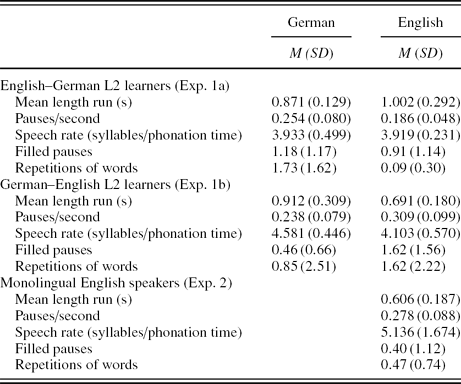
The proficiency test provides us with a measure of participants’ grammatical accuracy. As this experiment probed participants’ spoken language, in particular temporal aspects of speech including pauses and duration, it was also important to include a measure of their oral fluency. The participants therefore completed a picture-description task, also known as the “suitcase narrative,” that has been used in previous studies (e.g., Derwing, Munro, Thomson, & Rossiter, Reference Derwing, Munro, Thomson and Rossiter2009) to measure L1 and L2 fluency.Footnote 4 In this task the participants were presented with a series of drawings depicting a short story. In line with other studies that have investigated temporal aspects of fluency (e.g., Derwing et al., Reference Derwing, Munro, Thomson and Rossiter2009; Derwing, Rossiter, Munro, & Thompson, Reference Derwing, Rossiter, Munro and Thomson2004; Munro, Reference Munro1995; Munro & Derwing, Reference Munro and Derwing1994; Piper & Cansin, Reference Piper and Cansin1988), the first 20 s of the participants’ recordings were analyzed for mean length run (MLR), the number of pauses per second, and the speech rate (defined as the number of syllables divided by the total phonation time) because these measures correlate with native speaker ratings of fluency (Cucchiarini, Strik, & Boves, Reference Cucchiarini, Strik and Boves2000). These measures were obtained using a script for Praat (Boersma & Weenink, Reference Boersma and Weenink2009) developed by de Jong and Wempe (Reference de Jong and Wempe2009) that detects syllable nuclei and measures speech rate. Results from these analyses are reported in Table 1.
Fluency measures for all participants in Experiments 1a, 1b, and 2
Note: Because the monolingual English speakers did not complete the picture description task in German, we do not report any German fluency results for this group. L2, second language.
Temporal measures of speech are only one aspect of overall fluency, because these measures also include filled pauses and repetitions. For this reason, a second fluency analysis was run on the proportion of filled pauses and repair phenomena, because these have also been used as a fluency measure of L2 speech (Hasselgren, Reference Hasselgren, Granger, Hung and Petch-Tyson2002; Temple, Reference Temple2000). These include nonlexical fillers, such as um, and repetitions and self-corrections of one or more syllables. The resulting measures presented in Table 1 are a proportion of the total number of syllables produced. The t tests comparing fluency measures in their L1 English to their L2 German revealed no significant difference in the MLR, speech rate, and proportion of filled syllables, MLR: t (10) = 1.78, p = .106; Speech rate and filled syllables (t < 1).Footnote 5 However, the L2 participants paused more often and exhibited a greater proportion of repetitions in German than in English, pause/second: t (10) = –3.48, p < .01; repetitions: t (10) = –3.21, p < .01. A second set of t tests comparing the English–German L2 learners’ fluency measures in their L2 German to the L1 German fluency measures from the German–English L2 learners in Experiment 1b revealed no significant difference in MLR, pauses per second, or the proportion of repetitions (all ts < 1). However, the English–German L2 learners exhibited a slower speech rate in their L2 German compared to the German–English L2 learners and the difference in the proportion of filled pauses was marginally significant, speech rate: t (22) = 3.36, p < .01; filled syllables: t (15.21) = –1.82, p = .089. These comparisons suggest that although the English–German L2 learners were not near native speakers of German, they spoke German with relative ease.
Materials
The main task in this study was a contextualized speaking task similar to that used by Straub (Reference Straub1997; see also Price et al., Reference Price, Ostendorf, Shattuck-Hufnagel and Fong1991). Participants were recorded reading sentences, like (4b) and (5b), aloud. In half of the target sentences, the sentence-final PP modified the DO (NP-attachment), as in (4b), and in half of the sentences the PP modified the verb (VP-attachment), as in (5b). Although presented together here, the participants completed all German language tasks in one testing session followed by a second session 2 weeks later in which they completed all English language tasks.
(4) a. Die Königin kaufte dem König zwei Kronen als Geschenk und versteckte sie. Eine Krone hatte große Edelsteine, die Andere war aus Silber. Der König suchte überall seine Geschenke.
“The queen bought the king two crowns as presents. One crown had large jewels on it. The other was silver. The king searched everywhere for his presents.”
b. Der König sah die Krone mit den großen Edelsteinen. (NP-attachment)
“The king saw the crown with the large jewels.”
(5) a. Eine Krone war in einem Museum in England. Der König musste sich entscheiden, ob er sie selbst sehen wollte oder ob er seinen Diener schicken würde
“A crown was in a museum in England. The king had to decide if he should see the crown himself or if he would send his servant.”
b. Der König sah die Krone mit den eigenen Augen. (VP-attachment)
“The king saw the crown with his own eyes.”
(4ʹ) a. The queen bought the king two crowns as presents. One crown had large jewels on it. The other was silver. The king searched for his presents.
The king saw the crown with the large jewels. (NP-attachment)
(5ʹ) a. A crown was in a museum in England. The king had to decide if he should go to the exhibit himself or send his servant to see it.
b. The king saw the crown with his very own eyes. (VP-attachment)
Each target sentence was preceded by a short context, like (4a) or (5a), that contextualized the target sentence and aided in the comprehension of the target sentences and provided the background knowledge necessary to interpret each target sentence as either an NP-attachment or a VP-attachment sentence. Participants read the context on a computer screen and listened to a recording of the context read aloud by a female native speaker of German in the German-language task and by a female native speaker of American English in the English-language task. After hearing and silently reading the context, the participant pressed the spacebar and the target sentence appeared below the context for the participant to read aloud. Participants were instructed to read the target sentence silently before reading it aloud and to produce the sentence in a manner that best matched the meaning of the target context.
To ensure that the target sentences were equally plausible in both their NP- and VP-attachment versions, 16 native speakers of German and 16 native speakers of English, none of whom participated in the main experiment, rated the target sentences together with their contexts on a 7-point scale: 1 = sehr plausibel (very plausible) to 7 = überhaupt nicht plausibel (not at all plausible). The target sentences were divided into two lists, so that participants only saw one version of any given item, and were presented along with 34 filler items in a semirandomized order. The native speakers of German rated all target sentences lower than 5. The mean rating for all NP-attachment sentences in German was 2.98 and the mean rating for the VP-attachment sentences in German was 2.65, a difference that was not statistically significant, t (13) = 1.03, p = .324. The native speakers of English rated all items lower than 3. The mean rating for the NP-attachment sentences in English was 1.75 and the mean rating for the VP-attachment sentences in English was 1.72, a difference that was not statistically significant (t < 1).
Although it is important to ascertain that all of the target sentences were plausible continuations of their preceding contexts, for the purposes of the present study it is also important to measure the relative implausibility of the alternative attachment site for each target sentence. Specifically, if the target sentences are only temporarily ambiguous and the intended attachment site is implied via the semantic content of the PP, then the opposite interpretation (an NP-attachment interpretation of a VP-attachment sentence or a VP-attachment interpretation of an NP-attachment sentence) should be considered implausible. To test this hypothesis, an additional plausibility task was conducted in which 16 native speakers of German and 16 native speakers of English, none of whom participated in the first plausibility task or the main experiment, rated the plausibility of such alternative interpretations, as in Examples (6) and (6ʹ) below, using the same 7-point scale. These implausible alternatives were divided into two lists so that participants did not see more than one version of any item, and were presented in a semirandomized order along with six plausible and two implausible filler items.
(6) a. Der König benutzte die großen Edelsteine, um die Krone zu sehen. (Implausible VP interpretation of NP-attachment sentence)
“The king used the large jewels to see the crown.”
(6ʹ) a. The king used the large jewels to see the crown.
(6) b. Der König sah die Krone, die eigene Augen hatte. (Implausible NP interpretation of VP-attachment sentence)
“The king saw the crown that had its own eyes.”
(6ʹ) b. The king saw the crown that had its very own eyes.
For the native speakers of German, the mean rating for the NP interpretation of VP sentences was 5.9 and the mean rating for the VP interpretation of NP sentences was 4.5, a difference that was statistically significant, t (13) = 2.68, p < .05. For the native speakers of English, the mean rating for the NP interpretation of VP sentences was 5.0 and the mean rating for the VP interpretation of NP sentences was 4.0, a difference that was not statistically significant, t (13) = 1.68, p >.1.
In one final norming task, the same 16 native speakers of German and 16 native speakers of English who rated the relative implausibility of the alternative NP- and VP-attachment sentences were then presented with the actual NP- and VP-attachment target sentences along with their corresponding contexts and asked to judge whether the sentence-final PP provided more information about the DO or the primary action of the sentence. For instance, with examples (4) and (5), participants were asked: Informiert uns der unterstrichene Teil des Satzes mehr über die Krone oder die Art und Weise, wie der König die Krone sah? (Does the underlined portion of the sentence provide more information about the crown or the way the king saw the crown?) These target sentences were presented with eight filler items. The native speakers of German chose the intended meaning of the PP 94.1% of the time for NP-attachment sentences and 98.1% of the time for VP-attachment sentences, a difference that was statistically significant, t (13) = 2.26, p < .05. The native speakers of English chose the intended meaning of the PP 90.2% of the time in NP-attachment sentences and 97.3% of the time in VP-attachment sentences, a difference that was not statistically significant, t (13) = 1.67, p > .1. That both the German and the English native speakers chose the intended interpretation of the PP over 90% of the time highlights that although there was a difference in the relative plausibility of an alternative NP- or VP-interpretation of the target sentence when presented in isolation, once the target sentences were presented together with their preceding context, the intended attachment site for the PP was unambiguous for both NP- and VP-attachment sentences.
The primary contextualized speaking task in each language contained 14 target sentence–context pairs. These 14 sentences were divided into two lists so that participants read 7 NP-attachment and 7 VP-attachment sentences, but they never read more than one version of any given item. These 14 target sentences were interspersed with 34 filler items. Only 4 of the filler items were identical in both the English and German versions of the task, and participants did not report recognizing these materials. As with the experimental items, the filler items were similar in both languages. For each of the two lists, the target and filler items appeared in a pseudorandomized order, such that all experimental items were separated by at least 1 filler item. Each resulting presentation list was divided into two equal blocks, with half of the filler and target items presented in each block. To control for possible order effects, which block of items participants received first was varied across participants. All participants began the experiment with one practice item to familiarize them with the nature of the task.
Procedure
At the beginning of the experiment, participants filled out a language-background questionnaire and completed the German proficiency task. At the first session participants completed the contextualized speaking task and picture description task in their L2 German. In a second session 2 weeks later the participants completed the contextualized-speaking task and the picture-description task in their L1 English. Care was taken in assigning lists in the English contextualized speaking experiment so that the participants did not receive the same list of target sentences in both German and English.
At each session, participants completed the first block of the contextualized speaking task, followed by the picture description task. Then they completed the second block of the contextualized speaking task. The situational contexts and target sentences were presented via PowerPoint. All recordings were completed in a soundproof booth, using Audacity 1.2 for Mac OS X. All data were automatically digitized at a sampling rate of 44.1 kHz.
Prosodic analysis
Participants’ utterances were analyzed in Praat 5.1.21 (Boersma & Weenink, Reference Boersma and Weenink2009), using a visual inspection of the waveform displays and spectrograms to annotate constituent boundaries and rises in F0 values, the acoustic correlate of pitch. All utterances were annotated by one coder, and then checked for accuracy by a second coder. The resulting measurements were then automatically obtained via a second Praat script. In line with previous studies that have examined the production of PP-attachment sentences in English and German (e.g., Kraljic & Brennan, Reference Kraljic and Brennen2005; Lingel et al., Reference Lingel, Pappert and Pechman2006; Snedeker & Trueswell, Reference Snedeker and Trueswell2003; Snedeker & Yuan, Reference Snedeker and Yuan2008), we analyzed the duration of each critical constituent, which are the verb (V), the DO, and the PP, as well as the percentage of pauses between the verb and the DO (V-DO) and between the DO and the PP (DO-PP). A pause was considered a silence of at least 20 ms.Footnote 6 Similar to Price et al. (Reference Price, Ostendorf, Shattuck-Hufnagel and Fong1991), Snedeker and Trueswell (Reference Snedeker and Trueswell2003), and Snedeker and Yuan (Reference Snedeker and Yuan2008), participants’ data were also coded for the presence of a pitch accent on the preposition mit (with). That is, if mit was produced with the highest F0 in the PP, it was coded as carrying the pitch accent of the phrase. This prominence signaled by the presence of the pitch accent was most often accompanied by the highest intensity in the PP. Finally, because Lingel et al. (Reference Lingel, Pappert and Pechman2006) reported significant differences in F0 values at the DO noun in VP-attachment sentences relative to NP-attachment sentences in their L1 German data, we also analyzed pitch excursion on the verb and on the DO. This rise in pitch was annotated in Praat, following conventions set out in the literature on tonal alignment (e.g., Atterer & Ladd, Reference Atterer and Ladd2004; Braun, Reference Braun2006). This was done by marking the location of the F0 local rise (i.e., the F0 minimum) following the onset of the stressed syllable, but not later than the end of the stressed vowel, as well as the end of the F0 rise (i.e., the F0 maximum). In syllables that contained no rise, the F0 values were measured at the beginning of the stressed vowel and at the midway point between that vowel and the end of the constituent. We obtained all F0 values in Hertz and then converted them to equivalent rectangular bandwidth values, which allows for the normalization of speaker data (Barry, Reference Barry2007; Daly & Warren, Reference Daly and Warren2001).Footnote 7
Data analysis
To analyze whether the English–German L2 learners used one or more of these prosodic cues to differentiate NP-attachment from VP-attachment sentences, we ran mixed-effects regression analyses for each prosodic cue outlined above.Footnote 8 The duration and pitch excursion data were analyzed using mixed-effects linear regression models (e.g., Baayen, Davidson & Bates, Reference Baayen, Davidson and Bates2008) and the pitch accent data as a categorical variable were analyzed using mixed-effects logistic regression models (e.g., Dixon, Reference Dixon2008; Jaeger, Reference Jaeger2008). All mixed-effects analyses were conducted using the lme4 package in R version 2.11.1 (R Development Core Team, 2010).
We ran separate statistical analyses for the English–German L2 learners (Experiment 1a) and the German–English L2 learners (Experiment 1b) rather than running a single set of analyses across both participant groups. Due to differences in group sizes between the English–German L2 learners (n = 11) and the German–English L2 learners (n = 13), as well as greater variation in each groups’ L2 data, combining the data from each speaker group could have masked potential effects and interactions in both groups. Further, although the English sentences were translations of the German sentences, it was not possible to control for differences in lexical items across languages, such as syllable length. Therefore, we also ran separate analyses on the German and English data from the participants (for a similar treatment of L2 vs. native speaker and cross-linguistic data, see Gut, Reference Gut2009). In addition, analyzing the participant groups and each language separately allowed for the inclusion of individual participant variables as an additional predictor variable in the analysis of the participants’ L2 utterances.
Results
L2 German data
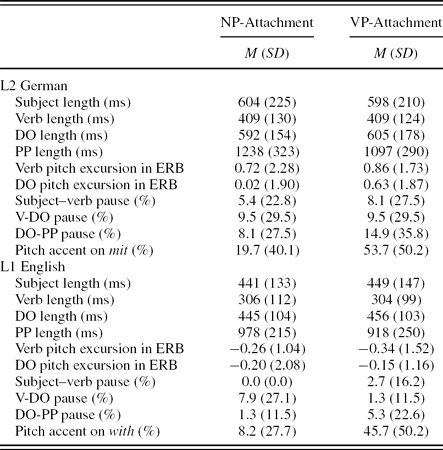
We started with 154 utterances for analysis. Six utterances were excluded because of repetitions in the subject, verb, or DO, such that the final analyses reported here were based on 148 observations. Repetitions in the PP led to the exclusion of 14 additional observations from the analyses of the PP, such that the analyses of this constituent are based on 134 observations. However, data from these 14 sentences were still included in the primary analyses of the verb and DO, because the disfluency in the PP did not have an impact on speakers’ productions earlier in the sentence. The mean duration for each critical constituent, the percentage of V-DO pauses and DO-PP pauses, the mean pitch excursion on the verb and DO, and the percentage of pitch accents on mit for the English–German L2 learners are presented in Table 2. A visual inspection of the percentage of V-DO and DO-PP pauses suggests that the English–German L2 learners paused less than 15% of the time overall in their German productions. Therefore, no statistical analyses were run on the English–German L2 learners’ pause data in German. For all other analyses, both participants and items were treated as random effects, and condition (NP-attachment vs. VP-attachment) was treated as a fixed effect. For the duration analyses of the verb, the DO and the PP, the number of syllables for each constituent was also entered as a fixed effect to control for differences in word length across items. These values were centered at the mean value for each constituent across all of the L2 German data from the German–English L2 learners, verb: M = 1.93 syllables, range = 1–4; DO: M = 3.12 syllables, range = 2–5; PP: M = 5.38 syllables, range = 3–8 (Hoffman & Rovine, Reference Hoffman and Rovine2007; Kreft, de Leeuw, & Aiken, Reference Kreft, de Leeuw and Aiken2007). Preliminary analyses indicated that the length of time participants had been living in Germany had a significant impact on their productions. Therefore, we included the length of time in Germany, calculated in terms of months abroad, as an additional fixed effect. This value was centered at the sample mean of 15.63. All models were estimated using restricted maximum likelihood. For each fixed and random effect included in the final model, a likelihood ratio test comparing the –2 restricted log likelihood values of the model including the variable to a version of the model without the variable was used to confirm the improvement in the goodness of fit of the final model (Hoffman & Rovine, Reference Hoffman and Rovine2007; Quené & van den Bergh, Reference Quené and van den Bergh2008).
Mean values of acoustic measures from the contextualized speaking task for the English–German L2 learners
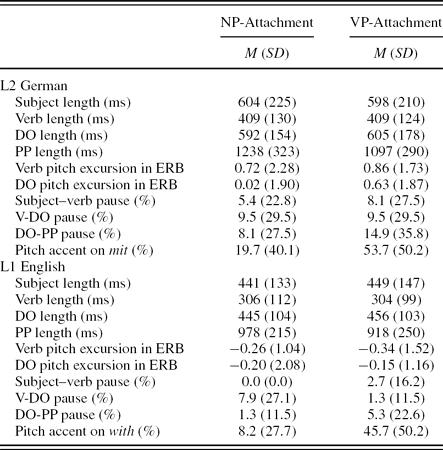
Note: L2, second language; NP, noun phrase; VP, verb phrase; DO, direct object; PP, prepositional phrase; ERB, equivalent rectangular bandwidth.
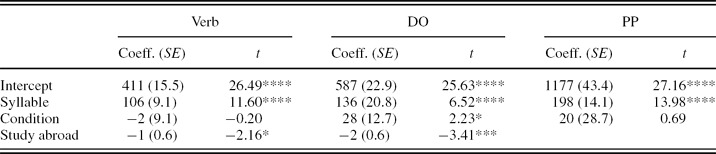
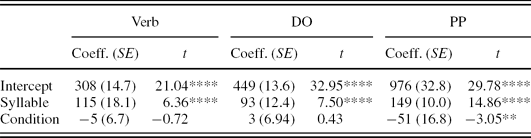
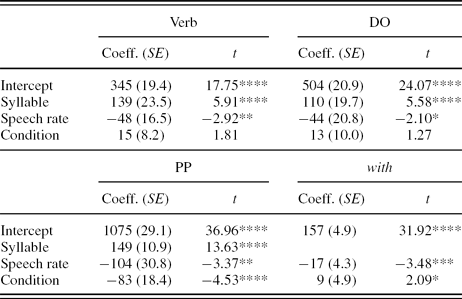
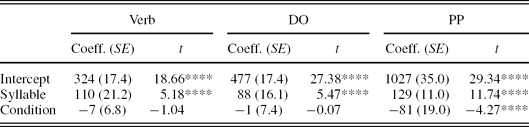
As seen in Table 3, there was a significant effect of syllable on the duration of each constituent because the participants took longer to produce words and phrases containing more syllables than words or phrases containing fewer syllables. The inclusion of syllable also significantly improved the explanatory value of the model for the duration of each constituent, verb: χ2 (1) = 34.09, p < .0001; DO: χ2 (1) = 21.02, p < .0001; PP: χ2 (1) = 114.79, p < .0001. There was also a significant effect of study abroad on the duration of the verb and the DO because L2 participants who had been living abroad for longer at the time of testing were faster than those who had not been living abroad for as long. The inclusion of months abroad also significantly improved the explanatory value of the model for the duration of the verb and the DO, verb: χ2 (1) = 4.50, p < .05; DO: χ2 (1) = 8.65, p < .01. In contrast, there was no significant effect of study abroad for the duration of the PP, so this variable was dropped from the final model reported here (p > .1). In the duration of the DO, there was a significant effect of condition because the participants took longer to produce the DO for VP-attachment than NP-attachment sentences. The inclusion of condition also significantly improved the explanatory value of the model for the duration of the DO, χ2 (1) = 4.91, p < .05. We tested for an interaction between condition and study abroad; however, this interaction was not significant for any constituent (all ps > .5).
Estimated coefficients from the multilevel model analyses of duration data from the English–German L2 learners in L2 German
Note: Syllable refers to the number of syllables in the target word. Condition refers to attachment type (noun phrase vs. verb phrase attachment). Study abroad refers to months spent abroad. Because the number of months spent abroad was not included in the final model for the prepositional phrase, this cell has been left blank. L2, second language; DO, direct object; PP, prepositional phrase.
*p < .05. ***p < .001. ****p < .0001.
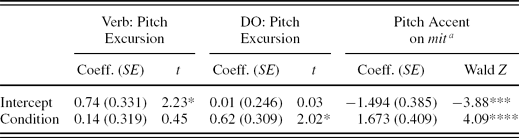
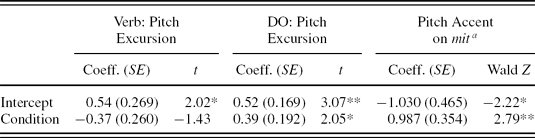
As seen in Table 4, in the analysis of pitch excursion and pitch accent data, neither the inclusion of study abroad nor the interaction between study abroad and condition improved the explanatory value of the model and was dropped from all analyses (all ps > .2). Similarly, the inclusion of items as a random effect did not improve the explanatory value of the model of pitch excursion on the DO or the pitch accent data, and therefore was dropped from these analyses. The final model of pitch excursion on the verb revealed no effect of condition. However, there was a significant effect of condition in the final model of pitch excursion on the DO because the participants exhibited a greater rise in F0 for VP-attachment sentences than NP-attachment sentences. The inclusion of condition also marginally improved the explanatory value of the model for pitch excursion on the DO, χ2 (1) = 3.83, p = .05.
Estimated coefficients from the mixed-effects model analyses of fundamental frequency excursion and pitch accent data from the English–German L2 learners in L2 German
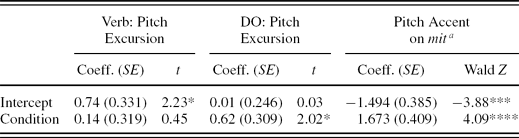
Note: Condition refers to attachment type (noun phrase vs. verb phrase attachment). L2, second language; DO, direct object.
aSee Note 10.
*p < .05. ***p < .001. ****p < .0001.
Finally, results from the mixed-effects logistic regression analysis of the pitch accent data revealed a main effect of condition because the participants were more likely to place a pitch accent on mit (with) in VP-attachment than in NP-attachment sentences.Footnote 9 The inclusion of condition also significantly improved the explanatory value of the model for pitch accent on mit, χ2 (1) = 17.84, p < .0001.
L1 English data
We started with 154 observations for analysis. Three utterances were excluded because of repetitions in the subject, verb, or DO, such that the final analyses reported here were based on 151 observations. Repetitions in the PP led to the exclusion of 8 additional observations from the analyses of the PP, such that the analyses of this constituent are based on 143 observations. However, as in the previous analyses, data from these 8 sentences were still included in the primary analyses of the verb and DO. The mean values for all acoustic measures for the English–L2 German learners’ English production data are presented in Table 2. Similar to the German results, the participants paused less than 8% of the time overall in English, and there is no apparent difference in the percentage of pauses on NP- versus VP-attachment sentences. Therefore, no statistical analyses were run on the pause data. For all other analyses, both participants and items were treated as random effects, and condition (NP-attachment vs. VP-attachment) was treated as a fixed effect. For the duration analyses, the number of syllables for each constituent was also entered as a fixed effect. These values were centered at the mean value for each constituent across all of the L1 English data from the German–English L2 learners, verb: M = 1.5 syllables, range = 1–3; DO: M = 2.65 syllables, range = 2–5; PP: M = 4.75 syllables, range = 3–7.
As seen in Table 5, there was a significant effect of syllable on the duration of each constituent because the English–German L2 learners took longer to produce words or phrases containing more syllables than words or phrases containing fewer syllables. The inclusion of syllable also significantly improved the explanatory value of the model for the duration of these constituents, verb: χ2 (1) = 20.50, p < .0001; DO: χ2 (1) = 24.03, p < .0001; PP: χ2 (1) = 128.74, p < .0001. There was no significant difference in duration as a function of condition for the verb or the DO. However, there was a significant effect of condition on the PP because the English–German L2 learners took longer to produce the PP in NP-attachment than VP-attachment sentences. The inclusion of condition also significantly improved the explanatory value of the model for the duration of the PP, χ2 (1) = 9.06, p < .01.
Estimated coefficients from the multilevel model analyses of duration data from the English–German second language learners in first language English
Note: Syllable refers to the number of syllables in the target word. Condition refers to attachment type (noun phrase vs. verb phrase attachment). DO, direct object; PP, prepositional phrase.
**p < .01. ****p < .0001.
An initial inspection of the mean pitch excursion values at the verb and the DO in Table 2 shows that, unlike their production of the German sentences, the English–German L2 learners’ F0 values fall rather than rise on the verb and the DO in both NP- and VP-attachment sentences in English. We fitted the models for pitch excursion on the verb and the DO, which did not show any significant differences between the NP- and VP-attachment conditions.
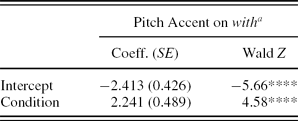
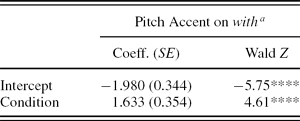
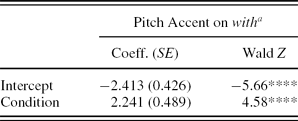
In the analysis of pitch accent data, as summarized in Table 6, the inclusion of items as a random effect did not improve the explanatory value of the model, and therefore was dropped from these analyses. The final model of the pitch accent data revealed a main effect of condition because the participants were more likely to place a pitch accent on with in VP-attachment than in NP-attachment sentences. Further, the inclusion of condition significantly improved the explanatory value of the model for pitch accent on with, χ2 (1) = 27.58, p < .0001.
Estimated coefficients from the mixed- effects model analyses of pitch accent data from the English–German second language learners in first language English
Note: Condition refers to attachment type (noun phrase vs. verb phrase attachment).
aSee Note 10.
****p < .0001.
Post hoc analysis
The durational effects reported on the PP, in which the English–German L2 learners exhibited longer durations on the NP- than the VP-attachment sentences, is the opposite pattern of what has been reported in previous English studies (Snedeker & Trueswell, Reference Snedeker and Trueswell2003; Snedeker & Yuan, Reference Snedeker and Yuan2008). One possible explanation for this difference is that even though the length of the PP did not differ between NP-attachment and VP-attachment sentences when averaged across all items (NP-attachment: M = 4.8 syllables; VP-attachment: M = 5.0 syllables), within individual items there were differences in both lexical content and the number of syllables. To control for these lexical and length differences across individual items, a post hoc analysis was conducted on the duration of the preposition itself, with, because this was the word that was present in all target sentences in both conditions. In a descriptive sense, the mean length of with was the same for both NP- and VP-attachment sentences (NP-attachment: M = 163 ms, SD = 33.2; VP-attachment: M = 167 ms, SD = 32.9). A mixed-effects linear regression analysis of the durations for with revealed no significant difference in duration on with as a function of condition.Footnote 10
EXPERIMENT 1b
Participants
Sixteen German–English L2 learners completed the same experiment as the English–German L2 learners. However, 3 of the participants did not complete the experiment in both languages. Therefore, all analyses reported here are based on the remaining 13 participants (mean age = 23.9 years, range = 19–30; 11 females). The German–English L2 learners were all from Hessen, Germany. They all scored at least 56 points (M = 79.8, SD = 13.6) on the Oxford Online Placement Test (Oxford University Press, 2009), indicating intermediate to advanced L2 English proficiency. Six of the participants had lived abroad in an English-speaking country for an average of 8 months (range = 6–10). The remaining 7 participants had never lived abroad in an English-speaking country.
These participants also completed the same picture description fluency task as the English–German L2 learners (see Table 1). A set of t tests comparing fluency measures in their L1 German to their L2 English revealed no significant difference in the proportion of repetitions but a significant or marginally significant difference in all other fluency measures, repetitions (t < 1): MLR: t (12) = 2.17, p = .051; pauses/second: t (12) = –2.57, p < .05; speech rate: t (12) = 3.75, p < .01; filled syllables: t (12) = –3.64, p < .01. A second set of t tests comparing the German–English L2 learners’ fluency measures in their L2 English to the L1 English fluency measures from the English–German L2 learners in Experiment 1a revealed no significant difference in speech rate or the proportion of filled pauses, speech rate: t (22) = –1.01, p = .326; filled pauses: –1.25, p = .225. However, there was a significant difference between the two groups with regard to MLR, pauses per second, and the proportion of repetitions, MLR: t (22) = 3.20, p < .01; pauses/sec; t (17.97) = –3.93, p < .01; repetitions: t (12.52) = –2.45, p < .05. Taken together, these comparisons suggest that the German–English L2 learners spoke English with relative ease, but their overall L2 English fluency may not have been at the same level as the L2 German fluency of the English–German L2 learners in Experiment 1a.
Materials
The materials used in Experiment 1b were the same as the German and English language materials described in Experiment 1a.
Procedure
The experimental procedure was the same as described for Experiment 1a except that the German–English L2 learners completed the contextualized speaking task and the picture description task in their L2 English in the first session, followed by the L1 German tasks in a second session 2 weeks later. However, for ease of exposition and to parallel the presentation of results from Experiment 1a, the German–English L2 learners’ L1 German results from the second session will be presented first.
Results
L1 German data
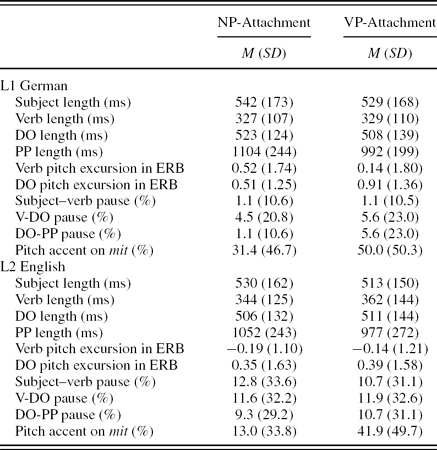
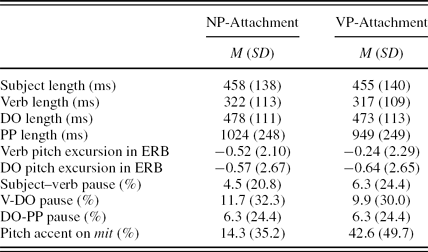
We started with 182 utterances for analysis. Three utterances were excluded because of repetitions in the subject, verb, or DO, such that the final analyses reported here were based on 179 observations. Repetitions in the PP led to the exclusion of 3 additional observations from the analyses of the PP, such that the analyses of this constituent are based on 176 observations. However, data from these three sentences were still included in the primary analyses of the verb and DO. The mean values for all acoustic measures for the German–English L2 learners’ German production data are presented in Table 7. The German–English L2 learners paused less than 6% of the time overall in German, and there is no apparent difference in the percentage of pauses on NP- versus VP-attachment sentences. Therefore, no statistical analyses were run on the pause data. For all other analyses, both participants and items were treated as random effects and condition (NP-attachment vs. VP-attachment) was treated as a fixed effect. For the duration analyses, the number of syllables for each constituent was also entered as a fixed effect. These values were centered at the mean value for each constituent, verb: M = 1.93 syllables, range = 1–4; DO: M = 3.13 syllables, range = 2–5; PP: M = 5.42 syllables, range = 3–8.
Mean values of acoustic measures from the contextualized speaking task for the German–English L2 learners
Note: L2, second language; NP, noun phrase; VP, verb phrase; L1, first language; DO, direct object; PP, prepositional phrase; ERB, equivalent rectangular bandwidth.
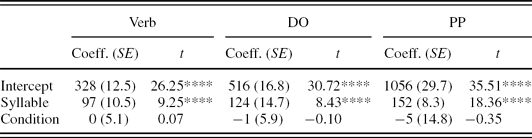
As seen in Table 8, there was a significant effect of syllable on the duration of each constituent because the German–English L2 learners took longer to produce words or phrases containing more syllables than words or phrases containing fewer syllables. The inclusion of syllable also significantly improved the explanatory value of the model for the duration of each constituent, verb: χ2 (1) = 28.97, p < .0001; DO: χ2 (1) = 26.72, p < .0001; PP: χ2 (1) = 182.35, p < .0001. There was no significant difference in duration as a function of condition for any of the constituents (all ps > .8).
Estimated coefficients from the multilevel model analyses of duration data from the German–English second language learners in first language German
Note: Syllable refers to the number of syllables in the target word. Condition refers to attachment type (noun phrase vs. verb phrase attachment). DO, direct object; PP, prepositional phrase.
****p < .0001.
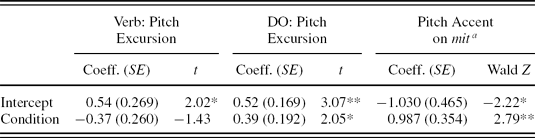
Table 9 displays the results from the mixed-effects linear models for pitch excursion and the mixed-effects logistic model for pitch accent. In the analysis of the pitch excursion data on the DO and the pitch accent data, the inclusion of items as a random effect did not improve the explanatory value of the model and was dropped from these analyses. Although there was no effect of condition in pitch excursion on the verb, this effect was significant on the DO because at the DO, the German–English L2 learners exhibited a higher rise in F0 for VP-attachment than for NP-attachment sentences. The inclusion of condition also significantly improved the explanatory value of the model for pitch excursion at the DO, χ2 (1) = 4.17, p < .05.
Estimated coefficients from the mixed-effects model analyses of fundamental frequency excursion and pitch accent data from the German–English second language learners in first language German
Note: Condition refers to attachment type (noun phrase vs. verb phrase attachment). DO, direct object.
aSee Note 10.
*p < .05. **p < .01.
Finally, results from the mixed-effects logistic regression analysis of the pitch accent data revealed a main effect of condition because the German–English L2 learners were more likely to place a pitch accent on mit in VP-attachment than in NP-attachment sentences in German. The inclusion of condition significantly improved the explanatory value of the model for pitch accent on mit, χ2 (1) = 7.26, p < .01.
L2 English data
We started with 182 utterances for analysis. Twelve utterances were excluded because of repetitions in the subject, verb, or DO, such that the final analyses reported here were based on 170 observations. Repetitions in the PP led to the exclusion of 19 additional observations from the analyses of the PP, such that the analyses of this constituent are based on 151 observations. However, data from these 19 sentences were still included in the primary analyses of the verb and DO. The mean values for all acoustic measures for the L2 English data from the German–English L2 learners is presented in Table 7. As seen in Table 7, the German–English L2 learners paused 13% of the time overall in their English productions, and there is no apparent difference in the percentage of pauses on NP- versus VP-attachment sentences. Therefore, no statistical analyses were run on the pause data. For all other analyses, both participants and items were treated as random effects and condition (NP-attachment vs. VP-attachment) was treated as a fixed effect. For the duration analyses, the number of syllables for each constituent was also entered as a fixed effect. These values were centered at the mean value for each constituent, verb: M = 1.52 syllables, range = 1–3; DO: M = 2.66 syllables, range = 2–5; PP: M = 4.84 syllables, range = 3–7. Preliminary analyses indicated that participants’ speech rate on the English picture description task had a significant impact on their productions so this was added as an additional fixed effect, centered at the sample mean of 4.10.
As seen in Table 10, there was a significant effect of syllable on the duration of each constituent, because the participants took longer to produce words and phrases containing more syllables than words or phrases containing fewer syllables. The inclusion of syllable also significantly improved the explanatory value of the model for the duration of each constituent, verb: χ2 (1) = 18.94, p < .0001; DO: χ2 (1) = 17.75, p < .0001; PP: χ2 (1) = 117.62, p < .0001. There was also a significant effect of speech rate on the duration of each constituent because those participants with faster speech rates on the English picture description task were faster overall than those with slower speech rates on the English picture description task. The inclusion of L2 speech rate also significantly improved the explanatory value of the model for each constituent, verb: χ2 (1) = 7.08, p < .01; DO: χ2 (1) = 4.19, p < .05; PP: χ2 (1) = 8.97, p < .01. There was no significant difference in duration as a function of condition for the verb or the DO. However, there was a significant effect of condition on the PP because the German–English L2 learners took longer to produce the PP in NP-attachment than in VP-attachment sentences. The inclusion of condition also significantly improved the explanatory value of the model for the duration of the PP, χ2 (1) = 19.37, p < .0001. We also tested for an interaction between condition and L2 speech rate; however, this two-way interaction was not significant for the duration of any constituent (all ps > .2).
Estimated coefficients from the multilevel model analyses of duration data from the German–English L2 learners in L2 English
Note: Syllable refers to the number of syllables in the target word (as there was no difference in syllable length on the preposition with, this cell has been left blank). Condition refers to attachment type (noun phrase vs. verb phrase attachment). Speech rate refers to second language (L2) speech rate. DO, direct object; PP, prepositional phrase.
*p < .05. **p < .01. ***p < .001. ****p < .0001.
An initial inspection of the mean pitch excursion values at the verb and the DO in Table 7 shows that, unlike their production of the German sentences, the German–English L2 learners’ F0 values fall rather than rise on the verb in their English productions. Further, although their F0 values still rise on the DO in English, there is no apparent difference in the pitch excursion values on NP- vs. VP-attachment sentences. We fitted the models for pitch excursion on the verb and the DO, including L2 speech rate as an additional fixed effect, but these analyses did not show any significant differences in pitch excursion between the NP- and VP-attachment conditions on either the verb or the DO.
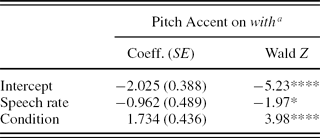
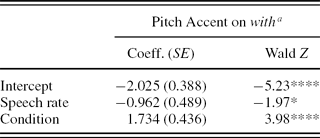
In the analysis of pitch accent data, as summarized in Table 11, the inclusion of items as a random effect did not improve the explanatory value of the model and was dropped from these analyses. The final model of the pitch accent revealed a main effect of condition because the German–English L2 learners were more likely to place a pitch accent on with in VP-attachment than in NP-attachment sentences. Further, the inclusion of condition significantly improved the explanatory value of the model for pitch accent on with, χ2 (1) = 17.93, p < .0001. There was also a main effect of L2 speech rate because participants with a faster L2 speech rate on the English picture description task were less likely to place a pitch accent on with than participants with a slower L2 speech rate. The inclusion of L2 speech rate also marginally improved the overall explanatory value for pitch accent on with, χ2 (1) = 3.67, p = .055. However, there was no significant interaction between condition and L2 speech rate (p > .7).
Estimated coefficients from the mixed- effects model analyses of pitch accent data from the German–English L2 learners in L2 English
Note: Condition refers to attachment type (noun phrase vs. verb phrase attachment). Speech rate refers to second language (L2) speech rate.
aSee Note 10.
*p < .05. ****p < .0001.
Post hoc analysis
Similar to the English–German L2 learners, a post hoc analysis was conducted on the duration of the preposition with. Descriptively, the mean length of with was longer on VP- than NP-attachment sentences (NP-attachment: M = 158 ms, SD = 30.0; VP-attachment: M = 164 ms, SD = 31.8). We ran a mixed-effects linear regression analysis of the durations for with, treating participants and items as random effects and condition and L2 speech rate as fixed effects. As seen in Table 10, there was a main effect of condition because the duration of with on VP-attachment sentences was longer than on NP-attachment sentences. The inclusion of condition also significantly improved the explanatory value for the duration of with, χ2 (1) = 4.08, p < .05. There was a main effect of L2 speech rate because faster participants had shorter durations overall than slower participants. The inclusion of L2 speech rate also significantly improved the explanatory value for the duration of with, χ2 (1) = 9.17, p < .01. However, there was no significant interaction between condition and L2 speech rate (p > .3).
Discussion
The goal of Experiments 1a and 1b was to explore whether English–German L2 learners and German–English L2 learners would transfer the use of specific prosodic cues to disambiguation in each of their languages. To summarize the results, the English–German L2 learners in Experiment 1a used F0 and pitch accent placement on the preposition mit (with) as cues to disambiguation in their L2 German, producing a rise on the DO noun and a pitch accent on mit in the VP-attachment condition. They also lengthened the duration of the DO in VP-attachment sentences compared to NP-attachment sentences. In contrast, when producing similar PP-attachment sentences in their L1 English, the English–German L2 learners did not produce an F0 rise in either NP- or VP-attachment sentences. They exhibited a fall in pitch at both possible boundary locations (the verb in NP-attachment sentences and the DO in VP-attachment sentences), regardless of attachment type. They also exhibited no durational differences on the verb or the DO as a means of disambiguation in their L1 English. However, they were more likely to place a pitch accent on with in VP-attachment than in NP-attachment sentences, similar to their L2 German productions. Finally, the English–German L2 learners took longer to produce the PP in NP- than in VP-attachment sentences, although post hoc analyses on the preposition with revealed no significant differences in duration as a function of attachment type.
The results from the German–English L2 learners in Experiment 1b were remarkably similar to the results from the English–German L2 learners in both languages. In their L1 German productions, the German–English L2 learners exhibited a greater F0 rise at the DO and a greater proportion of pitch accents on the preposition mit on VP-attachment compared to NP-attachment sentences. However, there were no durational differences at any constituent in their L1 German data as a function of attachment type. In their L2 English productions, the German–English L2 learners did not use a rise in pitch to distinguish VP- from NP-attachment sentences at either the verb or the DO, but they were more likely to place a pitch accent on the preposition with in VP-attachment than in NP-attachment sentences. Finally, the German–English L2 learners took longer to produce the PP in NP- than in VP-attachment sentences, although post hoc analyses on the preposition with revealed the reverse effect, with longer durations on VP- compared to NP-attachment sentences.
The results for both L2 participant groups suggest that they did not engage in the wholesale transfer of prosodic cues from their L1 to the L2. The most important point is that the speakers in both groups did not produce an F0 rise in either the NP- or VP-attachment condition when producing temporarily ambiguous PP-attachment sentences in English. Nonetheless, these same speakers reliably produced a rise in F0 on the DO in VP-attachment sentences in German, similar to findings reported by Lingel et al. (Reference Lingel, Pappert and Pechman2006) for native speakers of German. The only cue that the participants consistently used in both languages was placing a pitch accent on mit or with in VP-attachment sentences, paralleling previously reported findings in English (Snedeker & Trueswell, Reference Snedeker and Trueswell2003; Snedeker & Yuan, Reference Snedeker and Yuan2008). Taken together, the present results, when combined with the results from these previous L1 English and L1 German studies, suggest that pitch may play a more important role to syntactic disambiguation in German than in English, a possibility that will be discussed in greater detail in the General Discussion.
At the same time, the participants did not produce durational differences as reliably as has been reported in previous English and German studies, nor did they use pauses in either language (e.g., Cooper & Paccia-Cooper, Reference Cooper and Paccia-Cooper1980; Kraljic & Brennan, Reference Kraljic and Brennen2005; Lingel et al., Reference Lingel, Pappert and Pechman2006; Price et al., Reference Price, Ostendorf, Shattuck-Hufnagel and Fong1991; Schafer et al., Reference Schafer, Speer, Warren, Tanenhaus and Trueswell2005; Snedeker & Trueswell, Reference Snedeker and Trueswell2003; Snedeker & Yuan, Reference Snedeker and Yuan2008). We hypothesize that this is a task-induced effect. Like previous studies in which speakers only reliably used prosodic cues to disambiguate sentences when the situational context or the task instructions highlighted the need for structural disambiguation (e.g., Albritton, McKoon, & Ratcliff, Reference Albritton, McKoon and Ratcliff1996; Lingel et al., Reference Lingel, Pappert and Pechman2006; Snedeker & Trueswell, Reference Snedeker and Trueswell2003; Straub, Reference Straub1997), the participants in the present study may have been less likely to rely on pauses or duration because the context may not have required them to do so (see also Schafer et al., Reference Schafer, Speer, Warren, Tanenhaus and Trueswell2005). However, in light of the significant effects for pitch excursion and pitch accent, the lack of pauses should not be taken as an indication that the participants were unable to disambiguate the target sentences. Moreover, the paucity of pauses in the speech in participants’ L2 may speak to their overall L2 fluency.
Although there were no significant duration effects on either the verb or the DO in English for either the English–German L2 learners or the German–English L2 learners, both groups took longer to produce PPs in NP- than in VP-attachment sentences in English. Given that several previous studies have reported the reverse pattern, with longer durations on PPs in VP-attachment than in NP-attachment sentences in both English and German (Lingel et al., Reference Lingel, Pappert and Pechman2006; Snedeker & Trueswell, Reference Snedeker and Trueswell2003; Snedeker & Yuan, Reference Snedeker and Yuan2008), this effect is somewhat surprising. Possible reasons for this effect of duration on the PP will be addressed in the General Discussion. At the same time, this effect does not detract from the more important finding that neither group of participants used a rise in pitch when producing sentences in English. As such, this finding does not undermine the larger conclusion that the L2 participants did not simply transfer the use of L1 prosodic cues when producing similarly ambiguous sentences in their L2.
EXPERIMENT 2
In the English results from Experiments 1a and 1b neither participant group used duration, pauses, or an F0 rise to disambiguate temporarily ambiguous English PP-attachment sentences, similar to previous experiments involving more constrained reading tasks (e.g., Albritton et al., Reference Albritton, McKoon and Ratcliff1996; but see Straub, Reference Straub1997). However, the lack of significant differences in the English data, especially with regard to the duration of critical constituents, could be because both participant groups were living in a German-dominant environment at the time of testing. Thus, to corroborate the English data from Experiments 1a and 1b, in Experiment 2 we tested nonimmersed native English speakers with little foreign-language learning experience using the same materials and procedure as the previous experiments. If the lack of significant differences between NP- and VP-attachment sentences in the English data from Experiments 1a and 1b is the result of participants living in a German-dominant environment, then we predict to find significant effects of duration and pauses in the speech production of monolingual English participants. In contrast, if the lack of duration and pause effects in Experiments 1a and 1b is the result of task-based constraints, then we expect to see no duration or pause effects, even among monolingual English speakers.
Participants
Sixteen native speakers of American English were recruited from a large university in the northeastern United States (mean age = 21.4 years, range = 19–23 years; six females). All participants reported learning a foreign language in high school or in college. However, none of them considered themselves fluent in any language other than English and none had spent more than 6 weeks in an L2 environment. For this reason, we will refer to this group of participants as English monolinguals. These participants also completed the same picture description task in English as the previous participants. These results are presented in Table 1.
Materials
The materials used in Experiment 2 were the same as the English-language materials described in Experiment 1a.
Procedure
The experimental procedure was the same as in Experiment 1a except that participants filled out the language-background questionnaire after completing the English contextualized speaking task and the English fluency task. All recordings were made in a quiet room using Audacity 1.2 for Windows XP. All data were automatically digitized at a sampling rate of 44.1 kHz.
Results
The data from the monolingual English participants were coded and analyzed in the same manner as the previous experiments. We started with 224 utterances for analysis. Two utterances were excluded because of repetitions in the subject, verb or DO, such that the final analyses reported here were based on 222 observations. Repetitions in the PP led to the exclusion of 9 additional observations from the analyses of the PP, such that the analyses of this constituent are based on 213 observations. However, data from these nine sentences were still included in the primary analyses of the verb and DO. The mean values for all acoustic measures for the monolingual English participants’ production data are presented in Table 12. Similar to the previously reported results, the monolingual English participants paused less than 12% of the time, regardless of location or condition. Therefore, no statistical analyses were run on the pause data. For the duration analyses, the number of syllables for each constituent was also entered as a fixed effect. These values were centered at the mean value for each constituent (verb: M = 1.5 syllables, range = 1–3; DO: M = 2.64 syllables, range = 2–5; PP: M = 4.79 syllables, range = 3–7).
Mean values of acoustic measures from the contextualized speaking task for the monolingual English speakers
Note: NP, noun phrase; VP, verb phrase; DO, direct object; PP, prepositional phrase; ERB, equivalent rectangular bandwidth.
As seen in Table 13, there was a significant effect of syllable on the duration of the verb and the DO because the monolingual English participants took longer to produce words containing more syllables than words containing fewer syllables. The inclusion of syllable also significantly improved the explanatory value of the model for the verb and the DO, verb: χ2 (1) = 16.30, p < .0001; DO: χ2 (1) = 17.29, p < .0001. However, there was no significant effect of condition on the verb or the DO (all ps > .3). On the PP there was a significant effect of length because the monolingual English participants took longer to produce phrases containing more syllables than phrases containing fewer syllables. On the PP there was also a significant effect of condition. Like the English–L2 German learners and the German–L2 English learners, the monolingual English participants took longer to produce the PP in NP- than in VP-attachment sentences. The inclusion of condition and syllable also significantly improved the explanatory value of the model for the duration of the PP, syllable: χ2 (1) = 104.11, p < .0001; condition: χ2 (1) = 17.47, p < .0001.
Estimated coefficients from the multilevel model analyses of duration data from the monolingual English speakers
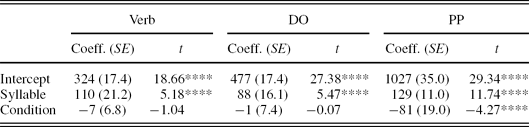
Note: Syllable refers to the number of syllables in the target word. Condition refers to attachment type (noun phrase vs. verb phrase attachment).
****p < .0001.
An initial inspection of the mean pitch excursion values at the verb and the DO for the monolingual English participants in Table 12 shows that, similar to the L1 English data from the English–German L2 learners, the monolingual English participants’ F0 values fall rather than rise on the verb and the DO in both NP- and VP-attachment sentences. We fitted the models for pitch excursion on the verb and the DO, which did not show any significant differences between the NP- and VP-attachment conditions.
In the analysis of pitch accent data, as summarized in Table 14, the inclusion of items as a random effect did not improve the explanatory value of the model, and therefore was dropped from these analyses. The final model for the pitch accent data revealed a main effect of condition because, like the English–German L2 learners and the German–English L2 learners, the monolingual English participants were more likely to place a pitch accent on with in VP-attachment than in NP-attachment sentences. Further, the inclusion of condition significantly improved the explanatory value of the model for pitch accent on with, χ2 (1) = 23.40, p < .0001.
Estimated coefficients from the mixed- effects model analyses of pitch accent data from the monolingual English speakers
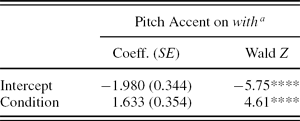
Note: Condition refers to attachment type (noun phrase vs. verb phrase attachment).
aSee Note 10.
****p < .0001.
Post hoc analysis
Similar to Experiments 1a and 1b, a post hoc analysis was conducted on the duration of the preposition with. Descriptively, the mean length of with was nearly the same for both NP- and VP-attachment sentences (NP-attachment: M = 180 ms, SD = 37.9; VP-attachment: M = 179 ms, SD = 36.1). A mixed-effects linear regression analysis of the durations for with revealed no significant difference in duration on with as a function of condition.Footnote 11
Discussion
The results of Experiment 2 indicate that the cues used by the English–German L2 learners and the German–English L2 learners when producing English sentences were not just an anomaly stemming from living in a German-dominant environment. The monolingual English speakers, like the L2 participants, placed a pitch accent on the word with in the VP-attachment sentences to distinguish VP- from NP-attachment sentences. Similar to the L2 participants, the monolingual English speakers took longer to produce the PP on NP-attachment than on VP-attachment sentences. However, the monolingual English speakers exhibited no other durational differences between NP- and VP-attachment sentences, nor did they rely on pauses to disambiguate the target sentences.
GENERAL DISCUSSION
The main goal of the current study was to determine whether late English L2 learners of German and late German L2 learners of English reliably produce prosodic cues to disambiguate temporarily ambiguous PP-attachment sentences when producing sentences in their L1 and their L2. A second goal was to determine precisely which cues they would use and whether these cues differ from those used by native speakers of their respective L2s. Results from Experiments 1a and 1b showed that the L2 learners prosodically disambiguated the target sentences and that they relied upon similar cues as native speakers. Both participant groups relied on an F0 rise on the DO and pitch accent placement on the preposition mit in VP-attachment sentences relative to NP-attachment sentences in German. In English, both participant groups relied on pitch accent placement on with as the primary cue to disambiguate VP-attachment sentences.
In Experiment 2, the analysis of the production data from monolingual English speakers paralleled the English results from both L2 participant groups in Experiments 1a and 1b in that the monolingual English speakers primarily made use of pitch accent on the preposition with in VP-attachment sentences. This rules out the possibility that the English results from the L2 participants in Experiments 1a and 1b stemmed from living in a German-dominant environment at the time of testing. As such, the findings from Experiment 2 lend additional support to the claim that the English–German L2 learners did not simply transfer disambiguation strategies from their L1 English when completing the German contextualized speaking task, and they confirm that the German–English L2 learners performed similarly to English native speakers when completing the production task in their L2 English.
One unexpected finding in the English data has to do with the durational effects on the PP in the NP-attachment condition. This finding stands counter to previous studies in both English and German (e.g., Lingel et. al., Reference Lingel, Pappert and Pechman2006; Snedeker & Trueswell, Reference Snedeker and Trueswell2003; Snedeker & Yuan, Reference Snedeker and Yuan2008), which have shown that speakers often take longer to produce PPs in VP-attachment sentences than in NP-attachment sentences. The present findings may stem from differences in the length and lexical content of the PP across conditions, which could have led to the emergence of durational differences independent of the primary manipulation of attachment type. Post hoc analyses of the preposition with support this hypothesis. Comparisons of the duration of with, which is the word that was identical across conditions for all NP- and VP-attachment items, revealed no significant difference in duration according to attachment type among either the English–German L2 learners or the monolingual English speakers, paralleling the lack of durational differences according to attachment type on the verb and the DO. For the German–English L2 learners, the duration of with was longer on VP-attachment than on NP-attachment sentences, similar to findings from previous native English and German studies in which participants have lengthened the PP in VP-attachment sentences (Lingel et. al., Reference Lingel, Pappert and Pechman2006; Snedeker & Trueswell, Reference Snedeker and Trueswell2003) and Snedeker and Yuan (Reference Snedeker and Yuan2008), in which they reported durational differences directly on the preposition with. It is more important that the presence of durational differences on the PP in English does not undermine the more critical finding, namely, the absence of significant effects related to pitch rise, in contrast to the German findings from Experiment 1. Thus, the effect of duration on the PP will not be discussed further.
Prosodic cues to disambiguation in German
Returning to the German findings from Experiments 1a and 1b, both the English–German L2 learners and the German–English L2 learners produced a prosodic boundary between the DO and the PP in VP-attachment sentences via an F0 rise and the placement of a pitch accent on mit. In placing a break between the DO and the PP, both participant groups indicated in German that the DO and the sentence-final PP should not be construed as a single unit, thereby facilitating an interpretation in which the PP modified the verb.
At the same time, there was no corresponding break between the verb and the DO in NP-attachment sentences for either L2 participant group in German. This contrasts with prior research that has found evidence of a prosodic break at this location in both languages (Lingel et al., Reference Lingel, Pappert and Pechman2006; Snedeker & Trueswell, Reference Snedeker and Trueswell2003; Snedeker & Yuan, Reference Snedeker and Yuan2008). One reason for these findings may be that NP interpretations may have been possible for sentences we classified as VP-attachment sentences. Thus, participants may have produced more robust cues to disambiguation to highlight the VP-attachment interpretation of these sentences. Even in studies that have reported a break between the verb and the DO in NP-attachment sentences, this break is both smaller and less reliable than the break between the DO and the PP in VP-attachment sentences (Lingel et al., Reference Lingel, Pappert and Pechman2006; Snedeker & Trueswell, Reference Snedeker and Trueswell2003; Snedeker & Yuan, Reference Snedeker and Yuan2008). Similarly, research has shown that speakers may be less likely to produce a prosodic boundary between verbs and DOs to begin with, either because the DO is often an obligatory argument of the verb (e.g., Watson et al., Reference Watson, Breen and Gibson2006; Watson & Gibson, Reference Watson and Gibson2005) or because of the semantic closeness of the verb and the DO (e.g., Selkirk, Reference Selkirk1984). Nonetheless, the lack of a significant difference in prosodic cues between NP- and VP-attachment sentences at the verb in the present study is not entirely out of line with previous findings.
Perhaps more unforeseen was that the participants in the present study produced few durational differences on critical constituents according to attachment type, and pauses between the critical constituents were rare. The only exception to this was that the English–German L2 learners produced longer DOs for VP-attachment than for NP-attachment sentences in German. The reliability of duration as a cue to disambiguation has been shown in comprehension (Lehiste et al., Reference Lehiste, Olive and Streeter1976; Scott, Reference Scott1982; Hoyte et al., Reference Hoyte, Brownell and Wingfield2009) and in production (Lingel et al., Reference Lingel, Pappert and Pechman2006; Snedeker & Trueswell, Reference Snedeker and Trueswell2003), and the importance of pauses has been reported in a number of previous studies in both English and German (e.g., Cooper & Paccia-Cooper, Reference Cooper and Paccia-Cooper1980; Lingel et al., Reference Lingel, Pappert and Pechman2006; Snedeker & Trueswell, Reference Snedeker and Trueswell2003; Snedeker & Yuan, Reference Snedeker and Yuan2008). That our participants rarely disambiguated via lengthening or pausing may be a task-related effect. Unlike a number of studies that have reported durational effects (e.g., Schafer et al., Reference Schafer, Speer, Warren, Tanenhaus and Trueswell2005; Snedeker & Trueswell, Reference Snedeker and Trueswell2003; Snedeker & Yuan, Reference Snedeker and Yuan2008), the task in the current study did not involve an interlocutor. Thus, participants were not engaged in other-directed, hyperspeech (Lindblom, Reference Lindblom, Hurford, Studdert-Kennedy and Knight1998), in which the inclusion of redundant cues would aid in the interpretation of the utterance. Further, the nature of the contexts preceding the target sentences may have constrained the possible interpretations of the target sentence, thereby limiting the need to use pauses and durational cues for disambiguation (Straub, Reference Straub1997). Despite the potential drawbacks of doing so, we relied upon read speech to guarantee comparable utterances across speakers. Future research involving a more spontaneous speech task could ascertain whether L2 learners would rely on duration and pauses to disambiguate utterances in the presence of an interlocutor.
One additional factor that potentially affected the durational differences was the number of syllables in each constituent. Although the number of syllables was included as a variable in the statistical analyses, this may not have completely eliminated the possibility that differences in number of syllables across items played a role. A follow-up study is currently under way to explore whether durational effects appear in German, once syllable length is controlled for.
Cross-linguistic differences in pitch as a cue to disambiguation
Whereas pitch accent placement on the preposition is a cue to disambiguation in both languages, the question remains as to why both the English–German L2 learners and the German–English L2 learners used pitch to disambiguate VP- from NP-attachment sentences when producing German sentences, whereas such effects were not apparent in the English results of any participant group. It may be that the F0 rise on the DO noun in VP-attachment sentences is a more fixed pattern or tune in German. In contrast, this same contour may be just one potential tune of many to signal VP-attachment in English. Given the differences in the current production data between English and German, along with previous research that has shown that pitch may not be the most reliable cue for English listeners (e.g., Cooper & Pacia-Cooper, Reference Cooper and Paccia-Cooper1980; Sedeker and Trueswell, Reference Snedeker and Trueswell2003; Snedeker & Yuan, Reference Snedeker and Yuan2008), future perceptual research could help determine whether pitch alone can aid disambiguation for listeners in German.
When extended to the L2 pronunciation literature, the results of the current study make two important contributions. First, both the English–German L2 learners and the German–English L2 learners used prosodic features to convey meaning in their respective L2, and these features were the same cues to disambiguation used by native speakers in each language. This stands in contrast to previous studies that have shown that L2 learners are less consistent and differ significantly from native speakers in their use of prosodic cues to meaning (e.g., Gut, Reference Gut2009; Ramírez Verdugo, Reference Ramírez Verdugo2002; Wennerstrom, Reference Wennerstrom1994). Second, a comparison of the German and English results from Experiments 1a and 1b suggest that the L2 participants did not use precisely the same cues to differentiate NP- from VP-attachment sentences in both of their languages. Although not completely speaking against transfer, this supports the results of previous studies showing that transfer is not an all-or-nothing phenomenon (e.g., Gut, Reference Gut2003, Reference Gut2009; Jilka, Reference Jilka, Trouvain and Gut2007; Kim & Kim, Reference Kim and Kim2001).
Conclusion
The L2 learners in the current study were able to produce prosodic cues to disambiguation in their L2, and they relied on the same cues as those used by native speakers. Further, they did so even though they were late-learning L2 learners who, although fluent, had arguably not yet reached asymptote, as demonstrated by the results from the independent measure of L1 and L2 fluency. Although the reliability of these prosodic cues must be validated through future perceptual studies involving both intelligibility tasks and foreign accent ratings, the present findings represent a valuable step toward determining precisely how L2 learners make use of prosodic cues during L2 production. As such, these results complement the findings of comprehension studies (Dekydtspotter et al., Reference Dekydtspotter, Donaldson, Edmonds, Fultz and Petrusch2008; Fultz, Reference Fultz, Chan, Jacob and Kapia2007) that point to the salience of prosodic cues in L2 processing and highlight how, at least in certain situations, even L2 learners who have not achieved near native levels of L2 proficiency grasp the important role prosody can play in expressing the meaning of an utterance.
APPENDIX A: ENGLISH CONTEXTS AND TARGET SENTENCES
English situational contexts and target experimental sentences used in the German contextualized sentence production task
APPENDIX B: GERMAN CONTEXTS AND TARGET SENTENCES
German situational contexts and target experimental sentences used in the German contextualized sentence production task