1. Introduction
Do public perceptions of a foreign power change over time? Are they shaped by a cultural and historical identity of a society passed down through generations? Or are they reflective of inter-generational ruptures driven by major historical events? One answer to this question can be found from traditional approaches to international security. Classical security literature establishes that foreign policies reflect cultures, norms, or identities constructed over an extended period of time (Huntington, Reference Huntington1996; Katzenstein, Reference Katzenstein1996). A country might have a unique and stable ‘strategic culture,’ which might define the overall public attitudes toward a foreign government. Public opinions about foreign countries, therefore, were assumed rather homogeneous within a society.
A different line of research, however, points to the square opposite: public opinions on foreign policies (and therefore foreign governments) vary wildly within a society. As contemporary international relation scholarship begins to directly examine public opinions on foreign policies, researchers grew increasingly interested in their time-variant, dynamic nature. One of the primary factors that help shape individuals' foreign policy opinions, this literature finds, is their experience of political socialization. This line of literature now enjoys considerable empirical support.Footnote 1 Different generations might have different experiences of major historical events and, thus, divergent foreign policy opinions.
The empirical domain of this new literature, however, has been confined largely to American foreign policy. A host of research questions surrounding the relationship between the USA and its close allies (or potential enemies) have traditionally determined the empirical boundaries of these studies (Lacina and Lee, Reference Lacina and Lee2013; Tomz and Weeks, Reference Tomz and Weeks2013; Kertzer et al., Reference Kertzer, Powers, Rathbun and Iyer2014). Although this line of research significantly advanced our understanding of the microfoundations of foreign policies, researchers remain largely agnostic as to how this empirical regularity holds in different contexts, particularly in a non-democratic, non-western environment.
Filling this lacuna, this research note studies Vietnamese public opinions about Chinese economic expansion. Beyond the popular, descriptive portrayal of ‘angry’ Vietnamese as a homogeneous group reacting to Chinese assertiveness in South China Sea (e.g., Clark, Reference Clark2011), I reveal the individual-level heterogeneity mapping into a rupture between birth cohorts over how the rise of the Chinese economy is viewed. I argue that through the dramatic modernization drive of the country in the 1980s, known as Doi Moi (renovation), the Vietnamese public was abruptly exposed to the non-Communist world. This sudden openness undermined the epistemological foundation of the Soviet-style political socialization of Vietnam, often referred to as the ‘Two-World Theory.’ Because the traditional communist political socialization had moderated an otherwise hostile sentiment of Vietnamese people toward China, Doi Moi, by weakening such a moderator, must have led to a significant shift in how Vietnamese citizens view China. In particular, one should expect a marked difference between the birth cohorts of this reform era and the prior generations who were already imbued by the traditional Soviet socialization. As such, comparing the Doi Moi birth cohorts and those immediately preceding them, two groups that are otherwise very similar in terms of demographic attributes, offers a prime opportunity to gage the causal effect of Doi Moi on Vietnamese public opinions about China. Utilizing the inter-birth cohort discontinuity of socialization experiences reflected in the latest Pew Global Attitude Survey, I demonstrate that Doi Moi contributed significantly to Vietnamese citizens' negative perceptions of China, particularly its economic expansion.
The rest of the research note proceeds as follows. In the next section, I delineate the theoretical tension between the two approaches to the determinants of public opinions about foreign governments. I then contextualize these tenets onto the modern history of Vietnam, generating a testable hypothesis. This is followed by empirical analyses using regression discontinuity designs (RDDs). I conclude with a summary of findings as well as a discussion of their implications for the literature and policymaking.
2. Political socialization and foreign policy opinions
Traditional international relations scholarship has long treated public opinions as of second-order importance. The classical paradigm-centric approaches in international relations left little room for researchers to investigate individual-level attributes of how foreign policies are publicly construed (Lake, Reference Lake2013). Renowned interests in behavioral science in recent years, however, brought about significant changes in this tradition (Kertzer and Tingley, Reference Kertzer and Tingley2018). Of particular relevance in this shift to the present research is an emerging body of literature focusing on the ‘microfoundation’ of public perception on foreign countries. It establishes that ordinary citizens form fairly clear opinions about other countries, sometimes even without any expertise in international relations, based on their own belief systems (Rathbun et al., Reference Rathbun, Kertzer, Reifler, Goren and Scotto2016). Highly individualized factors such as ‘psychological needs, fears, and views about human nature’ (Kertzer and McGraw, Reference Kertzer and McGraw2012: 247) and more collective attributes such as identity and ideology (Tomz and Weeks, Reference Tomz and Weeks2013) are found to be important determinants of public opinions on foreign policies.
How are these microfoundations formed? The political behavior literature maintains that there are two contending theories (Mishler and Rose, Reference Mishler and Rose2007). First, ‘cultural’ theories of learning emphasize political socialization processes (Almond and Verba, Reference Almond and Verba1963). They postulate that belief systems affecting individuals' political opinions are formed early in their childhood (Jennings, Reference Jennings, Russell and Klingemann2007). Institutions and authorities, particularly public education systems, strongly affect this process to ensure that these belief systems embrace the legitimacy of the political regime (Hahn, Reference Hahn1991). In cultural theories, the political, economic, and social contexts during individuals' childhood exert strong influence over their (foreign) policy opinions.
Second, ‘institutional’ theories suggest that political socialization is a life-long process and social events in their early childhood are not more important in shaping individuals' worldviews than those occurring at other junctures of their lifetime are. Individuals' value systems are ‘malleable and adaptable’ (Mishler and Rose, Reference Mishler and Rose2007) throughout their lifetime and socioeconomically salient events such as economic crises or wars, thus, can alter individuals' belief systems regardless of their age.
Not surprisingly, these two groups of theories diverge significantly on the effect of major political events on individuals' political opinions. Institutional theories would argue that the effect of such events is society-wide and current conditions influence the opinions of young and old individuals alike (e.g., Fordham, Reference Fordham2008). Traditional approaches to foreign policies that highlight the importance of a society's collective historical experience are consistent with such theories. Asmus (Reference Asmus1992), for example, demonstrates how pervasive anti-militarism as a reaction to the historical experience of Nazism was in German society.
Cultural theories, on the other hand, would point to a generational difference: the birth cohort whose childhood overlaps with a significant historical event should be most heavily affected by it. The evolution of individual-level research on foreign policies around the 2000s produced ample evidence supportive of this expectation. Brewer et al. (Reference Brewer, Gross, Aday and Willnat2004: 96), for instance, suggest that Americans who grew up during an internationally unstable period such as the 1940s should have relatively low trust in foreign countries (see also Branton, Reference Branton2007; Busby and Monten, Reference Busby and Monten2008). In a nutshell, recent development in the literature seems to favor the cultural theories as opposed to institutional theories.
Despite the strong empirical evidence, empirical domains of this line of research are confined almost exclusively to American foreign policy with only a few exceptions (e.g., Zhai, Reference Zhai2019). This is rather puzzling given that they aim at empirical regularities generalizable beyond the USA (e.g., Rathbun et al., Reference Rathbun, Kertzer, Reifler, Goren and Scotto2016). Although the methodological rigor built on randomized experiments presented in these studies might compensate for the limited external validity to a certain degree, the literature can benefit from evidence garnered in entirely different empirical contexts, that is, non-democratic, non-western, and/or emerging-market environments.
3. Vietnam and China: from ambivalence to animosity
I propose that the public opinions of Vietnamese citizens on China offer an interesting empirical ground to adjudicate between cultural and institutional theories on foreign policy. For starters, Vietnam is the single least likely country where one can find great variations in ordinary citizens' perceptions of China. Both journalistic (e.g., Elmer, Reference Elmer2018) and academic (Cho and Park, Reference Cho and Park2013) accounts highlight the deep-seated animosity the Vietnamese public maintains toward China based primarily on the perceived security threat the latter poses to the former (Hiep, Reference Hiep2017). This implies strong leverage for generalization: if one finds notable individual-level variations in a least likely place, it is plausible to assume that such variations are also probable in other national contexts.
Indeed, the country offers an opportunity to squarely test the empirical consequences of the theoretical discussions presented above. Both of the factors that can render the arguments for and against the birth cohort differences in public opinions on China plausible are present in the country. First, given the long-standing animosity between the two countries, one can make a plausible case that Vietnamese public is overall wary of China and its expansion. The history of Chinese dynasties' intervention in domestic matters of Vietnam runs through centuries. The cumulative experiences of these interventions,Footnote 2 punctuated by relatively modern events such as Sino–Vietnamese War in 1979 and the territorial disputes that ensued in the 1980s, nurtured uneasiness in the public image of China among Vietnamese public (Ong, Reference Ong2004; Cho and Park, Reference Cho and Park2013). This negative perception must have been strengthened by the recent Chinese government's territorial assertiveness in South China Sea and, particularly, the violent incidents around Chinese oil rigs in the region in 2014 (Elmer, Reference Elmer2018). As such, one could argue that the current popular uproar in Vietnam against China is indeed consistent with the public's traditional animosity toward the country. Anti-China opinions in this case are expected regardless of birth-cohorts, lending support to the institutional theories.
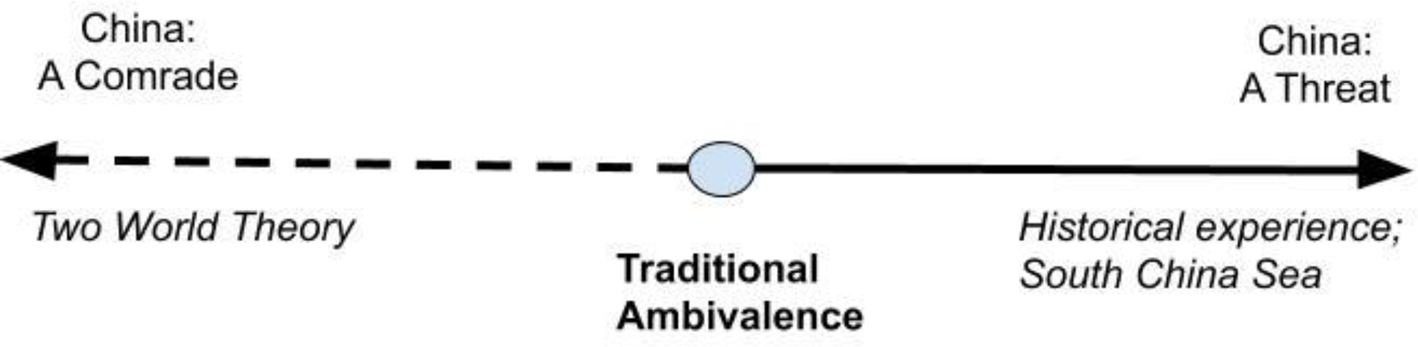
On the other hand, taking into account the dynamism in modern Vietnamese history, a more complex causal mechanism in which cultural theories can illuminate an inter-birth cohort difference is also plausible: the political socialization experience of Vietnamese citizens who were born around the early 1980s (the small dark circle in Figure 1) would lead them to be particularly skeptical of China.
From ambivalence to animosity.

The official relations between Vietnam and China in the twentieth century can be summarized as a ‘revolutionary brotherhood’ (Womack, Reference Womack2006: 23) given their shared history of fighting Western imperialism and the USA as a common enemy up until the late 1970s. The philosophical foundation of such a relationship can be found in the ‘Two World Theory’ that the Vietnamese Communist Party (VCP) advanced as a central tool for political socialization of the public. The Theory suggests that the world is shaped by ‘two antagonistic contradictions between socialism and capitalism’ (Thayer, Reference Thayer, Le Hong and Tsvetov2018: 24) and the people have to adhere to the principle of borderless unity among communist comrades.
The Brotherhood was not simply a rhetoric VCP propagated based on the old common struggles. The surprisingly generous support for Northern Vietnam from China during the initial phase of the Vietnamese War further substantiated the validity of this comradeship (Irvin, Reference Irvin1995; Womack, Reference Womack2006). Not surprisingly, in the Northern part of the country where the socialist tradition dates back well into the French colonial period, ‘people were made to believe that China was Vietnam's big and generous socialist brother’ (Vu, Reference Vu2010: 6). Through the Vietnam war, the recognition of this solidarity permeated the Vietnamese public discourse.
With the sense of malaise built on Chinese influence still very much real, the comradeship moderated the underlying public animosity of the Vietnamese toward China until the 1980s (Bayly, Reference Bayly2009). As indicated by the center circle in Figure 1, two opposing factors were at play in traditional Vietnamese public discourse on China. The Vietnamese public, consequently, was ambivalent about China: the country is a traditional threat but at the same time a comrade for fighting even larger threats.
The 1980s witnessed an abrupt dissolution of the comradeship and, thus, of this ambivalence, tilting the balance toward animosity. Starting in 1986, VCP implemented a series of sweeping reforms that brought about fundamental changes in the country's socioeconomic structure. The reforms included the discontinuation of diplomatic isolation and aggressive diversification of foreign relations, most notably with the USA and its allies in the region (Hiep, Reference Hiep2013). These newly established formal relations invariably exposed the Vietnamese public to the outside world. Although VCP put in place a state censorship, the public's direct contact with the non-communist world was active and frequent in cultural and educational domains. Marr (Reference Marr1998), for example, documents massive translations of western materials spearheaded by newspapers and magazines in this period. Abuza (Reference Abuza1996, 619) similarly notes that the number of Western countries that offered student and scholar exchange programs as well as education aid for Vietnam increase from nil in the 1970s to 40 by 1990. Reflecting such a massive exposure to the Western culture, by the mid-1990s the dominant foreign language in public education became English (Pham, Reference Pham2011). In fact, the change was so dramatic and widespread that local observers lamented about the ‘Western dominance’ of the fields of education and culture in Vietnam (Nguyen and Tran, Reference Nguyen and Tran2018).
This massive, and yet abrupt, exposure to the outside world posed a direct threat to the Two World Theory as it was built precisely on the antagonization of the West. Although VCP has been maintaining its official commitment to communism even to date, such a de jure commitment did not stop the public after Doi Moi from frequently coming in contact with the Western materials and ideas, a kind of interaction that used to be vilified. As was the case in East Germany (Henninghausen, Reference Hennighausen2015), the very ontological foundation of the communist political socialization was questioned upon this sudden exposure to the west. Consequently, socialism through the course of Doi Moi became ‘little more than a single party system’ for the public. Topics of politics and ideology were met by ‘cynicism’ from young students who went through the post-Doi Moi socialization (McCormick, Reference McCormick1998: 129). The new, post-Doi Moi generation grew up interested much more than their predecessors on ‘matters directly relevant to their lives’ and eager to ‘adapt to changes brought about by globalization’ (Raffin, Reference Raffin2011: 81). The young public's declining commitment to the orthodox communist principles and growing interest in the Western world rendered the ‘revolutionary brotherhood’ unconvincing as implied in Figure 1 by the dashed line on the left. Weakening of the brotherhood meant that the deep-seated historical animosity was now unchecked and the ambivalence about China came to be untenable after Doi Moi for this birth cohort.
In short, Doi Moi brought about a generation of Vietnamese people who were much less attached to the ideological ties to China than their predecessors were. This change should make significant differences between pre- and post-Doi Moi generations in their perception of China. This discussion generates a testable hypothesis consistent with the cultural theories:
Hypothesis: The post-Doi Moi generations Vietnamese view China more negatively than the pre-Doi Moi generations do.
A null hypothesis – the lack of such a difference – would be consistent with the institutional theories that project a homogeneously negative public opinion on China.
4. Research design
This paper studies the relationship between the modernization shock and citizens' perception of Chinese economic expansion in Vietnam. The Pew Global Attitudes Survey offers a unique, up-to-date data set that contains Vietnamese citizens' views on China. I consider the survey to be reflective of individuals' sincere foreign policy opinions irrespective of their interests in foreign countries. Although one may not doubtlessly assume that all respondents in the sample have highly sophisticated understandings of the Sino–Vietnamese relations, lack of detailed information in itself would not prevent ordinary citizens from forming their own foreign policy opinions. The public's holistic assessment of the situation, or a ‘folk’ foreign policy opinion, is formed nonetheless (Kertzer and McGraw, Reference Kertzer and McGraw2012).
To gage the effect of the shock of Doi Moi on the public views on China, I use RDDs. RDDs exploit a small window of opportunity available right around the shock (or ‘cutpoint’) where the control and treated groups are very much comparable in all aspects but the treatment. In other words, the empirical analysis is focused on the observations around the cutpoint, having not much to do with the overall trend in public opinions in Vietnam. This way, researchers can isolate the effect of the treatment similarly as they do in randomized experiments. The analysis is therefore not to delineate the overall generational trends in public opinions in Vietnam, the identification of which might be confounded by a host of factors, but to examine the direct effect of Doi Moi that can be captured just around several birth cohorts.
In the context of the current research, Doi Moi is understood as a ‘shock’ that abruptly altered the old Soviet-style political socialization processes of the Vietnamese citizens. The running variable is the birth years of citizens and the treated group is the birth cohorts who were born around Doi Moi and not much affected by the old, pre-Doi Moi political socialization. Specifically, I identify the birth year 1983 as a cutpoint that separates the treated from the control group who were born before 1983.
The identification of this cutpoint draws on extensive research on political socialization. The literature firmly establishes the importance of early stages of public education as a critical juncture at which the formation of individual value systems occurs most intensively (e.g., Van Deth et al., Reference Van Deth, Abendschön and Vollmar2011). Importantly, the literature does not merely highlight the curriculum of public education as the only way through which ‘civic knowledge’ is propagated. The significance of the early school age in political socialization also rests upon the effects of interpersonal interactions and social environments that elementary schools offer. Children just entering a public education system are suddenly exposed to social interactions with their classmates and teachers as well as public norms and practices largely reflecting social discourses (Ehman, Reference Ehman1980; Battistoni, Reference Battistoni1985). Beyond textbooks, schools ultimately serve as a conduit to the general atmosphere of the society by providing ‘social and emotional learning’ (Cohen, Reference Cohen2006: 205), directly and critically contributing to the formation of individuals' political worldview.
Vietnam is no exception to this importance of early school age in political socialization. The individuals that entered the public education system in 1990 (who were born in 1983) must have had a political socialization experience very different from that of their slightly older cohorts. They were imbued with pragmatist pursuit of individual excellence geared toward the world market and regular exposure to the Western culture, which had been unimaginable in the pre-Doi Moi, Two World Theory era (London, Reference London2010; Vu Reference Vu2010; Thanh, Reference Thanh2011). On the contrary, the control group, the birth cohort that immediately precedes the treated group, experienced Soviet-themed socialization in their early childhood.Footnote 3 The year 1983, in sum, effectively demarcates the birth cohorts whose early childhood was significantly affected by Doi Moi and those who were not.
As one cannot ‘select into’ being born after Doi Moi, particularly around the cutoff year, the birth year as a running variable is reasonably exogenous. It is still possible, however, that the assignment of being a post-Doi Moi generation is compounded with some of the other ‘predetermined’ effects. For instance, given the astonishingly rapid modernization that has been unfolding in Vietnam since the reform, post-Doi Moi birth cohort might actually mean being affluent and living in an urbanized area. To take this possibility into account, a dummy variable capturing whether the respondent lives in an urban area and a continuous variable showing where in the 24-step income level the respondent belongs are included as predetermined covariates to assure that the ‘continuity’ of assumption of RDD is not violated.Footnote 4
Following the traditional Thucydidean understanding of perceptions on neighboring countries (Lebow, Reference Lebow1984), the outcome variable captures the Vietnamese public's evaluation of Chinese economic expansion. This is a dichotomous measure identifying whether a Vietnamese citizen believes that ‘China's growing economy is a good thing.’ The variable is re-coded such that a ‘yes’ (=1) answer indicates a favorable view of Chinese economic expansion whereas a ‘no’ (=0) answer reflects the respondent's perception that Chinese expansion is a threat.
This outcome variable offers several analytical advantages, particularly in comparison with the generic favorability of China although, as discussed below (Table 1), two variables produce similar results. First, the opinion on Chinese expansion captures the latent threat perception that is causally prior to the generic favorability. As Martin and Eroglu (Reference Martin and Eroglu1993) suggest, whether and how a foreign country poses a danger determines its ‘national image’ which in turn constitutes the basis for the public's general favorability. The change in a foreign country's materialistic power primes the public to think about whether it is a threat (Yang and Liu, Reference Yang and Liu2012; Stein, Reference Stein, Leonie, Sears and Levy2013). One could only indirectly test the effect of Doi Moi, in other words, if favorability was employed as an outcome variable.
Benchmark RDD and robustness checks

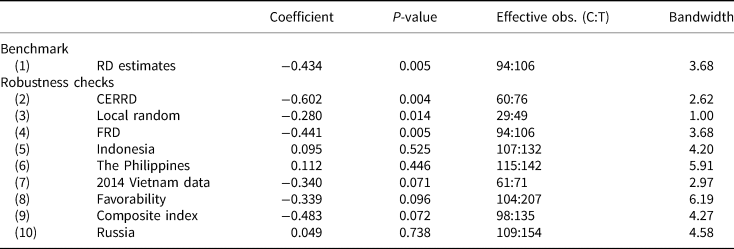
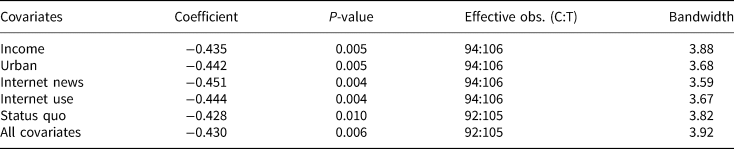
The P-values are based on bias-corrected confidence intervals. Reported in the ‘Effective obs.’ column is the number of observations below (Control) and above (Treated) cutpoint within the bandwidth. The benchmark RD estimates, RD estimate with CER-optimal bandwidth selector, and local randomization estimates are reported in the first, second, and third rows. Reported in the fourth and fifth rows are the RDD estimates using the data for Indonesia and the Philippines, respectively. The seventh row reports RD estimates using an alternative survey dataset (PEW Global Attitude Survey 2014). General favorability of China and an additive composite index of the public opinions on China as opposed to opinions on Chinese economic expansion are reported in eighth and ninth rows, respectively. The last row reports a result using Vietnamese’ favorability of Russia instead of China. In all models, predetermined covariates are income levels and urbanity.
Second, focusing on the perceptions on the economic expansion of China helps us tap into the respondents' attachment to the Two World Theory directly. It is reasonable to posit that an individual significantly affected by the Two World Theory (pre-Doi Moi cohort) would view China's expansion more positively than those unaffected by the Theory (post-Doi Moi cohort) do since it signals strengthening of the communist comrade. It is not clear, however, if the same can be told about the favorability of China, which is conceptually much more inclusive. If the ambivalence the Vietnamese public maintains toward China holds, one could actually approve of Chinese economic expansion as positive whereas not necessarily finding the country favorable.
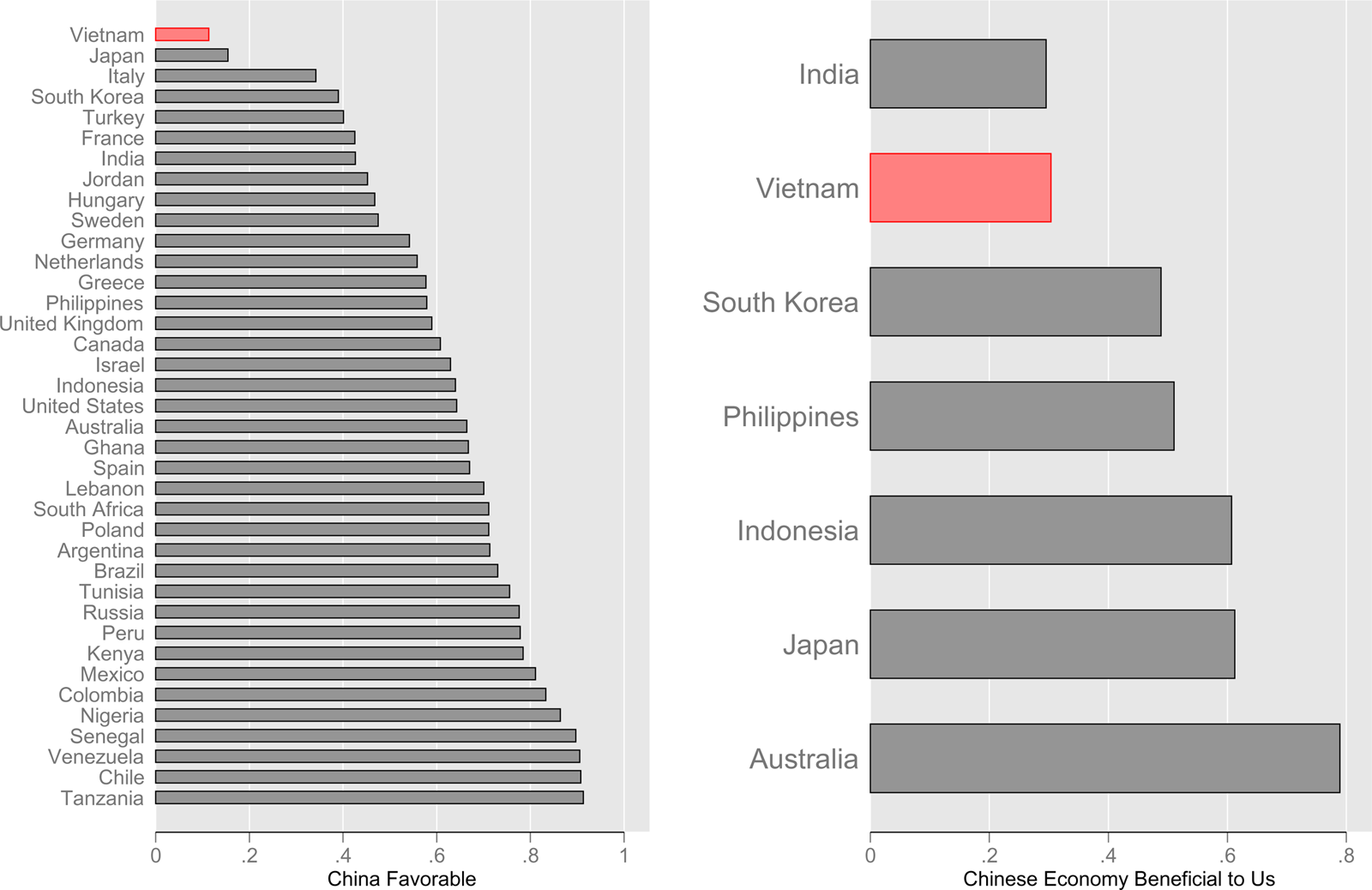
A quick look at the descriptive data offers evidence corroborative with this reasoning. As demonstrated in Figure 2, there is a significant discrepancy between the Vietnamese public's favorability of China (left panel) and their opinions about the country's economic expansion (right panel). Although only slightly more than 10% of Vietnamese citizens profess ‘very’ or ‘somewhat’ favorable views on China (red bar in the left panel), around 30% still consider Chinese economic growth positive (red bar in the right panel).Footnote 5 One can suspect that a sizable number of Vietnamese people are not fond of China as a country but still view its economic expansion desirable.
Is Chinese economic growth a good thing? A comparative perspective.
Note: The bars in the left panel represent the percentage of respondents in each country who have either ‘somewhat’ or ‘very’ favorable views on China. The bars in the right panel represent the percentage of respondents in each country who consider Chinese economic growth a ‘good thing.’ The latter questionnaire was available only in a limited number of countries in Pew 2017. In both cases, ‘do not know’ answers are treated as missing observations.

5. Analysis
Table 1 reports the benchmark RDD estimates with a number of robustness checks. The first model reports the benchmark RD estimate with the bias-corrected P-value and data-driven, mean-squared error optimal bandwidth following Reference Cattaneo, Idrobo and TitiunikCattaneo et al. (Forthcominga). Around 200 individuals below and above the cutoff are within the bandwidth as the number of effective observations indicates. The coefficient suggests that within this band, the post-Doi Moi cohorts are about 44% less likely than their predecessors to believe that Chinese economic growth is a good thing, a result consistent with the hypothesis. As the bias-corrected P-value indicates, this difference is strongly significant.
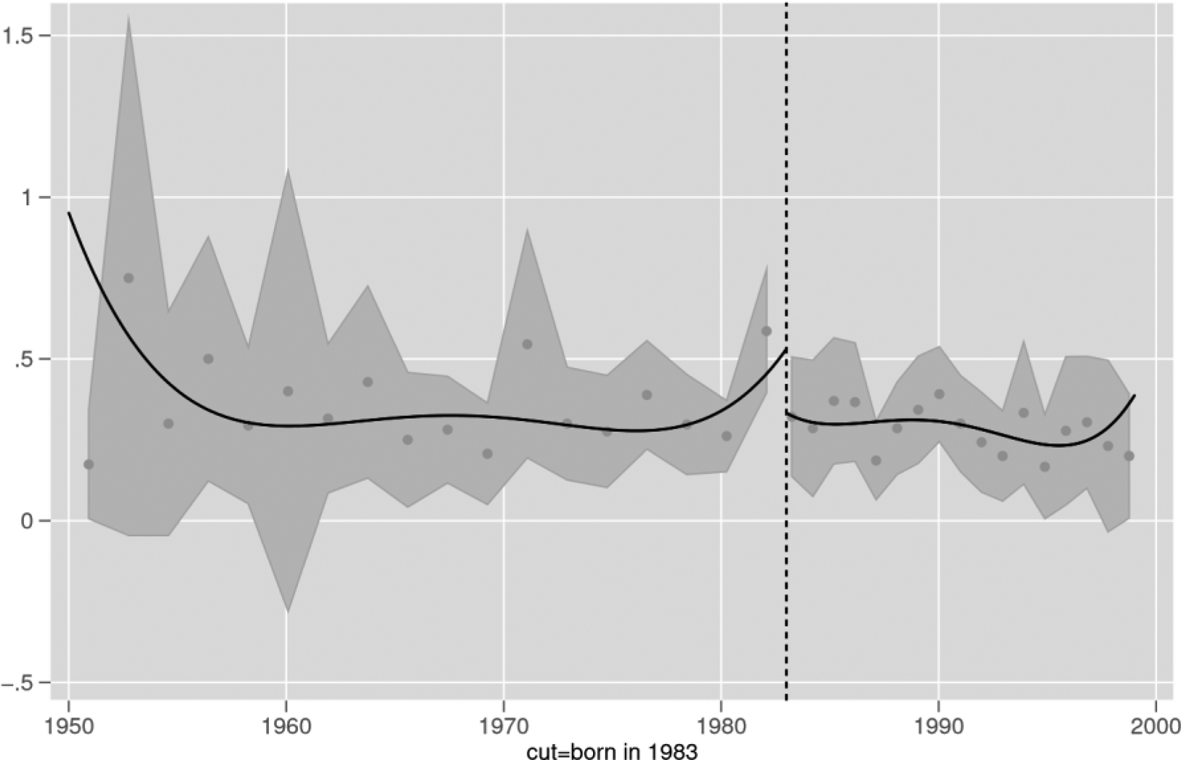
The P-value was effectively unaltered (=0.009) when the ‘conventional’ confidence intervals were used. Given the low mean value of the outcome variable for the entire sample (i.e., the average % of Vietnamese citizens in the sample who believe that Chinese economic growth is a good thing is about 31.4%), the size of this effect is very substantial. Figure 3 illustrates this stark discontinuity.
Regression discontinuity design.

We can be more confident in this benchmark result if it passes a series of critical robustness checks. First, one can apply an alternative bandwidth, particularly one that minimizes an approximation to the coverage error (CER) of the confidence interval of the benchmark. The estimate using this alternative band is reported in the second row of Table 1 (CERRD). The result suggests that with a smaller – and error-reducing – bandwidth, the difference between post- and pre-Doi Moi birth cohorts is actually even starker.
Second, I also test if the benchmark result holds when the potential problem of using a discrete running variable (Kolesár and Rothe, Reference Kolesár and Rothe2018) is addressed. In a strict sense, birth-year is an ordinal rather than continuous measure. Each birth-year cohort contains multiple observations and traditional RD estimates using such mass points could be biased. To see if this concern is warranted, I use a local randomization analysis recommended as an alternative by Reference Cattaneo, Idrobo and TitiunikCattaneo et al. (Forthcomingb: 74) where the observations in the two mass points immediately below and above the cutoff are randomized to estimate the difference-in-means of the outcome variable for the two groups. The third row in Table 1 reports this result, indicating that the benchmark result is not meaningfully altered when the issue of mass points is addressed.
Third, although Doi Moi was a sweeping, society-wide reform, it is possible that the political socialization of some of the 1983 birth cohort remained unaffected by it. If this is the case, the benchmark RDD estimate that assumes ‘perfect compliance’ of treatment (i.e., everybody in the treated group receives the treatment) could be biased. I use a fuzzy regression discontinuity design (FRD) to see if this is indeed a problem. Here, I assume that those who did not enter the public education system (i.e., stay-home children) also did not receive the ‘treatment’ in their early childhood even if they were born after 1983. Consistent with the assumptions of FRD, the number of these untreated people declines rapidly to zero after the cutpoint, 1983, because of the deliberate government effort to expand educational infrastructure. The fourth row of Table 1 reports that using FRD does not alter the benchmark result.
Fourth, it is possible that 1983 as a birth year captures not the effect of Doi Moi but other unique lifetime events that the post-1983 birth cohorts experienced. Examples of such events would include the Financial Crisis of 1997 and the ramped-up territorial assertiveness of China in the 2000s. We cannot rule out the possibility that these events somehow affected the post-1983 cohort in a very unique way. We can be more confident that these events did not interfere with the causal effect of Doi Moi if we do not find a significant result in cases that were exposed to these events but did not experience a transition from a communist regime in the late 1980s. To this end, I use the empirical model and data source identical to the benchmark for two countries neighboring Vietnam, namely, Indonesia and the Philippines. These countries were severely affected by the 1997 crisis as well as the territorial disputes with China and thus are good ‘control cases’ for testing the effect of Doi Moi. Rows five and six of Table 1 indicate that the benchmark result is found robust to these alternative country cases. The discontinuity reported in post-Doi Moi birth cohorts in Vietnam is not found elsewhere.
Fifth, I test the sensitivity of the benchmark result by using an alternative data set (Pew Global Attitude Survey, 2014). Row seven of Table 1 suggests that the benchmark result is robust to altering the data set. I also experiment with alternative outcome variables. Although the perception on China's economic expansion might be most suitable for testing the effect of Doi Moi, we can be confident in the benchmark result if we obtain similar results using other types of opinions about China that the Vietnamese public has. The general favorability as well as a composite additive index that includes all available opinions on China (favorability of China, perceptions on China's economic expansion, perceptions on China's military expansion, and whether Chinese government respects individual freedom) are used for this test. Rows eight and nine report the results of this sensitivity analysis, suggesting that the benchmark result is not significantly altered when these alternative empirical scenarios are applied.
Similarly, one might be concerned if the benchmark effect is not only about China but also about other fellow former-communist countries in general. To see if this concern is warranted, I use Vietnamese’ general favorability of Russia,Footnote 6 another subject country for the ‘socialist brotherhood.’ Since Vietnam does not have a historically deep-seated animosity with Russia, compared to China, the effect of Doi Moi should be weak, if any. The insignificant coefficient reported in the last row of Table 1 confirms that the effect of Doi Moi is indeed China-specific.
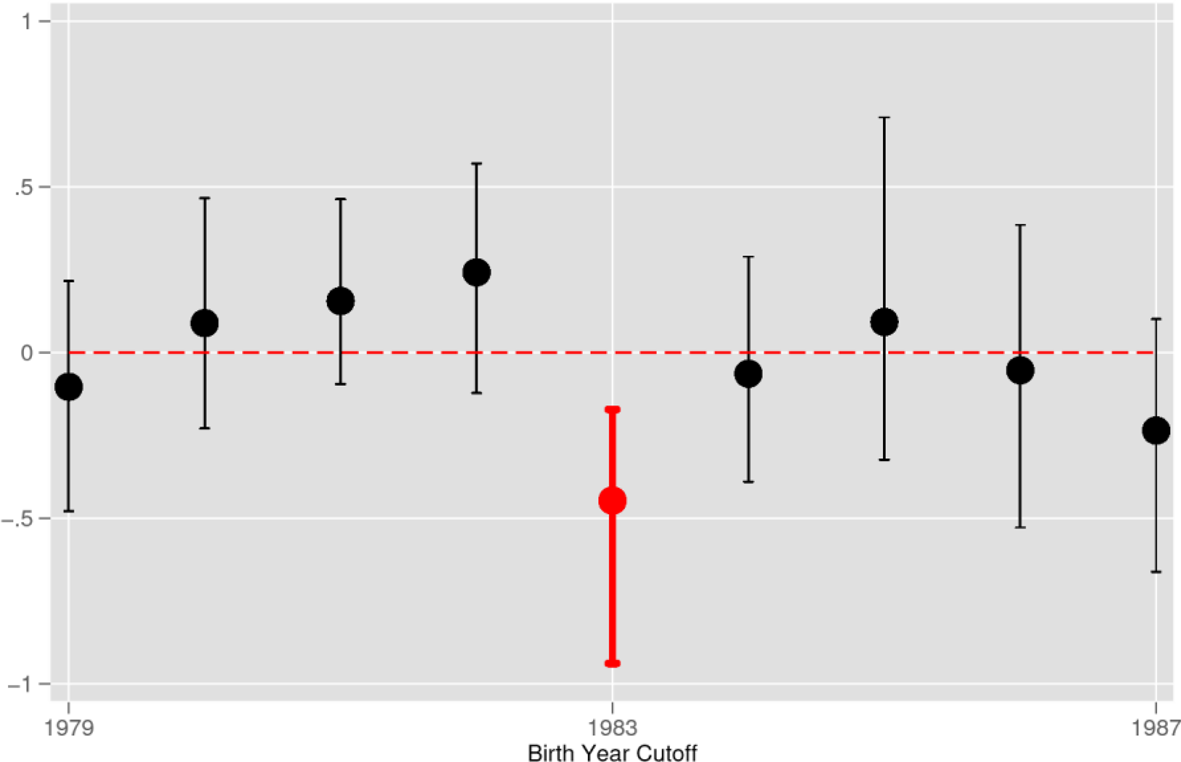
Finally, as a standard falsification test of the benchmark result, Figure 4 reports the RDD estimates using a host of alternative birth years as cutpoints. The result clearly demonstrates that 1983 is the only birth year cutpoint with which the RDD estimate for which is statistically significant.
Placebo tests: alternative cutpoints.
Note: RDD estimates (circles) with 95% confidence intervals (bars) using different birth years as cutpoints. The benchmark estimate is located at the center. The RDD coefficients are not exactly at the center of the bars because the confidence intervals are bias-corrected.

6. Conclusion
This research note studies the effect of Doi Moi on the public opinions of Vietnamese people about China. The Soviet-style Two World Theory paled into insignificance in the public discourse as the diplomatic relationship between Vietnam and the rest of the World was normalized and the Vietnamese society was exposed to the Western world. For the Vietnamese directly affected by the post-Doi Moi socialization, such a dramatic change in the worldview took away one pillar undergirding the traditional ambivalence toward China, thereby tilting the balance of the public opinion toward negativity. The post-Doi Moi birth cohorts in Vietnam, as a result, see China in a much more negative light than their immediate predecessors did. Using Pew Global Attitude Survey 2017 survey data, the note offers empirical evidence lending strong support to this argument.
The research note contributes to the political economy literature in several ways. First, it adjudicates between ‘institutional’ and ‘cultural’ theories which disagree on inter-birth cohort differences generated by salient sociopolitical events. By identifying the gap between pre- and post-Doi Moi birth cohorts, it offers evidence in support of the cultural theories. Second, the note extends the purview of the international relations literature on public opinions to a non-democratic emerging economy. The findings reported here depart from the literature whose empirical domain is confined to American foreign policy and add to the leverage for the generalization of the cultural theories.
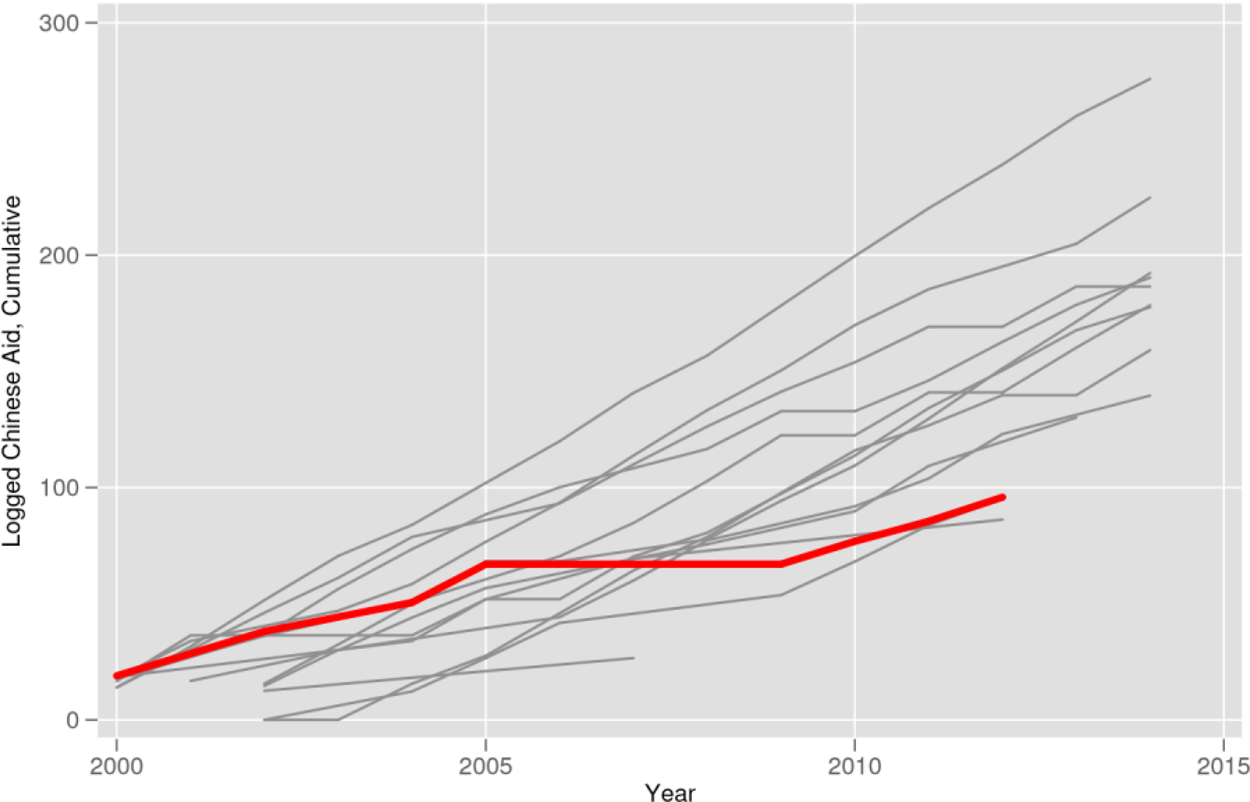
Finally, the research note offers a practical implication for China's ‘soft power wave’ (Shambaugh, Reference Shambaugh2015). Analysts find it puzzling that the favorability of China is low and in decline in Asia, particularly among younger generations, despite Chinese government's aggressive efforts to re-brand its image as a regional public good provider through financial transfers (Xie and Page, Reference Xie and Page2013; Zhai, Reference Zhai2019; also see Appendix Figure A1). At least in Vietnam, the findings here suggest, the particularly negative perception of Chinese economic growth among the young generations is due in large part to what has happened in the country, not much to what Chinese government has done. The negative effect of the territorial assertiveness China on public opinions are unabated for the younger generations who lack the kind of socialization experience that used to mitigate negative sentiments toward China for older generations. Financial transfers from China, therefore, would not add much to curbing these negative sentiments among younger generations.
Future research can build upon this finding and explore if the birth cohorts discontinuity also holds in similar contexts. Transitional economies in Eastern Europe, for example, underwent a similar process that this research note highlights for the Vietnamese case. Given the increasing assertiveness of Russia in the region, it would be interesting to see if a similar finding is obtained.
Acknowledgement
An earlier version of this paper was presented at ‘Global Affairs Seminar: Revisiting South-South/BRICs/Emerging Powers Investment and Development Aid,’ George Mason University, VA. I thank the seminar participants for helpful comments.
Byunghwan Son is an Associate Professor of Global Affairs, George Mason University (USA). His research interests lie in the intersection of domestic politics and international economics. His research appears in such venues as Journal of Politics, Journal of Peace Research, and Political Studies.
Appendix
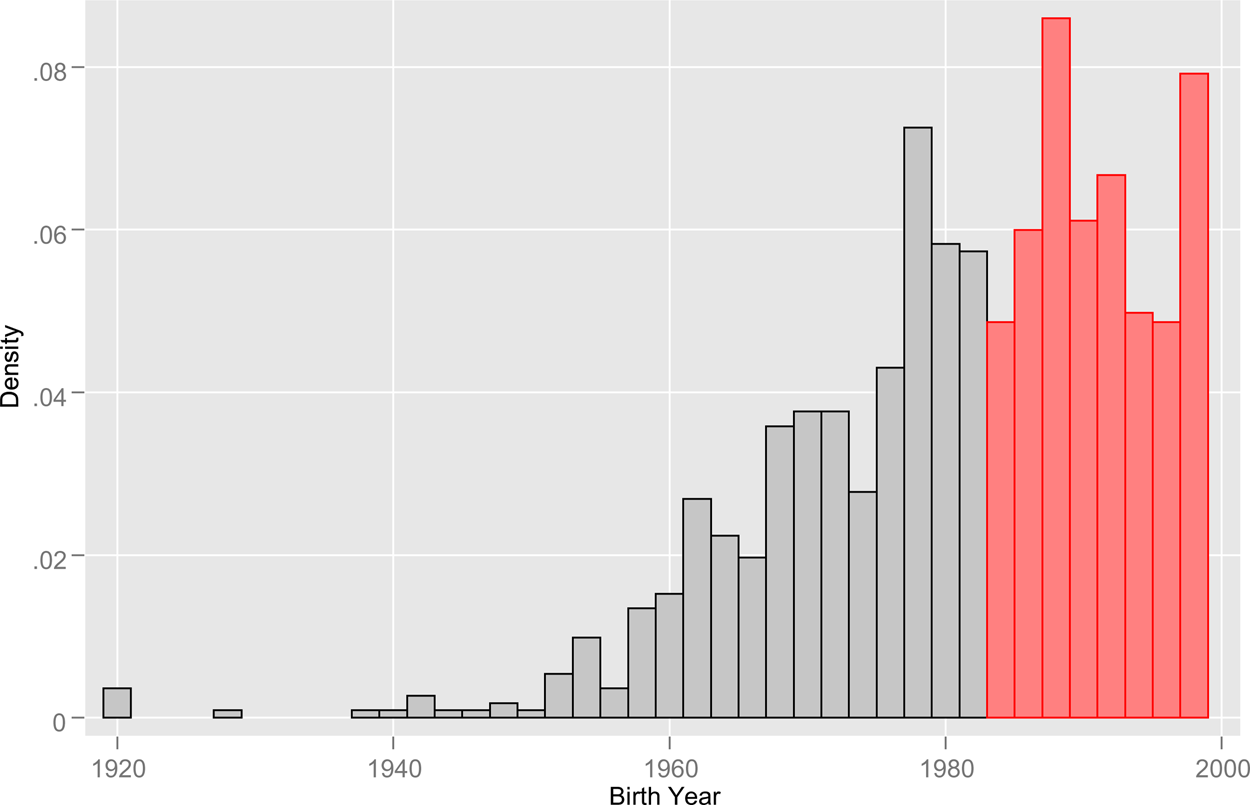
Descriptive statistics

Covariates

Cumulative financial transfer from China to Vietnam: a comparative perspective.
Note: Plotted are logged cumulative volume of financial transfer from China to countries in South and Southeast Asia. The case of Vietnam is marked red. The data are from AidData (https://www.aiddata.org/).

Observations by birth year.