On his first invited visit to the Oregon Social Learning Center (OSLC), Dr. Salvador Minuchin, the developer of structural family therapy, observed our work with families of children with antisocial behavior (ASB) problems and summed it up as Readers Digest -blah -blah -blah. He apparently thought the emphasis on parent training was of trivial importance. He was, however, deeply impressed by a clinical process he said he could feel but not articulate. Forty years later, it turns out that Minuchin was wrong in slighting our emphasis on parenting content. What he was missing was that strengthening parenting sets in motion an avalanche of enduring effects that generalize throughout and beyond the family. The present report explores evidence that cascading processes exist and identifies mechanisms concerned with the nature of change. We address several questions. Why do families change? Do changes that occur at different points in time reflect the same underlying process? Can more than one mechanism be influencing change?
Parent training procedures are acknowledged as belonging to the pantheon of evidence-based practices (Weisz & Kazdin, Reference Weisz and Kazdin2010). The present report addresses the nature of changes produced within families following an intervention with Parent Management Training—Oregon Model (PMTO™). PMTO represents a set of evidence-based practices that were developed at OSLC with a programmatic focus on child ASB.Footnote 1 We describe cascading effects evidenced in a PMTO preventive intervention for single mothers with early school-aged sons. Using a randomized controlled trial (RCT), we tested the program's efficacy and conducted an experimental test of the theoretical model. The study's repeated assessment design enabled us to investigate short-term (up to 3 years) and longer term (up to 9 years) changes in the focal youngsters and their mothers. In this paper, we briefly outline the theoretical model, summarize and integrate already published findings within a cascade conceptualization, and present surprising new data for mothers in the experimental group.
The authors take the position that effective PMTO intervention produces an orderly sequence of change in families and that the source and volume of change may vary as a function of which segment of follow-up is examined. At the simplest level, one's theory could consist of nothing more than a baseline (BL) model with measures of a single hypothesized mechanism and a single outcome. Experience with PMTO suggests that such a simplistic cross-sectional model would provide a serious underestimate of what is really going on. It is an underestimate because it does not reflect that multiple problem behaviors correlate with ASB, nor does it address issues of causality or endogeneity. Antisocial symptoms are thought to be embedded in a network of problem behaviors together with their causal mechanisms. Successful intervention implies significant changes for most of the variables involved in the theoretical network, mechanisms and outcomes. Tracing changes in the network constitutes an important contribution to the cascade of intervention effects.
Changes from BL to termination constitute Step 1 in the cascade effect. At that early juncture, the nature and number of intervention benefits take place within a predictable network of variables reflecting one's theory. The implication is that change in one problem will co-occur with change in the others in the network if they are controlled by the same mechanisms. In our model, the primary outcome of interest for youth is the network of problems co-occurring with ASB, including externalizing, internalizing, poor peer relations, delinquency, and school failure. In child clinical research, some co-occurring problems have been labeled comorbid. We take the position that comorbid problems co-occur because they are influenced by shared mechanisms. With regard to youth problems, we hypothesize two primary mechanisms for deviancy: ineffective parenting practices and training through interactions with deviant peers.
Our examination of the PMTO follow-up data has revealed another important source for cascade effects, which we label collateral change. We consider collateral effects to be a bonus of the intervention because our theory of ASB only hints at their possibility. Our data showed that changes in outcomes for one family member predicted significant changes for another. For example, shortly after intervention, mothers showed the anticipated improvements in their parenting practices, their sons showed reductions in deviancy, and it became evident that the mothers had powerful feelings about their sons' improvements. Surprisingly, other benefits to mothers' lives emerged, changes that may be at least as far reaching as those for the focal children. We call these maternal changes collateral effects. Such findings raise interesting questions. Why does change continue, grow, and cross over to other settings and family members following intervention? We propose expanding our theoretical model to incorporate these effects.
We hypothesize that successful intervention leads to changes in social interactional patterns within the family, and this can open doors to new social communities. The denizens of these new societies then promote mechanisms for further healthy development. The metaphor is analogous to a ripple effect that begins at home and spreads to surrounding environs. We provide ad hoc constructions in an effort to explain the maternal changes found in our long-term follow-up data. In a very real sense, we have come to believe that factors within the PMTO intervention have an emergent quality that calls for a dynamic systems approach of thinking. In the present report, we will detail these sources for cascade effects.
Theory as Predictor for Cascade Effects
The theoretical model underlying PMTO is social interaction learning (SIL), which reflects the fusion of social learning, social interaction, and behavioral perspectives (Dishion & Patterson, Reference Dishion, Patterson, Cicchetti and Cohen2006; Forgatch & DeGarmo, Reference Forgatch, DeGarmo, Reid, Patterson and Snyder2002; Forgatch, Patterson, DeGarmo, & Beldavs, Reference Forgatch, Patterson, DeGarmo and Beldavs2009; Patterson, Reference Patterson1982, Reference Patterson, Reid, Patterson and Snyder2002, Reference Patterson2005; Patterson & Chamberlain, Reference Patterson, Chamberlain and Wynne1988; Patterson, Reid, & Dishion, Reference Patterson, Reid and Dishion1992; Reid, Patterson, & Snyder, Reference Reid, Patterson and Snyder2002; Snyder & Stoolmiller, Reference Snyder, Stoolmiller, Reid, Patterson and Snyder2002). The SIL model has grown out of an iterative process among basic and applied research and theory development over several decades at the OSLC. In the present paper, we expand the theoretical model to incorporate developmental progressions for parents, in this case mothers.
Our SIL model for describing developmental processes in families of youth with ASB problems is contingency based. Changes in outcome variables imply changes in the contingencies hypothesized as mechanisms. Contingency analyses require data based on direct observation of settings and situations that evoke habitual patterns of social interaction. The SIL model includes two contingency-based mechanisms for change. The first mechanism describes interaction within the family, primarily negative reinforcement provided to children for deviant behavior. The second mechanism involves contingencies in the social environment outside the home, primarily from peers. Our basic assumption is that contingencies supplied by family members and peers must change or there would be no cascade effect. In the present report, we describe findings from an efficacious PMTO intervention. We subjected our hypothesis that changes in the social interactions within families and peers would account for intervention effects on the youngsters. We subjected these ideas to a stringent gold standard applying experimental manipulation and meditational analysis with both presumed mechanisms in tests of the theory.
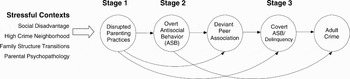
Figure 1 displays the SIL model outlining developmental delinquency trajectories for youth. The model unfolds in stages starting with contexts that impinge on the many social environments in a person's life. In Stage 1, stressful contexts are seen as instrumental in disrupting parenting practices. Adversities acting on parents can include social disadvantage, living in high crime neighborhoods, family structure transitions, mental or physical illness, discrimination, trauma, and a wide variety of difficulties. In keeping with Elder's stress amplification hypothesis (Elder, Van Nguyen, & Caspi, Reference Elder, Van Nguyen and Caspi1985), we presume that adversities can amplify coercive interactions within the family and diminish positive parenting practices. Our hypothesis is that children who grow up in noncontingent environments may become less responsive to positive contingencies and positive reinforcement may lose its impact on these children (see review in Patterson, Reference Patterson1982). From a dynamic systems view, adversity can produce an imbalance between two attractors (i.e., coercive and positive parenting practices). During BL in clinical or highly stressed risk samples, coercion may become the more likely attractor and prosocial exchanges the less likely.
The developmental social interactional learning model of youth delinquency.

Persistent negative imbalances in parenting can result in children developing overt forms of ASB, such as excessive noncompliance, arguing, teasing, hitting, and temper tantrums. The children learn this overt form of behavior primarily through negative reinforcement for aversive and aggressive behavior. PMTO programs based on this theoretical model intervene with the parents, teaching them strategies to reduce coercion and increase positive parenting with their children and other family members.
The next stage in the model takes place when behavior learned at home generalizes to social settings in the school and community. For a subset of children who exhibit high rates of overt ASB, the model predicts an orderly shift in the sequence of effects. For example, when a child displays obdurate noncompliance with teachers, academic failure becomes highly predictable. In exchanges with peers, ASB can lead to rejection by normal peers. Failure in either domain can lead to a youngster's depressed mood, and the combination can be even more powerful. When overt ASB and rejection by prosocial peers is followed with a drift into the deviant peer group, covert behavior can ensue. Deviant peers provide a powerful training ground for youngsters to learn new forms of ASB (e.g., lying, stealing, drug use, destruction of property, fire setting, and cruelty to animals). Deviant peers tend to rely on positive reinforcement to train the youngsters in covert acts. Parents can make their own contribution to covert behaviors through a combination of harsh parenting and poor monitoring that enables the youngsters to wander away from home and engage in unsavory activities outside the purview of adults. The training in ASB by peers and parents can lead to delinquency. It is interesting to note that although overt and covert forms of ASB are highly correlated, they tend to emerge from entirely different forms of reinforcement, provided by different social agents, and carried out in different settings. It is the youngsters who combine overt and covert ASB problems who are most likely to become career and adult offenders.
Data supporting the theoretical model in Figure 1 have grown out of research at OSLC supported by the National Institutes of Health involving passive and experimental longitudinal studies. Next, we briefly describe three longitudinal studies and their methods that have been instrumental in the development and testing of the SIL model. We summarize support for the SIL model based these and other studies. Our new findings and a focus on cascading processes have led us to return to theorizing about the dynamics that produce cascading effects.
Methods
Our approach to theory building and testing relies on structural equation modeling using multiple-method and -agent definitions for the key variables. We have employed passive and experimental longitudinal studies in an iterative fashion to design our measures and methods as well as our intervention programs. Findings from this programmatic work focused on ASB problems in youth have guided adjustments to refining and extending our theoretical perspectives, our analytical methods, and our intervention programs. We review some key findings from three studies: the Oregon Youth Study (OYS), the Oregon Divorce Study I (ODS-I), and ODS-II. OYS was initiated by G. R. Patterson in 1983 and continues under the leadership of D. Capaldi. ODS-I was initiated by Patterson in 1984 and continued by M. S. Forgatch in 1988–1990, and ODS-II was initiated by Forgatch in 1992 and continued through 2004. OYS and ODS-I employed passive longitudinal designs. ODS-II was designed to test experimentally the models specified in the earlier two samples. Intervention procedures were based on the more than 20 years of clinical work conducted by the OSLC group. Each sample, described next, focused on families with boys at risk for ASB. In OYS, the risk factor was that the families lived in high crime neighborhoods. In the two ODS samples, the risk factor was recent marital separation. OYS consisted of two cohorts (n = 102, n = 104) of boys in fourth grade at BL and their parents. ODS-I consisted of n = 196 boys in Grades K–7, their custodial mothers and 40 sibling sisters. In ODS-II, there were 237 boys in Grades K–3, their custodial mothers and 40 sibling sisters.
In all the studies, the multiple-agent and -method measures were as similar as possible and were collected repeatedly, although on varying schedules. Our approach to measurement incorporated microsocial analysis of social interaction based on direct observation of individuals with differing members of the social environment as well as more macro measures tapping youngsters' behavior in a variety of settings. Measurement methods consisted of the following: Direct observation of parent–child interactions in the home and/or laboratory with our validated assessment procedures; structured interviews with parents and youth; repeated telephone assessments developed by OSLC called parent daily report; parent and teacher ratings using the relevant Achenbach and colleagues' Child Behavior Checklist forms; standardized achievement tests; interviewer and observer ratings and impressions of family characteristics; court records of parent and child police arrests; and child self-report of deviant peer association, depressed mood, and peer relations. In both ODS samples, observations of mothers and their confidants were collected at BL as they discussed two issues identified by the mothers, parenting problems and personal problems.
In the OYS, the assessments were conducted every other year throughout the boys' school years. In ODS-I, two assessments with direct observation were conducted, at BL and 4 years later. Questionnaire data were collected at 6 and 12 months post-BL. In ODS-II, full assessment batteries were collected at BL and 6, 12, 18, and 30 months. Teacher ratings were collected annually (BL and 12, 24, and 36 months). A 3-year hiatus followed and assessments resumed between years 6 through 9. There were two full assessments on alternate years during that interval and questionnaire data were collected each year.
OYS and ODS-I were studies designed to conduct basic research on family process and to develop and test theoretical models with correlational longitudinal data. ODS-II was designed as an experimental longitudinal study to test the efficacy of a preventive intervention for children in families of recently separating mothers and to test the theoretical model underlying the intervention. The ODS-II study serves as the principal basis for our propositions and models regarding cascade effects. The repeated-measures design made it possible to study mechanisms and outcomes longitudinally at differing levels and stages following intervention.
The design for ODS-II was a randomized prevention trial in which mothers in the experimental group received PMTO in parent groups, whereas mothers in the no-intervention control group did not (Forgatch & DeGarmo Reference Forgatch and DeGarmo1999, Reference Forgatch, DeGarmo, Reid, Patterson and Snyder2002). We hypothesized that intervening with the mothers to alter parenting practices would benefit child outcome trajectories. To eliminate confounding concerns, we intervened with mothers only and not children. The choice of a selective prevention sample with divorcing mothers and their children was relevant because divorce is a risk factor for disruptions in both parent and child domains. Selective prevention samples provide solid testing grounds for theory-based interventions because variance is likely in the measures of process and outcomes. In terms of divorce, the literature suggests that about one-third of boys may have behavior problems before separation, about one-third are likely to develop problems after divorce, and about one-third are likely to fare well (Amato & Sobolewski, Reference Amato and Sobolewski2001; Cherlin et al., Reference Cherlin, Furstenberg, Chase-Lansdale, Kiernan, Robins and Morrison1991; Hetherington & Kelly, Reference Hetherington and Kelly2002; Shaw, Emery, & Tuer, Reference Shaw, Emery and Tuer1993).
Support for the SIL Model
In this next section we provide empirical support for the SIL model, relying on data primarily from the above OSLC studies. Of course, this body of OSLC work reflects strong influence from other investigators in the development of theory, research, and practical application.
Stressful contextual influences
Many of the studies examining the effect of context on parenting practices have tested mediational models in which the effect of a specific context on child outcome is evaluated and then tested for its effect on parenting practices, with parenting practices tested as a mediator of contextual effects. These tests have been carried out for multiple contexts (e.g., social disadvantage, family structure transitions, antisocial parental qualities, parental depression). In most cases, the effect of the context on youth outcomes is fully mediated through parenting practices, and this finding has been replicated many times in samples at OSLC and in studies by other investigators. In two OSLC studies using latent constructs for social disadvantage and disrupted parenting practices (i.e., discipline and monitoring), ODS-I and OYS yielded strong standardized path coefficients between the constructs (0.79 and 0.66, respectively; Bank, Forgatch, Patterson, & Fetrow, Reference Bank, Forgatch, Patterson and Fetrow1993; Larzelere & Patterson, Reference Larzelere and Patterson1990). In the ODS-II study, the relationship was examined between separate components of social disadvantage and a latent construct for parenting that included discipline and problem solving; the paths between parenting and maternal education, occupation, and income were 0.18, 0.24, and 0.19, respectively (DeGarmo, Forgatch, & Martinez, Reference DeGarmo, Forgatch and Martinez1999). In another study using ODS-II data, the relationship between the number of family structure transitions and a latent construct for parenting that combined coercive and positive parenting was 0.32 (Martinez & Forgatch, Reference Martinez and Forgatch2002). The relationship between antisocial parental qualities and disrupted parenting had both direct and indirect effects on child ASB. We describe these findings in more detail later. It should be mentioned that we assume that adverse contexts play an important role throughout the model, although our primary attention has been given to the direct influence on the family.
The relationship between parenting practices and ASB problems has been evaluated in multiple intervention studies that employed mediational analyses. The analyses showed that random assignment to intervention produces reduction in youngsters' adjustment problems, and these benefits can be explained by the intervention improvements to parenting practices. Support for this effect has been replicated in studies conducted by Webster-Stratton and group (Beauchaine, Webster-Stratton, & Reid, Reference Beauchaine, Webster-Stratton and Reid2005), the Fast Track Consortium (2002), Dishion and his colleagues (e.g., Dishion, Nelson, & Kavanagh, Reference Dishion, Nelson and Kavanagh2003; Dodge, Greenberg, & Malone, Reference Dodge, Greenberg and Malone2008), and various intervention developers at OSLC (e.g., DeGarmo, Eddy, Reid, & Fetrow, Reference DeGarmo, Eddy, Reid and Fetrow2009; Eddy & Chamberlain, Reference Eddy and Chamberlain2000; Forgatch, DeGarmo, & Beldavs, Reference Forgatch, DeGarmo and Beldavs2005; Forgatch et al., Reference Forgatch, Patterson, DeGarmo and Beldavs2009). We provide specific data on PMTO child deviancy outcomes later in this paper. The findings bolster our hypothesis that parenting practices are one of the key mechanisms that produce changes in ASB in children. We assume that future studies will identify other mechanisms of change, particularly deviant peer processes.
Overt ASB generalizes to covert behavior
A key concept in the model is that high levels of coercive and low levels of positive parenting lead to the development and maintenance of overt child ASB, which in turn connects the youngster to events outside the home with peers and in the academic arena. The data from our studies suggest both direct and indirect effects of parenting practices on peer relationships. For example, using cross-sectional data when the OYS boys were in Grade 4, the path from discipline to child ASB was −0.50 and in the same model the path from ASB to peer relations was 0.42 and to academic skills −0.57. There was also a direct path from discipline to academic skills of 0.28. Using the OYS data set in a longitudinal analysis, Dishion and colleagues tested for a path from Grade 4 child ASB to involvement with deviant peers in Grade 8; the path coefficient was 0.20 (Dishion, Owen, & Bullock, Reference Dishion, Owen and Bullock2004). In an experimental test with the ODS-II sample of the effect of disrupted parenting on deviant peer association, the path from the intent to treat (ITT) group assignment to improvements in parenting (BL to 12 months) to reduced association with deviant peers was 0.16, p < .05 (Forgatch & DeGarmo, Reference Forgatch, DeGarmo, Reid, Patterson and Snyder2002). In another ODS-II analysis extending the time frame from BL to 3 years, we tested the hypothesized path from improved parenting to reduced deviant peer association. There were significant intervention benefits to parenting and deviant peer association and both of these improvements mediated the 3-year intervention effects on reduced teacher-rated delinquency (DeGarmo & Forgatch, Reference DeGarmo and Forgatch2005). Nevertheless, the relationship between parenting and deviant peer association was nonsignificant.
Changing form of ASB
Moving along in the model to examine the manner in which overt ASB can transform into covert behavior, Patterson studied boys' development from Grades 4 through 8 with the OYS sample. The data revealed changes in the form of the behavior with the onset of adolescence, changes that seemed to grow out of alterations taking place in the social environment (Patterson, Reference Patterson1993). In that study, a model was tested in which parental monitoring and discipline served as predictors of Grade 4 ASB with significant paths of −0.31 and −0.44, respectively. Of particular importance, growth in ASB from Grades 4 to 8 was predicted by increases in wandering and deviant peer association during the same interval (0.24 and 0.56, respectively). In a further analysis within that study, increases in deviant peer association and wandering during that interval were significant predictors for adolescent growth in a latent construct for new problems (i.e., police arrest, substance abuse, and risky sexual experience). The significant path coefficients were 0.54 and 0.16 for the respective predictors. These new forms of deviancy were clearly of the covert variety.
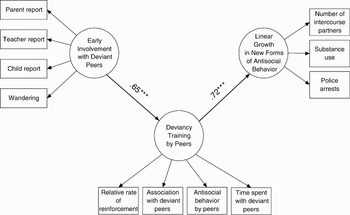
In a microsocial analysis of peer process using OYS data from Grades 4 through 12, Snyder and Stoolmiller (Reference Snyder, Stoolmiller, Reid, Patterson and Snyder2002) examined socialization as mechanism for the development of new forms of deviancy. The significant direct relationship between deviant peer involvement and growth in new forms of ASB was fully mediated by a latent construct defining peer deviancy training, accounting for 53% of the variance in the growth of new forms of ASB, as shown in Figure 2. It is clearly the case that during adolescence, training supplied by the deviant peer group is a major contributor to the development of criminal behavior, earning its status as a mechanism of change. Incidentally, Dishion and colleagues conducted a number of analyses with the OYS data set showing that the rate of deviant talk is a predictor for a variety of delinquent acts (Dishion, Andrews, & Crosby, Reference Dishion, Andrews and Crosby1995). Furthermore, data provided by Dishion and Snyder in separate studies showed that deviant peers provide positive reinforcement for deviant talk and this, in turn, predicts a variety of delinquent forms of ASB (Dishion & Andrews, Reference Dishion and Andrews1994; Snyder et al., Reference Snyder, Schrepferman, Oeser, Patterson, Stoolmiller and Johnson2005). The bulk of the positive reinforcement supplied by deviant peers is contingent upon talking about covert forms of ASB beginning as early as the first year of schooling (Snyder et al., Reference Snyder, Schrepferman, Oeser, Patterson, Stoolmiller and Johnson2005).
Changing forms of antisocial behavior. Data are from Snyder and Stoolmiller (Reference Snyder, Stoolmiller, Reid, Patterson and Snyder2002). Paths are standardized coefficients. ***p < .001.

Many of the variables in the model have been explored by other investigators, and there is now a growing consensus about the key components required to understand ASB problems. For example, the longitudinal study by Dodge and colleagues (2008) assumes an orderly sequence of seven variables as predictors and mediators for adolescent violence. The seven variables bear more than a passing resemblance to the variables in the SIL model. They use a substantial sample, long-term passive longitudinal design and multiple-method, multiple-agent measures to describe their model, which suggests that the study of this problem domain is coming of age. Their correlational network is very similar to our own. They found strong support for the sequence beginning with adverse contexts, harsh parental discipline, low monitoring, deviant peer involvement, conduct problems, poor school readiness, and school failure. A comparison of this model to what is shown in Figure 1 emphasizes the growing consensus about the network for externalizing problem behaviors.
Following the SIL model from childhood through adolescence
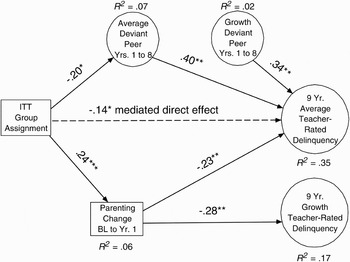
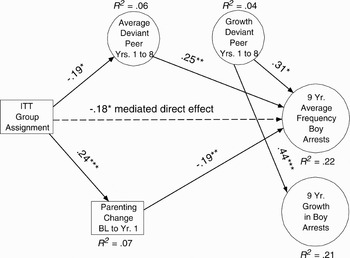
The most complete test of the SIL model employs ODS-II data using time-sequenced mediators with delinquency as the outcome (Forgatch et al., Reference Forgatch, Patterson, DeGarmo and Beldavs2009). Two delinquency outcomes were employed, teacher ratings and police arrest records obtained annually over the course of 9 years. The findings are presented in Figure 3 and Figure 4. The ITT group assignment led to significant improvements in parenting practices from BL to 12 months and reduction in average deviant peer association during the interval of 1–8 years post-BL. Both hypothesized mediators produced a reduced risk in delinquency over 9 years for both outcomes, teacher ratings of delinquency and police arrests. Although the path coefficients for the two models varied somewhat, the general structure for the two models is essentially similar. Early increases in parenting practices predicts less growth in future arrests, whereas increasing in involvement with deviant peers contributes heavily to later growth in arrests. It is interesting that the intervention decreased the risk of being arrested before age 14. Although hypothesized, parenting improvements were not associated with the reduction in deviant peer association.
Test of the social interaction learning intervention model predicting change in delinquency through adolescence. Data are from Forgatch, Patterson, DeGarmo, and Beldavs (Reference Forgatch, Patterson, DeGarmo and Beldavs2009). Paths are standardized coefficients. ITT, intent to treat; BL, baseline. *p < .05. **p < .01. ***p < .001.

Test of the social interactional learning intervention model predicting change in delinquency through adolescence. Data are from Forgatch, Patterson, DeGarmo, and Beldavs (Reference Forgatch, Patterson, DeGarmo and Beldavs2009). Paths are standardized coefficients. ITT, intent to treat; BL, baseline. *p < .05. **p < .01. ***p < .001.

It has required 40 years or more of programmatic research to develop and test the SIL model. The findings for youth are quite promising. The ODS-II data set also shows that there were equally dramatic changes in the behavior of the mothers. These changes covered such a range that one might characterize them as a life change. Data will be presented later showing significant maternal changes over the 9-year interval in the standard of living and police arrests. We will present several models that attempt to identify some of the paths that may lead to these outcomes. We first discuss the cascade issue of comorbidity.
Comorbid
One source for cascade effects largely ignored by investigators can be labeled as the comorbidity problem. Comorbidity is a clinical concept that implies that two or more diagnoses (traits) are correlated. Trait theorists typically have little to say about the origins of traits and even less to say about the means by which they might become correlated. One explanation is that the correlations reflect nothing more than errors of measurement, for example, when the traits are measured by the same method (e.g., self-report data from the Minnesota Multiphasic Personality Inventory), a problem easily minimized with reliance upon multiple-method, multiple-agent definitions for the traits. Alternatively, our assumption is that the traits are comorbid because they are affected by the same underlying mechanisms. In this section we review two examples where comorbid traits are shown to be exemplars for a shared process.
Patterson and Stoolmiller (Reference Patterson and Stoolmiller1991) examined paths to explain the frequently found relationship between ASB problems and children's depression. They hypothesized that academic failure and rejection by peers would contribute to children's depressed mood. Using a replication strategy with the two OYS cohorts and the ODS-I sample, they found a strong path between the latent constructs for positive peer relations and child depressed mood (i.e., −0.79, −0.66, and −0.67 for Cohort 1, Cohort 2, and ODS-I, respectively). Combining the three groups into a composite and modeling the path from peer relations to depressed mood yielded a significant path (−0.63). In contrast, the path between the latent constructs for academic achievement and child depression varied from highly significant to nonsignificant, depending on sample. The correlation between the two constructs was −0.54 and −0.67 for the OYS cohorts, but it was −0.02 for the ODS-I sample. Children whose parents are divorcing are at greater risk for depression. Perhaps this suggests the need for a triple failure model, with parental divorce as a contributor.
In an analysis with the OYS data set using longitudinal sequencing, Capaldi (Reference Capaldi1992) showed that current levels of ASB predicted future levels of child depression but current levels of child depression did not predict future levels of ASB. These findings would be consistent with the assumption that peer rejection causes some components of child depression (Capaldi, Reference Capaldi1992). One implication of these findings is that deviant behaviors emerging in one setting may be predictors for what happens in adjacent settings. For example, overt ASB learned at home produces predictable reactions from normal peers when they move into the community. They tend to reject the child based on only a few moments of interaction (Snyder & Stoolmiller, Reference Snyder, Stoolmiller, Reid, Patterson and Snyder2002). This, in turn, has implications for increasing involvement with members of the deviant peer group found in the school setting. Once again, this is a reminder that when PMTO is introduced one can expect an interconnectedness of outcomes.
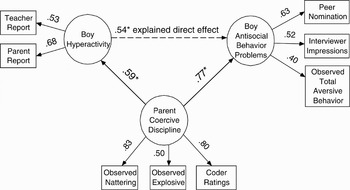
One of the best-known comorbid arrangements for children involves the relationship between hyperactivity and ASB. In the OYS we tested the hypothesis that the correlation between hyperactivity and ASB could be explained by coercive discipline (Patterson, DeGarmo, & Knutson, Reference Patterson, DeGarmo and Knutson2000). Findings are displayed in Figure 5. Hyperactivity and ASB were defined as two latent constructs using nonoverlapping measures. The path coefficient of 0.54 between the two dropped to 0.06 (ns) when the latent construct for coercive discipline was added to the model with a path of 0.59 to hyperactivity and 0.77 to ASB. These data support the hypothesis that hyperactivity and ASB belong to the same underlying process. In many cases the term hyperactivity may be a euphemism for ineffective socialization. Perhaps youngsters with especially high energy levels are harder to parent, and even more so for parents with adjustment problems of their own. A better understanding of the relationship between hyperactivity and ASB suggests that other factors must be taken into account.
The social interactional learning effects on comorbid behaviors. Data are from Patterson, DeGarmo, and Knutson (Reference Patterson, DeGarmo and Knutson2000). Paths are standardized coefficients. *p < .05.

An important dimension of the relationship between ASB and hyperactivity is that the relationship is not transitive. Half of the children who are identified as hyperactive also have ASB problems. However, the mirror image does not follow: half of the hyperactive children are not also antisocial. To address this conundrum we examined the relationship between parental antisocial qualities and child problems. The path from antisocial parents to child hyperactivity was nonsignificant, but the path from antisocial parent to child antisocial was a significant 0.31, accounting for 9% of the variance. Thus, a hyperactive child raised by antisocial parents is at prime risk to develop ASB problems. The next set of analyses sought mechanisms to explain the relationship between antisocial parental qualities and their children's ASB.
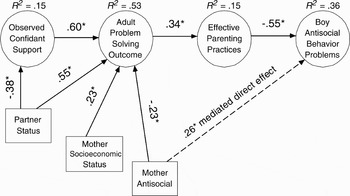
Forgatch and DeGarmo picked up the threads of that puzzle in a series of ODS-I studies in which mothers and their confidants were observed attempting to resolve the mother's personal and parenting problems (DeGarmo & Forgatch, Reference DeGarmo and Forgatch1997a, Reference DeGarmo and Forgatch1997b; Forgatch & DeGarmo, Reference Forgatch and DeGarmo1997). The model most relevant to understanding the relationship between parent and child ASB is displayed in Figure 6. Confidant support observed during the interactions led to better problem-solving outcomes, although when the confidant was an intimate partner less support was observed. Nevertheless, partners and mothers together were able to achieve better problem-solving outcomes than were dyads in which the couple was not in an intimate relationship. Other factors that contributed to the outcomes achieved in these adult problem solving interactions were mothers' antisocial qualities and socioeconomic status. There was a significant direct relationship between maternal antisocial qualities and parenting practices (i.e., monitoring, discipline, problem solving). A series of meditational models was conducted to study the relationship between maternal and child ASB. There was a direct path from antisocial parent to antisocial child behavior; this path was fully mediated by ineffective parenting practices; and poor problem-solving outcomes with confidants mediated the relationship between antisocial parent qualities and parenting problems. One way of interpreting this set of findings is that children's ASB problems may be influenced by the quality of their parent's functioning in two social domains: the family and their own social peer group. Parents who are unable to effectively draw on social agents in their adult support world to resolve personal and parenting issues may be less effective at parenting their children.
The model for the adult social environment. Data are from Forgatch and DeGarmo (Reference Forgatch and DeGarmo2007). Paths are standardized coefficients. *p < .05.

Conducting programmatic theory-based work using theory-driven studies that employ similar multiple-method measurement strategies and samples at risk for a single set of behavior problems can promote improved theory specification, intervention development, and hypothesis testing. The implications we take from these findings are relevant to the cascade problem for the present paper: parental functioning may be subject to contingencies within the adult peer domain. Is it possible that our goal of helping children through parent training can impact a mother's world outside the family, and thereby lead to a spread of intervention effects that go beyond the home?
The comorbidity problem attests the interconnectedness of the models for change. The data associated with comorbidity presented here are consistent with the idea that some aspects of the correlational network describe problem behaviors that are interrelated because they tie into a common mechanism within the same process. Understanding mechanisms, however, can be a time consuming and complicated process.
Reactive collateral changes within family effects
Some collateral changes produce reliable effects as a result of PMTO intervention, but the changes are not directly related to the theory one has about children's aggression. If under the aegis of PMTO one person changes and that change leads to change in another, this is a therapy bonus. We hypothesize that collateral changes contribute to cascade effects.
Early on we suspected a bilateral relationship between maternal depression and child ASB. Patterson applied an early form of PMTO as intervention for a clinical sample. The data showed a significant reduction in observed child externalizing behavior, and this in turn was accompanied by a significant reduction in mothers' self-reported depression (Patterson, Reference Patterson1980). In the ODS-II study, we found that simply assigning mothers to the experimental group was associated with reduced depression (Patterson, DeGarmo, & Forgatch, Reference Patterson, DeGarmo and Forgatch2004). Perhaps this led the mothers to believe that help was on the way. The improvements in maternal mood were accompanied by an increasing readiness to become involved in treatment. Furthermore, mothers who showed the early drop in depression were more likely to show parenting improvements. The reduction in maternal depression sustained through 30 months and the difference in levels depression for those in the experimental and control groups reached statistical significance by 30 months. The finding is certainly not a part of our general theory about child aggression. It is more about what may happen as a concomitant of PMTO-induced changes. As we develop a theory about the intervention process itself, it seems reasonable that it might contain some hypotheses about the kind of parent most likely to respond to the intervention at different points in time.
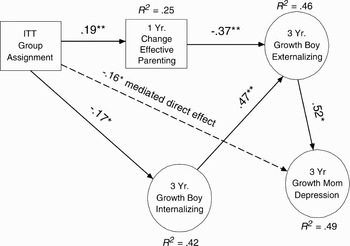
In an effort to further unravel the mechanisms of change, we used ODS-II and mediational modeling to test the paths through which reduction in maternal depression occurred (DeGarmo, Patterson, & Forgatch, Reference DeGarmo, Patterson and Forgatch2004). The findings are summarized in Figure 7. The intervention had a direct effect on reducing maternal depression, but the mechanisms of change were complicated. Changes in parenting fully mediated the intervention's impact on child externalizing but only partially mediated the impact on boys' internalizing. Improvements to internalizing contributed to reductions in the boys' externalizing. It was the benefit to externalizing that fully mediated the intervention's impact on maternal depression. The primary goal of the intervention developers was to reduce child deviant behavior, in which they succeeded. The unintended collateral effect was a reduction in maternal depression.
Collateral changes within the family. Data are from DeGarmo, Patterson, and Forgatch (Reference DeGarmo, Patterson and Forgatch2004). Paths are standardized coefficients. ITT, intent to treat. *p < .05. **p < .01.

One can take the position that what is labeled as collateral change is simply an addition to one's theory about aggression. In fact, some of the modern longitudinal studies with toddlers suggested maternal depression plays a key role in the general theory (Shaw, Connell, Dishion, Gardner, & Wilson, Reference Shaw, Connell, Dishion, Gardner and Wilson2009). Some of the preliminary findings suggest that maternal depression may set the occasion for the child's acquisition of coercive behavior. Our passive longitudinal studies show a relation between maternal depression and disrupted parenting practices (Forgatch, Patterson, & Ray, Reference Forgatch, Patterson, Ray, Hetherington and Blechman1996) and emphasize the relation between increasing success in the parent as being accompanied by the maternal sense of self-efficacy (Patterson et al., Reference Patterson, DeGarmo and Forgatch2004).
The mystery of expanding effect sizes
Thus far we have discussed two sources for cascade effects. The first source comprised the predictions from the theoretical network including information about comorbidity. The second source consisted of collateral changes in the mother that emerged shortly following intervention. In the present section we encounter a set of new questions involving massive changes that occurred during the follow-up years. It is surprising that the data show that the magnitude of these changes seems to increase over time. These data put us in a position analogous to geologists exploring a fossil bed where we can only speculate about how these changes came about.
Several lacunae have always been associated with our understanding of PMTO. One such area concerns the question of why the treatment effects persist after termination. Early findings across laboratories suggested stability in follow-up (Forehand & Long, Reference Forehand and Long1988; Patterson & Fleischman, Reference Patterson and Fleischman1979). For example, Patterson and Fleischman collected observations in the homes for a 12-month follow-up. The data showed modest stability over that interval. We had assumed that there would be an appreciable decay and actually hypothesized that after termination, parent training might require booster shots at regular intervals. Although these considerations were laid to rest when we saw the follow-up data, the findings posed new questions. Why do the data not return to BL levels following termination? Periodic increases in child deviancy are to be expected. We hypothesized that at such points the parents would use their new PMTO skills. This solution seemed intuitively obvious; no research was carried out.
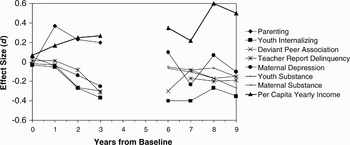
In the ODS-II study, the data showed that differences between the experimental and the comparison group sustained and effect sizes increased over time. Figure 8 displays these findings (Beldavs, Forgatch, Patterson, & DeGarmo, Reference Beldavs, Forgatch, Patterson, DeGarmo, Heinrichs, Haalweg and Döpfner2006). For youngsters, the effect sizes in terms of deviant peer association, teacher report externalizing, child report internalizing, and maternal report of depression increased over the first 30 months following BL (DeGarmo et al., Reference DeGarmo, Patterson and Forgatch2004). This expansion means things are generally improving for our families in the experimental group and staying the same or worsening for members of the comparison group. Furthermore, during that same interval, there was a significant increase in effect size for mothers in terms of economic benefits, including rise out of poverty, greater per capita annual income, and greater income/needs ratio (Forgatch & DeGarmo, Reference Forgatch and DeGarmo2007). How are these findings to be explained? There is obviously some process going on here that is more complex than the simplistic explanation provided to explain the stability of follow-up data. One method for studying this phenomenon would be to generate a separate model for each effect. Before we do that, we extend our SIL model to cover developmental trajectories in the lives of mothers following divorce.
Expanding effect sizes. Data are from Beldavs, Forgatch, Patterson, and DeGarmo (Reference Beldavs, Forgatch, Patterson, DeGarmo, Heinrichs, Haalweg and Döpfner2006).

Enter the social environment
Rigidity is one of the outstanding hallmarks of coercive individuals, who seem to transform social interactions across settings into vehicles for the expression of aversive behaviors. In the classic generalizability study by Jones, Reid, and Patterson (Reference Jones, Reid, Patterson and McReynolds1975), families were observed as they interacted in their homes on two or more occasions. The analysis showed a good deal of variability from one session to the next for the normal families. However, the interactions for the clinical families had a different feel. Family members tended to ignore variability in the settings and fall back on habitual performances of their coercive skills. The picture that emerges is that of a rigid and thoroughly unpleasant individual. What makes these findings particularly interesting is to encounter the same conclusion 50 years later, which this time is based on a dynamic systems analysis. Observation data collected from families interacting in a laboratory setting were used in a state space grid analysis (Granic & Hollenstein, Reference Granic and Hollenstein2003). The analysis showed that families with problem children tended to engage in rigid coercive sequences.
We are now beginning to appreciate that a coercive presence has a restricting influence on the variety and the frequency of social contacts. In a sense, the rigidity in the coercive person is matched by a social environment that has its own set of rigidities. The greater the level of coercion, the more infrequent is the opportunity to interact in prosocial settings. In effect, coercion might well be characterized as a kind of bilateral trait where rigid individuals' aversive behavior is matched by the restrictive settings in which they operate. Basically, their transactions are with limited social environments. There are several different analyses of the OSLC data sets that are in keeping with the hypothesis that coercion is associated with constraints imposed both upon behavior within the family and reactions provided by others outside the family. Our recent efforts to examine the rigidity concept are focused upon demonstrating that prosocial growth is almost always associated with the absence of coercion.
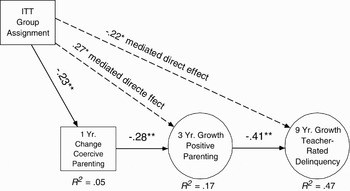
We were able to examine the relationship between coercive and positive parenting and its impact on change in boys' behavior with data from ODS-II. PMTO interventions focus on changing two sets of parenting practices deemed influential to child adjustment: decreasing coercive interactions to prevent and alter deviant child trajectories, and increasing positive parenting to promote prosocial skills and healthy child development. Our interest in how these dimensions of parenting may operate distinctly led to two sets of ODS-II analyses in which we divided the parenting practices construct into the two key dimensions, coercive and positive parenting practices. The specific components of the two forms of parenting are spelled out in numerous papers (e.g., Forgatch & DeGarmo, Reference Forgatch, DeGarmo, Reid, Patterson and Snyder2002; Forgatch & Patterson, Reference Forgatch, Patterson, Weisz and Kazdin2010). In one study using 30-month outcomes, we found that changes in coercive and positive parenting each explained unique variance to reductions in child noncompliance. We were surprised, however, that positive parenting change explained significantly more variance in reductions in child noncompliance than did reductions in coercive parenting (Martinez & Forgatch, Reference Martinez and Forgatch2001). Our theory, our passive longitudinal research, and our clinical experience repeatedly emphasized the role of coercion in children's noncompliance (Martinez & Forgatch, Reference Martinez and Forgatch2001). These findings led us to address chicken–egg questions: which comes first, reduction in coercion or increase in positive parenting? Do their effects occur simultaneously? Does change in one contribute to change in the other? In PMTO interventions we consistently adhere to the sequence of teaching positive parenting skills before introducing methods to avoid and terminate coercive interactions through effective discipline. Thus, we assumed that improving positive parenting would lead to reductions in coercion in that order, and these improvements would lead to reduced deviancy trajectories.
To examine these questions we arranged the constructs for coercive and positive parenting using differing time intervals and longitudinal sequencing. The outcome variable was youngsters' 9-year growth in teacher-rated delinquency. The model is displayed in Figure 9 (Forgatch, Beldavs, Patterson, & DeGarmo, Reference Forgatch, Beldavs, Patterson, DeGarmo, Kerr, Stattin and Engels2008). The first step tested for a direct effect of the intervention on 9-year growth in delinquency. Next we separately tested change in coercive parenting, and change in positive parenting as mediators for delinquency growth. Each model was supported indicating that the difference in growth between the two groups could be explained by change in each of the parenting constructs. Then we tested for order of effects for coercive and positive parenting, making the time interval BL to 1 year for the first construct in the sequence and growth from 1 to 3 years in the second construct. Change in coercive parenting over 1 year served as a predictor for growth in positive parenting over 3 years but the alternate sequence did not achieve good model fit. Finally, we found that the ITT group effects on 3-year growth in positive parenting were mediated by 1-year change in coercive parenting.
The latent variable growth model for the test of mediation on 9-year teacher-rated delinquency. Data are from Forgatch, Beldavs, Patterson, and DeGarmo (Reference Forgatch, Beldavs, Patterson, DeGarmo, Kerr, Stattin and Engels2008). Paths are standardized coefficients. ITT, intent to treat. *p < .05. **p < .01.

The findings carry two different implications for the cascade problem. First, successful intervention should be characterized by significant reductions in coercive parenting and significant increases in positive parenting. Second, changes in these two dimensions of parenting should be correlated. Testing alternative models with longitudinal analyses as we did strengthens support for notion that coercion may serve as a stop–go mechanism. The suggestion is that when coercive exchanges are the main attractor, there is a dampening effect on prosocial exchanges. Before we can give the stop–go metaphor credence, however, a new set of studies is necessary where the first phase is focused upon using only positive contingencies for prosocial behavior and the second phase is devoted to coercive processes. The contrast group would have just the reverse sequence.
Responsivity
A number of possible processes should be examined as potential mechanisms for delayed cascading effects. One possibility is that individuals raised in noncontingent environments become nonresponsive to contingencies when they are introduced. In this sort of situation a bad environment produces a socially unskilled person. Furthermore, a change in state can take place in which the individual becomes nonresponsive to the environment even when it does change. We can think of the antisocial person as subject to this sort of double jeopardy.
Perhaps the best-known studies on responsivity were conducted by Robert Cairns and his colleagues. Observation studies in classrooms of developmentally disabled children showed that many of teachers in these classrooms provided high rates of noncontingent positive reinforcement. The reinforcers were plentiful but they were not provided contingent upon anything the child was doing (Paris & Cairns, Reference Paris and Cairns1972; Warren & Cairns, Reference Warren and Cairns1972). When children from these classrooms were introduced to a discriminant learning task, they were shown to be less responsive to contingent reinforcement. Our earliest efforts to introduce parent training to families of children with ASB suggested that parental use of positive social reinforcement had little impact on the children. For this reason we stressed parental use of instrumental (e.g., material rewards) rather than social reinforcers during the initial stages of treatment. Our clinical experience provides nice support for the position taken by Cairns. By the way, the laboratory studies by David Lykken (Reference Lykken1957), which were replicated by others, showed that psychopaths were less responsive to punishment.
There is a second body of studies that takes a different approach to the responsiveness issue. Laboratory studies by Levin and Simmons (Reference Levin and Simmons1962) showed that conduct problem children were less responsive to social reinforcers provided by adults. Patterson and colleagues measured child responsiveness in a study with two related tasks (Patterson, Littman, & Brown, Reference Patterson, Littman and Brown1968). In the first task children were reinforced by adults. In the second task they could chose whether or not to imitate the reinforcing adult. Children most responsive to adult reinforcement were also more likely to imitate what the adult was doing. This suggests that responsiveness to social stimuli may be a generalized trait
Finally, there is a hint in these laboratory studies that responsiveness to reinforcers may lead children to acquire the social behaviors most valued by that environment. For example, Patterson and Anderson (Reference Patterson and Anderson1964) found that immature and out of control boys were significantly more responsive to positive peer reinforcement than to adult positive reinforcement. This effect was replicated by Patterson and Fagot (Reference Patterson and Fagot1967). We assume that the PMTO intervention in ODS-II may have increased boys' responsivity to reinforcers dispensed by their parents.
Enter collateral effects on mom
Thus far we have made a compelling case that PMTO significantly reduces a network of intercorrelated child behavior. As we have seen, these reductions in deviant child behavior are accompanied by increases in child prosocial behavior. It is at this point that we must change our focus. The lead question would now be: what is the impact of the child's changes in behavior upon the social environment? Presumably that same question would be reframed for each member of the family. We now turn to focus on the mothers in the ODS-II sample.
Does a reduction in coercive behavior and the concomitant increase in prosocial behaviors impact future transactions among family members? Is the impetus for the growth of new behaviors provided by the social environment in which the family is embedded? Testing this alternative would require a second set of observation data that might emphasize a variety of settings and interactions with peers. Does teaching mothers to reduce their coercive interactions and increase their positive parenting behavior with their children at home influence what happens in the mother's world outside the home? To address these questions we tested the basic mediational hypotheses that direct effects of ITT on long-term developmental outcomes of maternal adjustment would be mediated by early changes in coercive parenting, which in turn would be mediated by changes in positive parenting. A better test would examine changes in mother–confidant interactions following the intervention. Unfortunately, we have mother–confidant data at BL only.
Maternal adjustment: ODS-II
For examining long-term mother as person effects we focused on a negative domain, maternal arrests, and a positive domain of maternal adjustment, a composite standard of living. Nine waves of maternal outcome data were collected over a 9-year period at BL and 0.5-, 1-, 1.5-, 2.5-, 6-, 7-, 8-, and 9-year intervals.
Frequency of arrests were collected from official records searches of the Oregon Judicial Information Network, the Oregon circuit court databases, the State Police criminal database and, where applicable, out of state databases on all known aliases. Together these databases covered federal, municipal, and justice courts. Records included dates of entry, state offense codes, and disposition status. The focal dependent variable in this report was the total number of arrest records. Administrative entries were excluded (e.g., court date scheduled) and multiple record entries for the same offense were counted as one arrest (separate charges for the same offense, e.g., three counts of forgery on the same day). As a control covariate, arrest records for BL were measured as lifetime cumulative history of maternal arrests.
Standard of living was a composite construct including indicators of socioeconomic well-being, per capita annual income, financial stress, occupational prestige, and educational attainment. To index the standard of living over time, a growth score was computed by rescaling all the standard of living indicators to range from 1 to 5 and then averaging. The standard of living α ranged from 0.51 to 0.68 over nine waves and 9 years.
Composite indicators were the following: per capita annual income was computed from the mother's report of income divided by the number of persons reported living on that income. Annual income was measured in ordinal categories ranging from 1 (<$5,000) to 10 (>$100,000). Financial stress was a construct of seven items. One was an index summing “yes” responses to “Are you able to afford (a) a large enough house, (b) furniture or household equipment that needs replacement, (c) the kind of car you need, and (d) car repairs, fuel, insurance?” Four items were rated 1 (never) to 4 (every month), “How often does it happen that you do not have enough money to afford (a) the kind of food your family should have, (b) the kind of medical care your family should have, (c) the kind of clothing your family should have, and (d) the leisure activities that your family wants?” One item asked “How much difficulty do you have in meeting monthly bill payments?” rated 1 (a great deal of difficulty) to 4 (no difficulty at all); and one item asked “How do your finances work out at the end of month?” rated 1 (some money left over) to 3 (not enough money to make ends meet). All financial stress items were rescaled to range from 1 to 5 and then were averaged to reflect higher stress (total α = 0.81–0.89 over 9 years). Occupational prestige was scored from the mothers' reported primary occupation using categories ranging from 1 to 9 from the Hollingshead Four Factor Index of Social Status (Hollingshead, Reference Hollingshead1975). Educational attainment was measured as years of education completed measured in categories ranging from 1 (higher than eighth grade) to 13 (advanced doctorate).
Maternal coercive and positive parenting: ODS
To test hypotheses for intervention impacts on change in parenting influencing later maternal adjustment, latent constructs assessing change in coercive parenting and prosocial patenting were specified using change scores and previously validated indicators and factor structures (from Forgatch & DeGarmo, Reference Forgatch, DeGarmo, Reid, Patterson and Snyder2002; Forgatch et al., Reference Forgatch, Beldavs, Patterson, DeGarmo, Kerr, Stattin and Engels2008). Three observation-based measures specified change in maternal coercive parenting over 1 year, negative reinforcement, negative reciprocity, and coercive parenting ratings. The measures specified change in maternal positive parenting over 2.5 years that were observed positive involvement, skill encouragement, and monitoring.
Scores were obtained from laboratory observations during 45-min mother–youth structured interaction tasks. The tasks were four problem-solving discussions about current conflicts, a teaching task, an unstructured activity, a forbidden toy situation, and a refreshment break. Microsocial data that detail information on respondent, recipient, sequence, content, affect, context, and duration were scored in real time using the Interpersonal Process Code (Rusby, Estes, & Dishion, Reference Rusby, Estes and Dishion1991). Global ratings (Forgatch, Knutson, & Mayne, Reference Forgatch, Knutson and Mayne1992) were scored by coders following microsocial coding. Coders were blind to intervention status and never coded families more than once, and approximately 15% of the interactions at each wave were blindly scored for interrater reliability. For the microsocial scores below, the Cohen κ coefficient assessing coder agreement above chance ranged from 0.77 to 0.80 for behavior content codes over the first five waves of the study, and the κ for affect codes ranged from 0.67 to 0.76.
Negative reinforcement was a microsocial score defined as the frequency of conflict bouts initiated by the mother and terminated by the child. Negative discrete behaviors coded from the Interpersonal Process Code defined conflict bouts. Bouts continued until at least 12 s passed without aversive behavior by either party. Negative reciprocity was measured with the Haberman binomial Z score (Gottman & Roy, Reference Gottman and Roy1990), reflecting the conditional likelihood that the mother reciprocated the child's aversive behavior with an aversive behavior of her own. Coercive discipline was measured as the mean of 13 Likert scale global ratings. Sample items were overly strict, authoritarian, used nagging or nattering, indecisive, and inappropriate discipline (α = 0.91 and 0.92 for BL and 1 year, respectively; interrater intraclass correlations [ICCs] = 0.70 and 0.78).
Skill encouragement was measured using 11 Likert scale global ratings of the promotion of skill development through contingent encouragement and scaffolding that was observed during the 10-min teaching task. Sample items were “breaks task into manageable steps,” “reinforces success,” and “prompts appropriate behavior” (α = 0.69 and 0.81 at BL and 2.5 years, respectively; ICCs = 0.73 and 0.66). Positive involvement was a mean scale score ratings of items following each individual interaction task and also from an overall rating assessing positive involvement for the entire 45 min. All items were ratings using Likert scale items following each of the interaction tasks (e.g., showed warmth, respect, empathy, interest, affection, etc.; α = 0.96 and 0.97 for BL and 2.5 years, respectively; ICCs = 0.83 and 0.82). Monitoring comprised five items rated by coders and parent interviewers. Coders rated skill at supervising the child, tracking the youngster's behavior, and obtaining information from the child. Interviewers rated maternal knowledge of the boy's day-to-day behavior and ASB (α = 0.72 and 0.71).
Results for tests of collateral effects on mom growth in maternal standard of living
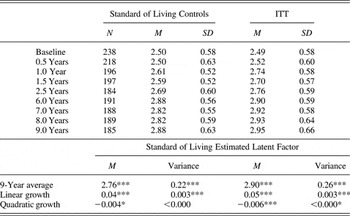
To conduct the analyses we employed latent variable growth models using Mplus 5.2 with full information maximum likelihood estimation (Muthén & Muthén, Reference Muthén and Muthén2007). The first set of hypotheses were tested in three basic steps: (a) specifying the pattern of growth over time, (b) testing for direct main effect of the intervention on long term growth, and (c) testing for mediation of the intervention effect through changes in coercive parenting and in turn by changes in prosocial parenting. The means and standard deviations by group condition are presented in Table 1. An independent sample t test revealed no group differences at BL in the standard of living.
Sample descriptives for measured indicators and estimated latent growth factors for maternal standard of living by group condition

Note: ITT, intent to treat condition.
*p < .05. **p < .01. ***p < .001.
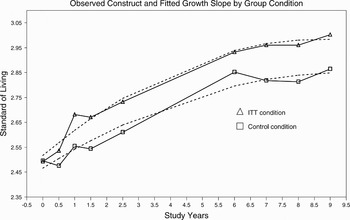
Centering time, the unconditional growth model specified three latent factors: Average Levels Over 9 Years, Linear Growth, and Quadratic Growth, χ2 (36) = 98.94, p = .00; comparative fit index = 0.97, standardized root mean square residual = 0.07. The sample obtained a 9-year average standard of living mean of 2.85 (p < .001) with significant individual differences in average levels (variance [VAR] = .25, p < .001). The Linear Growth factor obtained significant mean growth as well as individual differences in growth (M = 0.04, p < .001; VAR = 0.003, p < .001). For the Quadratic factor, the mean or leveling off over time was significant and there was individual variation (M = −0.006, p < .001; VAR < 0.000, p < .01). The Growth factor parameters by group condition are shown in Table 1. To illustrate the standard of living longitudinal pattern, the observed means and fitted slopes by group conditions are shown in Figure 10. Each group increased roughly 0.05 units per year over the study period. The significant quadratic indicated that groups increased more rapidly early in the study and then leveled off over the later years.
Oregon Divorce Study (ODS) maternal standard of living observed and fitted growth over 9 years. ITT, intent to treat.

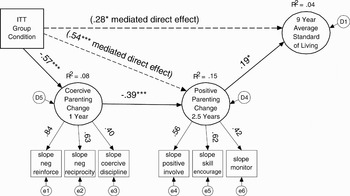
We next tested the meditational hypotheses by first examining the direct effects of the intervention on standard of living over time and testing whether these effects were mediated by change in coercive and change in prosocial parenting practices. The hypothesis was supported for average levels of maternal standard of living over time. A main effect of the intervention was mediated by changes in prosocial parenting.
We first evaluated the direct effects of the intervention on the average, linear, and quadratic growth. The ITT condition was associated with significantly higher average levels of over the study period. Because the standard deviation of a binary variable is not meaningful, the standardized effects of the ITT binary group predictor are reported as the Y standardized β (Muthén & Muthén, Reference Muthén and Muthén2007). The Y standardized beta is interpreted as the change in Y-dependent variable standard deviation units when a binary covariate X changes from zero to one. The standardized β was 0.29 (p < .05); therefore, the effect size was nearly a third of a standard deviation difference. For linear and quadratic growth, the intervention effect approached marginal significance for linear growth but was nonsignificant for either linear or quadratic growth rates. Therefore, further tests of mediation focused on the intervention impact on overall levels in standard of living.
In the final model we entered a latent variable measuring change in positive parenting practices over 2.5 years into the study. As demonstrated in previous reports, the intervention was associated with increases in positive parenting (β = 0.54, p < .001) which was mediated by the intervention effect on change in coercive parenting over 1 year. That is, the intervention predicted reductions in coercive parenting (β = −0.57, p < .001) and in turn increases in coercive parenting predicted decreases in positive parenting (β = −0.37, p < .001), rendering the direct effect of the intervention on positive parenting nonsignificant.
Finally, entering change in coercive parenting and change in positive parenting mediated the direct effect of the intervention on standard of living. Therefore, the intervention was associated with over half a standard deviation change in prosocial and coercive parenting that accounted for the effect of the intervention on average standard of living. We also tested an alternative model to examine whether coercive parenting effects on average standard of living was mediated by prosocial parenting. Results indicated that coercive parenting had an indirect effect but coercive parenting did not have a direct effect that was mediated. The final results are summarized in Figure 11. Therefore, early changes in coercive parenting were instrumental in producing changes in positive parenting which were more central to exhibiting changes in standard of living.
Average level growth model summarizing test of mediational hypotheses for maternal standard of living. Paths are standardized betas, and Y is standardized for the intent to treat (ITT) effect. Final model χ2 (109) = 178.08, p = .00; comparative fit index = 0.97, standard root mean square residual = 0.06. *p < .05. ***p < .001.

Count of maternal arrests
We next focused on the count of maternal arrest records. The sample descriptives for arrest records prior to entering the study and after entering the study are provided in Table 2 by group condition. There was no significant difference in the prior history of arrests between the two experimental conditions in terms of the number of arrests or the proportion of mothers arrested. At BL, 20% of the controls had a prior history of arrests and 21% of the ITT condition had been arrested. For the 9 years following BL, 25% of the sample experienced an arrest, 75% did not (29% of the control condition had experienced an arrest and 22% of the ITT). Nonparametric testing showed this proportion was not significantly different.
Descriptives for count of maternal arrest records by group condition

For any given year of arrest records data, the occurrence of being arrested was a relatively infrequent event. Using complete continuous annual records for each participant from BL to study exit, the highest proportion of mothers arrested in any given year after BL ranged from 0% to 7% (0% to 11% for the controls, and 0% to 5% for the ITT). The data in Table 2 indicate that the average count of arrests over the 9-year study period was ~1 for the control and ~0.5 for the ITT condition.
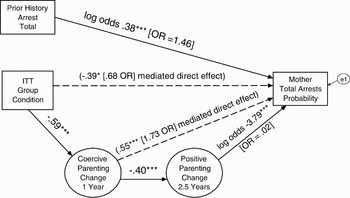
Therefore, to appropriately model arrest records we employed the zero-inflated Poisson (ZIP) model for count data. The ZIP model estimates the log odds of an arrest occurring adjusting for the large portion of the study not arrested. Further, because of the lack of variance in any given year we modeled the data as total count as opposed to latent growth ZIP models. More specifically, we modeled the probability of arrests during the study controlling for prior history of arrests.
Evaluation of the study hypotheses fully supported the meditational model. First, controlling for prior history arrests, the results indicated that the intervention main effect was associated with a reduction in the log odds of arrests (−0.39, p < .05) translating to an odds ratio of 0.68 or a 32% reduction in the count of arrests relative to the control condition. Prior history of arrests was associated with in increased log odds of .19 (p < .001). Second, this main effect was mediated by changes in coercive parenting practices and changes in prosocial parenting practices. The main effect of changes in coercive parenting practices was mediated or accounted for by the later changes in positive parenting practices. Increases in coercive parenting by 12 months were associated with almost twice the likelihood of being arrested; however, this effect was mediated by later increases in prosocial parenting, which was in turn almost entirely accounted for the reductions in arrest probability for the ODS sample obtaining a log odds of −3.79 translating to a 98% reduction in likelihood of arrests. These findings suggested that controlling for prior history of arrests, intervention-induced changes in prosocial parenting practices accounted for the majority of the intervention impact on reduced likelihood of arrests.
The final results are summarized in Figure 12. Unlike the standard of living pathway, the model indicated that early coercive parenting had a direct influence on arrests. This is consistent with the coercion model that prior levels of ASB measured by arrests, and coercive parenting had central effects predicting later arrests. The intervention impact on coercive patterns, however, demonstrated a cascading effect on the mother's later social environment and prosocial attractors, which was in turn shown to be a strong protective factor for standard of living and a buffer against arrests.
The zero-inflated Poisson model summarizing the test of mediational hypotheses for maternal arrests. Paths are unstandardized log odds and odds ratios (OR) for predictors of arrests. The remaining paths are standardized betas, and Y is standardized for the intent to treat (ITT) group effect. *p < .05. ***p < .001.

Discussion
In the late 1960s, our intervention studies focused on preschool children and their families. At that time, we thought reducing child noncompliance constituted a successful outcome. We had no idea that the parent management training procedures might produce a multitude of concomitant effects. Our early model might best be characterized as a trickle in contrast to a cascade. Simply focusing on noncompliance was a serious underestimate of treatment effects. Expanding the model to encompass a range of externalizing behaviors is also insufficient. What is needed is a broad perspective on what is changing. In that context, data reviewed in the present report strongly indicate that the entire family is changing and these changes are accelerating over time.
It is curious that we know so little about how and why behavior changes (Patterson, Reference Patterson1993). We are sorely in need of a general theory of change. Personality theory could have been directed to understand change. Instead, the bulk of empirical work on personality theory could be characterized as a myopic fascination with the stability of traits (Goldberg, Reference Goldberg1994). One way to address this omission is to draw on longitudinal data sets with multiple method measurement to focus on the question, why does X correlate with Y. For example, the pragmatic work by Masten and colleagues (Reference Masten, Roisman, Long, Burt, Obradovic, Riley, Boelcke-Stennes and Tellegen2005) demonstrates that use of multiagent definitions for constructs in longitudinal studies proves to be generalizable across investigations. In the Masten study, childhood measures of externalizing behavior predicted measures of adolescent incompetency, which in turn correlated with later internalizing problems. The finding that internalizing and externalizing problems are correlated proves to be highly generalizable, holding true in the present study, and the studies by Dishion and Dodge referenced earlier.
We view correlations of rigorously measured constructs across time as constituting a kind of road map that tells investigators where to look for explanations of why behavior changes. The collection of cascade papers in this special issue seems ideally suited to this task. Our general strategy has been to search for explanations of why change scores intercorrelate. Where such studies exist we have considered the role of antecedent constructs as possible mechanisms for change in outcomes that occur later in time. For aggression, for example, we hypothesize that coercion begins early and varies as a function of age. Ultimately, change models will require experimental tests in which putative mechanisms are manipulated. In the mean time, studies that cannot include this provision can make valuable contributions to investigations of change.
From Cascades to Theory
The Oregon, Dishion, and Dodge models show an orderly sequence in the development of aggression in children and adolescents. These three groups all rely upon multimethod and agent definitions for the constructs within the models with longitudinal sequencing. Beginning in the 1970s, two domains have been of particular interest to developmental researchers. One domain was labeled parenting practices and the other was child externalizing behavior. The hypothesis was that improving parenting practices would be accompanied by reductions in child externalizing behaviors.
The data across studies identify several dimensions to parenting. Estimates of cascade effects dramatically increased when the multiple dimensions of parenting were combined in construct scores. As investigators began to check on the myriad dimensions of youngsters' externalizing problems (e.g., noncompliance, oppositional behavior, hyperactivity, stealing, fire setting, bullying, delinquency), the relationship between the two domains became even more profound. When intervention affected changes in parenting, the effects could reverberate in any one or all of the youth outcomes.
A failure to parent effectively joined with what amounts to nonlinear increases in child pathology constitutes a very negative developmental picture for the child. In dynamic systems terms, the child is emerging as an unsocialized and increasingly destructive force in our society. The outcomes during young adulthood are so dire that one would think of the antisocial path as being untreatable. Developmental progress is characterized by the increasing presence of negative and destructive behavior, matched only by the accompanying absence of social competencies.
Our theory of aggression has only recently begun to incorporate estimates of cascade effects following successful treatment. The data from the Forgatch, DeGarmo, and Patterson studies cited earlier showed that changes in children's problem behavior had significant effects on their mothers' outcomes. These findings regarding changes in maternal behavior over the 9-year follow-up interval deliver two different messages. First, the findings suggest that the mother and more likely the entire family are deeply involved in the change process that is radically altering all of their lives. The depth and duration of these changes are far beyond any outcomes that we might have imagined for PMTO back in the 1960s, 1970s, and 1980s. Second, modeling studies account for only a modest amount of the variation in the change scores. In effect, as investigators we know that there is an important process underway. We can only guess how the changes come about. These dramatic collateral effects for mothers were a cascade bonus and leave little doubt that careful measurement of outcomes for fathers and siblings would yield similar contributions. What is needed now is a theory of change that can take into account a complex system, such as a family.
Why and when do changes occur?
Cascade models can show the connections between points X and Y in an emerging theory of aggression in youngsters. In turn, these connections form a map providing the investigator with precise directions about where to search for mechanisms. The cluster of longitudinal studies describing cascade effects seems ideally suited to this stage of theory development. The first task is to determine whether the sequences are orderly. The present report and the programmatic studies by Dishion, Véronneau, and Myers (Reference Dishion, Véronneau and Myers2010) and Dodge et al. (Reference Dodge, Greenberg and Malone2008) produce similar roadmaps by employing multiple-agent, multiple-method definitions for the constructs. All three models define developmental stages beginning with childhood adjustment and proceeding to adolescent antisocial outcomes, such as violence or arrest. The Dodge model consists of seven domains leading to violence with content similar to the Oregon model (e.g., Figure 1), consisting of five domains to predict adult crime. In both models the data show the prior domain to be a significant predictor for the domain that follows. Each stage also provides a significant increment in predicting the eventual outcome.
We propose that the correlational search for cascade effects provides a useful stage in building a theory of child aggression. The correlations tell us how the effects will spread at different points in time. What is left out is an explanation of why these events are intercorrelated. This section briefly reviews some findings that are relevant to these issues. Essentially we will work through the sequence outlined in Figure 1 and look for variables that might serve as mechanisms that could explain why changes in X correlate with changes in Y. The Dishion, Dodge, and Oregon models begin by defining the impact of negative contexts as disruptors for parenting practices during early childhood. For example, this implies that moving to a better neighborhood could lead to more effective parenting. Family structure transitions, parental depression, and economic adversity are all examples of harsh family contexts that can interfere with effective parenting (Capaldi & Patterson Reference Capaldi and Patterson1991; DeGarmo et al., Reference DeGarmo, Forgatch and Martinez1999; Martinez & Forgatch, Reference Martinez and Forgatch2002). The question is, why are the variables of contexts and parenting correlated? A good place to begin might be the seminal studies by Elder, Downey, and Cross (Reference Elder, Downey, Cross, Datan, Greene and Reese1986). They found that economic downturns were associated with significant increases in fathers' irritability, and increased irritability in turn predicted increased harsh discipline. Would these findings survive analyses for status as mediating mechanisms? Does the mechanism vary as a function of the kind of context we are studying? We think so.
The next linkage is found in both the Oregon (Patterson, Shaw, Snyder, & Yoerger Reference Patterson, Shaw, Snyder and Yoerger2005) and Dishion et al. (Reference Dishion, Véronneau and Myers2010) models. The key assumption is that ASB can assume two different forms: overt and covert. Both forms are maintained by reinforcing contingencies. The data show that the bulk of overt ASB is maintained by negative reinforcement supplied by family members (Snyder & Patterson, Reference Snyder and Patterson1995). Covert forms are maintained primarily by positive reinforcement provided by members of the deviant peer group. What makes these differences particularly interesting is that an accurate prediction of crime for young adults requires the contributions of both forms of ASB (Forgatch et al., Reference Forgatch, Patterson, DeGarmo and Beldavs2009).
Coercive behavior is associated with two distinct outcomes: high scores predict deviancy; low scores are associated with social competence. This suggests a strong correlation among coercion, deviancy, and social incompetence. Coercive parenting is characterized by microsocial patterns of behavior that incorporate high rates of aversive intrusions, irritable commands, negative reciprocity, and negative attributions about others. For children, maternal coercive discipline is directly related to high rates of noncompliance and other overt ASBs (Snyder & Patterson, Reference Snyder and Patterson1995; Snyder, Schrepferman, McEachern, & DeLeeuw, Reference Snyder, Schrepferman, McEachern, DeLeeuw, Potegal, Stemmler and Spielberger2010). In an early model tested with the OYS, coercive discipline predicted ASB, which in turn was correlated with academic failure (Patterson et al., Reference Patterson, Reid and Dishion1992). In a more recent cross-sectional analysis from the ODS-II sample using the BL data, we focused a measure of positive parenting more narrowly on academic skill promotion, and that construct directly accounted for 27% of the variance in academic functioning (Martinez & Forgatch, Reference Martinez and Forgatch2002). Using longitudinal analysis following intervention with ODS-II, we found the positive parenting construct to make a significantly stronger contribution to reductions in child noncompliance than did coercive parenting from BL to 30 months. Improvements in the measurement of parenting have enabled us to explore more discrete aspects of the model and to examine differing effects of coercive and positive parenting constructs.
Coercive parenting seems to be well represented by the stop–go metaphor detailed earlier in the report. The metaphor implies that the socialization process is retarded in conditions of high coerciveness; alternatively, the go aspect requires both low coerciveness and intensive positive parenting. Our findings showed that reductions in coercive parenting in the first 12 months of follow-up increased the likelihood of positive parenting between 12 and 30 months. It was the growth in positive parenting that mediated coercive parenting effects on changes in delinquency from BL to 9-year follow-up youngsters (Forgatch et al., Reference Forgatch, Patterson, DeGarmo and Beldavs2009) as well as for the mothers themselves in the same interval, as in the present report. The positive parenting construct also mediated intervention effects on growth on maternal standard of living. The question that emerges is, does coercive parenting cause a decrease in positive parenting? We do not know. However, we did test an alternative model, that early increases in positive parenting would mediate intervention effects on later decreased coercion. That model was not supported. We speculate an either–or characteristic that may reflect the ipsative nature of process and a strong negative correlation between the two parenting constructs: family members are essentially coercive or essentially positive in their interactions with each other. Families who are coercive tend not to support the development of social competence. We would expect a confirmatory factor analysis to yield discriminant validity for the two constructs.
Another research approach might bear on this issue. We spent a decade testing laboratory procedures to assess children's responsiveness to social reinforcers delivered by parents and peers (reviewed in Patterson, Reid, & Eddy, Reference Patterson, Reid, Eddy, Reid, Patterson and Snyder2002; Patterson & Forgatch, Reference Patterson, Forgatch, Befring, Frønes and Sørlie2010). The findings suggest that antisocial boys may be less responsive than normal children to social reinforcers delivered by parents and other adults. The findings also suggested that high levels of responsiveness to peer reinforcement were associated with immature and out of control behavior. In passing, we note that these findings for lack of responsiveness to social reinforcers led us to use instrumental rather than social reinforcers in the first stages of PMTO therapy. Although not yet tested, our clinical impression is that the structured social environment provided by PMTO results in an increase in responsiveness to social reinforcers.
Deviant peers as agents of change
We view the normal peer group as a major socializing environment for youngsters. Peer interactions serve as a powerful base for teaching the subtleties of interacting with children of the same age and gender. Antisocial children tend to be rejected by normal peers because of their coercive behavior and lack of social skills (Patterson et al., Reference Patterson, Reid and Dishion1992). Rejection by normal peers leads the coercive child into increasing contact with the deviant peer group. And, as we have seen, the deviant peer group is a major contributor to training in deviancy, as evidenced in our own work (Patterson & Yoerger, Reference Patterson, Yoerger, Reid, Patterson and Snyder2002) and the programmatic studies of Dishion et al. (Reference Dishion, Véronneau and Myers2010). If there is a nexus within the PMTO model, it would be in the interface of social environments provided by families and peer groups. What happens at home ties the results of training in overt ASB to training in covert ASB at school. The longitudinal data suggest the contribution of deviant peers begins in the first years of school (Snyder et al., Reference Snyder, Schrepferman, Oeser, Patterson, Stoolmiller and Johnson2005). The findings from the Dishion studies emphasize the increasing contribution of the deviant peer process in adolescence (Dishion et al., Reference Dishion, Andrews and Crosby1995).
Causal models at different levels
Earlier in this report we cited studies that consistently employed RCTs in which the experimental group received parent training. In all these studies, improvements in child outcomes were mediated by improvements in parenting practices. Examination of the data sets suggests several places in the model where causal mechanisms may exist, and they may exist at multiple levels. We assume that there is no single cause for child aggression. We also assume that each cause for child aggression can be examined at multiple levels. Reinforcement supplied by family members for overt ASB constitutes one set of causes. Reinforcement for covert ASB by peers constitutes a second set of causes. Finally, each of these causes can be tested at different levels.
At Level 1 we could proceed by using direct observation at microsocial levels to test family and peer reinforcing effects. Using observation of family interactions, the hypothesis is that the relative rate of reinforcement is highly correlated with the relative rate of overt ASB (Snyder & Patterson, Reference Snyder and Patterson1995; Snyder et al., Reference Snyder, Schrepferman, Oeser, Patterson, Stoolmiller and Johnson2005). In observation of peer interactions, the hypothesis is that positive reinforcement for deviant talk is associated with engaging in deviant acts (Dishion, Bullock, & Granic, Reference Dishion, Bullock and Granic2002; Patterson & Yoerger, Reference Patterson, Yoerger, Reid, Patterson and Snyder2002).
At Level 2 the data from multiple agents and methods can be combined in constructs and applied in models. This more macrolevel of analysis employed within RCTs can be applied to test meditational models. The hypothesis here is that intervention improvements to parenting practices would mediate intervention effects on reduced externalizing behaviors in the youngsters.
Part of this level will involve the mapping of fathering effects over time. The focus of the present report has been mother and child cascades. As with findings noted in the Elder et al. (Reference Elder, Downey, Cross, Datan, Greene and Reese1986) study, fathers play unique roles in contributing to the family system in terms of their direct and indirect genetic and environmental effects (DeGarmo, Reference DeGarmo2010; Dishion et al., Reference Dishion, Owen and Bullock2004) as well as identified spillover effects on maternal functioning (DeGarmo & Forgatch, Reference DeGarmo and Forgatch2002). We have observed that mothers typically engage in higher rates of both positive and negative behaviors with children; however, when fathers do engage in coercion it can be more salient. Relative to mothers in the OYS, for example, Patterson and Dishion (Reference Patterson, Dishion, Hinde and Stevenson-Hinde1988) showed that fathers' coercion explained twice the variance in children's problem behaviors. In a PMTO experimental evaluation larger effect sizes of parent training were observed for stepfathers (DeGarmo & Forgatch, Reference DeGarmo and Forgatch2007), a group of fathers typically at risk for lack of involvement, lower warmth, and elevated coercion. Before the development of more systemic parenting interventions, it will also be important to map out cascading effects of father influences and fathering social environments over time.
Level 3 of the analysis could include measures of Gene × Environment interactions and test the hypothesis that a propensity for aggression is exacerbated by the child's social environments. Recent innovations in studies of genetic effects have largely replaced twin designs that were flawed by their egregious failure to address the underlying assumptions associated with this approach. Contemporary studies rely on adoption designs, which cast a wider net in their study of Gene × Environment interactions (Leve, Harold, Ge, Neiderhauser, & Patterson, in press; Suomi, Reference Suomi, Bock and Goode2005). We hypothesize that genetic effects could be applied to either micro- or macrolevels of tests.
In search of new environments
Our experience applying PMTO in RCTs and studying the ensuing processes and outcomes has led us to believe that the resulting cascading effects develop because family members gain access to new social environments. We believe that such access may account for the expanding effect sizes that emerge during follow-up. Presumably the reduction in coercive patterns of behavior and the increases in positive processes do not go unnoticed by social groups outside the family. The idea is that a wide array of settings became available to mothers and their children in terms of peer groups and teachers for children, and confidants, intimate partners, social support groups, and relatives for the mothers. New social environments can support the acquisition of new skills, opening ever-expanding social horizons. Although these are speculations, they are in keeping with the model that emerges in the present paper. The intervention releases dynamic processes that remain in motion for years following the brief parent group intervention. We need new ideas about what the kinds of data sets that are required to understand these processes to enable us to improve our theoretical perspectives.
Conclusion
The study of change has shown itself to be replete with surprises. For example, our initial experience with intervention for ASB problems suggested clear beginnings and specific endings. Given four decades of research, we no longer see discrete endings. The eventual fate of specific externalizing problems may be of less importance than the quality and extent of the growth experience that emerges during the follow-up.
Another surprise has to do with findings that showed dramatic increases in the effect sizes for many of the key variables in the PMTO model. The studies evaluating long-term effects and processes based on parenting interventions are few and based on limited measurement. Very few intervention studies assess parenting practices and peer processes at levels characterizing ODS. There is a pressing need to replicate the findings in this report.