INTRODUCTION
The success of coral reefs largely depends on the symbiotic relationships between reef invertebrates and dinoflagellates of the genus Symbiodinium (Freudenthal, 1962). Disruption of these interactions produces coral bleaching, which is widely considered to be one of the biggest threats to the health of coral reefs today (Hoegh-Guldberg et al., Reference Hoegh-Guldberg, Mumby, Hooten, Steneck, Greenfield, Gomez, Harvell, Sale, Edwards, Caldeira, Knowlton, Eakin, Iglesias-Prieto, Muthiga, Bradbury, Dubi and Hatziolos2007). Currently, nine clades (A–I) of Symbiodinium have been identified as distinct lineages based on nuclear ribosomal DNA (rDNA) and chloroplast 23S rDNA (LaJeunesse, Reference LaJeunesse2002; Santos et al., Reference Santos, Taylor, Kinzie, Hidaka, Sakai and Coffroth2002; Pochon & Gates, Reference Pochon and Gates2010), with each clade containing numerous Symbiodinium types often resolved using the internal transcribed spacer (ITS) regions (ITS1 and ITS2: e.g. LaJeunesse et al., Reference LaJeunesse, Loh, van Woesik, Hoegh-Guldberg, Schmidt and Fitt2003, Reference LaJeunesse, Bhagooli, Hidaka, DeVantier, Done, Schmidt, Fitt and Hoegh-Guldberg2004; van Oppen, Reference van Oppen2004). Previous investigations have shown that distinct symbiont types exhibit physiologically diverse as well as distinct ecological functions (Sampayo et al., Reference Sampayo, Franceschinis, Hoegh-Guldberg and Dove2007, Reference Sampayo, Ridgway, Bongaerts and Hoegh-Guldberg2008; Frade et al., Reference Frade, De Jongh, Vermeulen, Van Bleijswijk and Bak2008; LaJeunesse et al., Reference LaJeunesse, Smith, Walther, Pinzon, Pettay, McGinley, Aschaffenburg, Medina-Rosas, Cupul-Magana, Perez, Reyes-Bonilla and Warner2010). Recent studies have highlighted the high genetic diversity within the genus Symbiodinium, which raised the possibility that reef corals' tolerance to bleaching and environmental stress may vary according to their symbiotic associations (Baker, Reference Baker2003). Consequently, investigating the patterns of diversity in coral–algal symbioses on a variety of spatial scales with specific habitats is important for understanding the tolerance and adaptability of coral species to natural and anthropogenic perturbations.
The patterns of coral–Symbiodinium associations depend largely on the specificity of the symbioses (Baker, Reference Baker2003; LaJeunesse et al., Reference LaJeunesse, Bhagooli, Hidaka, DeVantier, Done, Schmidt, Fitt and Hoegh-Guldberg2004, Reference LaJeunesse, Bonilla, Warner, Wills, Schmidt and Fitt2008; Garren et al., Reference Garren, Walsh, Caccone and Knowlton2006). Although a much debated issue, studies have suggested symbiont transmission mode have effect on symbiont diversity and specificity, especially apparent in corals with a vertical symbiont transmission strategy, in which symbionts are passed directly from the maternal colony to the offspring (Baker, Reference Baker2003; Barneah et al., Reference Barneah, Weis, Perez and Benayahu2004; van Oppen, Reference van Oppen2004; Stat et al., Reference Stat, Loh, Hoegh-Guldberg and Carter2008). Specificity of host–symbiont associations also depends largely on the host (Baker, Reference Baker2003; Weis, 2008). Additionally, the host–symbiont partnerships differ not only between coral taxa but also between conspecific populations at both large (Loh et al., Reference Loh, Loi, Carter and Hoegh-Guldberg2001; Rodriguez-Lanetty et al., Reference Rodriguez-Lanetty, Loh, Carter and Hoegh-Guldberg2001) and small scales (Oliver & Palumbi, Reference Oliver and Palumbi2009), as well as showing clear patterns of depth zonation (Sampayo et al., Reference Sampayo, Franceschinis, Hoegh-Guldberg and Dove2007; Frade et al., Reference Frade, De Jongh, Vermeulen, Van Bleijswijk and Bak2008). For example, a latitudinal pattern was observed in the coral Plesiastrea versipora along the eastern Australian coast, with a transition of Symbiodinium types occurring from clade C to clade B in the cooler, high latitude communities (Rodriguez-Lanetty et al., Reference Rodriguez-Lanetty, Loh, Carter and Hoegh-Guldberg2001). The symbiotic dinoflagellates of reef-building corals are sensitive to changes such as temperature, irradiance and turbidity. The combinations of corals and their symbionts may be environmentally determined (Toller et al., Reference Toller, Rowan and Knowlton2001; Garren et al., Reference Garren, Walsh, Caccone and Knowlton2006). It has also been shown that some symbiont types were better suited to withstand environmental pressure than others (Baker, Reference Baker2003). For instance, Berkelmans & van Oppen (Reference Berkelmans and van Oppen2006) found that Symbiodinium type D displaced symbiont type C in corals transplanted from a clear water habitat in the southern Great Barrier Reef (GBR) to a more turbid and warmer inshore reef in the centre of the GBR.
However, little is known concerning the fine-scale diversity for Symbiodinium spp. populations inhabiting coral species with different symbiont transmission mode (Stat et al., Reference Stat, Loh, Hoegh-Guldberg and Carter2008), particularly in an extreme environment. Given the projected global changes expected to affect the coral reefs (Hoegh-Guldberg et al., Reference Hoegh-Guldberg, Mumby, Hooten, Steneck, Greenfield, Gomez, Harvell, Sale, Edwards, Caldeira, Knowlton, Eakin, Iglesias-Prieto, Muthiga, Bradbury, Dubi and Hatziolos2008), there is a critical need to conduct more research on patterns of host–symbiont associations from different habitats, as differences in symbiosis may partially explain and help predict how coral communities respond to environmental change.
Herein, we examined the diversity of Symbiodinium associated with two scleractinian corals, Galaxea fascicularis (Linnaeus, 1767) and Pocillopora damicornis (Linnaeus, 1758), using denaturing gradient gel electrophoresis (DGGE) analysis of polymerase chain reaction (PCR) amplified fragments of ITS2 rDNA. Galaxea fascicularis and P. damicornis are two ecologically dominant reef-building corals in the Pacific as well as in the tropical regions of the South China Sea. Galaxea fascicularis is a bleaching resistant species which acquires Symbiodinium from the external environment each generation (horizontal transmission); Pocillopora damicornis is a bleaching sensitive species with a vertical symbiont transmission strategy (Richmond & Hunter, Reference Richmond and Hunter1990). We attempted to characterize the main environmental factors which drive the distribution pattern of Symbiodinium in Gaolong Bay, near Qinlan Harbor of Hainan Island, China. The results contribute to our understanding of the flexibility of coral–Symbiodinum and the local adaptation.
MATERIALS AND METHODS
Study site and sampling
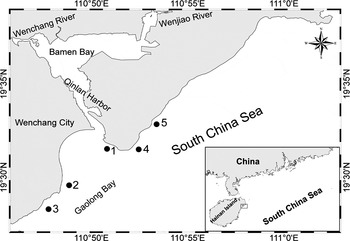
Gaolong Bay is located on the north-eastern coast of Hainan Island, the second largest island in China and in the northern part of the South China Sea (Figure 1). Wind-induced Qiongdong Upwelling in northern Hainan Island during the summer (June to September: Jing et al., Reference Jing, Qi, Hua and Zhang2009) exposes corals to cool and nutrient-rich waters and in addition, locations near Qinlan Harbor and estuarine zones of the Wenchang River and the Wenjiao River. The water quality here is particularly affected by several external physical factors, the most important of which are coastal development and by-passing of vessels to Qinlan Harbor contributing to turbidity. Therefore, such extreme environmental conditions can potentially affect the coral and symbiont.
Map of study locations along eastern coast of Hainan Island, China.

Corals were sampled at five sites with increasing distance away from Qinlan Harbor by SCUBA diving (Figure 1). At each site, approximately 5 cm2 fragments of coral Galaxea fascicularis were sampled at two depths (shallow back-reef: 3 m and deep fore-reef: 8 m) and Pocillipora damicornis was sampled at the shallow depth due to limited distribution. In all cases, coral colonies were collected at least separated by 5 m to avoid sampling possible clones formed by fragmentation. The samples were preserved in 100% ethyl alcohol (EtOH) at room temperature.
DNA extraction, PCR and DGGE
Total DNA was extracted using the modification of protocol described in Lin et al. (Reference Lin, Zhang, Hou, Miranda and Bhattacharya2006). Briefly, the fragments were preserved in the DNA isolation buffer (containing 0.1 M EDTA, 1% (w /v) sodium dodecyl sulphate, 10% (w /v) cetyltrimethylammonium bromide). Proteinase K (Promega) was then added to a final concentration of 0.5 mg/ml, prior to incubation at 55°C for at least 10 hours. DNA was then isolated by adding 17 µl of 5M NaCl and incubating at 55°C for 10 minutes, followed by one chloroform extraction and one phenol-chloroform extraction. DNA was then purified by being passed twice through DNA Clean and Concentrator columns (Zymo Research, Orange, CA). The DNA was resuspended in 50 µl aliquots of TE buffer and stored at –20°C until PCR was performed.
The Symbiodinium ITS2 region was analysed using DGGE in combination with DNA sequencing of dominant bands. The ITS2 was amplified using the primers: ITS2 clamp (5′-CGCCCGCCGCGCCCCGCGCCCGTCCCGCCGCCCCCGC CCGG-GATCCATATGCTTAAGTTCAGCGGGT-3′) and ITSintfor2 (5′-GAATTGCAGAACTCCGTG-3′) with a touch-down PCR protocol following LaJeunesse (Reference LaJeunesse2002). PCR products were loaded on 8% (w/v) polyacrylamide gels with a denaturant gradient of 20–60% (where 100% is defined as 7 M urea and 40% (v/v) formamide). Electrophoresis was performed with the D-code System (Bio-Rad, USA) using 0.5 × TAE buffer at 60°C for 14 hours at 100 V. Gels were stained for 30 minutes in 1 × TAE buffer containing ethidium bromide (0.5 mg/l) and photographed with UV transillumination.
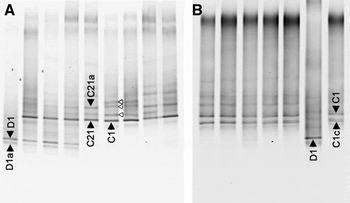
Distinct ITS2–DGGE profiles (fingerprints) were characterized by sequencing of the dominant bands (Figure 2). Bands were excised from the gel, eluted in DNase free water overnight, reamplified with a reverse primer lacking the GC-clamp, and sequenced directly on an ABI 3730 automated DNA sequencer (Applied Biosystems, Foster City, USA). Newly characterized fingerprints diagnostic of an ecologically distinct symbiont were given an alphanumeric name as described before (LaJeunesse, Reference LaJeunesse2002). The capital letter of these taxonomic designators refers to the particular clade of Symbiodinium and the numbers and lower case letters refer to bands diagnostic of the DGGE fingerprint. ITS2 sequences were deposited in GenBank (Accession Nos: HQ650834–HQ650839).
Representative polymerase chain reaction (PCR)-denaturing gradient gel electrophoresis fingerprinting analysis of the internal transcribed spacer 2 regions of Symbiodinium types observed in Galaxea fascicularis and Pocillopora damicornis. (A) Galaxea fascicularis; (B) Pocillopora damicornis. Closed arrowheads indicate the prominent bands diagnostic of a particular profile that are excised and sequenced. Bands in the upper part of a profile are heteroduplexes that form during PCR or due to other reasons (Thornhill et al., Reference Thornhill, Lajeunesse and Santos2007, Reference Thornhill, Kemp, Sampayo and Schmidt2010, open arrowheads).

Environmental data
Seawater temperature, salinity, pH and transparency were obtained for each site through the collection during this study. In addition, seawater temperatures were recorded every ten minutes with HOBO Temperature Loggers (±0.1°C) at the depths of 3 and 8 m at site 3 during May to August 2010. Seawater temperature, salinity and pH were measured in situ using an Orion multiparameter apparatus. The transparency was measured using a 30 cm diameter, black and white Secchi disc attached to a rope marked at 0.5 m intervals. The distance from harbour mouth to study site was calculated using GPS location; it represents the degree to which sites are influenced by the harbour environment.
Data analysis
Spatial patterns in Symbiodiniun community structure were examined by multivariate techniques using the PRIMER software package (v. 6.0) (Clarke & Warwick, Reference Clarke and Warwick2001). Samples were grouped according to depth and sampling stations and differences tested by the analysis of similarities test (Clarke & Warwick, Reference Clarke and Warwick2001). Canonical correspondence analysis (CCA) was performed using CANOCO 4.5 (ter Braak, Reference ter Braak, Jongman, ter Braak and Van Tongeren1995) to explore the relationship between environmental variables and the members of Symbiodinium communities in G. fascicularis. A Monte Carlo permutation test based on 199 random permutations was used to test the null hypothesis that Symbiodinium compositions were unrelated to environmental variables.
RESULTS
Environmental parameters
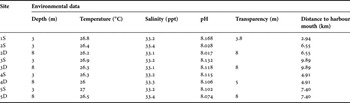
Environmental conditions differed a little along the gradient from the near-harbour mouth to outer locations (Table 1). Transparency was lower at the near-harbour mouth than at outer locations. The temperature in the shallow back-reef was higher than in the deep fore-reef. In site 3, the average temperature was 26.46°C and 24.96°C in shallow back-reef and deep fore-reef, respectively. The salinity and pH had no significant difference among sites (P < 0.05).
Environmental variables at all sampling sites (1–5). S, shallow back-reef; D, deep fore-reef.

Symbiodinium identification
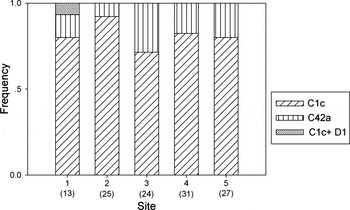
Analyses by PCR–DGGE of ITS2 enabled the identification of 6 distinctive Symbiodinium ITS2 types (three clade C and two clade D) across 179 samples from two coral species. Colonies of P. damicornis from all sites contained either Symbiodinium ITS2 type C1c (N = 60 of 74) or C42a (N = 13 of 74), but occasionally, one colony from site 1 had mixed symbioses of both C1c and D1. Colonies of G. fascicularis possessed either C1, C21a, Symbiodinium trenchi (formerly D1a), and/or combinations of these from all sites. Symbiodinium trenchi is typically restricted to G. fascicularis at both shallow and deep depth in this study. Figure 2 shows the different DGGE band profiles obtained from G. fascicularis and P. damicornis. Heteroduplexes were usually produced from the mismatching of intragenomic variants during the PCR process that largely reported in previous studies (LaJeunesse, Reference LaJeunesse2002; LaJeunesse et al., Reference LaJeunesse, Loh, van Woesik, Hoegh-Guldberg, Schmidt and Fitt2003; Thornhill et al., Reference Thornhill, Lajeunesse and Santos2007). Symbiont types that were designated C1 followed by a lowercase letter (e.g. C1c) indicated that their genomes contain the C1 sequence and a codominant sequence, C1c.
Fine-scale coral–Symbiodinium associations
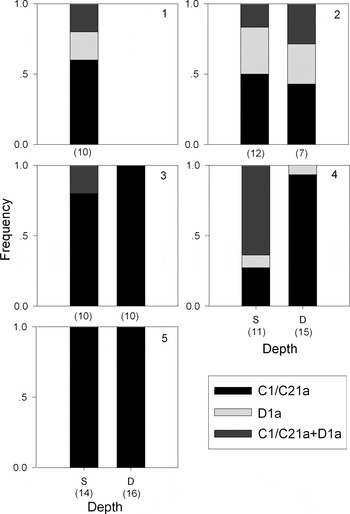
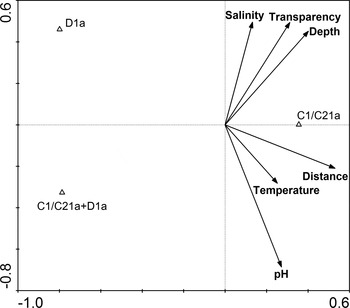
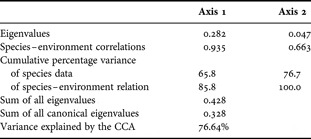
The distribution of symbionts associated with G. fascicularis showed no significant effect of sites (r = 0.422, P = 0.117). Colonies of G. fascicularis on the deep fore-reefs harboured mainly C1 (N = 47 of 105) and C21a (N = 33 of 105), and to a lesser extent S. trenchi (N = 10 of 105), with some colonies (N = 13 of 105) harboured both S. trenchi and one of the types C1 and C21a. In some cases, there was a slight decrease in the proportion of the S. trenchi from shallow back-reef to deep fore-reef (Figure 3). In other case, colonies of G. fascicularis collected from both depths at site 5 hosted types C1 or C21a exclusively. Similarly, symbiont diversity within P. damicornis did not differ significantly among sites. It appeared that the C symbiont was more commonly found among P. damicornis than G. fascicularis, and were entirely dominated by Symbiodinium C1c at all sites (Figures 1 & 4). Results from CCA ordination of Symbiodinium types in G. fascicularis and environment indicate that the abiotic factors partly influenced the symbiont community, explaining 76% of the total variance (Table 2; Figure 5). Symbiodinium types in clade C were significantly and positively related to depth and distance from the harbour mouth (Figure 5).
Frequency of Symbiodinium internal transcribed spacer 2 types in Galaxea fascicularis at shallow back-reef and deep fore-reef from all sites (1–5, see Figure 1). S, shallow back-reef; D, deep fore-reef.

Frequency of Symbiodinium internal transcribed spacer 2 types in Pocillopora damicornis at shallow back-reef from all sites (1–5, see Figure 1). Numbers of individual colonies sampled are provided in parentheses.

Canonical correspondence analysis ordination diagram of Symbiodinium types data in Galaxea fascicularis with respect to environmental factors.

Summary of canonical correspondence analysis (CCA) between Symbiodinium internal transcribed spacer 2 types in Galaxea fascicularis and different environmental variables.

DISCUSSION
The present study demonstrates that fine-scale diversity of Symbiodinium in populations of two reef-building corals with different symbiont transmission modes from a harbour–estuary–upwelling region. It highlights the implications of ecological and evolutionary processes in coral–algal associations.
Symbiont variation and functional diversity
The dominance of Symbiodinium clade C in G. fascicularis and P. damicornis in the present study is consistent with their prevalence in cnidarian symbioses in the Indo-Pacific (Loh et al., Reference Loh, Loi, Carter and Hoegh-Guldberg2001; LaJeunesse et al., Reference LaJeunesse, Loh, van Woesik, Hoegh-Guldberg, Schmidt and Fitt2003, Reference LaJeunesse, Bonilla, Warner, Wills, Schmidt and Fitt2008), as well as in dominant corals from the South China Sea (Huang et al., Reference Huang, Dong, Huang and Zhang2006; Dong et al., Reference Dong, Huang, Huang and Li2009). Almost all Symbiodinium types described here have been reported in the previous studies from the same host across the Pacific, including the GBR and Okinawa (LaJeunesse et al., Reference LaJeunesse, Loh, van Woesik, Hoegh-Guldberg, Schmidt and Fitt2003, Reference LaJeunesse, Bhagooli, Hidaka, DeVantier, Done, Schmidt, Fitt and Hoegh-Guldberg2004). A single exception is the type C42a, which is firstly detected in P. damicornis in the present study, whereas the closely related symbiont C42 has been reported in P. damicornis from the GBR (Sampayo et al., Reference Sampayo, Franceschinis, Hoegh-Guldberg and Dove2007). However, there were no shared symbiont types observed between the G. fascicularis and P. damicornis, which may indicate the host–symbiont specificity as shown by others (LaJeunesse et al., Reference LaJeunesse, Bonilla, Warner, Wills, Schmidt and Fitt2008; Thornhill et al., Reference Thornhill, Xiang, Fitt and Santos2009).
Fine-scale symbiont variation in corals could be caused by environmental factors such as light intensity (Iglesias-Prieto et al., Reference Iglesias-Prieto, Beltran, LaJeunesse, Reyes-Bonilla and Thome2004), temperature (Rowan et al., Reference Rowan, Knowlton, Baker and Jara1997; Tchernov et al., Reference Tchernov, Gorbunov, Devargas, Yadav, Milligan, Haggblom and Falkowski2004) or available nutrients (Fitt & Cook, Reference Fitt and Cook2001), that may be acting synergistically (Frade et al., Reference Frade, De Jongh, Vermeulen, Van Bleijswijk and Bak2008). In this study, CCA revealed that depth, distance and transparency accounted for the patterns of association between Symbiodinium and G. fascicularis. For G. fascicularis, deep fore-reef and the locations with increasing distance from the harbour mouth appeared to sustain less diverse symbiont communities than shallow and near the harbour mouth areas, which is likely due to higher light intensity and turbidity found in the shallow and closed to the harbour mouth in the present study. This may also partly explain the higher relative abundance of S. trenchi in the shallow and turbid habitats, which was usually associated with G. fascicularis from other regions in the Pacific (LaJeunesse et al., Reference LaJeunesse, Bhagooli, Hidaka, DeVantier, Done, Schmidt, Fitt and Hoegh-Guldberg2004). By contrast, P. damicornis hosted predominantly Symbiodinium ITS2 type C1c or C24a at all sites. It has been found that certain symbionts have adaptations to particular ecological niche (Rowan et al., Reference Rowan, Knowlton, Baker and Jara1997; Sampayo et al., Reference Sampayo, Franceschinis, Hoegh-Guldberg and Dove2007). ITS2 types in Symbiodinium clade D generally associates with corals from environments of both high and low temperature and significant terrestrial impacts, and some of them have been characterized as heat or stress tolerant types (Rowan et al., Reference Rowan, Knowlton, Baker and Jara1997; Toller et al., Reference Toller, Rowan and Knowlton2001; Garren et al., Reference Garren, Walsh, Caccone and Knowlton2006; Thornhill et al., Reference Thornhill, LaJeunesse, Kemp, Fitt and Schmidt2006a; Mostafavi et al., Reference Mostafavi, Fatemi, Shahhosseiny, Hoegh-Guldberg and Loh2007; Oliver & Palumbi, Reference Oliver and Palumbi2009).
In contrast to S. trenchi, D1 is a distinct type of Symbiodinium in clade D and this type is specific to the genus Pocillopora in the Pacific (LaJeunesse et al., Reference LaJeunesse, Bonilla, Warner, Wills, Schmidt and Fitt2008, Reference LaJeunesse, Smith, Walther, Pinzon, Pettay, McGinley, Aschaffenburg, Medina-Rosas, Cupul-Magana, Perez, Reyes-Bonilla and Warner2010). It had been reported that corals in the genus Pocillopora harbouring Symbiodinium D1 were mostly unaffected while the colonies possessing C1b-c were once bleached during an extreme cold-water event (LaJeunesse et al., Reference LaJeunesse, Smith, Walther, Pinzon, Pettay, McGinley, Aschaffenburg, Medina-Rosas, Cupul-Magana, Perez, Reyes-Bonilla and Warner2010). Some Symbiodinium types in clade C have been described as sensitive to both thermal and light stress and are generally located in deep water (Rowan et al., Reference Rowan, Knowlton, Baker and Jara1997; Berkelmans & van Oppen, Reference Berkelmans and van Oppen2006). The abundance of type C1 and C21a in association with G. fascicularis increased with both increasing distance from the harbour mouth and the deeper water; this pattern indicated that these symbionts are well adapted to the low light (or temperature) and clearer water. Nevertheless, most of the colonies of P. damicornis associated with Symbiodinium C1c and C42a were likely to be better adapted to the shallow and turbid environment. However, it is worthy of note that clade C types are still the most abundant symbiont in both G. fascicularis and P. damicornis in all locations, and this may indicate that functions of symbionts in clade C are complex. In the example from the 2006 GBR bleaching event, corals that originally hosted the putatively thermal susceptible Symbiodinium clade C2 switched either to clade D or C1, suggesting that members of clade C1 are also more resistant than C2 (Jones et al., Reference Jones, Berkelmans, van Oppen, Mieog and Sinclair2008). Consequently, substantial evidence demonstrates that the variants within clade C have different thermal properties (LaJeunesse et al., Reference LaJeunesse, Loh, van Woesik, Hoegh-Guldberg, Schmidt and Fitt2003; Jones et al., Reference Jones, Berkelmans, van Oppen, Mieog and Sinclair2008; Sampayo et al., Reference Sampayo, Ridgway, Bongaerts and Hoegh-Guldberg2008). Because the distribution of P. damicornis was limited to the shallow water, the depth patterns were not known in the present study. However, Sampayo et al. (Reference Sampayo, Franceschinis, Hoegh-Guldberg and Dove2007) reported that P. damicornis associated with multiple symbionts showed a strong zonation with depth. The presence of clades C and D in both G. fascicularis and P. damicornis colonies may be due to exposure to more environmental variability conditions, and may indicate a potential adaptation to the environment (Thornhill et al., Reference Thornhill, LaJeunesse, Kemp, Fitt and Schmidt2006a). All together, these may further ensure the complex ecological function of different types within each Symbiodinium clade (LaJeunesse et al., Reference LaJeunesse, Bhagooli, Hidaka, DeVantier, Done, Schmidt, Fitt and Hoegh-Guldberg2004; Sampayo et al., Reference Sampayo, Franceschinis, Hoegh-Guldberg and Dove2007, Reference Sampayo, Ridgway, Bongaerts and Hoegh-Guldberg2008).
Host–symbiont lifecycle and symbiont diversity
According to present knowledge, the mode of transmission of symbionts between host generations may also have a strong influence on symbiont diversity and the specificity of corals and Symbiodinium (LaJeunesse et al., Reference LaJeunesse, Loh, van Woesik, Hoegh-Guldberg, Schmidt and Fitt2003, Reference LaJeunesse, Bhagooli, Hidaka, DeVantier, Done, Schmidt, Fitt and Hoegh-Guldberg2004; Thornhill et al., Reference Thornhill, Fitt and Schmidt2006b; Stat et al., Reference Stat, Loh, Hoegh-Guldberg and Carter2008). LaJeunesse et al. (Reference LaJeunesse, Bhagooli, Hidaka, DeVantier, Done, Schmidt, Fitt and Hoegh-Guldberg2004) showed that coral hosts from Hawaii harboured a high number of unique symbiont types that could be due to the predominance of coral hosts which are vertical transmitters in Hawaiian reefs. Similarly, Barneah et al. (Reference Barneah, Weis, Perez and Benayahu2004) observed that symbiont clade correlated with mode of symbiont transmission in Red Sea soft corals. Several studies proposed that corals with vertical transmission mode are expected to be more specific and stable for their symbionts than corals acquiring their symbionts horizontally from the surrounding environment (Loh et al., Reference Loh, Loi, Carter and Hoegh-Guldberg2001; LaJeunesse et al., Reference LaJeunesse, Bhagooli, Hidaka, DeVantier, Done, Schmidt, Fitt and Hoegh-Guldberg2004, Reference LaJeunesse, Bonilla, Warner, Wills, Schmidt and Fitt2008; Thornhill et al., Reference Thornhill, Fitt and Schmidt2006b). In contrast to these results, van Oppen (Reference van Oppen2004) found that mode of symbiont transmission does not affect the levels of symbiont diversity in Indo-Pacific acroporid corals (Montipora spp. and Acropora spp.), suggesting that vertical transmitters are more flexible than previously thought (Thornhill et al., Reference Thornhill, Fitt and Schmidt2006b). In the present study, both G. fascicularis and P. damicornis with different symbiont transmission mode can have multiple symbionts. This pattern has also been revealed in previous studies and the exact correlation between symbiont diversity and transmission modes is still not well understood (but see Barneah et al., Reference Barneah, Weis, Perez and Benayahu2004; van Oppen, Reference van Oppen2004; Thornhill et al., Reference Thornhill, Fitt and Schmidt2006b; Stat et al., Reference Stat, Loh, Hoegh-Guldberg and Carter2008). Nevertheless, an open transmission mode could offer G. fascicularis the flexibility and opportunity to associate with locally adapted symbiont types as potentially seen in this study and proposed by others (LaJeunesse, Reference LaJeunesse2002; Stat et al., Reference Stat, Loh, Hoegh-Guldberg and Carter2008). The relationship between symbiont transmission mode and host–Symbiodinium associations certainly deserves further investigation.
In summary, we have shown that the symbiotic dinoflagellates of two widely distributed coral species with different symbiont transmission mode are variable at the fine-scale (<15 km), and may partly be due to fluctuating conditions of light and turbidity, exposure to the seasonal upwelling waters and symbiont acquisition mode. A considerable amount of work remains to be done to elucidate the seasonal effects on coral and Symbiodinium of exposure to summer upwelling conditions. Additionally, further experimental analyses are needed to explain the mechanisms that result in these observed association patterns. Unravelling the patterns of host–Symbiodinium associations is essential to understanding the adaptive capacity of corals by a rapidly changing environment, and may be particularly important in the complex regions.
ACKNOWLEDGEMENTS
The authors would like to thank X. Lei and J. Yang for assisting with the sample collection. This research was supported by grants from the National Natural Science Foundation of China (grant number 40830850), the National Key Technology Research and Development Program of the Ministry of Science and Technology of China (grant number 2009BAB44B01) and the Main Direction Program of Knowledge Innovation of the Chinese Academy of Sciences (grant number KZCX2-YW-227).