INTRODUCTION
Stories (a term often used interchangeably with “narratives” in relevant literature) occur in everyday conversation when speakers share their personal experiences with friends and family (Ochs et al. 1992). These extended sequences in conversation are sequentially organized and fit within the particular context of interaction (Sacks 1972, 1974, 1986, 1992). This article examines what constitutes a conversational story initiation for Australian and Japanese speakers. Through detailed and careful analyses, previous studies (Moerman 1977, 1988, 1996; Bilmes 1996; Firth 1996; Wagner 1996) have documented relationships among language, society, culture, and thought within the framework of conversation analysis (CA). It is hoped that the present research into linguistic patterns of story initiation will contribute to a better understanding of different expectations concerning human interaction in relation to social and cultural practice.
ASPECTS OF STORIES
This section reviews the CA approach to conversational stories and Labovian sociolinguistic research concerning narrative structure, and ways in which the current study of how a story is begun in conversation may be significant to the theories of CA. Conversation analysts (Sacks 1974, Jefferson 1978, C. Goodwin 1984) provide a thorough examination of sequential regularities in story initiation. It is helpful at the outset to give an example of sequences of story initiation in a naturally occurring conversation:

This is a prototypical environment for the occurrence of a “speaker-initiated” story (C. Goodwin 1996, 2002). The sense of what constitutes incredible is not yet available to the recipient but instead has to be discovered subsequently as the story proceeds. This sequence indicates that a narrative consists of two adjacency pairs: (i) the pre-sequence pair, or proposal (line 1) and acceptance (line 2), and (ii) the sequence pair, or production of the story (line 3) and receipt of the story (line 4) (Cortazzi 1993:29). One of the phenomenological consequences of this example is that the sequential environment of talk provides the primary context for the interlocutors' understanding, appreciation, and use of what is being said, meant, and – most important – done in and through the talk (Schegloff & Sacks 1973).
According to Sacks 1974, stories told in conversation properly begin with a “preface sequence.” The preface can take a minimal length of two turns, the first involving talk by the intending teller and the second by an intended recipient. The intending teller produces an utterance that contains such sequentially relevant components as (i) an offer to tell or a request for a chance to tell the story (e.g., you wanna hear muh-eh sister told me a story last night; Sacks 1974:338), (ii) an initial characterization of the story, or (iii) some reference to the time of the story events. A combination of these components can be incorporated into an utterance, and if such an utterance is followed by the intended story recipient's agreeing to hear the story, the storytelling can take place, the intending teller having created a situation in which he or she can tell the story. Thus, “story prefaces” provide for the recognizability of story initiation and serve as virtual instructions for how recipients should respond to forthcoming utterances (C. Goodwin 1984). Schegloff (1984:42) states that such initiating moves by the intending teller are designed to prevent other potential speakers from beginning to talk.
Similarly, Jefferson 1978 shows that stories are locally occasioned in conversation. She writes that a story is triggered in the course of turn-by-turn talk; that is, something said at a particular moment in conversation can remind a speaker or hearer of a particular story, which may or may not be topically coherent with the talk in progress. Alternatively, a story may be methodically introduced into turn-by-turn talk; that is, techniques are used to display a relationship between the story and prior talk and thus account for, and propose the appropriateness of, the story's telling (Jefferson 1978:220). Jefferson (1978:221) further demonstrates that a story can be introduced into the talk by the use of a disjunct marker (e.g., oh, incidentally, by the way), which signals that what follows is not topically coherent with the prior talk. A story can also be introduced into the talk by the use of embedded repetition in which some part of prior talk is mentioned, as in speaking of X, where X is the repeated element. Each of these devices, when applied in interaction, creates continuity between the story and the previous talk. The combined devices of disjunct and embedded repetition signal that the current talk is the source of the subject of the story, even if the story is not topically coherent with the previous talk; that is, it is a direct product of that talk, as in oh that tee-shirt reminded me (Jefferson 1978:222).
Having outlined the CA approach to stories occurring in everyday conversation, I turn to Labov's work on the structural components of narratives of personal experience, which in part is relevant to the present study. The following example demonstrates an interview process used by Labov & Waletzky (1967:14) for their research aimed at elucidating the overall structure of a narrative:

The interview question (line 1) is a request that the informant describe his past experience. The informant's response constitutes an “abstract” (line 2), which is often the first structural component of a fully developed narrative in response to interview questions (Labov 1972:356). However, the abstract is optional. When it occurs, it provides a summary of the story in such a way that it encapsulates the main point of the story.
In Labov's model, however, the place of narratives in the social organization of conversation is not considered (Cortazzi 1993:49). Storytelling is a social act, in that one's personal experience has a social life and operates beyond linguistic characteristics (i.e., temporal sequence) of Labovian story structure (Ochs & Capps 2001). Subsequent researchers have asked questions about how storytelling is embedded in its interactional context (Johnstone 2001:640). For example, Schiffrin 1996 examines how individual variation in story structure reflects the fact that stories need to be viewed as social actions situated in particular types of contexts, while other researchers (Polanyi 1985, Ochs et al. 1989, Norrick 1997) discuss how the participant is involved – the extent of audience involvement in the process of telling stories.
Clark 1994 and Eggins & Slade 1997 expand Labov's notion of the abstract and include floor-taking functions in the use of it. In his discussion of making room for stories, Clark (1994:1005–6) maintains that narratives can be introduced by either the prospective teller or the prospective audience. He argues that the simplest method is for a member of the prospective audience to request a particular story, as in the following example:

Barbara proposes a particular project in line 1: that Annabel tell them how she got on at her interview. In the second part of the adjacency pair, line 2, Annabel takes up the proposed project with a 30-minute narrative. However, if Barbara does not know Annabel has a particular story she wishes to tell, then Annabel must arrange for Barbara to want to hear it, as in the following example:

In the initial adjacency pair, Annabel alludes to a story and asks Barbara if she has heard it before (line 1), and Barbara replies no (line 2). In Clark's view, the participants take this adjacency pair to be more than a question and answer. They treat it as a pre-story that licenses Annabel to tell Barbara a story, for Annabel immediately launches into a five-minute narrative.
Clark (1994:1006) goes on to say that Annabel first gives a précis of her story, I acquired an absolutely magnificent sewing machine, by foul means – a blatant advertisement for the story – and then checks whether Barbara has heard it before, did I tell you? Only when Barbara says no does Annabel take them to be jointly committed to her telling the narrative. In a discussion of narrative organization within the Labovian framework, however, Clark (1994:1014) identifies Annabel's I acquired an absolutely magnificent sewing machine, by foul means as an abstract, a brief summary of the whole story.
In this connection, Eggins & Slade (1997:239) note that the abstract functions as a generic indicator which signals that a story is about to be told and establishes the point of the text, as illustrated here:

Line 1 sets up expectations as to what the text is going to be about by naming the activity that is going to be problematized (going home). The point of the story is established in 1a, where the event is assessed as ridiculous. As the excerpt shows, John, the storyteller, continues with his story in line 2. It looks as if the story has begun at this point; the abstract in line 1 thus has the effect of claiming the room in the conversation.
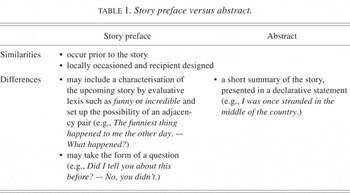
For the purposes of this study, I consider a story preface to be a device by which incipient tellers explicitly claim the room for the production of a story. In contrast, an abstract is much more like a statement with which the teller summarizes the central action/event and main point of the story. Table 1 summarizes the similarities and differences between a story preface and an abstract.
Story preface versus abstract.

I should mention here that the data analyzed for the purpose of this study consist of conversations arising out of the task of telling stories between native-speaker participants, which partially resembles the Labovian approach to data collection. This stands in contrast to the kind of data used by conversation analysts who make recordings of naturally occurring interaction (Atkinson & Heritage 1984). First of all, the tools and methods of traditional CA do not permit introspection or mental analysis, because CA is concerned with displaying the structure of conversation without revealing the intention of the interlocutors. In other words, the object of CA is to discover the rules governing conversation in a language, which are supposedly cognitive and potentially universal (Heller 2001:253). However, Lakoff (2001:210) suggests that, in line with Gumperz 1982 and Tannen 1984, “without the ability to address questions of intention and effect, the analysis of conversation bogs down much the way pretransformational syntactic analysis did.” Lakoff further notes that “there must be some way of talking about what speakers believe, find plausible, and use” (Lakoff 2001:211). In this light, my corpus and methodological approach may offer some insights into conversational storytelling as well as into differences between Australian and Japanese styles of communication, since the native-speaker participants rely on their shared cultural common ground (Iwasaki & Horie 1998), demonstrating what forms preferred sequences take and why.
PREVIOUS STUDIES OF JAPANESE DISCOURSE
This section discusses previous research concerning opening sequences in Japanese conversation. Watanabe 1990 and 1993, and R. Hayashi 1996 investigated the beginnings of conversations in American English and Japanese, while Maynard 1989 discussed story preface sequences in Japanese conversation. Although some similarities can be found between English and Japanese in the patterns of story initiation, there are certain features that distinguish the two languages.
Watanabe 1990 reports a comparative study of American and Japanese conversational structure. As for the ways discussions are initiated, Watanabe finds that Japanese begin by negotiating the first turn, suggesting who should speak first and conceding to others, and discussing how they should talk about an issue. In contrast, Americans begin promptly without discussing the first turn or the discussion style. Watanabe (1990:105) argues that Japanese prefer to prearrange the turn-taking order and/or discussion style through negotiation in which gender and seniority play important roles.
R. Hayashi (1996:180–84) studies American and Japanese conversational patterns with respect to conversational floors. Her analysis of the preparation phase before a conversation shows that Japanese spend a long time deciding on their roles (e.g., speakership) in conversation so that communicative stability can be maintained through the coordination of interaction and collaboration. She finds that a male speaker takes the leadership role in a group of two males and two females (R. Hayashi 1996:180–81), and she correlates this kind of conversational interaction with rigid hierarchical human relations characteristic of Japanese culture (R. Hayashi 1996:184).
More directly relevant to my work here is a study of what Maynard calls “prefacing” in the casual narrative (Maynard 1989:100–15). Maynard addresses the initial or early part of conversational storytelling in naturally occurring Japanese conversation with the theoretical perspectives put forth by Sacks 1974 and Jefferson 1978 as a starting point. Maynard (1989:101) focuses on the following seven strategies that Japanese speakers use for the purpose of narrative introduction:
(1) transitional claim
(2) evaluation/reportability
(3) specification of the source of the narrative
(4) connection to immediate context of the listener
(5) overt confirmation of new information and/or request for permission
(6) title-like theme announcement
(7) acceptance of theme suggested and solicited by the coparticipant
Maynard (1989:115) suggests that at least one of these seven utterance types must occur before the storyteller can successfully introduce a story into the talk. Interestingly, Maynard's extensive discussion of story initiation in Japanese conversation shares similarities with the story preface discussed by Sacks 1974. For example, with regard to the fifth category, Maynard describes a conversational pattern in which the storyteller requests a chance to report something unknown to the recipient as part of prefacing the narrative. This is exactly what Sacks describes. Maynard's list is certainly extensive and includes various strategies that may be found in Japanese conversation. This implies that both English and Japanese speakers need to do something to interactively manage the floor and establish the teller and listener roles.
In sum, the dominant characteristic for English speakers is that a teller obtains the floor by offering to tell a story, with the other conversational partner acknowledging and permitting the extended turn to be taken. In contrast, as Iwasaki 1997 and Iwasaki & Horie 1998 note, Japanese speakers seem to have an accommodating and what can be interpreted as a collaborative style of conversation in their management of floor. This is potentially a significant factor in sequences of story beginning in Japanese conversation.
METHODOLOGY
Data
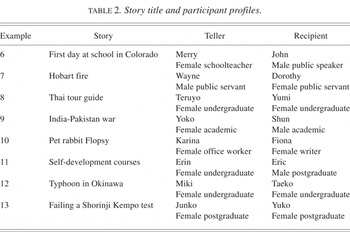
The data for the present study come from cross-cultural research into various aspects of personal experience stories. The Australian participants were aged between 23 and 52 years, speaking Australian English. The Japanese participants were aged between 21 and 54, speaking standard or regional dialects of Japanese. The story title and participant profiles for each example are shown in Table 2.
Story title and participant profiles.

Ultimately, I wanted to initiate a response in a way that would disturb as little as possible the environment conducive to storytelling, while at the same time, of necessity, intruding into it to make my observations. In other words, I wanted to ensure that participants would tell a personal experience story in a natural and enjoyable atmosphere without speculation as to the purpose of this investigation. With this in mind, preference was given to private settings over studio recording.
The data were collected at home parties, lunchtime breaks, and other private venues. I gave all prospective participants a copy of the explanatory note (Appendix 1) to obtain comparable sets of stories in the two languages. The conversations were recorded on audiotape. All participants were aware that they were being recorded and knew that the situation was set up to collect conversational data, but no guidelines were given to them as to what they should talk about. The researcher was not a participant in any of the stories. Two things needed to be clarified after showing the explanatory note to the participants: (i) the preferred length of talk would be approximately 30 minutes; and (ii) the participants had control over the recording equipment. The researcher would then leave the room for the participants to talk freely.1
There is something ephemeral about talking that is disrupted by recording a conversation. The kinds of conversations that are recorded with the participants' knowledge are often very sterile. As a researcher, one has to think carefully about the benefit of taping a conversation and being able to go back over the data, compared to the possibility that participants will become reluctant to disclose their thoughts and feelings freely and as lucidly as they might if they were not (i) self-conscious about being recorded and (ii) thinking that the recording might pose some kind of risk to them in the future. I believe that in any research both these factors are present to some extent. Initially, participants need to overcome the self-consciousness brought on by the situation. When someone is watching what participants are doing very closely, it is not possible for them to act naturally. The relationship of trust between the person doing the recording and the participants in the conversation is likely to have an impact on the level of disclosure.
Conversational storytelling in this kind of task setting potentially leads to the production of “recipient-initiated” stories. That is, in the event that participants discuss what they could talk about before turning the tape recorder on, the transcript starts off with a direct story-eliciting question such as “Tell me about X.” In contrast, when participants hold a conversation for a while and eventually start recounting personal experience stories, it gives rise to “speaker-initiated” stories.
The data consist of casual conversations of a nontechnical nature, ranging between 8 and 25 minutes. Any stories that were obviously unsuitable for analysis were excluded from this study. Examples of unsuitable data include poor recording quality or offensive content. Also, many participants ended up by producing rambling talk; in other words, they did not tell a story, and so their conversations were not suitable for analysis of story initiation. A total of 32 stories were collected in English, of which two were eliminated for poor recording, one for offensive content, and five for rambling talk. A total of 26 stories were collected in Japanese, of which two were eliminated for offensive content and four for rambling talk. This left me with 25 stories in English and 20 stories in Japanese. With regard to the English data, I chose the first 20 stories that I received to make it equivalent to the number of Japanese stories. Thus, 40 stories constitute the body of material for this article, although owing to space limitation only a portion of data samples are analyzed.
Transcription
The data were transcribed according to the conventions of CA (Appendix 2). Wherever possible, I limit lines to basic units – turn constructional units (TCUs) – to facilitate clear referencing using line numbers. The TCU is a stretch of speech at the end of which another person could start speaking (Sacks et al. 1974).2
A TCU is normally intonationally, grammatically, and semantically complete.
Romanization (or transliteration) involves writing/representing the original Japanese characters and sounds with roman letters. There are several systems that can be used to do this. The system chosen to romanize the Japanese data in this study is a modified version of the Hepburn system, one of the most commonly used today. This system comes closest to accurately representing the correct Japanese sounds. A description of the modified Hepburn system can be found in major Japanese-to-English dictionaries.
In each example, a story initiation is indicated by an arrow (→). Although the beginning part of the story – only a minute part – is included in the transcript, emphasis is given to analyses of sequences leading to the entry into the body of the story.
DATA ANALYSIS AND DISCUSSION
With regard to recipient-initiated stories, while the Australians enter into a story without showing much need for prompting, the Japanese take longer to begin a story; that is, there are moments when the recipient encourages the prospective teller to talk. As for speaker-initiated stories, Australian examples show the use of a story preface, which supports the findings of previous studies. In contrast, Japanese examples exhibit an interesting pattern: The prospective teller produces a summary statement, or abstract, of the forthcoming story and hands the floor back to the recipient. In the following, I analyze these phenomena in more detail to show these differences in story initiation.
Recipient-initiated stories in Australian English
The recipients ask either an open question referring to something that the storyteller has done in the past, or a closed question transformed into a statement-type utterance that anticipates confirmation. These utterances are accompanied by a specific elicitation device such as a direct reflection of the topic or emphatic stress. With these devices the recipients support the tellers, and there is no further prompting from the recipients. Having been given the floor necessary for the production of an extended telling, the storytellers then enter into the story.
Example (6) is taken from a conversation between old friends, Merry and John. They are chatting at a botanic garden. As shown below, Merry enters into the story via a prepositioned alignment device (let me tell you about…).

Merry shares the latest news about herself in starting a conversation (lines 1, 2). In line 4, John produces an assessment of the prior turn (lines 1, 2) and breaks the 0.7-second silence in line 3, which suggests that he needed time to think of an utterance. In line 5, Merry acknowledges that remark by saying yeah.
John uses a generic question in line 6 to probe Merry's teaching experience in Colorado. John's supportive statement in line 7 – a direct reflection of the topic – further prompts Merry to talk about that experience. These two utterances form an elicitation which gives Merry the floor for the production of a story. Also, John is verbalizing his own understanding of Merry's experience. In lines 8 and 9 Merry acknowledges John's contribution. Here the interlocutors are exploring the newsworthiness of the forthcoming story. John utters a continuer, mm hm (Gardner 2001:2) in line 10 and immediately hands the floor back to Merry. It seems that John is ready to be a story recipient.
In line 11, Merry explicitly announces that she has a story to tell about her first day at school. This utterance claims the room for an extended telling and expresses the speaker's strong commitment to the goal of telling a story. John's laughter in line 12 may not be an explicit acceptance, but at least it is not a blocking move for Merry's talk, and the story proceeds in line 13. Merry is therefore treating John's laughter as acceptance. Anything short of rejection of the story as tellable will lead to a story being told, and so the interaction here is not problematic, even though there is no clear “go-ahead” response.
Example (7) shows that the recipient uses an elicitation device as both a booster and a facilitative strategy. In this segment, Dorothy is eliciting a story from her workmate, Wayne. Clearly, Dorothy's question is based on previous encounters with Wayne.

In line 1, Dorothy formulates a confirmation question regarding the Hobart fires of the 1960s, which she knows Wayne experienced. Wayne provides an affirmative answer in lines 2 and 3. In line 4, Dorothy portrays Wayne's experience as very big. This utterance is an elicitation interpreted as an invitation for Wayne to tell a story. It involves stress as an emphatic boosting device (Holmes 2001). Dorothy is also expressing her own assessment of the Hobart fires. Line 5 is a summary evaluation that describes the emotional significance of his experience. Wayne is sharing how he actually felt at the time of the event in response to Dorothy's assessment remark. Dorothy's acknowledgment mm (Gardner 2001:2) in line 6 suggests that she is being the recipient. In line 7, Wayne provides background information and proceeds to tell the story. The participants have thus established themselves as storyteller and recipient, while Dorothy interacts with Wayne by providing comments in relation to the story event (lines 8, 10, 13).
Examples (6) and (7) demonstrate the use of a question and an elicitation device to indicate that the other person – the prospective storyteller – has the floor. After the question is presented, little prompting is needed; the teller enters into the story, which may be accomplished by an explicit announcement to do so, as in (6), with the recipient taking an audience role. This kind of local interactional structure enables the interlocutors to co-orient to the goal of telling a story. There are several possible ways to explain this sort of behavior. Previous research describes Australian characteristics that include egalitarianism (Thompson 1994), informality (Wierzbicka 1991, 1992) and friendliness (Renwick 1980, 1991), among others. Looking at the examples presented here, however, it seems that the participants view the conversational setting as a task that needs to be done well. It is appropriate to take turns in an interactive way, which implies that listening attentively without comment may not be the default conversational style. What is interesting is the way the recipients throw in comments in relation to the topic, even before the tellers enter into the narrative frame, as if the recipients themselves were anticipating the interest value of the story.
Recipient-initiated stories in Japanese
The following examples illustrate that among Japanese speakers, entry into the body of the story is preceded by pre-story sequences in which the participants build rapport and trust. It thus takes a while to build momentum for the teller to enter into the story. In one instance (9), the recipient starts a conversation with an open question and then narrows his focus in inviting the prospective narrator to tell a story, with the result that the participants go through more than one question-answer sequence before entry into the body of the story.
Example (8) shows how the first indication of a story about Thailand by the recipient leads to lengthy post-expansions. Teruyo and Yumi are housemates. When the tape recorder was turned on, Teruyo produced a suppressed smile and did not talk.4
This is the researcher's recollection.

After a question, an answer should be forthcoming. However, 1.4-second silence (line 2) occurs after Yumi's question in line 1. It is a sign that something is interactionally problematic in the sense that the silence belongs to Teruyo – it is a space for her to say something, but she does not. Such silence following a question may mean that one needs time to think of an answer, but then it means that the question, for that person, is the sort of question that requires planning to answer. That can be significant, even without disagreement. Teruyo produces laughter (line 3) and a 2.5-second silence (line 4) follows, which shows that Yumi's question is still not being answered.
By producing a theme-defining question in line 5, Yumi gives Teruyo a little more push to get the conversation going. After this question, there is no silence. That is, in line 6, Teruyo produces an utterance and orients to preference for contiguity (Sacks 1987). Yumi produces a minimal response token un un ‘uh huh’ in line 7 and aligns herself as the story recipient.
Although this sequence is potentially complete, Teruyo provides extra background details beyond her turn. In line 9, Teruyo produces a statement in relation to her travel experience, and in line 10, Yumi produces an assessment of that statement. Teruyo laughs (line 11) and provides more general information about her travel experience (line 12), which is recognizably associated with the preceding utterance (line 9). Yumi responds to Teruyo's contribution through laughter (line 13). Teruyo moves to close off the sequence in line 14 by referring to the topic-in-progress, and Yumi produces a minimal response token un ‘uh huh’ in line 15 and closes off the sequence.
Teruyo produces a summary evaluation of her trips to Thailand in line 17, insinuating a problematic experience in Thailand by saying anyu:juaruna ‘unusual’. Yumi acknowledges that evaluation with laughter in line 18. The 0.8-second silence in line 19 is interpreted as Yumi's assent to be the recipient of the story, which is evident because that is what happens: Teruyo enters into the body of the story in lines 20 and 21a. Yumi produces a minimal response token un in lines 21 and 22 and reinforces her role as the audience. Thus, through minimal response tokens (lines 7, 15) and laughter (lines 10, 13, 18), Yumi sustains listenership and continuously encourages Teruyo to begin a story.
Example (9) demonstrates how the teller enters into a story following a series of questions from the recipient. Yoko and Shun are academic colleagues whose relationship involves occasional work-related talk. This conversation took place one afternoon in Yoko's office. Yoko's fellow teachers and students know that she taught Japanese language in India some years ago. Shun asks Yoko about that experience.

This segment consists of multiple questions from the recipient that eventually bring about the effect of story initiation. First, Shun introduces a topic into the conversation (line 1), and Yoko acknowledges that statement (line 2). This sequence establishes a common ground between the interlocutors. In line 3, Shun produces an open question, which is interpreted as a preliminary to inviting Yoko to tell a story. Although Yoko responds to Shun's question in lines 4 and 5, giving a preferred response to that question, she does not yet enter into the story. In line 6, Shun produces an assessment of Yoko's response and closes off the sequence.
A successive exchange of minimal response tokens occurs between the interlocutors (lines 7–9). Specifically, Yoko utters ee ‘yeah’ (line 7) in response to Shun's assessment in line 6. To this minimal response token, Shun responds with ee ‘uh huh’ in line 8 and hands the floor back to Yoko. Although Yoko could secure the floor to produce a continuation of her previous turn and even begin a story at this point, she provides ee ‘yeah’ in line 9 and passes up the opportunity to talk. This resembles what Iwasaki (1997:662) calls the “loop” sequence, in which the conversationalists carefully negotiate floor transition.
The floor having been returned, Shun reformulates the original question and extends a clearer invitation for Yoko to tell a story in line 11. Shun uses the phrase dooyuu kikkake ‘what cause’ and designates Yoko as the next speaker. This question stretches the range of possible answer because using the word ‘what’ (or ‘who’, ‘where’, ‘when’, ‘why’, or ‘how’) itself makes the response longer than that of a yes/no question. Yoko now accepts Shun's invitation and enters into the story in line 12. Shun's minimal response tokens in lines 13 and 14 are an indication that he is maintaining his position as the story recipient.
What the recipient does in this example is initiate a story in three steps. First, the recipient introduces a topic (visit to India) into the talk (line 1). Second, he asks an open-ended, conversation-evoking question about the topic (line 3). Third, he expressly invites the teller to begin a story, using an open question (line 11).
Examples (8) and (9) show how the recipients manage interactional complexities and encourage the storytellers to enter into the story. The data suggest that Japanese speakers need to ensure that listeners are not hostile, although this does not immediately result in the goal of telling a story. In other words, sequences prior to the entry into the body of the story provide an initial time interval that enables the interlocutors to establish an interactional style by building rapport, trust, and cooperative spirit.
Speaker-initiated stories in Australian English
As opposed to recipient-initiated stories, speaker-initiated stories include a transitional signal on the part of the teller. This article thus supports previous research in that the teller produces a story preface to claim the room for the floor. The following two examples illustrate how both parties interactively establish an occasion for telling stories.
In (10), Karina and Fiona, who are childhood friends, talk about pets in general. The concept of sequential implicativeness (Schegloff & Sacks 1973:296), which recognizes that a conversation has a sequential organization, offers insight into how a story can be motivated by preceding talk (Jefferson 1978:222).

A display of story triggering is achieved by a story preface (line 22), which cites an element of prior talk Flopsy (lines 11, 12), Karina's pet rabbit. With this story preface Karina seeks to gain assent from Fiona. Fiona accepts the story preface, signaling and acknowledging Karina's proposal to tell a story (line 24). Fiona now takes the recipient role. These turns (lines 22, 24) form a pre-sequence (proposal–acceptance) – an adjacency pair that occurs prior to the body of the story. In line 26, Karina enters into the story, while Fiona provides a continuer in line 27 and demonstrates that she is listening. This segment thus supports previous claims about the use of the story preface, according to which conversational stories are locally occasioned and recipient-designed.
Example (11) also shows how a story is locally occasioned by means of a story preface. Erin and Eric are classmates. Here the preface is in the form of a statement and includes an evaluative lexis, which is then followed by an acceptance from the recipient.

In this segment, the conversationalists are talking about their outfits. In line 18, Erin announces that she had the coolest experience the previous week. This utterance sets up the possibility of a story with the evaluative lexis coolest. It is a story preface in the sense that it establishes the newsworthiness or interest of the forthcoming story without revealing the gist of it (Sacks 1974:340). Eric's acknowledgment yeah in line 19 is a response to that prior utterance and indicates how their talk is being understood: He is acknowledging Erin's proposal to tell a story. Erin's utterance in line 20, which is a self-repair (Schegloff et al. 1977), is met by a 0.5-second silence (line 21). This silence serves as a go-ahead signal: Eric is assenting to be the recipient. Having secured Eric's cooperation, Erin now has the floor for an extended telling. In line 22 Erin produces an abstract, a summary of the forthcoming story. It contains the main facts of the story and gives the recipient the chance to develop a sense for it. Eric's response oh yeah in line 24 marks that prior turn as newsworthy in some way, further encouraging Erin to keep talking.
In sum, the prospective tellers achieve entry into a story from turn-by-turn talk with a conventional story-prefixed phrase (Sacks 1974). This finding is consistent with prior research (Jefferson 1978:220) in that English discourse shows an explicit story-triggering signal. By utilizing words, speakers define events and objects and establish conversational roles, as in you tell me or I tell you. A story preface automatically grabs the attention of the person being spoken to because it is the single most common verbal signal used by a speaker intending or wanting to share a personal experience story about something with someone in everyday conversation.
Speaker-initiated stories in Japanese
Although Maynard (1989:101) lists seven strategies available to Japanese speakers for the purpose of narrative production, including a conventionalized story preface, it turns out that this device is not found in the Japanese corpus in this study. Rather, the teller produces an abstract and waits for the recipient's reaction in gaining the room for the story. This may be achieved with or without the personal pronoun watashi ‘I’, which signals that the utterance is going to be produced with reference to the speaker herself. Iwasaki (1997:669) discusses the same point with respect to the use of this first person pronoun in his analysis of the mechanism of floor transition relevance place (Schegloff 1993:106) in Japanese discourse.
In (12), the prospective teller produces an abstract and signals that she has a story in mind. The conversation is taken from a lunchtime chat between two university students, Miki and Taeko. Stretching over multiple turns, they talk about their travel experiences. Taeko mentions in line 1 that she has not been to Okinawa. The interlocutors subsequently discuss the quality of different beaches and make a comparison with Okinawa's clear water.

Taeko's utterance in line 27 is her assessment of the talk about Okinawa. Taeko elongates the sentential particle ka::. It looks as if Taeko is giving full play to her imagination, because this particle can be used by a speaker as a resource for demonstrating involvement in the talk, projecting something like ‘I want you to know that I am thinking about the topic’. Miki's utterance in line 28, which insinuates an actual experience, is indicative of a forthcoming story for several reasons. First, it clearly resembles an abstract that encapsulates the point of the story. Second, being hit by a typhoon is an unusual event that potentially evokes a ‘What happened?’ response from the other person. To this end, Miki's utterance in line 28 is designed to initiate a next action. Taeko's informational question in line 29 completes the action initiated. Here Taeko is giving a preferred response – a go-ahead signal in the form of a question demonstrating an interest in the theme just introduced by Miki. These turns (lines 28, 29) form a pre-sequence (abstract–acceptance), ensuring that the participants are available as interactants. Miki proceeds with the body of the story (lines 30, 31a), while Taeko inserts minimal response tokens (lines 31, 32) and aligns herself as the story recipient.
This excerpt shows that the teller does not use a story preface as in the English examples. The story comes out of discussion of holidays and the task of telling stories. Specifically, the teller establishes newsworthiness and interest of the story by an abstract (line 28). Following this, the recipient displays interest in the teller's utterance through an informational question (line 29), which has the effect of prompting her to continue talking. This question by the recipient also functions as acceptance, agreement to hear the teller's story. Thus the story initiation is achieved in subtle ways, in that the teller's utterance resembling an abstract requires a response other than a simple minimal response token to get the story going.
Similarly, (13) shows that an abstract serves as a preliminary to entering into the story. As in (12), the teller does not produce a story preface. The participants, Junko and Yuko, are postgraduates in the same university. Prior to this interaction, they talk about fitness, and the topic of neck-lifting comes up.

Following the topic of neck-lifting (lines 1–15), Junko signals that she has a story in mind with an abstract (line 16) that gives the gist of the forthcoming story. This utterance summarizes the general theme that is going to be problematized: failing a test. Junko uses the particle mo ‘also’ after watashi ‘I’, which, in this context, projects something like ‘normally I wouldn't’. It is therefore designed to elicit some kind of response from Yuko, in the sense that failing a test could be considered an extraordinary life event, at least for Junko. The 1.0-second silence in line 17 signals a problem in understanding the preceding utterance. Yuko remedies that problem by formulating a clarification question in line 18. Here Yuko is correlating with the preference for contiguity and produces the question, even though the silence momentarily breaks the contiguity of the sequence. These turns (lines 16, 18) form a pre-sequence – an abstract and acceptance. Junko responds to Yuko's question in line 19 and then enters into the story in lines 20 and 21a. Yuko's minimal response tokens in lines 21 and 22 are an indication of her role as audience.
Both (12) and (13) illustrate interactional complexities in the task of telling stories. The data show the ways in which the prospective teller produces an abstract and hands the floor back to the recipient. The fact that the teller produces an abstract and designs a next action means extra work for the recipient. That is, the recipient has somehow to help the storyteller proceed to the next step, entry into the story. In the examples cited above, the recipients prompt the tellers by asking questions.
Intuitive understanding of the meaning of the other person's message is part of the attentiveness that permeates personal interaction. The examples suggest that the onus is on the recipient, who somehow satisfies the expectations created by the tellers. I call this “recipient-prompted initiation.” Rather than projecting a clear story preface, the teller signals that he or she has a story to tell by constructing the main point of the story. The teller then waits for the recipient's response. In the absence of a story preface, the recipient asks a question, which at the same time functions as an acceptance to hear the story. In other words, the teller enters into the story upon receiving reinforcement from the recipient. To this extent, the recipient needs to be perceptive toward the teller's subtle signals. The use of questions serves as a tool to display interest in response to this kind of approach taken by the storytellers.
SUMMARY AND CONCLUSIONS
In contrast to the Japanese recipient-initiated stories, where the participants are seen as going through a lengthy process to reach the goal of telling a story, Australian speakers view the storytelling occasion as a task that needs to be done well. The Australian speaker-initiated stories conform to previous studies on conversational story prefaces, while Japanese beginnings are more gradual; the prospective teller signals a story by producing an abstract and then waits for the recipient's reaction. The recipient, in turn, helps the teller move on by asking questions.
The topic of sequences of story initiation in the two languages rests upon CA principles such as story preface, adjacency pairs, preference for contiguity, floor, and minimal response tokens. These principles are considered to be conventional linguistic patterns that reflect social routines. CA undoubtedly indicates the existence of a certain universal regularity in formal structures and mechanisms, although the particular means of communication within a linguistic group reveals preexisting conventions of speech and interaction. The notably characteristic sequential features demonstrated by Australian and Japanese speakers provide evidence that language cannot be correctly described and understood out of social context.
One of the criticisms of CA is that it does not pay enough attention to ideology, to implicit and unstated social assumptions. Because conversation analysts of English-speaking background determine that preferred responses tend to be short and straightforward and dispreferred responses long and complex (Pomerantz 1984), it is potentially misleading to suggest that it is linguistically unfavorable or unexpected for a speaker to require a number of sequences in achieving the goal of telling a story or to insinuate a forthcoming story on the basis of assumed expectations. However, this kind of shared linguistic and interactional competence (Schegloff & Sacks 1973:290) could be normal, routine, orderly, and recognizable for members of a single linguistic community. Firth (1996:248) notes that “CA cannot tell us carte blanche which linguistic and/or interactional resources are essential, necessary, or optional in order to sustain meaningful conversational involvement.” For this reason, consideration of the data type in this study casts new light on CA's methods and working assumptions, in the sense that there is evidence of cultural variation with respect to conversational sequences of story beginnings.
Paralleling this article are several studies (Kitagawa 1980; Maynard 1989, 1998; Cook 1990; Watanabe 1990, 1993; Yamada 1992; R. Hayashi 1996; Ono & Yoshida 1996; M. Hayashi & Mori 1998; Tanaka 1999, 2001, 2005) that have aimed to refine and supplement details in understanding Japanese ways of interaction. However, researchers interested in Japanese speech strategies have tended to account for variation through traditional explanatory variables such as gender and seniority (e.g., Watanabe 1990:105; R. Hayashi 1996:180–81), in addition to the oft-discussed cultural values and characteristics like omoiyari ‘thinking from another person's perspective’ (White 1989:67), amae ‘dependence’ (Doi 1981), and wa ‘harmony’ (Lebra & Lebra 1986), among others, which are probably not that useful.
In fact, English and Japanese are remarkably different, and while it is possible to compare the organization of story initiation in these two different languages, there are considerable difficulties in studying an activity such as storytelling across two languages and two cultures (Fujii 2003, forthcoming). I have therefore set aside preconceptions about Australian and Japanese culture in order carefully to examine the data and findings, and have then sought explanations for differences. I posit that the perception of language itself differs between Australian and Japanese speakers, and possibly how they view human relationships does as well. The occasions of speech which in essence were set up by the researcher for data collection suggest that, for Australians, conversation is a method of expression that can be used to present information in an engaging way. In English conversation, relatively high importance is attached to real communication and honesty, accompanied by a sense of detachment; it seems as though the speakers are being specific about their communicative preferences, even though the intentions behind them may be the same as those of Japanese speakers. As illustrated by the data examples, sizing each other up is perhaps geared to the establishment of interactional style in Japanese discourse. This is not necessarily a characterization of indirectness. Rather, their interactional style could be seen as an exchange of feelings and thoughts in which the building-up process has its meaning. Multi-utterance units give speakers more material to work with, thus contributing to the creation of rapport, trust, and cooperation. Furthermore, the conversationalists communicate through subtle indications or hints, where the message itself is buried between the lines without being explicitly expressed. It is important to recognize, therefore, how both culture and social structure (Bond et al. 2000; Harré 2001:695; Mayes 2003) and differences in linguistic intuitions influence the act of telling a story.5
No matter how much researchers may claim that any two given cultures are different, the extent of difference between such cultures may be offset by the extent of variation within each cultural group. In any culture there are people who are assertive, submissive, friendly, unfriendly, vibrant, mellow, and so on. Interestingly, however, conversational patterns within each cultural community tend to be more alike than different, because cultural/social contexts and demands shape the customs and rituals through which people express themselves and interact with one another.
Different cultures have certain rituals that to some extent conventionalize conversational openings and make them routine. These observations about interactions and expectations in story initiation could shed light on potential difficulties in cross-cultural communication. Australian speakers are likely to expect story initiation to consist of relatively little priming. If, in cross-cultural communication encounters between Australians and Japanese, native/nonnative conversationalists are unaware of the cultural ideologies that structure their perceptions and experience of reality (not to mention their communicative styles), then there is likely to be some miscommunication between the two cultural groups. In eliciting a story from a Japanese speaker, an Australian may feel that his or her Japanese conversational partner is being somewhat evasive because the Japanese speaker may need a little more “push” to start telling a story; an Australian who does not know of this need may stop priming prematurely, and the Japanese speaker may end up relinquishing the floor and not telling the story. It is hoped that this case study not only contributes to theories of CA but also makes a contribution to further investigations of the scope and extent of the effects of culture on language use.
APPENDIX 1: EXPLANATORY NOTE ON DATA COLLECTION, PROVIDED TO PARTICIPANTS
Japanese
anata ga jissaini keekenshita ka, aruiwa dareka kara kiita omoshiroi dekigoto o, ikutsuka omoidashitekudasai. sono hanashi o suuhun de shitekudasai. sono hanashi o motoni, kaiwa o tsuzuketekudasai. taikendan o hanasu no wa ohutari no uchi no dochira demo kamaimasen. soredewa, kaiwa o tsuzuketekudasai.
English
I want you to recall a few interesting or funny things that might have happened to you or that you have heard about that you could tell someone in a few minutes. Keeping them in mind, please continue talking and one of you could perhaps tell the other one of these happenings. It doesn't matter who. Please just keep talking as you were.