Introduction
Understanding the longitudinal course of symptoms is considered essential to understanding the disorder (Kraepelin, Reference Kraepelin1907; Bleuler, Reference Bleuler1950). Longitudinal studies have contributed vastly to our knowledge of schizophrenia, demonstrating that the disorder is largely chronic and that schizophrenia patients tend to have worse outcomes than patients with other major psychiatric disorders, including schizoaffective disorder, bipolar disorder and unipolar affective disorders (for a review, see McGlashan, Reference McGlashan1988). Furthermore, longitudinal studies have demonstrated that the majority of the loss of functioning in schizophrenia takes place in the first 5–10 years, and then the disorder remains relatively stable (McGlashan, Reference McGlashan1988). Last, longitudinal studies have demonstrated that outcome is heterogeneous in schizophrenia (McGlashan, Reference McGlashan1988). However, knowledge regarding the longitudinal course and predictive value of certain symptoms, such as hallucinations, in common psychiatric disorders is relatively absent (Waters et al. Reference Waters, Aleman, Fernyhough and Allen2012).
Hallucinations are a central diagnostic feature of psychotic disorders and can also occur in mood disorders. These symptoms are also some of the most noticeable signs of a psychiatric disorder and are often the reason why individuals are referred to the hospital for diagnostic assessment and treatment. Previous research has suggested that positive symptoms (Pfohl & Winokur, Reference Pfohl and Winokur1982; Mancevski et al. Reference Mancevski, Keilp, Kurzon, Berman, Ortakov, Harkavy-Friedman, Rosoklija and Dwork2007) and hallucinations specifically (Gur et al. Reference Gur, Petty, Turetsky and Gur1996) tend to decrease as patients age in schizophrenia; however, prospective longitudinal demonstration of how frequently different groups of psychotic and mood disorder patients experience hallucinations and whether the longitudinal trajectory of hallucinations can differentiate between these diagnostic categories is lacking.
Given the importance of predicting real-world day-to-day functioning in patients, further information on the relationship between hallucinations and independent living skills, especially work attainment, is necessary. For example, in Canada in 2004, the total direct healthcare and non-healthcare cost for schizophrenia was estimated at $2 billion, whereas the productivity loss was estimated at $5 billion (Goeree et al. Reference Goeree, Farahati, Burke, Blackhouse, O'Reilly, Pyne and Tarride2005). Understanding the determinants of work disability in individuals with psychotic disorders could lead to a substantial economic benefit. Prominent reviews have suggested that work attainment is predicted by cognition, and, to a lesser degree, by negative symptoms, with positive symptoms playing a minimal role (Green et al. Reference Green, Kern, Braff and Mintz2000). However, other studies have provided support that positive symptoms, such as delusions, are associated with work functioning (Harrow et al. Reference Harrow, Herbener, Shanklin, Jobe, Rattenbury and Kaplan2004; Harrow & Jobe, Reference Harrow and Jobe2010). The current study assessed the longitudinal trajectory of hallucinations and its relation to real-world functioning.
In summary, the goals of this investigation were to provide prospectively collected information to the field regarding: (1) the longitudinal course of hallucinations in patients with psychotic and mood disorders; (2) how the course of hallucinations differs in these disorders; and (3) whether hallucinations are associated with real-world functioning and in particular with work attainment.
Method
Participants and measures
The present study is based on data from the Chicago Follow-up Study, a prospectively designed, longitudinal, multi-follow-up research program studying psychopathology and recovery in psychiatric disorders (Harrow et al. Reference Harrow, Herbener, Shanklin, Jobe, Rattenbury and Kaplan2004; Harrow & Jobe, Reference Harrow and Jobe2005). Institutional Review Board approval was obtained from the University of Illinois-Chicago and signed informed consent was obtained from all participants. The sample for this investigation consisted of 150 patients, who were studied prospectively at an index phase of hospitalization and at six follow-up periods over 20 years. Using the Research Diagnostic Criteria (Spitzer et al. Reference Spitzer, Endicott and Robins1978), four major patient groups were studied – 51 schizophrenia, 25 schizoaffective (23 schizoaffective-depressed and three schizo-affective-manic), 25 bipolar with psychosis, and 49 non-psychotic unipolar depression patients – based on research diagnoses at the index hospitalization. The unipolar depression patients were included as a non-psychotic psychiatric group for comparison at the index hospitalization, and as a comparison with bipolar patients over the 20-year follow-up period. The research diagnoses were based on at least one of two structured interviews: (1) the Schedule for Affective Disorders and Schizophrenia (SADS; Endicott & Spitzer, Reference Endicott and Spitzer1978); and/or (2) the Schizophrenic State Inventory (Grinker & Harrow, Reference Grinker and Harrow1987). Satisfactory inter-rater reliability was established for diagnosis (e.g. a κ of 0.88 for schizophrenia).
The patients were then reassessed, individually, at six subsequent follow-ups over a 20-year period. The follow-ups occurred at approximately 2, 4.5, 7.5, 10, 15 and 20 years after the index hospitalization. Information for the 20-year follow-up was available for 73% of the original sample assessed. There were no notable differences in attrition for the different diagnostic groups. The sample assessed at the 20-year follow-up did not differ significantly on major demographic variables from the subsamples that were assessed at the index hospitalization and 2-year follow-up, but not assessed at the 20-year follow-up.
The follow-up evaluations involved structured interviews on symptoms and functioning. These interviews were conducted by trained raters who were blind to the diagnosis. Hallucinations at the index hospitalization and at each follow-up were assessed with the SADS for the past month (Endicott & Spitzer, Reference Endicott and Spitzer1978). Hallucinations were rated on a three-point scale as follows: 1 = hallucination absent; 2 = weak or equivocal hallucination; 3 = full hallucination present (Marengo et al. Reference Marengo, Harrow, Herbener and Sands2000; Ventura et al. Reference Ventura, Subotnik, Guzik, Hellemann, Gitlin, Wood and Nuechterlein2011). This included auditory hallucinations, such as audible thoughts, voices commenting, voices conversing, voices arguing; visual hallucinations; olfactory hallucinations; and somatic or tactile hallucinations. This paper combined across the different types of hallucinations to obtain a binary value coding the presence or absence of any hallucination. The Global Assessment Scale (GAS) was also completed at every follow-up, rated for the past year, as a global measure of functioning (Endicott et al. Reference Endicott, Spitzer, Fleiss and Cohen1976).
Operational criteria for recovery
Social and work attainment measures were acquired at every follow-up. The criteria for period of ‘recovery’ during a follow-up year were defined operationally as the absence of positive or negative symptoms and no re-hospitalizations during the follow-up year. Recovery also required partially adequate (or better) work and social functioning [scores of ‘2 – employed half-time or greater’ on the Strauss–Carpenter scales (Strauss & Carpenter, Reference Strauss and Carpenter1972)]. To avoid confounding the variables when assessing the relationship between hallucinations and recovery, we assessed whether index hallucinations predicted recovery over the next 20 years and also whether hallucinations at the 2-year follow-up predicted recovery over the next 18 years. Hence, that period of hallucinations that was used as a predictor was not included in the computation of recovery over the subsequent follow-ups.
Statistical analyses
All available data were used in analyses. Unipolar depression patients were excluded from correlation and regression analyses that assessed hallucinations at the index hospitalization. The generalized estimation equation in SPSS (SPSS, Inc., USA) was used to analyse the binary logistic repeated-measures hallucinatory data. The model and pair-wise least-squares difference post hoc tests were used to analyse the effect of psychiatric group and follow-up period on hallucinatory activity. Pearson's χ2 tests were used to compare groups at the index hospitalization and recovery status. Linear-by-linear association χ2 tests were used to compare groups for chronicity (none, some, frequent, chronic) as they account for increasing chronicity. Last, we assessed whether hallucinations predicted work attainment and recovery using logistic regressions. For all analyses, hallucination data were coded as being present (score of 2 or 3 on the three-point scale described above) or absent (score of 1 on the three-point scale described above).
In this study, we included patients who attended five or six follow-up assessments (out of a possible six). Diagnostic groups did not differ in number of follow-ups attended [χ2(3) = 1.80, p = 0.61]. Nor was the presence of hallucinations at the index hospitalization associated with the number of follow-ups attended [χ2(3) = 0.47, p = 0.49].
Additionally, we investigated the effects of sex by adding it as an additional factor in the generalized estimation equation model. There were no significant effects of sex, sex × follow-up period interaction, or sex × group interaction (χ2 <2.29, p's >0.81). Therefore, analyses were collapsed across sex.
Results
Participant characteristics
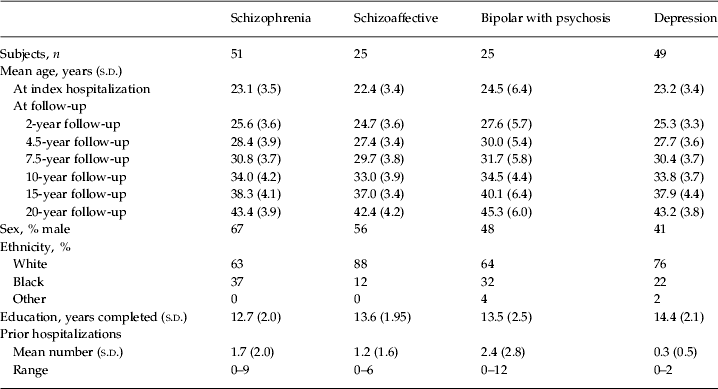
Table 1 describes participant characteristics. There were no significant differences between groups for age (F 3,146 = 1.41, p = 0.24) for the index hospitalization; however, there were trends for differences at the 2-year and 4.5-year follow-ups in the overall analyses of variance (F's = 2.28–2.51, p's = 0.06–0.08), demonstrating that bipolar patients were older than all other patients at the 2-year follow-up (p's = 0.01–0.04) and older than schizoaffective and depression patients at the 4.5-year follow-up (p's = 0.02). There was a trend for a sex difference between groups [χ2(3) = 7.09, p = 0.07], with the depression group having more female participants than the schizophrenia group [χ2(1) = 6.72, p = 0.01]. Groups did not differ for ethnicity [χ2(6) = 8.95, p = 0.18]. Groups differed on educational achievement (F 3,146 = 5.11, p = 0.002), with schizophrenia patients having a lower level of education than depression patients (p < 0.001). Higher education level was associated with less hallucinatory activity at the index hospitalization and at all the follow-ups (r = − 0.20 to −0.30, p's <0.0001–0.05). Greater index education level was also associated with a greater chance of having a period of recovery over the next 20 years (r = 0.22, p = 0.006). There were no differences in social class between groups [χ2(12) = 15.54, p = 0.21]. Groups differed for number of previous hospitalizations (F 3,146 = 8.81, p < 0.001). Schizophrenia (p < 0.001), schizoaffective (p = 0.04) and bipolar with psychosis (p < 0.001) patients had a greater number of previous hospitalizations compared with depression patients. Additionally, bipolar patients had a greater number of previous hospitalizations compared with schizoaffective patients (p = 0.02). Overall, 47% of patients were first-admission patients and 73% had one or no previous hospitalizations prior to the index hospitalization. A greater number of hospitalizations as measured at the index hospitalization was not associated with a greater level of hallucinations at the index hospitalization (r = − 0.06, p = 0.59). However, a greater number of hospitalizations at index was associated with being less likely to have a period of recovery over the next 20 years (r = –19, p = 0.02). Last, groups differed at all six follow-ups for global assessment of functioning (GAS) (F's = 5.09–13.79, p's <0.001–0.003). Schizophrenia patients did not differ from schizo-affective patients at any of the follow-ups (p's >0.09), but did have poorer functioning than bipolar with psychosis patients at the 4.5-year, 7.5-year, 10-year and 20-year follow-ups (p's <0.02) and depression patients at all follow-ups (p's <0.001). Schizoaffective patients had poorer functioning than bipolar with psychosis patients at the 4.5-year follow-up (p = 0.009) and depression patients at the 2-year, 4.5-year, 7.5-year and 10-year follow-ups (p's <0.009). Last, bipolar with psychosis patients had poorer functioning than the depression patients at the 7.5-year and 15-year follow-ups (p's <0.01).
Participant characteristics

s.d., Standard deviation.
Longitudinal trajectory of hallucinations in psychotic and mood disorders over a 20-year period
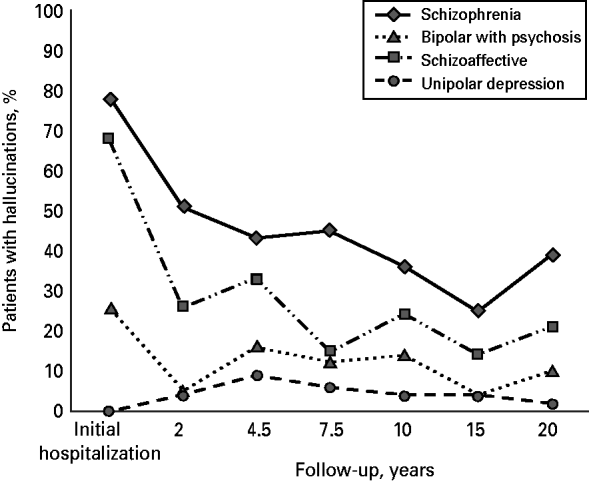
There was a significant effect of group on hallucination status at the index hospitalization [χ2(3) = 69.48, p < 0.001; see Fig. 1]. Schizophrenia patients did not differ from schizoaffective patients [χ2(1) = 0.79, p = 0.37] at the index hospitalization. Both schizophrenia [χ2(1) = 17.44, p < 0.001] and schizoaffective patients [χ2(1) = 8.43, p = 0.004] had more hallucinatory activity compared with bipolar with psychosis patients. Schizophrenia, schizoaffective and bipolar with psychosis patients had more hallucinations at the index hospitalization compared with non-psychotic unipolar depression patients (χ2 = 13.68–61.20, p's <0.001), who were used as a psychiatric control group.
Longitudinal trajectory of hallucinations in patients with schizophrenia, schizoaffective disorder, bipolar disorder with psychosis and unipolar depression over a 20-year period.
A generalized estimating equation model was used to evaluate the difference between the index hospitalization and follow-up periods for the three diagnostic groups (schizophrenia, schizoaffective and bipolar with psychosis disorders) at the index hospitalization. All three groups had more hallucinations at the index hospitalization compared with each follow-up period (χ2's = 14.05–29.98, p's <0.001). There was no interaction between time and group for any of the comparisons (p's >0.17).
A second generalized estimating equation model evaluated for differences in hallucinatory status between the four patient groups after the index phase over the six follow-up periods. The model demonstrated a significant effect of group [χ2(3) = 26.78, p < 0.001]. Least-squares difference pair-wise comparisons demonstrated that schizophrenia patients, collapsing across all follow-up periods, had more hallucinations than schizoaffective patients (p = 0.03), bipolar with psychosis patients (p < 0.001) and depression patients (p < 0.001). Schizoaffective patients did not differ significantly from bipolar with psychosis patients (p = 0.096), but had more hallucinatory activity than depression patients (p = 0.01). Bipolar with psychosis patients did not differ from depression patients (p = 0.37).
There was also a significant main effect of follow-up period [χ2(5) = 13.88, p = 0.02]. There was more hallucinatory activity during the 4.5-year (p < 0.001) and 7.5-year (p = 0.005) follow-up periods than during the 15-year follow-up. During the 4.5-year follow-up, there was also more hallucinatory activity than at the 20-year follow-up period (p = 0.02).
Additionally, the generalized estimating equation model demonstrated a trend towards a group × follow-up period interaction [χ2(15) = 23.72, p = 0.07]. Schizophrenia patients had more hallucinations compared with schizoaffective patients at the 2-year and 7.5-year follow-ups (p's <0.03). Schizophrenia patients had more hallucinations at all follow-ups over the 20 years compared with bipolar with psychosis patients (p's <0.04) and depression patients (p's <0.004). Schizoaffective patients had more hallucinations than bipolar with psychosis patients at the 2-year follow-up (p = 0.04), and depression patients at the 2-year, 4.5-year, 10-year and 20-year follow-ups (p's <0.03). Bipolar with psychosis patients did not differ from depression patients at any of the follow-ups (p's >0.22).
Chronicity of hallucinations in psychotic and mood disorders over a 20-year period
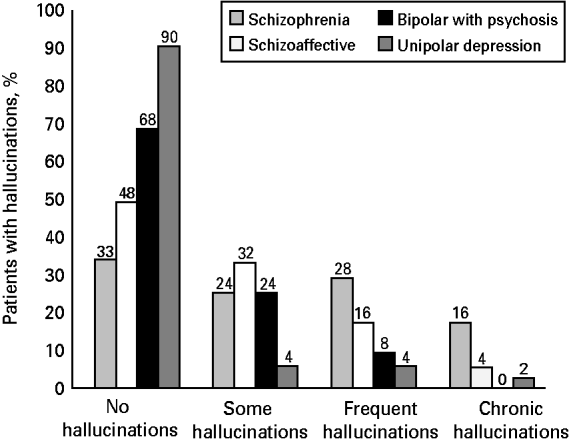
Fig. 2 depicts the percentage of patients in the four psychiatric groups who had chronic hallucinations (i.e. hallucinations at all follow-up periods), frequently recurring hallucinations (i.e. hallucinations at three or more of the follow-up periods), some hallucinations, and no hallucinations. A linear-by-linear association χ2 test taking into account order effects found that there was a significant difference in the chronicity of hallucinations between groups [χ2(1) = 33.15, p < 0.001]. Follow-up linear-by-linear association χ2 tests revealed that schizophrenia patients demonstrated greater chronicity of hallucinations compared with schizoaffective patients [χ2(1) = 3.74, p = 0.05], bipolar with psychosis patients [χ2(1) = 11.22, p = 0.001] and depression patients [χ2(1) = 26.86, p < 0.001]. Schizoaffective patients did not differ from bipolar with psychosis patients in chronicity [χ2(1) = 2.63, p = 0.11], but did show greater chronicity than depression patients [χ2(1) = 9.69, p = 0.002]. Last, bipolar with psychosis patients did not have more chronic hallucinatory activity than depression patients [χ2(1) = 2.01, p = 0.16].
Chronicity of hallucinations in patients with schizophrenia, schizoaffective disorder, bipolar disorder with psychosis and unipolar depression over a 20-year period.
Relationship between hallucinations and recovery
We conducted χ2 tests to investigate whether the presence of hallucinations at the index hospitalization and 2-year follow-up were associated with having a period of recovery over the next 18 or 20 years. Patients who did not have hallucinations at the index hospitalization were not more likely to have at least one period of global recovery over the next 20 years [(χ2(1) = 1.29, p = 0.26]. However, not having hallucinations at the 2-year follow-up was associated with having at least one period of global recovery over the next 18 years [χ2(1) = 27.57, p < 0.001]. For those patients who had a period of recovery, 90% had no hallucinations at the 2-year follow-up.
We also analysed the pattern specifically in schizophrenia patients, as recovery in schizophrenia has been a source of theoretical discussion. Schizophrenia patients who did not have hallucinations at the index hospitalization were significantly more likely to have at least one global recovery period over the next 20 years [χ2(1) = 3.79, p = 0.05]. The same relationship was present for the 2-year follow-up, predicting at least one global recovery period over the next 18 years [χ2(1) = 6.33, p = 0.01].
Relationship between hallucinations and work attainment
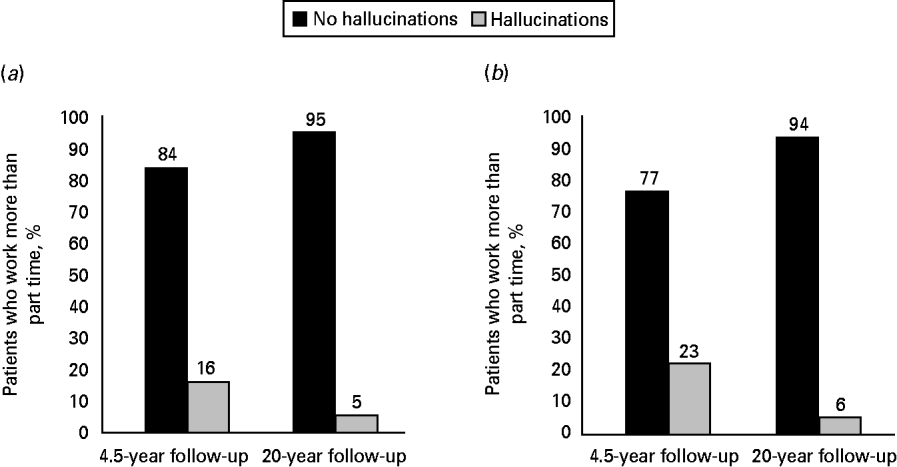
We conducted six χ2 tests to investigate whether the presence of hallucinations at the six follow-up periods predicted the ability to work more than part time (see Fig. 3). Collapsing across all diagnostic groups, the presence of hallucinations predicted working less than part time, whereas the absence of hallucinations predicted working more than part time at all six follow-ups (χ2's = 5.83–32.60, p's <0.001–0.02).
Association of hallucination status with work attainment in all patients (a) and schizophrenia patients (b) specifically at the 4.5-year and 20-year follow-ups.
We also analysed the pattern specifically in schizophrenia patients. Similar to when all patients were analysed, a lack of hallucinations was associated with working more than part time at all of the follow-ups in schizophrenia, which reached significance at the 4.5-, 7.5-, 10-, 15- and 20-year follow-ups (χ2's = 3.67–15.11, p's <0.001–0.055).
Do hallucinations predict future recovery and work attainment beyond global functioning and delusions in all patients?
The presence of hallucinations at the 2-year follow-up in all patients predicted a future period of recovery over the next 18 years [(χ2(1) = 5.94, p = 0.02], above and beyond the relationship between recovery and global functioning [χ2(1) = 4.29, p = 0.04]. Moreover, hallucinations at the 2-year follow-up predicted a future period of recovery over the next 18 years [χ2(1) = 12.15, p < 0.001], above and beyond the relationship between recovery and delusions [χ2(1) = 1.998, p = 0.16].
Additionally, in all patients, we found that hallucinations were associated with work attainment (χ2's = 4.62–5.34, p's = 0.02–0.03), above and beyond the relationship between work attainment and global functioning for the 7.5-year and 20-year follow-ups (χ2's = 15.74–23.53, p's <0.001). Furthermore, hallucinations were associated with work attainment at the 2-year, 4.5-year, 7.5-year and 20-year follow-ups (χ2's = 3.77–13.27, p's <0.001–0.05), above and beyond the relationship between work attainment and delusions (χ2's = 0.09–11.23, p's <0.001–0.76).
Antipsychotic medications
At the 2-year follow-up, 64% of schizophrenia patients, 58% of schizoaffective patients, 19% of bipolar with psychosis patients and 11% of unipolar depression patients were on antipsychotic medications. The figures remained relatively consistent over the next 18 years. At the 20-year follow-up, 55% of schizophrenia patients, 63% of schizoaffective patients, 27% of bipolar with psychosis patients and 10% of depression patients were on antipsychotic medications.
The relationship between antipsychotic medication status and hallucinations was assessed in schizophrenia and schizoaffective patients given that there were sufficient numbers for analyses. Schizophrenia patients not on any antipsychotic medication tended to have less hallucinatory activity than schizophrenia patients on antipsychotic medications, which reached significance at the 2-year, 4.5-year, 7.5-year, 10-year and 20-year follow-ups (χ2's = 4.33–5.74, p's = 0.02–0.04). Additionally, schizoaffective patients not on any antipsychotic medications had less hallucinatory activity at the 10-year follow-up than schizoaffective patients on antipsychotic medications [χ2(1) = 5.26, p = 0.02].
Discussion
Our understanding and categorization of severe mental disorders are based on our assumptions about longitudinal course. Despite the importance of hallucinations as a major type of psychotic symptom, systematic data on how many psychotic and mood disorder patients have frequent or persistent hallucinatory activity on a longitudinal basis have not previously been available to the field. The goals of this investigation were to determine: (1) the longitudinal course of hallucinations in patients with psychotic and mood disorders; (2) whether the course of hallucinations differs in these disorders; and (3) whether hallucinations can predict real-world functioning. This study demonstrated that the longitudinal course of hallucinations was useful in differentiating between disorders, and valuable in predicting the future clinical course of severe mental disorders.
Longitudinal trajectory of hallucinations in psychotic and mood disorders over a 20-year period
Schizophrenia, schizoaffective and bipolar with psychosis patients all had significantly more hallucinations at the index hospitalization than at the follow-ups. Although in this study having more hallucinations in the early years was confounded by selection of patients from hospitals at index, this finding is consistent with other studies that suggest that the early period is typically the worst symptomatic period in the course of psychosis (Harding et al. Reference Harding, Brooks, Ashikaga, Strauss and Breier1987; McGlashan, Reference McGlashan1988; Arndt et al. Reference Arndt, Andreasen, Flaum, Miller and Nopoulos1995). These data are consistent with previous research that demonstrates that positive symptoms tend to decrease over the lifespan of schizophrenia patients (Pfohl & Winokur, Reference Pfohl and Winokur1982; Gur et al. Reference Gur, Petty, Turetsky and Gur1996; Schultz et al. Reference Schultz, Miller, Oliver, Arndt, Flaum and Andreasen1997; Mancevski et al. Reference Mancevski, Keilp, Kurzon, Berman, Ortakov, Harkavy-Friedman, Rosoklija and Dwork2007). However, these data also demonstrate that there were a substantial number of patients who continued to show hallucinations after their index hospitalization. Of the patients, 54% of schizophrenia patients and 20% of schizoaffective patients showed frequent or chronic hallucinations over the 20-year course of the study. Comparatively, bipolar with psychosis and depression patients were less likely to have frequent or chronic hallucinations (8% and 6%, respectively). Overall, these data fit with long-held views that schizophrenia patients are more vulnerable to chronic courses of psychotic symptomatology compared with other disorders with psychosis (Kraepelin, Reference Kraepelin1907; Bleuler, Reference Bleuler1950; McGlashan, Reference McGlashan1988).
Hallucinatory status differentiates between groups over the course of 20 years
One of the main issues examined in this study was whether hallucinatory status over the course of 20 years is useful in differentiating between major mental disorders. Given that differential diagnosis between psychotic and mood disorders is often difficult, further knowledge regarding how symptoms differ in disorders is of key interest to the field. The data indicate that although schizophrenia and schizo-affective patients had similar levels of hallucinations at the index hospitalization, the longitudinal course of hallucinations differentiated between the two disorders. Schizophrenia patients had more hallucinations than schizoaffective patients collapsed across all follow-up periods, specifically at the earlier follow-ups (2 and 7.5 years), and more chronic hallucinations. Additionally, the longitudinal course of hallucinations differentiated schizophrenia patients from bipolar with psychosis and unipolar depression patients over the 20 years. At the index hospitalization and throughout the 20-year follow-up period, schizophrenia patients had more hallucinations than both groups. Consistent with previous research, this provides further evidence of the greater vulnerability of schizophrenia patients to psychotic symptoms (McGlashan, Reference McGlashan1988).
Another important diagnostic comparison is between mood disorders with psychosis and schizo-affective patients. This study found that schizo-affective patients had a more nuanced pattern of hallucinatory status compared with bipolar with psychosis and depression patients. Schizoaffective patients had more hallucinations at the index hospitalization and in the 2-year follow-up period compared with bipolar with psychosis patients. This suggests that the early course of hallucinations is more important in differentiating schizoaffective disorder from bipolar disorder with psychosis. Not surprisingly, schizoaffective patients continued to have more hallucinatory activity than depression patients over many of the follow-up periods (2, 4.5, 10 and 20 years). Historically, some have viewed schizoaffective patients as primarily mood disorder patients (Pope & Lipinski, Reference Pope and Lipinski1978; Pope et al. Reference Pope, Lipinski, Cohen and Axelrod1980). Our data, at least with regard to hallucinations, do not confirm this. Schizoaffective patients are more vulnerable to psychotic symptoms (Harrow et al. Reference Harrow, Grossman, Herbener and Davies2000) and show more frequent hallucinatory activity as compared with bipolar with psychosis patients. In accord with this, during the index phase, schizoaffective patients are similar to schizophrenia patients in hallucinatory status.
Last, bipolar with psychosis patients had more hallucinations at the index hospitalization compared with depression patients, who were included in the sample because they did not have any hallucinations at index. However, as the longitudinal trajectory demonstrated, bipolar patients with psychosis did not differ from unipolar depression patients at any of the follow-ups.
These findings have relevance for our understanding of diagnostic boundaries and differential diagnosis between similar disorders. The results suggest that in differentiating between schizophrenia and schizoaffective disorder, the longer-term course of hallucinations differentiates better than the index-hospitalization phase, whereas, the early years better differentiate schizoaffective disorder from bipolar with psychosis. At least with regards to hallucinatory status, this study also provides support for major aspects of the current diagnostic scheme, with schizophrenia and schizoaffective disorder being grouped together due to a similar early course and bipolar disorder and depression being grouped together. Additionally, schizoaffective disorder shared some commonalities with both schizophrenia and bipolar with psychosis with regards to hallucinatory activity.
Relationship between hallucinations and real-world functioning
Across all patients, the presence of a hallucination in the 2-year follow-up period predicted a reduced likelihood of having a future recovery period over the next 18 years. Also, there was a relationship between the presence of hallucinations and lower work attainment at the follow-up periods for all patients. This pattern was also present in schizophrenia patients when analysed separately. These data suggest that hallucinations which persist in the first few years after the acute phase are an indication in many cases of a more severe vulnerability to hallucinations, with this vulnerability influencing subsequent functioning and future outcome. Unfortunately, given that 44% of schizophrenia patients and 20% of schizoaffective patients demonstrate frequent or chronic hallucinations, experiencing a period of recovery or achieving adequate work functioning is unlikely for a large group of patients.
These results contrast with previous reports that have suggested that positive symptoms are not a predictor of real-world functioning in schizophrenia (Green, Reference Green1996; Green et al. Reference Green, Kern, Braff and Mintz2000). Green (Reference Green1996) and Green et al. (Reference Green, Kern, Braff and Mintz2000) indicate that (1) cognitive impairments in schizophrenia are strongly related to poorer functioning and (2) positive symptoms, such as hallucinations, are unrelated to real-world functioning. Our results demonstrate a relationship between hallucinations and real-world functioning. Our data spanning 20 years may differ from single time-point studies, as longitudinal studies may be better able to chronicle the complex relationship between the symptoms and functioning. In support of our finding that hallucinations are related to work attainment and recovery in patients, studies investigating children in the community for hallucinations longitudinally at baseline (Bartels-Velthuis et al. Reference Bartels-Velthuis, Jenner, van de Willige, van Os and Wiersma2010) and 5-year follow-up (Bartels-Velthuis et al. Reference Bartels-Velthuis, van de Willige, Jenner, van Os and Wiersma2011) also demonstrated that hallucinations were related to real-world functioning. Bartels-Velthuis et al. (Reference Bartels-Velthuis, van de Willige, Jenner, van Os and Wiersma2011) found a relationship between auditory hallucinations and school functioning at the 5-year follow-up. Children with severe auditory vocal hallucinations had lower school test scores and attended a lower secondary school type than children with mild auditory vocal hallucinations and controls (Bartels-Velthuis et al. Reference Bartels-Velthuis, van de Willige, Jenner, van Os and Wiersma2011). Together these studies underscore the importance of investigating the longitudinal relationship between symptoms and later outcome.
Additionally, cognitive data from the Chicago follow-up study strongly support Green's proposal (Green, Reference Green, Kern, Braff and Mintz2000) that cognitive impairments are related to poorer work and real-world functioning (Bonner-Jackson et al. Reference Bonner-Jackson, Grossman, Harrow and Rosen2010). However, our data also indicate that many other major types of psychopathology, in addition to hallucinations, also lead to impaired real-world functioning, including first-rank symptoms (Rosen et al. Reference Rosen, Grossman, Harrow, Bonner-Jackson and Faull2011), delusions (Racenstein et al. Reference Racenstein, Harrow, Reed, Martin, Herbener and Penn2002; Harrow et al. Reference Harrow, Herbener, Shanklin, Jobe, Rattenbury and Kaplan2004; Harrow & Jobe, Reference Harrow and Jobe2010), thought disorder (Racenstein et al. Reference Racenstein, Penn, Harrow and Schleser1999) and negative symptoms (Herbener & Harrow, Reference Herbener and Harrow2004; Strauss et al. Reference Strauss, Harrow, Grossman and Rosen2010). In this sample, we found that the presence of hallucinations was related to the lack of a period of recovery and poorer work attainment even when controlling for global functioning and delusions.
Relationship between hallucinations and antipsychotic medications
We found that schizophrenia and schizoaffective patients not on antipsychotic medications had less hallucinatory activity than patients on antipsychotic medications. These findings are consistent with other reports in the literature, which suggest that patients who are no longer in treatment show better global functioning (Johnstone et al. Reference Johnstone, Macmillan, Frith, Benn and Crow1990; Harrow & Jobe, Reference Harrow and Jobe2007, Reference Harrow and Jobe2010) and are more likely than those still on antipsychotic medication to have a period of recovery (Bland et al. Reference Bland, Parker and Orn1978; Fenton & McGlashan, Reference Fenton and McGlashan1987; Harrison et al. Reference Harrison, Hopper, Craig, Laska, Siegel, Wanderling, Dube, Ganev, Giel, An der Heiden, Holmberg, Janca, Lee, Leon, Malhotra, Marsella, Nakane, Sartorius, Shen, Skoda, Thara, Tsirkin, Varma, Walsh and Wiersma2001; Harrow & Jobe, Reference Harrow and Jobe2005, Reference Harrow and Jobe2007, Reference Harrow and Jobe2010). These seemingly counterintuitive associations are probably due to the fact that schizophrenia patients not on antipsychotics for prolonged periods are a subgroup of patients with greater resiliency. They have better prognostic factors, better pre-morbid developmental achievements, less vulnerability to anxiety and better cognitive functioning (Harrow et al. Reference Harrow, Jobe and Faull2012). However, it is possible that other factors involving the long-term use of antipsychotics may also have influenced these results (Samaha et al. Reference Samaha, Seeman, Stewart, Rajabi and Kapur2007; Harrow et al. Reference Harrow, Jobe and Faull2012).
Limitations
We evaluated hallucinations at six follow-up periods over 20 years. A more frequent assessment of hallucinations would be preferential. Second, we had a modest sample of schizoaffective and bipolar with psychosis patients (25 patients in each group). A larger sample of schizoaffective and bipolar with psychosis patients would have enabled us to conduct a more thorough analysis of the relationship between hallucinations and recovery and work attainment in those specific groups.
Conclusions
These results detailing the long-term trajectory of hallucinations in schizophrenia, other psychotic, and mood disorder may be useful in our categorization of psychiatric illnesses given the ongoing revisions to our current diagnostic systems. Additionally, as hallucinations are quite frequent in psychosis and one predictor of real-world functioning in all patients, better chronicling of the course of psychotic symptoms could be important in developing specialized treatment plans. Last, there is an increasing literature documenting biological mechanisms that may be involved in hallucinations (Shergill et al. Reference Shergill, Brammer, Williams, Murray and McGuire2000; Hubl et al. Reference Hubl, Koenig, Strik, Federspiel, Kreis, Boesch, Maier, Schroth, Lovblad and Dierks2004; Goghari et al. Reference Goghari, Sponheim and Macdonald2010; Jardri et al. Reference Jardri, Pouchet, Pins and Thomas2011); however, this literature needs to be supplemented with research on the phenomenology and theoretical significance of hallucinations to psychotic and mood disorders.
Acknowledgements
We thank Bob Faull for his role in data management. Funding was provided by the National Institute of Mental Health (NIMH) (grants no. MH-26341 and no. MH-068688 to M.H.). V.M.G. was funded by a Canadian Institutes of Health Research New Investigator Award and a University of Calgary Start-up Grant.
Declaration of Interest
None.