INTRODUCTION
The purpose of this research was to understand the meaning of existence when a patient is diagnosed with a life-threatening illness, in this case motor neurone disease (MND). People living with this disease often retain an active mind but are increasingly unable to move any of their muscles, and death usually occurs within months in the case of progressive bulbar palsy (PBP) MND, and three to five years for amyotrophic lateral sclerosis (ALS) MND (Motor Neurone Disease Association, 2000; Oliver, Reference Oliver2002). British research in this area of interest has focused on care values for MND (Brown, Reference Brown2003), on whether life is biographically disrupted when living with MND (Locock et al., Reference Locock, Ziebland and Dumelow2009), and on how people talk about living with MND (Brown & Addington-Hall, Reference Brown and Addington-Hall2008), with each of these studies identifying existential concerns for people living with MND.
MND is a relentlessly progressive disease with no curative treatment, and the recommended clinical management of MND is palliative care throughout the disease trajectory (Oliver, Reference Oliver2002). However, whether a person receives palliation in the United Kingdom may be dependent on their geographical location (Oliver, Reference Oliver2002), as well as the presenting symptoms (Motor Neurone Disease Association, 2013a; 2013b). In the United Kingdom, the recommendation for care of people with MND is medical and functional. Those who experience a loss of speech, loss of respiratory function, or are in their terminal phase are referred to the palliative care services (Motor Neurone Disease Association, 2013a; 2013b). People may prioritize their existential concerns ahead of their medical and functional needs, yet all have a need for palliative care services from the time of their diagnosis to affirm the meaning of life and death as a normative process (WHO, 2002). This paper discusses what it means to be a person living through the trajectory of MND, a life-limiting illness. The literature review provides an overview of the empirical research of living with MND, receiving healthcare, and the impact on self and identity. The section on the understanding of existential hermeneutic phenomenology outlines and justifies the methodological approach taken and the method adopted and developed for this research, including the ethical considerations and hermeneutic analysis, and provides a critical evaluation of the research. Extracts from the stories on the meaning of existence with MND from four participants are presented. Finally, the Discussion and Conclusions section appraises the findings in relation to the existing literature and guidelines, and provides recommendations for a lifeworld approach to healthcare for people living with MND and other life-limiting illnesses.
LITERATURE REVIEW
What is Motor Neurone Disease?
Motor neurone disease (MND) is an umbrella term for a group of age-related neurodegenerative disorders of unknown etiology. Motor neurons transmit electrical signals from the brain (upper motor neurons) and the spine (lower motor neurons) to muscle groups within the body in order to generate movement. The upper motor neurons situated in the higher brain area (motor cortex) send signals down the spinal cord to connect at different junctions with the lower motor neurons, which in turn send signals to the muscles to initiate movement of the arms and legs (Talbot & Marsden, Reference Talbot and Marsden2008). In MND, motor neurons progressively degenerate and eventually die (Talbot & Marsden, Reference Talbot and Marsden2008).
Little is understood about the causes of MND following extensive examination of the environment or the life histories of people living with the disease. Some of the suggested risk factors include: exposure to insecticides, heavy metals, electromagnetic radiation and solvents, a history of fractures and other traumas, athleticism, and military service; however, these risk factors remain unconfirmed. Talbot and Marsden (Reference Talbot and Marsden2008) state that only 2 to 3% of patients with familial MND carry mutations in the gene encoding superoxide dismutase (SOD1), and in 90% of patients it is obvious that they do not have any genetic basis for their disease. It remains a possibility that genetic variations, acting in concert, increase the risk of developing MND (Talbot & Marsden, Reference Talbot and Marsden2008). Other potential genes thought to be involved are TDP-43 and FUS (Oliver, Reference Oliver2002). Of course, this may be a significant concern for people diagnosed with MND and may determine whether they risk passing the disease on to other generations (Bolmsjö, Reference Bolmsjö2001).
In the most recent epidemiological research carried out in the United Kingdom, Alonso and colleagues (Reference Alonso, Logroscino, Jick and Hernan2009) analyzed the general practice research database for the period of 1990 to 2005, and found that 830 new cases of MND (360 in women; 470 in men) were recorded. Talbot and Marsden (Reference Talbot and Marsden2008) state that MND is a relatively rare disease, which means that healthcare professionals infrequently encounter people living with MND. For example, one in 1000 death certificates record MND as the cause of death, in comparison to stroke, which affects one in three, and cancer (all types), which affects one in four. There is no evidence to suggest that MND is becoming more common, though increasing life expectancy will impact on the number of people being diagnosed with MND.
At the time of diagnosis, a person learns that MND is a life-threatening disease with no known cure (Leigh et al., Reference Leigh, Abrahams and Al-Chalabi2003), and they are usually offered the drug Riluzole, which has been shown to increase survival times by up to 3–4 months (McDermot & Shaw, Reference McDermot and Shaw2008). A person may learn at the time of diagnosis that they have one of four types of MND: amyotrophic lateral sclerosis (ALS), progressive bulbar palsy (PBP), progressive muscular atrophy (PMA), or primary lateral sclerosis (PLS) (Talbot & Marsden, Reference Talbot and Marsden2008; Motor Neurone Disease Association, 2000; 2013).
Discourses on Living with MND
People may receive a diagnosis of ALS-type or PBP-type MND, and, depending on the type of MND diagnosed, they may have months or years to live (Motor Neurone Disease Association, 2013b). Research in the United Kingdom has focused on care values in MND (Brown, Reference Brown2003), on whether life is biographically disrupted when living with MND (Locock et al., Reference Locock, Ziebland and Dumelow2009), and on how people talk about living with MND (Brown & Addington-Hall, Reference Brown and Addington-Hall2008). These studies have identified that being diagnosed with MND is an “existential shock” (Brown, Reference Brown2003), a “biographical abruption” of a previously planned life (Locock et al., Reference Locock, Ziebland and Dumelow2009), and a “fracturing narrative,” telling of their loss and fear of the future (Brown & Addington-Hall, Reference Brown and Addington-Hall2008), with each of these studies identifying existential concerns for people living with MND. In studies conducted outside the United Kingdom, people talk about their existential concerns for life and death (e.g., Bolmsjö, Reference Bolmsjö2001), and, while this is the only research publicly available, more studies may exist.
Management of Illness: A Philosophical Perspective
Greek physicians had observed the body cannot be treated without at the same time treating the soul. It is further suggested that perhaps even this is not enough, that it is impossible to treat the body without possessing knowledge concerning the whole of being. (Gadamer, Reference Gadamer1993, p. 793)
The diagnosis of illness is determined from knowledge gained within the natural sciences; however, once given a diagnosis, a person with an illness is then defined by a social state of affairs and a psychological/moral state of affairs (Gadamer, Reference Gadamer1993). Gadamer is referring to the concept that, once a person is diagnosed, they then become involved in a social network, such as the United Kingdom healthcare system. Gadamer notes how people were previously reliant on their family doctor (general practitioner, GP) to provide social, psychological, and moral support, whereas today GPs are often unable to provide such levels of support. Consequently, we are more likely to be reliant on the practical experiences of clinicians, who see their patient in the clinical stage, “and therefore do not understand the patient and their history, and care becomes ‘unavoidably abstract’” (Gadamer, Reference Gadamer1993, p. 21). He argues that healthcare practice has become objectified in terms of the multiplicity of data, and that personhood has been lost. Although Gadamer refers to the healthcare practice of some 30 years ago, his insight has meaning for healthcare practice in the 21st century. A patient diagnosed with MND is a prime example: first, the patient visits their GP because they have noticed something untoward is happening to them; they then undergo a number of clinical investigations (brain scan, nerve testing, breathing tests), and all the information concerning the person is collated into a computerized system, and the relevant data are then applied to the person presenting to the consultant with the disease. Gadamer questions whether the unique value of the person is acknowledged during this process.
The Multidisciplinary Team Approach in the 21st Century
People living with MND require help to manage their symptoms from a multidisciplinary team of healthcare professionals (Motor Neurone Disease Association, 2011). Thomas (Reference Thomas2010) refers to patients receiving healthcare in the United Kingdom as being involved in a different social system (the NHS), and involvement in this social system means receiving healthcare from a range of healthcare professionals working in a variety of settings (Oliver, Reference Oliver2002). Oliver highlights the number of professional services that may be involved in the management of MND: (1) neurology services; (2) MNDA care centers; (3) research centers; (4) community services; and (5) palliative care services. This brings into question whether people receiving healthcare from so many different services experience a continuity of care, and patients with MND receiving healthcare have reported deficiencies in the organization of healthcare services (Brown et al., Reference Brown2006).
The Professional Paradigm
All healthcare professionals have their own professional paradigms and work within shared policy frameworks and practice guidelines that determine how their care is delivered. In the management of MND, Brown (Reference Brown2003) found that “professionals appreciate the debilitating effects of MND, but their practice prioritizes their functional roles over emotional support. This situation is often created through external constraints but leaves professionals in a constant state of tension” (p. 215). Brown (Reference Brown2003) further reported that healthcare professionals were unsatisfied with the care they delivered to patients with MND.
The MND Association (MNDA) has introduced the “Services Required Along the Year of Care Pathway” (Motor Neurone Disease Association, 2013a). While it is not clear why this is only directed toward the first year of the illness trajectory, this pathway offers guidance for healthcare professionals to manage a patient living with MND. The care pathway recommends referral to different healthcare services based upon milestones (generic needs at and after diagnosis), and the needs based on loss of function include the use of arms, ability to walk, ability to manage personal hygiene and care, speech, ability to swallow, respiratory function, cognitive function, and palliative care prior to death. What is clear from this pathway is that the care delivered is very much focused on management of the medical and functional needs of people living with MND, and not their spiritual and emotional needs. Referral to palliative care services is noted only for those who have experienced a loss of speech, respiratory function, and are nearing the end of life, and the pathway does not identify the need for a person diagnosed with MND to be put onto the palliative care pathway at the time of their diagnosis. Similarly, this care pathway does not acknowledge the significance of MND as an “existential shock” (Brown, Reference Brown2003), or a “biographical abruption” (Locock et al., Reference Locock, Ziebland and Dumelow2009) at the time of diagnosis, and the loss of movement as “existential suffering” (O'Toole, Reference O'Toole2011). However, the care pathway does suggest that practical, emotional, social, and financial support is available via the MND Association (MNDA) throughout the course of the disease, and people are able to contact an advisory line in order to access this support. The emphasis on the MNDA to provide emotional support removes this responsibility from the healthcare professionals.
Discourses on Receiving Healthcare
The current available literature suggests that the needs of people living with MND are not being met because the care tends to focus on the functional needs of the person living with MND (Brown, Reference Brown2003; Hughes et al., Reference Hughes, Sinha and Higginson2005; van Teijlingen, Reference Van Teijingen, Friend and Kamal2001). Brown (Reference Brown2003) argues that people need to be acknowledged independent of their disease; however, the currently available evidence suggests that people are not being acknowledged in this way because the care people do receive is based on objectified care pathways, which are focused on the person and their disease and do not acknowledge the patient in a wider temporal frame or beyond their illness context. However, a few studies have focused on the meaning of existence with an MND, a life-limiting illness, through time.
METHODOLOGY AND METHODS
Research Design
This research adopts an existential hermeneutic phenomenological approach (Heidegger, Reference Heidegger1927/1962). Heidegger terms human existence as “Dasein” (being-in-the-world, being-there) (Moran, Reference Moran2000), and he asked questions about experiencing and understanding, such as what does it mean to be a person? The unit of analysis is the experience of the situation and the person; what is shared history, culture, practice, and language. Interpreters participate in making data, with the understanding that their interpretation can only make explicit what is already understood. To accomplish this, Heidegger introduced the idea of the “hermeneutic circle,” whereby the researcher brings their own background and frames of meaning to the hermeneutic circle of understanding, and these cannot be “bracketed,” ignored, or forgotten, as they are contextualized life events (Koch, Reference Koch1995). Gadamer (Reference Gadamer1975) recommends engagement with one's own presuppositions, defined as preunderstandings, prejudices, and beliefs, in order to understand the meaning of ourselves and others. Schwandt (Reference Schwandt, Denzin and Lincoln2000) states that a researcher adopting this position for their study is taking a non-objectivist view of the meaning. Brown (Reference Brown2003) also framed her study on Heidegger and Gadamer's hermeneutic phenomenological perspectives, though it focused on care values.
The existential hermeneutic phenomenological approach adopted in this study captures the meaning of existence through time, the lived-through past, the experienced present, and the projected future. Alternative phenomenological perspectives were considered when designing this research, including Merleau-Ponty's meaning of existential phenomenology, which emphasizes the body as the primary site for knowing the world. He maintained that the body and that which it perceives could not be “disentangled” from each other. However, this perspective was rejected because the focus on the body is inappropriate for people with a progressive deterioration of motor neurons now controlling their lifeworld. Furthermore, the approach of hermeneutic phenomenology offers a sensitive approach to this research, and a way of understanding a person in a wider temporal frame, beyond their disease context; the participant is both the expert and an authority on his or her own life.
For this study, a life story approach was designed, using one-on-one interviews that asked the question “Can you please tell me the story of your life (…) since you first thought there might be something wrong with you?” This method of data collection is consistent with Wengraf's approach (Reference Wengraf2001) and the hermeneutic phenomenological approach. A hermeneutic phenomenological approach recognizes that we live our life in stories, and that the stories we tell are important for our identity, as they tell us who we are (Widdershoven, 1993, in Atkinson, Reference Atkinson1998). The life story interview was conducted through a series of three separate interviews, where the timeframe between interview 1 (parts A and B) and 2 (part C) was 4 to 6 weeks, depending on individual circumstances. This interval was employed to enable interpretation of the data gathered during the first interview, and the themes that emerged were explored in the second interview to gain a “fusion of meaning” (Gadamer, Reference Gadamer1975). Three further questions were asked during the second interview in order to gain a deeper understanding of the life being lived.
An information sheet and consent form for the study were read to the participants before they provided written or oral consent to take part. Three of the participants were unable to sign because of a loss of motor function in their upper body, and instead they were asked to provide oral consent in the presence of a witness, and this was recorded in writing. Process consent was appropriate for this study, and this was achieved by checking at each stage of data collection whether the participant still wanted to participate in the study. Consent was also obtained before commencing the second interview (Munhall, 1991, in Addington-Hall, Reference Addington-Hall2002).
Sample
As the purpose of hermeneutic phenomenology is to interpret the lifeworld experience of people, the sampling method had to select people who would contribute to providing an insight into the phenomenon of existence when given a diagnosis of MND and in the context of receiving healthcare. Thus, for the purposes of the present study, maximum variation purposive sampling was applied to recruit four participants with an accepted diagnosis of MND (all types) (see Table 1). Maximum variation purposive sampling was employed to ensure that a range of experiences from different stages of disease progression were included in the sample (Wengraf, Reference Wengraf2001). The participants were recruited from one geographic area in the United Kingdom. According to Patton's (Reference Patton1990) understanding of maximum variance purposive sampling, such data and their analysis will produce high-quality detailed descriptions of each case; this not only provides individual uniqueness, but also shared patterns across the cases, emerging from heterogeneity. This process of sampling is in line with interpretive philosophy because it promotes inclusion of people with unique and diverse experiences, and similar studies have successfully used a small sample size to examine the experiences of chronic disease (Finlay, Reference Finlay2003; Gullickson, Reference Gullickson1993; Koch, Reference Koch1995; Robertson-Malt, Reference Robertson-Malt1999) and life-threatening illness (Brown, Reference Brown2003). A story approach allowed for in-depth exploration of rich material, and the quality of the data provided by the four participants was sufficient for the purposes of this study.
Participant demographics

Analysis
Hermeneutic phenomenology has no specified method of interpretation to offer researchers (Finlay, Reference Finlay2011), although Heidegger introduced aspects of existence to understand (interpret) a person in their lifeworld. Cohn (Reference Cohn1997) interpreted Heidegger's onticFootnote 2 and ontologicalFootnote 3 aspects of existence, and those he considered important have been used here as a framework to interpret the participants in their lifeworld. Finlay (Reference Finlay2011, p. 135) offers justification for the use of such a framework:
The explicit focus on lifeworld dimensions offers phenomenology a clear pragmatic framework that is well anchored in phenomenological philosophy (and so justified). The framework is one that guides methodology and upon which researchers can hang their understanding.
Gadamer offered the “hermeneutic circle” as a process of coming to understand (interpret) the being of something, for example, a text, the phenomenon, or a participant in the research context (Finlay, Reference Finlay2011). Fleming and colleagues (Reference Fleming, Gaidys and Robb2003) interpret Gadamer's meaning of the hermeneutic circle as gaining understanding of the parts in order to understand the whole. The present study has brought forward these two philosophical positions to understand (interpret) the meaning of existence.
Stage 1: Gaining an Understanding of the Stories
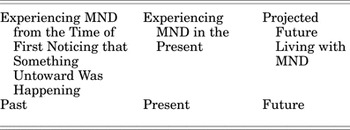
The present study adopted a story approach for gathering data. Heidegger (Reference Heidegger1927/1962) holds that all being through time is temporal; this involves the past, which is carried along by a present, which is already anticipating the future. This philosophy has been applied to the present study as described below (see also Table 2). Heidegger and Gadamer understood that gaining understanding of the whole should be the starting point of interpretation, because the meaning of the whole will influence the understanding of the parts (Atkinson, Reference Atkinson1998; Fleming et al., Reference Fleming, Gaidys and Robb2003). The process involved:
-
1. Iterative listening to the stories and organizing them into temporal themes (past, present, and future).
-
2. In the first stage of the data collection process (interview 1), the participant was asked to tell their story from when they first felt something untoward was happening to them.
-
a. This was naturally told as their experienced past, and was color-coded in blue.
-
-
3. In the second stage of the data collection process (interview 1), the participant was asked to elaborate on the meaning of their experiences.
-
a. Where stories still related to the past, these were also color-coded in blue.
-
b. Stories related to their experienced present were color-coded in pink.
-
c. Stories related to their anticipated future were color-coded in green.
-
-
4. In the third stage of the data collection process (interview 2), the participants were asked three broad questions to enhance their stories.
-
a. The responses to these questions have been combined with the earlier stories (of past, present, and future).
-
-
5. Stories that were repetitive or less relevant to the research focus were omitted.
Heidegger's aspects of temporality applied

Stage 2: Interpretation of the Meaning of Existence
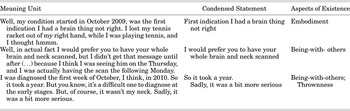
Atkinson (Reference Atkinson1998) recommends having a perspective broader than one's own in order to understand a story fully. Heidegger's (Reference Heidegger1927/1962) different aspects of existence offers a philosophical framework in which to understand what it means to be a person living through the illness trajectory of MND. The aspects of existence (lifeworld dimensions) used for this stage of analysis included: being-in-the-world; being-with-others; temporality; spatiality, thrownness; embodiment; mood; and mortality. The process involved:
Dividing the text into meaning units, which were then condensed, and organized into aspects of existence. The condensed statements are presented to bring closer attention to the metaphors/words/sentences used by the participants to emphasize their lifeworld experiences. (Finlay, Reference Finlay2011)
See the examples presented in Table 3.
Philosophical framework analysis

Stage 3: Sense of the Whole Story (Expanded)
It is understood that the meaning of the parts helps us to understand the meaning of the whole (Heidegger, Reference Heidegger1927/1962; Gadamer, Reference Gadamer1975), and this philosophy has been carried forward by a number of researchers (Atkinson, Reference Atkinson1998; Benzein et al., Reference Benzein, Norberg and Saveman2001; Fleming et al., Reference Fleming, Gaidys and Robb2003). The process involved:
-
1. Grouping together the existential themes.
-
2. Paying closer attention to the condensed statements in order to understand the meaning of the whole story.
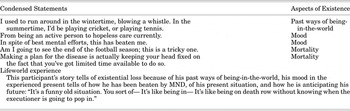
The lifeworld experiences of one participant are provided as an example of how the past is carried along by a present that is already anticipating the future (see Table 4) (Heidegger, Reference Heidegger1962).
Meaning of the whole story (James)

Stage 4: Identification of Passages
The final stage involves identification of passages (excerpts) that are representative of shared understandings between the researcher and the participants—the fusion of two horizons (Fleming et al., Reference Fleming, Gaidys and Robb2003). The research findings for this study have been co-created in dialogue, and I understand that another researcher with a different history, culture, and practice would have impacted differently on the participants, and is very likely to have heard a different story (Finlay, Reference Finlay2011). The process involved: identification of passages (excerpts) selected to bring forward what it means to be living through the illness trajectory of MND. The example provided in Table 5 is taken from one participant's meaning of existence now that he is no longer a being in the world of sport.
Identification of passages

A reflective diary and fieldnotes were kept throughout the course of the study and were drawn upon and utilized in the ethical consideration of this study. Addington-Hall (Reference Addington-Hall2002) highlights the methodological challenges of researching the healthcare experiences of palliative care patients. She points to issues that relate to the identification of patients in the first instance, and then to the following ethical concerns: physical problems; vulnerability; autonomy; cognitive impairment; and changes in the physical condition of the patient. The consultant and his team identified the participants in the first instance, and they chose the study participants because they met the inclusion criteria; those that did not have the mental capacity to consent were excluded. The criterion of avoiding harm is a basic ethical principle in the design of any study; however, as Hollway and Jefferson (Reference Hollway and Jefferson2000) state: “Can we assume that it is necessarily harmful to experience being upset or distressed? It can be reassuring and therapeutic to talk about an upsetting event in a safe context” (p. 87). Researchers using a life story approach understand that they must adopt active listening principles, which involve giving a person time to express their emotions (Wengraf, Reference Wengraf2001). Active listening principles are also applied in the context of occupational therapy (OT), and they were applied in the research context in the same manner. Harm must be evaluated independent of distress (Hollway and Jefferson, Reference Hollway and Jefferson2000), and the participants were informed during the process of gaining consent that, should they disclose the risk of harm to self, the researcher is legally obliged to report this information to their consultant/GP in charge of their care or their next of kin (COT, 2010). Participants consenting to be interviewed at the neurological center might experience fatigue following their visits to healthcare professionals, and for this reason the interviews were conducted in their homes, at times convenient for the participants, in order to reduce the risk of fatigue. It was also understood and explained to participants that, should they become fatigued during the interview, they would be given the option to continue another day. The lone-worker policy was put in place, and the personal details of each participant were sent to the research supervisor, only to be opened in case of an emergency. Contact was made with the supervisor at an agreed time, allowing two hours for each interview.
RESULTS
The findings from the participants' stories of the meaning of existence through the trajectory of MND include the many aspects of existence. The importance of their lived-through past, experienced present, projected future, and anticipated future is situated in the concept of “existential loss”: the loss of past ways of being-in-the-world, loss of embodiment, loss of spatiality, and loss of future. The significance of “existential loss” is illustrated through the seven themes that emerged during the analysis: “being thrown into the world of MND,” “loss of embodiment,” “loss of spatiality,” “mood,” “being-with-others,” “facing their own mortality,” and “facing their loss of temporality and spatiality.” On the basis of these findings, a conceptual framework recommending a lifeworld approach to care as a clinical tool has been developed.
Being Thrown into the World of MND
The “givens” of existence Heidegger terms our “thrownness” into the world, into events and conditions we do not choose and cannot control; thus, we do not choose the place where we are born, our parents, [and] the circumstances of our life (Cohn, Reference Cohn1997, p. 126). The participants did not choose to be thrown into the world of MND; however, they did choose to face up to their condition and to remain where possible in control of the “givens of existence.” Alternatively, they could have denied their condition or allowed their circumstances to control them. Allowing their condition to control them may have resulted in a number of attitudes, such as idealization, resentment, confusion, and a feeling of paralysis (Cohn, Reference Cohn1997). The findings suggest that Martin and Maureen were more positive about living with MND, although they did not consider their life ideal:
My past history has probably given me the resolve to fight the disease in the best way I can. (Martin)
I came home, and it didn't seem to bother me. I didn't come home and sit and think, oh you know! (Maureen)
While James and Charles had developed attitudes of resentment because MND was impacting on their past and future lives:
The interesting thing is, of course, the stock answer, when people ask how long they've got, is three to five years, and I'm never certain whether that three to five years is from diagnosis, or from actual onset of the disease. So just being silly, if you think the first noticeable symptom occurred in October ’09, I must have had— I must have had the disease prior to that, and— Let's say June, and since that time, as I say, the rate of degradation, or degeneration, has been relentless. (James)
When news suddenly comes out of the blue and it very much was so, er—The period after that you are in tatters really, both yourself and your immediate family. (Charles)
A sense of paralysis is life ruled in the shadow of loss (Cohn, Reference Cohn1997), although this is not to be confused with experiencing paralysis because of the loss of upper and lower motor neurons and its impact on movement. It may be that for James life is ruled in the shadow of loss, and as such he is making resolute choices:
You sort of— it's like being in— It's like being on death row without knowing when the executioner is going to pop in. Anyway, we shall be sorting that one out.
These study findings are not unique, as Bolmsjö (Reference Bolmsjö2001) also identified important ontological aspects of being related to thrownness, a fear of not being in control of current and future lives. Similarly, such fear is reflected by Charles:
But for instance, simple things like sleep— I normally sleep very well, but you are forever waking up thinking I am dying. What is this all about?
Loss of Embodiment
Embodiment relates to the physical, psychological, social, and spiritual ways of being (Heidegger, Reference Heidegger1962; Inwood, Reference Inwood1997). The currently available evidence acknowledges the remarkable degree of variance in the presentations of MND (Talbot & Marsden, Reference Talbot and Marsden2008). Such variance is due to the type of MND diagnosed and the progressive nature of each type (Motor Neurone Disease Association, 2013b), and the physical symptoms include rapidly progressive muscle weakness (atrophy), fasciculation, muscle spasticity, dysarthria, dysphagia, and dyspnea (Leigh et al., Reference Leigh, Abrahams and Al-Chalabi2003). The medical view of types of MND and symptoms does not inform us about how the physical symptoms that are being experienced. Brown (Reference Brown2003) focused on the impact of MND on the person in their present state: “bodily deterioration coupled with a loss of social and communication outlets forces a person to turn inward, to face death in an increasingly difficult day-to-day life.” The participants in this study described the impact of MND on the embodied self in their spatial world as degrading, humiliating, and cruel, due to an altered self-image and a fear for physical safety.
But, of course, it is a very degrading disease. I mean, I can't do such basic things for myself, and you feel humiliated. I mean, you can't feed yourself. You can't go to the toilet yourself properly. (Martin)
But also, cruel as it is, it is less cruel if you have got a partner, or a full-time carer who cares, if you see what I mean. (Charles)
Despite the different aspects of loss that appear more profound for each participant, there are shared patterns of experiences across the cases. For example, embodiment is now experienced as altered self-image and fear for physical safety:
When you are actually in this situation, you don't quite know what you look like, and I say that in a slightly humorous way, but because my wife has been dressing and sort of brushing my hair and everything, and there's no mirrors at wheelchair height in the bedroom or anything, I suddenly realized what I looked like with my ventilation on. But she showed me, and I said, “Bloody hell, I look a right state.” (Charles)
But I have never had on some of them good clothes because I know how my shape has gone. And when you look at yourself, you think, “Oh no,” you know. I do buy bits, tops, and that because I don't want to go out like that, you see. (Maureen)
I am frightened of going anywhere on my own. I mean I can't pull money out of my pocket for instance so— my bus pass or whatever. So you are really totally dependent on—Well, I am now. (Martin)
But I would say the last twelve months, two years I've started having a lot of falls, so then I had to stop going because they were worried. (Maureen)
Because there is no existing study that has understood the ontic/ontological aspects of existence with MND, similarities are drawn here to Ashworth (Reference Ashworth2006) in relation to existence with Alzheimer's, which is understood by the patient as “embodiment just is.” Ashworth goes on to define what he means by this statement: “The body may seem to need no particular protection from the gaze of others and may not be vulnerable to negative assessment—indeed, praise about her appearance is not sought” (Ashworth, Reference Ashworth2006, p. 220). These findings bring together stark differences between these two neurological diseases and the experienced impact on the body, without suggesting that any one of these neurological conditions is any more debilitating than the other.
Loss of Spatiality
If an existence is being-in-the-world, it is “spatial,” and as such part of a wider context to which it is related (Heidegger, Reference Heidegger1962; Cohn, Reference Cohn1997). In their spatial world, the participants discussed the need to be with others for their survival, and also the need for aids and adaptations for their physical safety. Both are a constant reminder of their loss of control and increased dependency. In their spatial world, they have accepted health and social care professionals, not through choice, but for survival. Spatiality is dependency and a limited choice:
Yeah. Social services come in twice a day to help with shaving, washing, dressing, cooking breakfast, doing my teeth. (James)
Anyway, we have had a fantastically intricate [Bio-Bidet] fitted, because hand dexterity for toileting isn't great. (James)
It's probably a good time to look at the total cost of (…) situation, and in a way it links back to this thing about whether you do harm to yourself. I think that one's life does have a value, and if it suddenly was going to cost, we have a house that's worth, take a figure of three hundred thousand, and you end up having to spend ten thousand pounds on a through-floor lift from one floor to another, and fifteen thousand for a totally new bathroom. Then the cost when you have passed away for those things to be cleaned up, tidied up, to make good— to sell the house, if you had any income at all— Sorry if you have any capital at all, you could end up spending that sum of money. (Charles)
The carers have to stay overnight because sometimes my breathing equipment can drop out, and they are here because I can't put things back, you know, pick up or anything. I never wanted them, but I would be lost without them. (Maureen)
Ashworth (Reference Ashworth2006) described spatiality for a person living with dementia as follows: “The rescheduling or rerouting of a local bus service, or a change (at the behest of planners and developers) to a familiar place, can shrink the world.” The spatial worlds of people living with dementia and those living with MND are not too different; the argument here is that both neurological conditions involve changes to the embodied self, although these changes are notably different in symptoms and effect, yet both conditions result in the shrinking of a spatial world. A person living with dementia and a person living with MND has no choice but to accept care if they are to survive in their spatial world. Control was seen to be an issue for only one of the participants: Maureen had limited control over accepting overnight carers, but without accepting them she would not survive in her spatial world.
Mood
We now discuss understanding (interpreting) the participant's mood in relation to their lifeworld. Heidegger (Reference Heidegger1962) holds that we are always in one mood or another, and that this is how we understand ourselves. Two of the participants said they were not depressed but that they were sad, and people diagnosed with MND have been perceived to be at risk of depression because of the effects of MND on everyday functioning (Hogg et al., Reference Hogg, Goldstein and Leigh1994). According to the American Psychological Association (2014), depression is more than just sadness, and people with depression may experience a lack of interest and pleasure in daily activities, significant weight loss or gain, insomnia or excessive sleeping, a lack of energy, the inability to concentrate, feelings of worthlessness or excessive guilt, and recurrent thoughts of death or suicide (American Psychological Association, 2014). The participants described weight loss, insomnia, and a lack of energy, but they did not relate feelings of worthlessness, though they did talk about recurrent thoughts of death. Two participants discussed recurring thoughts of assisted suicide, again not because they were depressed but because of their emotional response to their existential “given”:
I am quite religious, and of course I've— I would certainly never consider going to Switzerland or anything like. (Martin)
It's worth documenting that people do consider a Switzerland-type of approach initially. (Charles)
The variance in mood/attitude to their existential “given” is evident:
It's such a huge change in your lifestyle, from being an active person, running around, and being a bit of a hopeless case currently. (James)
I have never felt any depression for the full period, because depression to me is usually defined as a medical condition. But what I do feel is incredibly sad that I won't be around to see things in the future and to enjoy my retirement with my family, etc. (Charles)
I mean, you have got to be positive and move forward. (Martin)
But I won't give in, in that way. (Maureen)
Brown and Addington-Hall (Reference Brown and Addington-Hall2008, pp. 205–206) similarly captured expressions of distress in their fracturing and enduring narrative, and also expressions of finding positive meaning in life in their preserving narrative.
Being-With-Others
This section involves understanding (interpreting) what the healthcare professionals are doing to help people with their expressions of distress. We have a choice as to whether we are with others or not (Heidegger, Reference Heidegger1962; Cohn, Reference Cohn1997), but being diagnosed with MND means that people do not have a choice but to be associated with healthcare professionals for their diagnosis, management of symptoms, and survival. For three of the participants with ALS-type MND, their involvement with healthcare professionals began to intensify in the second year of the illness trajectory, and much later for one participant with PMA-type MND. Brown (Reference Brown2003, p. 215) states that the need for “professionals and carers to interact with people with MND as ‘being human in extremis’ cannot be overemphasized. Keeping the focus on the person rather than the disease appears so simple, yet so challenging.” Similarly, Bolmsjö (Reference Bolmsjö2001, p. 504) states that “in the absence of a curative treatment, it is the individual rather than the disease that must be cared for.” The study findings here concur with those of Brown (Reference Brown2003) and Bolmsjö (Reference Bolmsjö2001) by suggesting that, from the point of diagnosis, the focus of care and treatment is on the person living with MND. The participants commented on the care they received from the multidisciplinary team at the MNDA care centre and in the community, which in the main focused on the management of their medical and functional needs:
They're obviously very keen to ask me about my swallow, and my breathing. And we all know the reason for that. [Clears throat] I have lost [sigh] a stone and a half in weight. (James)
Well, to be honest, they are only monitoring it. That's all they are doing. For instance, they have been monitoring my blood gas levels and things like that, and any assistance I need on breathing, although my lungs are okay. They only suggested putting a peg in my stomach and things like that. (Martin)
The participants' experiences of receiving healthcare are consistent with the MNDA (2013) practice guidelines. However, care that focuses on the medical and functional needs of the person in the present does not focus on their emotional response to the existential loss of past, nor to the existential loss of future.
Facing their Own Mortality
This section of the discussion concentrates on understanding (interpreting) participants' emotional responses to facing their own mortality:
We are never a “finished” item, or a totalized entity in our lifetime; we are always ahead of ourselves in the process of becoming, until we become no more. We do not make our choices, or choose ourselves, once and for all: we are faced with choosing and re-choosing as we project ourselves toward our deaths. Furthermore, by virtue of the interconnectedness of the ecstasies, every choice impacts on and is affected by, all three dimensions of temporality. (Weixel-Dixon & Strasser in van Deurzen and Arnold-Baker, Reference van Deurzen and Arnold-Bacon2005, p. 229)
For Heidegger, the three dimensions of temporality are expressed as follows: the past is carried along into the present, which is always anticipating the future, while the process of facing death is filled with anxieties due to certainties and uncertainties. For example, the certainties included the knowledge that their illness will progress further before they die, and some of the uncertainties are not knowing how long they have left to live and how they will die. In the present, they are anticipating their future:
The interesting thing is, of course, the stock answer, when people ask how long they've got, [which] is three to five years, and I'm never certain whether that three to five years is [counted] from diagnosis, or from actual onset of the disease. So just being silly, if you think the first noticeable symptom occurred in October '09, I must have had— I must have had the disease prior to that, and— Let's say June, and since that time, as I say, the rate of degradation, or degeneration, has been relentless. (James)
There was a period when I just had a bit of a chest infection, early January, and you start to think, “Oh, I can't breathe,” this that and the other, and you think, “I might not be around in three months,” and you start to panic. (Charles)
I mean, I do try and ask them, er— you know, when I am going to die, and is it going to be pneumonia, is it this? And they all seem to be very reluctant to communicate that. (Martin)
When I went back to [the hospital] and when I was talking to [the nurse] she said, “Well, I am surprised that you have spoken like this,” things about when you die and all that, because of how it comes. She said, “I am amazed that you have asked these questions.” So you see, I am just beginning to open up. My sister was with me. (Maureen)
McPherson et al. (Reference McPherson, Wilson and Murray2007) found that people have a fear of becoming a burden when they are nearing the end of life, and this was discussed by one participant, but was not recorded, and so for confidential reasons cannot be discussed. Another participant was dealing with his fear of becoming a burden, and he had organized some respite care, which involved him going into a hospice to give his wife a break from caring. This same participant discussed being in the process of documenting his needs, priorities, and preferences in an advance directive (living will):
There will come a time when you think, “I've had enough,” and, therefore, that will be probably the time to stop feeding, stop this [points to noninvasive breathing machine], and please make me as comfortable as possible in the period while I fade away type of thing. (Charles)
The findings suggest that discussions about the end of life are being left until people are in the second year of their illness trajectory. A key recommendation of the End-of-Life Care Strategy for England (2008) is for an explicit discussion around death if a person is likely to die within 12 months (Department of Health, 2008). The findings here may indicate that the timeliness for such end-of-life discussions is consistent with practice guidelines. Beauchamp and Childress (Reference Beauchamp and Childress2001) advocate the timeliness of the information given in relation to maleficence and beneficence. Maleficence refers to cases in which it is considered harmful to overwhelm the patient with information when they may be unwilling or unable to understand the information, while beneficence refers to actions that should benefit people. There is a fine line to follow for people with MND between maleficence and beneficence, and it is argued that not discussing needs, priorities, and preferences early on in the illness trajectory may mean that people lose their ability to communicate and sign the appropriate documentation (Preston et al., Reference Preston, Fineberg and Callagher2012). All of the participants involved in the present study were able to understand the information about how their illness trajectory was likely to progress toward the end of life, and how providing information on their illness trajectory might outweigh any risk. Although all of the participants could still communicate, three were no longer able to sign this important end-of-life documentation. The present findings suggest that discussions about needs, priorities, and preferences are occurring too late in the illness trajectory. Doughty (Reference Doughty2012) reported on the landmark decision in which a judge at the Court of Protection approved a contested living will. A patient living with MND wished for his ventilation machine to be turned off when he no longer had any quality of life, and he had discussed and documented his needs, preferences, and priorities in an advance directive (a legally binding document) when he could still communicate and sign the documentation.
Bolmsjö (Reference Bolmsjö2001) also identified important ontological aspects of being related to mortality, such as thoughts about death creating anxiety, suicidal thoughts, and thoughts of euthanasia. The findings of this study reveal three different opinions on the value of life and views on euthanasia via the Dignitas route. James is determined to act; for Martin, it is not an option; and Charles acknowledges that this was once a possible option, at least in the initial stages following diagnosis, although he also stated:
But generally, if you start looking at other people and think, “God, am I that bad?” And if they have symptoms that— obviously, they are able to speak, which I don't know, for instance, what my attitude would be going back to a will to live, if I lose my speech. (Charles)
These are powerful words spoken by a man who lives in “hope” to live long enough to see his boys home from university, and in his own words, “to know that we are getting on all right.”
Facing the Loss of Temporality and Spatiality
Understanding (interpreting) the participant's loss of temporality and spatiality from an existential therapeutic perspective is the focus of this section. Medard Boss (1903–1990) was a Swiss psychiatrist who adopted Heidegger's view on being-in-the-world to inform his own practice (Cohn, Reference Cohn1997). Boss suggests that the loss of temporality (past, present, and future) and spatiality can result in melancholia,Footnote 4 because the experience of loss is not just anticipated—it is a fact (Boss, Reference Boss1994, in Cohn, Reference Cohn1997). Boss provides reasons for what happens to patients experiencing melancholia: “Of the three temporal existential extensions of past, present, and future, the first and third are almost totally covered up in such patients, so much so their existence is practically reduced to the present” (Boss, Reference Boss1994, in van Deurzen & Arnold-Baker, Reference van Deurzen and Arnold-Bacon2005, p. 192). The present findings suggest that the participants are experiencing mixed degrees of a loss of temporality and spatiality; though they may not be depressed, they may be experiencing melancholia (their physical and emotional response to MND). The following are examples of loss of temporality and spatiality that appeared more profound for each participant:
-
• James talked about his past ways of being-in-the-world of professional sports as loss, his present is likened to being a prisoner on death row, and he can no longer see his future. He had expressions of distress that need acknowledgment and treatment.
-
• Martin talked about his loss of past ways of being-in-the-world of business, and loss of embodiment and spatiality. Despite such losses, he is grateful for living on borrowed time and being able to plan for his future. He has made resolute choices not to go into a hospice, but to die at home, or at the office, or in the car. He has identified that his wishes, priorities, and preferences need to be discussed and documented in an advance directive while he can still communicate, though he is no longer able to sign the documentation.
-
• Charles does not focus on his loss of past or loss of embodiment and spatiality in the present; however, he is experiencing a loss of a once-projected future alongside his family with incredible sadness. Despite this, he has hope to see his boys home from university and settled. He is in the process of discussing and documenting his end-of-life plans in an advance care plan/advance directive.
-
• Despite Maureen's loss of past ways of being-in-the-world of retirement, and loss of embodiment and spatiality, she remains positive and has recently started discussing her future and has planned her funeral. Although Maureen finds it difficult to talk about her future, her wishes, priorities, and preferences need to be discussed and documented in an advance directive while she can still communicate, though she is no longer able to sign the documentation.
DISCUSSION AND CONCLUSIONS
Discussion
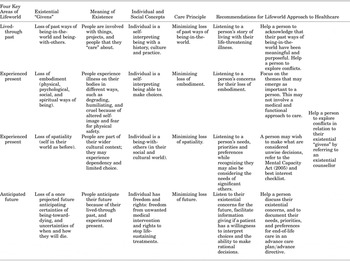
The present study findings bring to the literature an understanding that people living through the illness trajectory of MND do experience existential loss of temporality (past, present, and future) and spatiality. At the time of data collection, they did not perceive that they were depressed; however, they relate other expressions of distress that need to be recognized by healthcare professionals (McLeod & Clarke, Reference McLeod and Clarke2007). The findings have been conceptualized into a framework, which when used as a clinical tool will prompt multidisciplinary healthcare professionals to focus on the key areas of a patient's lifeworld. These key areas are: (1) lived-through past, experienced present, and anticipated future; (2) their emotional response to the existential “given” of being diagnosed with a life-threatening illness; and (3) the meaning of their existence. The application of this lifeworld approach to healthcare recognizes such individual and social concepts as: (1) the individual is recognized as a self-interpreting being with a history, culture, and practice; (2) the individual is a self-interpreting being with rights to make choices; (3) the recognition of being with others (in their social and cultural world); and (4) the individual has freedom and rights: freedom from unwanted medical intervention and rights to stop life-sustaining treatments. The overriding care principle for this lifeworld approach to healthcare is minimizing the loss of past ways of being-in-the-world, the loss of embodiment, the loss of spatiality, and the loss of future. For recommendations for a lifeworld approach to healthcare, see Table 6.
Lifeworld approach to MND: A clinical tool

A further explanation of the lifeworld approach and how this may potentially be utilized as a clinical tool in healthcare practice is offered here. The three key areas of existence serve as a dialectic approach to enable a person diagnosed with MND to reclaim the meaning of their life as lived, as experienced, and as anticipated. The purpose of this dialectic approach is to guide multidisciplinary healthcare professionals on the key area(s) of existence that are important to a patient. This process involves enabling a person to come to terms with the inherent contradictions of human living, and allowing them to reclaim their personal freedom (van Deurzen & Arnold-Baker, Reference van Deurzen and Arnold-Bacon2005) and gain control over the direction of their healthcare. The lifeworld approach used as a clinical tool for people diagnosed with MND may also be used as a clinical tool for people diagnosed with other life-limiting illnesses. The timing of this study is appropriate, as a review into end-of-life care services in England has been launched. As Henry (Reference Henry2014, p. 8) states, “We only have one chance to get it right for people who are dying, but despite some excellent practice, many people are not currently getting the care and support that is right for them.” Freedom to make choices is the key message of the lifeworld approach as a clinical tool.
Conclusions
The purpose of the present study was to gain an understanding of living with MND, receiving healthcare, and the impact on self and identity, in order to contribute to caring policy and practice. The aim was to answer the research question “What does it mean to be a person living through the illness trajectory of MND?” and to study the phenomenon of existence when given a diagnosis of MND in the context of receiving healthcare over time. The four participants provided eloquent stories of their unique existence from the time they first noticed something untoward was happening to them until the present day. These stories have helped us understand that the focus of the management of MND is currently medical and functional, and it is only when healthcare professionals consider that a patient is in their last year of their illness trajectory, or when they are experiencing respiratory loss, that they are referred to the hospice services for palliative care. This study has uncovered some important issues in relation to people having the right to discuss and document through a “living will” their needs, preferences, and priorities while they can still communicate and sign the documentation. The participants are experiencing existential loss: the loss of past ways of being-in-the-world, the loss of embodiment, the loss of spatiality, and the loss of future. Yet, despite experiencing existential loss, the four participants had not been given the opportunity to explore their loss until the second year of their illness trajectory, when they were referred into the hospice service for palliative care. Although none of the participants reported being depressed, two stated that they were sad. One participant may be ruled by the shadow of his loss, past ways of being-in-the-world of sports, and the loss of future with his family; in the present, he is making resolute choices, and he had independently sought counseling from the hospice services.
The findings from this study help us to make sense of what it means to be a person living through the illness trajectory of MND. The findings are conceptualized into a framework, which was used as a clinical tool, to prompt healthcare professionals to focus on the four key areas of existential loss: the loss of past ways of being-in-the-world, the loss of embodiment, the loss of spatiality, and the loss of future, and their emotional response to the existential “given.”
LIMITATIONS OF THE STUDY
One limitation of this study is the inability to take the findings back to the participants for their thoughts on the researcher's interpretations, as three of participants died before completion of the interpretations. I do not claim that all people living with MND will experience existential loss or that all people are not in receipt of healthcare that takes account of their loss of past ways of being-in-the-world, loss of embodiment, loss of spatiality, and loss of future, as these findings are taken from a small sample consisting of just four individuals. A story approach requires considerable time to be spent on examining the detailed nuances (Brown & Addington-Hall, Reference Brown and Addington-Hall2008), and in the present study it took time to examine the differences between the four presentations of MND and the different stages of their illness trajectories. Although it has taken extra time to describe and interpret, such a level of information does add to the current body of knowledge. Interpreting the individual participant stories at a phenomenological level involves iterative listening, which was emotionally draining, but deep respect was given to the in-depth stories recounted, and it was considered worthy of the time and emotion in order to understand participants' stories at a phenomenological level. The participants came to this study wanting to make a difference for other people diagnosed with MND. They told their stories, and I listened and interpreted them to understand the meaning of their existence; I took their stories to a deeper level than I had anticipated. Some may argue that using Heidegger's ontic and ontological aspects of existence to interpret participants' stories may overly structure and constrain the analysis (Finlay, Reference Finlay2011), but in response to such arguments, I would state that there is no existing evidence that has focused on both the ontic and ontological aspects of existence for a patient diagnosed with MND.
ACKNOWLEDGMENTS
I would like to thank my supervisors—Dr. Jackie Taylor, Mr. Michael Ravey, and Dr. Julie Nightingale—for their guidance and support. Ethical approval for this study was gained from the NHS Research Ethics Service (NRES), the University of Salford Research Governance and Ethics Committee, and the local NHS Research and Development Department prior to commencement of the study. In addition, adherence to the Code of Ethics and Professional Conduct for Occupational Therapists (2010) and the Research Ethics Guidelines of the College of Occupational Therapists (2003) was maintained throughout the study.