INTRODUCTION
Citrus species do not tolerate freezing temperatures or poorly drained soils very well, so most citrus trees are grown in warm climates with soils that have a low water-holding capacity and experience periodic droughts. Limited water availability in many of these areas has increased interest in the use of water-saving irrigation techniques to improve the growth or yield per quantity of water used (water use efficiency (WUE)). The application of water below the evapotranspiration (ET) requirements is termed as deficit irrigation (DI; Fereres & Soriano Reference Fereres and Soriano2007). DI strategies, where a reduced amount of irrigation water is supplied for specific periods during the crop cycle, were first proposed to control vegetative growth in peach orchards (Chalmers et al. Reference Chalmers, Mitchell and Van Heek1981) and have been widely used in other fruit crops to increase WUE and yield (Cifre et al. Reference Cifre, Bota, Escalona, Medrano and Flexas2005; Tognetti et al. Reference Tognetti, D'Andria, Morelli and Alvino2005). Similarly, partial rootzone drying (PRD), where only half of the rootzone is kept well irrigated while the other half is allowed to dry, can increase WUE and reduce vegetative growth while maintaining yield and quality (Dry & Loveys Reference Dry and Loveys1998).
In sub-tropical evergreen citrus trees, vegetative growth is sensitive to water stress (Syvertsen Reference Syvertsen1985). Faster growing larger trees use more water than smaller trees, but large trees also generally yield more fruits than small trees. Growth is often positively related to yield, and drought stress almost always results in reductions in the growth and yield. Thus, citrus growers often strive to avoid any drought stress by using ample amounts of irrigation water. In addition, water savings by DI and PRD in citrus have not been entirely successful in Mediterranean-like climates, where tree growth, fruit size and yield decreased together when insufficient amounts of water were applied (Hutton Reference Hutton2004).
Roots in dry soil can synthesize abscisic acid (ABA) as a chemical signal that can be transported to shoots, potentially triggering partial stomatal closure (Zhang & Davies Reference Zhang and Davies1989) and activating genes that increase drought tolerance (Bray et al. Reference Bray, Shih, Moses, Cohen, Imai and Plant1999). ABA, as well as other chemical regulators, has been documented to interact with hydraulic signals (Tardieu & Davies Reference Tardieu and Davies1993) and xylem sap pH (Schurr et al. Reference Schurr, Gollan and Schulze1992). Partial stomatal closure can reduce leaf transpiration (Elf) without limiting CO2 assimilation (ACO2) (Jones Reference Jones1992). So leaf WUE, defined as the ratio ACO2/Elf (WUElf), can be increased by endogenous ABA (Davies & Zhang Reference Davies and Zhang1991).
DI strategies during the intermediate stage of citrus fruit growth have been reported to save water under semi-arid conditions (Pérez-Pérez et al. Reference Pérez-Pérez, Romero, Navarro and Botía2008). However, the use of PRD in citrus trees has not been extensively investigated as there is a lack of understanding of growth response to seasonal drought stress. In addition, the adoption of such water saving practices in sub-tropical humid production areas will be problematic, since such climates have distinct wet and dry seasons and heterogeneous soils. The objectives of the present experiments were to determine physiological, growth and nutritional responses of Swingle citrumelo (Citrus paradisi Macfad.×Poncirus trifoliata (L.) Raf.) rootstock seedlings to PRD and DI under controlled conditions in the glasshouse. These experiments were designed as a ‘proof of concept’ prior to setting up similar experiments in the field. It was hypothesized that these DI techniques would trigger root-to-shoot signalling of ABA, induce partial stomatal closure, reduce water loss and increase WUE with only small reductions in growth.
MATERIALS AND METHODS
Plant material and growth conditions
Two separate experiments were conducted in a glasshouse at the University of Florida, Citrus Research and Education Center (Lake Alfred, Florida, USA, 28°09′N, 81°73′W; elevation 51 m asl). The average day/night temperature in the glasshouse was 36/21°C, the relative humidity varied between 40% and 100% and maximum photosynthetically active radiation (PAR; LI-170, LICOR Inc., Lincoln, Nebraska, USA) measured above the plants was 1300 μmol/m2/s with natural photoperiods of about 11 h.
Experiment 1. DI
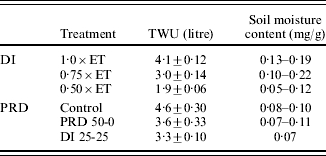
Twenty-one uniform 3-month-old Swingle citrumelo seedlings were transplanted from the nursery into 300 mm tall, 2·4 litre pots filled with moist, previously autoclaved, Candler fine sand soil. This soil is a typical quartzsamment with about 97% sand by volume and less than 10 g organic matter/kg. The root systems were initially about 100 mm deep. All seedlings were well irrigated during the first 2 weeks until fully established. ET was calculated gravimetrically by measuring the weight lost daily from each pot and used to establish three irrigation treatments: well-watered control (receiving 1·00×ET), 0·75×ET and 0·5×ET (n=7). On days when the plants consumed more or less water than 0·75 or 0·50 of the control plants, the amount of water required to maintain the target water proportions was adjusted. DI treatments were continued for 12 weeks between March and May. The average total water use (TWU) per plant was calculated as the sum of the water applied over the course of the experiment after 12 weeks of treatment (Table 1).
Average TWU (litres)±s.e. and ranges of soil moisture content (mg/g) of Swingle citrumelo seedlings at the end of the DI (n=7) and PRD (n=10) experiments. Soil moisture content in the PRD 50-0 plants reflects only the values in the irrigated pots as the soil moisture content in the dry pots was below detection by TDR

Experiment 2. PRD
Thirty uniform 6-month-old seedlings of Swingle citrumelo were transplanted from the nursery and grown with each root system equally split between two adjacent 2·4 litre pots filled with previously autoclaved Candler fine soil sand. The tap root of each seedling was split with a sharp knife up to the soil line and each half of the root system was allowed to establish separately in pots that were taped together, while the shoot remained intact. All pots were well irrigated for 2 weeks to permit the seedlings to recover from transplanting. ET was calculated daily by measuring the weight lost from each pair of attached pots as above and 10 replicate split root plants were established in each of the three irrigation treatments: 1·00 ET (well-watered control with 0·5×ET applied to each pot), PRD 50-0 (0·50×ET applied to one pot while the other pot was allowed to dry) and DI 25-25 (total 0·50×ET, with 0·25×ET applied to each pot). PRD treatments were continued for 11 weeks, from September to November. The TWU per plant was calculated as above after 11 weeks of treatment (Table 1).
For both experiments, plants were watered three times per week with a complete fertilizer solution containing 150 mg N/l, 16·5 mg P/l, 124·5 mg K/l and 1·9 mg Mg/l plus micro-elements. Fertilizer in PRD plants was applied only in the irrigated pots, but nutrient concentrations were increased to supply the same weekly rate as in the other treatments.
Leaf gas exchange and water relations
In the DI experiment, net gas exchange of leaves and water relations measurements were taken up during weeks 9, 10 and 11–12 after the initiation of treatments. In the PRD experiment, measurements were taken up 2, 5, 8 and 11 weeks after the initiation of treatments. All measurements used individual mature leaves from the middle of the shoot of six replicate plants per treatment. The net assimilation of CO2, stomatal conductance (gs), internal CO2 partial pressure (Ci), Elf and WUElf were determined with a portable photosynthesis system (LI-6200, LICOR Inc., Lincoln, Nebraska, USA) using a 250 ml cuvette. All measurements were made in the morning (09.00–11.00 h) to avoid high afternoon temperatures and low humidity, which can reduce net gas exchange parameters (Jifon & Syvertsen Reference Jifon and Syvertsen2003; Hu et al. Reference Hu, Guo, Shen, Guo and Li2009). During all gas exchange measurements, PAR exceeded 800 μmol/m2/s, leaf temperatures were 27±5°C and leaf to air vapour pressure difference was 1·8±0·5 kPa within the cuvette.
Growth and leaf nutrient responses
All plants were harvested at the end of each experiment and separated into leaves, stems and roots. The total leaf area of each plant was measured with a leaf area meter (LI-3000, LICOR Inc., Lincoln, Nebraska, USA) in combination with a transparent belt conveyor accessory (LI-3050A, LICOR Inc., Lincoln, Nebraska, USA). After gently washing the roots free of sand, the root length was estimated using a line-intercept method (Tennant Reference Tennant1975). In the PRD experiment, both root halves were weighed and measured separately regardless the irrigation treatment. The leaves were briefly rinsed with deionized water, oven-dried at 60°C for at least 48 h, weighed and ground to powder for mineral analysis. The total dry weight (DW) of stems and roots was also determined and the leaf area/root DW (LA/RDW) ratio, shoot/root (S/R) ratio, total plant dry weight (TPDW) and whole plant water use efficiency (WUEWP=TPDW/TWU) were calculated. Specific root length (SRL) was calculated as root length per RDW (m/g) and the root density in pots were expressed as mm/ml of soil. When there were no differences between root halves in the PRD experiment (other than those described in the results), the root weight and length values from both halves were summed. Leaf and root N concentrations (mg/g DW) were determined by a commercial analytical laboratory (Waters Agricultural Lab, Camilla, Georgia, USA). Nitrogen concentration was determined by combustion (AOAC method 968.06; AOAC 2000) using a total N analyser (LECO Truspec, St. Joseph, Michigan, USA); K concentration was determined by emission spectrophotometry (inductively coupled argon plasma emission spectrophotometer 6500, ThermoScientific, Waltham, Massachusetts, USA). Total nutrient accumulation was calculated by multiplying tissue nutrient concentrations by tissue DW and expressed as total content (mg) in root and leaf tissues.
Soil moisture measurements
A Time-Domain Reflectometer (TDR; Fieldscout, Spectrum Tech. Inc., Plainfield, Illinois, USA) was gravimetrically calibrated in this sand soil type and used to measure soil volumetric water content during the last 3 weeks of the DI experiment and on weeks 2, 8 and 11 in the PRD experiment. The TDR probe consisted of two parallel rods, 5 mm in diameter, 33 mm apart and 200 mm long. Since changes in the soil moisture contents within treatments during both experiments were small, only treatment ranges at the end of the experiments are shown (Table 1).
Stem water potential (SWP)
SWP was measured at solar noon (13.00–14.00 h) at the end of the PRD experiment using a Scholander-type pressure chamber (PMS instrument, Corvallis, Oregon, USA; Scholander et al. Reference Scholander, Hammel, Bradstreet and Hemmingsen1965). Two mature leaves per plant on three plants per treatment (n=6) were enclosed in plastic bags covered with aluminium foil for at least 1 h (McCutchan & Shackel Reference McCutchan and Shackel1992) and used to determine SWP.
ABA extraction and determination
At the end of both experiments, a mature leaf sub-sample (c. 1 g fresh weight (FW)) from each plant was taken between 09.00 and 12.00 h. The samples were immediately frozen in liquid nitrogen and stored in a −18°C freezer until the frozen tissue was ground to a fine powder with a mortar and pestle. ABA was extracted from each sample with 20 ml of cold acetone (800 mg/g) containing 100 mg/l 2·6-di-tert-butyl-methyl phenol (BHT) and 500 mg/l citric acid for 16 h at 4°C. Extracts were centrifuged at 3000 g for 5 min and a 12·5 μl aliquot of the supernatant was diluted to 0·5 ml with ice-cold Tris-buffered saline (TBS; 50 mM Tris, 1 mM MgCl2, 150 mM NaCl, pH 7·8). Duplicate samples were analysed by the indirect enzyme-linked immunosorbent assay (ELISA) method using the monoclonal antibodies from Phytodetek® (Agdia, Elkhart, Indiana, USA). The ABA content was calculated by interpolation with the logit transformation of the ABA standard curve (Quarrie et al. Reference Quarrie, Whitford, Appleford, Wang, Cook, Henson and Loveys1988).
Experimental design, data analysis and statistics
The DI and PRD experiments were analysed separately using regression or analysis of variance (SAS Institute Inc., Cary, North Carolina, USA) as completely randomized designs, with seven replicate plants for the DI experiment and 10 replicate plants for the PRD experiment. When a significant F-test was observed, linear polynomial contrasts were performed in the DI experiment (with continuous treatments) or treatment means and s.e.d. at P<0·05 were calculated in the PRD experiment (with qualitative treatments).
RESULTS
All water deficit treatments in both experiments, of course, reduced the TWU per plant (Table 1).
DI experiment
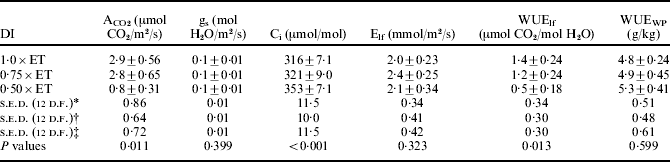
DI caused a reduction in all measured plant growth parameters (Table 2). Plant growth linearly decreased with water deficit. Shoot growth was reduced more than root growth resulting in decreased S/R and LA/RDW. Although WUEWP was not affected by DI treatments, DI reduced WUElf by decreasing ACO2 but not Elf (Table 3). Only leaf gas exchange data from the last measurement (week 12) are shown, since there were no differences between weeks.
Effects of DI treatments (1·00, 0·75 or 0·50×ET) on mean (n=7±s.e.) RDW, stem DW, leaf DW, root FW/DW, root length, SRL, root density in soil, total leaf area, total LA/RDW, S/R DW ratio and total plant DW of Swingle citrumelo seedlings 12 weeks after initiating the treatments

* Standard errors of mean differences to compare 1·0×ET and 0·75×ET.
† Standard errors of mean differences to compare 1·0×ET and 0·50×ET.
‡ Standard errors of mean differences to compare 0·75×ET and 0·50×ET.
Effects of DI treatments (1·00, 0·75 or 0·50×ET) on mean (n=7±s.e.) net assimilation rate of CO2 (ACO2), stomatal conductance (gs), internal CO2 partial pressure (Ci), leaf transpiration (Elf), leaf water use efficiency (WUElf) and whole plant water use efficiency (WUEWP) of Swingle citrumelo seedlings 11–12 weeks after initiating the treatments

* Standard errors of mean differences to compare 1·0×ET and 0·75×ET.
† Standard errors of mean differences to compare 1·0×ET and 0·50×ET.
‡ Standard errors of mean differences to compare 0·75×ET and 0·50×ET.
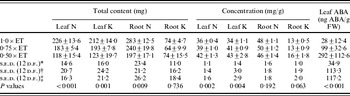
Total leaf N, root N and leaf K contents linearly decreased with water deficit (Table 4). Leaf N and K concentrations, however, were higher in the smaller DI treated plants than in the 1·0×ET control plants. N and K concentrations in roots were not affected by treatments. The leaf ABA content linearly decreased with water deficit.
Effect of DI treatments (1·00, 0·75 or 0·50×ET) on mean (n=7±s.e.) total N and K content and concentration in leaf and root tissue and on mean (n=5±s.e.) leaf ABA concentration of Swingle citrumelo seedlings 12 weeks after initiating the treatments

* Standard errors of mean differences to compare 1·0×ET and 0·75×ET.
† Standard errors of mean differences to compare 1·0×ET and 0·50×ET.
‡ Standard errors of mean differences to compare 0·75×ET and 0·50×ET.
PRD experiment
Stem WP decreased from −1·18 MPa in control leaves to −2·03 MPa in PRD 50-0 and to −2·83 MPa in DI 25-25 leaves. The growth characteristics of plants grown in PRD 50-0 were similar to those of control plants except for stem DW, which was lower in PRD 50-0 plants (Table 5). DI 25-25 plants had leaf area similar to the PRD 50-0 and control plants but PRD 50-0 had a greater total root length when roots in both pots were summed. Root length in the irrigated pot of the PRD 50-0 was shorter than in the dry pot (Table 6). Roots from the irrigated pot also had a greater FW/DW ratio, but a similar DW and, consequently, roots from the dry pot had a greater SRL (i.e. were thinner) than those in the irrigated pots.
Effects of three different irrigation (IRR) regimes: control (well watered=1·00×ET, with 0·50×ET on each pot), partial root drying (PRD 50-0, total of 0·5×ET applied to only one-half of plant root zone) and DI 25-25 (total of 0·5×ET with 0·25×ET applied to each root half) on mean (n=10±s.e.) RDW, stem DW, leaf DW, root FW/DW, root length, root density, SRL, total leaf area, total LA/RDW, S/R and TPDW of Swingle citrumelo seedlings 11 weeks after initiating the treatments

Root data are the mean of both halves (n=10).
* Standard errors of mean differences to compare control and PRD 50-0.
† Standard errors of mean differences to compare control and DI 25-25.
‡ Standard errors of mean differences to compare PRD 50-0 and DI 25-25.
Effects of PRD 50-0 (total of 0·5×ET applied to only one-half of plant root zone) on mean (n=10±s.e.) root length, RDW, root FW/DW, root density and SRL of Swingle citrumelo seedlings 11 weeks after initiating the treatments

The PRD 50-0 plants had lower leaf gas exchange than well-irrigated control plants during most of the experiment (Table 7). Data from week 2 were very similar to those from weeks 5 and 8 (data not shown). The DI 25-25 plants had significantly lower ACO2 than control plants but gs only was reduced after 2 weeks. Although WUElf decreased in both PRD treatments, WUEWP was not affected.
Effects of three different irrigation (IRR) regimes: control (well watered=1·00× ET, with 0·50×ET on each pot), partial root drying (PRD 50-0, total of 0·5×ET applied to only one half of plant root zone) and DI 25-25 (total of 0·5×ET with 0·25×ET applied to each root half) on mean (n=10±s.e.) CO2 assimilation rate (ACO2), stomatal conductance (gs), total internal CO2 partial pressure (Ci), leaf transpiration (Elf), leaf water use efficiency (WUElf) of Swingle citrumelo seedlings 2 and 11 weeks after initiating the treatments and on mean (n=10±s.e.) whole plant water use efficiency (WUEWP,) 11 weeks after initiating the treatments

* Standard errors of mean differences to compare control and PRD 50-0.
† Standard errors of mean differences to compare control and DI 25-25.
‡ Standard errors of mean differences to compare PRD 50-0 and DI 25-25.
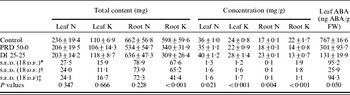
The total leaf N and K contents and root N contents were similar for both PRD 50-0 and DI 25-25 treatments, although the drought-stressed roots had lower K contents and K concentration than well-irrigated roots (Table 8). The DI 25-25 treatment increased the concentration of N in leaves and roots and concentration of K in leaves. PRD treatments also increased leaf ABA concentration, with the highest value in the PRD 50-0 seedlings.
Effect of three different irrigation (IRR) regimes: control (well watered=1·00×ET, with 0·50×ET on each pot), partial root drying (PRD 50-0, total of 0·5×ET applied to only one half of plant root zone) and DI 25-25 (total of 0·5×ET with 0·25×ET applied to each root half) on mean (n=10±s.e.) total N and K content and concentration in leaf and root tissue and leaf ABA concentration of Swingle citrumelo seedlings 11 weeks after initiating the treatments

For all the treatments, mineral content data are the mean of both halves as no differences were found between them.
* Standard errors of mean differences to compare control and PRD 50-0.
† Standard errors of mean differences to compare control and DI 25-25.
‡ Standard errors of mean differences to compare PRD 50-0 and DI 25-25.
DISCUSSION
Results from the present experiment did not fully support the original hypothesis about WUE. Although there was a reduction in water consumption with the DI-induced decreases in plant growth, WUEWP was not affected by the DI treatments. In addition, gs and leaf water use did not decrease in spite of increases in leaf ABA. Thus, WUElf decreased with the decrease in ACO2 and was apparently not an indicator of longer term WUEWP. It is possible that the DI 0·5×ET treatment was great enough to negate stomatal responses to ABA, since under severe stress hydraulic signals can limit physiological responses by decreasing the stomatal sensitivity to ABA (Tardieu et al. Reference Tardieu, Zhang and Gowing1993). This idea was supported in the PRD experiment by the greater increase in the leaf ABA in PRD 50-0 than in the more drought-stressed DI 25-25 treatment after 12 weeks. There were also smaller effects by the DI 25-25 treatment on gs and Elf than the PRD 50-0 treatment.
Citrus trees have been reported to tolerate drought better if drought stresses are exerted differentially on different parts of the root system (Zekri & Parsons Reference Zekri and Parsons1990), as in these split root PRD treatments. ABA is generally regarded as an inhibitor of shoot growth (Trewavas & Jones Reference Trewavas, Jones, Davies and Jones1991), but ABA can increase root elongation at low soil water potential due to its important role in restricting ethylene production (Spollen et al. Reference Spollen, LeNoble, Samuels, Bernstein and Sharp2000). As a consequence, shoot growth can be more sensitive than root growth to soil drying (Sharp & Davies Reference Sharp, Davies, Jones, Flowers and Jones1989). The greater root length of PRD 50-0 than the DI 25-25 and control plants (Table 5) would undoubtedly have enabled roots of PRD 50-0 plants to explore the available soil volume more fully than the DI 25-25 roots and may have diminished the PRD 50-0 responses to drying soil. Thus, the high ABA content in PRD 50-0 plants may have maintained the similar SRL to that of control plants. In addition, there were longer and thinner roots (higher SRL) in the dry pot than in the wet pot in the PRD 50-0 plants. Growth allocation to shoots was reduced more than root growth by DI (Table 2), but LA/RDW and S/R ratio were not affected by the PRD drought treatments (Table 5). Nonetheless, PRD 50-0 plants had the lowest shoot (leaf+stem) DW and the greatest root length and density. These results suggest that with the appropriate management, PRD techniques might be used to increase root growth at the expense of shoot growth. This may be relevant to intensively managed irrigation systems for citrus that have been proposed as a tool for reducing the summer growth flush for use as a pest management strategy to control the psyllid vector of Huanglongbing disease (HLB) or other leaf diseases such as citrus canker (Schumann et al., in press).
Prolonged drying of one side of the root system diminished the effects of chemical signals on reduced gs (Stoll et al. Reference Stoll, Loveys and Dry2000) as a consequence of a reduced sap flow from roots in drying soil (Yao et al. Reference Yao, Moreshet and Aloni2001; Dodd et al. Reference Dodd, Egea and Davies2008 a, Reference Dodd, Egea and Daviesb). In grapevine, a long-term effect of lowered gs was only possible if the signal originating from the dry side could be sustained by alternating the wet and dry sides (Dry et al. Reference Dry, Loveys, McCarthy and Stoll2001). However, there are many differences among species, especially in long transport signals in woody plants (Croker et al. Reference Croker, Witte and Auge1998). Thus, in lemon citrus trees, no advantage of alternate over fixed PRD on yield or growth has been reported (Raveh Reference Raveh2008). In addition, greater leaf ABA concentrations can be found in PRD plants without alternating cycles than in regular deficit irrigated plants (Dodd Reference Dodd2007). Although only the leaf ABA content was measured at the end of the present experiments, there was no apparent reduction in the leaf ABA concentration and the values were relatively high after 12 weeks of constant DI-50 treatment (Table 4) and after continuously drying one side in the fixed PRD-50 treatment for 11 weeks (Table 8).
The higher ABA concentration in smaller drought-stressed plants than in the larger well-watered control plants from both experiments could also have been related to a growth dilution effect in the larger control plants. This is not likely, however, since the 10-fold increase in leaf ABA in the DI-50 plants and the more than 3-fold increase in the PRD-50 plants relative to their respective controls are far greater than their drought-induced reductions in growth. The lower concentrations of leaf N and K in the control treatments (1·0×ET), however, seem to have been decreased by growth dilution compared to drought treatments in both experiments, because these differences disappeared when leaf N and K were expressed on a total leaf content basis. Thus, the combination of drought stress, the higher concentrations of applied fertilizer in drought treatments and the reduced growth increased N and K concentrations in the leaves in both experiments.
PRD and DI water conservation strategies resulted in no differences in the yield and fruit quality of peaches (Goldhamer et al. Reference Goldhamer, Salinas, Crisosto, Day, Soler and Moriana2002). PRD in grapevines resulted in water savings of up to 0·50 with significant reductions in vegetative growth and improved the fruit quality without loss of yield (Dry & Loveys Reference Dry and Loveys1998). However, any change in soil water availability or using alternate or fixed PRD can considerably alter the results. In the present PRD experiment, PRD 50-0 reduced the need for irrigation by 22% without significant decreases in total plant growth or net gas exchange at the end of the experiment. A decrease in net gas exchange parameters was observed during the first weeks of the experiment, but this was not reflected in growth responses. Apparently, limitations to ACO2 were not due to decreases in gs (Farquhar & Sharkey Reference Farquhar and Sharkey1982), since an increase in Ci was observed in both experiments. Rather, ACO2 was probably limited by direct effects of the lower SWP on biochemical processes affecting ACO2.
Both fixed and alternate PRD with drip irrigation in peach, apple and pear orchards have been shown to reduce plant daily water consumption by 10–18% and increase WUElf when compared to whole root-zone irrigation (control; Gong et al. Reference Gong, Wang and Kang2001; Kang et al. Reference Kang, Hu, Goodwin and Jerie2002). Differences between PRD and traditionally deficit irrigated vines were mostly explained by differences in soil evaporation between these two irrigation methods (Marsal et al. Reference Marsal, Mata, Del Campo, Arbones, Vallverdú, Girona and Olivo2008). In the present PRD experiment, PRD 50-0 plants had a lower proportion of wetted soil compared to DI 25-25, since only one pot was irrigated in PRD 50-0. Thus, soil evaporation may have been lower in the PRD 50-0 than in the DI 25-25 treatment. In the field, soil surface moisture heterogeneity in PRD treatments can lower soil surface evaporation as PRD involves fewer emitters than uniform wetting (Sadras Reference Sadras2009).
In summary, water savings were considerable in both irrigation regimes. Although drought stress increased the leaf ABA in both experiments, plant WUE was not affected. DI clearly did not permit full growth, ACO2 and total content of N and K in leaves. The fixed PRD 50-0 treatment, however, did not affect growth or net gas exchange. Leaf ACO2 and WUElf were decreased by the DI 25-25 treatment after 11 weeks without changes in the leaf ABA concentration. These experiments can form the basis for PRD studies in the field while considering soil evaporative losses.
This work was supported by University of Florida/Institute of Food and Agricultural Sciences.