Introduction
Babbling can be considered as an important stage in infant speech development as articulatory skills improve markedly during this period (Green & Wilson, Reference Green and Wilson2006; Morgan & Wren, Reference Morgan and Wren2018; Smith, Brown-Sweeney & Stoel-Gammon, Reference Smith, Brown-Sweeney and Stoel-Gammon1989). The improvement in articulatory abilities can be observed through the decrease in the duration and variability of articulatory movements (Green & Wilson, Reference Green and Wilson2006; Nip & Green, Reference Nip and Green2013) and the resulting units such as syllables (Lynch, Oller, Steffens & Buder, Reference Lynch, Oller, Steffens and Buder1995; Nathani, Oller & Cobo-Lewis, Reference Nathani, Oller and Cobo-Lewis2003). The area of articulatory development at the transition to speech has not been well studied. The aim of our research was to examine the development of syllable duration and its relation to various properties of syllables during the babbling stage: such as their position, their type or their articulatory complexity.
Early babbling: an uncontrolled motor behavior
Babbling is a rhythmic motor behavior that starts at the same time as other stereotypical behaviors such as limb movements (Iverson, Reference Iverson2010). The onset of babbling is associated with repetitive syllabically organized vocalizations in which syllabic repetitions are considered to arise from a regular and cyclic movement of the jaw (mandibular lowering and elevation) associated with phonation (Davis & MacNeilage, Reference Davis and MacNeilage1995; MacNeilage, Reference MacNeilage1998).
The jaw plays a predominant role in early syllable productions and may be the only articulator involved in their articulation (Green, Moore & Reilly, Reference Green, Moore and Reilly2002). However, jaw movement is still not well controlled. The poor efficiency of the motor system can be observed through slower movements (Nip, Green & Marx, Reference Nip, Green and Marx2011) and longer syllabic durations (Oller & Smith, Reference Oller and Smith1977) in infants than in adults. The adult articulation rate, expressed as syllable production over time, is in the range of 5–7 syllables per second (Jacewicz, Fox, O'Neill & Salmons, Reference Jacewicz, Fox, O'Neill and Salmons2009; Pellegrino, Coupé & Marsico, Reference Pellegrino, Coupé and Marsico2011) while the articulation rate of infants is around 2–3 syllables per second (see Table 1).
Temporal organization of the syllable in infants

Factors affecting syllable duration
The syllable duration varies according to the level of orofacial motor control development, but also as a function of other factors such as syllable position, utterance length or articulatory complexity.
Syllable position
Final lengthening is an important temporal characteristic of speech (Lindblom, Reference Lindblom, Garding, Bruce and Bannert1978; Oller, Reference Oller1973). In adults, final syllables are longer than non-final ones (Oller & Smith, Reference Oller and Smith1977). Many authors have investigated the timing of the final syllables of multisyllabic utterances at early stages of speech development, and have shown that these syllables were consistently longer (on average from 20% to 40% longer) and more variable in duration than other syllables (Levitt & Wang, Reference Levitt and Wang1991; Lynch et al., Reference Lynch, Oller, Steffens and Buder1995; Nathani et al., Reference Nathani, Oller and Cobo-Lewis2003; Nathani, Ertmer & Stark, Reference Nathani, Ertmer and Stark2006; Robb & Saxman, Reference Robb and Saxman1990).
Utterance length
Utterance length can also influence the timing of speech. Several authors have reported that adults and children increase their overall speech rate when producing longer sentences (Maner, Smith & Grayson, Reference Maner, Smith and Grayson2000; Sadagopan & Smith, Reference Sadagopan and Smith2008). Thus, the syllable duration is compressed when the number of syllables per utterance increases (Malécot, Johnston & Kizziar, Reference Malécot, Johnston and Kizziar1972; Lynch et al., Reference Lynch, Oller, Steffens and Buder1995). Infants also produce significantly longer syllables when the syllables are monosyllabic than when embedded in multisyllabic utterances. For infants aged from 6 to 8 months, Lynch et al. (Reference Lynch, Oller, Steffens and Buder1995) observed that syllables in monosyllabic utterances are about 140 ms longer than syllables in multisyllabic utterances. This difference declines slightly at the age of 10–12 months (around 120 ms longer in this case). Utterance length also affects the variability of lip and jaw movements: the longer an utterance is, the more variable movements are (Maner et al., Reference Maner, Smith and Grayson2000; Sadagopan & Smith, Reference Sadagopan and Smith2008). But, in 6- to 12-month-olds, Lynch et al. (Reference Lynch, Oller, Steffens and Buder1995) showed a higher variability in the duration of monosyllabic than of multisyllabic utterances.
Syllable complexity
During development the infant's articulatory skills progress and productions become more complex (MacNeilage, Reference MacNeilage1998; Oller, Reference Oller1978, Reference Oller, Yeni-Komshian, Kavanagh and Ferguson1980; Roug, Landberg & Lundberg, Reference Roug, Landberg and Lundberg1989). Syllable complexity can be defined by its structure or the number of constituent sounds. The more sounds in a syllable, the more complex the structure is, the longer its duration is (Crystal & House, Reference Crystal and House1990; Tiffany, Reference Tiffany1980). Nevertheless, even if other structures regarded as more complex due to the presence of several consonants appear (Nathani et al., Reference Nathani, Ertmer and Stark2006), syllables have mainly a CV structure at the babbling stage (Davis & MacNeilage, Reference Davis and MacNeilage1995; MacNeilage, Reference MacNeilage1998) – that is why CV syllables will be the syllable of interest targeted in this study.
The complexity of early productions can also be categorized through the phonetic changes between consecutive syllables (MacNeilage & Davis, Reference MacNeilage, Davis and Jeannerod1990; MacNeilage, Reference MacNeilage1998). Babbling becomes more complex with age, changing from utterances which are composed of repeated syllables (reduplicated babbling) to those composed of varied syllables (variegated babbling) (Stoel-Gammon, Reference Stoel-Gammon1989). Reduplicated babbling is considered less complex because it corresponds to rhythmic stereotypes from which more complex speech movements and more complex syllables emerge (Thelen, Reference Thelen, Krasnegor, Rumbaugh, Schiefelbusch and Studdert-Kennedy1991). A decrease in the frequency of reduplicated babbling in favor of variegated babbling is claimed to appear between 10 and 12 months (Fagan, Reference Fagan2009; Rome-Flanders & Cronk, Reference Rome-Flanders and Cronk1995; Smith et al., Reference Smith, Brown-Sweeney and Stoel-Gammon1989). Mandibular kinematics vary among types of babbling (Moore & Ruark, Reference Moore and Ruark1996; Steeve & Moore, Reference Steeve and Moore2009) which may impact the duration of syllables. In fact, some studies focused on the syllable duration of babbling exclusively considered syllables embedded in reduplicated babbling (Dolata et al., Reference Dolata, Davis and MacNeilage2008; Levitt & Wang, Reference Levitt and Wang1991), while others also analysed syllables from variegated babbling, including intersyllabic changes (combination of syllables differing in sounds) (Nathani et al., Reference Nathani, Oller and Cobo-Lewis2003). A comparison of the results shows that mean durations are shorter and less variable when only the reduplicated syllables are analysed.
Finally, the less developed the articulatory skills are, the less complex the C and V associations within a syllable are (MacNeilage & Davis, Reference MacNeilage, Davis and Jeannerod1990; MacNeilage, Reference MacNeilage1998). Preferential CV combinations may mirror the limited tongue displacements that are strongly determined by jaw movements, since the tongue mainly moves in the vertical dimension while there is no involvement of this articulator in the horizontal dimension. Thus, in a CV syllable, the tongue position of the consonant part is maintained for the vocalic part (Davis & MacNeilage, Reference Davis and MacNeilage1995; MacNeilage, Reference MacNeilage1998; MacNeilage, Davis, Kinney & Matyear, Reference MacNeilage, Davis, Kinney and Matyear2000). When the tongue is in a resting position, labial consonants are associated with central vowels (e.g., [ba]). When the tongue moves slightly to the front part of the mouth, front vowels co-occur with coronal consonants (e.g., [dɛ]); when the tongue moves back in the oral cavity, velar consonants co-occur with back vowels (e.g., [ɡu]). An increase in the number of syllables composed of non-preferential CV associations is observed over time (Davis & MacNeilage, Reference Davis and MacNeilage1995; MacNeilage, Reference MacNeilage1998). To our knowledge, although intrasyllabic associations may be an indicator of the complexity of early production, there is no study comparing the duration of preferential and non-preferential associative patterns. However, given that the duration of speech units is physiologically conditioned (Delattre, Reference Delattre1962) and that infants initially organize their speech gestures over the syllable (Nittrouer, Reference Nittrouer1993), the complexity of intrasyllabic associations could also influence syllable duration.
The emergence of articulatory control: decrease in duration and variability
In general, children produce longer and more variable segments and syllables than adults (Smith & Goffman, Reference Smith and Goffman1998).
A general trend that has been observed in a range of orofacial movements is an acceleration over time (Green & Wilson, Reference Green and Wilson2006; Nip & Green, Reference Nip and Green2013; Sadagopan & Smith, Reference Sadagopan and Smith2008; Sharkey & Folkins, Reference Sharkey and Folkins1985; Smith & Gartenberg, Reference Smith and Gartenberg1984; Smith & Goffman, Reference Smith and Goffman1998; Smith & Zelaznik, Reference Smith and Zelaznik2004; Smith & McLean-Muse, Reference Smith and McLean-Muse1986). This phenomenon is also noticed in activities such as feeding (Wilson & Green, Reference Wilson and Green2009; Woda, Foster, Mishellany & Peyron, Reference Woda, Foster, Mishellany and Peyron2006) or spontaneous silent facial movements (Green & Wilson, Reference Green and Wilson2006). A concomitant decrease in duration of the resulting units (e.g., syllable or open-close) and an increase in syllabic rate have been observed (Lynch et al., Reference Lynch, Oller, Steffens and Buder1995; Nathani et al., Reference Nathani, Oller and Cobo-Lewis2003; Nip & Green, Reference Nip and Green2013; Smith & Gartenberg, Reference Smith and Gartenberg1984; Smith & McLean-Muse, Reference Smith and McLean-Muse1986). For example, de Boysson-Bardies, Bacri, Sagart and Poizat (Reference de Boysson-Bardies, Bacri, Sagart and Poizat1981) showed that the mean duration of syllables produced by a toddler from 18 to 20 months is shorter than the reference data for earlier periods (see Table 1). Smith (Reference Smith1978) suggested that this decline takes place between the age of 2;6 and 4;6, which is later than what Fagan (Reference Fagan2009) observed (between 6 and 19 months). Fagan's results are in accordance with Nip et al.'s data (Reference Nip, Green and Marx2011) demonstrating an increase in the speed and amplitude of the opening and closing movements of the lips and the jaw between the age of 9 months and 21 months.
The temporal stability of orofacial movements and syllable duration could also be an indicator of the development of articulatory control. In general, trajectories such as the good timing of orofacial movements are more variable in children than in adults, whether for the lips (Green, Moore, Higashikawa & Steeve, Reference Green, Moore, Higashikawa and Steeve2000, Green et al., Reference Green, Moore and Reilly2002; Sadagopan & Smith, Reference Sadagopan and Smith2008; Schötz, Frid & Löfqvist, Reference Schötz, Frid and Löfqvist2013; Smith & Goffman, Reference Smith and Goffman1998; Smith & Zelaznik, Reference Smith and Zelaznik2004), the tongue (Murdoch, Cheng & Goozée, Reference Murdoch, Cheng and Goozée2012) or the jaw ( Sharkey & Folkins, Reference Sharkey and Folkins1985; Steeve & Moore, Reference Steeve and Moore2009). The temporal and spatial variability of articulatory gestures decreases over development. According to some authors, the stabilization of lip and tongue gestures continues until late childhood (Sharkey & Folkins, Reference Sharkey and Folkins1985; Sadagopan & Smith, Reference Sadagopan and Smith2008). According to others, it continues until adolescence (Walsh & Smith, Reference Walsh and Smith2002), even adulthood (Murdoch at al., Reference Murdoch, Cheng and Goozée2012; Schötz et al., Reference Schötz, Frid and Löfqvist2013). The stabilization of jaw movements occurs much earlier. At 12 months, jaw movement patterns are quite similar to those of adults for speech activity in terms of trajectory as well as stability (Green et al., Reference Green, Moore, Higashikawa and Steeve2000, Reference Green, Moore and Reilly2002; Steeve & Moore, Reference Steeve and Moore2009). However in spite of the early stabilization of jaw motions, syllable duration remains more variable in infants than in adults (Dolata et al., Reference Dolata, Davis and MacNeilage2008).
Objectives
Babbling is a crucial period for oromotor development and articulatory skills. Studying changes in syllable duration during infancy can contribute to our knowledge about the process of articulatory control emergence. Yet only few longitudinal quantitative studies focusing on the timing of oral productions during this period are available.
The aim of our research was to report on syllable duration, its temporal variability during the babbling stage and its evolution in 22 French infants followed every month from the age of 8 to 14 months. The study also seeks to understand how parameters such as syllable position, utterance length and syllable complexity can influence the duration and the temporal variability of syllables and their change over time.
The primary research questions were as follows:
1. Do parameters such as position, intersyllabic changes and intrasyllabic associations influence syllable duration and temporal variability at the babbling stage?
2. Do the duration and the variability of syllables decrease with age? If so, do the parameters of position, intersyllabic changes and intrasyllabic associations impact this evolution?
Method
Participants
Twenty-two full-term typically developing infants (12 girls and 10 boys) were recruited in a French-speaking monolingual environment. Typical development was established via the French version of the MacArthur-Bates Communicative Development Inventory, IFDC (Kern & Gayraud, Reference Kern and Gayraud2010) and a questionnaire on food orality whose main items were age of spooning, age of dietary diversification, feeding mode, food textures, quality of meal, position during meal, hydration, teething, and sucking habits.
Infants with preterm birth, ENT pathology, neurological disability, sensory dysorality syndrome, a known mental disorder and twins were not included in the experiment.
Data collection
Oral productions of each infant were recorded monthly from the age of 8 months to 14 months, with a total of 7 sessions per infant. The recordings were made either at the nursery or at the parents' home, in a room that was sufficiently quiet or isolated to avoid interference from unwanted noise. Infants were recorded in interaction with a parent, an investigator or a caregiver. The average recording time was one hour. A mobile device (Zoom® Handy Recorder H1) was used. A minimum of 40 syllables per recording session and per infant was expected. It was sometimes necessary to run several recording sessions in order to reach this number of occurrences. The goal was not achieved for 16 sessions out of the 154. One participant (M03) did not produce any syllable at 8 months and neither at 10 months.
Segmentation and annotation
The targeted oral productions were extracted (eliminating overlaps, cries, vocalizations and trills) and segmented into syllables, then annotated using the version 6.0.29 of Praat® software (Boersma & Weenink, Reference Boersma and Weenink2017). Praat ® is a free computer software for analyzing, synthesizing and manipulating the speech signal. Speech segmentation and annotation in this study were performed manually by post-graduate students or researchers in Speech Therapy or in Speech Sciences, who were experts or trained in phonetic transcription (including authors of the present article). All CV syllables or consecutive sequences of CV syllables surrounded by perceptible pauses were taken into account. Each syllable was segmented using the waveform and the spectrogram: for example, using the presence of periodic cycles, or the amplitude envelope, or intensity peaks.
The annotation of each production included four levels:
– Phonetic transcription. Annotators were asked to produce a phonetic transcription of each syllable that was as accurate as possible, using all the necessary diacritics, based on what they perceived in the audio recording and what they saw in Praat. They could use any acoustic cue shown in the waveform and in the spectrogram (such as the presence of a voice bar, friction noise, formant transitions, etc.) to decide on a phonetic symbol.
– Syllable position in the utterance. Four categories were used: initial syllable (In), median syllable (Me), final syllable (Fi) for polysyllabic utterances, and monosyllabic utterances (Mo).
– Intersyllabic change. The variation/phonetic change or the similarity of each syllable with respect to the previous one was noted. A syllable was considered a reduplication of the previous one (“R”) if their phonetic transcriptions were exactly the same on the segmental level (including diacritics). If not, the syllable was considered as a variation from the previous one (“V”).
– Utterance variation. In polysyllabic utterances, “SV” was used when the production sequence exhibited phonetic changes between syllables and “SR” when it had only reduplicated syllables.
From this information, the duration of each syllable was obtained thanks to the adaptation of a Praat script (# Copyright 12.3.2002 Mietta Lennes). From the phonetic transcription of each syllable (Tier 1), the consonant and the vowel were described automatically in terms of articulatory features, thanks to an algorithm adapted from Yamaguchi, dos Santos and Kern (Reference Yamaguchi, dos Santos and Kern2015). Thus, all consonants were classified according to the features of place of articulation: labial (e.g., [p, b, m, w, ʋ, f, v], coronal (e.g., [t, d, n, j, ð]), velar (e.g., [k, g, ŋ, ɟ]) (uvulars were also included in the velar category) and glottal (e.g., [ʔ, h]); and of manner of articulation: nasal (e.g., [m, n, ŋ]), constrictive (e.g., [v, z, ʒ, l, ʀ]), glide (e.g., [j, w, ɥ]), and plosive (e.g., [b, d, g]). The vowels were described with reference to the anterior-posterior dimension of the vocal tract and thus distributed into 3 categories: central (e.g., [a, ə, ɨ]), front (e.g., [i, e, ɛ, œ, ø, æ]) and back (e.g., [u, ɯ, ʌ, o, ɔ, ɑ]); and, according to the aperture, also distributed into 3 categories: high (e.g., [i, y, u, ɯ]), low (e.g., [a, ɑ, ɒ]), middle (e.g., [e, ɛ, œ, o, ɤ, ɔ, ʌ]).
Data analyses
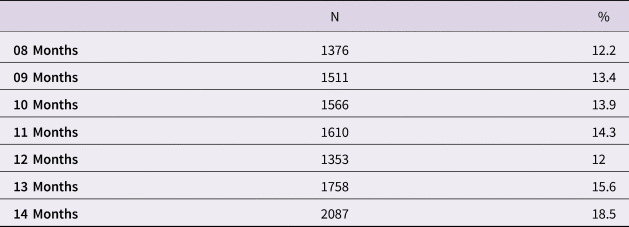
In total, 11 532 CV syllables were annotated. Syllables shorter than 100 ms and longer than 1000 ms were excluded, which corresponds to 2.35% of the syllables from the initial sample. Finally, 11 261 CV syllables were retained for analysis. The minimum number of syllables analysed according to age was 1 353 (12 months) and the maximum 2 087 (14 months) (Table 2).
Syllables analyzed by age in months

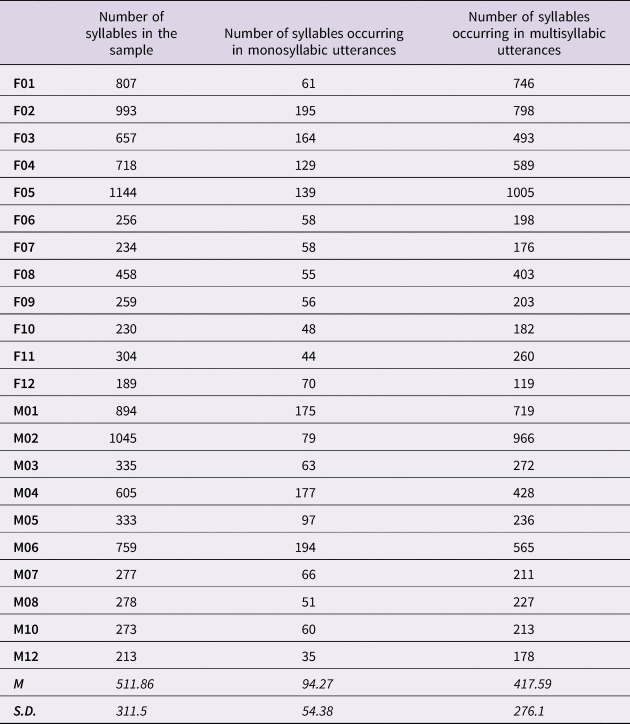
The average number of syllables per infant for the period under scrutiny was 511.86 (s.d. = 311.5). The average number of syllables per infant and stage analyzed was 74 (s.d. = 43.2). Every infant produced more syllables embedded in multisyllabic utterances than monosyllabic utterances (Table 3).
Number of syllables produced per infant (F = girl; M = boy)

Reliability
Reliability was completed on 13.35% of the sample set (Amayreh & Dyson, Reference Amayreh and Dyson1998; Edwards & Beckman, Reference Edwards and Beckman2008; Tyler & Edwards, Reference Tyler and Edwards1993). The first 10 syllables of each infant at each age were segmented and transcribed by a second expert (totalling 1540 syllables) in order to evaluate the average difference in syllable length between the two segmentations and the percentage difference between the place and manner of articulation for consonants, and place and aperture for vowels. For example, a vowel transcribed [ɛ] by expert 1 and [æ] by expert 2 was considered identical in terms of place of articulation because they are both front vowels. On the other hand, if a vowel was transcribed [i] by expert 1 and [ɨ] by expert 2, the divergence of place of articulation was taken into account because the vowel [i] is a front vowel and the vowel [ɨ] is central (see Segmentation and annotation).
The absolute average difference in syllable durations between the experts was 58 ms. Cronbach's alpha was 0.99 and the intraclass correlation coefficient was 0.86. For the transcription of the categories, the agreement rate varied between 80% (place of articulation in consonants) and 90% (vowel aperture).
Statistical analysis
The data were analyzed via linear mixed models, using R software and the nlme library (Baayen, Davidson & Bates, Reference Baayen, Davidson and Bates2008). The significance of the predictor effects was estimated with ANOVA based on Fisher tests. When relevant, post-hoc pairwise comparisons of means (Tukey contrasts) were performed.
The dependent measures were syllable duration and coefficient of variation as a relative measure of the dispersion of the durations around the mean (standard deviation divided by the mean).
Position (initial, median, final and monosyllable), intersyllabic change (reduplicated syllable, variegated syllable), intrasyllabic associations (preferential CV associations, non-preferential CV associations) and age (8 months (M = 0;8.1; SD = 0;0.9), 9 months (M = 0;9.11; SD = 0;0.9), 10 months (M = 0;10.14; SD = 0;0.10), 11 months (M = 0;11.11; SD = 0;0.7), 12 months (M = 0;12.12; SD = 0;0.8), 13 months (M 0;13.14; SD = 0;0.8) and 14 months(M = 0;14.4; SD = 0;0.9)) were used as fixed effects in separate models.
We also observed interaction effects between age and syllable position, or intersyllabic changes or intrasyllabic associations on the two dependent variables (i.e., duration and coefficient of variation). Data were averaged for each infant across each condition. The subject was always included as a random effect.
Visual inspection of the residual distributions of each model did not reveal any clear violation of the normality and homoscedasticity conditions.
Results
We first address the distribution of syllables in the corpus, according to the variables identified. We then report findings with respect to the questions of interest, first by investigating the impact of factors such as position, intersyllabic changes, and CV associations on the duration, and the temporal variability of all CV syllables in the whole sample, and secondly by analyzing the evolution of the duration of CV syllables across ages.
Distribution of syllables in the corpus
Distribution of syllables according to their position and utterance length
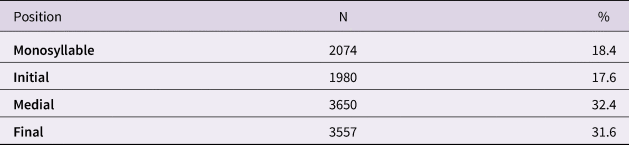
CV syllables occurred less in monosyllabic (18.4%) than in polysyllabic utterances (81.6%). In the latter case, they could occur in the initial, medial or final positions.
Medial and final syllables were the most frequent CV syllables (Table 4). These syllables represented respectively 32.4% and 31.6% of all the syllables in the corpus. Monosyllables and initial syllables were the least frequent in the corpus (respectively 18.4% and 17.6%). The difference between the distribution of initial and final syllables can be explained by the fact that, in our initial sample, a great number of syllables with a V-structure occurred in the initial position of polysyllabic utterances and were thus excluded from our analyzed sample.
Distribution of syllables according to their position

Distribution of syllables according to intersyllabic changes
In the case where CV syllables occurred in the medial or final position of polysyllabic utterances, they could be either identical to the preceding syllable (in other words, reduplicated), or different from the preceding syllable (in other words, variegated). Among the 7207 syllables within this configuration, syllables with intersyllabic changes were more numerous than reduplicated syllables. Variegated syllables represented 79.8% of CV syllables whereas reduplicated syllables only represented 20.2% of the corpus (Table 5).
Distribution of syllables according to intersyllabic changes

Distribution of syllables according to intrasyllabic associations
As there were only 98 occurrences of glottal consonants in the whole corpus, including all subjects and all ages, they were excluded from the following analyses.
A predominance of coronal consonants (50.88%) and central vowels (49.87%) was observed among all CV syllables (Table 6). Labial and coronal consonants were used within preferential intrasyllabic associations since 55.15% of labial consonants co-occurred with central vowels and 47.21% of coronal consonants co-occurred with front vowels, even if co-occurrences with central vowels were quite numerous (45.34%). On the contrary, velar consonants, which represented a small proportion of the corpus, hardly ever co-occurred with back vowels. This type of pattern was found in only 5.37% of cases, while they co-occurred at a rate of 52.83% with central vowels and 41.8% with front vowels.
Proportion of intrasyllabic associations in the corpus

Do parameters such as position, intersyllabic changes and intrasyllabic associations influence syllable duration and temporal variability at the babbling stage?
Mean duration of syllables
81.2% of CV syllables of our sample had a duration between 200 and 500 ms (Fig. 1). The mean duration of CV syllables for the overall observation period was 358.5 ms. This mean duration nevertheless varied according to subjects. The minimum mean observed was 319.3 ms and the maximum mean was 423.8 ms, i.e., a difference of 104.5 ms and a standard deviation of 31 ms.
Frequency distribution of syllable durations for all infants

Syllable position
Duration
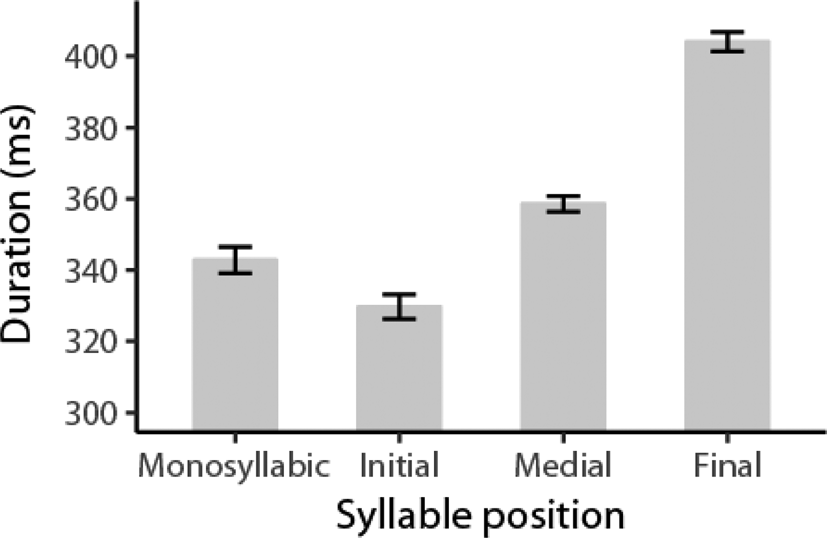
Syllable duration depended on position (F(3, 63) = 11.37, p < 0.0001) (Fig. 2). Tukey post hoc tests revealed that the duration of final syllables (M = 404 ms) was greater than that of the initial (M = 329.7 ms; p < 0.0001) and medial (M = 358.6 ms; p = 0.007) syllables, as well as that of monosyllabic utterances (M = 342.8 ms; p < 0.0001); moreover, the duration of initial syllables was shorter than that of medial syllables (p = 0.046). In contrast, the duration of monosyllabic utterances was not statistically different from that of initial and medial syllables.
Syllable duration by syllable position

Variability
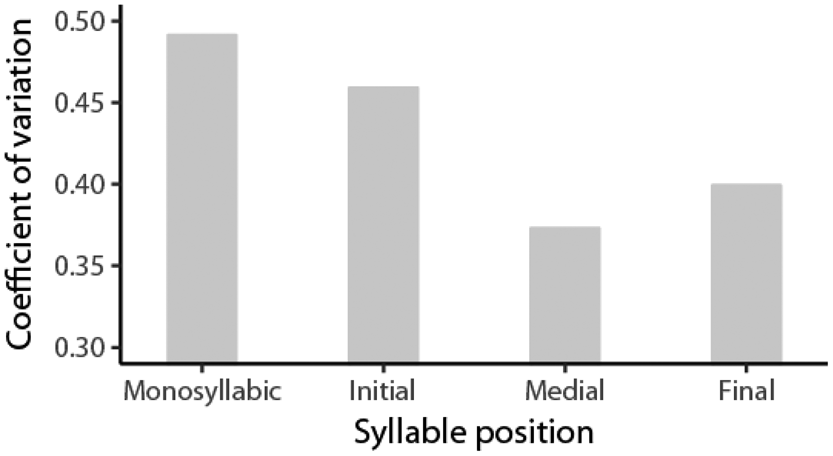
There was also an effect of position and utterance length on the variability of syllable duration (F(3, 63) = 9.11, p < 0.0001) (Fig. 3). Initial syllables of polysyllabic utterances and syllables of monosyllabic utterances presented more variable durations with mean variation coefficients of 0.46 and 0.49 respectively, while medial syllables were the least variable syllables in their duration (CoV = 0.37). Tukey post hoc tests revealed that initial syllables were more variable than final syllables (p = 0.016) and medial syllables (p = 0.001) but also more variable than monosyllabic utterances. Tukey post hoc tests also revealed that monosyllabic utterances were more variable than final (p = 0.004) and medial syllables (p < 0.0001).
Coefficient of variation (CoV) of duration by syllable position

Intersyllabic changes
Duration
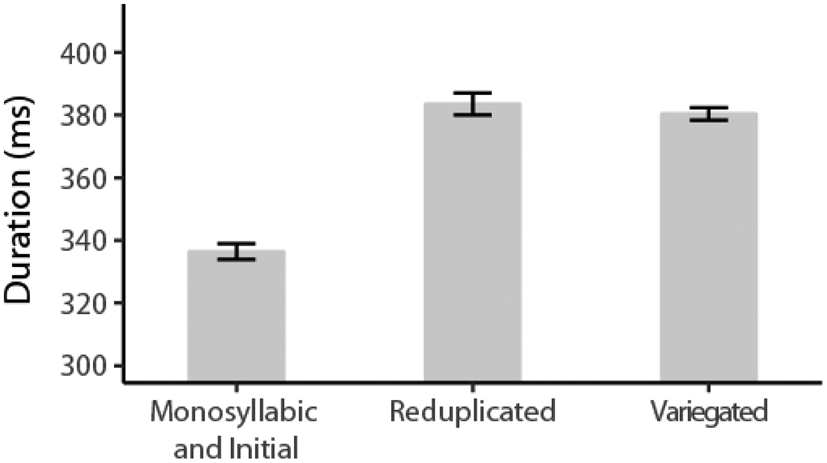
The model used showed an effect of intersyllabic changes on duration (F(2, 42) = 27.06, p < 0.0001). Tukey post hoc tests revealed that initial syllables and monosyllables (M = 336.4 ms) were significantly shorter than reduplicated syllables (p < 0.0001) and variegated syllables (p < 0.0001). However, there was no significant difference between the mean duration of reduplicated syllables (383.6 ms) and that of variegated syllables (380.4 ms) (Fig. 4).
Duration of syllables by intersyllabic changes

Variability
Statistical analyses were conducted on the duration of the coefficient of variation according to intersyllabic changes, and showed a significant effect (F (2, 42) = 39.71, p < 0001). Monosyllables and initial syllables presented the greatest temporal variability (CoV = 0.48) (Fig. 5). The Tukey post hoc test revealed that their duration was more variable than that of subsequent syllables, whether they were reduplicated (p < 0.0001) or variegated (p < 0.0001). Besides, syllables presenting an intersyllabic change (Var) had a more variable duration (CoV = 0.4) than reduplicated syllables (CoV = 0.35; p < 0.0001).
Coefficient of variation (CoV) of the duration by intersyllabic changes

Intrasyllabic associations
The statistical model showed no effect of intrasyllabic association type on the duration of the syllable, nor on its variability. Preferential CV combinations had a mean duration of 363.1 ms with a coefficient of variation of 0.43 and non-preferential co-occurrences had a duration of 367.2 ms with a coefficient of variation of 0.42.
Do the duration and the temporal variability of syllables decrease with age?
Duration
The syllable duration decreased significantly with age (F(6, 124) = 2.17, p = 0.05) from an average of 393.2 ms at 8 months to 348.3 ms at 14 months (Fig. 6). A Tukey post hoc test revealed that the syllable duration at 8 months was statistically greater than that at 13 months (p = 0.02) and 14 months (p = 0.008). The Tukey post hoc tests also showed that the syllable duration at 10 months (M = 371.2 ms) was statistically greater than that at 12 months (M = 359.3 ms; p = 0.049), 13 months (M = 352.1 ms; p = 0.016) and 14 months (M = 348.3 ms; p = 0.006), but not statistically different from that at 8 months and 9 months. Moreover, the syllable duration at 11 months is neither statistically different from that at 8, 9, 10 months nor from that at 12 and 13 months, but a trend towards significance is observed between 11 months (M = 370.7 ms) and 14 months (M = 348.2 ms; p = 0.079).
Evolution of syllable duration between the age of 8 months and 14 months for all infants

Variability
Regarding temporal variability, the model did not show any significant effect of age on the evolution of the coefficient of variation.
Do the parameters of position, intersyllabic changes and intrasyllabic associations impact this evolution?
The statistical model did not reveal any interaction of age and position on duration or on temporal variability. Thus, the simple effects that were observed for position did not depend on age, and those observed for age did not depend on position. Similarly, statistical analyses did not reveal any interaction of age and intersyllabic changes or intrasyllabic associations on syllable duration. As for the coefficient of variation, no interaction was found between age and syllable position, intersyllabic changes or intrasyllabic associations.
Summary of the results
The main goals of this work were to investigate the potential influence of syllable position, intersyllabic changes and intrasyllabic patterns on the temporal organization of the syllable at the babbling stage and to study the evolution of syllable duration and temporal variability between the age of 8 months and 14 months.
The mean syllable duration over the observed period was 358.5 ms. This duration depends on the syllable position, with final syllables being longer than the other syllables; yet syllable duration does not depend on intersyllabic changes (reduplicated syllables vs. variegated syllables) nor on intrasyllabic patterns (preferential vs. non-preferential CV combinations), even if it has to be noted that isolated syllables (monosyllables) and first position syllables (initial syllables) are shorter than other types of syllables. The mean variation coefficient of syllables was 0.42, and depends on the syllable position and utterance length: initial syllables and syllables from monosyllabic utterances seem the most variable. The temporal variability of syllables also depends on intersyllabic articulatory changes, with variegated syllables having a higher coefficient of variation than reduplicated syllables. However, temporal variability does not depend on intrasyllabic patterns.
Furthermore, syllable duration decreases with age. This decrease in syllable duration seems to start at the age of 10 months. No significant change in duration is observed between 8 and 10 months of age. This trajectory does not seem to depend on syllable position, intersyllabic changes or intrasyllabic patterns. The coefficient of variation does not show a significant decrease with age. Thus, different trajectories are observed for duration and coefficient of variation between the age of 8 months and 14 months. Moreover, no interaction of age with position, intersyllabic changes and intrasyllabic associations is observed on both variables.
Discussion
Babbling is considered as a period during which the child's oral productions result from a poorly controlled motor activity (MacNeilage, Reference MacNeilage1998). Nevertheless, an increase in orofacial motor control is observable at 10 months.
We found an average syllabic duration of 358.5 ms for the period under scrutiny. This value is close to values found in other languages such as English (Dolata et al., Reference Dolata, Davis and MacNeilage2008; Nathani et al., Reference Nathani, Oller and Cobo-Lewis2003) or German (Canault et al., Reference Canault, Sock and Perrier2010). Thus, babbling among French infants seems to be produced at a rate that is common to different natural languages. This result confirms that early syllables, as articulation units, are primarily constrained by the limited oro-motor skills of the production system (MacNeilage, Reference MacNeilage1998). The articulation rate of about 3 syllables/second could constitute a reference value of the syllabic rhythm of babbling for infants with typical development. Some studies have shown that syllables produced by young deaf children (Nathani et al., Reference Nathani, Oller and Cobo-Lewis2003) or by children with Down syndrome (Lynch et al., Reference Lynch, Oller, Steffens and Buder1995) are longer than those of children in the general population.
The influence of limited motor skills on babbling also seems to be confirmed by the existence of a length effect on the duration of the final syllables produced by infants between 8 months and 14 months. Final syllable duration is statistically longer than the duration of syllables in other positions. The length effect could be explained by the prosodic characteristics of French, whose primary accentuation is characterized by the lengthening of final syllables. However, this phenomenon is present at the same stage in English children's productions (see for example Nathani et al., Reference Nathani, Oller and Cobo-Lewis2003). Final syllable lengthening is therefore the reflection of a general motor behaviour only (Klatt, Reference Klatt1976; Oller, Reference Oller1973). The movement of lowering and elevation of the mandible underlying syllable production offers a strong temporal frame for speech that neither intrasyllabic articulatory changes (preferential vs. non-preferential associations) nor intersyllabic articulatory changes (reduplicated syllable vs. variegated syllable) appear to affect. Syllables with more complex articulatory movements (variegated syllables, syllables with non-preferential associations) are not longer than syllables resulting in movements that are more primary (reduplicated syllables, syllables with preferential associations).
On the other hand, we did not observe the compression phenomenon described by Lynch et al. (Reference Lynch, Oller, Steffens and Buder1995). Indeed, monosyllabic utterances are not longer than syllables in polysyllabic utterances. We can explain the relatively short duration of monosyllabic and initial syllables by the fact that no articulation precedes them. Therefore, no adjustment is needed for articulator positions: adjustments that can cause articulatory reorganization and lengthen syllable duration. Absolute initial positions could therefore allow faster access to targets.
Besides the oro-motor constraints on syllable duration, its shortening takes place between 8 and 14 months and is believed to correspond to the emergence of a better control of the oro-motor movements (Nip & Green, Reference Nip and Green2013). The average syllabic duration decreases from 393.2 ms at 8 months to 348.3 ms at 14 months and confirms results in earlier studies with smaller samples (de Boysson-Bardies et al., Reference de Boysson-Bardies, Bacri, Sagart and Poizat1981; Fagan, Reference Fagan2009; Lynch et al., Reference Lynch, Oller, Steffens and Buder1995; Nathani et al. Reference Nathani, Oller and Cobo-Lewis2003; Nip et al., Reference Nip, Green and Marx2011). Even if the decrease in duration observed is minor in terms of absolute value, it is significant and relevant. To achieve an adult speech rate with syllables about 150–200 ms (Jacewicz et al., Reference Jacewicz, Fox, O'Neill and Salmons2009; Pellegrino et al., Reference Pellegrino, Coupé and Marsico2011; Walsh & Smith, Reference Walsh and Smith2002), the infant's syllable duration must decrease by around 200 ms. The observed decrease amounts to almost a quarter of the expected decrease. Moreover, the articulation rate of a 3- to 4-year-old child is around 3.5–3.6 syll/s (Walker., Archibald & Fish, Reference Walker, Archibald, Cherniak and Fish1992; Walker & Archibald, Reference Walker and Archibald2006). Going from 2.5 syll/s to 2.9 syll/s, we notice an increase of 0.4 syll/s in 6 months while the articulation rate increases by only 0.6–0.7 syll/s in the next two years.
The observed temporal changes are not linear. The 10-month stage appears to be a transitional step. Before 10 months, syllable duration does not change, whereas, after 10 months, a phase of decrease in duration begins. This result can be compared to Fagan's (Reference Fagan2009) showing a decline in utterance duration from 9.5 months onwards. This developmental course seems to be independent from syllable position or from CV type association. The non-linearity of oro-motor developments has already been well described in the literature (Green, Nip, Maassen & van Lieshout, Reference Green, Nip, Maassen and Van Lieshout2010; Nip et al., Reference Nip, Green and Marx2011; Smith & Thelen, Reference Smith and Thelen2003; Thelen, Reference Thelen, Krasnegor, Rumbaugh, Schiefelbusch and Studdert-Kennedy1991). These studies suggest that speech development is sequential and consists in successive stable phases and periods of change. Speech as well as articulatory control processes could be considered as a set of changes within a complex dynamic system (Smith & Thelen, Reference Smith and Thelen2003; Thelen, Reference Thelen, Krasnegor, Rumbaugh, Schiefelbusch and Studdert-Kennedy1991) where many extrinsic (e.g., input) and intrinsic (e.g., cognitive) factors interact. For example, there is a link between the speed and the amplitude of tongue and jaw movements, and changes in cognitive (attention, memory) and linguistic (number of understood and produced words) behaviors (Nip et al., Reference Nip, Green and Marx2011). Thus, articulatory movements tend to accelerate as the infant acquires new linguistic and cognitive abilities. The 10-month stage might characterize the transition between a production system based solely on motor activity and a production system that integrates more complex forms (Thelen, Reference Thelen, Krasnegor, Rumbaugh, Schiefelbusch and Studdert-Kennedy1991). To verify that the change in duration observed at 10 months can be explained by the emergence of new linguistic abilities, it would be interesting to compare infants’ prelinguistic behaviors with their linguistic ones (e.g., communicative gestures, word comprehension and production, segmental content of the target language).
Finally, changes in syllabic duration are not a consequence of changes in temporal variability. The average coefficient of variation (standard deviation divided by the mean) was 0.42 (42% of mean syllable duration). The variability is higher than that reported by Dolata et al. (Reference Dolata, Davis and MacNeilage2008). This difference can be explained by the type of production we considered: we took into account all CV syllables in monosyllabic utterances and in polysyllabic utterances (reduplicated and variegated), whereas Dolata et al. took into account only CV syllables embedded in reduplicated utterances. Our findings show that syllable duration variability is indeed linked to intersyllabic articulatory changes (variegated syllables are significantly more variable than reduplicated syllables). As suggested by MacNeilage (Reference MacNeilage1998), at the early stage of babbling, syllable constituents are dependent on one another and, because of this dependence, the syllable is a strong articulatory unit whose rhythm will not be disturbed by internal articulatory modulations.
This coefficient of variation remains stable between 8 and 14 months but it is higher than in adults (Dolata et al., Reference Dolata, Davis and MacNeilage2008). The movements of articulators remain more variable than those of adults long after the babbling period (Green et al., Reference Green, Moore and Reilly2002; Green et al., Reference Green, Nip, Maassen and Van Lieshout2010; Smith & Zelaznik, Reference Smith and Zelaznik2004), as does the syllable duration (Dolata et al., Reference Dolata, Davis and MacNeilage2008). Variability is often considered as a sign of motor control learning (Thelen & Smith, Reference Thelen and Smith1994). Thus, producing a high number of syllables should train the oro-motor system by connecting sensory-motor information to the different movements. Articulatory exploration may contribute to the development of adapted motor programs. This result has to be interpreted with caution as an effect of syllable position on syllable duration and variability has been established. Monosyllables and the first syllable of polysyllabic utterances are shorter but also significantly more variable. The infant seems to have a higher range of syllable duration variability when nothing precedes the syllable. It may be easier to move away from the biological rhythm imposed by the mandible at the beginning of a motor sequence than when it has already started, thus allowing a greater degree of freedom for the articulators.
In conclusion, this work enabled us to study the temporal organization of syllables at the babbling stage in a sample of 22 French-speaking infants followed longitudinally. We found that syllable duration decreases during babbling. This shortening of syllable duration is not linear with the existence of a transitional step at around the age of 10 months. This could be a period of interest for early oro-motor assessment in order to detect early atypical patterns. We also found a specific syllabic rate at this stage, which is around 3 syllables per second. This rate is subject to a high temporal variability, allowing the infant to learn to control the underlying mandibular movements. Nevertheless, some interindividual differences emerged from our data; and this question of individual trajectories needs further exploration.
Acknowledgments
The authors wish to thank: the participants and their families; Marion Hieullé, Sanaé Moinard and Céline Martin for providing valuable help with data collection and their participation in the processing of infant productions; Elodie Clayette for her help with reliability. This work was supported by the Labex Aslan and the Labex Efl.