Implications
Oak (Quercus spp.) trees, widespread in many areas of the world, has leaves and acorns rich in tannins. The last 2 months of goat pregnancy in some areas of oak forest is simultaneous with fodder shortage and abundance of oak acorn. Feeding oak acorn is a common practice by goat producers. The current results indicate some adverse effect of feeding oak acorn on colostrum quality and plasma immunoglobulin (Ig) G.
Introduction
Oak (Quercus spp.), a genus under the family Fagaceae, is a large group of hardwood trees. This species extending from cool temperate to tropical latitudes in the Americas, Asia, Europe, and North Africa. Goat production in some of these areas are almost exclusively based on forests and pastures of the native plants and oak acorn (OA) is an important feed for goats during autumn season when quality and quantity of pasture is limited. However, oak products contain high levels of secondary metabolites (Yousef Elahi and Rouzbehan, Reference Yousef Elahi and Rouzbehan2008; Froutan et al., Reference Froutan, Azizi, Sadeghi, Fatehi and Lashkari2015). Plant secondary metabolites are a diverse group of molecules that are involved in the adaptation of plant to their environment. Tannins are one of the most important secondary metabolites, which are divided into two main groups, according to their chemical structure and properties: hydrolysable (HT) and condensed tannins (CT). Oak acorn contains high level of HT (Makkar et al., Reference Makkar, Siddhuraju and Becker2007). The intake of plants containing high levels of tannins reduce dry matter intake (DMI) and CP digestibility (Frutos et al., Reference Frutos, Hervás, Giráldez and Mantecón2004) and hydrolyzable tannins lead to liver and kidney toxicity in ruminants if consumed at high levels (Makkar et al., Reference Makkar, Siddhuraju and Becker2007).
Goat foetus acquires up to 75% to 80% of its birth weight during the final month of pregnancy. Nutrients requirements increase progressively due to foetal growth and colostrum secretion in the mammary glands. Therefore, feeding management practices during this period aims to produce colostrum in appropriate quantity and quality and production of kids with normal birth BW (Cannas et al., Reference Cannas, Atzori, Boe and Teixeira2008). The placenta of the goats prevents in utero transmission of protective Ig from dam to foetus. Consequently, kids are depended entirely on the absorption of maternal IgG from colostrum (Argüello et al., Reference Argüello, Castro, Capote, Tyler and Holloway2004). Nutritional status of goats during late pregnancy had pronounced effects on their colostrum quality and kid survival (Ramírez-Vera et al., Reference Ramírez-Vera, Terrazas, Delgadillo, Serafín, Flores, Elizundia and Hernández2012). Therefore, any reduction in Ig synthesis by dams may decrease their colostrum quality and consequently kid’s survival (Argüello et al., Reference Argüello, Castro, Capote, Tyler and Holloway2004).
In some regions covered by oak trees, OA abundance in autumn is simultaneous with the last 2 months of goat pregnancy and producers reported some adverse effects of feeding high level of OA in pregnant goats and their kids such as abortion and kid’s low birth weight and viability. In accordance to the reduction of CP digestibility by OA feeding in previous studies (Al Jassim et al., Reference Al Jassim, Ereifej, Shibli and Abudabos1998; Aghamohamadi et al., Reference Aghamohamadi, Hozhabri and Alipour2014), we hypothesised that any reduction of CP digestibility could reduce CP availability for IgG synthesis. This in turn may decrease colostrum quality in pregnant goats. Thus, the objective of this study was to examine the effects of feeding different levels of OA on colostrum quality and blood IgG level of pregnant goats and their kids.
Material and methods
All procedures were conducted under protocols approved by Iranian Council of Animal Care (1995). The current study was conducted in Ilam province (latitude, 33.29°N; longitude, 46.26°E), west of Iran. In brief, this area is characterised by a moderate semi-arid climate with an annual average rainfall of 445 mm and annual average temperature of 20°C.
Animals, heat synchronization and experimental diets
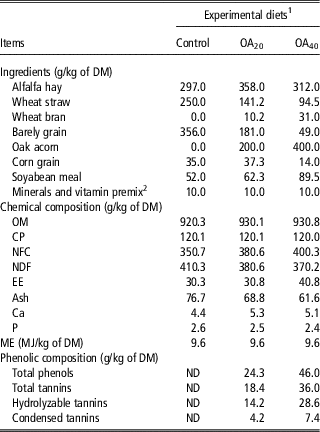
In all, 50 clinically healthy goats were bought from livestock holders in spring (2016). All goats received anthelmintic drug (Ivermectin drench, 0.2 mg per kg BW; Albendazole boluses, 5 mg per kg BW) and vaccinated against common disease based on the recommendation of veterinary organisation at the start of the experiment. All animals were allowed to graze on rangeland and pasture during the day time, from 0900 to 1800 h and they were kept in indoor pens at night. The animals received a flushing supplement feed (250 g/day per animal), 3 weeks before and up to 2 weeks after heat synchronization. Flushing feed containing barley grain (40%), corn grain (30%), soyabean meal (15%), wheat bran (13%) and minerals and vitamins premix (2%). Heat was synchronised using intravaginal sponges containing 60 mg medroxyprogesterone acetate (Esponjavet; Hipra, S. A., Amer, Girona, Spain) for 14 days, followed by an intramuscular injection of 500 IU PMSG (Gonaser; Hipra, S. A.) at sponge removal. Animals were housed with ten mature bucks with similar BW and age (one buck/five goats) for 5 days at 24 h after sponge removal and grazed on pastures for 3 months. Pregnancy diagnosis was performed 40 days post-breeding using both serum progesterone level (Progesterone ELISA kit; Monobind Inc., Lake Forest, CA, USA) and veterinary ultrasonography machine (Model Future-1; Inserbo S.L., Torrefarrera, Lleida, Spain). Among the pregnant goats, 24 multiparous animals (41.7±2.3 kg BW) were selected, blocked by parity and BW, randomly allocated to experimental diets and housed in 24 individual pens (2×1 m) for the last 60 days of pregnancy. Oak (Quercus persica) acorn was collected from oak forests during autumn (2016), shade-dried, cups removed and ground similar to other ingredients. Chemical composition of feedstuffs and phenolic compounds of OA are presented in Table 1. Metabolisable energy (MJ/kg of dry matter (DM)) of OA was estimated by equation of Menke and Steingass (Reference Menke and Steingass1988), based on 24 h gas production (ml) and CP, ether extract and ash contents (g/kg of DM) as:
 $$\eqalignno{{\rm ME}\,({\rm MJ/kg}\,{\rm DM}){\,\equals\,}&1.06{\plus}0.157\,{\rm GP}{\plus}0.0084\,{\rm XP}\cr& {\plus}0.022\,{\rm XL}{\minus}0.0081\,{\rm XA}$$
where GP is the net gas production (ml/200 mg of DM in 24 h); XP, XL and XA are CP, ether extract and ash (g/kg DM) respectively.
Chemical composition of feed ingredients used in experimental diets

DM=dry matter; OM=organic matter; NFC=non-fibre carbohydrate; EE=ether extract.
Experimental diets (Table 2) were formulated to meet the nutrient requirements of mature goats (non-dairy) during the last 60 days of pregnancy according to National Research Council (2007) and consisted of control diet (without OA) and diets containing 20 (OA20) or 40% OA (OA40) on DM basis. Diets were isoenergetic and isonitrogenous. The goats were fed the total mixed rations ad libitum with a 5% daily refusal. Animals were fed individually twice daily (0800 and 1800 h) with experimental diets during the last 60 days of pregnancy in two equal meals and had free access to water.
Ingredients and chemical composition of experimental diets

DM=dry matter; OM=organic matter; NFC=non-fibre carbohydrate, calculated by equation: NFC (g/kg of DM)=1000−(CP+NDF+EE+ash); EE=ether extract; ME=metabolisable energy; ND=not detectable.
1 Control=diet without oak acorn; OA20=diets containing 20% oak acorn; OA40=diets containing 40% oak acorn.
2 Each kg of the premix contains: vitamin A, 500 000 IU; vitamin D3, 100 000 IU; vitamin E, 100 mg; Ca, P, Mg, Na, Mn, Fe, Cu, Zn, Co, I and Se, 180 000, 90 000, 19 000, 60 000, 2000, 3000, 300, 3000, 100, 100 and 1 mg respectively.
Data recording and samples collection
To determine DMI, diets and orts were weighed daily. Sample of diets was collected twice weekly, dried at 55°C in a forced air oven for 72 h, composited per diet at the end of experiment and ground to pass through a 1-mm screen using a Wiley mill (Thomas Scientific, Swedesboro, NJ, USA). All goats were monitored for BW changes at days 60, 40, 20 and 1 before expected kidding using digital scale. Acid-insoluble ash was used as internal marker to estimate apparent nutrients digestibility. Faecal samples of individual goats collected twice daily (0900 and 1500 h) for 3 consecutive days every 2 weeks, stored at −20°C and composited at the end of study for each animal. Blood samples (10 ml) of all animals were collected from the jugular vein using vacutainer tube containing sodium heparin just before morning feeding on days 40, 20 and 1 before expected kidding. Plasma was separated by centrifuging samples at 1700×g for 10 min at 4°C and was stored at −20°C for subsequent analysis. Ruminal fluid was sampled from animals by stomach tube on day 20 before expected kidding. Approximately 50 ml of ruminal fluid was collected 3 h after the morning meal. Samples were squeezed through four layers of cheesecloth. A sub-sample of 5 ml ruminal fluid was mixed with 1 ml of HCL 0.2 N for NH3-N analysis and kept frozen at −20°C. Another sub-sample of 4 ml was combined with 1 ml of 25% (w/v) meta-phosphoric acid and kept frozen (−20°C) for the analysis of volatile fatty acids (VFA). After birth, all new-born kids were allowed to be licked and dried by their dams, weighed within 1 h, ear tagged and their navels were disinfected. The total mixed colostrum was hand-milked from individual dams immediately after kidding. Kids received their dam’s colostrum equal to 10% of their birth BW during the first 24 h of life (Solaiman, Reference Solaiman2010). An aliquot sample (10 ml) was stored at −20°C for IgG determination and a 20 ml sample at 4°C for analysis of fat, protein, lactose and solids not fat. The time of day when kids were fed colostrum was designated as 0 h. Kids blood samples (5 ml) were collected 24 h after colostrum consumption (Hashemi et al., Reference Hashemi, Zamiri and Safdarian2008) and processed as described previously for plasma separation.
Laboratory analyses
Feed ingredients, diets, orts and faecal samples were analysed (Association of Official Analytical Chemists, 2007) for DM (procedure 934.01), ash (procedure 942.05), CP (procedure 976.05) and ether extract (procedure 973.18). Organic matter was calculated from the difference between DM and ash. NDF was determined using sodium sulphite, but without α-amylase (Van Soest et al., Reference Van Soest, Robertson and Lewis1991). Total extractable phenols, total tannins and CT contents of experimental diets and OA were determined in triplicate according to Makkar (Reference Makkar2000). Dried sample (200 mg) was extracted with acetone:water (10 ml; 70:30, v/v) in ultrasonic bath for 20 min. Contents were centrifuged (4°C, 10 min, 3000×g) and the supernatant was kept on ice until analysis. Total extractable phenols were estimated by Folin–Ciocalteu reaction reagent and expressed as gram equivalent tannic acid per kg DM. Non-tannin phenols were determined using absorption to insoluble polyvinylpyrrolidone. Total tannins were calculated by difference. For CT fraction, the extract was treated with butanol–HCl in the presence of ferric ammonium sulphate reagents and expressed as gram equivalent leucocyanidins per kg DM (Makkar, Reference Makkar2000).
To analyse VFA concentration, the frozen samples were thawed at 4°C and centrifuged at 3000×g for 10 min. The supernatant (1 ml) was mixed with 0.2 ml of 20 mM 4-methyl N-valeric acid as an internal standard. Ruminal VFA profile was assessed by gas chromatography (GC 6890; Agilent Technologies, Inc., Wilmington, DE, USA). Ammonia–N of ruminal fluid was assessed according to phenol-hypochlorite method (Broderick and Kang, Reference Broderick and Kang1980).
Plasma biochemical parameters were determined using a commercial analyser (BT1500; Biotecnica, SRL, Roma, Italy) according to the manufacturer’s protocol. Parameters for the biochemistry panel were calcium, phosphate, magnesium, iron, glucose, urea, total protein, albumin, globulin, total cholesterol, triglycerides, high-density lipoprotein cholesterol, low-density lipoprotein cholesterol and alanine aminotransferase (ALT). Colostrum samples were analysed for fat, protein, lactose and solids not fat using Lactostar (Lactostar 3510; Funke Gerber, Berlin, Germany). Samples of plasma were collected on day 1 before expected kidding and colostrum were analysed for IgG content using the reagents of goat IgG ELISA Kit (Bethyl Laboratories, Montgomery, TX, USA).
Statistical analysis
All data were analysed using PROC MIXED of SAS 9.4 (SAS Institute Inc., Cary, NC, USA) as randomised complete block design. Data repeated over time (goat’s plasma biochemistry) analysed according to the following model with repeated measures:
 $$Y_{{ijkl}} {\,\equals\,}\mu {\plus}{\rm OA}_{i} {\plus}{\rm Time}_{j} {\plus}({\rm OA}{\times}{\rm Time})_{{ij}} {\plus}{\rm B}_{k} {\plus}{\rm G}_{{\rm l}} ({\rm B}_{k} ){\plus}e_{{ijkl}} $$
where Y ijkl =dependent variable, µ=overall mean, OA i =fixed effect of diet, Time j =fixed effect of time, (OA×Time) ij =interaction between diet and time, B k =random effect of block (parity), Gl(B k )=random effect of goat within block, and e ijkl =residual error. For each analysed parameter, the goat nested within parity was subjected to three covariance structures. The autoregressive order one was the covariate structure used for most of the variables measured because it resulted in the smallest Akaike’s information criterion. The variables without repeated measure data (goat’s BW changes, goat’s plasma IgG, colostrum composition, kid plasma parameters, DMI, nutrient digestibility and ruminal fermentation parameters) were analysed without sampling time and relevant interaction from the original model. The covariates for expected kidding day, and initial BW were kept in the model for all variables when significant. Normality of distribution and homogeneity of variance for residuals were tested and ensured using Proc Univariate (SAS Institute Inc.). For all statistical models, P-value⩽0.05 was considered significant and those with 0.05<P⩽0.10 were considered tendency. The orthogonal contrast was used to compare the effect of control diet with OA containing diets.
Results
Dry matter intake, digestibility and ruminal fermentation
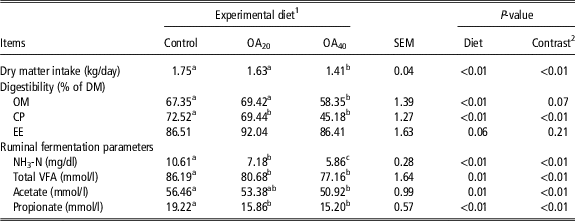
Effect of experimental diets on DMI, nutrients digestibility and ruminal fermentation parameters of late-pregnant goats are shown in Table 3. The lowest DMI (P<0.01) and organic matter digestibility (P<0.05) were observed in animals fed OA40 diet. According to the orthogonal contrast, animals fed diets containing OA had lower DMI compared with those fed the control diet (P<0.01). Ether extract digestibility tended to be greater (P=0.06) in the OA20 diet compared with the other groups. Animals fed OA containing diets had lower CP digestibility compared with those fed the control diet (P<0.01). Ruminal fluid NH3-N concentration decreased with increasing OA level in the diets (P<0.01). Animals fed OA containing diets had lower ruminal total VFA, acetate and propionate concentrations compared with those fed the control diet (P<0.01).
Effect of dietary oak acorn level on dry matter (DM) intake, nutrients digestibility and ruminal fermentation parameters of late-pregnant goats

OM=organic matter; EE=ether extract; NH3-N=ammonia nitrogen; VFA=volatile fatty acids.
a,b,cMeans within a row with different superscript letters are different (P⩽0.05).
1 Experimental diet: control=diet without oak acorn; OA20=diet with 20% oak acorn; OA40=diet with 40% oak acorn.
2 Contrast=control diet v. diets containing oak acorn.
Goats BW changes and their kids birth weight
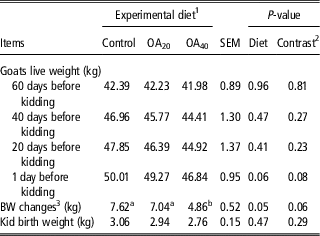
Effect of experimental diets on goat’s BW changes in the last 60 days of pregnancy and their kid’s birth weight are shown in Table 4. There was no difference between BW of goats at days of 60, 40 and 20 before expected kidding (P>0.05), whereas orthogonal contrast showed that BW of goats fed OA containing diets tended to be lower than those fed the control diet at day 1 before expected kidding (P=0.08). The BW changes were lower for goats fed diets containing 40% OA compared with those fed other diets (P⩽0.05). Kids’ birth weight was not affected by feeding diets containing different level of OA (P>0.05).
Effect of dietary oak acorn level on goats BW change during the last 60 days of pregnancy and their kid’s birth weight

a,bMeans within a row with different superscript letters are different (P⩽0.05).
1 Experimental diet: control=diet without oak acorn; OA20=diet with 20% oak acorn; OA40=diet with 40% oak acorn.
2 Contrast=control diet v. diets containing oak acorn.
3 BW changes of goats at the last 60 days of pregnancy.
Goat plasma parameters
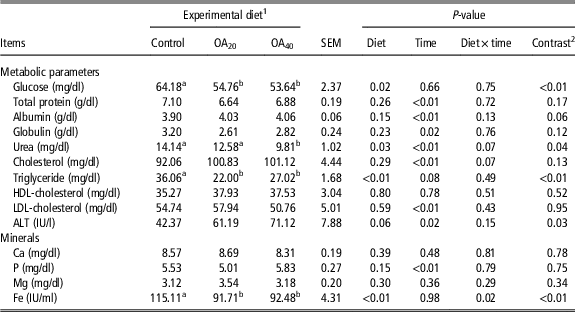
Effect of experimental diets on goat’s plasma parameters are presented in Table 5. Plasma glucose, triglyceride and iron concentrations were lower in animals fed OA containing diets compared with those fed the control diet (P<0.01). Experimental diets had no effect on plasma total protein, albumin, globulin, total cholesterol, high-density lipoprotein-cholesterol, low-density lipoprotein-cholesterol, Ca, P and Mg concentrations (P>0.05). Plasma urea concentration was lower in animals fed diet containing 40% OA (OA40) compared with the other groups (P⩽0.05). Animals fed OA containing diets had higher plasma ALT concentration than those fed the control diet (P⩽0.05). Plasma concentrations of phosphate, urea, total protein, albumin, globulin, total cholesterol, low-density lipoprotein cholesterol and ALT were affected by the time of sampling (P⩽0.05). The lowest plasma concentrations of total protein (6.48, 7.17 and 6.95 g/dl on days 40, 20 and 1 before expected kidding, respectively) and globulin (2.68, 2.91 and 3.04 g/dl on days 40, 20 and 1 before expected kidding, respectively) were observed on day 40 compared with those collected on day 20 and 1 before the expected kidding. Whereas, plasma samples collected on day 20 before the expected kidding had highest albumin (3.81, 4.26 and 3.92 g/dl on days 40, 20 and 1 before expected kidding, respectively) and urea (10.83, 14.16 and 11.53 mg/dl on days 40, 20 and 1 before expected kidding, respectively) concentrations. Plasma cholesterol (76.93, 103.30 and 113.79 mg/dl on days 40, 20 and 1 before expected kidding, respectively) and LDL-cholesterol (33.88, 65.11 and 64.44 mg/dl on days 40, 20 and 1 before expected kidding, respectively) concentrations increased and phosphate (6.04, 6.03 and 4.29 mg/dl on days 40, 20 and 1 before expected kidding, respectively) level decreased with approaching to kidding. Furthermore, the highest plasma ALT concentration (75.42, 43.59 and 55.67 IU/l on days 40, 20 and 1 before expected kidding, respectively) was observed on day 40 before expected kidding. All goat’s plasma parameters with the exception of iron were not affected by the interaction of time×diet (P>0.05). There was no difference between plasma iron concentration (96.32, 97.70 and 104.02 IU/ml for control, OA20 and OA40 diets, respectively) of goats fed experimental diets on day 40 before expected kidding. Whereas, goats fed OA containing diets had lower plasma iron concentration on days 20 (123.20, 78.60 and 97.98 IU/ml for control, OA20 and OA40 diets, respectively) and 1 (125.80, 99.53 and 76.26 IU/ml for control, OA20 and OA40 diets, respectively) before expected kidding compared with those fed the control diet.
Effect of dietary oak acorn level on goats’ plasma biochemistry during the last 60 days of pregnancy

IgG=immunoglobulin G; HDL=high-density lipoprotein; LDL=low-density lipoprotein; ALT=alanine aminotransferase.
a,bMeans within a row with different superscript letters are different (P⩽0.05).
1 Experimental diet: control=diet without oak acorn; OA20=diet with 20% oak acorn; OA40=diet with 40% oak acorn.
2 Contrast=control diet v. diets containing oak acorn.
Dam’s plasma immunoglobulin G concentration and colostrum composition
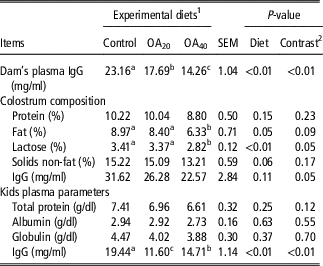
Effects of dietary OA level on dam’s plasma IgG concentration and colostrum composition are shown in Table 6. Goats fed OA40 had the lowest plasma IgG concentration (P<0.01). In addition, orthogonal contrast showed that plasma IgG concentration was lower in animals fed OA containing diets than those fed the control diet (P<0.01). There was no difference in colostrum protein content between goats fed experimental diets (P>0.05). The lowest colostrum fat (P⩽0.05) and lactose (P<0.01) concentrations were observed in animals fed OA40. Animals fed diets containing OA had lower colostrum IgG content compared with those fed the control diet (P⩽0.05).
Effect of dietary oak acorn level on dam’s plasma IgG concentration, chemical composition of colostrum and kid’s plasma parameters 24 h after colostrum intake

IgG=immunoglobulin G.
a,b,cMeans within a row with different superscript letters are different (P⩽0.05).
1 Experimental diet: control=diet without oak acorn; OA20=diet with 20% oak acorn; OA40=diet with 40% oak acorn.
2 Contrast=control diet v. diets containing oak acorn.
Kid’s plasma metabolites and immunoglobulin G
Table 6 shows the results of kid’s plasma metabolites and IgG. Concentrations of plasma total protein, albumin and globulin of kids were not affected by diet fed to their dams during the last 2 months of pregnancy (P>0.05). According to orthogonal contrast, feeding kids with colostrum produced by goats fed OA containing diets decreased their plasma IgG level (P<0.01). The lowest plasma IgG level was observed in kids that consumed colostrum from goats fed OA20 (P<0.01).
Discussion
Although OA is an important feed source for goats during autumn in oak forest areas, to our knowledge the effect of OA during late pregnancy on DMI, nutrients digestibility, ruminal fermentation, BW changes, plasma biochemistry, colostrum quality and IgG level of pregnant goats and their kids have not been reported previously.
Dry matter intake, digestibility and ruminal fermentation
Dry matter intake reduction in goats fed OA containing diets reported herein is inconsistent with Froutan et al. (Reference Froutan, Azizi, Sadeghi, Fatehi and Lashkari2015) who reported increasing OA level in the diet of growing kids had no effect on DMI. In the present study, reduction of DMI in goats fed OA can be attributed to the decreasing palatability due to bitter or astringent taste of tannins (Becker and Makkar, Reference Becker and Makkar1999) as well as the reduction of OM digestibility (Table 3). Consistent with our results, feeding OA in growing lambs (Al Jassim et al., Reference Al Jassim, Ereifej, Shibli and Abudabos1998) and mature sheep (Aghamohamadi et al., Reference Aghamohamadi, Hozhabri and Alipour2014) decreased organic matter and CP digestibility. This phenomenon could be related to the fact that tannins are able to form a strong complex with proteins (Patra and Saxena, Reference Patra and Saxena2011) which may be a reason for lower CP digestibility in the current study. The results of ruminal fluid NH3-N concentration was comparable to Aghamohamadi et al. (Reference Aghamohamadi, Hozhabri and Alipour2014) who reported the lower ruminal NH3-N concentration in mature sheep fed OA containing diets. The decrease in ruminal NH 3 -N concentration following OA inclusion may be partly due to decreasing deamination of amino acids and protein degradation by ruminal microorganisms (Patra and Saxena, Reference Patra and Saxena2011). Reduction of total VFA concentration by increasing OA level in the current study was in agreement to those reported by Aghamohamadi et al. (Reference Aghamohamadi, Hozhabri and Alipour2014). As shown in Table 3, DMI decreased with increasing OA level in the diet, which can partly explain the lower total VFA concentration in the rumen. Similar to our results, addition of CT to diet of different species of animal decreased ruminal acetate concentration (Bueno et al., Reference Bueno, Brandi, Franzolin, Benetel, Fagundes, Abdalla, Louvandini and Muir2015). Whereas, Buccioni et al. (Reference Buccioni, Serra, Minieri, Mannelli, Cappucci, Benvenuti, Rapaccini, Conte and Mele2015b) reported higher ruminal acetate concentration in dairy ewes fed chestnut extract containing diet. Although, we did not measure the ruminal cellulolytic bacteria population, Wang et al. (Reference Wang, Alexander and McAllister2009) reported lower population of some cellulolytic bacteria that may explain the lower acetate concentration. The lower concentration of propionate in ruminal fluid of goats fed OA containing diets compared with those fed the control diet can be attributed to the different starch source (barley v. OA) in these diets and reduction of starch degradation in the presence of tannins (Martinez et al., Reference Martinez, McAllister, Wang and Reuter2006). Tannins have been reported to reduce the growth of Ruminobacter amilophilus and Prevotella bryantii as the main propionate producing bacteria (Narvaez et al., Reference Narvaez, Wang, Xu, Alexander, Garden and McAllister2013).
Goats BW changes and their kids birth weight
Lower BW changes in goats fed diets containing 40% OA compared with those fed other diets in the current study can be attributed to lower DMI and CP and organic matter digestibility in these animals (Table 3). The foetus has a high priority for nutrients and, if the mother has a low intake, her reserves will be used to meet the needs of the foetus (McDonald et al., Reference McDonald, Edwards, Greenhalgh, Morgan and Sinclair2011). So, in spite of the lower BW changes in goats fed OA40, their kids birth weight were not adversely affected by experimental diets.
Goat’s plasma parameters
In contrast to our results, Froutan et al. (Reference Froutan, Azizi, Sadeghi, Fatehi and Lashkari2015) reported no effect of feeding OA on plasma glucose concentration of growing kids. In the current study, lower plasma glucose concentration in goats fed OA containing diets can be related to lower propionate concentration in ruminal fluid of these animals (Table 3). Propionate that produced from ruminal carbohydrate fermentation is the major substrate for hepatic gluconeogenesis in ruminants (Reynolds, Reference Reynolds2006). In addition, other substrates such as amino acids can be used for hepatic gluconeogenesis. Hence, the higher plasma glucose concentration in goats fed the control diet may be due to amino acids deamination for glucose synthesis, which could be explained by higher plasma urea concentration in these animals (Table 5). The lack of experimental diets effect on plasma total protein, albumin and globulin concentrations in the present study was in agreement to a previous study (Froutan et al., Reference Froutan, Azizi, Sadeghi, Fatehi and Lashkari2015). However, Raju et al. (Reference Raju, Sahoo, Chandrakar, Sankar, Garg, Sharma and Pandy2015) reported higher plasma total protein, albumin and globulin concentrations in goats fed a diet containing oak leaves compared with control diet. The lowest plasma total protein, albumin, globulin and urea concentrations on day 40 before expected kidding may be related to short adaptation period to dietary tannins and consequently probably lower CP digestibility. The higher plasma globulin concentration on day 1 before expected kidding can be related to greater Ig synthesis for colostrum deposition in mammary glands (Godden, Reference Godden2008). Similar plasma total cholesterol concentration in goats fed experimental diets in our experiment was in agreement to other studies (Froutan et al., Reference Froutan, Azizi, Sadeghi, Fatehi and Lashkari2015; Raju et al., Reference Raju, Sahoo, Chandrakar, Sankar, Garg, Sharma and Pandy2015) and indicated no adverse effect of feeding OA on liver cholesterol synthesis. Effect of feeding diets containing OA on plasma triglyceride level in our study was similar to the result of Froutan et al. (Reference Froutan, Azizi, Sadeghi, Fatehi and Lashkari2015) who reported lower plasma triglyceride concentration in growing kids fed different OA levels. Oak acorn is a rich source of oleic acid (Estévez et al., Reference Estévez, Morcuende, Ramirez, Ventanas and Cava2004) and contains a noticeable amount of α-linolenic acid (Karolyi et al., Reference Karolyi, Salajpal, Kis, Dikic and Juric2007). This fatty acid is an important precursor of eicosapentaenoic acid (C20:5n-3) synthesis and has been reported to reduce plasma triglyceride level (Simopoulos, Reference Simopoulos1991), which may explain lower plasma triglyceride concentration in goats fed OA containing diets in the current study. In addition, OA contains various biologically active phenolic compounds such as tannins, gallic and ellagic acids, and different galloyl and hexahydroxydiphenoyl derivatives (Rakic et al., Reference Rakic, Povrenovic, Tesevic, Simic and Maletic2006), which are known for their role in the regulation of blood lipid concentrations. Hydroxyl groups in HT through binding to methyl groups can decrease plasma triglycerides concentration by reducing methionine availability for very low-density lipoproteins (VLDL) synthesis in the liver. The VLDL compounds are the main carriers of triglycerides in plasma (Aiura and de Carvalho, Reference Aiura and de Carvalho2007). Similar to our data, Solaiman et al. (Reference Solaiman, Thomas, Dupre, Min, Gurung, Terrill and Haenlein2010) found higher plasma ALT concentration in kids fed tanniferous plants, whereas, Raju et al. (Reference Raju, Sahoo, Chandrakar, Sankar, Garg, Sharma and Pandy2015) observed no difference in plasma ALT concentration of goats fed oak leaves. Plasma level of ALT is conventionally used for diagnosing hepatic damage and to detect bile obstruction (Bain, Reference Bain2003). Thus, in the present study, elevated levels of plasma ALT may suggest compromised liver integrity by feeding OA tannins (Makkar et al., Reference Makkar, Siddhuraju and Becker2007). In the present study, higher plasma ALT concentration on day 40 before expected kidding can be attributed to short adaptation of animals to dietary tannins and probably animals adapted to experimental diets with advancing the experiment. So plasma ALT concentration decreased gradually. The response of plasma urea concentration to experimental diets in the current study was in agreement with Raju et al. (Reference Raju, Sahoo, Chandrakar, Sankar, Garg, Sharma and Pandy2015). Plasma urea level is an indicator of protein degradation in the rumen. In the present study, the higher plasma urea level in goats fed the control diet can be attributed to higher CP digestibility and ruminal ammonia concentration in these animals (Table 3). Although, we did not measure iron availability in the present study, the lower plasma Fe concentration in animals fed OA containing diets may be explained by lower Fe absorption from the small intestine by dietary tannins (Lee et al., Reference Lee, Shinde, Choi, Kwon, Lee, Pak, Cho and Chae2010). Most of the tannins have several O-diphenol groups and are thus capable forming chelates with many metal ions such as Fe, Cu and Zn (Brito et al., Reference Brito, Cardoso, Caires and Siqueira2015). This may be a reason for the reduction of plasma Fe concentration in goats fed diets containing OA on days 20 and 1 before expected kidding in the current study. The reduction of plasma P concentration on day 1 before expected kidding in the present study may be related to increase P requirements for colostrum synthesis (Goff et al., Reference Goff2004).
Dam’s plasma immunoglobulin G concentration and colostrum composition
Lower plasma IgG level in goats fed OA containing diets compared with those fed the control diet in the current study can be attributed to suppressing effects of tannins, including gallotannins and ellagitannin, on Ig production by inhibiting IL-4 and IL-13-induced signalling (Kim et al., Reference Kim, Yoshimoto, Nakayama, Tanino, Fujimura, Yamada and Tachibana2013). On the other hand, the lower plasma IgG level in animals fed OA containing diets compared with those fed the control diet probably can be explained by lower total tract digestibility of CP in these animals (Table 3). Stave and Weech (Reference Stave and Weech1978) reported a positive correlation between dietary protein intake and Ig production in infants and children. To our knowledge, there is no report on the effect of feeding tanniferous plants on colostrum composition. However, there are some experiments which addition of chestnut or quebracho tannins had no effect (Buccioni et al., Reference Buccioni, Pauselli, Viti, Minieri, Pallara, Roscini, Rapaccini, Marinucci, Lupi, Conte and Mele2015a and Reference Buccioni, Pauselli, Minieri, Roscini, Mannelli, Rapaccini, Lupi, Conte, Serra, Cappucci, Brufani, Ciucci and Mele2017) or chestnut tannin decreased (Buccioni et al., Reference Buccioni, Serra, Minieri, Mannelli, Cappucci, Benvenuti, Rapaccini, Conte and Mele2015b) milk protein content in dairy ewes. This discrepancy between different experiments could be attributed to animal species and their response to type and amount of tannins in the diet. Colostral proteins are utilised by the neonate for protein synthesis and Ig absorption (Quigley and Drewry, Reference Quigley and Drewry1998). Furthermore, colostrum protein content also contributes profoundly to neonate immunity and growth, not only because of the Ig content, but might also be due to other nutritional and physiological effects on the neonates (Chen et al., Reference Chen, Changa, Peha and Chen1999). The lack of experimental diets effect on colostral protein content may be due to similar plasma total protein concentration (Table 5). The lowest fat content of colostrum in goats fed diets containing OA40 was in contrast to Buccioni et al. (Reference Buccioni, Pauselli, Viti, Minieri, Pallara, Roscini, Rapaccini, Marinucci, Lupi, Conte and Mele2015a, Reference Buccioni, Serra, Minieri, Mannelli, Cappucci, Benvenuti, Rapaccini, Conte and Mele2015b and Reference Buccioni, Pauselli, Minieri, Roscini, Mannelli, Rapaccini, Lupi, Conte, Serra, Cappucci, Brufani, Ciucci and Mele2017) who reported no effect of supplemented HT and CT on milk fat content in lactating ewes. Colostrum fat content is influenced by dietary as well as non-dietary factors. Dietary factors affect milk fat content mainly by changing the rumen concentrations of VFA and production of rumen biohydrogenation intermediates such as trans fatty acids, which were considered to be potent inhibitors of fat synthesis by mammary tissue (Palmquist and Beaulieu, Reference Palmquist and Beaulieu1993; Baumgard et al., Reference Baumgard, Matitashvili, Corl and Bauman2002). Although in the present study, the fatty acids profile of colostrum was not measured, but some previous studies (Buccioni et al., Reference Buccioni, Pauselli, Viti, Minieri, Pallara, Roscini, Rapaccini, Marinucci, Lupi, Conte and Mele2015a, Reference Buccioni, Pauselli, Viti, Minieri, Pallara, Roscini, Rapaccini, Marinucci, Lupi, Conte and Mele2015b and Reference Buccioni, Pauselli, Minieri, Roscini, Mannelli, Rapaccini, Lupi, Conte, Serra, Cappucci, Brufani, Ciucci and Mele2017) have reported that HT and CT increased production of trans fatty acid in the rumen. In the present experiment, the lower fat content of colostrum in goats fed OA containing diets also can be related to lower ruminal fluid acetate (Table 3) and plasma triglyceride (Table 5) concentrations in these animals. Plasma triglyceride can be used as a precursor for fat synthesis in udder tissue (Palmquist and Beaulieu, Reference Palmquist and Beaulieu1993). Colostral fat plays a major role in supplying energy to the neonate and in establishing glucose homoeostasis (Quigley and Drewry, Reference Quigley and Drewry1998). Our result showed that feeding OA containing diets decreased lactose content of colostrum, which did not agree with findings reported by previous studies (Buccioni et al., Reference Buccioni, Pauselli, Viti, Minieri, Pallara, Roscini, Rapaccini, Marinucci, Lupi, Conte and Mele2015a, Reference Buccioni, Pauselli, Viti, Minieri, Pallara, Roscini, Rapaccini, Marinucci, Lupi, Conte and Mele2015b and Reference Buccioni, Pauselli, Minieri, Roscini, Mannelli, Rapaccini, Lupi, Conte, Serra, Cappucci, Brufani, Ciucci and Mele2017), who evaluated the effect of both HT and CT on milk lactose content in dairy ewes. In the present study, the plasma glucose concentration was higher for goats fed the control diet (Table 5), which can explain the higher lactose content of colostrum produced by these animals. The lower colostral IgG level in goats fed OA containing diets can be related to the lower plasma IgG level in these animals (Table 6). On the other hand, feeding diets containing OA compromised nutrients digestibility (Table 3), which, in part, can explain the lower quality of colostrum produced by these animals. Inadequate colostrum intake or poor-quality colostrum causes failure of transfer of passive immunity (Godden, Reference Godden2008). Subsequently, neonates are at increased risk of developing infectious diseases and have higher morbidity and mortality rates (Kolb and Kaskous, Reference Kolb and Kaskous2003). The IgG level in colostrum is influenced by several factors including dam breed, parity and age, nutritional status of late pregnancy and herd vaccination programme (Godden, Reference Godden2008). The results of previous studies indicated that nutritional status of sheep and goats during late pregnancy had pronounced effects on their colostrum quality and kid’s survival (Hashemi et al., Reference Hashemi, Zamiri and Safdarian2008; Ramírez-Vera et al., Reference Ramírez-Vera, Terrazas, Delgadillo, Serafín, Flores, Elizundia and Hernández2012).
Kid’s plasma metabolites and immunoglobin G
Our results showed that nutritional status of goats during the late pregnancy had no effect on plasma total protein, albumin and globulin concentrations of their kids which can be explain by similar protein content of colostrum produced by these animals (Table 6). Lower plasma IgG level in kids fed colostrum produced by goats fed OA containing diets compared with those fed the control group can be attributed to lower IgG level in colostrum of their dams (Table 6). Chen et al. (Reference Chen, Changa, Peha and Chen1999) reported greater IgG absorption when the colostral IgG was more concentrated. A positive correlation (r=0.86) was also reported between concentrations of IgG in the colostrum and in the serum of new-born kids (Argüello et al., Reference Argüello, Castro, Capote, Tyler and Holloway2004). Although, it was expected the lower plasma IgG concentration in kids consumed colostrum from goats fed OA40, but higher plasma IgG concentration in kids of this group compared with kids from OA20 group was unexpected. Nevertheless, Godden (Reference Godden2008) demonstrated that absorption of colostral IgG is driven by both colostrum quality and the efficiency of absorption. The efficiency of IgG absorption in ruminant neonates is affected by several factors such as metabolic disturbances, cold stress, sex and bacterial contamination of colostrum. In addition, the individual variation in efficiency of absorption across ruminant neonates fed in similar manners is unclear (Halleran et al., Reference Halleran, Sylvester and Foster2017).
Conclusion
It is concluded that feeding OA during the last 60 days of pregnancy significantly decreased plasma glucose, IgG, triglyceride and Fe levels of goats. In addition, goats fed OA containing diets produced colostrum with lower fat, lactose and IgG contents. Subsequently, kids fed colostrum of goats fed OA had lower plasma IgG level. These results suggest that feeding OA has negative impacts on colostrum quality which is likely to impact kid performance.
Acknowledgements
The authors would like to acknowledge Ilam Agricultural and Natural Resources Research and Education Centre, Ilam Deputy of Animal Affairs and Iran Animal Science Research Institute, for their corporation.
Declaration of interest
The authors declare no conflicts of interest.
Ethics statement
All procedures were conducted under protocols approved by Iranian Council of Animal Care (1995).
Software and data repository resources
Authors declare that no data or models of this research are deposited in an official repository.