


1. Introduction
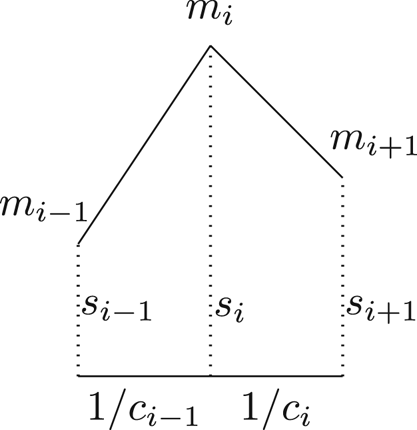
Sturm–Liouville problems in the discrete version come from several physical models, including the vibrating string and random walk with discrete time process [Reference Atkinson4, Reference Jirari9]. We briefly introduce these two models. Suppose that a weightless string bears $l$ particles with masses $m_1,\ldots, m_{l}$
 , and the horizontal distance between $m_i$
 and $m_{i+1}$
 is $1/c_{i}$
 , $1\leq i\leq l-1$
 . Moreover, the string extends to length $1/c_{l}$
 beyond $m_{l}$
 and $1/c_{0}$
 beyond $m_1$
 . Let $s_i$
 , $1\leq i\leq l$
 , be the displacement of the particle $m_i$
 at a fixed time. Both ends are pinned down (i.e. $s_0=s_{l+1}=0$
 ). Since the particle $m_i$
 does not move horizontally, we may assume that the horizontal component of the tension at $m_i$
 is both unit from the left and right, respectively. Then the restoring forces, induced by the vertical component of the tension from the left and right, are $c_{i-1}(s_i-s_{i-1})$
 and $c_i(s_i-s_{i+1})$
 , respectively. See Fig. 1.
Vibrating string.

Therefore, by Newton's second law,

where $\Delta s_i=s_{i+1}-s_{i}$ and $\nabla s_i=s_i-s_{i-1}$
 . Taking $s_i=y_i\cos (\omega t),$
 where $y_i$
 is the amplitude of $m_i$
 , we obtain from (1.1) that

where $\lambda =\omega ^{2}$ . Since the boundary condition corresponds to the assumption that both ends are pinned down, this system becomes a self-adjoint discrete Sturm–Liouville problem.
Another model of the discrete Sturm–Liouville equation is random walking with discrete time process from probability theory.
Let a particle be in one of the $l$ positions $1,\ldots,l$
 at $t=0$
 . Suppose that the particle is in position $i$
 at $t=t_0$
 . The rule of this random walking is that the particle will move to $i+1$
 at $t=t_0+1$
 with a probability $\alpha _i$
 , move to $i-1$
 at $t=t_0+1$
 with a probability $\beta _i$
 , and stay in position $i$
 with a probability $1-\alpha _i-\beta _i$
 . See Fig. 2. Moreover, if the particle moves to the left of position $1$
 , or to the right of position $l$
 , it is considered permanently lost. So it is reasonable to set $\alpha _{0}=0$
 and $\beta _{l+1}=0$
 . Define $p_{rs}(j)$
 as the probability of the particle being in position $s$
 at $t=j$
 and starting in position $r$
 at $t=0$
 . Then we have $p_{rs}(0)=\delta _{rs}$
 , and

where $\delta _{rs}=1$ if $r=s$
 , and $\delta _{rs}=0$
 if $r\neq s$
 . Let $P(j)=(p_{rs}(j))_{1\leq r,s\leq l}$
 , $j\geq 0$
 , and

Then $P(0)=I_l$ and (1.2) is equivalent to

So $P(j+1)=(I_l+T)^{j}$ , $j\geq 0$
 . However, the form $(I_l+T)^{j}$
 provides little information on asymptotic form of $P(j)$
 for large $j$
 . Instead, in the spectral theory, the eigenvalues and corresponding eigenfunctions of $T$
 play an important role in studying properties of $P(j)$
 for any $j\geq 1$
 . To find an eigenvalue $\lambda$
 and the corresponding eigenfunction $(y_1,y_2,\ldots,y_{l})$
 of $-T$
 , we need to study the self-adjoint discrete Sturm–Liouville equation

with the boundary condition $y_{0}=y_{l+1}=0$ , where $g_j=\alpha _ja_j$
 and $g_{j-1}=\beta _j a_j$
 .
Random walk with discrete time process.

Motivated by these two interesting models and recent interest on discrete equations [Reference Bohner, Došlý and Kratz5, Reference Clark6, Reference Jirari9], in this paper we consider a general self-adjoint discrete $d$ -dimensional Sturm–Liouville problem for any $d\geq 1$
 . It consists of a symmetric discrete Sturm–Liouville equation

and a self-adjoint boundary condition

where $\Delta y_i=y_{i+1}-y_{i}$ , $\nabla y_i=y_i-y_{i-1}$
 , $y=\{y_i\}_{i=0}^{N+1}$
 is a sequence of $d$
 -dimensional complex-valued vectors; $P=\{P_j\}_{j=0}^{N}$
 , $Q=\{Q_i\}_{i=1}^{N}$
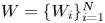
 and $W=\{W_i\}_{i=1}^{N}$
 are sequences of $d\times d$
 complex-valued matrices and satisfy

$0\leq j\leq N$ ; $\lambda \in \mathbb {C}$
 is the spectral parameter, $N\ge 2$
 ; $A$
 and $B$
 are $2d\times 2d$
 complex-valued matrices such that

The spectrum of a self-adjoint discrete Sturm–Liouville problem consists of real and finite eigenvalues, and thus can be arranged in the non-decreasing order. The $n$ -th eigenvalue can be considered as a function defined on the space of self-adjoint discrete Sturm–Liouville problems or on its subset. This function is not continuous in general, see the $1$
 -dimensional case in [Reference Zhu and Shi22]. The $n$
 -th eigenvalue exhibits jump phenomena near the discontinuity points. Unlike only jumping to $-\infty$
 in the continuous case, the $n$
 -th eigenvalue also blows up to $+\infty$
 in the discrete case. So we call the set of all discontinuity points in the considered space to be the jump set, and call any element in the jump set to be a jump point.
The aim of this paper is to determine the jump set and to completely provide the asymptotic behaviour of the $n$ -th eigenvalue near any fixed jump point for the discrete Sturm–Liouville problems. As applications, we consider the Sturm–Liouville problem of Atkinson type, transform it into a discrete Sturm–Liouville problem, and then apply the discrete method to completely characterize jump phenomena of the $n$
 -th eigenvalue for the Atkinson type. Though the $n$
 -th eigenvalue jumps to $\pm \infty$
 near the jump points in the Atkinson type as well as in the discrete case, the jump set in the Atkinson type is the same one as in the continuous case and is independent of coefficients of the Sturm–Liouville equations. This leads tremendous difference with the discrete case, where the jump set is involved heavily with coefficients of the equations.
Singularity of the $n$ -th eigenvalue of Sturm–Liouville problems has attracted a lot of attention (see [Reference Everitt, Möller and Zettl7, Reference Hu, Liu, Wu and Zhu8, Reference Kato10, Reference Kong, Wu and Zettl13, Reference Kong and Zettl16, Reference Zettl20, Reference Zhu and Shi22] and references therein) since Rellich [Reference Rellich18]. Let us mention three contributions to finding the jump set of the $n$
 -th eigenvalue and providing all the asymptotic behaviour near each jump point. Kong, Wu and Zettl completely characterized it for the continuous $1$
 -dimensional Sturm–Liouville problems, while Hu et al. gave the answer for the continuous $d$
 -dimensional case, where $d\geq 2$
 . Zhu and Shi obtained the desired result for the discrete $1$
 -dimensional case. This paper is devoted to the discrete case in any dimension. We mention here that our result in theorem 4.4 for jump phenomena of the $n$
 -th eigenvalue on the boundary conditions is complete, while the conclusion in theorem 4.9 for jump phenomena on the equations is partial due to the non-degenerate assumption (4.22)–(4.23).
Compared with the continuous Sturm–Liouville problems, the $n$ -th eigenvalue in the discrete case is not continuously dependent on the equations, and the criterion for continuity of the $n$
 -th eigenvalue is different due to the finiteness of the number of eigenvalues. This makes the method used in the continuous case [Reference Hu, Liu, Wu and Zhu8, Reference Kong, Wu and Zettl13] unable to apply to the discrete case. On the other hand, compared with the $1$
 -dimensional discrete case, the first difficulty for any dimensional case is how to divide areas in layers of the considered space such that the $n$
 -th eigenvalue has the same jump phenomena in any given area. Our method in this paper is to find some invertible elementary transformations converting the matrix, which determines the number of eigenvalues of the Sturm–Liouville problems, to a Hermitian matrix. The areas’ division is then determined by the spectral information of this Hermitian matrix. The second difficulty is how to prove the asymptotic behaviour of the $n$
 -th eigenvalue. Our approach is first to prove the asymptotic behaviour in a certain direction using the monotonicity of continuous eigenvalue branches, and then combine the local topological property (geometric structure) of the considered space with the perturbation theory of eigenvalues to obtain the whole asymptotic behaviour. This can be regarded as a generalization of the method developed for $1$
 -dimensional discrete case in [Reference Zhu and Shi22] to any dimension. Finally, though our method for the Atkinson type is by transforming the Sturm–Liouville problem into a discrete one, it turns out to be no singularity of the $n$
 -th eigenvalue on the equations for the Atkinson type.
The rest of this paper is organized as follows. In § 2, topology on the space of Sturm–Liouville equations, and that on the space of boundary conditions are presented. Properties of eigenvalues are given in § 3. The number and multiplicity of eigenvalues are discussed in § 3.1, continuous eigenvalue branches are constructed and their properties are provided in § 3.2 and properties of the $n$ -th eigenvalue are presented in § 3.3. In § 4, jump phenomena of the $n$
 -th eigenvalue on the boundary conditions are completely characterized for a fixed equation in § 4.1, while jump phenomena of the $n$
 -th eigenvalue on the equations are obtained for a fixed boundary condition under a non-degenerate assumption in § 4.2. Sturm–Liouville problem of the Atkinson type is transformed to a discrete one, and jump phenomena of the $n$
 -th eigenvalue are provided thoroughly in § 5. Conclusions are given in § 6.
Notation.
By $\mathbb {R}$ and $\mathbb {C}$
 denote the set of all the real and complex numbers, respectively. The set of all $m\times n$
 matrices over a field $\mathbb {F}$
 is denoted by $\mathcal {M}_{m,n}(\mathbb {F})$
 , and $\mathcal {M}_{n,n}(\mathbb {F})$
 is abbreviated to $\mathcal {M}_n(\mathbb {F})$
 . $A^{*}$
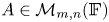
 is the complex conjugate transpose of $A\in \mathcal {M}_{m,n}(\mathbb {F})$
 , while $A^{T}$
 is the transpose of $A$
 . $\mathcal {H}_{n}(\mathbb {F})$
 is the set of all $n\times n$
 Hermitian matrices, while $\mathcal {P}_{n}(\mathbb {F})$
 is the set of all $n\times n$
 positive definite matrices over a field $\mathbb {F}$
 . For a matrix $S\in \mathcal {M}_{n}(\mathbb {F})$
 , its entries and columns are denoted by $s_{ij}$
 and $s_j = (s_{1j},\ldots, s_{nj})^{T}$
 , respectively, $1\le i,j\le n$
 . By $I_n$
 denote the $n\times n$
 unit matrix. $\sharp (K)$
 is the cardinality of the set $K$
 . By $r^{-}(A)$
 , $r^{0}(A)$
 and $r^{+}(A)$
 denote the total multiplicity of negative, zero and positive eigenvalues of $A\in \mathcal {H}_n(\mathbb {C})$
 , respectively. Moreover, $L((a,b),\mathbb {C}^{n\times n})$
 is the space of all $n\times n$
 matrix-valued functions satisfying that every component of such a function is Lebesgue integrable on $(a,b)$
 .
2. Space of self-adjoint discrete Sturm–Liouville problems
In this section, we introduce the topology on the space of self-adjoint discrete Sturm–Liouville problems.
The space of discrete Sturm–Liouville equations is

with the topology induced by $\mathbb {C}^{(3N+1)d^{2}}$ .
Note that the space of self-adjoint boundary conditions is the same as the continuous case. Following [Reference Hu, Liu, Wu and Zhu8], it is exactly the quotient space

where

and

The boundary condition in $\mathcal { B}^{\mathbb {C}}$ is denoted by $[A\,|\,B]:=\{(TA\;|\;TB):T\in {\rm GL}(2d,\mathbb {C})\}$
 . Bold faced capital Latin letters, such as $\mathbf {A}$
 , are also used for boundary conditions.
Next we introduce the following form for the local coordinate systems on $\mathcal {B}^{\mathbb {C}}$ . Let $K$
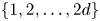
 be any subset of $\{1,2,\ldots,2d\}$
 . Denote

By $E_K$ denote the $4d\times 4d$
 matrix generated from $I_{4d}$
 by multiplying $-1$
 to the $(k+2d)$
 -th column and then exchanging the $k$
 -th and the $(k+2d)$
 -th columns for each $k\in K$
 . Then it has the following form:

where $E_{K,1},E_{K,2}\in \mathcal {M}_{2d,4d}(\mathbb {C})$ , $E_1=\{\alpha _1,\alpha _2,\ldots,\alpha _d\}$
 and $E_2=\{\beta _1,\beta _2,\ldots,\beta _d\}$
 are $d\times d$
 diagonal matrices with

and $e_i$ is the $i$
 -th column of $I_d$
 . Then

where

We define

For $\mathbf {A}=[(S\,|\, I_{2d})E_{K}]\in \mathcal { O}_{K}^{\mathbb {C}}$ , we denote $S$
 by $S(\mathbf {A})$
 to indicate its dependence on $\mathbf {A}$
 if necessary. It is clear that $\mathcal { O}_{K}^{\mathbb {C}}$
 defined here coincides with that defined in (2.1) of [Reference Hu, Liu, Wu and Zhu8]. It follows from theorem 2.1 in [Reference Hu, Liu, Wu and Zhu8] that

Moreover, $\mathcal {B}^{\mathbb {C}}$ is a connected and compact real-analytic manifold of dimension $4d^{2}$
 . The readers are also referred to [Reference Arnold2, Reference Arnold3, Reference Kong, Wu and Zettl14, Reference Long17] for more details.
The product space $\Omega _N^{\mathbb {C}} \times \mathcal { B}^{\mathbb {C}}$ is the space of self-adjoint discrete Sturm–Liouville problems, and $(\pmb \omega, \mathbf {A})$
 is used to stand for an element in $\Omega _N^{\mathbb {C}} \times \mathcal { B}^{\mathbb {C}}$
 in the sequel.
3. Properties of eigenvalues
In this section, we study properties of eigenvalues of the self-adjoint discrete Sturm–Liouville problems.
3.1 The number and multiplicity of eigenvalues
Let

The initial value problem of (1.3) has a unique solutions. More precisely,
Lemma 3.1 Let $z_{i_0}, \tilde z_{i_0}\in \mathbb {C}^{d}$ for some $1\leq i_0\leq N$
 . Then, for each $\lambda \in \mathbb {C},$
 (1.3) has a unique solution $y(\lambda ) \in l[0, N + 1]$
 satisfying $y_{i_0}(\lambda ) = z_{i_0},$
 $P_{i_0}\Delta y_{i_0}(\lambda ) = \tilde z_{i_0}$
 .
Proof. This can be deduced by the invertibility of $P_{j}$ for $0\leq j\leq N$
 and the iteration of

Recall that $\lambda$ is called an eigenvalue of the discrete Sturm–Liouville problem $(\pmb \omega, \mathbf {A})$
 if there exists $y \in l[0, N + 1]$
 which is non-trivial and solves (1.3)–(1.4). Here $y$
 is called an eigenfunction corresponding to $\lambda$
 , and it is said to be normalized if $\sum _{i=1}^{N}y^{*}_iW_iy_i=1.$
 By $\sigma (\pmb \omega, \mathbf {A})$
 denote the spectral set of $(\pmb \omega, \mathbf {A})$
 . For any $\lambda \in \mathbb {C}$
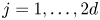
 , let $\phi ^{j}(\lambda )=\{\phi _i^{j}(\lambda )\}_{i=0}^{N+1}$
 , $j=1,\ldots,2d$
 , be the fundamental solutions to (1.3) determined by the initial data

Denote

We write $\Phi (\lambda )$ and $\Psi (\lambda )$
 as $\Phi _{\pmb \omega }(\lambda )$
 and $\Psi _{\pmb \omega }(\lambda )$
 if necessary. Then the eigenvalues of $(\pmb \omega, \mathbf {A})$
 can be regarded as zeros of the polynomial $\Gamma _{(\pmb \omega, \mathbf {A})}$
 as follows.
Lemma 3.2 $\lambda \in \sigma (\pmb \omega, \mathbf {A})$ if and only of $\lambda$
 is a zero of

Proof. The proof is similar to that of lemma 3.2 in [Reference Zhu, Sun, Shi and Wu23].
Let $\lambda \in \sigma (\pmb \omega,\mathbf {A})$ . The order of $\lambda$
 as a zero of $\Gamma _{(\pmb \omega,\mathbf {A})}$
 is called its analytic multiplicity. The number of linearly independent eigenfunctions for $\lambda$
 is called its geometric multiplicity. Let $x_i=P_i\Delta y_i$
 for $0\leq i\leq N$
 . Then the Sturm–Liouville equation (1.3) can be transformed to a discrete linear Hamiltonian system:

where $R(y^{T}_{i},x^{T}_i)^{T}=(y^{T}_{i+1},x^{T}_i)^{T}$ is the partial right shift operator and

Then by theorem 4.1 in [Reference Zhu21], we get the relationship of analytic and geometric multiplicities of $\lambda$ :
Lemma 3.3 The analytic and geometric multiplicities of $\lambda \in \sigma (\pmb \omega,\mathbf {A})$ are the same.
Therefore, we do not distinguish these two multiplicities of $\lambda$ . Let $\sharp _1(\sigma (\pmb \omega,\mathbf {A})\cap I)$
 be the number of eigenvalues in $I\subset \mathbb {R}$
 , counting multiplicities, of $(\pmb \omega,\mathbf {A})$
 . Since $\sigma (\pmb \omega,\mathbf {A})\subset \mathbb {R}$
 by [Reference Shi and Chen19], we have $\sharp _1(\sigma (\pmb \omega,\mathbf {A})\cap \mathbb {R})=\sharp _1(\sigma (\pmb \omega,\mathbf {A}))$
 . The next lemma determines $\sharp _1(\sigma (\pmb \omega,\mathbf {A}))$
 .
Lemma 3.4

where $A_j,B_j\in \mathcal {M}_{2d\times d}$ $(j=1,2)$
 are given by

Proof. By theorem 4.1 in [Reference Shi and Chen19],

Then (3.1) is obtained by $(A_1+B_1P_0,B_2)\left [\begin {smallmatrix}P_0^{-1} & 0\\0 & I_d\end {smallmatrix}\right ]=(A_1P_0^{-1}+B_1,B_2)$ .
Note that $(N-2)d\leq \sharp _1(\sigma (\pmb \omega,\mathbf {A}))\leq Nd$ .
3.2 Continuous eigenvalue branch
In this subsection, we construct continuous eigenvalue branches. Then we study their derivative formulae and monotonicity in some directions.
The first lemma is the small perturbation theory of eigenvalues.
Lemma 3.5 Let $(\pmb \omega _0, \mathbf {A}_0)\in \mathcal {O}\subset \Omega _N^{\mathbb {C}} \times \mathcal { B}^{\mathbb {C}},$ and $c_1, c_2\in \mathbb {R}\setminus \sigma (\pmb \omega _0, \mathbf {A}_0)$
 with $c_1 < c_2.$
 Then there exists a neighbourhood $\mathcal {U}\subset \mathcal {O}$
 of $(\pmb \omega _0, \mathbf {A}_0)$
 such that for each $(\pmb \omega, \mathbf {A})\in \mathcal {U}$
 , $\sharp _1(\sigma (\pmb \omega, \mathbf {A})\cap (c_1, c_2))=\sharp _1(\sigma (\pmb \omega _0, \mathbf {A}_0)\cap (c_1, c_2))$
 and $c_1, c_2\notin \sigma (\pmb \omega, \mathbf {A})$
 .
Proof. Using lemma 3.2, the proof is by a standard perturbation procedure for zeros of the analytic function $\Gamma _{(\pmb \omega _0, \mathbf {A}_0)}$ .
By lemma 3.5 and a similar approach to theorem 3.5 in [Reference Zhu, Sun, Shi and Wu23], we then construct the continuous eigenvalue branches.
Lemma 3.6 Let $(\pmb \omega _0, \mathbf {A}_0)\in \Omega _N^{\mathbb {C}} \times \mathcal { B}^{\mathbb {C}}$ and $\lambda _*\in \sigma (\pmb \omega _0, \mathbf {A}_0)$
 with multiplicity $m$
 . Fix a small $\varepsilon >0$
 such that $\sigma (\pmb \omega _0, \mathbf {A}_0)\cap [\lambda _*-\varepsilon,\lambda _*+\varepsilon ]=\{\lambda _*\}$
 . Then there is a connected neighbourhood $\mathcal {U}$
 of $(\pmb \omega _0, \mathbf {A}_0)$
 and continuous functions $\Lambda _i:\mathcal {U}\to \mathbb {R}$
 , $1\le i\le m,$
 such that $\lambda _*-\varepsilon <\Lambda _1(\pmb \omega,\mathbf {A})\leq \cdots \leq \Lambda _m(\pmb \omega,\mathbf {A}) <\lambda _*+\varepsilon$
 and $\lambda _*\pm \varepsilon \notin \sigma (\pmb \omega, \mathbf {A})$
 for all $(\pmb \omega, \mathbf {A})\in \mathcal {U},$
 where $\{\Lambda _i(\pmb \omega _, \mathbf {A})\}_{i=1}^{m}\subset \sigma (\pmb \omega, \mathbf {A})$
 .
Here $\Lambda _i:\mathcal {U}\to \mathbb {R}$ , $1\le i\le m$
 , are called the continuous eigenvalue branches through $\lambda _*$
 . We write $\Lambda _i(\pmb \omega )$
 when $\mathbf {A}$
 is fixed, and write $\Lambda _i(\mathbf {A})$
 when $\pmb \omega$
 is fixed. Then we shall make a continuous choice of eigenfunctions for the eigenvalues along a continuous simple eigenvalue branch $(m=1)$
 .
Lemma 3.7 Let $u_0$ be an eigenfunction for a simple eigenvalue $\lambda _*\in \sigma (\pmb \omega _0,\mathbf {A}_0),$
 and $\Lambda$
 be the continuous eigenvalue branch defined on $\mathcal {U}$
 through $\lambda _*$
 . Then there exists a neighbourhood $\mathcal {U}_1\subset \mathcal {U}$
 of $(\pmb \omega _0,\mathbf {A}_0)$
 such that for any $(\pmb \omega,\mathbf {A})\in \mathcal {U}_1,$
 there is an eigenfunction $u_{\Lambda (\pmb \omega,\mathbf {A})}$
 for $\Lambda (\pmb \omega,\mathbf {A})$
 satisfying that $u_{\Lambda (\pmb \omega,\mathbf {A})}=u_0,$
 and $u_{\Lambda (\pmb \omega,\mathbf {A})}\to u_{\Lambda (\pmb \omega _0,\mathbf {A}_0)}$
 in $\mathbb {C}^{(N+2)d}$
 as $\mathcal {{U}}_1\ni (\pmb \omega,\mathbf {A})\to (\pmb \omega _0,\mathbf {A}_0)$
 .
Proof. The proof is similar to that of lemma 4.3 in [Reference Zhu, Sun, Shi and Wu23], and thus we omit the details.
Besides lemma 3.7, we also need the following lemma to deduce the derivative formulae for continuous simple eigenvalue branches.
Lemma 3.8 Let $y$ be an eigenfunction for $\lambda \in \sigma (\pmb \omega,\mathbf {A})$
 and $z$
 be an eigenfunction for $\tilde \lambda \in \sigma ({\pmb {\tilde \omega }},\mathbf {A}),$
 where $\pmb \omega =(P^{-1},Q,W),{\pmb {\tilde \omega }} =(\tilde {P}^{-1},\tilde {Q},\tilde {W})$
 and $\mathbf {A}=[A\,|\,B]$
 . Then

Proof. For convenience, denote

where $\alpha _i\in \mathcal {M}_{1,4d}(\mathbb {C})$ , $i=1,\ldots,2d$
 . Then

Since ${\rm rank}(A,\,B)=2d$ , the first equation in (3.5) yields that each solution of the equation $(A,\,B)X=0$
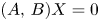 is a linear combination of ${J}_{2d}\alpha _i^{*}$
 , $1\leq i\leq 2d$
 . From the last two equations in (3.5), we know that there exists $c_i, d_i\in \mathbb {C}$
 , $1\leq i \leq 2d$
 , such that $Y=\sum _{i=1}^{2d}c_iJ_{2d}\alpha _i^{*}$
 and $Z=\sum _{i=1}^{2d}d_iJ_{2d}\alpha _i^{*}$
 . The first equation in (3.5) also implies that

So

which is equivalent to (3.3). The proof is complete.
Note that the method used in lemma 4.4 of [Reference Zhu and Shi22] depends on separated and coupled boundary conditions, and thus cannot be applied to lemma 3.8 here for mixing boundary conditions when $d\ge 2$ . With the help of lemma 3.8, we give the derivative formulae of the continuous simple eigenvalue branch with respect to coefficients of the Sturm–Liouville equations.
Lemma 3.9 Fix $\mathbf {A}\in \mathcal {B}^{\mathbb {C}}$ . Let ${\pmb \omega }=(P^{-1},Q,W)\in \Omega _N^{\mathbb {C}},$
 $\lambda _*$
 be a simple eigenvalue of $(\pmb \omega,\mathbf {A}),$
 $y\in l[0, N+1]$
 be a normalized eigenfunction for $\lambda _*,$
 and $\Lambda$
 be the continuous simple eigenvalue branch over $\Omega _N^{\mathbb {C}}$
 through $\lambda _*$
 . Then

for all $(H,K,L)=((H_0,\ldots,H_N), (K_1,\ldots,K_N), (L_1,\ldots,L_N))\in (\mathcal {H}_{d}(\mathbb {C}))^{3N+1}$ and $(P^{-1}+H,Q+K,W+L)\in \Omega _N^{\mathbb {C}}$
 .
Proof. Let $\pmb {\sigma }\in \Omega _N^{\mathbb {C}}$ with $\pmb \sigma =({P}^{-1}+H,{Q}+K,{W}+L)=:(\tilde P^{-1},\tilde Q,\tilde W)$
 . By lemma 3.7, we can choose an eigenfunction $z = z(\cdot, \pmb {\sigma })$
 for $\Lambda =\Lambda (\pmb {\sigma })$
 with $\pmb {\sigma }$
 sufficiently close to $\pmb \omega$
 in $\Omega _N^{\mathbb {C}}$
 such that $z\to y$
 as $\pmb {\sigma }\to \pmb \omega$
 . Then it follows from (1.3) that

By lemma 3.8, we get

which yields that (3.6) holds. This completes the proof.
Let us fix all the components of $\pmb \omega$ except $P_j^{-1}$
 , and write the perturbed term $P_j^{-1}$
 by $P_j^{-1}(\pmb \omega )$
 to indicate its dependence on $\pmb \omega$
 for a given $0\leq j\leq N-1$
 . $Q_i(\pmb \omega )$
 has the similar meaning for $1\leq i\leq N$
 . Then we get the following monotonicity result.
Corollary 3.10 Fix $\mathbf {A}\in \mathcal {B}^{\mathbb{C}}$ . Let $\Lambda$
 be a continuous eigenvalue branch defined on $\mathcal {V}\subset \Omega _N^{\mathbb {C}}$
 . If $P_j^{-1}(\pmb \sigma )-P_j^{-1}(\pmb \omega )$
 is positive semi-definite for a given $0\leq j\leq N-1$
 , then $\Lambda (\pmb \sigma )\leq \Lambda (\pmb \omega )$
 . If $Q_i(\pmb \sigma )-Q_i(\pmb \omega )$
 is positive semi-definite for a given $1\leq i\leq N,$
 then $\Lambda (\pmb \omega )\leq \Lambda (\pmb \sigma )$
 .
Proof. We only prove it for the case that $P_j^{-1}(\pmb \sigma )-P_j^{-1}(\pmb \omega )$ is positive semi-definite, since the other is similar. Let $\pmb \omega (s)=s\pmb \sigma +(1-s)\pmb \omega$
 for $0\leq s\leq 1$
 . Since $\Gamma _{(\pmb \omega (s), \mathbf {A})}(\lambda )=\det (A\Phi _{\pmb \omega (s)}(\lambda )+B \Psi _{\pmb \omega (s)}(\lambda ))$
 is a polynomial of the two variables $s$
 and $\lambda$
 , we have that either there exist finite points $s_1,\ldots,s_{n_0}\in [0,1]$
 such that $\Lambda (\pmb \omega (s))$
 is a simple eigenvalue for $(\pmb \omega (s), \mathbf {A})$
 with $s\in [0,1]\setminus \{ s_1,\ldots,s_{n_0}\}$
 , or $\Lambda (\pmb \omega (s))$
 is a multiple eigenvalue for all $(\pmb \omega (s), \mathbf {A})$
 with $s\in [0,1]$
 , see § 13 in chapter 5 of [Reference Knopp11]. For the former case, choose any $s_0\in [0,1]\backslash \{s_1,\ldots,s_{n_0}\}$
 . Since $\Lambda (\pmb \omega (s_0))$
 is simple, by lemma 3.9 we have

where $y\in l[0, N+1]$ is a normalized eigenfunction for $\Lambda (\pmb \omega (s_0))$
 . This implies that $\Lambda (\pmb \omega (\cdot ))$
 is non-increasing on $[0,1]$
 . Thus, $\Lambda (\pmb \sigma )=\Lambda (\pmb \omega (1))\leq \Lambda (\pmb \omega (0))=\Lambda (\pmb \omega )$
 . For the latter case, there exists $\pmb \tau \in \Omega _N^{\mathbb {C}}$
 such that $\Lambda (\pmb \omega +t\pmb \tau )$
 is a simple eigenvalue for $(\pmb \omega +t\pmb \tau, \mathbf {A})$
 , where $t\in (0,t_0)$
 and $t_0>0$
 is small enough. Then it follows from the former case that $\Lambda (\pmb \omega (\cdot )+t\pmb \tau )$
 is non-increasing on $[0,1]$
 for any fixed $t\in (0,t_0)$
 . Thus,

Then we give the derivative formula of a continuous simple eigenvalue branch with respect to boundary conditions.
Lemma 3.11 Fix $\pmb \omega \in \Omega _N^{\mathbb{C}}$ . Let $\lambda _*$
 be a simple eigenvalue of $(\pmb \omega, \mathbf {A})$
 for some $\mathbf {A}\in \mathcal {O}_{K}^{\mathbb {C}},$
 $y \in l[0, N + 1]$
 be a normalized eigenfunction for $\lambda _*,$
 and $\Lambda$
 be the continuous simple eigenvalue branch through $\lambda _*$
 . Then

for $H\in \mathcal {H}_{2d}(\mathbb {C}),$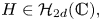 where $E_{K,1}$
 and $Y$
 are given in (2.3) and (3.4), respectively.
Proof. By (2.6), there exists $S\in \mathcal {H}_{2d}(\mathbb {C})$ such that $\mathbf {A}=[S\;|\;I_{2d}]E_K$
 . Let $\mathbf {B}=[S+H\;|\;I_{2d}]E_K$
 with $H\in \mathcal {H}_{2d}$
 . Then there exists an eigenfunction $\tilde y=y_{\Lambda (\mathbf {B})}$
 for $\Lambda (\mathbf {B})$
 such that $\tilde y\to y$
 in $\mathbb {C}^{(N+2)d}$
 as $\mathbf {B}\to \mathbf {A}$
 . $\tilde Y$
 has the similar meaning as $Y$
 . Note that $\tilde y$
 and ${y}$
 satisfy

and thus

where $[y_i,\tilde y_i]=(\Delta \tilde y_i)^{*}P_iy_i-\tilde y_i^{*}P_i\Delta y_i$ . From the boundary conditions $\mathbf {A}$
 and $\mathbf {B}$
 , we have

It then follows from (2.5) and (3.7) that

This completes the proof.
By the derivative formula of a continuous simple eigenvalue branch in lemma 3.11, the following result can be obtained with a similar argument to corollary 3.10.
Corollary 3.12 Fix $\pmb \omega \in \Omega _N^{\mathbb{C}}$ . Let $\Lambda$
 be a continuous eigenvalue branch defined on $\mathcal {U}\subset \mathcal {O}_K^{\mathbb {C}}$
 . Then $\Lambda (\mathbf {A})\leq \Lambda (\mathbf {B})$
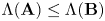 if $\mathbf {A},\mathbf {B}\in \mathcal {U}$
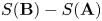
 and $S(\mathbf {B})-S(\mathbf {A})$
 is positive semi-definite.
The monotonicity of continuous eigenvalue branches in corollaries 3.10 and 3.12 plays an important role in studying the asymptotic behaviour of the $n$ -th eigenvalue in a certain direction, see (4.19) and (4.39).
3.3 Properties of the $n$ -th eigenvalue

Based on lemma 3.4, the eigenvalues of $(\pmb \omega,\mathbf {A})\in \Omega _N^{\mathbb {C}} \times \mathcal { B}^{\mathbb {C}}$ can be arranged in the following non-decreasing order:

Therefore, for any $1\leq n\leq Nd$ , the $n$
 -th eigenvalue can be regarded as a function defined on $\Omega _N^{\mathbb {C}} \times \mathcal { B}^{\mathbb {C}}$
 or on its subset, called the $n$
 -th eigenvalue function. Firstly, we provide a criterion for all these functions to be continuous on a subset of $\Omega _N^{\mathbb {C}} \times \mathcal { B}^{\mathbb {C}}$
 .
Lemma 3.13 Let $\mathcal {O}$ be a connected subset of $\Omega ^{\mathbb {C}}_N\times \mathcal {B}^{\mathbb {C}}$
 . If $\sharp _1(\sigma (\pmb \omega,\mathbf {A}))\equiv k_0$
 , $(\pmb \omega,\mathbf {A})\in \mathcal {O},$
 for some $k_0>0$
 , then the restrictions of $\lambda _n$
 , $1\leq n\leq k_0,$
 to $\mathcal {O}$
 are continuous. Moreover, they are locally continuous eigenvalue branches on $\mathcal {O}$
 .
Then we list several other properties of the $n$ -th eigenvalue function in order to study its asymptotic behaviour. The following lemma strengthens the result in theorem 2.2 of [Reference Zhu, Sun, Shi and Wu23].
Lemma 3.14 Let $\mathcal {O}\subset \Omega ^{\mathbb {C}}_N\times \mathcal {B}^{\mathbb {C}},$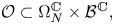 $\sharp _1(\sigma (\pmb \omega,\mathbf {A}))=m_1+m_2+m_3$
 for all $(\pmb \omega,\mathbf {A})\in \mathcal {O},$
 and $\sharp _1(\sigma (\pmb \omega _0,\mathbf {A}_0))=m_2$
 for some $(\pmb \omega _0,\mathbf {A}_0)\in \bar {\mathcal {O}}\setminus \mathcal {O},$
 where $m_i\geq 0,$
 $1\leq i\leq 3$
 . If

and

then

Proof. Let $c_1,c_2\in \mathbb {R}$ such that $\sharp _1(\sigma (\pmb \omega _0,\mathbf {A}_0)\cap (c_1,c_2))=m_2$
 . Then we get by lemma 3.5 that there exists a neighbourhood $\mathcal {U}\subset \mathcal {O}$
 of $(\pmb \omega _0,\mathbf {A}_0)$
 such that $\sharp _1(\sigma (\pmb \omega,\mathbf {A})\cap (c_1,c_2))=m_2$
 and $c_1,c_2\notin \sigma (\pmb \omega,\mathbf {A})$
 for all $(\pmb \omega,\mathbf {A})\in \mathcal {U}$
 . It follows from (3.8)–(3.9) that $\mathcal {U}$
 can be shrunk such that $\sharp _1(\sigma (\pmb \omega,\mathbf {A})\cap (-\infty,c_1))=m_1$
 and $\sharp _1(\sigma (\pmb \omega,\mathbf {A})\cap (c_2,\infty ))=m_3$
 for all $(\pmb \omega,\mathbf {A})\in \mathcal {U}$
 . This implies that $\sigma (\pmb \omega,\mathbf {A})\cap (c_1,c_2)=\{\lambda _{n}(\pmb \omega,\mathbf {A}):\;m_1+1\le n\le m_1+m_2\}$
 for all $(\pmb \omega,\mathbf {A})\in \mathcal {U}$
 . Then the conclusion holds again by lemma 3.5.
Lemma 3.15 Let $\mathcal {O}$ be a connected subset of $\Omega ^{\mathbb {C}}_N\times \mathcal {B}^{\mathbb {C}}$
 and $c_1,c_2\in \mathbb {R}$
 with $c_1< c_2$
 . Assume that for all $(\pmb \omega,\mathbf {A})\in \mathcal {O},$
 $\sharp _1(\sigma (\pmb \omega,\mathbf {A}))=k,$
 $\sharp _1(\sigma (\pmb \omega,\mathbf {A})\cap (c_1, c_2))=m$
 with $m< k,$
 and $c_1, c_2\notin \sigma (\pmb \omega,\mathbf {A})$
 . Then the other $k-m$
 eigenvalues out of $[c_1, c_2],$
 denoted by $\hat {\lambda }_1(\pmb \omega,\mathbf {A})\le \cdots \le \hat {\lambda }_{k-m}(\pmb \omega,\mathbf {A}),$
 have the following properties.
(1) Let $E_i=\{\hat {\lambda }_{i}(\pmb \omega,\mathbf {A}):\,(\pmb \omega,\mathbf {A})\in \mathcal {O}\}$
. Then for all $1\le i\le k-m,$
\[ {\rm either}\, E_i\subset(-\infty,c_1)\; {\rm or}\; E_i\subset (c_2, +\infty), \]and there exists $1\le i_0\le k$ such that $\hat {\lambda }_i=\lambda _{i_0}$ is continuous on $\mathcal {O}$.(2) Let $(\pmb \omega _0,\mathbf {A}_0)\in \bar {\mathcal {O}}\setminus \mathcal {O},$
$\sharp _1(\sigma (\pmb \omega _0,\mathbf {A}_0)) =m,$ and $\sigma (\pmb \omega _0,\mathbf {A}_0)\subset (c_1, c_2)$. If $E_{i_0}\subset (-\infty,c_1)$ for some $1 \le i_0\le k-m$, then
\[ \lim_{\mathcal{O}\ni(\pmb\omega,\mathbf{A})\to (\pmb\omega_0,\mathbf{A}_0)}\hat{\lambda}_{i}(\pmb\omega,\mathbf{A})={-}\infty,\quad 1\leq i\leq i_0. \]If $E_{j_0}\subset (c_2, +\infty )$ for some $1 \le j_0\le k-m$, then
\[ \lim_{\mathcal{O}\ni(\pmb\omega,\mathbf{A})\to (\pmb\omega_0,\mathbf{A}_0)}\hat{\lambda}_{j}(\pmb\omega,\mathbf{A})={+}\infty,\quad j_0\leq j\leq k-m. \]












The following result indicates that the monotonicity of $\lambda _n$ in a certain direction determines its asymptotic behaviour in this direction.
Lemma 3.16 Let $\mathcal {O}=\{(\pmb \omega,\mathbf {A})_{\nu }\in \Omega _N^{\mathbb{C}}\times \mathcal {B}^{\mathbb {C}}: \nu \in (\nu _0-\epsilon,\nu _0+\epsilon )\},$ where $(\pmb \omega,\mathbf {A})_{\nu }$
 is continuously dependent on $\nu \in (\nu _0-\epsilon,\nu _0+\epsilon )$
 for some $\epsilon >0$
 . Assume that $\sharp _1(\sigma (\pmb \omega,\mathbf {A})_{\nu _0})=m \ge 0,$
 and for all $\nu \in (\nu _0-\epsilon,\nu _0+\epsilon )\setminus \{\nu _0\},$
 $\sharp _1(\sigma (\pmb \omega,\mathbf {A})_{\nu })=k>m$
 .
(1) If $\lambda _n(\nu ):=\lambda _n((\pmb \omega,\mathbf {A})_{\nu })$
is non-increasing on $(\nu _0-\epsilon,\nu _0)$ for all $1\le n\le k,$ then
\begin{align*} & \lim_{\nu\to \nu_0^{-}}\lambda_n(\nu)={-}\infty, \quad 1\le n\le k-m, \\ & \lim_{\nu\to \nu_0^{-}}\lambda_n(\nu)=\lambda_{n-(k-m)}(\nu_0), \quad k-m+1\le n\le k. \end{align*}(2) If $\lambda _n(\nu )$
is non-decreasing on $(\nu _0-\epsilon,\nu _0)$ for all $1\le n\le k,$ then
\[ \lim_{\nu\to \nu_0^{-}}\lambda_n(\nu)=\lambda_{n}(\nu_0), \quad 1\le n\le m,\quad \lim_{\nu\to \nu_0^{-}}\lambda_n(\nu)={+}\infty, \ m+1\le n\le k. \](3) If $\lambda _n(\nu )$
is non-increasing on $(\nu _0,\nu _0+\epsilon )$ for all $1\le n\le k,$ then
\[ \lim_{\nu\to \nu_0^{+}}\lambda_n(\nu)=\lambda_{n}(\nu_0), \quad 1\le n\le m, \ \lim_{\nu\to \nu_0^{+}}\lambda_n(\nu)={+}\infty, \ m+1\le n\le k. \](4) If $\lambda _n(\nu )$
is non-decreasing on $(\nu _0,\nu _0+\epsilon )$ for all $1\le n\le k,$ then
\begin{align*} & \lim_{\nu\to \nu_0^{+}}\lambda_n(\nu)={-}\infty, \quad 1\le n\le k-m,\\ & \lim_{\nu\to \nu_0^{+}}\lambda_n(\nu)=\lambda_{n-(k-m)}(\nu_0), \ k-m+1\le n\le k. \end{align*}



Note that the analyses in the proofs of lemmas 3.13, 3.15 and 3.16 are independent of the dimension of the Sturm–Liouville problem (1.3)–(1.4). Thus they are indeed a straightforward generalization of theorems 2.1, 2.3 and lemma 2.7 in [Reference Zhu and Shi22].
4. Jump phenomena of the $n$-th eigenvalue of discrete Sturm–Liouville problems

In this section, we completely characterize jump phenomena of the $n$ -th eigenvalue on the boundary conditions for a fixed equation. Then we characterize jump phenomena of the $n$
 -th eigenvalue on the equations for a fixed boundary condition under a non-degenerate assumption.
4.1 Jump phenomena of the $n$-th eigenvalue on the boundary conditions

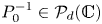
Fix a Sturm–Liouville equation $\pmb \omega =(P^{-1},Q, W)$ such that $P_0^{-1}\in \mathcal {P}_d(\mathbb {C})$
 in this subsection. Let $K\subseteq \{1,2,\ldots,2d\}$
 . For any boundary condition $\mathbf {A}=[A\;|\;B]\in \mathcal {O}_K^{\mathbb {C}}$
 , it follows from (2.6) that there exists $S\in \mathcal {H}_{2d}(\mathbb {C})$
 such that $\mathbf {A}=[(S\,|\, I_{2d})E_{K}]$
 . Let us write $S=S(\mathbf {A})$
 in the partitioned form:

where $S_1, S_3\in \mathcal {H}_d(\mathbb {C})$ and $S_2\in \mathcal {M}_d(\mathbb {C})$
 . Then it follows that

Recall that $A_j, B_j\in \mathcal {M}_{2d\times d}$ , $j=1,2$
 , are defined in (3.2). Then we have

From the structure of $E_1$ and the fact that $P_0^{-1}\in \mathcal {P}_{d}(\mathbb {C})$
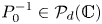 , we infer that $E_1P_0^{-1}+I_d-E_1$
 is invertible. Then it follows that

Recall that $K_2$ is defined in (2.2), and $e_i$
 is the $i$
 -th column of $I_d$
 . For convenience, we set $r=\sharp (K_2)$
 . Let us write $K_2=\{k_1+d,k_2+d,\ldots,k_r+d\}$
 with $1\le k_1< k_2<\cdots < k_r\le d$
 , and

if $K_2\neq \emptyset$ . For any $\mathbf {A}\in \mathcal {B}^{\mathbb{C}}$
 , we define

For any $\mathbf {A}\in \mathcal {O}_K^{\mathbb{C}}$ , we define


Then the following result holds.
Lemma 4.1 Let $\mathbf {A}\in \mathcal {O}_K^{\mathbb{C}}$ . Then

and $S^{D}_K(\mathbf {A})\in \mathcal {H}_{d+r}(\mathbb {C})$ .
Proof. By (2.4), ${\rm rank} (E_2)=d-r$ and thus (4.7) holds. To prove $S^{D}_K(\mathbf {A})\in \mathcal {H}_{d+r}(\mathbb {C})$
 , it suffices to show that

Direct computation gives

Since $(P_0^{-1}E_1+I_d-E_1)$ and $(E_1P_0^{-1}+I_d-E_1)$
 are invertible, we have

which yields (4.8).
Define


for nonnegative integers $r^{0}, r^{\pm }$ with $r^{0}+ r^{-}+ r^{+}=d+r$
 . Equation (4.9) gives the $2d+1$
 layers in $\mathcal {B}^{\mathbb{C}}$
 , while (4.10) divides $\mathcal {O}_K^{\mathbb{C}}$
 into different areas. Theorem 4.4 below indicates that the $n$
 -th eigenvalue exhibits the same jump phenomena in any given area. By lemma 3.4, we have the following result.
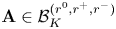
Lemma 4.2 $\sharp _1(\sigma (\pmb \omega,\mathbf {A}))=Nd-k$ for $\mathbf {A}\in \mathcal {B}_k,$
 and $\sharp _1(\sigma (\pmb \omega,\mathbf {A}))= Nd-r^{0}$
 for $\mathbf {A}\in \mathcal {B}_{K}^{(r^{0},r^{+},r^{-})}$
 .
Lemma 4.3 Let $\mathbf {A}\in \mathcal {B}_{K}^{(r_1^{0},r_1^{+},r_1^{-})}$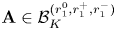 . Then

with $\mathcal {U}_\varepsilon =\{\mathbf {B}\in \mathcal {O}_K^{\mathbb{C}}:\| S(\mathbf {B})- S(\mathbf {A})\|_{\mathcal {M}_{2d}}<\varepsilon \}$ is path connected for any $r^{0}\leq r_1^{0}$
 , $r^{\pm }\geq r_1^{\pm }$
 satisfying $r^{0}+r^{+}+r^{-}=d+r,$
 and $\varepsilon >0$
 sufficiently small.
Proof. The proof is similar to lemma 7.2 in [Reference Hu, Liu, Wu and Zhu8].
We are now in a position to give the complete characterization of jump phenomena of the $n$ -th eigenvalue on the boundary conditions.
Theorem 4.4 Fix $\pmb \omega \in \Omega _N^{\mathbb{C}}$ .
(1) Let $0\leq k\leq 2d$
. Then the restriction of $\lambda _n$ to $\mathcal {B}_k$ is continuous for any $1\leq n\leq Nd-k$.(2) Consider the restriction of $\lambda _n$
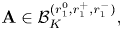
to $\mathcal {O}_K^{\mathbb{C}},$ where $K\subset \{1,\ldots,2d\}$. Let $0\le r^{0}< r^{0}_1\leq d+r$ and $r^{\pm }\geq r_1^{\pm }$. Then for any $\mathbf {A}\in \mathcal {B}_{K}^{(r_1^{0},r_1^{+},r_1^{-})},$ we have
(4.11)\begin{align} & \lim_{\mathcal{B}_K^{(r^{0},r^{+},r^{-})}\ni \mathbf{B}\to \mathbf{A}}\lambda_{n}(\mathbf{B})={-}\infty, \quad 1\le n\le r^{+}-r_1^{+}, \end{align}(4.12)\begin{align} & \lim_{\mathcal{B}_K^{(r^{0},r^{+},r^{-})}\ni\mathbf{B}\to\mathbf{A}}\lambda_{n}(\mathbf{B}) =\lambda_{n-(r^{+}-r^{+}_1)}(\mathbf{A}),\notag\\ & \qquad r^{+}-r_1^{+}< n\le Nd-r^{0}-( r^{-}-r_1^{-}), \end{align}(4.13)\begin{align} & \lim_{\mathcal{B}_K^{(r^{0},r^{+},r^{-})}\ni\mathbf{B}\to \mathbf{A}}\lambda_{n}(\mathbf{B})={+}\infty, \quad Nd-r^{0}-( r^{-}-r_1^{-})< n\le Nd-r^{0}. \end{align}










Consequently, the jump set is $\cup _{1\leq k\leq 2d} \mathcal {B}_k$ .
Proof. (1) is a direct consequence of lemmas 3.13 and 4.2. Now, we prove (2). Note that $\sharp _1(\sigma ({\pmb \omega },\mathbf {A}))=Nd-r_1^{0}$ by lemma 4.2. Choose $c_1,c_2\in \mathbb {R}$
 such that $\sharp _1(\sigma (\pmb \omega,\mathbf {A})\cap (c_1,c_2))=Nd-r_1^{0}$
 . By lemma 3.5, there exists $\varepsilon >0$
 such that for all $\mathbf {B}\in \mathcal {U}_\varepsilon$
 defined in lemma 4.3, we have $\sharp _1(\sigma (\pmb \omega,\mathbf {B})\cap (c_1,c_2))=Nd-r_1^{0}$
 and $c_1,c_2\notin \sigma (\pmb \omega,\mathbf {B})$
 . It follows from lemma 4.3 that $\mathcal {U}_\varepsilon ^{(r^{0},r^{+},r^{-})}$
 is path connected. By lemma 4.2, $\sharp _1(\sigma ({\pmb \omega },\mathbf {B}))=Nd-r^{0}$
 for $\mathbf {B}\in \mathcal {U}_\varepsilon ^{(r^{0},r^{+},r^{-})}$
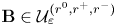 , and thus $\sharp _1(\sigma ({\pmb \omega },\mathbf {B})\cap ((-\infty,c_1)\cup (c_2,+\infty )))=r_1^{0}-r^{0}$
 . Let $\sigma ({\pmb \omega },\mathbf {B})\cap ((-\infty,c_1)\cup (c_2,+\infty )):=\{\hat \lambda _1(\mathbf {B})\leq \cdots \leq \hat \lambda _{r_1^{0}-r^{0}}(\mathbf {B})\}$
 for $\mathbf {B}\in \mathcal {U}_\varepsilon ^{(r^{0},r^{+},r^{-})}$
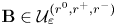 . By lemma 3.15 (1), either $\hat \lambda _n(\mathcal {U}_\varepsilon ^{(r^{0},r^{+},r^{-})})\subset (-\infty,c_1)$
 or $\hat \lambda _n(\mathcal {U}_\varepsilon ^{(r^{0},r^{+},r^{-})})\subset (c_2, +\infty )$
 for all $1\leq n\leq r_1^{0}-r^{0}$
 . Then we divide our proof in two steps.
Step 1. We show that


for $r^{+}>r_1^{+}, r^{-}=r_1^{-}$ ; and


for $r^{+}=r_1^{+}, r^{-}>r_1^{-}$ .
Consider $r^{+}>r_1^{+}$ and $r^{-}=r_1^{-}$
 . In this case, $r_1^{0}-r^{0}=r^{+}-r_1^{+}$
 . Note that there exists a unitary matrix $M\in \mathcal {M}_{d+r}$
 such that

where $M_+={\rm diag}\{\mu _1,\ldots,\mu _{r_1^{+}} \}$ with $\mu _{i}>0$
 , $1\leq i\leq r_1^{+}$
 , and $M_-={\rm diag}\{\nu _1,\ldots, \nu _{r_1^{-}} \}$
 with $\nu _j<0$
 , $1\leq j\leq r_1^{-}$
 . Recall that $S=S(\mathbf {A})$
 . If $K_2\neq \emptyset$
 , we define $\mathbf {B}_t=[S(\mathbf {B}_t)\,|\,I_{2d}]E_K$
 with

$t\geq 0$ is sufficiently small, and $s_{ij}(\mathbf {B}_t)=s_{ij}$
 if $i\in \{d+1,\ldots,2d\}\setminus K_2$
 or $j\in \{d+1,\ldots,2d\}\setminus K_2$
 . If $K_2=\emptyset$
 , we only modify (4.18) as

in the definition of $\mathbf {B}_t$ . Then $\mathbf {B}_0=\mathbf {A}$
 ,

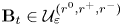
and thus $r^{0}(S^{D}_K(\mathbf {B}_t))=r^{0}$ , $r^{\pm }(S^{D}_K(\mathbf {B}_t))=r^{\pm }$
 , which gives $\mathbf {B}_t\in \mathcal {U}_\varepsilon ^{(r^{0},r^{+},r^{-})}$
 . Moreover, $\sharp _1(\sigma ({\pmb \omega },\mathbf {B}_t))$
 $=Nd-r^{0}$
 for $t>0$
 , and $\sharp _1(\sigma ({\pmb \omega },\mathbf {B}_0))=Nd-r_1^{0}$
 . It follows from lemma 3.13 that for any fixed $1\leq n\leq Nd-r^{0}$
 , $\lambda _n(\mathbf {B}_{\cdot })$
 is locally a continuous eigenvalue branch for $t>0$
 . Since

is a positive semi-definite matrix, we get by corollary 3.12 that $\lambda _n(\mathbf {B}_{t_1})\leq \lambda _n(\mathbf {B}_{t_2})$ with $0< t_1< t_2$
 for all $1\leq n \leq Nd-r^{0}$
 . Hence, by lemma 3.16 (4), $\lim _{t\rightarrow {0}^{+}}\lambda _{n}({\mathbf {B}}_t)=-\infty, 1\leq n\leq r^{+}-r_1^{+}.$
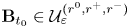
 Therefore, there exists $t_0>0$
 such that $\mathbf {B}_{t_0}\in \mathcal {U}_\varepsilon ^{(r^{0},r^{+},r^{-})}$
 and ${\lambda }_{n}(\mathbf {B}_{t_0})< c_1$
 , $1\leq n\leq r^{+}-r_1^{+}$
 , which yields that $\hat {\lambda }_{n}(\mathbf {B}_{t_0})={\lambda }_{n}(\mathbf {B}_{t_0})$
 . According to lemma 3.15 (1), $\hat \lambda _n(\mathcal {U}_\varepsilon ^{(r^{0},r^{+},r^{-})})={\lambda }_{n}(\mathcal {U}_\varepsilon ^{(r^{0},r^{+},r^{-})})\subset (-\infty,c_1)$
 , $1\leq n\leq r^{+}-r_1^{+}$
 , and (4.14) holds. Thanks to lemma 3.14, we get (4.15).
Consider $r^{+}=r_1^{+}$ and $r^{-}>r_1^{-}$
 . Since (4.16)–(4.17) can be shown in a similar way, we omit the details.
Step 2. Show that (4.11)–(4.13) hold for $r^{\pm }>r_1^{\pm }$ .
In this case, $r_1^{0}-r^{0}=(r^{+}-r_1^{+})+(r^{-}-r_1^{-})$ . It follows from (4.14) and (4.17) that

This implies that $\lambda _n(\tilde {\mathbf {B}}_1) \in (-\infty,c_1)$ with $1\leq n\leq r^{+}-r_1^{+}$
 , and $\lambda _{n}(\tilde {\mathbf {B}}_2)\in (c_2,+\infty )$
 with $Nd-r_1^{0}< n\leq Nd-r_1^{0}+(r^{-}-r_1^{-})$
 for any fixed $\tilde {\mathbf {B}}_1\in \mathcal {U}_\varepsilon ^{(r_1^{0}-(r^{+}-r_1^{+}),r^{+},r_1^{-})}$
 and $\tilde {\mathbf {B}}_2\in \mathcal {U}_\varepsilon ^{(r_1^{0}-(r^{-}-r_1^{-}),r_1^{+},r^{-})}$
 .
Note that $(r^{0},r^{+},r^{-})=(r_1^{0}-(r^{+}-r_1^{+})-(r^{-}-r^{-}_1),r^{+},r_1^{-}+(r^{-}-r_1^{-}))$ . Then we infer from (4.16) that

Since $N\geq 2$ , we get that

Therefore, there exists $\tilde {\mathbf {B}}_3\in \mathcal {U}_\varepsilon ^{(r^{0},r^{+},r^{-})}$ such that $\lambda _n(\tilde {\mathbf {B}}_3) \in (-\infty,c_1)$
 with $1\leq n\leq r^{+}-r_1^{+}$
 .
On the other hand, $(r^{0},r^{+},r^{-})=(r_1^{0}-(r^{+}-r_1^{+})-(r^{-}-r_1^{-}),r_1^{+}+(r^{+}-r_1^{+}),r^{-})$ . Thus we get by (4.15) that

which, along with (4.20), yields that there exists $\tilde {\mathbf {B}}_4\in \mathcal {U}_\varepsilon ^{(r^{0},r^{+},r^{-})}$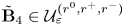 such that $\lambda _n(\tilde {\mathbf {B}}_4) \in (c_2,+\infty )$
 with $Nd-r^{0}-(r^{-}-r_1^{-})< n\leq Nd-r^{0}$
 . Therefore, we have shown

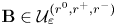
Note that $\mathcal {U}_\varepsilon ^{(r^{0},r^{+},r^{-})}$ is path connected and $\sharp _1(\sigma (\pmb \omega,{\mathbf {B}})\cap (c_1,c_2))=Nd-r_1^{0}=Nd-r^{0}-(r^{+}-r_1^{+})-(r^{-}-r_1^{-})$
 for all $\mathbf {B}\in \mathcal {U}_\varepsilon ^{(r^{0},r^{+},r^{-})}$
 . Thus we infer from (4.21) and lemma 3.15 (1) that $\lambda _n(\mathcal {U}_\varepsilon ^{(r^{0},r^{+},r^{-})})\subset (-\infty,c_1)$
 for all $1\leq n\leq r^{+}-r_1^{+}$
 , and $\lambda _{n}(\mathcal {U}_\varepsilon ^{(r^{0},r^{+},r^{-})})\subset (c_2,+\infty )$
 for all $Nd-r^{0}-(r^{-}-r_1^{-})< n\leq Nd-r^{0}$
 . Then it follows from lemma 3.15 (2) that (4.11) and (4.13) hold. This, along with lemma 3.14, implies that (4.12) holds. This completes the proof.
4.2 Jump phenomena of the $n$-th eigenvalue on the Sturm–Liouville equations

Fix a boundary condition $\mathbf {A}=[(A_1,\;A_2)|(B_1,\;B_2)]=[S\;|\;I_{2d}]E_K\in \mathcal {O}_K^{\mathbb{C}}$ . In this subsection, we always assume that one of the following non-degenerate conditions holds:


where $E_0$ is defined in (4.3) and $R:=S_1E_1+E_1-I_d$
 . In particular, the assumption holds for any $\mathbf {A}\in \mathcal {O}_K^{\mathbb{C}}$
 when $K_1=\{1,\ldots,d\}$
 and $K_2=\emptyset$
 . For any $\pmb \omega =(P^{-1},Q,W)\in \Omega _N^{\mathbb{C}}$
 , we have by (4.1) that

Then

Next, we analyse the partitioned structure of the matrix above.
Lemma 4.5 $[E_1-I_d+E_1R^{-1}(S_1(I_d-E_1)+E_1)]R^{*}=I_d$ and $S_2^{*}E_1R^{-1}S_2-S_3\in \mathcal {H}_d(\mathbb {C})$
 .
Proof. Direct computation gives

Since

we have

$S_2^{*}E_1R^{-1}S_2-S_3\in \mathcal {H}_d(\mathbb {C})$ follows directly from (4.25).
By lemma 4.5, we have $S_2^{*}[E_1-I_d+E_1R^{-1}(S_1(I_d-E_1)+E_1)]=(R^{-1}S_2)^{*}$ . In the case that $K_2\neq \emptyset$
 , we define

Then by assumption (4.22) and lemma 4.5, $\hat T_2\in \mathcal {H}_r(\mathbb {C})$ is invertible. Direct computation implies that

In the case that $K_2=\emptyset$ , we have $E_2=I_d$
 . Then the next transformation after (4.24) is

where $\tilde R= S_2^{*}[E_1-I_d+E_1R^{-1}(S_1(I_d-E_1)+E_1)]$ . For any $\pmb \omega \in \Omega _N^{\mathbb{C}}$
 , we define


and $F(\pmb \omega ):=(A_1P_0^{-1}+B_1,\,B_2)$ in both cases. Then ${\rm rank}\, F(\pmb \omega )= {\rm rank}\,T(\pmb \omega )+d.$
 Moreover, we have the following result.
Lemma 4.6 Let $\pmb \omega \in \Omega _N^{\mathbb{C}}$ . Then $T(\pmb \omega )\in \mathcal {H}_{d}(\mathbb {C})$
 .
Proof. Since

and $R$ is invertible, we have

This implies that $P_0^{-1}+ R^{-1}(S_1(I_d-E_1)+E_1)\in \mathcal {H}_{d}(\mathbb {C})$ . Since $\hat T_2\in \mathcal {H}_r(\mathbb {C})$
 when $K_2\neq \emptyset$
 , we get $T(\pmb \omega )\in \mathcal {H}_{d}(\mathbb {C})$
 .
Let

Then $l_1\leq d$ . Define


for attainable nonnegative integers $r^{0}, r^{+}, r^{-}$ with $r^{0}+ r^{+}+ r^{-}=d$
 . The $l_1+1$
 layers of $\Omega _N^{\mathbb{C}}$
 are given in (4.30), while the areas’ division is provided in (4.31). Note here that not all the nonnegative integers $0\leq r^{0},r^{\pm }\leq d$
 satisfying $r^{0}+r^{+}+r^{-}=d$
 can be achievable in general, since $P_0^{-1}\in \mathcal {P}_d(\mathbb {C})$
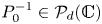 while it is not necessary that $P_0^{-1}-T(\pmb \omega )\in \mathcal {P}_d(\mathbb {C})$
 . Similarly, it is possible that $l_1< d$
 . The following result is a direct consequence of lemma 3.4.
Lemma 4.7 $\sharp _1(\sigma (\pmb \omega,\mathbf {A}))=Nd-k$ for any $\pmb \omega \in \mathcal {E}_k$
 , and $\sharp _1(\sigma (\pmb \omega,\mathbf {A}))= Nd-r^{0}$
 for any $\pmb \omega \in \mathcal {E}^{(r^{0},r^{+},r^{-})}$
 .
Note that the transformations (4.24), (4.26) and (4.27) are independent of $\pmb \omega \in \Omega _N^{\mathbb{C}}$ . Moreover, the following result holds by the construction of $T(\pmb \omega )$
 and a similar argument to that in the proof of lemma 7.2 in [Reference Hu, Liu, Wu and Zhu8].
Lemma 4.8 Let $\pmb \omega \in \mathcal {E}^{(r_1^{0},r_1^{+},r_1^{-})}$ . Then $\mathcal {V}_\varepsilon ^{(r^{0},r^{+},r^{-})}:=\{\pmb \sigma \in \Omega _N^{\mathbb{C}}:\| \pmb \sigma - \pmb \omega \|_{\mathbb {C}^{(3N+1)d^{2}}}<\varepsilon \}\cap \mathcal {E}^{(r^{0},r^{+},r^{-})}$
 is path connected for any $0\leq r^{0}\leq r_1^{0},$
 $r^{\pm }\geq r_1^{\pm }$
 satisfying $r^{0}+r^{+}+r^{-}=d,$
 and $\varepsilon >0$
 sufficiently small.
Theorem 4.9 Fix $\mathbf {A}\in \mathcal {O}_K^{\mathbb{C}}$ .
(1) Let $0\leq k\leq l_1$
. Then the restriction of $\lambda _n$ to $\mathcal {E}_k$ is continuous for any $1\leq n\leq Nd-k$.(2) Consider the restriction of $\lambda _n$
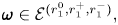
to $\Omega _N^{\mathbb{C}}$. Let $0\le r^{0}< r^{0}_1\leq l_1$ and $r^{\pm }\geq r_1^{\pm }$. Then for any $\pmb \omega \in \mathcal {E}^{(r_1^{0},r_1^{+},r_1^{-})},$ we have
(4.32)\begin{align} & \lim_{\mathcal{E}^{(r^{0},r^{+},r^{-})}\ni \pmb{\sigma}\to \pmb{\omega}}\lambda_{n}(\pmb\sigma)={-}\infty, \quad 1\le n\le r^{-}-r_1^{-}, \end{align}(4.33)\begin{align} & \lim_{\mathcal{E}^{(r^{0},r^{+},r^{-})}\ni\pmb{\sigma}\to \pmb{\omega}}\lambda_{n}(\pmb\sigma) =\lambda_{n-(r^{-}-r^{-}_1)}(\pmb\omega),\notag\\ & \qquad r^{-}-r_1^{-}< n\le Nd-r^{0}-( r^{+}-r_1^{+}), \end{align}(4.34)\begin{align} & \lim_{\mathcal{E}^{(r^{0},r^{+},r^{-})}\ni\pmb{\sigma}\to \pmb{\omega}}\lambda_{n}(\pmb{\sigma})={+}\infty, \quad Nd-r^{0}-( r^{+}-r_1^{+})< n\le Nd-r^{0}. \end{align}









Consequently, the jump set is $\cup _{1\leq k\leq l_1}\mathcal {E}_k$ .
Proof. By lemma 4.7, $\sharp _1(\sigma (\pmb \omega,\mathbf {A}))=Nd-k$ for any $\pmb \omega \in \mathcal {E}_k$
 . It follows from lemma 3.13 that (1) holds. Choose $c_1,c_2\in \mathbb {R}$
 such that $\sharp _1(\sigma (\pmb \omega,\mathbf {A})\cap (c_1,c_2))=Nd-r_1^{0}$
 . Then lemmas 3.5, 3.15 (1) and 4.8 ensure that for $\pmb \sigma \in \mathcal {V}_\varepsilon ^{(r^{0},r^{+},r^{-})}$
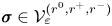 with $\varepsilon >0$
 small enough, all the eigenvalues of $(\pmb \sigma,\mathbf {A})$
 outside
 $[c_1,c_2]$, denoted by $\tilde \lambda _1(\pmb \sigma )\leq \cdots \leq \tilde \lambda _{r_1^{0}-r^{0}}(\pmb \sigma )$
 , satisfy that either $\tilde \lambda _n(\mathcal {V}_\varepsilon ^{(r^{0},r^{+},r^{-})})\subset (-\infty,c_1)$
 or $\tilde \lambda _n(\mathcal {V}_\varepsilon ^{(r^{0},r^{+},r^{-})})\subset (c_2, +\infty )$
 , $1\leq n\leq r_1^{0}-r^{0}$
 . Then we divide our proof in two steps.
Step 1. We show that


for $r^{-}>r_1^{-}, r^{+}=r_1^{+}$ ; and


for $r^{-}=r_1^{-}, r^{+}>r_1^{+}$ .
We only prove (4.35)–(4.36), since (4.37)–(4.38) can be proved similarly. Let $L\in \mathcal {M}_{d}(\mathbb {C})$ be a unitary matrix such that $T(\pmb \omega )=L\,{\rm diag}\{\tilde \mu _1,\ldots,\tilde \mu _{d} \}L^{*},$
 where $\tilde \mu _{i}$
 , $1\leq i\leq d$
 , are the eigenvalues of $T(\pmb \omega )$
 and $\tilde \mu _1=\cdots =\tilde \mu _{r_1^{0}}=0$
 . Recall that $P_0^{-1}(\pmb \omega )$
 is used to indicate its dependence on $\pmb \omega$
 , while all the components of $\pmb \omega$
 except $P_0^{-1}$
 are fixed. Define

with $t\leq 0$ small enough. Then $\pmb \sigma _0=\pmb \omega$
 and $\pmb {\sigma }_t\in \mathcal {V}_\varepsilon ^{(r^{0},r^{+},r^{-})}$
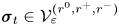 , $t<0$
 . Since $P_0^{-1}(\pmb \sigma _{t_2})-P_0^{-1}(\pmb \sigma _{t_1})$
 is a positive semi-definite matrix for $t_1< t_2<0$
 , we infer from corollary 3.10 and lemma 3.13 that $\lambda _n(\pmb \sigma _{t_1})\geq \lambda _n(\pmb \sigma _{t_2})$
 for each $1\leq n \leq Nd-r^{0}$
 . Hence, by lemma 3.16 (1), $\lim _{t\rightarrow {0}^{-}}\lambda _{n}(\pmb \sigma _{t})=-\infty, 1\leq n\leq r^{-}-r_1^{-}.$
 Then we get by lemma 3.15 that $\tilde {\lambda }_{n}(\mathcal {V}_\varepsilon ^{(r^{0},r^{+},r^{-})})={\lambda }_{n}(\mathcal {V}_\varepsilon ^{(r^{0},r^{+},r^{-})})\subset (-\infty,c_1)$
 , $1\leq n\leq r^{-}-r_1^{-}$
 , satisfy (4.35). This, along with lemma 3.14, yields (4.36).
Step 2. Show that (4.32)–(4.34) hold for $r^{\pm }>r_1^{\pm }$ .
By (4.35) and (4.38), we have $\lambda _n(\tilde {\pmb \sigma }_1) \in (-\infty,c_1)$ with $1\leq n\leq r^{-}-r_1^{-}$
 , and $\lambda _{n}(\tilde {\pmb \sigma }_2)\in (c_2,+\infty )$
 with $Nd-r_1^{0}< n\leq Nd-r_1^{0}+(r^{+}-r_1^{+})$
 for any fixed $\tilde {\pmb \sigma }_1\in \mathcal {V}_\varepsilon ^{(r_1^{0}-(r^{-}-r_1^{-}),r_1^{+},r^{-})}$
 and $\tilde {\pmb \sigma }_2\in \mathcal {V}_\varepsilon ^{(r_1^{0}-(r^{+}-r_1^{+}),r^{+},r_1^{-})}$
 . Then we infer from (4.36)–(4.37) that

Since $Nd-r^{0}-(r^{+}-r_1^{+})\geq r^{-}-r_1^{-}$ , we obtain that there exists $\tilde {\pmb {\sigma }}_3\in \mathcal {V}_\varepsilon ^{(r^{0},r^{+},r^{-})}$
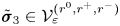 such that $\lambda _n(\tilde {\pmb {\sigma }}_3) \in (-\infty,c_1)$
 with $1\leq n\leq r^{-}-r_1^{-}$
 , and there exists $\tilde {\pmb {\sigma }}_4\in \mathcal {V}_\varepsilon ^{(r^{0},r^{+},r^{-})}$
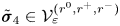 such that $\lambda _n(\tilde {\pmb {\sigma }}_4) \in (c_2,+\infty )$
 with $Nd-r^{0}-(r^{+}-r_1^{+})< n\leq Nd-r^{0}$
 . This implies that

for all $\pmb {\sigma }\in \mathcal {V}_\varepsilon ^{(r^{0},r^{+},r^{-})}$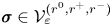 . Then lemma 3.15 (2) ensures that (4.32) and (4.34) hold. Finally, (4.33) is obtained by lemma 3.14.
5. Applications to $d$-dimensional Sturm–Liouville problems of Atkinson type

Consider the $d$ -dimensional Sturm–Liouville problem of Atkinson type with $d\geq 1$
 . The continuous Sturm–Liouville equation is

where $\hat P, \hat Q$ and $\hat W$
 are $d\times d$
 Hermitian matrix-valued functions on $[a,b]$
 , and

The self-adjoint boundary condition is given by

where $A$ and $B$
 are $2d\times 2d$
 complex matrices, where $A$
 and $B$
 satisfy (1.6). Let $u=y$
 and $v=\hat Py'$
 . Then (5.1) is transformed to

on $(a,b)$ . Equation (5.1) is said to be of Atkinson type if there exists a partition of the interval $(a,b)$
 ,

for some $N>1$ such that

and

Note that (5.1) is a formal equation due to the definition of $\hat P^{-1}$ in (5.4). The conditions (5.4)–(5.5) for Atkinson type should be understood in the sense of (5.3), where $\hat P^{-1}$
 is regarded as a notation, see also (1.3) and (2.2) in [Reference Kong, Volkmer and Zettl12], or (1.2) and (H4) in [Reference Kong, Wu and Zettl15]. A $d$
 -dimensional Sturm–Liouville problem is said to be of Atkinson type if it consists of (5.1) of Atkinson type and a self-adjoint boundary condition. A $1$
 -dimensional case has been studied in [Reference Ao, Sun and Zettl1, Reference Atkinson4, Reference Kong, Volkmer and Zettl12, Reference Kong, Wu and Zettl15]. In this section, we always assume that (5.1)–(5.2) is of Atkinson type. The space of Sturm–Liouville equations of Atkinson type is

with topology induced by $(L((a,b),\mathbb {C}^{d\times d}))^{3}$ . $\pmb {\hat \omega }=(\hat P^{-1},\hat Q, \hat W)$
 is used for an element in $\hat \Omega$
 . Note that the space of self-adjoint boundary conditions is also $\mathcal { B}^{\mathbb {C}}$
 defined by (2.1). Set

It follows from (5.4)–(5.5) that if $(u,v)$ is a solution of (5.3), then $u(t)\equiv u_i\in \mathcal {M}_{d\times 1}$
 is a constant vector on $[a_i,b_i]$
 , $0\leq i\leq N$
 , and $v(t)\equiv v_j\in \mathcal {M}_{d\times 1}$
 is a constant vector on $[b_{j-1},a_j]$
 , $1\leq j\leq N$
 . Furthermore, we define

We construct a $d$ -dimensional discrete Sturm–Liouville problem as follows:

where $\hat P_{N+1}=\hat P_0=I_{d}$ , and a boundary condition

where $A$ and $B$
 are given in (5.2). By writing $A$
 and $B$
 into the form (3.2), direct computation implies that (5.8) is equivalent to the standard discrete boundary condition:

Now we show that (5.1)–(5.2) is equivalent to the constructed discrete Sturm–Liouville problem above.
Lemma 5.1
Proof. Firstly, we show that (1) holds. Since $A$ and $B$
 satisfy (1.6), we have

Thus

and

It follows that (5.9) is a self-adjoint boundary condition. Since $\hat P_{j+1},\hat Q_i, \hat W_i$ are Hermitian, $\hat P_{j+1}$
 is invertible, and $\hat W_i\in \mathcal {P}_d(\mathbb {C})$
 for $0\leq i\leq N$
 and $-1\leq j\leq N$
 , we have

Hence, (1) holds.
Next, we prove (2). It suffices to show that (5.3) with (5.2) is equivalent to (5.7)–(5.8). Let $(u,v)$ be a solution of (5.3). Since $v\equiv v_i$
 is a constant vector on $[b_{i-1},a_{i}]$
 , we have

for any $1\leq i\leq N$ , which, together with (5.6) and the fact that $\hat P_{N+1}=\hat P_0=I_{d}$
 , yields that

Since $u\equiv u_j$ is a constant vector on $[a_{j},b_{j}]$
 , we obtain

for any $0\leq j\leq N$ . Then (5.7) is obtained by combining (5.10)–(5.11).
Conversely, let $\{u_i\}_{i=-1}^{N+1}$ be a solution of (5.7) and define $v_i=\hat P_i(u_i-u_{i-1})$
 for $0\leq i\leq N+1$
 . Let $u(t)=u_i$
 for all $t\in [a_i,b_i]$
 and $0\leq i\leq N$
 , $v(t)=v_j$
 for all $t\in [b_{j-1},a_j]$
 and $1\leq j\leq N$
 , $v(a)=v_0$
 , and

Then $(u,v)$ is a solution of (5.3).
Moreover, $y(a)=u_0$ , $y(b)=u_{N}$
 , $(\hat P y')(a)=v(a)=u_0-u_{-1}=\Delta u_{-1}$
 and $(\hat P y')(b)=v(b)=u_{N+1}-u_{N}=\Delta u_N$
 . Thus (5.2) is equivalent to (5.8).
By transforming the Sturm–Liouville problem of Atkinson type to the discrete case, we can now determine the number of eigenvalues in the following lemma, which generalizes theorems 2.1 and 3.1 in [Reference Kong, Wu and Zettl15] for 1-dimension to any dimension.
Lemma 5.2 Let $(\pmb {\hat \omega },\mathbf {A})\in \hat \Omega \times \mathcal { B}^{\mathbb {C}}$ with $\mathbf {A}$
 given in (3.2). Then the eigenvalues of $(\pmb {\hat \omega },\mathbf {A}),$
 including multiplicities, are the same as those of $(\pmb \tau,\mathbf {A})=(\pmb \tau,\mathbf {C}),$
 and

where $\pmb \tau \in \Omega _{N+1}^{\mathbb{C}}$ is the transformed discrete Sturm–Liouville equation by $\pmb {\hat \omega }$
 , and

Remark 5.3 Note that here $\mathbf {A}$ is under the basis $(-u_0,u_N, \Delta u_{-1},\Delta u_N)$
 when we write $(\pmb \tau,\mathbf {A})$
 , while $\mathbf {C}$
 is under the standard basis $(-u_{-1},u_N, \Delta u_{-1},\Delta u_N)$
 when we write $(\pmb \tau,\mathbf {C})$
 . In this sense, $(\pmb \tau,\mathbf {A})=(\pmb \tau,\mathbf {C})$
 .
Proof. By lemma 5.1 (2), $(\pmb {\hat \omega },\mathbf {A})$ is equivalent to $(\pmb {\tau },\mathbf {A})=(\pmb {\tau },\mathbf {C})$
 , and $\hat P_0=I_d$
 . Then applying lemma 3.4 to $(\pmb {\tau },\mathbf {C})$
 , we have

This completes the proof.
Then we study jump phenomena of the $n$ -th eigenvalue of $d$
 -dimensional Sturm–Liouville problems of Atkinson type. We first claim in proposition 5.4 below that there is no singularity of the $n$
 -th eigenvalue on the equations. In fact, for a fixed $\mathbf {A}\in \mathcal {B}^{\mathbb{C}}$
 , we infer from lemma 5.2 that $\sharp _1(\sigma (\pmb {\hat \omega },\mathbf {A}))$
 is independent of $\pmb {\hat \omega }\in \hat \Omega$
 . This, together with lemma 3.13, implies the following result.
Proposition 5.4 Fix $\mathbf {A}=[A\;|\;B]\in \mathcal {B}^{\mathbb{C}}$ . Then the $n$
 -th eigenvalue is continuous on the whole space of Sturm–Liouville equations of Atkinson type $\hat \Omega$
 for all $1\leq n\leq \sharp _1(\sigma (\pmb {\hat \omega },\mathbf {A}))=(N-1)d+\textrm {rank}(B).$

Next, we consider jump phenomena of the $n$ -th eigenvalue on the boundary conditions. Lemma 5.2 indicates that it suffices to study jump phenomena of the $n$
 -th eigenvalue of $(\pmb \tau,\mathbf {C})=(\pmb \tau,\mathbf {A})$
 for the fixed $\pmb \tau$
 . The coupled term $B_1-A_1$
 in the standard boundary condition $\mathbf {C}$
 makes it hard to apply theorem 4.4 to $(\pmb \tau,\mathbf {C})$
 directly. We shall apply the method developed in § 3 and 4 to the discrete Sturm–Liouville problem $(\pmb \tau,\mathbf {A})$
 and provide a direct proof here. In order to study jump phenomena in a certain direction, we need the derivative formula of a continuous simple eigenvalue branch.
Lemma 5.5 Fix $\pmb {\tau }\in \Omega _{N+1}^{\mathbb{C}}$ . Let $\lambda _*$
 be a simple eigenvalue of $(\pmb \tau, \mathbf {A})$
 for $\mathbf {A}\in \mathcal {O}_{K}^{\mathbb{C}},$
 $u \in l[-1, N + 1]$
 be a normalized eigenfunction for $\lambda _*,$
 and $\Lambda$
 be the continuous simple eigenvalue branch through $\lambda _*$
 . Then we have the following derivative formula

for $H\in \mathcal {H}_{2d}(\mathbb {C}),$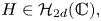 where

Remark 5.6 Lemma 3.11 is unable to be directly applied here due to the different basis. Note carefully that $Z$ in lemma 5.5 is different from $Y$
 in lemma 3.11.
Proof. Recall that there exists $S\in \mathcal {H}_{2d}(\mathbb {C})$ such that $\mathbf {A}=[S\;|\;I_{2d}]E_K$
 . Let $\mathbf {B}=[S+H\;|\;I_{2d}]E_K$
 with $H\in \mathcal {H}_{2d}(\mathbb {C})$
 . Then by lemma 3.7, there exists an eigenfunction $\tilde u=\{\tilde u_i\}_{i=-1}^{N+1}$
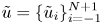 for $\Lambda (\mathbf {B})$
 such that $\tilde u\to u$
 in $\mathbb {C}^{(N+2)d}$
 as $\mathbf {B}\to \mathbf {A}$
 . Note that $\tilde u$
 and ${u}$
 satisfy

and thus

where $\lfloor u_i,\tilde u_i\rfloor =(\Delta \tilde u_i)^{*}\hat P_{i+1}u_i-\tilde u_i^{*}\hat P_{i+1}\Delta u_i.$ $\mathbf {A}$
 and $\mathbf {B}$
 tell us that $SE_{K,1}Z+E_{K,2}Z=0$
 and $(S+H)E_{K,1}\tilde Z+E_{K,2}\tilde Z=0$
 . Then we infer from (2.5) that

This completes the proof.
As a consequence, we get the following conclusion.
Corollary 5.7 Let $\Lambda$ be a continuous eigenvalue branch defined on $\mathcal {U}\subset \mathcal {O}_K^{\mathbb {C}}$
 . Then $\Lambda (\mathbf {A})\leq \Lambda (\mathbf {B})$
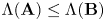 if $\mathbf {A},\mathbf {B}\in \mathcal {U}$
 and $S(\mathbf {B})-S(\mathbf {A})$
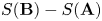 is positive semi-definite.
Let the $k$ -th layer in $\mathcal {B}^{\mathbb{C}}$
 be defined as

Then the following result is a direct consequence of lemma 5.2.
Corollary 5.8 Fix $\pmb {\hat \omega }\in \hat \Omega$ . Then
(1) $\sharp _1(\sigma (\pmb {\hat \omega },\mathbf {A}))=(N+1)d-k$
for all $\mathbf {A}\in \hat \Sigma _{k}$.(2) $\sharp _1(\sigma (\pmb {\hat \omega },\mathbf {A}))=(N+1)d$
for all $\mathbf {A}\in \mathcal {O}_\emptyset ^{\mathbb {C}}$.




For a nonempty subset $K=\{n_1,\ldots,n_{m_0}\}\subset \{1,\ldots, 2d\}$ , we define $\hat E_0=(\hat e_{n_1},\ldots,\hat e_{n_{m_0}})$
 , and

where $\mathbf {A}\in \mathcal {O}_K^{\mathbb{C}}$ , and $\hat e_i$
 is the $i$
 -th column of $I_{2d}.$
 The divided area is defined by

for three nonnegative integers $r^{0},$ $r^{+}$
 and $r^{-}$
 satisfying $r^{0}+r^{+}+r^{-}=m_0$
 . Then we are ready to provide the complete characterization of jump phenomena of the $n$
 -th eigenvalue for the Atkinson type.
Theorem 5.9 Fix $\pmb {\hat \omega }\in \hat \Omega$ .
(1) Let $0\leq k\leq 2d$
. Then the restriction of $\lambda _n$ to $\hat \Sigma _k$ is continuous for any $1\leq n\leq (N+1)d-k$. Moreover, the restriction of $\lambda _n$ to $\mathcal {O}_\emptyset ^{\mathbb {C}}$ is continuous for any $1\leq n\leq (N+1)d$.(2) Consider the restriction of $\lambda _n$
to $\mathcal {O}_K^{\mathbb {C}}$, where $\emptyset \neq K\subset \{1,\ldots,2d\}$. Let $0\leq r^{0}< r^{0}_1\leq \sharp (K)$ and $r^{\pm }\geq r_1^{\pm }$. Then for any $\mathbf {A}\in J^{(r_1^{0},r_1^{+},r_1^{-})}_{{K}},$ we have
(5.13)\begin{align} & \lim\limits_{J^{(r^{0},r^{+},r^{-})}_{{K}}\ni\mathbf{B}\to\mathbf{A}}\lambda_n(\mathbf{B})={-}\infty,\quad 1\leq n\leq r^{+}-r_1^{+}, \end{align}(5.14)\begin{align} & \lim_{J_K^{(r^{0},r^{+},r^{-})}\ni\mathbf{B}\to\mathbf{A}}\lambda_{n}(\mathbf{B}) =\lambda_{n-(r^{+}-r^{+}_1)}(\mathbf{A}),\notag\\ & \qquad r^{+}-r_1^{+}< n\le (N+1)d-r^{0}-( r^{-}-r_1^{-}), \end{align}(5.15)\begin{align} & \lim_{J_K^{(r^{0},r^{+},r^{-})}\ni\mathbf{B}\to \mathbf{A}}\lambda_{n}(\mathbf{B})={+}\infty,\notag\\ & \qquad (N+1)d-r^{0}-( r^{-}-r_1^{-})< n\le (N+1)d-r^{0}. \end{align}











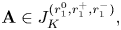


Consequently, the jump set is $\cup _{1\leq k\leq 2d}\hat \Sigma _k$ .
Remark 5.10 Note that $S_K^{A}(\mathbf {A})$ is independent of the Sturm–Liouville equations of Atkinson type, while $S_K^{D}(\mathbf {A})$
 defined in (4.5)–(4.6) is indeed involved heavily with the coefficient $P_0^{-1}$
 of the discrete equations.
Proof. We study the equivalent discrete Sturm–Liouville problem $(\pmb {\tau },\mathbf {A})$ . (1) is straightforward by lemma 3.13 and corollary 5.8. Next, we show that (2) holds. Choose $c_1,c_2\in \mathbb {R}$
 such that $\sharp _1(\sigma ({\pmb {\tau }},\mathbf {A})\cap (c_1,c_2))=(N+1)d-r_1^{0}$
 . It follows from lemma 3.5 that $\sharp _1(\sigma ({\pmb {\tau }},\mathbf {B})\cap (c_1,c_2))=(N+1)d-r_1^{0}$
 with $c_1,c_2\notin \sigma ({\pmb {\tau }},\mathbf {B})$
 for all $\mathbf {B}\in \mathcal {U}_\varepsilon$
 , defined in lemma 4.3, and $\varepsilon >0$
 small enough. Lemma 7.2 in [Reference Hu, Liu, Wu and Zhu8] implies that $\hat {\mathcal {U}}_\varepsilon ^{(r^{0},r^{+},r^{-})}=\mathcal {U}_\varepsilon \cap J_K^{(r^{0},r^{+},r^{-})}$
 is path connected. Note that

for $\mathbf {B}\in \hat {\mathcal {U}}_\varepsilon ^{(r^{0},r^{+},r^{-})}$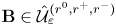 .
We show that if $r^{+}>r_1^{+}$ and $r^{-}=r_1^{-}$
 , then (4.14$'$
 )–(4.15$'$
 ) hold. Similarly, if $r^{+}=r_1^{+}$
 and $r^{-}>r_1^{-}$
 , then (4.16$'$
 )–(4.17$'$
 ) hold. Here (4.14$'$
 )–(4.17$'$
 ) are defined as (4.14)–(4.17) with $\mathcal {B}_K^{(r^{0},r^{+},r^{-})}$
 and $N$
 replaced by ${J}_K^{(r^{0},r^{+},r^{-})}$
 and $N+1$
 . Let $\hat M\in \mathcal {M}_{m_0}$
 be the unitary matrix such that $S^{A}_K(\mathbf {A})=\hat M{\rm diag} \{\tilde \nu _1,\ldots,\tilde \nu _{m_0}\}\hat M^{*}$
 , where $m_0=\sharp (K)$
 and $\tilde \nu _1=\cdots =\tilde \nu _{r_1^{0}}=0$
 . Define $\hat {\mathbf {B}}_t=[S(\hat {\mathbf {B}}_t)\,|\,I_{2d}]E_K$
 with

$t\geq 0$ is sufficiently small, and $s_{ij}(\hat {\mathbf {B}}_t)=s_{ij}(\mathbf {A})$
 if $i\in \{1,\ldots,2d\}\setminus K$
 or $j\in \{1,\ldots,2d\}\setminus K$
 . Since $S(\hat {\mathbf {B}}_{t_2})-S(\hat {\mathbf {B}}_{t_1})$
 is a positive semi-definite matrix for $t_2>t_1>0$
 , it follows from lemma 3.13 and corollary 5.7 that $\lambda _n(\hat {\mathbf {B}}_{\cdot })$
 is non-decreasing on $t\in (0,\varepsilon )$
 for each $1\leq n \leq (N+1)d-r^{0}$
 , where $\varepsilon >0$
 is small enough. Hence, by lemma 3.16 (4), $\lim _{t\rightarrow {0}^{+}}\lambda _{n}(\hat {\mathbf {B}}_t)=-\infty, 1\leq n\leq r^{+}-r_1^{+}=r_1^{0}-r^{0}.$
 This, along with lemma 3.15 and (5.16), yields that ${\lambda }_{n}(\hat {\mathcal {U}}_\varepsilon ^{(r^{0},r^{+},r^{-})})\subset (-\infty,c_1)$
 , $1\leq n\leq r^{+}-r_1^{+}$
 , and (4.14$'$
 ) holds. Then we get by lemma 3.14 that (4.15$'$
 ) holds.
Finally, we prove (5.13)–(5.15) for $r^{\pm }>r_1^{\pm }$ . It follows from (4.14$'$
 ) and (4.17$'$
 ) that $\lambda _n(\tilde {\mathbf {A}}_1) \in (-\infty,c_1)$
 with $1\leq n\leq r^{+}-r_1^{+}$
 , and $\lambda _{n}(\tilde {\mathbf {A}}_2)\in (c_2,+\infty )$
 with $(N+1)d-r_1^{0}< n\leq (N+1)d-r_1^{0}+(r^{-}-r_1^{-})$
 for any fixed $\tilde {\mathbf {A}}_1\in \hat {\mathcal {U}}_\varepsilon ^{(r_1^{0}-(r^{+}-r_1^{+}),r^{+},r_1^{-})}$
 and $\tilde {\mathbf {A}}_2\in \hat {\mathcal {U}}_\varepsilon ^{(r_1^{0}-(r^{-}-r_1^{-}),r_1^{+},r^{-})}$
 . Furthermore, we have by (4.16$'$
 ) that there exists $\tilde {\mathbf {A}}_3\in \hat {\mathcal {U}}_\varepsilon ^{(r^{0},r^{+},r^{-})}$
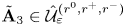 such that $\lambda _n(\tilde {\mathbf {A}}_3) \in (-\infty,c_1)$
 with $1\leq n\leq r^{+}-r_1^{+}$
 . It follows from (4.15$'$
 ) that there exists $\tilde {\mathbf {A}}_4\in \hat {\mathcal {U}}_\varepsilon ^{(r^{0},r^{+},r^{-})}$
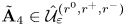 such that $\lambda _n(\tilde {\mathbf {A}}_4) \in (c_2,+\infty )$
 with $r^{+}-r_1^{+}\leq (N+1)d-r^{0}-(r^{-}-r_1^{-}) < n\leq (N+1)d-r^{0}$
 . Then we get by lemma 3.15 (1) that $\lambda _n(\hat {\mathcal {U}}_\varepsilon ^{(r^{0},r^{+},r^{-})})\subset (-\infty,c_1)$
 for $1\leq n\leq r^{+}-r_1^{+}$
 , and $\lambda _{n}(\hat {\mathcal {U}}_\varepsilon ^{(r^{0},r^{+},r^{-})})\subset (c_2,+\infty )$
 for $(N+1)d-r^{0}-(r^{-}-r_1^{-})< n\leq (N+1)d-r^{0}$
 . Thanks to lemma 3.15 (2), we get (5.13) and (5.15). Then (5.14) is a direct consequence of lemma 3.14. The proof is complete.
6. Conclusions and comparisons of jump phenomena of the $n$-th eigenvalue among continuous case, discrete case and Atkinson type

In this section, we compare jump phenomena of the $n$ -th eigenvalue among the Sturm–Liouville problems for the continuous case (1.1)–(1.2) in [Reference Hu, Liu, Wu and Zhu8], the discrete case (1.3)–(1.4), and the Atkinson type (5.1)–(5.2).
(i) Comparison of jump phenomena on boundary conditions.
According to theorem 7.1 in [Reference Hu, Liu, Wu and Zhu8], theorems 4.4 and 5.9, the jump phenomena on the boundary conditions are determined by the constructed Hermitian matrices, which are $S_K^{C}(\mathbf {A})$ given in (4.2) of [Reference Hu, Liu, Wu and Zhu8] for the continuous case, $S_K^{D}(\mathbf {A})$
 defined in (4.5)–(4.6) for the discrete case, and $S_K^{A}(\mathbf {A})$
 defined in (5.12) for the Atkinson type, where $\mathbf {A}\in \mathcal {O}_K^{\mathbb{C}}$
 .
For the continuous case, theorem 7.1 in [Reference Hu, Liu, Wu and Zhu8] tells us that the first $m_c$ eigenvalues jump to $-\infty$
 as a path of boundary conditions from the lower layer of $\mathcal {O}_K^{\mathbb{C}}$
 tends to a given boundary condition in the upper layer. Here the jump number $m_c$
 is exactly the number of transitional eigenvalues (from positive to zero) of the determined Hermitian matrices. It is further shown that this number is the Maslov index of the path of boundary conditions in a forthcoming paper.
For the discrete case, theorem 4.4 indicates that not only the first $m_d^{-}$ eigenvalues jump to $-\infty$
 , but the last $m_d^{+}$
 eigenvalues also blow up to $+\infty$
 as a path of boundary conditions from the lower layer tends to a given boundary condition in the upper layer. Here the jump number $m_d^{-}$
 has the similar meaning as $m_c$
 in the continuous case, while $m_d^{+}$
 is the number of transitional eigenvalues (from negative to zero) of the determined Hermitian matrices.
For the Atkinson type, theorem 5.9 renders both similar jump phenomena to $\pm \infty$ with numbers $m_a^{\pm }$
 as in the discrete case. However, $m_d^{\pm }\neq m_a^{\pm }$
 in general, which is due to the fact that the determined Hermitian matrices are different, i.e. $S_K^{D}(\mathbf {A})\neq S_K^{A}(\mathbf {A})$
 . It is also interesting to see that the determined Hermitian matrices for the continuous case and the Atkinson type are the same, i.e.$S_K^{C}(\mathbf {A})=S_K^{A}(\mathbf {A})$
 . The jump set in the Atkinson type coincides with that in the continuous case. This, in particular, provides a direct consequence: $m_c=m_a^{-}$
 .
The determined Hermitian matrix is independent of coefficients of the Sturm–Liouville equations for the continuous case and the Atkinson type, while the coefficient $P_0^{-1}$ involves heavily in the Hermitian matrix for the discrete case. In addition, the order of the determined Hermitian matrix is $d+\sharp (K_2)$
 for the discrete case, while it is $\sharp ( K)$
 for the continuous case and the Atkinson type. This implies that the maximal jump number in the discrete case is always no less than that in the continuous case and the Atkinson type.
(ii) Comparison of jump phenomena on the equations.
Based on theorem 6.1 in [Reference Hu, Liu, Wu and Zhu8], theorem 4.9and proposition 5.4, the $n$ -th eigenvalue has no singularity on coefficients of the Sturm–Liouville equations for the continuous case and the Atkinson type, while indeed exhibits jump phenomena when coefficients of the Sturm–Liouville equations vary for the discrete case.
For the discrete case, theorem 4.9 also provides jump phenomena to both $\pm \infty$ with jump numbers $\tilde m_d^{\pm }$
 as a path of equations from the lower layer of $\Omega _N^{\mathbb{C}}$
 tends to a given equation in the upper layer. The determined Hermitian matrix is given by $T(\pmb \omega )$
 defined in (4.28)–(4.29). $\tilde m_d^{-}$
 is the number of transitional eigenvalues (from negative to zero) of the determined Hermitian matrices, while $\tilde m_d^{+}$
 is the number of transitional eigenvalues (from positive to zero) of the determined Hermitian matrices. Here the reverse direction for the transitional eigenvalues in the definitions of $m_d^{\pm }$
 and $\tilde m_d^{\pm }$
 is essentially due to the opposite monotonicity of the continuous eigenvalue branches, see corollaries 3.10 and 3.12.
(iii) Comparison of the method in the proof of jump phenomena.
Compared with the continuous cases in [Reference Hu, Liu, Wu and Zhu8] and [Reference Kong, Wu and Zettl13], the jump set in the discrete case is involved heavily with coefficients of the Sturm–Liouville equations. Moreover, the finiteness of spectrum for the discrete case or the Atkinson type makes the method for the continuous case (e.g. continuity principle in [Reference Hu, Liu, Wu and Zhu8, Reference Kong, Wu and Zettl13]) invalid here. Compared with the $1$ -dimensional discrete case in [Reference Zhu and Shi22], the first difficulty is how to divide areas in each layer of the considered space such that the $n$
 -th eigenvalue has the same jump phenomena in a given area. We study jump phenomena by partitioning and analysing the local coordinate systems, and provide a Hermitian matrix which can determine the areas’ division. As mentioned in the Introduction, our approach to proving the asymptotic behaviour of the $n$
 -th eigenvalue here should be taken as a generalization of the method developed for $1$
 -dimensional discrete case in [Reference Zhu and Shi22] to any dimension.
Finally, we list several determined Hermitian matrices as follows in $2$ -dimensions to exhibit how the difference is between the continuous case (Atkinson type) and the discrete case. The orders of the determined Hermitian matrices for the discrete case are larger than those for the continuous case (Atkinson type) in (2)–(3), (5)–(6) and (8). On the other hand, these orders are the same in (4), (7) and (9). Even though, for example, the maximal jump number is $1$
 in the continuous case and the Atkinson type, while it is $3$
 in the discrete case when $K=\{3\}$
 . However, it is both $2$
 in any case when $K=\{1,2\}$
 .
Let

for the discrete case.
(1) $K=\emptyset$
.


and there are no $S^{C}_K(\mathbf {A})$ and $S^{A}_K(\mathbf {A})$
 , since there is no singularity for the continuous case and the Atkinson type when $K=\emptyset$
 .
(2) $K=\{1\}$
.


(3) $K=\{3\}$
.


(4) $K=\{1,2\}$
.


(5) $K=\{1,3\}$
.


(6) $K=\{3,4\}$
.


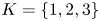
(7) $K=\{1,2,3\}$
.

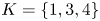
(8) $K=\{1,3,4\}$
.

(9) $K=\{1,2,3,4\}$
.


Acknowledgments
H. Zhu sincerely thanks Prof. Yiming Long for his encouragement. G. Ren was partially supported by NSFC (No. 11571202) and NNSF of Shandong Province (Grant ZR2020MA012). H. Zhu was partially supported by NSFC (No. 11790271), CPSF (No. 2018M630266) and Postdoctoral Innovative Talents Support Program (No. BX20180151) when he was a postdoc in CIM, Nankai University.