Introduction
Solidarity between children and parents manifests in the many and various ways that support is provided between the generations across the entire lifespan. Parents support their adult children mainly with money and by assisting with the care of their grandchildren (Attias-Donfut, Ogg and Wolff Reference Attias-Donfut, Ogg and Wolff2005; Rossi and Rossi Reference Rossi and Rossi1990; Szydlik Reference Szydlik2000, Reference Szydlik2004). In most European countries today, the majority of people aged 50 or more years have been able to build up assets during their working lives, and many also receive an adequate pension. Their savings and incomes enable them not only to help their children who are short of money, but also to insure themselves against the risks of ageing, such as the need for paid care.
Many retirees have a great deal of free time, which enables them to be much involved in looking after and helping to bring up their grandchildren, which in turn relieves the burden on their children. Great age also takes its toll, however, and it is common for a retired parent to require increasing assistance as the years pass. This might initially be the case just with housework or home maintenance, but later as infirmities increasingly restrict the parent's everyday activities, she or he may need personal care. An ever-increasing number of people are in this situation as a consequence of demographic ageing. Most care of older people is provided by partners and children (Bender Reference Bender and Bien1994; Connidis Reference Connidis2001; Finch and Mason Reference Finch and Mason1990; Höpflinger Reference Höpflinger, Schroeter and Rosenthal2005). The proportion of older people with children is likely to be higher during the next quarter-century than for many decades, but looking further ahead, the family's capacity to provide support is likely to diminish (Murphy, Martikainen and Pennec Reference Murphy, Martikainen and Pennec2006).
Both the family and working life have recently undergone significant changes that impact on the availabilty of family members, e.g. the increased prevalence unstable partner relationships and of women not only working but also working for more hours and years, and the rising demand for a flexible and mobile labour force, which results in less free time, longer commuting and greater residential separation distances between family members (Schneider, Limmer and Ruckdeschel Reference Schneider, Limmer and Ruckdeschel2002). While more and more people are in need of care, the number of care-givers is not increasing at a comparable rate. In the long run, there are likely to be fewer people able and willing to provide the care required (cf. Bundesministerium für Familie, Senioren, Frauen und Jugend 2006: 142ff.; Blinkert and Klie Reference Blinkert and Klie2004).
These developments call the current societal organisation of care into question, and make clear that governments face an immense task in ensuring that older people in the future are cared for. European societies currently provide care in various ways. Whereas in Mediterranean countries it is provided almost exclusively by relatives or migrant workers, in Scandinavia it is frequently provided by professional carers (Haberkern and Szydlik Reference Haberkern and Szydlik2008). As large-scale comparative surveys have been lacking, the effects of the different institutional societal structures and cultural norms on the support exchanged between parents and children have not been tested statistically, especially when simultaneously examining individual and family characteristics. With the release of data from the Survey of Health, Ageing and Retirement in Europe (SHARE), this has become possible. SHARE variables provide detailed information on the children of the older respondents, and information on both the care-giver and the care-receiver can be used to analyse variations in intergenerational care.
This paper examines the following research questions. How prevalent and variable is intergenerational care among European countries? Which characteristics of parents and children favour intergenerational care, and which hinder it? What is the relationship between, intergenerational care and institutional and cultural factors? We begin by reviewing theoretical contributions on the relationships between family care, home-care services and residential care, legal obligations and cultural norms, with a focus on the effects of these institutional and cultural factors on intergenerational care. The following section presents the empirical investigation using the SHARE data, and the paper closes with an evaluative discussion and our conclusions.
The societal organisation of care
The welfare state's organisation of care has recently been investigated from various perspectives, most often with the objective of creating a typology of care systems. These studies have mostly centered on institutional structures, such as the cash and non-cash benefits to persons in need of care, and the state's support of relatives who are carers (e.g. Behning Reference Behning, Pfau-Effinger and Geissler2005; Bettio and Plantenga Reference Bettio and Plantenga2004; Lundsgaard Reference Lundsgaard2006). Irrespective of the approach, these studies have shown that European countries are reacting to demographic ageing and managing the care of dependent older people in different ways. Family care has been of greater importance and more widespread in southern European countries, whereas in the northern countries, home care and residential care are more widely provided. Investigations of the cultural aspects of care systems are multiplying, as about the normative and legal obligations between relatives, and the perceived relationship between family and state support (seeLowenstein and Daatland Reference Lowenstein and Daatland2006; Leitner Reference Leitner2003; Mestheneos and Triantafillou Reference Mestheneos and Triantafillou2006; Millar and Warman Reference Millar and Warman1996; Rostgaard and Fridberg Reference Rostgaard and Fridberg1998). In a nutshell, the studies support two hypotheses, that formal care services substitute for family and intergenerational care, and in countries with strong legal and normative obligations underpinning intergenerational support, that children more often care for their elderly parents. Yet the questions of how and to what extent the institutional and cultural structures affect intergenerational care have not been statistically scrutinised; this paper reports an empirical investigation of these aspects.
The comparison of countries belonging to the same cultural group but in which the type and extent of state-funded formal care differ significantly is particularly appropriate for empirical study. According to Esping-Andersen (Reference Esping-Andersen1990), (western) countries' welfare arrangements can be classified into three groups or regimes. The social democratic countries, as in Scandinavia, are characterised by comprehensive support and generous payments. In the conservative-corporate states, such as Belgium, Germany, France and Austria, entitlements to non-family support are based primarily on insurance systems, such as nursing-care (or long-term care) insurance. In the liberal welfare regimes, as in the United Kingdom and the United States of America, rather low public transfers are made on the basis of need. Some recent authors have distinguished southern European countries such as Italy, Spain and Greece as a separate group (e.g. Arts and Gelissen Reference Arts and Gelissen2002; Ferrara Reference Ferrara, Rhodes and Mény1998). The provision of state services in those countries is comparatively low, while obligations between relatives are strong and in some cases reinforced by statute.
The Esping-Andersen typology is rather broad and is not exclusively about the support of elderly people in need of care. For this purpose, a different classification based on the institutional and cultural underpinning of the social organisation of care is preferred (cf. Anttonen and Sipilä Reference Anttonen and Sipiliä1996; Pfau-Effinger Reference Pfau-Effinger2005). This should take into account three dimensions. Firstly, indicators are required of whether and to what extent there is a legal obligation to support relatives in need. This obligation can refer to either practical (instrumental) or financial support, or both, but most legal instruments deal predominantly with the financial responsibility. Accordingly we define a legal obligation as the requirement to contribute to or finance the cost of one's parent home-care or residential-care. In practice, there are no such obligations in the Scandinavian countries. Those in need receive public transfers irrespective of whether or not they have relatives who can pay in full or part for their help and care. In the southern European countries and in many conservative welfare states, by contrast, close family members, in some cases including (step-) siblings, are obliged to finance the costs of care if the person in need cannot himself or herself pay. State-funded services are available only if the relatives cannot afford to pay for the services (Gori Reference Gori2000: 263ff.).
Secondly, countries need to be grouped by the services that the state provides or funds. State-financed or organised services include those for persons in need of care – domiciliary or home care by peripatetic staff and residential care in nursing homes and comparable facilities – and the professional support of carers. Another service of growing importance is financial support for family carers in the form of individual care budgets to the care recipients (as in Germany and The Netherlands). These care budgets enable the recipients to decide how their care is provided, which can include paying relatives for their assistance. As the example of German nursing-care insurance has shown, high state expenditure does not necessarily lead to a correspondingly high provision of state-funded formal care, because public and insurance funds can be an incentive for family care. As might be expected, in Germany many older people are cared for by their families. State expenditure on the care of frail elderly people is thus a sensitive indicator, but in isolation not a reliable measure of the effect of state funding on family support because the various countries provide support for those in need of care in completely different ways. More suitable for this purpose are indicators of the utilisation of state-funded complementary aid and alternatives to family care, namely home-care and residential-care. These enable the substitution and complementarity theses to be investigated.
Thirdly, opinions differ among European national populations about whether the state or ‘the family’ should in general be responsible for the care and support of dependent elderly people. In the so-called ‘individualistic’ countries of northern Europe, most people believe that the state should be the main provider of care. Normative obligations for mutual support between relatives are low, and parents do not want to become a burden on their children in their old age, or at least they do not expect them to provide substantial financial support or intensive personal care. In contrast, care is regarded as a family matter in Mediterranean and most central European countries (Daatland and Herlofson Reference Daatland, Herlofson, Lowenstein and Ogg2003b: 137ff.; European Commission 2007: 66ff.; Naldini Reference Naldini2000). It is important to note that normative and legal obligations towards family members generally coincide and that care systems broadly reflect these societal differences. Of course there are dissenting cases, as with family members who do not accept or act upon the legal obligation to support their parents and believe that the responsibility lies with the state (cf. Twigg and Grand Reference Twigg and Grand1998).
What are the effects of institutions and societal opinion on family care? Three principal interdependencies between state and family support services can be conceived: substitution, complementarity, and the joint responsibility of family and state. Advocates of the substitution thesis (implicitly) assume that state and family care services are functionally equivalent, and that the need for care does not increase if there is a greater availability of support (cf. Lingsom Reference Lingsom1997). An expansion of state care would accordingly lead to a decline in family care, and vice versa. Advocates of the complementarity thesis, by contrast, assume that state services also create favourable conditions for family care (e.g. Attias-Donfut and Wolff Reference Attias-Donfut, Wolff, Arber and Attias-Donfut2000; Daatland and Herlofson Reference Daatland, Herlofson, Lowenstein and Ogg2003a). They reduce the burden on family members, who otherwise would have to choose between taking over the full extent of the care – which might mean having to give up gainful employment – or paying for domiciliary or residential care (Daatland and Herlofson Reference Daatland, Herlofson, Lowenstein and Ogg2003a). On the contrary, state support gives them the opportunity to have a continuing role in looking after their elderly relatives without taking on intensive personal or quasi-nursing care. In this respect, shared responsibility and functional differentiation occurs (Motel-Klingebiel, Tesch-Römer and Kondratowitz Reference Motel-Klingebiel, Tesch-Römer and Kondratowitz2005). In this model, state and family support services complement each other, with the state tending to take on the long-term, routine and clinically demanding tasks, such as nursing care, whereas the family concentrates on providing low-intensity personal care, everyday help and emotional support (Brandt and Szydlik Reference Brandt and Szydlik2008; Brandt, Haberkern and Szydlik Reference Brandt, Haberkern and Szydlik2009; Igel et al. Reference Igel, Brandt, Haberkern and Szydlik2009; Litwak et al. Reference Litwak, Silverstein, Bengtson, Wilson Hirst, Bengtson and Lowenstein2003).
These distinctions apply primarily to the availability of state-funded home-care and residential-care services, and do not take into account the relationship between intergenerational care and either the legal obligations upon relatives to provide (financial) support or the cultural preference for family or public care. The legal obligation to support a parent in need can, on the one hand, force a child to finance (and indirectly to provide) care even if she or he does not want to. Where the obligation exists, the level of intergenerational care in a country would be relatively high. On the other hand, the legal regulation of family support could endanger voluntary help. Care might then be provided primarily only when and where demanded by the law, and overall children might involve themselves less frequently in their parents' care.
A cultural preference for the state to assume the responsibility for providing care may have different bases or causes. A heavy burden of care could nurture the desire for publicly-financed home care and residential care. In the so-called ‘familistic welfare states’, where there are strong obligations between relatives, care is mainly provided within the family and carers receive little assistance, but this might lead to a demand for the state to take on more responsibility. In this case, there would be a disparity between the organisation of care and the societal preference, or, in short, between institutions and culture. On the other hand, the preference for state involvement could have arisen through positive experiences with the public provision of care and the absence of legal family obligations, as in the Scandinavan countries. In these countries, relatives are not required to provide care, and when it is needed it is provided by professional carers. To this extent, one could speak of a correspondence between wants and provision. On the whole, it appears that care systems are consistent with cultural preferences or the values and norms of a society, but they also have an effect on them. The exact nature of this relationship; that is, whether institutions and culture are congruent or divergent across the 11 studied countries, is examined further below.
Comparisons of national-level studies can identify differences between countries but provide insufficient information by which to attribute the differences to particular societal conditions. Apart from the national context effects, individual and familial attributes, such as health, employment, the size of the family and residential separation distances could be responsible (i.e. composition effects). These factors need to be examined in multivariate analyses. We used a general solidarity model that had been found appropriate in previous studies to identify and systematise individual, family and societal factors (Brandt, Haberkern and Szydlik Reference Brandt, Haberkern and Szydlik2009; Haberkern and Szydlik Reference Haberkern and Szydlik2008; Szydlik Reference Szydlik2000, Reference Szydlik2004, Reference Szydlik2008). According to the model, structures at the micro, meso and macro levels promote or hinder relatives' support. At the individual level, the parent's need for help (‘need structures’) and the child's resources and opportunities to give support (‘opportunity structures’) are important prerequisites for family solidarity. In addition, family structures and cultural-contextual structures are of great importance. Family structures include, for example, family size and composition, earlier family events as well as family roles and norms. Cultural-contextual structures represent the societal conditions in which intergenerational relations develop, including the characteristics of the social, economic and tax systems, state-welfare provision, features of the labour and housing markets, as well as the specific rules and norms of certain institutions and groups. With respect to intergenerational care, especially important features of the cultural-contextual structures are welfare-state policies and cultural norms about who should be primarily responsible for the care of dependent older parents.
The degree of physical incapacity is very likely to be a crucial influence on the receipt of care. It can also be assumed that if an older person has a partner, she or he will be the primary carer, and that their presence will substantially reduce the need for intergenerational care (Qureshi and Walker Reference Qureshi and Walker1989). Those who live alone will probably be more dependent on their children's care (if they have children). Parents' opportunity structures also include their financial resources, which can stimulate descendants to provide care, or be used to relieve the burden on the children by employing paid care staff – which applies is clearly an empirical question. Furthermore, those with greater knowledge and/or persistence may be better able to take advantage of available public services (Theobald Reference Theobald2005), so the better educated may turn to their descendants less frequently. Taken in conjunction with the effects of personal finances, a strong possibility arises that patterns of care are related to social class or socio-economic position (cf. Broese van Groenou et al. Reference Broese van Groenou, Glaser, Tomassini and Jacobs2006).
In order for a care relationship to develop, first of all the carer must have the time required to care. Children who live near their parents are more likely to be able to reconcile care-giving with other aspects of their lives. Thus, parents who live close to their children are more likely to receive care from their offspring, while the greater the residential separation, the more difficult this becomes, and very long distances make regular care impossible (seeQureshi and Walker Reference Qureshi and Walker1989). Being in paid employment also restricts the time available for care (seeArber and Ginn Reference Arber and Ginn1995), but on the other hand their financial needs are less, which may be influential when care provided by children is ‘paid for’ or stimulated by intergenerational transfers from their parents (reciprocity). Financial transfers should therefore increase a child's willingness to provide care.
Whether and to what extent parents are cared for by a daughter or a son also depends on family structures. If the mother or father requires care, the first question is whether a son or daughter is available and willing to provide it. Obvious hypotheses are that it is primarily daughters that care for parents, and predominantly mothers that receive support from their children (Höpflinger Reference Höpflinger, Schroeter and Rosenthal2005). Furthermore, as the number of descendants increases, the likelihood of being cared for by an individual child may decrease, because siblings can share the task and less is demanded of each one. When there are more siblings, one (or more) may be able to withdraw from providing instrumental and personal care, depending on the availability and circumstances of the others, by making financial transfers or by waiving an expected inheritance. Last but not least, there is evidence that sons leave the care work to sisters (cf. Martin-Matthews and Campbell Reference Martin-Matthews, Campbell, Arber and Ginn1995). Most importantly, individual and family structures are embedded in the societal context. The fundamental decision of whether or not care is provided by one or more family members is likely to be strongly influenced by the availability of home-care and residential-care services, by legal obligations, and by the prevailing cultural convention of whether the family or the state is seen as being mainly responsible for the provision of care.
Data, variables and method
The empirical analyses use data from SHARE (Börsch-Supan and Jürges Reference Börsch-Supan and Jürges2005). A total of 28,516 people were interviewed during 2004 and 2005 in Austria (AU), Belgium (BE), Denmark (DK), France (FR), Germany (DE), Greece (GR), Italy (IT), The Netherlands (NL), Spain (ES), Sweden (SE) and Switzerland (CH). The respondents were aged at least 50 years and their partners were also interviewed if they were living in the same household. One focus was the exchange of time and money between family generations. The socio-economic attributes of the families and information on all children were gathered, and each respondent – or potential care recipient – answered questions on his or her children, but some questions such as those on employment status were asked about no more than four children. For the very few respondents with more than four children, a random selection was made. The information on children enabled relationships in parent–child dyads to be analysed, including not only questions of whether and why people are cared for by their children, but also why a person is cared for by a particular child and not another. For our analysis of parent–child relationships, a data set of 49,548 parent–child dyads was created.
The measures
Investigations of transfers of time between generations usually conflate ‘help’ and ‘personal care’ under a single label such as ‘care’, ‘support’ or ‘time transfer’ (Attias-Donfut, Ogg and Wolff Reference Attias-Donfut, Ogg and Wolff2005; Martin-Matthews and Campbell Reference Martin-Matthews, Campbell, Arber and Ginn1995). This masks the fundamental differences in the nature and scale of the two types of assistance (Walker, Pratt and Eddy Reference Walker, Pratt and Eddy1995). (Personal) care is designated as assistance with the physical performance of everyday activities, such as washing, dressing and using the toilet. This type of assistance is usually provided regularly and is time consuming. Such care is vitally important to its recipients, who are in a dependent relationship with their care providers (Fine and Glendinning Reference Fine and Glendinning2005; cf. Lewis Reference Lewis and Brubaker1990). In this paper, a recipient of care was defined as a person who received assistance with eating, dressing, washing and physical activities from their children at least weekly over at least several months during the previous year. As the questions on care relations were answered by only one member of a couple (the ‘family respondent’), for partners the care recipient was defined as the person with (more) functional limitations. If both partners reported at least three limitations in carrying out the Activities of Daily Living (ADLs), they were both classified for the analysis as care recipients.Footnote 1
Opportunity and need structures of parents were examined using the following categories: physical impediments, partner in the household, financial situation of the household, financial payments to their children, and education. The degree of physical impediment was determined using six daily activities: dressing, eating, getting out of bed, washing oneself, crossing a room, going to the toilet by oneself. The count of the activities with which the interviewee had difficulties was derived as an additive ADL index. As the provision of care is a function of physical need, the multivariate analyses were conducted on the basis of the 4,234 parent–child dyads with a parent having at least one physical impediment.
Whether or not the household income was sufficient to cover needs without difficulty was taken as an indicator of the financial situation. Another financial variable was whether the parent would probably leave a legacy of more than €50,000 during the next 10 years, and whether they had given the child at least €250 during the previous year – both factors might stimulate a child to provide care. The International Standard Classification of Education of 1997 was used to classify the parents' levels of education under three categories: primary, secondary and tertiary (Organisation for Economic Cooperation and Development 1999). The children's opportunity and need structures were determined by how far away from their parents they lived, their employment status and marital status. The residential separation distance was recorded for each child in nine categories ranging from ‘same household’ to ‘over 500 km or foreign country’. To assess restrictions on available time, people were classified as unemployed or in part-time or full-time employment. As no information was available on the working hours of the self-employed, they were classified under ‘full-time’. The scope of employment could also be taken as a proxy of the child's income, since this was not explicitly surveyed by SHARE. Furthermore, the family respondent was asked whether the child was married or lived in a registered partnership.
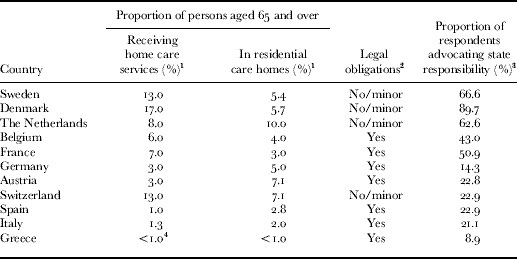
Family structures were operationalised by the gender composition of the dyad, the overall number of children, and the presence of other sons and daughters. Cultural-contextual structures were examined with four national variables. The institutional influence was measured by the national proportion of people aged 65 or more years who received professional nursing services in their own homes or who were living in residential care homes (Daatland Reference Daatland2001; Pinnelli Reference Pinnelli, Pinnelli, Hoffmann-Nowotny and Fux2000). Another national variable indicated whether children were legally obliged to contribute to the costs of such care, as recorded by Millar and Warman (Reference Millar and Warman1996) and by the EUROFAMCARE project (Mestheneos and Triantafillou Reference Mestheneos and Triantafillou2006). The ‘care culture’ of a country was measured by the percentage of all SHARE interviewees who advocated state responsibility for the provision of care. Table 1 presents the cultural contextual scores for the investigated countries.
Institutions and cultural norms relevant to intergenerational care and support in 11 European countries, early 2000s
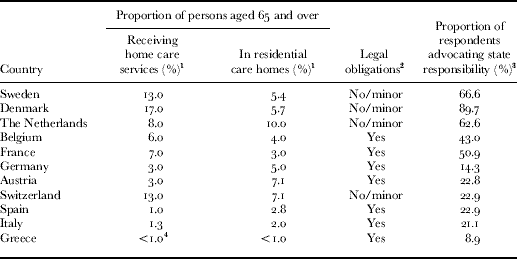
Source of data: 1. Pinnelli (Reference Pinnelli, Pinnelli, Hoffmann-Nowotny and Fux2001: Table 10). 2. Mestheneos and Triantafillou (Reference Mestheneos and Triantafillou2006) ; Millar and Warman (Reference Millar and Warman1996). 3. SHARE 2004/2005, release 2, weighted, own calculations (see text and Acknowledgements). 4. Daatland (Reference Daatland2001).
The design of the analyses
Theoretical considerations and the structure of the data required four analytical levels: relational, individual, household and national. Most of the principal respondents had more than one child, and many were able to provide detailed information about up to four parent–child relationships (Level 1). As the respondents (Level 2) and their partners lived together, the household (Level 3) was treated as a statistically ‘higher-level’ unit of analysis. The national context variables constituted Level 4. Multilevel logistic models were used to estimate the influences and differences at these levels (Guo and Zhao Reference Guo and Zhao2000; Hox Reference Hox1995; Snijders and Bosker Reference Snijders and Bosker2002).Footnote 2 They avoid the problem of double counting: each relationship, person, household and country is entered only once. At the lowest level, the parent–child dyads, the characteristics of the relationship and of the child are taken into account. The individual specificities of the parents (respondents) are recorded under personal characteristics. Differences between households are attributed to the characteristics of the households. At the ‘highest’ country level, institutional and cultural factors explain the differences between the countries in the levels of care provision.
Findings
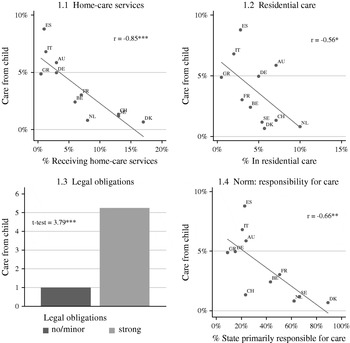
We begin with the bivariate findings. As already indicated, although the 11 countries differ greatly in the societal organisation of care, there is a clear north–south contrast. In the Scandinavian countries, The Netherlands and Switzerland, where both home-care and residential-care services are widely available, less than two per cent of parents aged over 64 years were cared for by their children in 2004 and 2005 (Figures 1.1 and 1.2). By contrast, in the southern European countries, between five and 10 per cent were involved in the care of elderly people, not least because of the fragmentary provision of care services. Overall, it is found that the provision of home-care services was more closely related to intergenerational care (r=−0.85, p<0.001) than the availability of residential care (r=−0.56, p<0.05).
Care systems are not defined only by the services and assistance provided, for demands and obligations have also to be considered. Italy imposes the greatest obligations on relatives to provide financial support (or care instead). In Germany, nursing-care insurance responds initially when substantial need arises, but the sums available are nowhere near sufficient to cover the costs of food and accommodation let alone medical care, especially in the case of residential care, so in practice relatives are then required to contribute if they have the means. The comparison among all 11 countries reveals a clear difference between family-based care systems, in which relatives are obliged to provide or finance care, and service-based systems, in which the state is mainly responsible for the care of dependent older people. In the family-based care systems, intergenerational care is underpinned by the legal obligation, and 5.3 per cent of parents aged 65 or more years were looked after by their children, five times the percentage in the Scandinavian countries (Figure 1.3).
Intergenerational care, institutions and cultural norms, 11 European countries 2004–5.

Both the state provision of formal care and the legal obligations placed on relatives reflect country differences in the normative view of who should be responsible for the care of elderly people in need. As Figure 1.4 shows, over one-half of those aged 65 or more years in the northern and social democratic countries interviewed by SHARE believed that the state and public institutions should bear the primary responsibility for care of the aged, while in the conservative and Mediterranean countries, the majority believed that the family should mainly be responsible. The preference for state care was particularly low in Greece, Germany and, more surprisingly, Switzerland (cf. Berger-Schmitt Reference Berger-Schmitt and Allmendinger2003). The relationships depicted on the four graphs of Figure 1 compel the conclusion that the higher level of informal care in central and southern Europe in large measure arises from the involvement of adult children in care, and that it is less likely for parents to receive care from children if there is no legal or normative obligation to provide it, if the state is regarded as being mainly responsible, or if alternatives to family care are available. It is manifest, then, that the important influences are not only individual and family factors but also cultural-contextual structures.
The multivariate findings
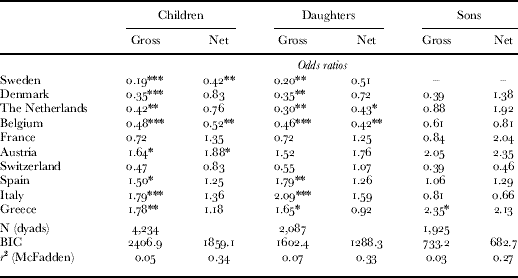
We now turn to the extent to which national differences remained after the characteristics of the interviewees and their children, households and families were taken into account, and to their associations with specific cultural-contextual factors. Table 2 shows for each country the estimated odds ratio for the level of intergenerational care for parents with functional limitations (with Germany as the reference case). Values greater than ‘1’ indicate a higher level of intergenerational care than in Germany; values less than ‘1’ a lower level. The ‘gross’ logistic regression models without control variables indicate substantial differences among the countries. Parents were significantly more likely to be cared for by one of their children in southern European countries than in Germany, whereas parents in the northern European and Benelux countries received this assistance significantly less frequently.Footnote 3 The ‘net’ models controlled for individual factors, such as income, age, the parent's state of health, gender and child's employment status, and for other characteristics of relationships and families, such as the parent's and child's marriage/partnership, financial transfers to the children, and the distance between the child's and parent's residences. When the controls were taken into account, the national differences were reduced but the overall picture did not change; as before, least intergenerational care was provided in Sweden and Belgium. The overall or net model found no significant differences between the Mediterranean countries and Germany, but the coefficients point in the same direction as the gross model estimates; that is, they had a significantly higher level of intergenerational care than Sweden (results not shown). As Germany had an intermediate position, Table 2 displays very moderate estimates of the national differences.
Care of parents aged 50 or more years by adult children, 11 European countries, 2004/2005
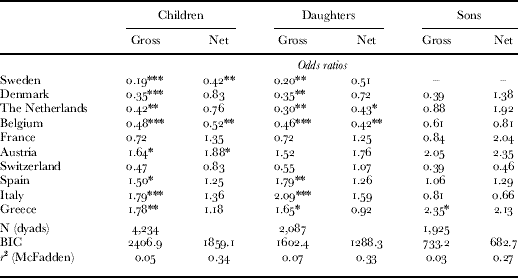
Notes: Binary logistic regression models with Germany the reference country. The unit of analysis is parent–child dyads, with the parents aged 50 or more years. Binary logistic regression, own calculations, sample weights were not used. The net models are controlled for the same opportunity, need and family structure variable as specified in Table 3. Robust standard errors were used. BIC: Bayesian information criterion.
Source of data: SHARE 2004/2005, release 2 (see text).
Significance levels: * p<0.05, ** p<0.01, *** p<0.001 (two-tailed tests).
Separate models for men (sons) and women (daughters) were run, and confirmed that sons and daughters were involved in care to differing extents in the individual countries. For example, in Italy an above-average proportion of parents were cared for by daughters, but sons were carers less frequently than in most other countries. The north–south difference in care by daughters reflects the overall (or both sex) picture, whereas the variations in sons' care are distinctive. Overall, few parents received care from a son, the differences among the countries were less marked, and different southern European countries had higher and lower odds ratios than Germany. Care received by parents from their sons might therefore be less a response to the institutional and cultural context than to variant individual and family circumstances. As the national differences were less pronounced in the net models, it can be argued that individual and family factors went a long way in explaining the differences among the countries, although substantial differences remained with respect to care by daughters.
The multilevel analyses
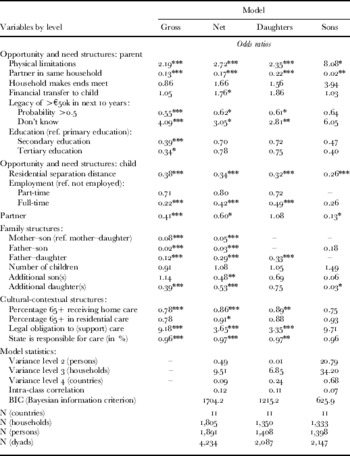
The multilevel analyses examined these national variations further. Given the small number of countries (or cases) for this statistical procedure, the various contextual conditions – legal obligations, the proportion of persons receiving home-care services and residential care, and societal opinion on care responsibilities – were modelled separately. The multilevel estimates indicate that whether or not a care relationship existed depended largely on the child's opportunities and the parent's needs (Table 3). The physical condition of parents was the prime influence: elderly parents with multiple physical impediments and who were unable to cope with everyday activities, particularly those without a partner, tended to be supported by their children. In partnerships, it was mainly the partner who took on the tasks. It seems that children are not asked to provide care until the partner ceases to be available or becomes no longer able to provide care for reasons of health, as noted by Künemund and Hollstein (Reference Künemund, Hollstein, Kohli and Künemund2005) and Qureshi and Walker (Reference Qureshi and Walker1989).
Care of parents aged 50 or more years by adult children, 11 European countries, 2004/2005

Notes: Basis: parent–child dyads, parents aged 50 or more years. Logistic multilevel models, own calculations, sample weights not used. Indicators at country level were tested separately. The effects on Levels 1–3 show the results for the model with the macro indicator ‘percentage aged 65 or more years receiving home care’. Robust standard errors.
Source of data: SHARE 2004/2005, release 2 (see text).
Significance levels: * p<0.05, ** p<0.01, *** p<0.001 (two-tailed tests).
At first glance, sufficient financial resources ‘to make ends meet’ did not appear to influence the care provided by children, but financial incentives played a role when parents gave money to a child: parents were more likely to receive care from adult children if they had given financial assistance during the previous year. The available data do not enable us to distinguish the extent to which financial transfers were an incentive to provide care or were given in appreciation of care already received. Nevertheless, the results on inheritances support the conclusion that care behaviour can be financially ‘strategic’ (seeSzydlik Reference Szydlik2004). Parents who are likely to leave a substantial estate are less likely to be cared for by a child, possibly because they can afford the professional alternatives, and their children might be in a better economic position through previous intergenerational support. Moreover, in most of the 11 studied countries, parents are legally obligated to leave a specified share of their estate to their children, and the financial incentive for a child to provide care may be lower. On the other hand, a possible but uncertain inheritance appears to increase a child's willingness to provide care, possibly because saving the expenditure on formal care maintains the value of the possible legacy, and the testator might have indicated that a bequest would depend on previous support. Overall, the multilevel findings show that care tends to be accompanied by reciprocal solidarity in the parent–child relationship, and that strategic financial motives also play a role. To this extent, one can speak of normative obligations between parents and children being pragmatic in execution and practice.
More highly-educated people are better informed than others of their rights and entitlements to state services, and are possibly better able to assert them so that their children are less frequently called upon – the odds ratios are in this direction but not significant. Regarding the opportunities to care and need structures of the children, the residential separation distance was a reliable predictor of intergenerational care. Living a short distance from a parent is a structural prerequisite for providing regular care. The analyses confirmed that the further away a parent lives, the less likely that they were cared for by their children. Apart from the time involved and the costs of travel, relatively low emotional closeness could be an influence (seeSzydlik Reference Szydlik2000). Parents less often received care from full-time employed children, who clearly had less time for care work, and for the same reasons, if a child worked part-time, the odds that they cared for a parent were reduced. Intergenerational care also occurred less often when the son lived with a partner.
In line with previous findings, the analyses of family structures confirmed that both mothers and fathers were much more likely to be cared for by daughters than by sons. The probability of being cared for by a son was less than half that of a daughter providing care. Clearly much higher expectations are placed upon daughters (-in-law) (Bender Reference Bender and Bien1994; Finch and Mason Reference Finch and Mason1990; Hugentobler Reference Hugentobler and Schweiz2003). On the other hand, sons are more likely to be expected to help with financial matters and practical tasks (Campbell and Martin Matthews Reference Campbell and Martin Matthews2003; Gallagher Reference Gallagher1994). We found that the number of children had no significant influence on the care behaviour of individual sons or daughters, which contradicts the assumption that caring tasks are shared among siblings, but the presence of at least one other son or daughter was highly significant. Parents with sons and daughters tended to be cared for by daughters, and sons were less likely to provide care if they had one or more sisters. It appears that parents also received less care from a son when there were other sons; but the relationship was not significant. Previous research has shown that sons give their sisters – if they have any – ‘precedence’ when it comes to providing care, but on the other hand do obtain and organise professional care services (Anderson Reference Anderson and Harper2004; Gerstel and Gallagher Reference Gerstel and Gallagher2001). If a son has brothers but no sisters, they jointly make an arrangement for professional care and perform physical care less frequently themselves (Haberkern Reference Haberkern2009).
As well as the many individual and family influences, the multilevel models confirmed that general institutional conditions also play a role. Among the investigated countries, parents were less frequently cared for by a child if home-care services were available and widely used, as in Sweden and Denmark. In the southern European countries, the provision of care is neither adequate nor widely available, and care is provided largely by the family, particularly partners and daughters. An expansion of home-care services might lead to reduced family care in these countries. In Italy, for example, a shortage of professional alternatives has promoted many to recourse to the services of (legal and illegal) female migrants from low-wage countries, so-called badanti (Da Roit Reference Da Roit2007: 258ff.; Gori Reference Gori2000: 267). On the other hand, the provision of residential-care institutions, such as nursing homes, had only a weak effect, probably because the majority of interviewees regard nursing homes as an alternative to family care only in the most severe case of a long, disabling illness. Legal obligations were also significant. The level of family care was nearly four times higher in those countries with a legal obligation to contribute to the cost for one's parents care. In the Mediterranean countries, commonly people in need of care have a right to state support only if none of their relatives can pay (Millar and Warman Reference Millar and Warman1996): children's obligations to their parents are correspondingly high.
Lastly, the multilevel model confirmed that cultural norms concerning the responsibility for the provision of care also affect intergenerational care. Only 10 per cent of the Greek respondents believed that the state should be the primary provider of care for elderly people, but 80 per cent of the Danes had this opinion. The analyses show that the care behaviour (of daughters) corresponded with these views. The stronger the consensus that care is a family matter, the more likely that parents were cared for by daughters. On the other hand, institutions and cultural norms did not influence care relationships with sons, another indication that parents have lower expectations of their sons than their daughters. On the whole, in most of the studied countries, the care systems in 2004–5 were broadly consistent with cultural norms and institutional requirements.
On the basis of the four macro-indicators, the studied countries can be placed in two groups, those with strong formal-care systems and those with strong family-based care systems (cf. Leitner Reference Leitner2003). In the former, there were only weak legal obligations for relatives to provide care, and the state was clearly regarded as being responsible for providing care. In these respects, the Scandinavian countries, The Netherlands and (to a degree) Switzerland can be regarded as having state-funded services-based care systems. The widely-accepted alternatives to family care in those countries not only relieve the relatives (Daatland and Herlofson Reference Daatland, Herlofson, Lowenstein and Ogg2003b), but also enable them to decide whether or not to provide care. In the countries with family-based care systems, i.e. most of the Mediterranean countries, Germany and Austria, the responsibility for the care of an older person with needs is primarily borne by their relatives, as required by the state. Extensive state care provision has a lower priority in those countries and is generally meagre, and most older people who require personal care are cared for by their families. In Belgium and France, the division of roles between family and state is less clear-cut than in the other countries. On the one hand, these countries provide more extensive state care than most of the countries with family-based systems, on the other hand, a higher proportion of older people believe that the state has prime responsibility for the provision of care. In this respect, these countries have ‘mixed’ arrangements rather than family-based systems. Switzerland also has a mixed care system, but for different reasons. The societal organisation is similar to that of northern European countries, with extensive state-funded formal care, but the cultural norm – who should be responsible for care – is in line with family-based care systems. Switzerland displays a disparity between its institutions and culture.
The decision whether or not the family provides care thus depends not only on the availability of professional alternatives but also on legal obligations and cultural norms.Footnote 4 One should be clear, however, that an expansion of home-care or residential-care services would not necessarily lead to a change in overall care arrangements. It is believed that this would only be the case if the provision of formal care coincided with the population's cultural preferences and the demand for these services.
Conclusions
The presented analyses have investigated the factors that influence whether dependent older parents are cared for by their children, and the relationships between intergenerational care, institutions and cultural norms. The findings have shown that intergenerational care depends on many and various factors, among which the need for care, the child's resources and opportunities to care, and the family's structure are most influential, and that both institutional (or formal care) arrangements and cultural norms play a role. The weaker the obligation to care, the more alternatives to family care are available, and the more that public opinion regards the state as primarily responsible, the less frequently are parents cared for by their children.
The various factors are closely related, which supports the distinction between family-based and service-based care systems. In the former, characteristic of southern European and some central European countries, extensive filial obligations are accompanied by a rudimentary care infrastructure and a relatively high prevalence of intergenerational care, which is the care arrangement preferred by the majority. The situation is exactly the opposite in the service-based systems, as in Scandinavian countries and The Netherlands. State-funded care services are available nationwide, are easily accessible and highly regarded, there are only minor obligations upon adult children to support and care for their parents, and intergenerational care is comparatively rare. The evidence for this clear inversion does not necessarily support, however, the contention that the welfare state endangers solidarity between family members. In service-based care systems, parents receive less medically-demanding and time-consuming intergenerational care. However, parents receive considerable support with organisational tasks and housekeeping (Brandt, Haberkern and Szydlik Reference Brandt, Haberkern and Szydlik2009). Children thus still feel responsible for their parents' wellbeing. One can therefore speak of specialisation and a division of labour between family and state in service-based care regimes.
The rapidly growing number of people reaching their eighties and nineties is a long-term challenge to public and private care arrangements. The need to expand (state) home-care services appears unavoidable, principally to ease the burden on caring relatives, above all adult daughters, who in most European countries have previously provided care to frail parents at home without much assistance, and have been unable to pursue their own careers. If the additional home-care services are proficient, which is by no means certain, they would also raise the quality of the care of frail older people. Expanding home care and residential care would not in itself necessarily change the societal organisation of care. As the German nursing-care insurance arrangment shows, the availability of non-cash benefits has had only a slight effect on family care, because of the strong normative intergenerational care obligation and because care by children and their partners is highly regarded in society. Even a radical restructuring of care systems will not produce the desired result if the culture that conditions care is not taken into account. Across Europe, social policy must strive to achieve institutional arrangements that are compatible with the cultural context: both must be in tune so that family care and state support intermesh and ensure the best possible care of older people in need.
Acknowledgements
The data analysed in this paper are from Release 2 of SHARE 2004/2005. Data collection for SHARE was funded primarily by the European Commission through the Fifth Framework Programme (project QLK6-CT-2001-00360 in the Quality of Life programme). Additional funding came from the United States National Institute on Aging (U01 AG09740-13S2, P01 AG005842, P01 AG08291, P30 AG12815, Y1-AG-4553-01 and OGHA 04-064). Data collection in Austria (through the Austrian Science Foundation), Belgium (through the Belgian Science Policy Office) and Switzerland (through BBW/OFES/UFES) was nationally funded. Further support by the European Commission through the Sixth Framework Programme (projects SHARE-I3, RII-CT-2006-062193 and COMPARE, 028857) is gratefully acknowledged. Details of the SHARE data are available in Börsch-Supan, Hank and Jürges (Reference Börsch-Supan, Hank and Jürges2005), and the methodology is described in Börsch-Supan and Jürges (Reference Börsch-Supan and Jürges2005). We are grateful for the helpful comments received from the anonymous reviewers, the editor and from our colleagues of the Research Group AGES (‘lAbour, GEneration, Stratification’), Christian Deindl, Corinne Igel, Bettina Isengard and Tina Schmid, as well as Martina Brandt. We are also very grateful for the support given to the ‘Generations in Europe’ project by the Swiss National Science Foundation.