INTRODUCTION
It has been put forward that obsessive-compulsive disorder (OCD) patients process perceptual details to the disadvantage of the gestalt, that is, patients focus on single elements and tend to “miss the forest for the trees” (Cabrera et al., 2001).1
In the following, we refer to this putative processing abnormality as a bias. However, we would like to note that other research groups (Savage et al., 2000) have conceptualized this processing style as reflective of an impairment to processing contextual features. Since our study does not collect more direct measures of neuronal impairment, we would like to stick with the less “causal” expression bias, thereby leaving open the specific origin of this response pattern.
Strong adherence to local features may explain some OCD symptoms. For example, the recollection of a strange sound while driving may fuel the obsession in an OCD patient that a person has been hit on the highway. While obsessive ideas as such are by no means restricted to OCD (Rachman & de Silva, 1978), the latter concern would neither induce strong worry nor trigger behavioral consequences (e.g., drive back) in a healthy subject because of the appeasing impact of counter-cognitions (e.g., if a person was hit, the noise would have been louder).
So far, the study of global versus local processing has been mainly pursued with the Rey-Osterrieth test. This task requires the participant to copy a complex figure and then to redraw the figure from memory (immediate and delayed recall). It has been found by a number of research groups that patients with OCD adopt a suboptimal, so-called piecemeal approach (Savage et al., 1999, 2000; Deckersbach et al., 2000; Mataix-Cols et al., 2003; Shin et al., 2004; Penades et al., 2005): Instead of starting to draw core structures of the figure, such as the overall contour, patients commence with details. This strategy often results in poor memory performance. Although the evidence for deficits on this task is impressingly robust, there are at least two exceptions, which have not found organizational problems on this measure in OCD (Moritz et al., 2003; Bohne et al., 2005).
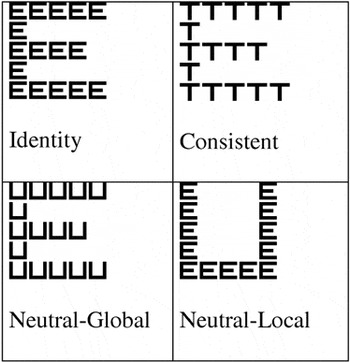
Despite its frequent usage, assessing performance with the organizational score of the Rey-figure bears several problems. For example, it is based on only a few items, raising concerns about its reliability, and does not allow one to discern whether the piecemeal approach adopted by OCD patients stems from a bias towards local elements or a bias against global elements. Most importantly, with regard to the focus of the current study, findings collected with the Rey-figure are not informative with regard to the stage of processing at which the apparent bias towards local elements in OCD patients comes into operation. In particular, it is unclear whether the bias already occurs during early perceptual stages, that is, during encoding of a stimulus, thereby affecting the formation of a percept, or whether it does not occur until later stages, once the initial percept has been completed (i.e., when the figure is copied or redrawn from memory). A useful and validated (e.g., Robertson et al., 1988) method to detect peculiarities in early encoding stages is to have participants respond to global and local targets in so-called hierarchical stimuli (Navon, 1977). Such stimuli typically consist of a large symbol, which is composed of an array of small identical symbols (e.g., the letter “T” composed out of small “H”s; see Figure 1). If the OCD patients' bias towards local elements affects encoding of the stimuli, one would expect relatively faster responses towards local relative to global targets, compared to a control group (see Robertson & Lamb, 1991, for a similar reasoning regarding brain damaged patients).

Examples of item types. Participants were instructed to respond as fast and as accurately as possible to target letters (left button: “E,” “T”; right button: “F,” “H”). The letters “S” and “U” served as neutral elements.
In the current study we administered a divided-attention task in which participants made two-choice responses to prespecified targets, irrespective of whether they occurred on the global or local level (or on both; Miller, 1981). This procedure bears some resemblance to requirements in the Rey-figure task in which local and global features are also both relevant (i.e., even if it results in suboptimal performance to start with local details, local features still have to be reproduced). Moreover, it has been shown in a different context that preferences for global or local attributes are more easily revealed when attention has to be divided across both levels relative to a focussed attention procedure (Yovel et al., 2001). As indicated earlier, the worse processing of the gestalt (i.e., global stimulus) relative to details (i.e., local features) can be conceptualized as either a bias towards details or an impairment to elaborate the full picture. While the former predicts faster responses for the local condition in OCD patients relative to controls, the latter predicts response slowing for the global condition in OCD patients relative to controls.
METHODS
Research Participants
Thirty patients who met criteria for a diagnosis of OCD, as determined via a semistructured interview (M.I.N.I. Neuropsychiatric Interview, Sheehan et al., 1998), participated in the study. Participants did not reveal a history of comorbid substance abuse, substantial neurological disorder, or current or previous psychotic symptoms. The patient sample was comprised of consecutively admitted inpatients from the behavioral ward of the psychiatric hospital. OCD symptoms were assessed with the Yale-Brown Obsessive-Compulsive Scale (Goodman et al., 1989).
The mean sociodemographic and psychopathological characteristics of the OCD patients were as follows: 14 males, 16 females; age: 35.41 years (SD = 11.56); education: 10.64 years (SD = 1.61); number of previous hospitalizations: 2.14 (SD = 1.46); Hamilton Depression Rating Scale (HDRS, 17 items): 15.00 (SD = 5.74); Y-BOCS total score: 24.45 (SD = 6.80); vocabulary test IQ (premorbid intelligence quotient): 104.07 (SD = 13.51); medicated with antidepressant agents: 15 patients. The healthy control group consisted of 28 participants: 12 males, 16 females; mean age: 35.86 years (SD = 10.34); mean education: 11.39 years (SD = 1.75); mean vocabulary test IQ: 111.54 (SD = 11.63).
Healthy controls were drawn from hospital staff and via advertisements. Healthy participants were screened for psychopathological disturbances or substance abuse. All participants gave written informed consent to participate after they had been fully informed about the study. The present study fully complied with the ethical guidelines according to the Helsinki declaration.
Experiment
Participants were seated in front of an Apple-Macintosh computer monitor. The task was constructed with Superlab® for the Macintosh. Participants were told that letters would be presented to them which were composed out of small identical letters. Their task was to press the left button of a computer keyboard with their dominant hand (b) whenever the letter “E” or “T” were displayed (either as local or global features) and the right button (n) whenever “F” or “H” (local or global features) were shown. “S” and “U” (local or global features) served as neutral elements (no assignment for a specific response button). The letters were presented in black against a white background (see Figure 1). Each stimulus was 0.40 × 0.40 inches and presented centrally. The stimuli remained visible until the participant pressed a key. The response-to-stimulus interval was 2000 milliseconds (ms). Responses had to be made as fast and as accurately as possible. A written computerized feedback was provided in case errors were made. It was further communicated to the participants that each item was unambiguous, that is, either the left or the right button was correct (e.g., letters “E” and “F” were never shown together). After a practice trial consisting of 24 items to familiarize participants with the procedure, 40 items from each of the following conditions were presented in random order (capital letters designate the global feature, small letters designate local features; the actual items involved uppercase letters only):
- Identical: Ee, Tt, Ff, Hh (10 items each)
- Convergent (both features require same response): Et, Te, Fh, Hf (10 items each)
- Global: Es, Eu, Ts, Tu, Fs, Fu, Hs, Hu (5 items each)
- Local: Se, Ue, St, Ut, Sf, Uf, Sh, Uh (5 items each)
RESULTS
Participants did not significantly differ on any sociodemographic background variable (all comparisons were at least p > .1), except for performance on a vocabulary test (estimate of premorbid intelligence in patients), on which OCD patients achieved lower scores (p = .03). As differences in premorbid intelligence are known confounds in neuropsychological research, this parameter was treated as a covariate.
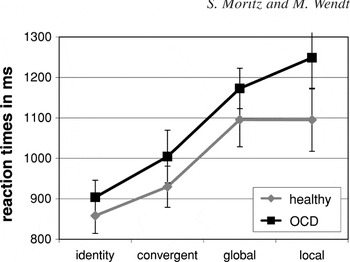
The overall error rate was low (healthy: 2.86%; OCD patients: 2.94%). A 2-way mixed analysis of variance (ANOVA) with Condition (identity, convergent, global, local) as within-subject factors, Group (OCD, healthy sample) as between-subject factors and mean reaction time (correct responses only) as the dependent variable, yielded a significant main effect of Condition [F(3,168) = 76.29, p < .001]. Subsequent pairwise t tests revealed that participants responded fastest in the identity condition, followed by the convergent, global, and local conditions (all analyses p < .001, except for the difference between the global and local condition). The effect for Group [F(1,56) = 1.47, p > .2], and the Group × Condition interaction [F(3,168) = 1.04, p > .3], failed to reach significance (see Figure 2). Results remained unchanged (all ps > .2) when premorbid intelligence (vocabulary test) was entered as a covariate. The study had sufficient power (d = .90) to detect a significant two-way interaction (tested with the program G POWER, Erdfelder et al., 1996) given a medium to strong effect with an alpha of .05. The real effect size was weak (d = .02).

Means and standard error of the mean (SEM). The samples did not differ on any condition. The mixed ANOVA did not yield a significant interaction of Group × Condition, p > .3.
Correlational analyses between the 6 possible difference scores (e.g., global–local, identity–convergent, etc.) for psychopathological and background variables did not yield any significant relationships, in which the level of significance was set at p = .01 to guard against an inflated chance of false-positive findings. Patients on and off antidepressant medication did not differ on any of the difference scores or on psychopathological dimensions.
DISCUSSION
The findings of the current study do not support the assumption that OCD patients' bias concerning local stimulus elements observed in the Rey-task affects early perceptual stages.2
In contrast to the majority of studies that required responding to global and local elements of hierarchical stimuli, no advantage for global features was found in the current study. However, there are also numerous examples of comparable performance on global and local targets, or even a local advantage, found in studies that used stimulus conditions comparable to the current study (Robertson et al., 1988; Lamb & Robertson, 1989, 1998).
In line with the results of the current study, a recent study (Yovel et al., 2005) failed to find a correlation between response time differences regarding global and local target letters and scores on an obsessive-compulsive personality disorder (OCPD) questionnaire. Intriguingly, however, there was a modest correlation with local interference. Performance of high-scoring individuals suffered disproportionately when a global target was accompanied by a local element, which was associated with an incorrect response. The lack of a (relative) local advantage and Yovel et al.'s finding of a correlation between local interference and the OCPD measure suggest that the deficit of processing global stimulus information in OCD may be restricted to situations in which conflict is exerted by distracting information at the local level. Such conflict is also present in the Rey figure, in which both global and local elements have to be reproduced and thus compete for the control of action.
Given this state of affairs, future research should continue to target the precise locus of processing, at which a potential local bias of OCD patients occurs, thereby carefully examining the role of conflict between global and local stimulus features. To this end, one might use the focussed attention task of Yovel et al. (2005) or a divided attention task with distractors, which resemble either one or the other target (see for example Lamb & Robertson, 1989).